

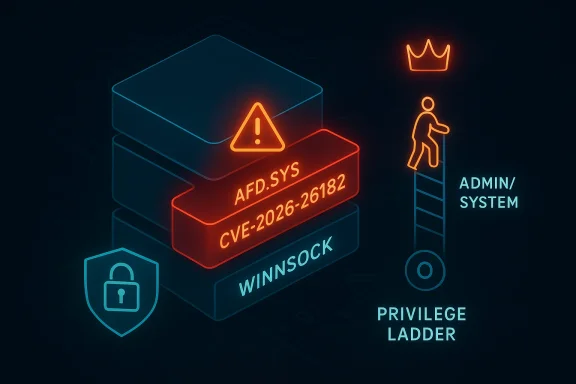
Microsoft’s CVE-2026-26182 is a Windows Ancillary Function Driver for WinSock elevation-of-privilege vulnerability, and the phrase that matters most here is elevation of privilege. In practical terms, Microsoft is flagging a flaw that could let an attacker who already has a foothold on a machine climb to a higher permission level, which is exactly the kind of bug that often turns a limited compromise into a full system takeover. The public MSRC framing also emphasizes confidence and technical credibility, meaning the existence of the issue and its basic impact are being treated as sufficiently established to warrant a CVE entry.
This matters because AFD.sys and related WinSock plumbing sit close to the Windows networking stack, a region that has historically attracted security attention. Microsoft has repeatedly patched privilege-escalation issues in this area over the years, which makes any new CVE in the same subsystem worth a careful look. Even without exploit details, the classification alone tells defenders that this is not a theoretical concern but a bug Microsoft believes deserves urgent attention.
The broader security lesson is familiar but still important: local vulnerabilities can be just as dangerous as remote ones when they enable post-compromise escalation. For enterprises, that means a compromised standard user account, malicious code execution, or an abused service context could become the first step toward domain-wide risk. For consumers, it means a single initial infection could become much harder to contain if the attacker can gain admin-level control.
Windows privilege escalation vulnerabilities tend to fall into a few recurring buckets: kernel drivers, file-system components, service configuration mistakes, and token or object-ownership errors. The Ancillary Function Driver for WinSock sits in a category that security researchers watch closely because network-facing kernel components often expose complex interfaces to user mode. Complexity is the enemy here, especially when older compatibility layers and modern security boundaries have to coexist.
Microsoft’s Security Response Center has long treated vulnerability confidence as a meaningful signal, not just a bureaucratic label. When MSRC assigns a CVE, it is not merely saying “something might be wrong,” but that enough evidence exists to justify a tracked security issue and the associated remediation workflow. That makes the existence of CVE-2026-26182 itself an important indicator, even if exploit mechanics are not yet public.
The WinSock stack has a history of appearing in MSRC advisories and monthly Patch Tuesday releases. In 2025, Microsoft explicitly called out CVE-2025-21418, another Windows Ancillary Function Driver for WinSock elevation-of-privilege issue, which is a reminder that this code path has been under sustained security scrutiny. That does not mean every new CVE shares the same root cause, but it does suggest the component remains both important and attackable.
Historically, kernel and driver bugs have been especially valuable to attackers because they can neutralize user-mode protections in one move. A successful local escalation can turn sandboxed malware into administrative malware, and administrative malware into persistence, credential theft, and defense evasion. That is why Windows driver flaws often sit high on incident-response priority lists even when they are not internet-facing.
Microsoft’s classification language suggests this flaw is considered credible enough to be treated as a real threat, not a speculative code path. The wording around confidence and known technical detail is especially important for defenders because it indicates whether the issue is still abstract or already well understood. In this case, the practical takeaway is to assume the weakness is real and plan accordingly.
The Ancillary Function Driver for WinSock has historically served as a bridge between user-mode network APIs and the kernel-mode behavior Windows needs to manage sockets and related operations. Bridges are inherently sensitive. If the boundary checks, object handling, or request validation are flawed, attackers may be able to coax the driver into doing work on their behalf with elevated rights.
MSRC’s confidence metric, as described in the vulnerability page, is about how certain Microsoft is that the flaw truly exists and how much technical detail is available to potential attackers. That is an important distinction because some issues are announced early, before root cause is fully understood, while others are confirmed after deeper internal analysis. The more certain the vendor is, the more urgent it becomes for customers to assess exposure and patch fast.
The wider market implication is also straightforward: Microsoft continues to close the gap between exposed functionality and privilege boundaries, but attackers keep finding ways to exploit the seams. Every newly disclosed kernel or driver EoP reinforces the idea that endpoint hardening cannot stop at EDR and application control. It also has to include patch hygiene, privilege minimization, and rapid response to Microsoft advisories.
This is also the sort of issue that tends to be most dangerous in blended intrusion scenarios. A ransomware crew, for example, may not need a zero-day remote exploit if it can combine phishing, token theft, and a local EoP to complete the compromise. That makes driver-level weaknesses disproportionately valuable even when they are not headline-grabbing at first glance.
The broader lesson from Microsoft’s vulnerability history is that mature platforms still contain edges where modern security assumptions meet legacy design. Networking APIs in Windows have to serve enterprise workloads, consumer apps, compatibility layers, and performance requirements all at once. That kind of balancing act creates opportunities for subtle bugs, especially in code paths that are rarely exercised in clean, simple ways.
A historical comparison is helpful here. In many past Windows EoP cases, the attacker already needed local execution or at least a foothold on the device. That pattern continues to matter because it shows these bugs are often post-exploitation accelerants rather than initial access vectors. They are the second act, not the opening scene.
For organizations, that means the question is not simply “can this be exploited remotely?” but “what happens after the first compromise?” A local privilege escalation in a widely deployed driver can convert a manageable incident into a full incident-response event. That is why even seemingly narrow CVEs can have outsized operational significance.
That distinction matters because cybersecurity teams often confuse “lack of exploit details” with “low threat.” Those are not the same thing. A vulnerability can be sufficiently confirmed to justify urgent patching even if the public proof-of-concept does not yet exist. Conversely, an issue with more public discussion may still be less urgent if it is only weakly corroborated.
For CVE-2026-26182, the fact that Microsoft has assigned a public CVE and framed it in a confidence-oriented description suggests the issue is not just speculative. Defenders should assume the root cause is sufficiently credible to merit patch priority, even if exploit mechanics remain unpublished. That is especially true for a privilege escalation in a core Windows driver.
The practical takeaway for security teams is simple: confidence metrics should influence triage. If a vendor is signaling high certainty and the affected component is foundational, the issue belongs near the top of the remediation queue. This is one of those cases where absence of details is not reassurance.
In practice, local EoP often appears after some other initial breach. Malware may arrive through phishing, malicious downloads, compromised credentials, or a vulnerable service. Once a foothold is present, the attacker begins looking for a privilege-escalation path to finish the job, and driver bugs are often high on the wish list.
The impact is different across environments. On a home PC, escalation may lead to credential theft, ransomware, or stealthy persistence. In an enterprise, the same escalation can expose cached credentials, internal tools, software deployment systems, and endpoints used by administrators. The blast radius can expand fast.
Microsoft has long treated these flaws as important even when they are not remote code execution vulnerabilities. That is because the post-exploit stage is often where the real damage happens. The first exploit gets attention; the second exploit gets control.
This also affects incident response. If the escalation path is used on a workstation that belongs to an employee with access to internal resources, the compromise can extend far beyond the device itself. Security teams should think in terms of identity, not just hardware.
For Microsoft, the upside of fast disclosure and fast remediation is credibility. The company can demonstrate that it finds, classifies, and patches serious bugs in core components with regularity. The downside is that each recurring EoP in a foundational subsystem offers critics another example of the platform’s complexity and exposure.
For competitors and adjacent ecosystems, the story cuts both ways. Linux and macOS are not immune to privilege escalation issues, but Microsoft’s enormous installed base means Windows flaws typically draw more attention and more attacker investment. That attention can create a perception gap, even when the technical reality is that all operating systems have to defend similarly complex kernel surfaces.
This CVE also reinforces the market importance of rapid patch management, endpoint hardening, and vulnerability intelligence. Vendors that help customers shorten remediation windows gain relevance when foundational platform bugs appear. In that sense, a single Windows driver CVE can ripple into security tooling, managed services, and enterprise patch orchestration.
The result is a broader security economy built around Microsoft’s release cadence. Patch Tuesday is not just a vendor event; it is a market rhythm that affects budgeting, staffing, and risk management. When a high-confidence EoP appears, the pressure on that ecosystem increases immediately.
That chain thinking is why seemingly narrow local vulnerabilities can be highly attractive to ransomware operators and intrusion groups. If the endpoint is already compromised, a reliable privilege escalation can reduce noise, increase speed, and help attackers avoid triggering some security controls until late in the intrusion. In that sense, the flaw’s utility may be greater than its CVSS score alone suggests.
Unlike enterprises, consumers often have fewer layers of defense and fewer recovery options. They may not have centralized patch reporting or managed endpoint tools, and they may delay updates because a device is “working fine.” That delay can leave a vulnerable system exposed longer than the user realizes.
Security teams should also watch for whether this CVE becomes part of a broader pattern in the WinSock driver family. If Microsoft begins clustering fixes around similar plumbing, that may suggest a deeper hardening effort is underway. If not, the issue still serves as another reminder that foundational Windows components remain attractive targets.
Source: MSRC Security Update Guide - Microsoft Security Response Center
This matters because AFD.sys and related WinSock plumbing sit close to the Windows networking stack, a region that has historically attracted security attention. Microsoft has repeatedly patched privilege-escalation issues in this area over the years, which makes any new CVE in the same subsystem worth a careful look. Even without exploit details, the classification alone tells defenders that this is not a theoretical concern but a bug Microsoft believes deserves urgent attention.
The broader security lesson is familiar but still important: local vulnerabilities can be just as dangerous as remote ones when they enable post-compromise escalation. For enterprises, that means a compromised standard user account, malicious code execution, or an abused service context could become the first step toward domain-wide risk. For consumers, it means a single initial infection could become much harder to contain if the attacker can gain admin-level control.
 Background
Windows privilege escalation vulnerabilities tend to fall into a few recurring buckets: kernel drivers, file-system components, service configuration mistakes, and token or object-ownership errors. The Ancillary Function Driver for WinSock sits in a category that security researchers watch closely because network-facing kernel components often expose complex interfaces to user mode. Complexity is the enemy here, especially when older compatibility layers and modern security boundaries have to coexist.Microsoft’s Security Response Center has long treated vulnerability confidence as a meaningful signal, not just a bureaucratic label. When MSRC assigns a CVE, it is not merely saying “something might be wrong,” but that enough evidence exists to justify a tracked security issue and the associated remediation workflow. That makes the existence of CVE-2026-26182 itself an important indicator, even if exploit mechanics are not yet public.
The WinSock stack has a history of appearing in MSRC advisories and monthly Patch Tuesday releases. In 2025, Microsoft explicitly called out CVE-2025-21418, another Windows Ancillary Function Driver for WinSock elevation-of-privilege issue, which is a reminder that this code path has been under sustained security scrutiny. That does not mean every new CVE shares the same root cause, but it does suggest the component remains both important and attackable.
Historically, kernel and driver bugs have been especially valuable to attackers because they can neutralize user-mode protections in one move. A successful local escalation can turn sandboxed malware into administrative malware, and administrative malware into persistence, credential theft, and defense evasion. That is why Windows driver flaws often sit high on incident-response priority lists even when they are not internet-facing.
Why this CVE draws attention
The key issue is not just that the bug exists, but what it represents in an attacker’s chain. A low-privilege foothold is common; what changes the story is the ability to transform that foothold into control. That is why local privilege escalation bugs are a favorite follow-on objective after phishing, drive-by malware, or supply-chain compromise.Microsoft’s classification language suggests this flaw is considered credible enough to be treated as a real threat, not a speculative code path. The wording around confidence and known technical detail is especially important for defenders because it indicates whether the issue is still abstract or already well understood. In this case, the practical takeaway is to assume the weakness is real and plan accordingly.
- Local privilege escalation can be a gateway to full compromise.
- Kernel-adjacent drivers often have broader blast radius than user-mode apps.
- Network stack components frequently interact with complex, legacy interfaces.
- Confirmed CVEs should be treated as operationally urgent, not academic.
- Even limited details can be enough for defenders to prioritize patching.
Overview
What makes CVE-2026-26182 notable is that it lands in a part of Windows that many organizations do not think about until something breaks. Users understand browsers, email clients, and office suites; fewer can name the drivers underneath the network stack that make those products function. Yet attackers absolutely understand those layers, because they are rich targets for privilege escalation and persistence.The Ancillary Function Driver for WinSock has historically served as a bridge between user-mode network APIs and the kernel-mode behavior Windows needs to manage sockets and related operations. Bridges are inherently sensitive. If the boundary checks, object handling, or request validation are flawed, attackers may be able to coax the driver into doing work on their behalf with elevated rights.
MSRC’s confidence metric, as described in the vulnerability page, is about how certain Microsoft is that the flaw truly exists and how much technical detail is available to potential attackers. That is an important distinction because some issues are announced early, before root cause is fully understood, while others are confirmed after deeper internal analysis. The more certain the vendor is, the more urgent it becomes for customers to assess exposure and patch fast.
The wider market implication is also straightforward: Microsoft continues to close the gap between exposed functionality and privilege boundaries, but attackers keep finding ways to exploit the seams. Every newly disclosed kernel or driver EoP reinforces the idea that endpoint hardening cannot stop at EDR and application control. It also has to include patch hygiene, privilege minimization, and rapid response to Microsoft advisories.
What the naming tells us
The product name itself is meaningful. When Microsoft labels an issue “Windows Ancillary Function Driver for WinSock,” it is generally pointing to a component with broad system relevance rather than a niche optional feature. That raises the stakes because widely deployed components create large patching surfaces and large potential attacker payoff.This is also the sort of issue that tends to be most dangerous in blended intrusion scenarios. A ransomware crew, for example, may not need a zero-day remote exploit if it can combine phishing, token theft, and a local EoP to complete the compromise. That makes driver-level weaknesses disproportionately valuable even when they are not headline-grabbing at first glance.
- Broadly deployed components create large defensive and offensive incentives.
- Driver-level flaws often matter more than their description suggests.
- Hybrid intrusion chains frequently rely on local EoP for final escalation.
- Visibility is low for kernel plumbing, but attacker interest is high.
- Patch latency is often the difference between containment and escalation.
Historical Pattern in WinSock-Related Issues
Windows networking components have not been strangers to privilege escalation reports. Microsoft’s own historical advisories show that the Ancillary Function Driver for WinSock has appeared before in security bulletins and monthly update summaries, which suggests the area is both complex and repeatedly scrutinized. This does not mean every issue is a repeat of the last one, but it does mean defenders should expect recurring pressure on the same subsystem.The broader lesson from Microsoft’s vulnerability history is that mature platforms still contain edges where modern security assumptions meet legacy design. Networking APIs in Windows have to serve enterprise workloads, consumer apps, compatibility layers, and performance requirements all at once. That kind of balancing act creates opportunities for subtle bugs, especially in code paths that are rarely exercised in clean, simple ways.
A historical comparison is helpful here. In many past Windows EoP cases, the attacker already needed local execution or at least a foothold on the device. That pattern continues to matter because it shows these bugs are often post-exploitation accelerants rather than initial access vectors. They are the second act, not the opening scene.
For organizations, that means the question is not simply “can this be exploited remotely?” but “what happens after the first compromise?” A local privilege escalation in a widely deployed driver can convert a manageable incident into a full incident-response event. That is why even seemingly narrow CVEs can have outsized operational significance.
Recurring lessons for defenders
Microsoft’s repeated patching of adjacent system components suggests three persistent truths. First, network- and kernel-adjacent code tends to remain under pressure because it is both essential and difficult to rewrite. Second, attackers prefer these flaws because they are valuable once they have local access. Third, patch cadence matters as much as vulnerability type, because delayed deployment leaves the attack surface effectively open.- Kernel-adjacent code is hard to make perfectly safe.
- Legacy compatibility can preserve risk across versions.
- Post-exploitation bugs are highly prized by advanced actors.
- Patch velocity directly affects real-world exposure.
- Attack chains often matter more than single-vulnerability narratives.
What MSRC’s Confidence Framing Means
Microsoft’s description of the confidence metric is not just explanatory text; it is a severity signal in disguise. It tells readers how certain Microsoft is that the vulnerability exists and how much technical knowledge is available to attackers. In other words, it is partly a measure of epistemic certainty and partly a proxy for operational risk.That distinction matters because cybersecurity teams often confuse “lack of exploit details” with “low threat.” Those are not the same thing. A vulnerability can be sufficiently confirmed to justify urgent patching even if the public proof-of-concept does not yet exist. Conversely, an issue with more public discussion may still be less urgent if it is only weakly corroborated.
For CVE-2026-26182, the fact that Microsoft has assigned a public CVE and framed it in a confidence-oriented description suggests the issue is not just speculative. Defenders should assume the root cause is sufficiently credible to merit patch priority, even if exploit mechanics remain unpublished. That is especially true for a privilege escalation in a core Windows driver.
The practical takeaway for security teams is simple: confidence metrics should influence triage. If a vendor is signaling high certainty and the affected component is foundational, the issue belongs near the top of the remediation queue. This is one of those cases where absence of details is not reassurance.
How to interpret the signal
A confidence-oriented metric is useful because it lets defenders infer how much reverse-engineering and exploit engineering may already be possible. If Microsoft believes the technical basis is strong, attackers may also have enough to begin research, even if they do not yet have a public exploit chain. That can compress the window between disclosure and weaponization.- Vendor confidence can be a proxy for real-world urgency.
- Public CVEs are not the same as public exploits.
- Core drivers deserve faster triage than peripheral components.
- No details does not mean no danger.
- Exploitability windows can shrink quickly after disclosure.
Technical Significance of Elevation of Privilege
Elevation of privilege flaws are especially dangerous because they transform a partial compromise into a systemic one. If an attacker can move from standard user to administrator or SYSTEM, they can disable controls, modify security settings, dump credentials, and establish persistence that is much harder to remove. That makes EoP bugs among the most operationally useful classes of Windows vulnerability.In practice, local EoP often appears after some other initial breach. Malware may arrive through phishing, malicious downloads, compromised credentials, or a vulnerable service. Once a foothold is present, the attacker begins looking for a privilege-escalation path to finish the job, and driver bugs are often high on the wish list.
The impact is different across environments. On a home PC, escalation may lead to credential theft, ransomware, or stealthy persistence. In an enterprise, the same escalation can expose cached credentials, internal tools, software deployment systems, and endpoints used by administrators. The blast radius can expand fast.
Microsoft has long treated these flaws as important even when they are not remote code execution vulnerabilities. That is because the post-exploit stage is often where the real damage happens. The first exploit gets attention; the second exploit gets control.
Why attackers care
Attackers care about EoP because it reduces the number of additional barriers they must bypass manually. A low-privilege shell is useful, but it is rarely enough for destructive or strategic objectives. A successful escalation can unlock a much larger set of tools and techniques, including tampering with security products and modifying protected resources.- Administrative control changes the threat model entirely.
- SYSTEM access can expose secrets and persistence mechanisms.
- Security tooling is easier to disable after escalation.
- Attack chains become shorter and more reliable.
- One local bug can have system-wide consequences.
Why enterprises feel it more
Enterprises run more privileged services, more management agents, and more scripts than consumer PCs. That means there are more opportunities for an attacker with limited access to find a pathway upward. A driver-level EoP can therefore be a force multiplier in corporate environments, especially where local admin rights are loosely controlled.This also affects incident response. If the escalation path is used on a workstation that belongs to an employee with access to internal resources, the compromise can extend far beyond the device itself. Security teams should think in terms of identity, not just hardware.
- Enterprise endpoints often have richer privilege targets.
- Identity tokens can become more valuable than the machine.
- Management tooling expands the attacker’s options.
- Privilege escalation frequently precedes lateral movement.
- Containment is harder when admin context is already lost.
Competitive and Market Implications
Every major Windows security issue has competitive implications, even if indirectly. Microsoft competes on trust, manageability, and the perception that Windows can be defended at scale. When a driver-level privilege escalation surfaces, it reminds buyers that the platform remains a high-value target, and that security is an ongoing engineering race rather than a finished state.For Microsoft, the upside of fast disclosure and fast remediation is credibility. The company can demonstrate that it finds, classifies, and patches serious bugs in core components with regularity. The downside is that each recurring EoP in a foundational subsystem offers critics another example of the platform’s complexity and exposure.
For competitors and adjacent ecosystems, the story cuts both ways. Linux and macOS are not immune to privilege escalation issues, but Microsoft’s enormous installed base means Windows flaws typically draw more attention and more attacker investment. That attention can create a perception gap, even when the technical reality is that all operating systems have to defend similarly complex kernel surfaces.
This CVE also reinforces the market importance of rapid patch management, endpoint hardening, and vulnerability intelligence. Vendors that help customers shorten remediation windows gain relevance when foundational platform bugs appear. In that sense, a single Windows driver CVE can ripple into security tooling, managed services, and enterprise patch orchestration.
What rivals will notice
Competitors watch these issues because they shape procurement conversations. Security teams weighing endpoint platforms often ask whether a vendor can identify and fix dangerous vulnerabilities quickly, and whether the ecosystem provides enough telemetry and controls to reduce risk. High-profile EoPs are evidence points in those debates.- Patch speed influences customer trust.
- Security posture is part of platform competition.
- Enterprise buyers care about remediation workflows.
- Vulnerability trends shape product positioning.
- One CVE can influence several adjacent markets.
Why the ecosystem matters
The ecosystem around Windows—EDR vendors, managed service providers, patch automation tools, and incident response firms—often sees demand rise after serious driver flaws are disclosed. That demand reflects a hard truth: customers need help not just understanding vulnerabilities, but operationalizing response.The result is a broader security economy built around Microsoft’s release cadence. Patch Tuesday is not just a vendor event; it is a market rhythm that affects budgeting, staffing, and risk management. When a high-confidence EoP appears, the pressure on that ecosystem increases immediately.
- Incident-response demand often rises after driver CVEs.
- Patch orchestration becomes a differentiator.
- Risk governance gets more board-level attention.
- Security tooling is judged by reaction speed.
- Operational readiness is as important as detection.
Enterprise Exposure and Attack Chains
Enterprises should think about CVE-2026-26182 as part of a chain, not a standalone event. Attackers rarely care about a driver flaw in isolation; they care about how it helps them move from one state to another. A compromised user account becomes a privileged workstation session, which becomes access to a file share, which becomes credential harvesting or domain compromise.That chain thinking is why seemingly narrow local vulnerabilities can be highly attractive to ransomware operators and intrusion groups. If the endpoint is already compromised, a reliable privilege escalation can reduce noise, increase speed, and help attackers avoid triggering some security controls until late in the intrusion. In that sense, the flaw’s utility may be greater than its CVSS score alone suggests.
Typical enterprise scenarios
A few common scenarios stand out. A helpdesk technician with standard rights gets phished and the attacker lands on the machine; a contractor session is abused to run code locally; or a low-privilege foothold from a browser exploit needs a final escalation to become useful. In each case, an EoP in a trusted driver can be the last missing piece.- Phishing footholds often precede privilege escalation.
- Contractor accounts can be especially attractive targets.
- Browser-based execution still needs post-exploit steps.
- Ransomware crews value fast escalation paths.
- Low-privilege access is often just the beginning.
Security controls that matter most
Organizations should prioritize controls that reduce the chance that local access turns into full compromise. That means tight privilege management, aggressive patching, application control, EDR coverage, and monitoring for unusual driver or kernel activity. It also means not assuming that “non-admin” equals “safe.”- Least privilege reduces the attacker’s starting advantage.
- Application control can limit initial footholds.
- EDR telemetry helps identify escalation attempts.
- Patch hygiene closes known local EoPs quickly.
- Credential hygiene limits post-escalation damage.
Consumer Exposure and Practical Impact
Consumers may not think about kernel drivers, but they feel the effects when malware becomes harder to remove. A privilege escalation bug can allow an attacker to disable antivirus, change system settings, hide files, or install persistence that survives a reboot. That is why local EoPs can be especially frustrating for home users.Unlike enterprises, consumers often have fewer layers of defense and fewer recovery options. They may not have centralized patch reporting or managed endpoint tools, and they may delay updates because a device is “working fine.” That delay can leave a vulnerable system exposed longer than the user realizes.
Why home users should care
The consumer risk is not abstract. If a standard user infection can become admin-level malware, then browser hijacks, rogue installers, and trojanized downloads become much more serious. The difference between nuisance and systemic compromise can come down to whether the privilege boundary holds.- Malware removal becomes harder after escalation.
- Security software may be easier to bypass.
- Reboots do not always erase persistence.
- Delayed updates increase practical exposure.
- A small infection can snowball fast.
What users can do
For consumers, the best defense is still boring but effective. Keep Windows updated, avoid running untrusted software, use a standard account where practical, and maintain backups. Those habits do not eliminate a driver flaw, but they reduce the odds that an attacker can turn one mistake into a full-device takeover.- Install updates promptly when Microsoft releases them.
- Use standard accounts where possible.
- Avoid shady downloads and cracked software.
- Keep backups in case recovery is needed.
- Run reputable security tools and leave them enabled.
Strengths and Opportunities
The strongest aspect of Microsoft’s handling of a CVE like this is that the company is surfacing it through a formal, trackable security channel rather than leaving defenders to infer risk from rumors. That gives organizations a chance to prioritize, communicate, and patch using a shared reference point. It also reinforces the value of MSRC’s disclosure process as a defensive tool, not just a reporting mechanism.Key strengths
- Formal disclosure helps defenders align quickly.
- Driver-level patching can remove high-value attack paths.
- Confidence framing improves triage quality.
- Enterprise response teams can build targeted remediation plans.
- Security vendors can update detections and playbooks.
- Patch management teams get a clear assignment.
- Public accountability can shorten remediation cycles.
Risks and Concerns
The main concern with CVE-2026-26182 is not only the flaw itself, but the likelihood that it fits neatly into attacker playbooks already proven effective against Windows. A local privilege escalation in a widely deployed subsystem is exactly the sort of issue that ransomware groups, access brokers, and hands-on-keyboard intruders can operationalize quickly. Once weaponized, the window between disclosure and exploitation can become uncomfortably short.Key risks
- Post-exploitation utility is very high.
- Attack chaining makes the flaw more dangerous.
- Delayed patching creates unnecessary exposure.
- Legacy systems may be slower to remediate.
- Endpoint trust can be undermined after escalation.
- Detection gaps may miss kernel-level abuse.
- Confidence without details still signals real risk.
Looking Ahead
The next question is not whether Windows will continue to see privilege escalation bugs—it will—but how quickly Microsoft and customers can reduce the practical value of those bugs once disclosed. The best outcome is a fast patch, clear guidance, and rapid adoption by organizations that understand the stakes. The worst outcome is predictable: delayed patching, a public exploit chain, and attackers folding the issue into broader intrusion kits.Security teams should also watch for whether this CVE becomes part of a broader pattern in the WinSock driver family. If Microsoft begins clustering fixes around similar plumbing, that may suggest a deeper hardening effort is underway. If not, the issue still serves as another reminder that foundational Windows components remain attractive targets.
What to monitor
- Patch availability and whether it is broadly deployed.
- Any exploit advisories or researcher disclosures.
- Related WinSock driver fixes in subsequent releases.
- EDR detections for unusual kernel or driver behavior.
- Enterprise remediation speed across managed endpoints.
Source: MSRC Security Update Guide - Microsoft Security Response Center
Last edited:
