

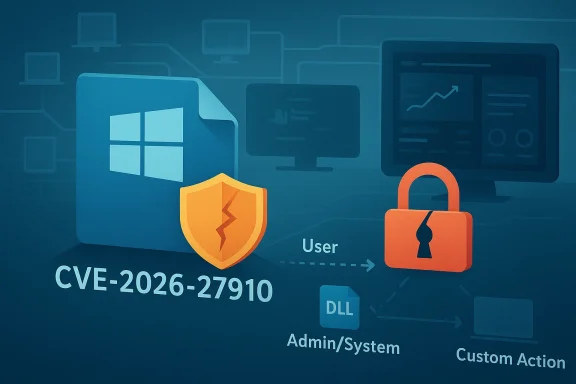
The current CVE sits in a well-establish nted Windows Installer elevation issues that involved insecure library loading behavior, improper sanitization of input, or incorrect execution of custom action scripts. In 2015, Microsoft said a Windows Installer service bug could allow elevation of privilege if the service incorrectly ran custom action scripts, and in 2018 Microsoft described another installer-related elevation issue tied to insecure library loading. Those earlier advisories are important context because they show how subtle installer behavior can translate into full administrative control once an attacker already has a foothold on a machine.
The broader MSRC disclosure model matters too. Microsoft’s Security Update Guide ibystem for risk. Microsoft has repeatedly emphasized that the guide now surfaces richer vulnerability information, including tracking for CVEs and machine-readable advisory data, so customers can prioritize remediation more efficiently. In that framework, the confidence-related language attached to a vulnerability is not decorative. It is a signal about the certainty of the issue and the credibility of the details, and that signal affects how quickly defenders should move.
For administrators, the key practical point is simple: Windows Installer issues are almost never “just installer issues.” Thhtion in elevated contexts, abuse of repair operations, tampering with installed software, or silent privilege escalation after an initial compromise. That makes them especially relevant in shared workstations, hybrid enterprise fleets, and environments that still rely heavily on legacy deployment tooling. The more normal installer activity is in an environment, the more attractive a flaw like this becomes to an attacker.
What the CVE Tells Us
The first thing the CVE label tells us is scope. Elevation of Privilege means the issue is not primarily about remote compromise frtlocal foothold into something more powerful. That distinction matters because attackers do not need to begin with admin rights to benefit from the flaw. Once they have any meaningful local access, a privilege boundary weakness can turn into SYSTEM-level control, policy tampering, credential theft, or lateral-movement staging.
The second thing it tells us is how Microsoft wants defenders to interpret the record. The confidence language in Microsoft’s security taxonomy is meant to convey how certain the vendor is that the vulnerabilit known technical detail is available to would-be attackers. That is a subtle but important difference from a generic CVE listing. A low-detail advisory can still be a real, vendor-acknowledged defect, and Microsoft’s confidence signal helps separate tentative research from issues that are sufficiently credible to enter active patch planning.
Why confidence matters
A high-confidence local privilege-escalation advisory can create urgency even without a flashy exploit narrative. Defenders should read that as a statement about evidence quality, not public drama. In oiling the world how the exploit works; it is telling the world how seriously it takes the issue. That distinction is easy to miss and dangerous to ignore.
It also tells attackers something useful. The more confident the advisory, the more likely there is a well-understood code path, a reproducible bug, or a vulnerability class that is already understood by researchers. Even when the exact primitive is not public, the existenc shape red-team and criminal interest. That is why the confidence metric has operational value beyond vendor transparency.
What is still missing
What is missing, at least from the public material available here, is a full root-cause description. We do not have a detailed exploit write-up, a proof of concept, or a published patch note describing whether the flaw involves path handling, unsafe loading, improper te. That absence should not be mistaken for uncertainty about the existence of the vulnerability itself. It simply means Microsoft has chosen the familiar balance of disclosure and caution that often accompanies sensitive local privilege-escalation bugs.
Why Windows Installer Bugs Keep Reappearing
Windows Installer sits in an awkward place in the platform: it must be powerful enough to install, repair, and roll back software, yet constrained enough not to grant unsafe escalation by default. That tension has produced recurring bug classes over the years. Custom actions are espetl executables, scripts, or DLLs during privileged installation phases, which creates a wide surface for abuse if trust boundaries are mishandled.
Library loading is another recurring theme. If an installer or installer-related service searches for dependencies insecurely, an attacker may be able to plant or redirect a malicious library and gain code execution in a more privileged context. Microsoft’s 2018 Windows Installer advisory explicitly described insecure library loading behavior as the underlying issue, which showsrdinary file-resolution logic can become a privilege boundary failure.
Common Windows Installer abuse patterns
- Custom action misuse during elevated install or repair operations.
- Insecure DLL search order or library-loading behavior.
- Input sanitization failures that let attacker-controlled data steer privileged operations.
- Permission mistakes around install directories, temp paths, or repair artifacts.
- Rollback and repair abuse that tre or registry changes.
The reason these flaws recur is that installers are operationally messy. They have to support legacy software, vendor-specific packaging quirks, enterprise deployment systems, and long-lived compatibility requirements. That complexity makes the subsystem a natural target for attackers who know that a single bug can yield a very high return on effort. *Complexity is the attacker’s friend when the code path is privilegedssoft pays close attention to installer problems. In enterprise environments, software installation often runs with delegated privilege or through managed deployment tools, meaning a local break in the installer model can cascade into a fleet-wide issue if the same package or workflow is reused. That is why an installer flaw can have outsized impact even if its starting conditions look “local” on paper.
Enterprise es, the real risk is not merely that a low-privileged user might become an admin on one machine. The bigger concern is that Windows Installer privilege escalation can become a reliable bridge from initial access to meaningful persistence. Once an attacker escalates, they can tamper with software, disable defenses, steal credentials from a local system context, or plant payloads that survive reboot and reauthentication.
This matters most in ndard users still interact with software installation, self-service repair, or device onboarding. Shared workstations, call centers, VDI pools, and lab machines tend to have more complex local privilege relationships than a locked-down laptop fleet. In those environments, a local EoP bug can be a force multiplier because many users have enough access to trigger installer behavior but not enough to notice malicious chaining.
Enterprise-specific exposure
Ampounds the problem through operational uniformity. If a vulnerable installer package, image, or management workflow is reused across many endpoints, exploitation logic can scale quickly. That turns an apparently local issue into a fleet management problem, especially when patch validation is delayed by compatibility concerns. Patch slippage is where local bugs become enterprise incidents.
Microsoft’s updated Security Update Guide and machine-readable vulnerabilityp with that exact kind of triage. The point is to shorten the path between awareness and action. For defenders, that means patching should be paired with inventorying where Windows Installer is heavily used, where privileged repair workflows exist, and where legacy software might depend on older installer behaviors.
Practical enterprise priorities
- Identify systems with elevated software-install workflows.
- Review software deployment toolms.
- Apply Microsoft updates as soon as they are available.
- Watch for suspicious installer launches from low-privileged users.
- Validate least-privilege policies around installation rights.
Consumer Impact
Consumers face a different but still serious risk profile. A home user is less likely to have enterprise deployment tools or complex installer orchestration, but the exploit outcome can still bs already on the device. Once a low-privileged attacker or malicious payload is present, a Windows Installer flaw can help convert a nuisance infection into a full machine compromise.
That is why local privilege escalation still matters in consumer security. Most endpoint infections do not begin with kernel panic or obvious system takeover. They staied software, or a lure that obtains standard-user execution. If a Windows Installer vulnerability is available, the attacker’s job becomes much easier after that initial foothold.
What home users should understand
The real-world effect is often invisible until it is too late. A threat actor that crosses into elevated context can turn off security tools, modify startup behavior, dump credentials, or stage additionalr-visible drama. The danger is not the installer window itself; it is what the installer context allows next.
This is also where Windows’ layered protections matter. Standard accounts, UAC prompts, application control, and prompt patching all reduce the damage a bug can do. None of those controls are perfect, but together they raise the cost of exploitation. Consumers who stay current wduce the window in which this sort of local escalation can be chained into a lasting compromise.
Microsoft’s Disclosure Model
Microsoft’s current approach to vulnerability disclosure is built around more than just bulletin text. The company has emphasized the Security Update Guide as a richer, modern system for vulnerability data, and it has also expanded transpareable CSAF files. That matters because defenders increasingly rely on structured metadata to automate prioritization, monitoring, and reporting.
The confidence indicator is part of that broader transparency story. It exists to help customers understand whether a CVE is backed by strong evidence and how much technical detail is available. In a world where some advisories are sparse and others ar that distinction changes not just research interest but patch urgency.
The practical meaning of “confidence”
The confidence metric is best read as a maturity signal. High confidence suggests that Microsoft has enough basis to stand behind the vulnerability record, even if it is not publishing a full exploit chain. Lower confidence would imply a more tentative picture, perhaps driven by partial evidence or incomplete technical corrobor,ance between routine tracking and immediate intervention.
That approach also reflects a larger reality in modern vulnerability management: the public record is often intentionally incomplete. Vendors want to protect customers without handing attackers a ready-made blueprint. So the security team’s job is to infer operational meaning from metadeverity class, and confidence indicators, not just from exploit details. In 2026, reading the metadata is part of reading the vulnerability.
How This Fits the Current Windows Threat Landscape
CVE-2026-27910 is not an isolated event. It belongs to a continuing pattern of Windows local privilege escalation issues that surface across kernel code, services, drivers, and core user-interface subsystems. Recent Microsoft advisories across the platform have repeatedoP remains one of the most common and most operationally important classes of Windows security issues.
That pattern matters because defenders sometimes over-focus on remote code execution and underweight local escalation. But in real-world intrusions, local escalation is often the second stage, not the first. It is the step that turns a limited foothold into control over the host, and control over the host into a platform for broader network movemas an attack chain
The best way to think about this CVE is as a link in a chain. An attacker may first gain execution through phishing, browser exploitation, malicious software, or stolen credentials. A Windows Installer EoP then provides the mechanism to cross the privilege boundary and convert that foothold into a durable compromise. That is why even a “local” bug can be strategically important at scale.
This also explains why the public detail le.es not imply low danger. It can mean the issue is still being carefully handled, the exploit class is sensitive, or the vendor is avoiding unnecessary disclosure while still warning customers. In other words, thin public detail is not thin risk.
Strengths and Opportunities
Microsoft’s handling of CVE-2026-27910 has a few clear strengths. Thsignaling the issue at the right level of specificity, and the broader security update ecosystem now provides richer metadata for defenders to act on. For organizations that take patch governance seriously, this is an opportunity to tighten deployment discipline around installer-related privileges and to use the event as a forcing function for better local-access control.
- The advisory is tied to a well-understood priMicrosoft’s confidence model helps teams gauge how seriously to triage**.
- The issue reinforces the need for least privilege on endpoints.
- It creates a natural opportunity to review installer execution paths.
- It can improve hygiene around software deployment tools and repair workflows.
- It encourages more disciplinnd verification**.
- It may prompt defenders to hunt for installer abuse telemetry.
The larger opportunity is operational maturity. Every high-confidence local escalation advisory is a reminder that endpoint hardening is not only about blocking malware at the perimeter. It is about preventing the inevitable low-privileged foothold from becoming full system compromise. That is the kind of security lesson that pays off beyond a single CVE.
Risks and Concerns
The biggest concern is smate a local Windows Installer flaw because it does not sound as dramatic as a browser RCE or a wormable service bug. That would be a mistake. Privilege escalation can be the decisive step that turns routine malware into a persistent, high-impact intrusion.
- Security teams may treat the issue as “just local” and delay remediation.
- Legacy installer workflows may preserve unsafe behavior longer than expected.
- Shared systems can make local abuse far more damaging.
- Attackers may chain the bug with phishing o
ail can lead to complacency rather than urgency. - Enterprises may face compatibility pressure when rolling out fixes.
- Unpatched software repair or deployment paths can remain exposed.
There is also a communications risk. If Microsoft’s confidence language is misunderstood as uncertainty about the existence of the bug, defenders may wrongly deprioritize tty, the metric exists to help customers calibrate trust and urgency, not to invite delay. Confidently tracked does not mean safely ignorable.
What to Watch Next
The most important near-term development will be whether Microsoft publishes additional technical context, whether third-party researchers map the vulnerability to a known installeher exploit proof emerges in the wild. If that happens, the advisory’s operational significance will jump again, because a local EoP with public exploit detail can quickly become a commodity post-compromise tool.
The second thing to watch is enterprise patch behavior. In many organizations, Windows Installer issues prompt compatibility testing delays because software deployment stacks are deeply intertwined with line-of-business applications. That means security teams should expect puc be ready to show business stakeholders why a local privilege break deserves immediate attention.
Watch list
- Any Microsoft update that adds technical detail or mitigations.
- Independent research that identifies the root-cause class.
- Evidence of exploitation in post-compromise toolsets.
- Enterprise compatibility issues durings that related installer abuse patterns are increasing.
The final thing to watch is the broader pattern of Windows local privilege escalation advisories. Microsoft’s update guidance keeps showing that the most security-sensitive bugs are often in the least glamorous places: services, drivers, and subsystems that ordinary users never think about until they fail. Windows Installer belongs in that category. It is boring infrastructure untipath to admin.
CVE-2026-27910 should be treated as a serious local escalation issue, not because the public record is richly detailed, but because the public record is already strong enough to justify action. Microsoft’s confidence-oriented disclosure model is telling defenders that the bug is real enough to matter, and the history of Windows Installer weaknesses shows why that warning deserves respect. If the nechnical clarity, the strategic picture may sharpen; if not, the safest assumption is still the same: patch quickly, reduce local privilege, and assume that installer abuse remains one of Windows’ most reliable paths from foothold to full control.