

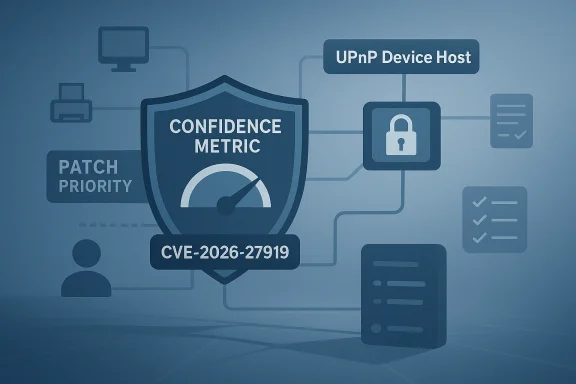
Microsoft’s public tracking for CVE-2026-27919 places it squarely in the familiar but still dangerous category of Windows UPnP Device Host elevation-of-privilege flaws. The key story is not just that Microsoft has assigned a CVE, but that the advisory’s own confidence metric tells defenders how certain the company is about the vulnerability’s existence and the reliability of the technical details attached to it. In other words, this is one of those cases where the metadata itself matters almost as much as the label on the bug. The practical consequence is straightforward: even without a flood of public exploit detail, administrators should treat the issue as a real local escalation path and prioritize verification and patching.
The Windows UPnP Device Host sits in a part of the operating system many users never think about, yet it helps support device discovery and interoperability across Windows networks. That makes it a classic example of an inbox component with broad reach but relatively invisible day-to-day importance. When Microsoft assigns an elevation-of-privilege CVE to a component like this, the concern is rarely remote compromise from the open internet; it is the much more common, and often more devastating, scenario in which an attacker first gets a foothold and then moves laterally upward on the system.
Microsoft’s Security Response Center has long used advisory metadata to help customers decide how urgently to act, especially when the public record is intentionally sparse. The confidence signal in the update guide exists precisely because not every vulnerability is equally well understood at disclosure time. Sometimes Microsoft is confirming a fully analyzed root cause; sometimes it is communicating that the company is highly confident a flaw exists, while technical specifics remain constrained for coordinated release or defensive reasons. That distinction is important because it tells defenders whether they are looking at an abstract report, a confirmed bug, or something close to an exploit-ready issue.
This pattern is not new. Microsoft has repeatedly emphasized that local elevation-of-privilege bugs are among the most valuable to attackers once they have an initial foothold. The reason is simple: a local EoP often turns a limited compromise into full control of the machine, and in enterprise environments that can mean credential theft, persistence, and expansion into adjacent systems. The UPnP Device Host is especially relevant because service-hosted Windows components often provide rich attack surface through IPC, service brokering, and object lifetime management.
The broader context also matters. Windows security updates in 2026 have continued to reflect a steady stream of local privilege escalation issues across kernel and service components. That is a reminder that operating system hardening is not only about remote attack surfaces. It is also about reducing the value of every low-privilege foothold, whether it comes from phishing, browser compromise, malicious documents, or a compromised internal application.
A final piece of context is the way Microsoft now frames many advisories around exploitability and confidence rather than dumping technical internals into public view. That tradeoff helps defenders because it communicates urgency, but it can frustrate teams hoping for a clear exploitation recipe. Still, from an operational standpoint, certainty of existence is often enough to drive action when the affected component runs broadly across managed Windows fleets.
The practical value is especially high in large Windows estates, where many advisories arrive at once. Teams need a way to separate “interesting” from “urgent,” and Microsoft’s confidence metadata helps do that. It becomes part of the decision tree alongside severity, attack complexity, privilege requirements, and the availability of an update.
In the case of Windows service-host vulnerabilities, that distinction matters because defenders often cannot rely on exploit chatter before acting. They have to work from the vendor’s own assessment. That is why Microsoft’s confidence metadata has become so valuable: it compresses a lot of security engineering judgment into a small operational signal.
This is one reason local EoP bugs matter so much in Windows. They are not merely niche issues for malware authors. They are the connective tissue between first-stage compromise and full enterprise impact. Once privilege is elevated, the attacker can disable defenses, dump credentials, tamper with logs, and stage secondary payloads.
The bigger takeaway is that Windows services tied to interoperability tend to accumulate complexity over time. Complexity creates room for implementation errors, especially in code that has to mediate between user-mode requests and privileged operations. That is exactly the kind of environment where Microsoft’s local EoP advisories tend to emerge.
A sensible response plan typically looks like this:
For consumer systems, the impact is often less visible but no less real. A home user might never know the device host exists, yet a compromised machine can still become a stepping stone for credential theft or persistence. For enterprises, the stakes are multiplied by management rights, domain trust, and the value of sensitive internal data.
That is why defenders care so much about “just” local bugs. They are often the decisive step in converting an opportunistic compromise into a durable breach. In practical terms, local EoP is what transforms noisy malware into an enterprise incident with real blast radius.
The UPnP Device Host fits that pattern well. Even if only a subset of users actively notice its function, it remains embedded in the Windows service ecosystem. If the advisory corresponds to a memory-safety or authorization flaw, the likely attacker payoff is privileged execution rather than a flashy visible crash.
Security teams should pay attention to systems that are used as jump hosts, admin workstations, shared remote-access endpoints, and file or print infrastructure. Those machines often hold the most valuable tokens. If a local escalation lands there, the incident can grow quickly.
Consumer systems also tend to lag behind in update hygiene. That makes even a non-remote EoP important, because an already-compromised device can remain vulnerable for longer than an enterprise endpoint with central patch enforcement. In a household environment, the patch is the defense.
That means defenders should review:
That does not mean the platform is broken. It means the platform is large, deeply integrated, and asked to support a huge amount of functionality by default. Security teams therefore have to assume that a meaningful share of risk lives inside the endpoint, not just at the perimeter.
For defenders, the key is to read between the lines without overreading them. A high-confidence local EoP in a Windows service should be treated as actionable even before the public vulnerability ecosystem fills in the blanks. In modern endpoint defense, speed often matters more than perfect certainty.
That makes this CVE a good forcing function for broader hardening. Teams can review admin separation, local admin use, service exposure, and update cadence while the vulnerability is still fresh in everyone’s mind. In security, urgency is often what makes long-delayed hygiene work finally happen.
That matters because attackers do not need perfect conditions. They need one unpatched host, one useful privilege boundary, and one foothold. If defenders assume the issue is low urgency because it is local, they may accidentally leave the door open for the exact chain attackers prefer.
It will also be important to see whether security tooling vendors start correlating telemetry around the component. If exploit attempts appear, defenders will need detection logic that can identify suspicious post-exploitation behavior without waiting for a signature tied specifically to this CVE. That is often where the real value of early advisory awareness shows up: not just in patching, but in hunting.
What to monitor next:
Source: MSRC Security Update Guide - Microsoft Security Response Center
 Overview
The Windows UPnP Device Host sits in a part of the operating system many users never think about, yet it helps support device discovery and interoperability across Windows networks. That makes it a classic example of an inbox component with broad reach but relatively invisible day-to-day importance. When Microsoft assigns an elevation-of-privilege CVE to a component like this, the concern is rarely remote compromise from the open internet; it is the much more common, and often more devastating, scenario in which an attacker first gets a foothold and then moves laterally upward on the system.Microsoft’s Security Response Center has long used advisory metadata to help customers decide how urgently to act, especially when the public record is intentionally sparse. The confidence signal in the update guide exists precisely because not every vulnerability is equally well understood at disclosure time. Sometimes Microsoft is confirming a fully analyzed root cause; sometimes it is communicating that the company is highly confident a flaw exists, while technical specifics remain constrained for coordinated release or defensive reasons. That distinction is important because it tells defenders whether they are looking at an abstract report, a confirmed bug, or something close to an exploit-ready issue.
This pattern is not new. Microsoft has repeatedly emphasized that local elevation-of-privilege bugs are among the most valuable to attackers once they have an initial foothold. The reason is simple: a local EoP often turns a limited compromise into full control of the machine, and in enterprise environments that can mean credential theft, persistence, and expansion into adjacent systems. The UPnP Device Host is especially relevant because service-hosted Windows components often provide rich attack surface through IPC, service brokering, and object lifetime management.
The broader context also matters. Windows security updates in 2026 have continued to reflect a steady stream of local privilege escalation issues across kernel and service components. That is a reminder that operating system hardening is not only about remote attack surfaces. It is also about reducing the value of every low-privilege foothold, whether it comes from phishing, browser compromise, malicious documents, or a compromised internal application.
A final piece of context is the way Microsoft now frames many advisories around exploitability and confidence rather than dumping technical internals into public view. That tradeoff helps defenders because it communicates urgency, but it can frustrate teams hoping for a clear exploitation recipe. Still, from an operational standpoint, certainty of existence is often enough to drive action when the affected component runs broadly across managed Windows fleets.
What the confidence metric means
Microsoft’s confidence metric exists to answer a deceptively simple question: how much should defenders trust the public advisory at the moment it appears? In the case of CVE-2026-27919, the presence of that signal means the issue is not merely theoretical. Microsoft is telling customers how strongly the report is grounded in internal validation, vendor analysis, or corroborated technical detail, even if the public page does not expose every low-level fact.Why this matters operationally
For security teams, confidence is a prioritization tool. A high-confidence disclosure usually means the vendor is not speculating and that patching should proceed as if the issue is real and actionable, because it is. A lower-confidence label does not mean “ignore it”; it means treat the advisory more cautiously while corroborating exposure through inventory, patch status, and any external reporting.The practical value is especially high in large Windows estates, where many advisories arrive at once. Teams need a way to separate “interesting” from “urgent,” and Microsoft’s confidence metadata helps do that. It becomes part of the decision tree alongside severity, attack complexity, privilege requirements, and the availability of an update.
- High confidence generally increases patch urgency.
- Lower confidence suggests more verification before drawing technical conclusions.
- The metric helps distinguish confirmed bugs from partially characterized reports.
- It also hints at how much attacker-relevant detail may be known.
- Defenders can use it to decide whether to hunt immediately or stage validation first.
Confidence is not severity
A key point is that confidence is not the same thing as severity. A vulnerability can be severe even if the technical analysis is still being finalized, and a low-confidence report can still describe a serious class of flaw. Conversely, a high-confidence advisory may involve a narrower attack path or limited impact. The two axes answer different questions, and good patch governance needs both.In the case of Windows service-host vulnerabilities, that distinction matters because defenders often cannot rely on exploit chatter before acting. They have to work from the vendor’s own assessment. That is why Microsoft’s confidence metadata has become so valuable: it compresses a lot of security engineering judgment into a small operational signal.
Why UPnP Device Host is a meaningful target
The UPnP Device Host is part of the Windows plumbing that supports device discovery and related networking features. It is not the sort of component most users interact with directly, but it can sit in the path of service communication, device enumeration, and system integration tasks. Components like this often become attractive to attackers because they are widely present and trusted by default.The attack-surface problem
A service that coordinates device-related functionality tends to run with more privileges than a typical user process. That does not make it vulnerable by itself, but it means any memory corruption, authorization mistake, or object-handling bug can have outsized consequences. If an attacker can coerce the service into mismanaging a privileged action, the result is often a straight line to SYSTEM-level control.This is one reason local EoP bugs matter so much in Windows. They are not merely niche issues for malware authors. They are the connective tissue between first-stage compromise and full enterprise impact. Once privilege is elevated, the attacker can disable defenses, dump credentials, tamper with logs, and stage secondary payloads.
- Broadly installed components expand exposure across the fleet.
- Privileged service contexts make defects more valuable to attackers.
- Service brokers and discovery features often involve complex state handling.
- Hidden attack surface can be overlooked during hardening.
- Local EoP frequently follows an initial foothold from another bug.
Why UPnP still appears in modern risk models
UPnP as a technology has been around for years, and many organizations have a complicated relationship with it. Some environments disable it where possible; others leave it enabled because legacy workflows or device compatibility still depend on it. That variability matters because exposure is not evenly distributed. A component that sits dormant in one enterprise may be actively used in another.The bigger takeaway is that Windows services tied to interoperability tend to accumulate complexity over time. Complexity creates room for implementation errors, especially in code that has to mediate between user-mode requests and privileged operations. That is exactly the kind of environment where Microsoft’s local EoP advisories tend to emerge.
Microsoft’s patch posture and what it signals
When Microsoft publishes a CVE in the Security Update Guide, the message is usually not “wait for more details.” It is “we have identified a problem, we have assigned a remediation path, and the right response is to update.” For CVE-2026-27919, the advisory structure implies the normal Patch Tuesday discipline: inventory affected systems, confirm update applicability, and deploy according to enterprise change control.Patch guidance in practice
In a mature environment, patching is less about clicking “install” and more about sequencing. Teams need to know which Windows editions are affected, whether any servers depend on the component, whether reboots are required, and whether parallel security updates might interact. That is especially true with local privilege escalation bugs, because the goal is to close the window before attackers can chain them with other weaknesses.A sensible response plan typically looks like this:
- Confirm whether the advisory applies to your Windows builds.
- Verify current patch levels across clients and servers.
- Prioritize exposed or high-value endpoints first.
- Stage the update in a pilot group if change control requires it.
- Reboot and re-verify remediation before widening rollout.
Why “Important” still demands urgency
Even when a vulnerability is not rated Critical, an EoP on a shared enterprise platform can still be a major operational risk. Attackers do not need every vulnerability to be internet-worm material. They need reliable escalation after they land. That is why Important issues in core Windows services often land high in real-world patch queues.For consumer systems, the impact is often less visible but no less real. A home user might never know the device host exists, yet a compromised machine can still become a stepping stone for credential theft or persistence. For enterprises, the stakes are multiplied by management rights, domain trust, and the value of sensitive internal data.
Local privilege escalation in the current Windows threat model
Local privilege escalation remains one of the most lucrative classes of Windows weakness because it converts partial access into full control. This is especially relevant in 2026, when attackers increasingly rely on chained exploitation rather than a single miracle bug. A successful intrusion often begins with phishing, token theft, a browser exploit, or misuse of legitimate credentials, then ends with EoP to solidify control.The chain attackers want
A typical intrusion chain may begin with a low-privilege code execution event. From there, the attacker looks for a kernel bug, service bug, or broker weakness that can elevate privileges. Once elevated, the attacker can disable EDR, dump LSASS, tamper with security tooling, and install persistence more safely.That is why defenders care so much about “just” local bugs. They are often the decisive step in converting an opportunistic compromise into a durable breach. In practical terms, local EoP is what transforms noisy malware into an enterprise incident with real blast radius.
- Initial access is often noisy and imperfect.
- EoP is the step that makes an intrusion sticky.
- Service-based escalation can bypass some application-layer controls.
- Credential theft becomes much easier after privilege gain.
- Incident response becomes harder after attacker persistence is established.
Why service-host EoPs are especially dangerous
Service-host vulnerabilities are attractive because they frequently live in code paths that are always on, always trusted, and hard to sandbox. Unlike a user-facing app that can be removed or isolated, inbox Windows services are part of the operating system’s core fabric. That makes them durable targets and durable obligations for Microsoft.The UPnP Device Host fits that pattern well. Even if only a subset of users actively notice its function, it remains embedded in the Windows service ecosystem. If the advisory corresponds to a memory-safety or authorization flaw, the likely attacker payoff is privileged execution rather than a flashy visible crash.
Enterprise impact versus consumer impact
Enterprises should read CVE-2026-27919 as a fleet-management problem first and a technical bug second. Most organizations have at least some Windows hosts where a local privilege escalation is immediately useful to an attacker, especially where standard users have broad application access or where remote management is common. Once the bug is in an enterprise setting, even a small number of affected machines can have disproportionate impact.Enterprise considerations
A local EoP in a service like UPnP Device Host can create several downstream risks in managed networks. It can enable attackers to harvest credentials from privileged sessions, move from endpoint to endpoint, and evade controls that assume low-privilege users remain low-risk. It also complicates forensic analysis because the compromise may look like legitimate system activity after escalation.Security teams should pay attention to systems that are used as jump hosts, admin workstations, shared remote-access endpoints, and file or print infrastructure. Those machines often hold the most valuable tokens. If a local escalation lands there, the incident can grow quickly.
Consumer considerations
For home users, the concern is different but still serious. A successful local exploit is usually chained after some other compromise, meaning the victim may not notice the escalation point. The machine can still be used for credential theft, banking fraud, account takeover, or crypto-mining persistence.Consumer systems also tend to lag behind in update hygiene. That makes even a non-remote EoP important, because an already-compromised device can remain vulnerable for longer than an enterprise endpoint with central patch enforcement. In a household environment, the patch is the defense.
What differs in practice
- Enterprises need inventory, telemetry, and rollout discipline.
- Consumers need automatic updating and restart compliance.
- Admin workstations deserve faster patching than ordinary clients.
- Shared systems raise the risk of credential exposure.
- Remote-management platforms magnify the impact of privilege escalation.
How defenders should prioritize this CVE
The best way to handle CVE-2026-27919 is to treat it as a confirmed Windows service-host privilege issue and fold it into standard high-priority patch operations. Because the public advisory is centered on Microsoft’s own confidence and classification signals, defenders do not need exploit proof-of-concept code to justify action. They need patch status, asset visibility, and a plan.A practical response checklist
A workable defender workflow starts with simple questions and ends with verified remediation:- Which Windows SKUs in the estate include the affected component?
- Which of those systems have the April 2026 security updates installed?
- Which endpoints have privileged-user exposure or sensitive credentials?
- Which machines are difficult to reboot or require maintenance windows?
- Has post-patch validation confirmed the advisory is remediated?
Hunt, don’t just patch
Patch verification is necessary, but so is detection tuning. In many incidents, the first signal of a successful local escalation is not a neat alert saying “EoP exploited.” It is a suspicious process tree, a security product being disabled, or privilege-sensitive actions occurring from a user context that should not have them.That means defenders should review:
- Unexpected SYSTEM-level child processes.
- Service tampering on Windows hosts.
- Credential dumping behaviors.
- Disabled or altered security tooling.
- Unusual post-exploitation lateral movement.
The strategic lesson for Windows security
The broader lesson from CVE-2026-27919 is that Windows security is still deeply shaped by the trust boundary between low-privilege users and high-privilege system services. That boundary is where modern attackers hunt. It is also where Microsoft has to keep making incremental hardening improvements without breaking compatibility for the enormous range of Windows workloads in the wild.Why these bugs keep surfacing
Service-hosted EoPs continue to appear because operating systems are full of privileged brokers that do important work on behalf of users. Every one of those brokers is a potential privilege boundary, and every boundary is a possible bug source. Add in legacy support, complex inter-service messaging, and decades of compatibility constraints, and you get a steady stream of local escalation advisories.That does not mean the platform is broken. It means the platform is large, deeply integrated, and asked to support a huge amount of functionality by default. Security teams therefore have to assume that a meaningful share of risk lives inside the endpoint, not just at the perimeter.
What Microsoft’s disclosure style suggests
Microsoft’s use of advisory metadata, confidence cues, and patch-first guidance suggests a mature view of vulnerability communication. Rather than overexplain every bug in public, the company is signaling enough for defenders to act. That is a reasonable balance, even if it frustrates those seeking immediate root-cause detail.For defenders, the key is to read between the lines without overreading them. A high-confidence local EoP in a Windows service should be treated as actionable even before the public vulnerability ecosystem fills in the blanks. In modern endpoint defense, speed often matters more than perfect certainty.
Strengths and Opportunities
Microsoft’s handling of this disclosure has several strengths, and defenders can turn them into operational advantages if they move quickly and methodically. The advisory’s value lies not only in the fix itself but in the way it gives teams a clear signal to prioritize remediation and sharpen their endpoint visibility.- Clear vendor acknowledgement reduces ambiguity about whether the flaw is real.
- The confidence metric helps security teams prioritize without waiting for exploit proof.
- A local EoP is often easier to scope through patch inventory than a remote network flaw.
- The issue reinforces the value of least privilege on Windows endpoints.
- It creates an opportunity to improve service-level monitoring across the estate.
- Organizations can use the event to test rapid patch validation workflows.
- Security teams can strengthen credential hygiene on admin workstations.
Why this is a chance to improve defenses
Incidents like this are useful reminders that endpoint defense is not just about signatures and alerts. It is also about reducing the utility of a successful foothold. If a machine cannot easily hand an attacker the keys to the kingdom, then the value of a local EoP falls sharply.That makes this CVE a good forcing function for broader hardening. Teams can review admin separation, local admin use, service exposure, and update cadence while the vulnerability is still fresh in everyone’s mind. In security, urgency is often what makes long-delayed hygiene work finally happen.
Risks and Concerns
The biggest risk with a vulnerability like CVE-2026-27919 is underestimating it because the public details are limited. That is a common mistake with local escalation issues: teams see “not remotely exploitable” and mentally downgrade the problem. That is exactly backward in environments where attackers already have a foothold, because local privilege is often the final barrier between compromise and breach escalation.- Patch lag can leave old builds exposed for too long.
- Mixed fleets make it easy to miss affected endpoints.
- Limited public detail can encourage false reassurance.
- Attackers may chain the EoP with other disclosed bugs.
- Privileged endpoints can magnify the blast radius.
- Detection gaps may allow exploitation to blend into normal system behavior.
- Reboot-heavy rollout windows can slow remediation in production environments.
The hidden cost of waiting
Another concern is operational delay. Even when a patch exists, enterprise testing cycles can stretch remediation over days or weeks. During that time, the vulnerability remains usable by anyone who can get code execution on a machine.That matters because attackers do not need perfect conditions. They need one unpatched host, one useful privilege boundary, and one foothold. If defenders assume the issue is low urgency because it is local, they may accidentally leave the door open for the exact chain attackers prefer.
Looking Ahead
The next thing to watch is whether Microsoft or third-party researchers publish more detail about the advisory’s root cause, affected versions, or exploitation conditions. If those details emerge, the immediate operational picture could change, especially if the bug turns out to be paired with a more easily reachable adjacent weakness. Until then, the right stance is to treat the issue as real, confirmed, and worth urgent patch attention.It will also be important to see whether security tooling vendors start correlating telemetry around the component. If exploit attempts appear, defenders will need detection logic that can identify suspicious post-exploitation behavior without waiting for a signature tied specifically to this CVE. That is often where the real value of early advisory awareness shows up: not just in patching, but in hunting.
What to monitor next:
- Microsoft updates to the advisory page or severity metadata.
- Any independent writeups that explain the bug class.
- Signs of exploitation attempts in endpoint telemetry.
- Patch deployment rates across managed Windows fleets.
- Whether the issue appears in cumulative update rollups or out-of-band fixes.
Source: MSRC Security Update Guide - Microsoft Security Response Center
