

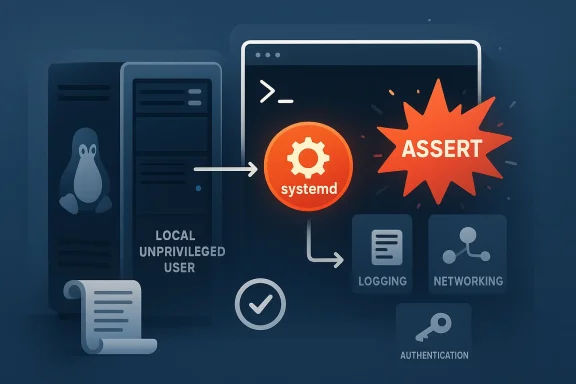
Microsoft’s CVE-2026-29111 advisory points to a systemd issue that lets a local unprivileged user trigger an assert, a failure mode that is especially important on Linux systems where a single service crash can cascade into broader disruption. Although the wording does not immediately imply full privilege escalation, an assert in a core init/service-management component can still be a serious operational problem because it can destabilize the host, interrupt service supervision, and in some environments become a stepping stone for more consequential abuse. In other words, this is the kind of bug that administrators should not dismiss simply because it starts with “local user.”
systemd has become one of the most influential components in modern Linux distributions, acting as the bootstrap, service manager, logging coordinator, and in many cases the central orchestrator for system state. That makes any flaw in its parsing, validation, or control-path logic disproportionately important, because a defect is rarely isolated to one tiny feature. A crash, assertion failure, or daemon restart in systemd can affect boot reliability, watchdog behavior, service availability, and the security assumptions of the software stack layered above it.
An assert is not the same thing as a memory corruption bug or a classic remote code execution flaw. Instead, it is a deliberate program abort when code encounters a condition the developers believe should be impossible. In security terms, though, an attacker who can reliably force an assert can still cause denial of service, disrupt automation, and sometimes force the software down rare paths that were never intended for hostile input.
The phrase “local unprivileged user” is also doing important work here. It means the attacker does not need root, administrative rights, or a special kernel capability to begin. On multi-user servers, developer workstations, containers, VDI hosts, and shared Linux appliances, local users are common. That expands the practical risk well beyond the narrow scenario of “someone already owns the machine.”
Microsoft’s update guide entries often summarize vulnerabilities tersely, but that brevity should not be mistaken for triviality. An advisory that says a local user can trigger an assert in systemd suggests an attack surface involving validation logic, state transitions, or IPC-facing behavior where a crafted sequence can knock over a privileged daemon. That is the sort of flaw defenders must interpret in the broader context of service isolation, uptime requirements, and the possibility that a crash can be weaponized as part of a chained attack.
The most likely practical effect is denial of service, but defenders should think more broadly. A forced assert can interrupt unit management, break session workflows, and potentially destabilize services that rely on systemd state. In environments with tight uptime requirements, repeated aborts can be as operationally damaging as a more glamorous exploit.
A second implication is that the flaw may reveal a weakness in input validation or state handling inside systemd’s local interfaces. Those interfaces are not always “public” in the internet sense, but they may be reachable through local IPC, system calls, generated state, or files that a low-privilege user can influence. That makes these bugs common in practice and difficult to reason about without strong defensive coding and fuzzing coverage.
Finally, vulnerabilities in a platform component like systemd often get more attention after patching because they are trust anchors. Once a fix exists, defenders need to ask where the vulnerable code path may already have been triggered, whether service crashes occurred around suspicious user activity, and whether patch deployment is uniform across all nodes. That post-patch diligence is often where the real security value is captured.
A local unprivileged user may not control the whole machine, but they can often influence files, sockets, process state, or IPC endpoints that privileged services consume. If systemd performs an operation on behalf of a user or reads a user-influenced value without sufficiently defensive validation, an assert can become reachable. That is why local bugs in core infrastructure tend to be more dangerous than local bugs in ordinary desktop applications.
The phrase “can trigger an assert” also implies deterministic behavior in at least some cases. Determinism matters because it turns an otherwise theoretical bug into an operationally exploitable one. If an attacker can repeat the condition reliably, incident teams will see crashes that recur after reboot or service restart, making the problem easier to abuse and harder to suppress.
The key security lesson is that service managers frequently sit in the middle of privilege transitions. They start daemons, supervise processes, and coordinate resources that standard users cannot directly touch. If a local user can alter something systemd interprets as control data, even without directly escalating privileges, they may still destabilize the whole host or create a reliable nuisance primitive.
Assertions in such code often indicate that the software encountered a condition it considered impossible based on its own invariants. Attackers love invariant violations because they can reveal blind spots between design intent and actual runtime behavior. A good fix usually hardens validation, removes invalid assumptions, and turns fatal aborts into graceful rejection where possible.
For enterprises, the stakes are broader. A local-only issue on a workstation fleet can become an operational incident if the vulnerable condition is reachable by standard users, scripts, or managed software. On servers, especially shared Linux infrastructure, a local user that can crash a core daemon may affect many other accounts, containers, or workloads.
The divide between enterprise and consumer impact is also about monitoring and response maturity. Consumer systems often recover by rebooting and moving on. Enterprise systems may require incident review, patch orchestration, version tracking, and service health validation across hundreds or thousands of nodes. That means even a “mere assert” can become a major helpdesk and SRE event.
The presence of a local trigger does not reduce urgency. In many environments, a local trigger is easier to reach than a network exploit because local access already exists. If untrusted users, automation accounts, or third-party software are present, the vulnerability can be exercised without any external intrusion at all.
Operationally, teams should also watch for signs that the bug is being hit accidentally. A malfunctioning application or a misconfigured script can resemble an attack when it repeatedly triggers the same assert. That makes telemetry, crash logging, and change correlation especially important during the remediation window.
This matters because assertions can reveal more than the immediate bug. They may indicate missing bounds checks, inconsistent object lifecycle handling, or stale state assumptions in a concurrent system. In a service manager, those categories are particularly dangerous because the daemon is constantly juggling state transitions across processes, units, and dependencies.
Modern secure coding trends increasingly favor resilient error handling over fatal aborts wherever possible. That does not mean asserts have no place in development. It means production code should minimize the number of reachable conditions where a user can cause a trusted service to crash simply by forcing it into an unexpected state.
The issue also highlights the continuing tradeoff between feature richness and attack surface. systemd has accumulated responsibilities over time because it solves real operational problems, but the more central a component becomes, the more painful its defects are. Competitors and alternative init systems may use an advisory like this to argue for minimalism, while systemd proponents may point to rapid patching and the value of a single hardened control plane.
For enterprise buyers, the ecosystem question is less ideological and more practical. They want to know whether their distribution vendor ships a fix, whether containers inherit the vulnerable component, and whether their fleet management tools can verify remediation. A vulnerability in a foundational daemon tends to ripple into procurement, support, and platform standardization decisions.
Telemetry should focus on the period surrounding the first failure, because the triggering activity may be subtle and ephemeral. Logs, shell history, scheduled jobs, and any recent changes to user-accessible files or IPC-heavy workflows may all matter. If the same user account appears near multiple incidents, that is worth investigating even if the account is nominally low-privilege.
Forensics in these cases often benefit from comparing “known good” and “known bad” states. If the system behaves normally until a particular local action occurs, the attacker’s path may be more reproducible than the crash itself. That makes reproductions in a lab environment useful not just for patch validation, but for understanding the original exploit mechanism.
Security teams should also treat this as a reminder to watch for service-manager crashes as potential security signals, not just operational noise. In mature environments, the difference between a bug and an incident is often the quality of logging, the speed of patching, and the ability to correlate a crash with a plausible local actor. That makes this advisory a useful stress test for Linux fleet maturity as much as a narrow vulnerability notice.
Source: MSRC Security Update Guide - Microsoft Security Response Center
 Background
systemd has become one of the most influential components in modern Linux distributions, acting as the bootstrap, service manager, logging coordinator, and in many cases the central orchestrator for system state. That makes any flaw in its parsing, validation, or control-path logic disproportionately important, because a defect is rarely isolated to one tiny feature. A crash, assertion failure, or daemon restart in systemd can affect boot reliability, watchdog behavior, service availability, and the security assumptions of the software stack layered above it.An assert is not the same thing as a memory corruption bug or a classic remote code execution flaw. Instead, it is a deliberate program abort when code encounters a condition the developers believe should be impossible. In security terms, though, an attacker who can reliably force an assert can still cause denial of service, disrupt automation, and sometimes force the software down rare paths that were never intended for hostile input.
The phrase “local unprivileged user” is also doing important work here. It means the attacker does not need root, administrative rights, or a special kernel capability to begin. On multi-user servers, developer workstations, containers, VDI hosts, and shared Linux appliances, local users are common. That expands the practical risk well beyond the narrow scenario of “someone already owns the machine.”
Microsoft’s update guide entries often summarize vulnerabilities tersely, but that brevity should not be mistaken for triviality. An advisory that says a local user can trigger an assert in systemd suggests an attack surface involving validation logic, state transitions, or IPC-facing behavior where a crafted sequence can knock over a privileged daemon. That is the sort of flaw defenders must interpret in the broader context of service isolation, uptime requirements, and the possibility that a crash can be weaponized as part of a chained attack.
Why an assert matters
A crash in a low-level service manager can be more serious than a crash in an ordinary application because it may affect multiple subsystems at once. systemd is responsible for keeping services alive, tracking dependencies, and enforcing resource and lifecycle boundaries. If an attacker can repeatedly trigger an assert, the result may be persistent denial of service rather than a one-time inconvenience.- Availability impact is often the first concern.
- Operational disruption can ripple into authentication, logging, and networking services.
- Monitoring noise can hide the real cause if the crash is intermittent.
- Chaining potential increases when the flaw can be triggered predictably.
- Incident response complexity rises when the failure occurs in a core daemon.
Overview
The advisory language suggests a defect in systemd that can be exercised from a non-privileged local context. That matters because Linux hardening assumes privileged boundaries are meaningful; if a standard user can make a privileged process abort, then the boundary is already weakened. Even when there is no direct code execution, the ability to force failure in a trusted system component is a security event, not just a bug.The most likely practical effect is denial of service, but defenders should think more broadly. A forced assert can interrupt unit management, break session workflows, and potentially destabilize services that rely on systemd state. In environments with tight uptime requirements, repeated aborts can be as operationally damaging as a more glamorous exploit.
A second implication is that the flaw may reveal a weakness in input validation or state handling inside systemd’s local interfaces. Those interfaces are not always “public” in the internet sense, but they may be reachable through local IPC, system calls, generated state, or files that a low-privilege user can influence. That makes these bugs common in practice and difficult to reason about without strong defensive coding and fuzzing coverage.
Finally, vulnerabilities in a platform component like systemd often get more attention after patching because they are trust anchors. Once a fix exists, defenders need to ask where the vulnerable code path may already have been triggered, whether service crashes occurred around suspicious user activity, and whether patch deployment is uniform across all nodes. That post-patch diligence is often where the real security value is captured.
Why Microsoft’s naming matters
Microsoft’s update guide is not simply describing a Linux bug for curiosity’s sake; it is cataloging a vulnerability that has enough ecosystem relevance to warrant coordination and tracking. That suggests downstream products, managed Linux estates, or vendor-integrated distributions may be affected in ways enterprise teams will want to verify.- The issue is tracked as a real security vulnerability, not just a crash report.
- The affected component is systemd, which is central to system operation.
- The attacker model is local but unprivileged, which expands practical exposure.
- The likely outcome is service disruption rather than browser-style exploitation.
- The advisory may signal patch urgency for managed environments.
How Local Privilege Boundaries Break Down
Local vulnerabilities can look deceptively mild because they do not cross a network boundary. In practice, that assumption often underestimates how real attacks happen. Shared workstations, bastion hosts, CI runners, container hosts, and jump boxes all routinely allow some form of local code execution by users who are not fully trusted.A local unprivileged user may not control the whole machine, but they can often influence files, sockets, process state, or IPC endpoints that privileged services consume. If systemd performs an operation on behalf of a user or reads a user-influenced value without sufficiently defensive validation, an assert can become reachable. That is why local bugs in core infrastructure tend to be more dangerous than local bugs in ordinary desktop applications.
The phrase “can trigger an assert” also implies deterministic behavior in at least some cases. Determinism matters because it turns an otherwise theoretical bug into an operationally exploitable one. If an attacker can repeat the condition reliably, incident teams will see crashes that recur after reboot or service restart, making the problem easier to abuse and harder to suppress.
Threat model implications
The real-world risk depends on who has local access and what they can reach. On a single-user laptop, the attack surface is narrower, though still relevant if untrusted software or sandbox escapes are involved. On a multi-user server or development host, the risk rises because one account’s actions may affect the whole machine.- Standard users can become availability attackers.
- Shared environments increase the blast radius.
- Automated systems may restart into the same failure.
- Local attacks often evade network-based defenses.
- Service managers are especially sensitive to crafted input paths.
The systemd Attack Surface
systemd is not one monolithic feature but a collection of interacting pieces: service units, timers, sockets, journal plumbing, login/session handling, cgroups, and more. Each layer creates opportunities for input to cross trust boundaries in subtle ways. That complexity is precisely why a local assert bug is worth attention.The key security lesson is that service managers frequently sit in the middle of privilege transitions. They start daemons, supervise processes, and coordinate resources that standard users cannot directly touch. If a local user can alter something systemd interprets as control data, even without directly escalating privileges, they may still destabilize the whole host or create a reliable nuisance primitive.
Assertions in such code often indicate that the software encountered a condition it considered impossible based on its own invariants. Attackers love invariant violations because they can reveal blind spots between design intent and actual runtime behavior. A good fix usually hardens validation, removes invalid assumptions, and turns fatal aborts into graceful rejection where possible.
Why service managers are special
Service managers are privileged by design, and that privilege comes with trust assumptions. They are supposed to act on behalf of many other components, some of which are inherently less trusted. That makes them a favorite target for low-privilege attackers seeking leverage.- They interact with multiple trust domains.
- They may parse user-influenced configuration or state.
- They often run with high privilege.
- They are expected to be stable under load.
- A crash can affect many dependent services at once.
Enterprise Risk vs Consumer Risk
For consumers, the immediate risk from a local systemd assert bug is usually inconvenience, instability, and the possibility of a machine that becomes unreliable under certain local actions. That can still be serious on a home PC if the machine is used for school, remote work, or personal storage. But the main consequence is often a reboot loop, service failure, or a degraded desktop session.For enterprises, the stakes are broader. A local-only issue on a workstation fleet can become an operational incident if the vulnerable condition is reachable by standard users, scripts, or managed software. On servers, especially shared Linux infrastructure, a local user that can crash a core daemon may affect many other accounts, containers, or workloads.
The divide between enterprise and consumer impact is also about monitoring and response maturity. Consumer systems often recover by rebooting and moving on. Enterprise systems may require incident review, patch orchestration, version tracking, and service health validation across hundreds or thousands of nodes. That means even a “mere assert” can become a major helpdesk and SRE event.
Different consequences by environment
A vulnerability like this behaves differently depending on where it appears. The same bug can be a nuisance on a personal device and a production risk in a shared cluster.- Consumer systems: instability, service disruption, loss of productivity.
- Developer workstations: broken builds, failing local daemons, debugging noise.
- Shared servers: interference across users and services.
- Cloud hosts: possible impact to orchestration layers or tenant isolation boundaries.
- Edge devices: reduced reliability and hard-to-diagnose outages.
Patch Management and Operational Response
Once a systemd flaw of this type is disclosed, patch management becomes the first line of defense. Because systemd is so central, organizations should not assume one distribution’s package schedule matches another’s. The correct response is to identify affected builds, confirm package provenance, and stage updates in a way that avoids self-inflicted outages.The presence of a local trigger does not reduce urgency. In many environments, a local trigger is easier to reach than a network exploit because local access already exists. If untrusted users, automation accounts, or third-party software are present, the vulnerability can be exercised without any external intrusion at all.
Operationally, teams should also watch for signs that the bug is being hit accidentally. A malfunctioning application or a misconfigured script can resemble an attack when it repeatedly triggers the same assert. That makes telemetry, crash logging, and change correlation especially important during the remediation window.
Practical response steps
A disciplined response should be simple, measurable, and repeatable. The goal is to reduce exposure quickly without causing avoidable downtime.- Inventory Linux systems that use systemd and identify vendor package streams.
- Check package advisories and confirm whether the patched build is available.
- Prioritize shared and multi-user systems where local access is common.
- Test the update in a staging environment before broad rollout.
- Monitor for repeated service crashes or unusual assert messages after deployment.
- Patch first on shared systems.
- Validate unit health after reboot.
- Confirm log retention is sufficient for forensics.
- Recheck automation accounts and scheduled jobs.
- Document the exact package versions deployed.
Why Assertions Become Security Issues
Developers often treat assertions as internal guardrails, not as user-facing behavior. But in security-sensitive software, an assert is still a failure condition that users can potentially reach. If hostile input can traverse enough code paths to trip it, then the attacker has found a place where the program’s assumptions no longer hold.This matters because assertions can reveal more than the immediate bug. They may indicate missing bounds checks, inconsistent object lifecycle handling, or stale state assumptions in a concurrent system. In a service manager, those categories are particularly dangerous because the daemon is constantly juggling state transitions across processes, units, and dependencies.
Modern secure coding trends increasingly favor resilient error handling over fatal aborts wherever possible. That does not mean asserts have no place in development. It means production code should minimize the number of reachable conditions where a user can cause a trusted service to crash simply by forcing it into an unexpected state.
The security lesson
The deeper lesson is that availability is part of security. If a low-privilege user can reliably bring down a privileged daemon, they have achieved a real security outcome even without code execution. For administrators, that can translate into a service desk event, a compliance issue, or a production incident.- Fatal assertions should never be trivially reachable.
- Graceful failure is usually safer than aborting.
- State validation must be defensive under hostile input.
- Crash loops can create sustained disruption.
- Core daemons deserve extra hardening scrutiny.
Competitive and Ecosystem Implications
A vulnerability in systemd has implications that extend beyond one vendor or one distribution. systemd sits in a large ecosystem of Linux distributions, container images, appliances, and vendor-hardened builds. A bug in that stack can force vendors to coordinate patches, backports, and security notices across different release trains.The issue also highlights the continuing tradeoff between feature richness and attack surface. systemd has accumulated responsibilities over time because it solves real operational problems, but the more central a component becomes, the more painful its defects are. Competitors and alternative init systems may use an advisory like this to argue for minimalism, while systemd proponents may point to rapid patching and the value of a single hardened control plane.
For enterprise buyers, the ecosystem question is less ideological and more practical. They want to know whether their distribution vendor ships a fix, whether containers inherit the vulnerable component, and whether their fleet management tools can verify remediation. A vulnerability in a foundational daemon tends to ripple into procurement, support, and platform standardization decisions.
Broader market signal
The market message is clear: foundational Linux plumbing remains a high-value target, even when the trigger is local. That means security teams cannot focus only on perimeter exploits and browser zero-days.- Linux internals remain security-sensitive.
- Vendor backports matter as much as upstream patches.
- Containers may still inherit host-level risk.
- Appliance firmware can lag behind upstream fixes.
- Platform standardization increases the importance of timely updates.
Detection, Telemetry, and Forensics
If this issue is being used maliciously, the most obvious evidence may be repeated crashes or asserts in systemd-related logs. But defenders should not rely on a single indicator. Attackers who understand service behavior may space out attempts or hide them inside routine administrative actions, making the issue look like random instability.Telemetry should focus on the period surrounding the first failure, because the triggering activity may be subtle and ephemeral. Logs, shell history, scheduled jobs, and any recent changes to user-accessible files or IPC-heavy workflows may all matter. If the same user account appears near multiple incidents, that is worth investigating even if the account is nominally low-privilege.
Forensics in these cases often benefit from comparing “known good” and “known bad” states. If the system behaves normally until a particular local action occurs, the attacker’s path may be more reproducible than the crash itself. That makes reproductions in a lab environment useful not just for patch validation, but for understanding the original exploit mechanism.
What defenders should collect
The most useful artifacts are the ones that help reconstruct the timeline before the assert.- systemd and journal logs around the crash window
- user login and session records
- recent package updates or configuration changes
- cron, timer, and automation activity
- any repeated process restarts or watchdog events
Signals worth correlating
Not every crash is malicious, but repeated patterns deserve scrutiny. Correlating multiple signals usually reveals whether the event was accidental, scripted, or adversarial.- Same user account appearing before multiple failures
- Repeated crash intervals after reboot
- Unexpected local file modifications
- Automated jobs launched shortly before the assert
- Service restarts that fail in the same sequence
Strengths and Opportunities
The good news is that vulnerabilities like this are usually manageable once they are clearly identified. Because the trigger is local and the flaw is in a well-understood core component, defenders have a chance to patch systematically and reduce exposure quickly. There is also an opportunity here for organizations to improve the way they handle Linux platform updates, crash logging, and shared-host hardening.- Clearer threat model: local unprivileged abuse is easier to prioritize than vague instability.
- Patchability: package-based remediation can be rolled out centrally.
- Better hardening: teams can review how local users interact with system services.
- Improved monitoring: crashes provide a visible signal for detection engineering.
- Operational learning: incidents like this expose weaknesses in fleet hygiene.
- Vendor coordination: distribution maintainers can backport fixes to stable releases.
- Security culture: core-daemon bugs tend to improve attention to defensive coding.
Risks and Concerns
The concern is not that this advisory describes a dramatic remote takeover; it is that a seemingly modest local bug can still create meaningful disruption when it lands in the wrong place. systemd sits at the center of Linux service management, so even a crash-only flaw can have outsized consequences if it affects production infrastructure, multi-user servers, or automated build hosts.- Denial of service can be repeated if the trigger remains reachable.
- Multi-user environments increase the real-world impact.
- Crash loops can mask root cause and slow response.
- Backport gaps may leave older enterprise releases exposed.
- Silent exposure is possible if teams assume local bugs are low priority.
- Chained exploitation remains a concern if the assert exposes deeper weakness.
- Inconsistent remediation across fleets can leave pockets of risk.
Looking Ahead
The most important next step is for administrators to confirm which Linux builds and distributions they run, then verify whether their vendor has shipped a fix or backport. Because systemd is foundational, patch validation should include normal boot, login, service startup, and any automation that depends on local system management. It is also worth reviewing whether any standard users, service accounts, or third-party agents have sufficient local access to exercise the affected code path.Security teams should also treat this as a reminder to watch for service-manager crashes as potential security signals, not just operational noise. In mature environments, the difference between a bug and an incident is often the quality of logging, the speed of patching, and the ability to correlate a crash with a plausible local actor. That makes this advisory a useful stress test for Linux fleet maturity as much as a narrow vulnerability notice.
- Verify vendor patch status across all Linux images and hosts.
- Confirm systemd version and distribution backport level.
- Review local user access on shared systems and automation nodes.
- Monitor for repeated asserts or unexpected daemon restarts.
- Rehearse rollback and recovery in case remediation exposes unrelated issues.
Source: MSRC Security Update Guide - Microsoft Security Response Center
Last edited:
