
 Microsoft’s Advisory Feed Has Become a Map of Someone Else’s Kernel
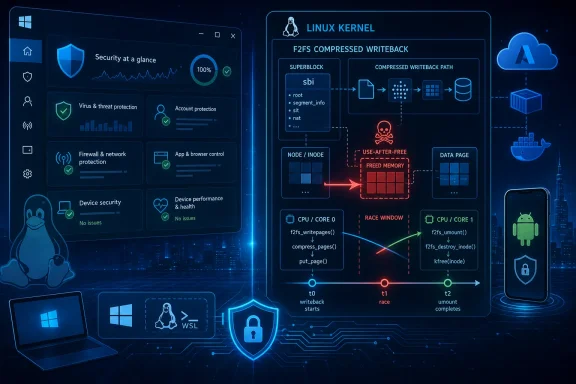
The short version of CVE-2026-31702 is deceptively simple: F2FS, the Flash-Friendly File System originally designed for NAND flash storage, had a race in the compressed write completion path. The function at the center of the report, f2fs_compress_write_end_io(), could continue touching the superblock information structure after another CPU had been allowed to proceed with unmount cleanup. That is the classic use-after-free pattern, but in kernel space the phrase carries more weight than it does in an ordinary application crash report.
The affected code path revolves around sbi, shorthand for the F2FS superblock information structure. In the vulnerable sequence, a writeback completion handler decrements an internal page counter, potentially waking a thread that is waiting to unmount the filesystem. If that counter reaches zero too early, the unmount path can continue tearing down the filesystem while the original completion callback still has work left to do.
That is the kind of bug that looks almost academic until you remember what a filesystem is allowed to do. It is trusted code running in the kernel, handling memory, metadata, writeback, and concurrency under load. A logic error in that layer is not a mere application fault; it is a failure in the machinery that decides when kernel objects still exist.
The Microsoft angle is odd but not accidental. MSRC tracks and republishes vulnerabilities that affect Microsoft products, dependencies, cloud services, or ecosystems customers reasonably expect Microsoft tooling to know about. A Linux kernel CVE showing up there is no longer surprising. Windows administrators increasingly manage Linux guests, Linux containers, Linux-based appliances, Azure images, WSL environments, and mobile fleets that are tied into Microsoft security products.
This is the world Microsoft helped create. Windows is still Windows, but the operating environment around it is hybrid, layered, and full of Linux. An advisory like CVE-2026-31702 is a reminder that the Windows security perimeter now includes code that never shipped as ntoskrnl.exe.
The Bug Lives in the Gap Between “Done” and Actually Done
Use-after-free flaws are often described as memory safety bugs, which is accurate but incomplete. CVE-2026-31702 is really a lifecycle bug. One part of the kernel concluded that a writeback operation had progressed far enough to let unmount continue; another part of the same completion path still needed the object that unmount was now free to destroy.
That makes the vulnerability a timing problem dressed as a pointer problem. The compressed writeback path uses accounting to determine when checkpoint-related data pages are no longer outstanding. When the last relevant counter drops to zero, f2fs_wait_on_all_pages() can unblock in the unmount path. From the unmounting CPU’s point of view, the pages it was waiting for are gone, and teardown may proceed.
But the completion callback still had post-counter work to perform. In the reported sequence, page_array_free() could still need data from sbi after the counter decrement had opened the gate for unmount cleanup. If the superblock info structure was freed in that window, the callback could dereference stale memory.
The fix changes the ordering so that the final operations that still depend on the superblock happen before the accounting step that tells unmount it is safe to move on. In plain English, the kernel must stop announcing “nothing to see here” while one of its own callbacks is still holding a map to the scene.
That distinction matters because many concurrency bugs are not caused by missing locks in the simplistic sense. They are caused by a contract that was almost right. The wait condition did wait for something real; it just did not wait for the whole thing that mattered.
F2FS Compression Turns a Niche Filesystem Detail Into a Real Fleet Concern
F2FS is not the default filesystem of most Windows desktops, and that fact will lead some administrators to dismiss CVE-2026-31702 too quickly. The filesystem is far more common in flash-oriented Linux environments, especially Android devices and systems optimized for solid-state storage. The vulnerable path specifically involves compressed F2FS writeback, which narrows the exposure but does not make it imaginary.
The reason the bug matters is that compression changes the shape of I/O completion. Compressed data is not merely written and forgotten; it is tracked through clusters, pages, bio completion callbacks, and cleanup structures. That extra machinery gives the filesystem more performance and space-efficiency options, but it also gives kernel developers more lifecycle edges to get wrong.
The vulnerability description ties the issue to the compressed write completion path rather than the ordinary F2FS write end path. That is important because an earlier, related F2FS use-after-free issue existed in the non-compressed write completion logic. CVE-2026-31702 is not merely the same bug with a new number; it is a sibling problem in a parallel path.
This is a familiar pattern in kernel security. A fix lands for one function, and the community later finds that a similar assumption exists in another callback, driver, or fast path. The first patch resolves the known report. The second teaches the larger lesson: kernel subsystems often contain families of bugs, not isolated defects.
For WindowsForum readers, the practical question is not whether their Windows 11 laptop uses F2FS. It almost certainly does not. The better question is whether their organization inventories Linux kernels with the same discipline it applies to Windows cumulative updates. In many environments, the answer is still no.
The Severity Score Says “Local,” but Kernel Local Is Not Comforting
CVE-2026-31702 carries a high severity rating under CVSS 3.1, with local attack vector, low attack complexity, low privileges required, no user interaction, and high impact across confidentiality, integrity, and availability. That combination is worth parsing carefully. “Local” does not mean harmless; it means the attacker needs a foothold before trying to turn a kernel bug into something worse.
Modern attack chains are built exactly that way. A browser bug, exposed service, stolen credential, malicious app, or compromised container gets the attacker onto the box. A kernel use-after-free then becomes the tool for escaping a sandbox, elevating privileges, disabling protections, or forcing a crash at a strategically useful moment.
The reported impact profile is severe because kernel memory corruption can theoretically compromise the whole system. Not every use-after-free is reliably exploitable, and not every exploit is practical across kernel versions, build options, heap layouts, and mitigations. But defenders should not take comfort in uncertainty when the affected component runs at the privilege level that owns the machine.
The local nature of the bug is especially relevant for Android and embedded Linux devices. In those environments, “local attacker” may mean an app with limited privileges rather than a person at a shell prompt. If the device uses F2FS compression on user data, heavy file I/O may become part of a trigger path.
For server administrators, exposure is narrower but not nonexistent. F2FS is not the mainstream choice for most enterprise Linux servers, where ext4 and XFS dominate. Still, specialized appliances, development boards, test devices, Android build environments, and storage experiments have a habit of showing up in corporate networks without appearing in the official server inventory.
The Patch Is a Small Ordering Change With a Large Security Meaning
The fix for CVE-2026-31702 is not a sweeping rewrite. It is a surgical correction in the order of operations. The vulnerable behavior allowed dec_page_count() to run before all later uses of sbi were safely out of the way; the corrected logic ensures the last folio path frees the page array while the relevant counter still keeps the superblock alive, then performs the decrement as the final step.
That is the sort of patch that can look trivial in a diff but profound in a postmortem. Kernel code is full of counters, wait queues, references, and completion paths that encode assumptions about ownership. Move one line past another, and the entire safety argument changes.
This is why filesystem bugs are so resistant to casual review. The code may compile. It may pass ordinary workloads. It may run for years on millions of devices. Then a stress path involving compressed writeback, unmount, and completion callbacks reveals that the lifetime guarantee was narrower than everyone thought.
The affected version ranges also tell a story. The vulnerable feature traces back to F2FS data compression support, introduced years before this CVE was assigned. The fixed stable kernels include updated releases across multiple maintained branches, including 6.6, 6.12, 6.18, 7.0, and the 7.1 release-candidate line. That broad backport pattern is a sign that maintainers judged the issue important enough to repair across supported kernel streams.
For administrators, the version lesson is straightforward but easy to botch. Do not search only for the CVE in your distribution’s package notes and stop there. Kernel vendors frequently backport fixes without adopting the same upstream version number, and appliance vendors may ship kernels that are neither pristine upstream nor clearly documented. The right question is whether your vendor has incorporated the relevant F2FS compressed writeback fix, not whether uname -r matches a headline version.
Windows Shops Now Inherit Linux Risk Through the Side Door
The reflexive response from a Windows administrator might be: “Why is this in my feed?” The answer is that Microsoft’s security world has expanded beyond Windows binaries. Defender for Endpoint runs across platforms. Azure hosts Linux at enormous scale. WSL gives developers Linux userlands on Windows machines. AKS, container registries, IoT devices, Android integration, and cloud images all drag Linux kernel exposure into Microsoft-managed workflows.
CVE-2026-31702 is unlikely to be the vulnerability that breaks a typical Windows workstation. But it is exactly the kind of vulnerability that exposes gaps in cross-platform patch management. Many organizations have mature reporting for Windows Update compliance and comparatively fuzzy visibility into Linux kernels embedded in developer workstations, lab devices, mobile fleets, and cloud images.
WSL deserves a nuanced mention here. WSL 2 uses a Microsoft-provided Linux kernel, and Microsoft updates that kernel through its own mechanisms rather than relying on a user’s chosen distribution packages. Whether a particular WSL kernel build is affected depends on its configuration and patch level, not merely on the presence of Ubuntu, Debian, or Fedora user space inside WSL. Most WSL users are not mounting compressed F2FS filesystems, but security teams should still treat WSL kernel updates as part of endpoint hygiene rather than developer convenience.
Azure adds another wrinkle. Cloud teams often think in terms of VM images, container base images, and managed services, but kernel vulnerabilities sit underneath those abstractions. If a Linux guest or node image includes F2FS support and uses the affected code path, the remediation story belongs to the image maintainer, distribution vendor, or service operator. The customer still has to know which layer is responsible.
This is the uncomfortable part of hybrid IT. Microsoft can publish an advisory, Defender can flag a CVE, and a vulnerability scanner can generate a ticket, but none of that guarantees the owner of the affected kernel is obvious. The technical bug is a race in F2FS. The operational bug is assuming the platform boundary will tell you who has to fix it.
The Android Shadow Makes the Vulnerability More Interesting Than the Server Count
F2FS has always had a stronger association with flash-heavy systems than with conventional enterprise servers. That naturally points attention toward Android. Many Android devices use F2FS for data partitions, and compression support has been part of the filesystem’s appeal on storage-constrained devices.
The original patch discussion reportedly framed the compressed-path issue as relevant to devices where unprivileged app I/O can interact with compressed F2FS directories. That does not automatically mean every Android phone is exploitable, or that a public exploit exists, or that an ordinary app can trivially weaponize the race. Kernel configuration, mount options, SELinux policy, heap state, timing, and device-specific code all matter.
Still, Android’s relevance changes the risk conversation. A local kernel bug on a desktop Linux machine often requires shell access or some other foothold that narrows the affected population. A local kernel bug on a mobile device can be reached through an app model where many pieces of untrusted code are designed to run locally by default.
That is why security teams should resist the temptation to bucket CVE-2026-31702 as “Linux server only.” The affected upstream component is the Linux kernel, but the natural deployment zone for F2FS includes phones, tablets, embedded devices, development boards, and other places that do not look like traditional servers in an asset database.
For Microsoft-oriented environments, Android relevance is not as remote as it once sounded. Enterprise mobility management, Microsoft Intune, Defender for Endpoint on Android, conditional access, and mobile threat defense all tie Android posture back into the Microsoft security estate. A kernel filesystem CVE on a managed phone may never touch a Windows patch dashboard, but it can still affect a user identity, a corporate app, or a compliance decision.
The Disclaimer Is Boilerplate, but the Risk Transfer Is Real
The text attached to Microsoft Knowledge Base content often includes broad warranty disclaimers: information is provided as-is, Microsoft disclaims implied warranties, and Microsoft is not liable for consequential damages. That language is not unique to this CVE, and it should not be read as a special warning that CVE-2026-31702 is unusually uncertain. It is the legal packaging around a security information pipeline.
But boilerplate can still reveal the nature of the system. Security advisories are not guarantees; they are signals. They tell administrators where to look, what vendors believe is affected, and which updates or mitigations may matter. They do not replace testing, vendor-specific guidance, asset inventory, or change control.
That matters in this case because the upstream Linux kernel, distribution kernels, Android device kernels, cloud image kernels, and Microsoft-managed kernels can all differ. The CVE identity gives the industry a shared handle. It does not magically flatten all those branches into one remediation path.
MSRC’s publication of the item should therefore be treated as a prompt, not a complete answer. If you run only conventional Windows endpoints, the practical exposure is probably indirect. If you run Linux in Azure, Android in the enterprise, WSL on developer machines, or container hosts with custom kernels, the advisory belongs in your triage queue.
There is also a subtle trust issue here. Security teams increasingly consume CVE data through automated tools, and those tools often flatten context into severity, product, and due date. A high-severity Linux kernel CVE in a Microsoft feed can look either more alarming or less relevant than it really is. The job of the human analyst is to restore the missing architecture.
Patch Management Needs to Follow the Filesystem, Not the Brand
The most common failure mode with vulnerabilities like CVE-2026-31702 is brand-based triage. Windows team sees Linux and ignores it. Linux team sees F2FS and assumes no servers use it. Mobile team waits for OEM patches. Cloud team assumes the base image is someone else’s problem. Every assumption is individually plausible, and together they form a gap.
A better approach starts with filesystem reality. Where is F2FS used? Is compression enabled? Which kernel branches are deployed? Are any affected systems reachable by untrusted local users, untrusted apps, shared tenants, build workloads, or sandboxed code? Those questions matter more than whether the advisory arrived through Microsoft, NVD, a distribution tracker, or a phone vendor bulletin.
For enterprise Linux servers, the answer may be reassuring. Many fleets will discover that F2FS is not mounted anywhere and the vulnerable path is not practically exposed. That is a valid result, but it should be the result of checking, not guessing.
For developer endpoints, the picture is messier. Developers experiment with filesystems, loop devices, custom kernels, Android images, and WSL configurations. A machine that looks like a Windows endpoint in an inventory tool may be a small zoo of Linux runtimes in practice. The more privileged the developer, the more seriously the endpoint should be treated.
For mobile and embedded fleets, remediation will often depend on vendor updates. That can be frustrating because kernel fixes may arrive inside monthly Android security updates, OEM firmware packages, or device-specific builds rather than as a package an administrator can install directly. The practical control may be policy: require supported patch levels, retire abandoned devices, and restrict corporate access from devices outside compliance.
Exploitability Is the Wrong Binary Question
Security teams often ask whether a CVE is exploitable in the wild. It is an understandable question, but for kernel lifecycle bugs it can be a trap. The absence of known exploitation is not the same as the absence of exploitability, and a public proof of concept is not the only reason to patch.
CVE-2026-31702 has characteristics exploit developers like: kernel context, use-after-free, local reachability, and a race involving I/O and unmount behavior. It also has characteristics defenders should weigh carefully: it depends on F2FS compression, a specific completion path, timing, and kernel heap behavior. That combination argues for prioritization, not panic.
The most defensible posture is to treat it as a high-severity local privilege-escalation class issue where exposure depends heavily on configuration. Systems with untrusted local code and F2FS compression deserve faster attention. Systems without F2FS usage can document non-exposure. Systems whose kernel provenance is unknown need inventory before anyone can make a credible claim either way.
This is also where mitigations are easy to overstate. Kernel hardening features, slab freelist protections, KASLR, SELinux, app sandboxes, and mount restrictions can all raise the bar. None of them should be sold as a substitute for the ordering fix. Memory corruption mitigations are seatbelts; they are not a repair for a steering fault.
The deeper lesson is that exploitability should be treated as a spectrum of operational risk. A vulnerability can be difficult to weaponize on one build, crash-only on another, and useful for privilege escalation on a third. CVE records do not encode that richness well, which is why administrators need both vendor guidance and local context.
The Kernel Community Fixed the Symptom and Exposed the Pattern
One reason open-source kernel vulnerabilities can appear noisy is that the development process is visible. Patch discussions, version revisions, stable backports, and CVE enrichment often unfold in public. That can make the Linux world look messier than closed ecosystems, but it also gives defenders unusual insight into root cause.
In this case, the pattern is clear: a previous F2FS writeback use-after-free had already highlighted the danger of signaling completion before all superblock-dependent work was done. CVE-2026-31702 extends that lesson to the compressed write path. The fix is therefore not just a one-off memory safety patch; it is a correction to an ordering assumption repeated in related code.
That matters for code reviewers and kernel maintainers because compressed and uncompressed paths often evolve in parallel. Features are added to one path, mirrored in another, and later maintained by people who may not have the original mental model. When the original model contains a lifetime hazard, the copies inherit it.
It also matters for defenders reading advisories. A CVE with a narrowly named function may indicate a broader class of recent fixes in the same subsystem. If your environment relies heavily on a filesystem, driver, or kernel module, one CVE should prompt you to look at adjacent stable updates rather than cherry-picking the single patch with the scariest score.
The upstream process is not perfect, but it is legible. The challenge for enterprise IT is translating that legibility into action before advisory fatigue turns every kernel CVE into background noise.
The Action Items Hide in the Version Numbers
The concrete remediation path is to run a kernel that contains the fix for the compressed F2FS write completion ordering bug. Upstream stable releases identify fixed points in multiple maintained branches, and downstream vendors will incorporate those changes according to their own update processes. That sounds simple until it meets the real world of vendor kernels, mobile firmware, and cloud images.
The safest operational move is to ask each platform owner for evidence, not vibes. Linux server teams should verify distribution advisories and installed kernel package changelogs. Android fleet owners should map device models to security patch levels and OEM release notes. Cloud teams should check node images, VM images, and managed service documentation. Endpoint teams should verify WSL kernel update policy where WSL is allowed.
Administrators should also be careful about scanners. Some tools flag vulnerability based on upstream version ranges and may miss backported fixes. Others may report a CVE against a kernel package even when the vulnerable module is not used. Neither false positives nor false negatives are rare in kernel CVE management.
The right response is not to disable the finding; it is to enrich it. Add whether F2FS is enabled, whether compressed F2FS is mounted, whether untrusted local code runs on the asset, and whether the vendor has shipped the relevant fix. That context turns a generic high-severity ticket into an actionable risk decision.
CVE-2026-31702 is exactly the kind of item that rewards mature asset management. If you know your kernels, filesystems, mount options, and device ownership, the advisory is manageable. If you do not, the CVE becomes one more reminder that your inventory is less complete than your vulnerability dashboard implies.
The F2FS Race Leaves a Practical Checklist Behind
For all the kernel nuance, the operational message is compact. CVE-2026-31702 should not send every Windows administrator into emergency mode, but it should force hybrid shops to prove where Linux kernel risk lives in their environment.
- Systems running Linux kernels with F2FS compression support should be checked for vendor updates that include the
f2fs_compress_write_end_io()lifetime-ordering fix. - Windows-only endpoints are unlikely to be directly exposed, but WSL, Linux VMs, developer machines, and security tooling that embeds Linux should remain in scope for inventory.
- Android and embedded devices deserve special attention because F2FS is common in flash-oriented deployments and patch delivery depends heavily on OEM support.
- Vulnerability scanners should be reconciled against vendor backports, because upstream kernel version numbers alone can misrepresent whether a fix is present.
- The highest-priority assets are those where untrusted local code can run on a system using compressed F2FS, since the vulnerability is local but kernel-level.
- Teams should document non-exposure based on actual filesystem and kernel evidence rather than dismissing the CVE because it appeared in a Microsoft advisory feed.
CVE-2026-31702 will probably not be remembered as a watershed vulnerability, and that is precisely why it is useful. It is an ordinary high-severity kernel bug in an increasingly ordinary place: a Microsoft-facing security workflow that now has to account for Linux, Android, cloud images, and developer runtimes. The organizations that handle it well will not be the ones that panic fastest; they will be the ones that can answer, with evidence, which kernels they run, which filesystems they mount, and where the old boundary between Windows administration and Linux security has quietly disappeared.
