

The Bug Lives Where Windows Semantics Meet Linux Kernel Speed
ksmbd exists because Samba’s traditional user-space model is not the only way to serve SMB from Linux. By moving more SMB server work into the kernel, ksmbd can reduce context switching and improve performance in some workloads. That bargain has always come with a sharper edge: bugs in parsing, translating, or constructing SMB metadata can now happen in kernel space.
CVE-2026-31704 lands precisely in that uncomfortable boundary layer. The affected code handles ACL conversion, taking Linux-side POSIX ACL information and building Windows-style security structures. That means the bug is not in the glamorous part of SMB — not authentication theater, not encryption negotiation, not ransomware-adjacent file locking — but in the plumbing that makes “who can access this file” intelligible across operating systems.
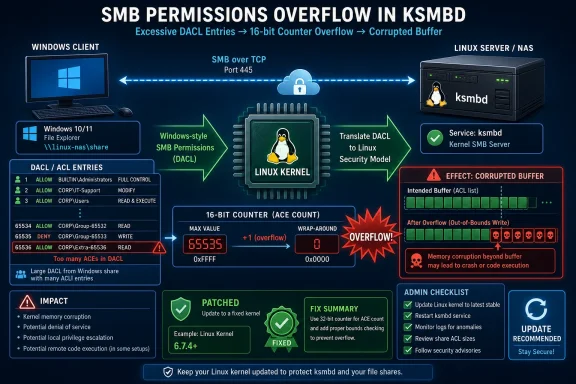
The short version is that ksmbd accumulated Access Control Entry sizes into 16-bit variables while building a DACL, or discretionary access control list. With enough POSIX ACL entries, that size can overflow past the maximum value a 16-bit unsigned integer can hold. Once the arithmetic wraps, later pointer calculations can aim back into already-written structures, corrupting the buffer that is supposed to describe file permissions.
That kind of bug is easy to underestimate because the fix sounds almost mundane: use check_add_overflow() when adding sizes. But integer overflow bugs are rarely mundane in kernel code. When arithmetic lies, every bound check and pointer calculation downstream may inherit the lie.
A 16-Bit Counter Is a Small Crack in a Large Trust Boundary
The vulnerable pattern described for CVE-2026-31704 is a familiar one: code calculates how much space a structure needs, stores the running total in a type that can be too small, and later trusts that total when writing into memory. In ordinary application code, that can be a crash. In kernel code, it becomes a more serious category of memory corruption, even when the known impact is framed conservatively.
The specific limit matters. A u16 can represent values from 0 through 65,535. If the actual ACL data grows beyond that and the running size wraps, the program no longer has a faithful representation of the buffer layout it is building. From that moment onward, the code can overwrite earlier entries while believing it is appending new ones.
This is not merely a type-choice nitpick. SMB ACLs are translation-heavy objects because Windows and Linux permission models do not map perfectly onto one another. The more translation a subsystem performs, the more it depends on careful accounting, and the more dangerous it becomes when accounting variables are narrower than the real-world input they are asked to summarize.
The patch’s use of check_add_overflow() is therefore not decorative hardening. It changes the logic from “add and hope the result still means what it appears to mean” to “refuse the operation once arithmetic can no longer be trusted.” That is exactly the sort of defensive programming kernel interfaces need, especially when dealing with externally influenced metadata.
ksmbd’s Performance Pitch Keeps Colliding With Kernel Reality
There is a reason administrators and NAS vendors look at ksmbd with interest. SMB is chatty, file-serving latency matters, and the Linux kernel is already where the filesystem and network stack live. If you can handle more of the server path in-kernel, you can plausibly deliver better throughput or lower overhead than a pure user-space implementation.
But performance is never free. Samba’s long-standing user-space architecture means that many classes of memory corruption remain outside the kernel boundary. A crash in a daemon can still be disruptive and exploitable in its own right, but it is not the same blast radius as corrupting memory inside the kernel.
ksmbd narrows that distance. The code has to parse SMB protocol state, manipulate file metadata, translate security descriptors, and interact with kernel filesystems. Every one of those tasks is complex; putting them in kernel space raises the cost of mistakes.
That does not mean ksmbd is a failed idea. It does mean administrators should resist treating it as a drop-in performance knob with no security trade-off. In infrastructure, the fastest path is not automatically the safest path, and file sharing is one of the last places where you want a quiet arithmetic bug to decide where a kernel write lands.
The Microsoft Angle Is About Ecosystems, Not Ownership
The presence of CVE-2026-31704 in Microsoft’s security ecosystem can look strange at first glance. The affected component is Linux kernel ksmbd, not Windows Server’s SMB implementation. Microsoft did not suddenly acquire responsibility for every Linux SMB bug simply because Windows clients speak SMB.
But modern Microsoft is inseparable from Linux in ways that would have sounded absurd two decades ago. Azure runs Linux at enormous scale. Microsoft ships Linux components, maintains Linux distributions and container hosts, and has customers who blend Windows clients with Linux file services every day. A Linux kernel SMB vulnerability can therefore be operationally relevant to Microsoft customers even when the vulnerable code is upstream Linux, not Windows.
That is the more interesting story here. The old Windows-versus-Linux framing does not help administrators who run Windows desktops, Linux storage appliances, Active Directory identities, and cloud-hosted workloads in the same environment. SMB has become connective tissue, and connective tissue tends to inherit risk from both sides of the body.
The Knowledge Base disclaimer attached to Microsoft security material is boilerplate, but its presence is unintentionally fitting. Security advisories are not warranties. They are signals. The work still belongs to the people who must determine whether ksmbd is enabled, which kernels are deployed, and whether a patch has actually landed on the systems that expose SMB service.
This Is a Local-Looking Bug With Network-Shaped Consequences
Available descriptions point to a scenario involving files with many POSIX ACL entries, which can sound more like a local filesystem oddity than an internet-facing emergency. That distinction matters, and defenders should not inflate the bug into a universal remote-code-execution panic without evidence. The public record describes memory corruption in the ksmbd ACL-building path, not a fully weaponized remote exploit chain.
Still, file servers are messy places to draw neat boundaries. Authenticated users can often create files, modify metadata, preserve ACLs through copy operations, or interact with shared folders in ways administrators do not inspect closely. If a vulnerable ksmbd server can be coaxed into processing pathological ACLs, the fact that the trigger involves permissions metadata does not make it irrelevant.
The risk is also uneven. A Linux desktop that never loads ksmbd is not in the same position as a NAS-like server exporting SMB shares through the kernel module. A server that only runs traditional Samba in user space is not affected in the same way. A storage appliance using a vendor kernel with ksmbd enabled may depend on the vendor’s firmware or kernel update cadence rather than a distribution’s normal package stream.
That unevenness is why the right response is inventory before alarm. Find where ksmbd is actually running. Confirm whether the kernel line includes the fix. Then decide how urgently to patch based on exposure, user access, and the sensitivity of the shares involved.
ACL Translation Remains One of SMB’s Quiet Danger Zones
Security descriptors are not the most cinematic part of SMB, but they are one of the most consequential. Users experience them as permission checkboxes, inherited rights, deny entries, and “why can’t I open this folder?” tickets. Underneath, they are structured binary data with enough historical compatibility baggage to punish casual assumptions.
Linux POSIX ACLs and Windows DACLs do not express the same model in the same way. Bridging them requires mapping identities, ordering entries, calculating sizes, and preserving semantics closely enough that access control does not drift. The code has to be correct not only for the average office folder, but also for strange, large, migrated, or machine-generated ACL sets.
That is why CVE-2026-31704 is more than another entry in the eternal scroll of kernel CVEs. It exposes a class of risk that lives in compatibility code. The subsystem is trying to make one operating system’s security model look natural to another, and the danger emerges not from a single spectacular mistake but from thousands of small assumptions about size, layout, and bounds.
For Windows administrators, this should sound familiar. Many enterprise outages and security surprises begin not with malware but with permissions behaving differently than expected after migration, synchronization, backup restore, or cross-platform access. CVE-2026-31704 is the memory-safety version of that same story: translation is never passive.
The Patch Is Small Because the Lesson Is Old
The fix uses checked addition at each accumulation point, aligning the vulnerable code with existing overflow-checking patterns elsewhere in the same source area. That is a small patch in the best sense. It addresses the dangerous arithmetic directly instead of attempting to paper over the resulting corruption later.
Small patches can carry large implications. They often reveal places where old assumptions survived because ordinary workloads never exceeded them. A 16-bit size field may feel natural when most ACLs are small, but security code must be written for hostile and pathological inputs, not for the tidy case.
The industry has learned this lesson repeatedly. Length fields, counters, offsets, and allocation sizes are where vulnerability archaeology keeps finding bones. Any time code says “add this size to that size, then write based on the result,” the width of the type and the behavior on overflow become part of the security boundary.
The good news is that modern kernel code has better idioms for this than it once did. Helpers like check_add_overflow() make intent explicit and reduce the temptation to rely on manual comparisons that are easy to get subtly wrong. The bad news is that the existence of helpers does not automatically retrofit every corner of a large subsystem.
Administrators Should Treat ksmbd as a Distinct SMB Stack
One practical trap is assuming that “SMB on Linux” means Samba. For many years that was a safe mental shortcut. Today it is not safe enough.
ksmbd and Samba are different implementations with different architectures, different code paths, and different security histories. A patch for one does not imply a patch for the other. A configuration audit that checks only smbd may miss a kernel SMB server loaded as a module or integrated into an appliance image.
That matters in mixed Windows environments because administrators often troubleshoot SMB from the client side. If a Windows 11 workstation can map a drive, authenticate, and read files, the backend implementation may be invisible to the help desk. The share looks like a share until something goes wrong.
For enterprise IT, the inventory question should be explicit: are any Linux systems, NAS appliances, embedded devices, lab servers, or cloud images using ksmbd rather than Samba? If the answer is unknown, that is the first problem to solve. Unknown SMB stacks are not a vulnerability by themselves, but they make vulnerability response slower and less reliable.
Appliances Are Where Kernel SMB Bugs Can Hide Longest
The most exposed ksmbd deployments may not be hand-built Linux servers administered by kernel-conscious staff. They may be storage appliances, home-lab boxes, small-business NAS units, routers with USB sharing, or vendor images where the SMB implementation is an implementation detail. Those systems are often patched less frequently, monitored less aggressively, and documented less clearly than general-purpose servers.
That does not mean every NAS is vulnerable. Some use Samba. Some ship patched kernels. Some never enabled ksmbd. The problem is opacity. Administrators may know that a device offers “Windows file sharing” without knowing which stack implements it or whether the vendor has backported a particular kernel fix.
The risk is especially pronounced in small organizations that rely on file shares as a poor person’s collaboration platform. Those environments often have broad write access, long-lived accounts, and inconsistent firmware maintenance. A vulnerability requiring crafted ACL conditions may be less attractive than a trivial unauthenticated bug, but it still belongs on the patch radar when the server holds business-critical data.
Vendors should be clearer here. “Security fixes included” is not enough when the fix concerns a specific kernel subsystem. Release notes should identify affected CVEs, kernel baselines, and whether ksmbd is present. Administrators should not have to reverse-engineer firmware to learn whether their SMB server lives in user space or kernel space.
Windows Clients Are Not the Vulnerable Endpoint, but They Are Part of the Story
For most WindowsForum readers, the natural question is whether Windows PCs need a patch for CVE-2026-31704. Based on the public description, the answer is no: this is a Linux kernel ksmbd issue. Windows clients connecting to SMB shares are not the vulnerable component described by the CVE.
But Windows clients can still participate in the operational chain. They may create, copy, preserve, or request metadata on files stored on a vulnerable ksmbd-backed share. They may be the everyday interface through which complex permissions arrive on the server. In a mixed environment, the client that appears unaffected can still be part of the workflow that exercises the vulnerable server code.
That distinction is important because security teams often divide patching responsibilities by platform. Windows endpoints go to one queue, Linux servers to another, appliances to a third. SMB cuts across all three, and CVE-2026-31704 sits in the seam.
The correct Windows-side response is therefore not a Windows Update hunt. It is a service ownership question. If Windows users depend on Linux-hosted SMB shares, somebody needs to verify the server stack and kernel fix level.
The Absence of Drama Should Not Produce Complacency
CVE-2026-31704 is not being discussed with the same volume as a wormable Windows SMB flaw or a widely exploited VPN zero-day. That is appropriate. Not every kernel memory corruption issue is an internet fire.
The quieter tone should not be mistaken for irrelevance. File servers occupy privileged positions in networks because they concentrate data, trust relationships, and user activity. A flaw in a file-serving path deserves disciplined attention even when exploitation appears constrained.
There is also a broader security-maintenance issue. Linux kernel CVEs now flow through infrastructure that many Windows-centric organizations depend on indirectly. Azure workloads, containers, WSL-adjacent development environments, NAS devices, backup targets, and hybrid identity systems all blur the platform map. A Windows shop can be exposed to a Linux kernel bug without thinking of itself as a Linux shop.
That is the operational reality Microsoft’s modern security universe reflects. The advisory may sit in a Microsoft-facing feed, the code may live in the Linux kernel, and the users may be sitting at Windows desktops. The old boundaries are gone; the patch process has to notice.
The Sensible Response Is Boring, Which Is Usually Correct
The response to CVE-2026-31704 should be methodical rather than theatrical. Confirm whether ksmbd is enabled, check the deployed kernel or vendor firmware against fixed releases, and patch systems that expose SMB service. If patching is delayed, reduce exposure and scrutinize who can write to affected shares.
For Linux servers, that likely means checking loaded modules, service configuration, distribution advisories, and kernel package versions. For appliances, it means reading vendor release notes and applying firmware updates when available. For cloud and managed environments, it means confirming whether the provider’s image or host layer is responsible for the relevant kernel path.
Temporary mitigations depend on environment, but the principle is straightforward: if you do not need ksmbd, do not expose it. If you need SMB service but not ksmbd specifically, consider whether Samba is the better-supported operational choice for your environment. If you must keep ksmbd online, limit access to trusted networks and users while the patch window is arranged.
None of this is glamorous. That is the point. Most effective vulnerability response is not heroic incident handling; it is knowing what you run before an advisory forces the question.
The Small Overflow That Should Change an SMB Inventory
CVE-2026-31704 is concrete enough to act on and narrow enough to resist panic. Its significance is not that every Windows user is suddenly at risk. Its significance is that SMB infrastructure now spans kernel boundaries, vendor ecosystems, and platform assumptions in ways many inventories still fail to capture.
- CVE-2026-31704 affects Linux kernel ksmbd ACL handling, not the Windows SMB client or Windows Server’s native SMB implementation.
- The flaw involves unchecked 16-bit DACL size accumulation that can overflow when processing files with many POSIX ACL entries.
- Systems are only relevant if they use ksmbd, so administrators should distinguish ksmbd from traditional Samba deployments.
- Storage appliances and embedded devices deserve special scrutiny because their SMB stack may be hidden behind generic “Windows file sharing” branding.
- The fix is a kernel-side checked-addition change, so remediation depends on patched kernels, backports, or vendor firmware updates.
- Windows-heavy organizations should still care if their users depend on Linux-hosted SMB shares or hybrid storage infrastructure.
CVE-2026-31704 will probably not be remembered as a defining security crisis, and that is fine. Its value is as a warning shot from the machinery underneath everyday file sharing: small arithmetic assumptions can become kernel memory corruption, and cross-platform convenience can obscure who actually owns the risk. The next SMB advisory may arrive wearing a Windows badge, a Linux badge, or an appliance vendor’s logo; mature shops will be the ones that already know which stack is serving their files before the CVE number lands.
References
- CVE-2026-31704 ksmbd: use check_add_overflow() to prevent u16 DACL size overflow MSRC · 2026-05-19T01:42:08-07:00