

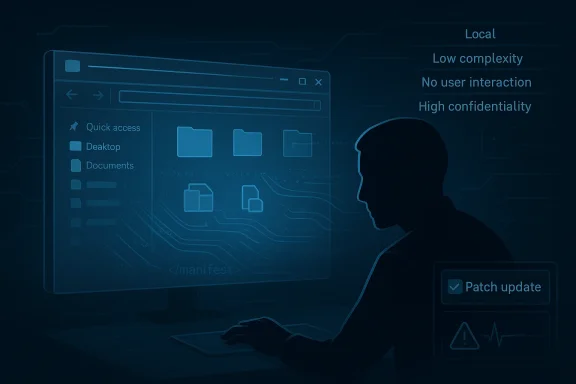
 CVE-2026-32081 and the growing attention on Windows File Explorer information disclosure
Microsoft’s newly published CVE-2026-32081 is another reminder that not every dangerous vulnerability looks dramatic at first glance. In this case, the issue is described as a Package Catalog Information Disclosure Vulnerability affecting Windows File Explorer, with Microsoft’s own language indicating that an authorized attacker could disclose information locally. That combination — local attack surface, low complexity, and a confidentiality-only impact — can tempt organizations to underweight the risk, even though information disclosure bugs often become stepping stones for broader compromise.The public details are still sparse, but the available metadata paints a useful picture. The CVE is scored at 5.5 under CVSS 3.1, with local attack vector, low attack complexity, low privileges required, no user interaction, and high confidentiality impact. In other words, this is not a flashy remote code execution headline, but it is exactly the kind of vulnerability that can matter in real-world environments where local access, post-exploitation discovery, and privilege escalation chains are part of a longer attack campaign.
Overview
Microsoft’s security update guidance now lists CVE-2026-32081 as a fresh entry with a publication timestamp of April 14, 2026. The description is brief, but it is specific enough to establish the core risk: sensitive information can be exposed to an unauthorized actor through Windows File Explorer. The wording suggests a flaw in how Explorer handles package catalog-related data, which may expose details that should remain private on the local system.That matters because Explorer sits in an unusually privileged place in the Windows ecosystem. It is not merely a file browser; it is a major shell component that touches previews, metadata, packaged content, and many other user-facing and system-adjacent workflows. When a shell component leaks information, the result can be more than embarrassment or minor privacy loss. It can reveal credentials, configuration artifacts, file paths, internal package structure, or other clues that help an attacker map the environment.
The current public record also suggests that this issue is, at least for now, a local problem rather than a remote one. That distinction changes how defenders should think about it. A local disclosure bug is often less urgent than a network-exposed flaw, but it can still be highly relevant on endpoints, RDS hosts, developer workstations, and systems where an attacker has already gained some foothold.
Microsoft has not yet published a detailed explainer in the usual public-facing text visible through static crawling, and the Security Update Guide page itself is rendered dynamically. Still, the CVE metadata is enough to indicate that Microsoft has validated the flaw and assigned it a severity classification rather than leaving it as a vague rumor or third-party hypothesis. That is an important confidence signal, especially when evaluating the credibility of technical details.
What the CVE metadata tells us
The available metadata is consistent across the public mirror and Microsoft’s own advisory endpoint. It identifies CWE-200: Exposure of Sensitive Information to an Unauthorized Actor, which is the standard taxonomy for disclosure bugs. The CVSS vector also indicates AV:L/AC:L/PR:L/UI:N/S:U/C:H/I:N/A:N, which is a classic profile for a locally exploitable leak with significant confidentiality impact.- Attack vector: local
- Attack complexity: low
- Privileges required: low
- User interaction: none
- Confidentiality impact: high
- Integrity impact: none
- Availability impact: none
The published date is also significant. A CVE disclosed on the same day it appears in public metadata is usually still early in the lifecycle of understanding, patching, and exploitation assessment. That means defenders should expect the technical picture to evolve as more details surface through patch analysis, vendor notes, or downstream security research.
Why this kind of flaw deserves attention
Information disclosure vulnerabilities often receive less attention than RCEs because they do not immediately hand over the keys to the kingdom. That perception is misleading. Many serious intrusions begin with disclosure, not with direct execution. Attackers need visibility into targets before they can move laterally, harvest secrets, or turn a foothold into persistence.A local disclosure flaw in Explorer can be especially useful in post-compromise scenarios. If an attacker already has a foothold, even a low-privilege one, the ability to enumerate package-related metadata or other sensitive local data can shorten the path to escalation. It can also help attackers locate high-value files, identify software state, or infer what security tools are present.
The fact that Microsoft labeled the issue as requiring an authorized attacker is also worth unpacking. That phrase does not mean the bug is harmless. It usually indicates that exploitation assumes the attacker can already operate on the system in some legitimate or semi-legitimate local context. In practice, that can include a compromised user session, malicious code running under a limited account, or a scenario where an attacker abuses a low-privilege launcher.
Background
Windows File Explorer has long been a rich target for security researchers because it is deeply integrated into the operating system and constantly handles untrusted content. From thumbnails and icon handlers to archive previews and shell extensions, Explorer routinely touches data that can be complex, structured, and easy to mishandle. That makes it fertile ground for both reliability bugs and information leaks.Package-related functionality adds another layer of complexity. Windows increasingly relies on packaging mechanisms, app metadata, and catalog-like structures to manage software distribution, integrity, and user experience. When shell components surface those structures to users, they can inadvertently expose internals that were never intended to be public. Even when the leak is technically “local,” the consequences can stretch far beyond the current session.
Microsoft has also become more transparent in how it publishes vulnerability information. In recent years, the company has expanded structured disclosure through the Security Update Guide, machine-readable CSAF files, and related channels. That broader transparency helps defenders track changes, correlate advisories, and automate response. It also means that early CVE entries like this one can be taken as deliberate signals rather than placeholders.
The other key context is that the security industry has grown more sensitive to the role of enabling vulnerabilities. A flaw that only reveals data can still play a decisive role in a chain that leads to full system compromise. Modern attackers do not always need the first vulnerability to be catastrophic; they need it to be dependable, quiet, and useful.
Why Explorer vulnerabilities recur
Explorer sits at the intersection of usability and security. It has to render rich content, interpret metadata, and present system state in a convenient way. Every feature added for convenience can create an edge case that leaks data, especially when dealing with catalogs, previews, or integration hooks.- Explorer must handle many file and package formats.
- It often loads components that expand attack surface.
- Metadata rendering can expose hidden paths or internal state.
- Shell integration tends to favor usability over minimal exposure.
- Local attackers can exploit mistakes without needing internet exposure.
Why “package catalog” is an interesting clue
The phrase package catalog suggests the vulnerable logic may involve the way Explorer reads or displays package trust information, signing details, or catalog-associated metadata. That does not tell us the precise bug class, but it does hint at a subsystem that likely handles structured records rather than simple files.That is important because structured formats can fail in subtle ways. A parser might reveal information it should redact. A UI component might display a value from an internal catalog. Or a trust-related path might reveal references that would normally stay hidden from low-privilege users.
The public evidence does not yet prove which of those applies. Still, the naming convention itself usually signals where Microsoft believes the weakness lives, and that is often a valuable clue for defenders and researchers alike.
Vulnerability profile
The most striking aspect of CVE-2026-32081 is the mismatch between its modest headline and its meaningful operational implications. A CVSS score of 5.5 sounds middling, but the details show a carefully scoped disclosure issue with strong confidentiality impact. That combination can matter a lot in enterprise environments.The local attack vector means internet exposure is not the main concern. Instead, defenders should think in terms of endpoint compromise, insider abuse, lateral movement, and post-exploitation activity. In many real incidents, the first adversary foothold is already local by the time defenders detect anything.
The no user interaction element is also important. If exploitation does not require a victim click or approval, then the attacker only needs execution context. That lowers the friction of abuse, especially in malware or automated post-exploitation tooling.
What the CVSS score really implies
CVSS is often misunderstood as a ranking of “how bad” a flaw is in the abstract. In practice, it is better viewed as a structured summary of technical characteristics. Here, the score reflects a bug that is neither catastrophic nor trivial: limited in scope, but potentially very useful to an attacker with local code execution or authenticated access.A confidentiality-only bug can still be highly sensitive if it reveals the right data. Exposure of paths, package manifests, or security-relevant catalog information can help an attacker defeat defenses elsewhere. That is why information disclosure vulnerabilities sometimes become quiet force multipliers rather than attention-grabbing standalone events.
Why the “authorized attacker” wording matters
Microsoft’s description says the vulnerability allows an authorized attacker to disclose information locally. That wording implies the system may need an existing local context, such as a signed-in user or a process running with limited access. It does not necessarily imply that the attacker is trusted in any meaningful security sense.This is an important nuance for incident response teams. If an attacker has already achieved local execution, they may be exactly the type of actor who can weaponize a disclosure flaw most effectively. The weakness may not be the initial breach point; it may be the thing that converts a small foothold into a deeper compromise.
How disclosure bugs are used in practice
Attackers rarely stop at the first useful vulnerability. They chain. A disclosure bug can reveal where sensitive data lives, how files are laid out, which software versions are installed, or what security posture a host has. That intelligence can then guide privilege escalation or persistence.- Discover hidden file paths and internal component names.
- Identify software versions and patch status.
- Locate credentials, tokens, or configuration artifacts.
- Map the presence of security controls.
- Support follow-on exploitation with greater precision.
Microsoft’s disclosure model
Microsoft’s modern CVE publishing model is designed to give defenders enough information to prioritize action without unnecessarily arming attackers. The Security Update Guide, CSAF publications, and related advisory channels form a layered disclosure system. That approach is increasingly important in a world where vulnerability intelligence is consumed automatically by tools, not just read by humans.The company has also emphasized structured transparency in recent years. Its move toward machine-readable security data means that a CVE like this one can appear quickly in security tooling, asset inventories, and patch orchestration systems. For enterprise defenders, that can turn an otherwise obscure advisory into an actionable remediation item almost immediately.
At the same time, Microsoft’s public descriptions remain intentionally concise. That is especially true when a vulnerability is newly published, lightly documented, or still under active remediation. The effect is a balancing act: enough detail to support patching, not enough to hand over a step-by-step exploit recipe.
Why the sparse description is normal
Some readers may find the brief wording unsatisfying, but it is not unusual. Microsoft often starts with a short summary and then expands details in later updates, release notes, or ecosystem research. That is particularly common for vulnerabilities that are still being evaluated or that are likely to attract proof-of-concept experimentation.The sparse public description also reflects an important security principle: avoid over-explaining the exact failure mode until customers have had a chance to patch. That is especially prudent when the weakness is in a core shell component that many systems share.
What can be inferred, and what cannot
It is reasonable to infer that the issue involves a trust boundary problem in how Explorer handles package catalog information. It is also reasonable to infer that the leaked data is sensitive enough to justify a high confidentiality rating. But it is not yet safe to infer the exact format, file type, or workflow that triggers disclosure.That distinction matters. Security reporting should be precise about evidence and cautious about speculation. The current public metadata supports a strong operational assessment, but not a full reverse-engineered theory of the bug itself.
The role of the Security Update Guide
Microsoft’s Security Update Guide is the authoritative consumer-facing location for these CVEs, even when the page is rendered dynamically. That means defenders should treat the MSRC entry as the primary source of truth for affected products, patch status, and later revision history.For now, the value of the advisory is mostly in the technical classification rather than the remediation steps. When Microsoft adds affected products, mitigations, or exploitability data, that will sharpen the response guidance considerably.
Enterprise impact
For enterprises, a local information disclosure bug in File Explorer should be understood in the context of endpoint compromise. It is unlikely to be the initial breach vector in a perimeter-only model, but it can absolutely matter once an adversary lands on a machine. That makes it relevant to threat hunting, EDR telemetry, and incident response triage.The strongest concern is that the flaw could reveal information that reduces attacker uncertainty. Enterprises are full of data that looks mundane until a malicious actor needs it: service account names, share paths, package deployment details, internal software inventory, or remnants of administrative activity. If Explorer surfaces that information in an unauthorized way, the attacker benefits immediately.
The second concern is scale. A bug that affects a common Windows shell component can affect large fleets at once. Even if exploitation requires local access, the bug may still be attractive to ransomware operators, internal threat actors, or malware authors who already rely on post-exploitation discovery.
Why defenders should care even without remote exploitation
Security teams sometimes de-prioritize local disclosure bugs because they appear to lack Internet-scale blast radius. That is a mistake. Many enterprise compromises start with a phishing email, stolen session, or malicious attachment that yields local execution. Once that happens, local vulnerabilities become highly relevant.- Malware often runs under the same user context as the victim.
- EDR detections may not trigger on pure information gathering.
- Attackers value stealthy reconnaissance before noisy actions.
- Data disclosure can support credential theft and lateral movement.
- One weak endpoint can become the map for many others.
How this affects security operations
SOC teams should consider whether they already log the artifacts most likely to be affected by a shell disclosure issue. Explorer-related data exposure can be hard to detect if the organization is only looking for obvious malware signatures. Telemetry around suspicious local enumeration, unusual shell behavior, and post-exploitation staging may be more useful.It is also worth reviewing whether administrative workstations, developer endpoints, and jump servers are treated as higher-value targets. Those systems often contain more sensitive package and configuration data than standard user devices, making disclosure more consequential.
Consumer impact
For consumers, the immediate risk is narrower, but not nonexistent. Home users generally face lower adversary sophistication than enterprise targets, yet they also tend to run with less visibility and fewer layered controls. A local disclosure flaw can still expose personal files, cloud sync metadata, app catalogs, or private configuration data.The practical issue is that consumers rarely think in terms of “local attacker.” They think in terms of malware, drive-by compromise, or account takeover. Once any of those occurs, a disclosure vulnerability becomes another tool in the attacker’s hands. That means the bug’s impact depends heavily on the safety of the surrounding system.
Another factor is the role of shared devices. Family PCs, lab computers, and remote-support scenarios create local trust boundaries that are not as clean as people assume. If an untrusted user can run code or access an account, then the disclosure bug may expose more than one person’s data.
Why privacy matters here
The word “information disclosure” can sound abstract, but the effect is often very concrete. If Explorer reveals file paths, package metadata, or local catalog details, that information can expose a user’s habits, installed software, and potentially sensitive documents. Privacy harm is not always about reading the contents of a file; sometimes it is about learning enough context to infer the rest.For consumers, that means patching should still be taken seriously once Microsoft issues corrective updates. Even a vulnerability that does not execute code can undermine confidence in the system’s ability to keep data compartmentalized.
What ordinary users should take from this
The best consumer takeaway is simple: keep Windows updated, especially shell and file-management components. Users do not need to understand the internals of a package catalog to benefit from the fix. They just need to install it once Microsoft ships it.In the meantime, caution is warranted around untrusted software, unknown archives, and shady remote-support tools. Local disclosure bugs are most dangerous when attackers already have a foothold, and consumer footholds often begin with social engineering rather than technical exploitation.
Attack chain potential
The biggest reason to follow CVE-2026-32081 closely is not the leak itself, but the way leaks support chains. An information disclosure bug in a trusted shell component can be a powerful precursor to deeper exploitation. It can tell an attacker where to look next, what tools are installed, and which protections might get in the way.That is especially relevant in a post-compromise workflow. Attackers often start with generic enumeration, then use specific data exposures to tune their next move. If Explorer reveals the wrong bit of package or catalog information, it can save them time, reduce noise, and improve reliability.
It is also possible that the exposed information could assist in bypassing security features indirectly. Even when a vulnerability does not provide code execution, it may reveal internal references that help an attacker craft a more effective follow-on payload. In modern attacks, knowledge is leverage.
Typical ways disclosure bugs get chained
- Initial access is gained through phishing, a stolen token, or a vulnerable app.
- The attacker runs under a limited local context.
- The disclosure bug reveals sensitive system or package data.
- The attacker uses that information to locate secrets or target escalation.
- Persistence or lateral movement follows.
Why catalog-related leaks can be especially valuable
Catalogs often contain trust-related metadata. Even a small leak in that area can tell an attacker how software is signed, what packages are present, or how the system validates content. Those details can inform tampering attempts or guide attackers toward high-value system components.The exact danger depends on the data exposed, which Microsoft has not yet described in full. Still, package and catalog information is rarely irrelevant. Security-sensitive metadata tends to be worth more than it looks at first glance.
What defenders should look for
- Unusual local enumeration activity.
- Explorer spawning unexpected child processes.
- Suspicious access to package- or catalog-related paths.
- Changes in user behavior after a foothold.
- Evidence that an attacker is mapping installed software.
Historical pattern and competitive context
Microsoft is not alone in dealing with information disclosure vulnerabilities, and the broader software industry has seen plenty of examples where a seemingly modest bug later became strategically important. The pattern is consistent: a local leak helps attackers understand the target, then the leak becomes part of a larger chain. That is why defenders increasingly treat confidentiality bugs as operational issues rather than mere curiosities.The competitive context also matters because Windows remains the dominant endpoint platform in enterprise environments. Any flaw in a core shell component has a long tail, simply because the installed base is enormous. That scale means even a relatively narrow vulnerability can attract attention from red teams, exploit developers, and defenders.
Microsoft’s newer transparency mechanisms make this easier to track than it was in the past. Structured CVE publishing, machine-readable advisory formats, and public guidance all help the ecosystem react faster. But transparency also means vulnerabilities become visible sooner, which can accelerate researcher interest and proof-of-concept experimentation.
Why platform ubiquity changes the equation
When a vulnerability affects a niche tool, exploit development is often constrained by low return on investment. When it affects a ubiquitous platform like Windows File Explorer, the economics are different. A bug that helps enumerate secrets on millions of endpoints can be worth serious attention even if it never becomes a headline RCE.That means patch management teams should not dismiss the issue simply because the base score is midrange. The real question is whether the vulnerability can expose valuable data in environments where attackers already have some presence. In many enterprises, the answer is yes.
What this says about Microsoft’s current security posture
The presence of yet another File Explorer disclosure issue does not automatically imply a systemic failure, but it does reinforce a familiar truth: shell components remain security-critical. Microsoft’s challenge is to balance rich user experience with a narrower exposure surface, and that balance is difficult in a platform as old and as widely extended as Windows.The company’s publication of the CVE suggests it is engaging the issue through its normal disclosure and remediation pipeline. That is reassuring, but the next step is equally important: shipping a clear fix and documenting exactly what changed.
Strengths and Opportunities
Microsoft’s handling of CVE-2026-32081 has a few clear strengths. The advisory is public, the classification is explicit, and the CVSS metadata makes the risk easy to triage. For defenders, that clarity is valuable because it allows security teams to slot the issue into existing vulnerability-management workflows without waiting for a vendor press release.More broadly, the case highlights an opportunity for better endpoint hygiene. A disclosure bug is often easiest to exploit after a machine is already compromised, so the best mitigation is not just patching but reducing the chances of that initial foothold. In that sense, this CVE is a reminder that endpoint hardening and vulnerability management are inseparable.
- The CVE is clearly identified and already scored.
- The issue is localized enough to support focused remediation.
- Microsoft’s advisory model helps security teams track changes quickly.
- The flaw highlights the importance of patching shell components.
- It reinforces the value of least-privilege and endpoint isolation.
- It may motivate stronger telemetry around local reconnaissance behavior.
- It creates a chance to review package and catalog exposure across fleets.
Where the situation could improve
The most obvious opportunity is for Microsoft to expand the technical detail once safe to do so. A clearer description of the affected workflow would help defenders and researchers validate exposure. It would also make it easier to assess whether specific deployment patterns are more vulnerable than others.Another opportunity is for security teams to map local disclosure issues more directly into incident response playbooks. Many organizations have mature workflows for RCE, but less structured treatment for leaks. That gap is worth closing.
Risks and Concerns
The largest concern is that a local disclosure flaw may be underestimated because it lacks the drama of remote code execution. That kind of underestimation is dangerous, especially in environments where attackers routinely gain a local foothold before moving laterally. A modest bug in a high-value component can still create major operational risk.A second concern is the likelihood of chaining. Information disclosure vulnerabilities are often not the final goal; they are a tool for discovery and follow-on abuse. If the leaked data includes software state, internal paths, or package-related metadata, it could materially improve an attacker’s next move.
- Local bugs are often ignored until after compromise.
- Disclosure can accelerate credential theft and lateral movement.
- The exact scope of exposed data is still unclear.
- Enterprise endpoints may be more exposed than consumer systems.
- Security teams may not have dedicated telemetry for this class of issue.
- Adversaries can exploit the flaw quietly and without user interaction.
- Package-related data may reveal more than defenders expect.
Why uncertainty is itself a risk
The lack of public technical detail cuts both ways. It means attackers do not yet have a full roadmap, but it also means defenders may not know exactly what to monitor. That uncertainty can slow response, especially if the fix or affected component is subtle.It is also possible that the issue’s real importance will only become obvious after patch diffing or third-party analysis. That lag is normal, but it argues for caution rather than complacency.
The broader security lesson
The broader lesson is that not all high-value vulnerabilities announce themselves with severe scores. Sometimes the bugs that matter most are the ones that quietly erode trust boundaries. A shell component leaking the wrong local data can be the difference between a contained incident and a wider compromise.Looking Ahead
The next milestone will be Microsoft’s follow-up documentation: whether it adds affected versions, mitigation guidance, exploitability context, or revision history. That will help security teams determine whether this is a broad Windows client issue, a narrower Explorer edge case, or a problem tied to a specific package-handling workflow. Until then, defenders should assume the vulnerability is real, local, and potentially useful to an attacker with an existing foothold.The second milestone will be ecosystem analysis. Independent researchers, patch analysts, and threat intelligence teams will likely examine the advisory and any related binaries or release notes for clues. If the bug proves easy to understand or easy to trigger, that increases the chance of proof-of-concept disclosure and opportunistic abuse. If the flaw turns out to be narrowly scoped, the immediate risk may remain constrained, but the patch will still matter.
The third milestone is operational: how quickly organizations ingest the fix once it is available. In practice, the difference between a manageable local disclosure bug and a real incident often comes down to patch velocity, endpoint visibility, and whether an attacker is already present. That is why even a midrange CVSS score should not lull teams into delay.
- Watch for Microsoft’s full affected-product list.
- Track any later change to the CVSS vector or score.
- Review whether Explorer-related telemetry is enabled.
- Prioritize patching on administrative and high-trust endpoints.
- Look for research that explains the exact package-catalog workflow involved.
Source: MSRC Security Update Guide - Microsoft Security Response Center
Last edited:
