

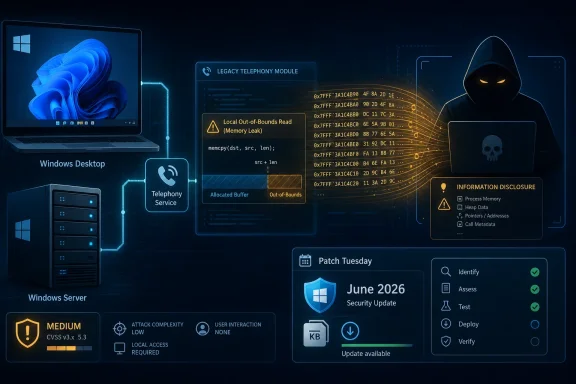
A Medium Score Can Still Tell a Serious Story
The first trap with CVE-2026-42968 is to read the 5.5 CVSS base score and move on. In a Patch Tuesday pile, a medium-numbered information disclosure bug can look like background noise beside remote code execution flaws, privilege escalation chains, and vulnerabilities with active exploitation banners. That reaction is understandable, but it is also how low-drama bugs accumulate into operational blind spots.
Microsoft describes the issue as an out-of-bounds read in Windows Telephony Service that allows an authorized attacker to disclose information locally. That sentence is doing a lot of work. It says the attacker already needs some level of access, the exploit path is local rather than network-based, and the effect is disclosure rather than code execution, tampering, or denial of service.
Yet “information disclosure” is not a synonym for “harmless.” In modern exploitation, memory layout information can help defeat mitigations, stabilize exploit chains, or make a separate vulnerability more reliable. A disclosed local memory address is rarely the whole intrusion; it is more often one rung on the ladder.
That is why the vulnerability’s shape matters more than its headline score. CVE-2026-42968 is not the kind of bug that should trigger panic patching on every unmanaged laptop at midnight. It is the kind of bug that rewards disciplined patch management because it shrinks the set of known primitives available to attackers already operating on a machine.
Microsoft’s Confidence Metric Is the Quiet Signal
The user-supplied passage points to the CVSS Report Confidence metric, and in this case it is the most interesting part of the advisory. Microsoft lists report confidence as confirmed, meaning the vendor acknowledges the vulnerability’s existence or the technical details are sufficiently credible and reproducible. That is a materially different situation from a vague, rumor-driven disclosure where defenders know only that something may be wrong.
The confirmed rating does not mean working exploit code is circulating. Microsoft’s exploitability section says the vulnerability was not publicly disclosed before release, was not known to be exploited, and was assessed as exploitation less likely at original publication. Those three signals should lower the immediate fire-drill temperature.
But confirmation does raise the baseline seriousness. A confirmed vulnerability gives defenders something concrete to remediate, and it gives researchers and attackers a validated target area to examine. Even sparse advisories can become roadmaps when paired with patch diffing, symbol analysis, and the accumulated folk knowledge of Windows internals.
The awkward truth for administrators is that the same public metadata that helps prioritization also helps adversarial triage. A vendor-confirmed CWE-125 out-of-bounds read in a named Windows service is not an exploit recipe. It is, however, enough to tell a capable researcher where to start looking.
Telephony Is Legacy Plumbing That Never Fully Left
The Windows Telephony Service is easy to ignore because the word “telephony” sounds like a museum label from the dial-up era. Many users will never knowingly configure a modem, PBX integration, or telephony-aware application on a modern Windows 11 system. But Windows compatibility has always been a long tail business, and services built for older enterprise assumptions can remain present long after the average user stops thinking about them.
That is the recurring tension in Windows security. Microsoft must support a broad ecosystem of clients, servers, management software, vertical-market applications, and legacy workflows. Attackers, meanwhile, do not care whether a component feels fashionable. They care whether it is present, reachable under useful conditions, and running with access to interesting data.
CVE-2026-42968 affects both client and server SKUs across a wide range of supported Windows releases. The update table spans Windows 10 versions, Windows 11 versions including current and forward-looking branches, and multiple Windows Server generations. That breadth suggests the vulnerable code path is not a niche add-on installed only by a few specialized customers.
For WindowsForum readers, the practical question is not whether you personally use telephony features. The question is whether the vulnerable component exists in your supported Windows estate and whether the official cumulative update that addresses it has reached the machine. In most environments, the answer is handled through normal servicing rather than a special mitigation project.
Local Exploitation Narrows the Threat but Does Not Erase It
Microsoft’s CVSS vector marks the attack vector as local, with low attack complexity, low privileges required, no user interaction, unchanged scope, high confidentiality impact, and no integrity or availability impact. That combination is specific enough to separate this flaw from the breathless end of the vulnerability market. An unauthenticated internet attacker cannot simply fire packets at exposed Windows machines and harvest memory addresses through this CVE.
The required attacker position matters. Local access could mean a user account, a foothold obtained through phishing, a compromised low-privilege process, or some other initial compromise. By the time CVE-2026-42968 becomes useful, something else has likely already gone wrong.
That does not make it irrelevant. Security incidents are rarely single-bug morality plays. They are chains: a macro here, a browser escape there, a weak credential, a local privilege escalation, an information leak that makes the next step more reliable. Defenders patch individual links because they often do not know which chain an attacker will attempt.
The “no user interaction” field is also worth noticing. Once an attacker has the required local privileges, Microsoft’s scoring says exploitation does not depend on convincing another user to click, open, approve, or otherwise participate. That removes one common source of uncertainty and makes the bug more deterministic inside its constrained attack model.
The “low attack complexity” field points in the same direction. It does not say exploitation is trivial or publicly understood, but it does indicate that Microsoft’s model does not require rare environmental conditions. In other words, the local prerequisite is the main brake; once that prerequisite is satisfied, the vulnerability is not scored as unusually finicky.
The Real Disclosure Is an Address, Not a Database
Microsoft’s FAQ says the information that could be disclosed is the local memory address. That is narrower than many users assume when they see “information disclosure.” It does not mean the Telephony Service is handing over documents, passwords, call logs, emails, or domain secrets. It means successful exploitation could reveal address information from local memory.
On paper, that sounds almost anticlimactic. In practice, address leaks have long mattered because modern operating systems rely on memory randomization and related mitigations to make exploitation harder. If an attacker can learn where something lives in memory, a separate memory corruption bug may become easier to weaponize.
This is why information disclosure flaws often live in the shadow of more dramatic vulnerabilities. They are not always the payload; they are the scaffolding. A local memory address leak may not get an attacker administrator rights by itself, but it can reduce uncertainty in the exploit developer’s model of the target.
That distinction should guide patch priority. A standalone information disclosure bug with no exploitation reports should not automatically outrank actively exploited remote code execution. But in environments where attackers are expected to pursue chained exploitation — developer workstations, jump boxes, terminal servers, VDI pools, security tooling hosts, and high-value admin endpoints — memory disclosure deserves more respect than its category label usually receives.
“Exploitation Less Likely” Is a Forecast, Not a Permission Slip
Microsoft’s exploitability assessment is useful, but it is not a guarantee. “Exploitation less likely” is a judgment at the time of original publication, not a permanent property of the vulnerability. It reflects Microsoft’s view of available exploit code, observed exploitation, technical barriers, and likely attacker economics when the advisory was released.
That temporal framing is important. Patch Tuesday advisories enter a public research cycle the moment they are published. Security vendors ingest them, defenders prioritize them, hobbyists catalog them, and attackers compare patched and unpatched binaries. A bug that is obscure on Tuesday can become better understood after days or weeks of analysis.
For CVE-2026-42968, there is no public-disclosure flag and no exploitation-in-the-wild flag in the Microsoft advisory. That should calm the room. It means defenders can route the update through normal testing rings unless their environment has an unusually high exposure to local attacker activity.
Still, “less likely” is not “not useful.” Local information disclosures can become relevant after another vulnerability grants initial access. In an enterprise incident, the attacker is not shopping for the highest CVSS score; the attacker is shopping for whatever advances the chain on the machines they already control.
The Patch Table Says This Is a Servicing Problem, Not a One-Off Fix
One of the most telling parts of the advisory is the affected-product list. Microsoft shipped fixes across Windows Server 2012 and 2012 R2, Windows Server 2016, Windows Server 2019, Windows Server 2022, Windows Server 2025, Windows 10, and Windows 11. Server Core installations are included where applicable, which matters for administrators who assume reduced GUI footprint equals reduced vulnerability footprint.
The KB mapping follows the usual cumulative-update rhythm rather than a bespoke tool. Windows 10 21H2 and 22H2 entries point to the same June 2026 cumulative update family. Windows 11 23H2, 24H2, 25H2, and 26H1 have their own update entries. Server releases likewise receive fixes tied to their servicing branches and build numbers.
That distribution reinforces a practical point: for most organizations, the answer is not to uninstall Telephony Service in a panic or create a special detection rule around this one CVE. The answer is to make sure June 2026 security updates are flowing, installing, and reporting correctly across both clients and servers.
The build numbers also matter because patch compliance dashboards can lie by omission. A machine may say it checked in, or an update may be approved, without actually reaching the fixed build. For administrators who need assurance, the fixed build number is the more useful truth than the presence of a KB in a management console.
The Server Core Lesson Is That Minimal Is Not Magical
Server Core appears repeatedly in the affected list, and that deserves attention. Server Core is a valuable hardening choice because it reduces installed components, removes much of the graphical shell, and cuts down management clutter. But it is not a force field. If a vulnerable service or library remains part of the supported Windows image, Core can still be in scope.
This is a recurring source of complacency in infrastructure conversations. Administrators may correctly prefer minimal installs and then incorrectly assume minimal means immune to whole classes of Windows bugs. CVE-2026-42968 is a reminder that the servicing boundary is not always the same as the visible-feature boundary.
That does not diminish the value of Server Core. Reduced surface area still helps. Fewer components, fewer interactive workflows, and less third-party clutter generally mean fewer ways to trigger bugs. But when Microsoft ships a security update for Server Core, the right response is to treat it as applicable unless there is clear evidence to the contrary.
In mixed estates, the Core entries also complicate prioritization. A GUI server running legacy applications may draw attention because it feels messier. A Server Core domain member hosting infrastructure services may feel cleaner, but it may also be more valuable to an attacker if compromised. Patch policy should follow role and exposure, not aesthetics.
The Acknowledgements Hint at Coordinated Research, Not Chaos
Microsoft credits external researchers in the advisory, including z1r0, Diffract, and wxz. That acknowledgement matters because it places the vulnerability in the coordinated disclosure ecosystem rather than the emergency disclosure economy. The advisory does not read like a scramble to contain public exploit code or active abuse.
Coordinated disclosure is not glamorous, but it is the machinery that keeps routine security maintenance routine. Researchers find a flaw, report it, Microsoft validates it, assigns severity and metrics, ships a fix, and then publishes enough information for customers to act. That process is imperfect, but it is vastly better than defenders learning about a Windows service bug from exploit traffic.
The presence of multiple credited researchers may also suggest independent or collaborative discovery around the same area, though Microsoft’s advisory does not provide enough detail to reconstruct the research path. It would be unwise to overread the acknowledgement field. Still, it reinforces that the vulnerability has been through a formal handling process and is not merely a speculative database entry.
That is where the Report Confidence metric loops back into the story. Confirmation is not hype. It is a statement that the vulnerability is real enough for Microsoft to patch and document. In a world full of inflated vulnerability marketing, that kind of boring certainty is valuable.
Enterprise Risk Lives in the Gaps Between Rings
For home users, the advice is simple: install the June 2026 cumulative update through Windows Update when it is offered, and do not treat this CVE as a standalone crisis. The vulnerability requires local authorized access and is not known to be exploited. A fully patched home PC is the right target state; elaborate workarounds are not.
For enterprises, the story is less about this one bug and more about patch latency. If updates routinely take weeks to reach low-priority workstations, lab machines, VDI pools, kiosks, or forgotten server roles, then confirmed local vulnerabilities become permanent inventory. Attackers love the machines that asset management forgot.
VDI and multi-user systems deserve special scrutiny. Local, low-privilege vulnerabilities are more interesting on systems where many users or sessions share an operating environment, or where a compromised low-privilege account can coexist near higher-value processes. CVE-2026-42968 is not scored as privilege escalation, but memory disclosure on shared infrastructure is still more consequential than memory disclosure on a disposable single-user test box.
Administrative workstations are another category where medium-severity local bugs deserve a shorter patch leash. If an attacker lands on a machine used for privileged administration, anything that improves local exploit reliability is more valuable. The machine’s role changes the risk calculus even when the CVSS score does not.
Security teams should also resist the urge to measure only internet exposure. Because this is a local vulnerability, external scanners will not tell the story. Endpoint inventory, update compliance, EDR telemetry, and identity-aware risk modeling are more relevant than perimeter reachability.
Windows 10’s Long Tail Keeps Showing Up
CVE-2026-42968 lands in a Windows ecosystem still carrying Windows 10 branches alongside Windows 11 and multiple supported server generations. That long tail is not surprising, but it is operationally expensive. Each supported branch has its own update cadence, build numbers, servicing constraints, and failure modes.
The advisory’s Windows 10 entries include older version lines such as 1607 and 1809 as well as 21H2 and 22H2. In many environments, those older branches are not general-purpose consumer desktops; they are enterprise, LTSC, embedded, or server-adjacent realities. They persist because replacing them is harder than patching them.
That is the bargain Microsoft and its customers have made for decades. Windows remains useful in part because old software and old workflows continue to run. The cost is that defenders must keep servicing a wide compatibility surface, including components that may feel obsolete until a CVE reminds everyone they are still alive.
Windows 11 does not make that cost disappear. The advisory includes Windows 11 23H2, 24H2, 25H2, and 26H1 entries, making clear that this is not simply a legacy Windows 10 problem. Modern branches inherit plenty of shared Windows plumbing, and shared plumbing means shared security maintenance.
Patch Tuesday Metadata Is Now Part of the Attack Surface
There is a larger story here about the way vulnerability metadata has matured. Microsoft’s advisory gives defenders CVSS vectors, exploitability assessment, report confidence, weakness classification, affected products, KBs, build numbers, and acknowledgements. That is a lot of structured information, and it is indispensable for modern patch operations.
It is also enough for adversaries to prioritize research. A CWE-125 out-of-bounds read, local attack vector, low privileges, high confidentiality impact, and confirmed report confidence form a concise profile. An attacker still needs the technical work, but the metadata reduces uncertainty about whether the target is worth opening in a disassembler.
This is not an argument for less transparency. Security through obscurity does not scale, and defenders need structured advisories to manage thousands of machines. The better argument is that organizations should assume public advisories start a clock. The more specific the metadata, the more important it is that patch deployment not drift indefinitely.
For defenders, the best use of the metadata is prioritization, not paralysis. CVE-2026-42968 should probably sit below actively exploited remote bugs and above purely theoretical issues affecting software you do not run. Its place in the queue depends on endpoint role, attacker model, and how quickly your normal Windows cumulative update process can absorb it.
The June Telephony Fix Belongs in the Patch Queue, Not the Panic Queue
CVE-2026-42968 is a good test of whether an organization can distinguish urgency from importance. It is not a screaming zero-day, but it is also not a disposable footnote. The right response is calm, timely servicing backed by verification.
- Microsoft released the vulnerability information on June 9, 2026, and classified the issue as Important with a CVSS 3.1 base score of 5.5.
- The vulnerable component is Windows Telephony Service, and Microsoft identifies the root weakness as an out-of-bounds read.
- The attack path is local, requires low privileges, and does not require user interaction once the attacker has the necessary access.
- Microsoft says the vulnerability was not publicly disclosed, was not known to be exploited, and was assessed as exploitation less likely at publication.
- The disclosed information is a local memory address, which is narrow but potentially useful in exploit chaining.
- The fix is delivered through normal Windows security updates across affected Windows client and server releases, including Server Core variants.
The broader lesson is that medium-severity Windows bugs are where security programs prove their maturity. Anyone can react to a critical zero-day with headlines attached. The harder, more valuable work is keeping ordinary confirmed vulnerabilities from becoming durable attacker tools simply because they were not dramatic enough to command attention. CVE-2026-42968 should move through the June 2026 patch cycle with urgency proportional to its role: not a crisis, but a real flaw in shared Windows plumbing that deserves to disappear from managed estates before someone finds a clever way to chain it.