

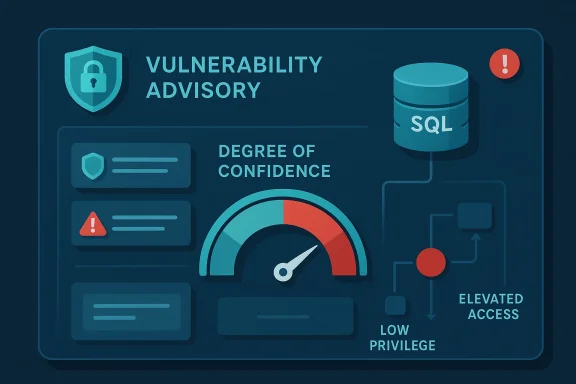
Microsoft’s CVE-2026-32176 advisory is another reminder that in security, metadata can matter almost as much as mechanics. The vulnerability is labeled a SQL Server Elevation of Privilege Vulnerability, but the key field the user quoted is the degree of confidence metric: Microsoft uses it to communicate how certain it is that the bug exists and how credible the technical details are. In practical terms, that means defenders should treat the entry as more than a placeholder; it is a signal about certainty, attacker usefulness, and remediation urgency. Microsoft’s security guidance on confidence is specifically intended to distinguish between merely suspected issues and vulnerabilities with enough technical basis to prioritize immediately.
Microsoft has spent years trying to make its vulnerability records more actionable, and the confidence metric is part of that effort. The company’s Security Update Guide and MSRC ecosystem are not just a catalog of CVEs; they are meant to help organizations decide which flaws are real enough to drive patching, exposure analysis, and incident response. That is especially important for SQL Server, where a local or authenticated privilege escalation can become the pivot point for a full database compromise, lateral movement, or operational disruption.
SQL Server has long been a high-value target because it sits close to the data crown jewels. If an attacker can move from a low-privilege context to a higher one inside the database layer, the impact can extend far beyond the database itself: service accounts, linked servers, data exports, agent jobs, and administrative automation can all become leverage points. Microsoft’s own historical SQL Server advisories show that elevation-of-privilege bugs are recurring and operationally meaningful, not theoretical curiosities.
The public record around CVE-2026-32176 is still thin, and that matters. When Microsoft publishes a CVE with limited detail, the community often receives only the category, the affected product family, and the confidence framing. That does not mean the issue is vague or unimportant; it usually means Microsoft is withholding exploit mechanics while still signaling that the flaw has enough substantiation to be tracked and remediated.
For defenders, that combination is often the most actionable kind of advisory. A vague-but-real SQL Server EoP can be enough for red teams, insider threats, or post-compromise attackers who already have access to a foothold on the host or database tier. In other words, the absence of public proof-of-concept code does not reduce the operational relevance of the issue; if anything, it increases the value of Microsoft’s confidence signal because it helps separate confirmed risk from rumor.
In practice, Microsoft is telling customers whether they are dealing with a confirmed issue, a strongly supported technical finding, or a more tentative advisory record. That distinction matters because security teams rarely have unlimited patch windows, and they need to know whether to move a flaw to the top of the queue. If a CVE is both high impact and high-confidence, it deserves faster treatment than a speculative entry with little evidence.
A high-confidence EoP also changes how teams think about dwell time. Attackers do not need a vulnerability to be publicly weaponized if they can already reach the relevant service or host. A confirmed escalation path inside SQL Server can be chained with credential theft, exposed service accounts, or weak segmentation to turn a small intrusion into an enterprise incident.
That is part of why SQL Server vulnerabilities routinely attract attention from defenders. Microsoft has repeatedly issued SQL Server security updates over the years, including multiple elevation-of-privilege fixes in prior cycles. The historical pattern suggests that privilege boundaries in the product are a recurring attack surface, especially where server-side features, service accounts, or administrative components interact with each other.
This is why local or authenticated bugs can be more urgent than they first appear. A flaw that requires an existing foothold may still be heavily abused once a single low-privileged account has been compromised. That is especially true in environments where shared administrative patterns, legacy service accounts, or weak separation between application and database tiers are common.
That backdrop matters because CVE-2026-32176 is not just a one-off SQL Server item. It is part of a disclosure model where Microsoft increasingly tries to convey both technical risk and information quality. The confidence metric fits neatly into that model: it tells customers not only what the vulnerability class is, but how much trust to place in the record.
The tradeoff is that attackers may also learn enough from the advisory category to focus their own research. That is the tension Microsoft is trying to balance: enough disclosure to let defenders act, but not so much detail that it hands out a ready-made exploit recipe. The confidence metric becomes part of that balancing act because it hints at maturity without over-sharing the mechanics.
Once the inventory exists, the next step is patch validation. Microsoft’s SQL Server update ecosystem can be version-sensitive, and administrators need to confirm they are applying the correct build, branch, and servicing model. That is especially important in mixed estates where older SQL Server versions remain in service alongside newer releases.
If the environment uses service accounts with elevated rights, those permissions should be reviewed in parallel. The best time to reduce blast radius is before an incident, and privilege trimming can turn a potential exploit from catastrophic to merely annoying. That is especially true for SQL Server instances running with broad OS-level access or integrated management privileges.
For consumers, the issue is more indirect. Most home users will never interact with a SQL Server instance directly, but they may still be affected by application software that embeds or depends on SQL Server components. That makes patching important even for people who think they “do not use SQL Server,” because the database engine may be present as part of a larger application stack.
That hidden dependency problem is one reason Microsoft’s confidence metric is useful. If a flaw is real and credible, organizations should not wait for the vendor of the application layer to explain its risk. They should act on the platform advisory itself and then handle compatibility, regression testing, and application-owner communication afterward.
Even without public exploit details, the combination of SQL Server and Elevation of Privilege tells a clear story. It suggests a vulnerability somewhere in the trust boundary, permission model, service interaction, or object-handling logic that governs who gets to do what. Attackers do not need the exact root cause to know where to focus once a patch lands or a new advisory appears.
For that reason, organizations should not wait for threat-intelligence headlines before acting. By the time exploit chatter becomes visible, the patch window may already have narrowed. The better approach is to treat Microsoft’s confidence signal as a standing order to verify exposure and close the hole on the normal remediation schedule—or faster if the environment is especially sensitive.
The broader lesson is that database platforms tend to accumulate high-value interfaces over time. Administration features, compatibility layers, service components, browser-like management surfaces, and automation hooks all increase the attack surface. Each new layer can introduce an opportunity for authorization mistakes, and those mistakes are exactly what attackers can turn into EoP.
That historical pattern is useful because it keeps teams from overfocusing on the novelty of the CVE number. A new identifier may look fresh, but the underlying risk pattern is familiar: authenticated or local access, privilege boundary failure, and a high-value server component. Those ingredients have produced real-world incidents for years, which is why they should still move quickly through change management.
The other question is how much the broader industry will learn from Microsoft’s disclosure model. If confidence metrics continue to appear consistently, they may become as important to defenders as severity scores and CVSS numbers, especially in the gray zone where technical details are partial but the threat is real. That would be a meaningful step toward smarter patch prioritization, provided organizations use the signal to act rather than to procrastinate.
Source: MSRC Security Update Guide - Microsoft Security Response Center
 Overview
Microsoft has spent years trying to make its vulnerability records more actionable, and the confidence metric is part of that effort. The company’s Security Update Guide and MSRC ecosystem are not just a catalog of CVEs; they are meant to help organizations decide which flaws are real enough to drive patching, exposure analysis, and incident response. That is especially important for SQL Server, where a local or authenticated privilege escalation can become the pivot point for a full database compromise, lateral movement, or operational disruption.SQL Server has long been a high-value target because it sits close to the data crown jewels. If an attacker can move from a low-privilege context to a higher one inside the database layer, the impact can extend far beyond the database itself: service accounts, linked servers, data exports, agent jobs, and administrative automation can all become leverage points. Microsoft’s own historical SQL Server advisories show that elevation-of-privilege bugs are recurring and operationally meaningful, not theoretical curiosities.
The public record around CVE-2026-32176 is still thin, and that matters. When Microsoft publishes a CVE with limited detail, the community often receives only the category, the affected product family, and the confidence framing. That does not mean the issue is vague or unimportant; it usually means Microsoft is withholding exploit mechanics while still signaling that the flaw has enough substantiation to be tracked and remediated.
For defenders, that combination is often the most actionable kind of advisory. A vague-but-real SQL Server EoP can be enough for red teams, insider threats, or post-compromise attackers who already have access to a foothold on the host or database tier. In other words, the absence of public proof-of-concept code does not reduce the operational relevance of the issue; if anything, it increases the value of Microsoft’s confidence signal because it helps separate confirmed risk from rumor.
What Microsoft’s confidence metric actually means
The phrase “degree of confidence” is easy to skim past, but it does important work. Microsoft defines it as a measure of how certain the company is that the vulnerability exists and how credible the known technical details are. That means the metric is not the same thing as severity, exploitability, or likely impact; it is a credibility signal layered on top of the usual CVE fields.In practice, Microsoft is telling customers whether they are dealing with a confirmed issue, a strongly supported technical finding, or a more tentative advisory record. That distinction matters because security teams rarely have unlimited patch windows, and they need to know whether to move a flaw to the top of the queue. If a CVE is both high impact and high-confidence, it deserves faster treatment than a speculative entry with little evidence.
Why defenders should care
For SQL Server, confidence becomes more valuable because the platform is often deployed in layered enterprise environments. Administrators may not know exactly where a vulnerable instance sits, what permissions it runs with, or whether it is exposed to internal-only users that are still reachable after a compromise. The advisory’s confidence level helps narrow the question from “is this real?” to “how quickly do we need to respond?”A high-confidence EoP also changes how teams think about dwell time. Attackers do not need a vulnerability to be publicly weaponized if they can already reach the relevant service or host. A confirmed escalation path inside SQL Server can be chained with credential theft, exposed service accounts, or weak segmentation to turn a small intrusion into an enterprise incident.
- Confidence is not severity, but it influences urgency.
- Confidence is not exploitability, but it can hint at how much attackers know.
- Confidence is not proof of in-the-wild abuse, but it can justify faster patching.
- Low public detail does not mean low risk.
- Confirmed advisory records deserve operational attention even before exploitation appears.
Why SQL Server EoP issues are strategically important
Elevation of privilege in SQL Server is one of those classes of bugs that looks narrow on paper but broad in consequence. SQL Server is often used by enterprise applications, line-of-business systems, ERP platforms, reporting engines, and custom internal tools. A privilege boundary failure inside that stack can affect not only the database administrator, but also application service accounts and automation pipelines that were never meant to have expansive rights.That is part of why SQL Server vulnerabilities routinely attract attention from defenders. Microsoft has repeatedly issued SQL Server security updates over the years, including multiple elevation-of-privilege fixes in prior cycles. The historical pattern suggests that privilege boundaries in the product are a recurring attack surface, especially where server-side features, service accounts, or administrative components interact with each other.
Local footholds become enterprise problems
An EoP flaw is rarely the first step in an intrusion. More often, it is the step that turns an initial intrusion into something materially dangerous. If an attacker lands on a server through stolen credentials, a vulnerable web application, or a misconfigured service, then SQL Server privilege escalation can provide the bridge to sensitive data, broader control, or persistence.This is why local or authenticated bugs can be more urgent than they first appear. A flaw that requires an existing foothold may still be heavily abused once a single low-privileged account has been compromised. That is especially true in environments where shared administrative patterns, legacy service accounts, or weak separation between application and database tiers are common.
- Attackers often chain credential theft + EoP.
- SQL Server often sits near high-value data.
- Service accounts can amplify a small intrusion into a broader compromise.
- Privilege escalation bugs are especially dangerous in multi-tier enterprise environments.
- Internal-only exposures are still meaningful once a network foothold exists.
How this advisory fits Microsoft’s broader disclosure strategy
Microsoft has spent the past few years trying to improve transparency in its vulnerability records. In 2024, MSRC said it was adding machine-readable CSAF files to CVE information and described that effort as part of a broader transparency push. The company’s goal was to help customers accelerate CVE response and remediation by making security data more usable across tooling and automation.That backdrop matters because CVE-2026-32176 is not just a one-off SQL Server item. It is part of a disclosure model where Microsoft increasingly tries to convey both technical risk and information quality. The confidence metric fits neatly into that model: it tells customers not only what the vulnerability class is, but how much trust to place in the record.
Why less detail can still be useful
There is a common assumption that fewer public details make an advisory less actionable. In reality, the opposite is often true for enterprise defenders. A confirmed CVE with limited exploit information can still be enough to drive patching, exposure validation, and compensating controls, especially when the affected product is as central as SQL Server.The tradeoff is that attackers may also learn enough from the advisory category to focus their own research. That is the tension Microsoft is trying to balance: enough disclosure to let defenders act, but not so much detail that it hands out a ready-made exploit recipe. The confidence metric becomes part of that balancing act because it hints at maturity without over-sharing the mechanics.
- Microsoft is moving toward more structured CVE data.
- Confidence helps enterprises prioritize automation and triage.
- Limited technical detail can still support effective remediation.
- Public advisories may under-share mechanics for good operational reasons.
- The advisory model is increasingly designed for both humans and tooling.
What defenders should do first
The first response to a SQL Server EoP advisory is not panic; it is inventory. Organizations should identify where SQL Server is deployed, which versions are affected, and whether any instances sit on systems with broader privilege exposure. SQL Server is often spread across production, reporting, development, and test environments, and the hardest failures are the ones buried in “temporary” servers nobody fully owns.Once the inventory exists, the next step is patch validation. Microsoft’s SQL Server update ecosystem can be version-sensitive, and administrators need to confirm they are applying the correct build, branch, and servicing model. That is especially important in mixed estates where older SQL Server versions remain in service alongside newer releases.
Patch strategy and verification
Patching SQL Server should never be treated as a simple “install and forget” event. Database teams should verify the applied update in the instance metadata, test application compatibility, and confirm that maintenance jobs, linked servers, and vendor tools continue to behave correctly. The real-world risk is not only the vulnerability itself; it is also the business disruption caused by rushed patching without validation.If the environment uses service accounts with elevated rights, those permissions should be reviewed in parallel. The best time to reduce blast radius is before an incident, and privilege trimming can turn a potential exploit from catastrophic to merely annoying. That is especially true for SQL Server instances running with broad OS-level access or integrated management privileges.
- Inventory every SQL Server instance.
- Identify version and servicing branch.
- Apply the matching Microsoft update.
- Validate jobs, extensions, and third-party integrations.
- Review service account privileges and role assignments.
- Monitor for unusual post-patch behavior or privilege use.
- Do not assume “one SQL Server patch” fits all.
- Treat service-account review as part of remediation.
- Preserve rollback options for production systems.
- Confirm that backup and restore procedures still work after patching.
- Document which business systems depend on each instance.
Enterprise impact versus consumer impact
The impact of a SQL Server EoP is overwhelmingly enterprise-focused, but that does not make it irrelevant to smaller environments. In business settings, SQL Server typically supports critical applications, authentication workflows, reporting systems, or data warehousing. A successful escalation can therefore affect not just one machine, but entire business processes that depend on database integrity and availability.For consumers, the issue is more indirect. Most home users will never interact with a SQL Server instance directly, but they may still be affected by application software that embeds or depends on SQL Server components. That makes patching important even for people who think they “do not use SQL Server,” because the database engine may be present as part of a larger application stack.
The hidden dependency problem
Enterprise administrators know this pain well: the most business-critical SQL Server instance is often the one embedded in a product nobody wants to touch. Line-of-business software, ERP packages, asset management platforms, and custom internal tools can all carry their own database dependencies. A vulnerability in SQL Server therefore becomes a supply-chain problem inside the enterprise, not just a database-admin issue.That hidden dependency problem is one reason Microsoft’s confidence metric is useful. If a flaw is real and credible, organizations should not wait for the vendor of the application layer to explain its risk. They should act on the platform advisory itself and then handle compatibility, regression testing, and application-owner communication afterward.
- Enterprises must think in terms of systems, not just products.
- Consumers are affected mainly through bundled applications.
- Database compromises often become business-process outages.
- Embedded SQL dependencies create patch coordination headaches.
- Platform advisories should drive immediate triage, not vendor-by-vendor delay.
The attacker’s perspective
Attackers love EoP bugs because they convert access into control. If an attacker can already run code under a low-privilege account on a server that hosts SQL Server, the difference between standard access and elevated access can be the difference between a blocked intrusion and a full compromise. That is why privilege escalation remains one of the most strategically important vulnerability classes in modern Windows and server environments.Even without public exploit details, the combination of SQL Server and Elevation of Privilege tells a clear story. It suggests a vulnerability somewhere in the trust boundary, permission model, service interaction, or object-handling logic that governs who gets to do what. Attackers do not need the exact root cause to know where to focus once a patch lands or a new advisory appears.
Why limited disclosure cuts both ways
Limited disclosure protects defenders from premature exploit recipes, but it also creates a research race. Security researchers, exploit developers, and threat actors all know that a high-confidence advisory in a high-value platform deserves attention. That is especially true when the public record suggests the issue is real but leaves the technical gaps that motivated adversaries want to fill.For that reason, organizations should not wait for threat-intelligence headlines before acting. By the time exploit chatter becomes visible, the patch window may already have narrowed. The better approach is to treat Microsoft’s confidence signal as a standing order to verify exposure and close the hole on the normal remediation schedule—or faster if the environment is especially sensitive.
- Attackers prioritize privilege escalation because it multiplies access.
- SQL Server bugs are attractive because they sit near valuable data.
- Public advisory categories can guide attacker research even without exploits.
- Waiting for proof-of-exploit is often too late.
- Confidence signals can also tell defenders where adversaries are likely to look next.
Historical context: why SQL Server advisories keep recurring
Microsoft SQL Server has a long security history, and elevation-of-privilege fixes are not unusual. Older Microsoft bulletins and support articles show repeated attention to SQL Server-related privilege escalation issues across product generations. That does not mean the product is uniquely flawed; it means the database engine is both complicated and central enough that its security bugs matter whenever they appear.The broader lesson is that database platforms tend to accumulate high-value interfaces over time. Administration features, compatibility layers, service components, browser-like management surfaces, and automation hooks all increase the attack surface. Each new layer can introduce an opportunity for authorization mistakes, and those mistakes are exactly what attackers can turn into EoP.
What history suggests about prioritization
Historical MSRC guidance makes one thing clear: when Microsoft labels a vulnerability as important and frames it as exploitable enough to matter operationally, the safest response is usually prompt remediation. The company has consistently positioned exploitability and confidence as practical decision aids for patch prioritization. CVE-2026-32176 fits that same philosophy, even if the public technical detail is still sparse.That historical pattern is useful because it keeps teams from overfocusing on the novelty of the CVE number. A new identifier may look fresh, but the underlying risk pattern is familiar: authenticated or local access, privilege boundary failure, and a high-value server component. Those ingredients have produced real-world incidents for years, which is why they should still move quickly through change management.
- SQL Server EoP is a recurring security class, not an anomaly.
- Database engines accumulate feature complexity over time.
- Microsoft has long used guidance to help with patch triage.
- The number on the CVE does not change the underlying risk pattern.
- Familiar bug classes still deserve fresh urgency.
Strengths and Opportunities
Microsoft’s confidence metric is genuinely useful because it gives defenders a cleaner way to separate confirmed, actionable issues from weaker signals. For a platform as important as SQL Server, that extra layer of information can make patch queues more intelligent and less noisy. It also improves communication between security teams, DBAs, and business owners who need to understand why a specific update matters now.- Better prioritization across large vulnerability backlogs.
- Clearer distinction between confirmed risk and speculative concern.
- Improved communication between security and database teams.
- Faster remediation for high-value systems.
- More useful automation for vulnerability management platforms.
- Lower chance of missing a real flaw hidden in sparse public detail.
- Stronger alignment with Microsoft’s broader transparency efforts.
Risks and Concerns
The biggest risk is that sparse public detail may lead some teams to underestimate the issue. When a CVE page does not show the whole root cause, people can mistake absence of detail for absence of danger, which is a bad habit in enterprise security. There is also the risk that organizations will delay patching until a third party publishes a more digestible summary, by which time the window for safe action may already have narrowed.- False confidence from limited technical detail.
- Patch delay while waiting for third-party analysis.
- Compatibility risk if updates are rushed without testing.
- Privilege sprawl that makes exploitation easier than expected.
- Hidden SQL dependencies inside other software.
- Operational blind spots in mixed-version estates.
- Attack chaining after an initial foothold.
Looking Ahead
What matters next is not whether CVE-2026-32176 turns into a splashy exploit headline, but whether organizations treat Microsoft’s confidence signal as a decision-making tool. A high-confidence SQL Server EoP is exactly the kind of advisory that should move through inventory, validation, patching, and monitoring with minimal delay. In a modern enterprise, the safest assumption is that any confirmed privilege boundary flaw in a database engine will eventually find a real-world use case.The other question is how much the broader industry will learn from Microsoft’s disclosure model. If confidence metrics continue to appear consistently, they may become as important to defenders as severity scores and CVSS numbers, especially in the gray zone where technical details are partial but the threat is real. That would be a meaningful step toward smarter patch prioritization, provided organizations use the signal to act rather than to procrastinate.
- Inventory all SQL Server instances and owners.
- Verify patch applicability by version and servicing branch.
- Audit service accounts and high-privilege roles.
- Test business-critical integrations after updating.
- Watch for post-patch anomalies and privilege changes.
Source: MSRC Security Update Guide - Microsoft Security Response Center
Last edited:
