

Microsoft has published a new advisory for CVE-2026-33101, identifying it as a Windows Print Spooler elevation-of-privilege vulnerability and assigning the kind of confidence signal that matters most in a live patch cycle: how sure the vendor is that the flaw exists and how much technical detail is actually known. The public record is still thin, but the combination of Microsoft’s advisory entry and the surrounding pattern of Print Spooler issues means defenders should treat it as operationally real, not theoretical. In practical terms, this is another reminder that Print Spooler remains one of Windows’ most enduring attack surfaces, especially for local privilege escalation and post-compromise movement. The risk is less about a flashy exploit narrative and more about the accumulated history of a subsystem that has repeatedly offered attackers a path to higher privilege. int Spooler has long occupied a strange place in Windows security. It is a core service that most organizations cannot simply remove without breaking business workflows, yet it sits close enough to privileged system functions that even small mistakes can become powerful escalation paths. Microsoft’s own history of fixing Spooler flaws goes back years, including classic privilege-escalation issues and high-profile incidents that demonstrated how quickly a printer-facing bug can become a domain-wide problem. That history is why even a sparse advisory is worth attention: the service has earned a presumption of danger.
The advisory for CVE-2026-33101 fits into that long pattern. The issue is described as an elevation of privilege problem, which means the attacker’s goal is not necessarily remote takeover from nowhere, but rather moving from a lower permission context to a more privileged one. That distinction matters because local privilege escalation is often the step that turns a low-grade intrusion into full machine control. In enterprise environments, it can also become a launch point for credential theft, lateral movement, and persistence.
Microsoft’s confidence metric is especially important here. The wording in the user-provided definition underscores that the metric measures the degree of confidence in the existence of the vulnerability and the credibility of the technical details. In other words, the issue is not merely whether a CVE exists, but whether the root cause has been convincingly identified and whether the exploit model is credible enough to guide defenders and attackers alike. That makes the advisory more than a label; it is a signal about the quality of the information ecosystem around the bug.
This is not the first time Windows Print Spooler has been implicated in serious security problems. Public records show a long line of printer-service vulnerabilities, including older elevation-of-privilege cases and widely discussed flaws such as PrintNightmare-era issues that changed how administrators think about print infrastructure. The larger lesson is persistent: any component that bridges user activity, driver handling, service privileges, and network exposure can become a privilege pipeline when a bug lands in the wrong place.
A vulnerability advisory without solid technical confidence is still actionable, but it requires a different kind of operational response. If the vendor has confirmed the issue and provided a patch, defenders can prioritize remediation even when exploit details remain limited. If the bug is only partially understood, the best response is usually to reduce exposure, validate affected builds, and watch for indicators of exploitation rather than waiting for a full technical root cause.
That is exactly why Microsoft’s report-confidence style signaling exists. It gives security teams a way to distinguish confirmed but underexplained problems from speculative reports. In the case of Print Spooler, that distinction matters because organizations often run the service for legitimate business reasons and cannot simply switch it off everywhere. The result is a defensive posture built on trust in the vendor’s confirmation and caution about the unknowns.
For organizations, the practical impact is often bigger than the wording suggests. A low-privilege workstation compromise can become a server breach if the attacker can reuse the same methodology on a more valuable host. On a domain-connected machine, privilege escalation can also unlock the secrets needed for password theft, token abuse, or service-account hijacking. In that sense, a single EoP bug can be a force multiplier for an intrusion.
Historically, Print Spooler issues have been repeatedly attractive to attackers because they can provide a route to system-level execution or privilege escalation. Some flaws were local in nature, others were reachable through network pathways, and some were chained with other weaknesses to produce higher-value intrusions. The most damaging incidents did not just expose an implementation bug; they exposed the operational assumption that printing is low risk. Experience has shown the opposite.
The vendor response pattern is equally revealing. Microsoft typically publishes a formal CVE, a Security Update Guide entry, and servicing updates to address the flaw. Third-party trackers then mirror the advisory with varying degrees of completeness. When those sources line up, defenders get enough confidence to act decisively. When they do not, the advisory itself becomes part of the evidence that must be weighed against incomplete public detail.
That is where CVE-2026-33101 lands: public confirmation exists, but the technical narrative is still limited. This is increasingly common in modern vulnerability disclosure, where vendors may confirm that a bug exists and provide remediation before the underlying exploit research is fully public. For defenders, this is not a reason to delay. It is a reason to treat the patch as the authoritative artifact and the technical details as something to be refined later.
The broader context also includes the security industry’s growing sensitivity to patchability versus exposure. A Windows component like Print Spooler is difficult to retire in enterprise environments because it is embedded in business processes, print servers, and legacy workflows. That means a bug in the service is not just a code defect; it is a governance problem, a compatibility problem, and a risk-management problem all at once. The right response therefore combines patching, exposure reduction, and careful service inventory.
The downside is obvious once a vulnerability lands. A service that processes device interactions, drivers, and job metadata has a broad attack surface, and any memory-safety or authorization mistake can have consequences well beyond the printer queue. That is why Print Spooler vulnerabilities keep returning to the top of patch queues.
For administrators, this is not unusual. It simply means the vendor’s security response is ahead of the public research cycle. In practical terms, the patch exists because the risk is real, and the absence of a deep public write-up should not be mistaken for uncertainty about whether the issue matters.
The third reason is the advisory’s confidence framing. A high-confidence vendor signal tells defenders that Microsoft believes the issue is real and meaningful enough to publish, even if the finer technical details are still restrained. That distinction is especially important for patch triage because organzens of Windows CVEs in a single month and must decide which ones get emergency treatment. This one belongs high on the list precisely because the subsystem is so privileged and so widely deployed.
That is enough for operational response. Even when the root cause is opaque, defenders can still patch, inspect for affected SKUs, and reduce unnecessary exposure. In security work, confirmed impact beats speculative detail when the clock is ticking.
For defenders, the right question is not whether a proof of concept is public. The right question is whether a service that handles privileged operations needs immediate remediation. For CVE-2026-33101, the answer is yes.
Past Microsoft advisories on Print Spooler have shown how a flaw in parsing, permission checks, or impersonation can become a practical path to higher privilege. Public references to older Print Spooler bugs, including Microsoft’s own bulletins and notable incidents, reinforce the point that this subsystem has repeatedly carried outsize risk. The fact that new CVEs continue to land in this area suggests the attack surface is still difficult to fully tame.
Another lesson is that fixes are often evolutionary rather than final. Microsoft can harden one avenue of abuse and still face a new flaw later because the service remains necessary and broad in scope. That means the defender’s job is never finished; it is managed risk, not permanent elimination.
For defenders, that history is a warning not to normalize Spooler risk. The presence of a patchable advisory is an opportunity to reduce exposure before the next campaign decides to probe this path again.
That is why the most important enterprise question is not simply “Is the patch available?” It is “Which machines stible service, and where could a local attacker leverage it fastest?” On laptops, that may mean user-session compromise becoming full machine compromise. On shared servers, it could mean one weak account becoming a foothold for broader administrative abuse.
The operational burden extends beyond patching itself. Administrators must verify which Windows builds, editions, and server roles are affected. They also need to ensure that update management systems, maintenance windows, and downstream testing do not leave print servers exposed for longer than necessary. In larger organizations, those delays are exactly where attackers like to operate.
The result is that a “local” vulnerability is often not local in effect. In a connected enterprise, one machine can become the first domino in a wider intrusion.
The practical difference is that small environments usually have less segmentation and weaker monitoring. That makes post-exploitation activity harder to detect and easier to complete. A local privilege escalation can therefore be especially damaging when no centralized security tooling is present.
Home users are also more likely to postpone patching because printing issues are not seen as urgent. That is a mistake with vulnerabilities like this. When the advisory points at a service that can materially increase attacker privilege, delay becomes exposure.
In that environment, the fastest path to safety is not complex policy engineering. It is timely Windows Update deployment, service inventory, and confirmation that print-related devices are not left in a partially remediated state.
The likely attacker model is familiar: gain a foothold by phishing, exploit another endpoint weakness, or abuse a low-privilege account, then use the Print Spooler bug to cross the privilege boundary. That makes the issue especially relevant in environments with many interactive users or weak local admin hygiene. In other words, the exploit does not need to be internet-facing to be operationally important.
That is why patching these flaws is not just a preventive measure. It also limits blast radius after the first compromise, which is increasingly the reality in modern incident response.
Here the category is clear enough: local privilege escalation in a core Windows service is serious, regardless of the missing exploit narrative.
The second priority is verification. Patching a Print Spooler issue is only useful if the affected systems actually received the right cumulative update and rebooted successfully. A surprising number of enterprises discover after the fact that a “deployed” patch was only staged, deferred, or blocked by local policy. For a vulnerability in a privileged subsystem, that false sense of completion is dangerous.
The longer a privileged Print Spooler host stays unpatched, the more attractive it becomes as a target.
Another thing to watch is whether the advisory ends up mapping to broader servicing changes in later cumulative updates. Microsoft sometimes uses incremental hardening to close adjacent pathways after the initial fix, especially in legacy-rich services like printing. If that happens, administrators may need to re-validate printer behavior after installing the updates.
CVE-2026-33101 is therefore less a surprise than a confirmation of an old truth: the Print Spooler remains one of Windows’ most security-sensitive services, and any confirmed elevation-of-privilege flaw in it deserves immediate attention. If Microsoft’s confidence signal is saying the vulnerability is real, defenders should respond as though the only remaining question is how fast they can remove the exposure. In Windows security, speed of remediation is often the difference between a contained issue and an incident.
Source: MSRC Security Update Guide - Microsoft Security Response Center
The advisory for CVE-2026-33101 fits into that long pattern. The issue is described as an elevation of privilege problem, which means the attacker’s goal is not necessarily remote takeover from nowhere, but rather moving from a lower permission context to a more privileged one. That distinction matters because local privilege escalation is often the step that turns a low-grade intrusion into full machine control. In enterprise environments, it can also become a launch point for credential theft, lateral movement, and persistence.
Microsoft’s confidence metric is especially important here. The wording in the user-provided definition underscores that the metric measures the degree of confidence in the existence of the vulnerability and the credibility of the technical details. In other words, the issue is not merely whether a CVE exists, but whether the root cause has been convincingly identified and whether the exploit model is credible enough to guide defenders and attackers alike. That makes the advisory more than a label; it is a signal about the quality of the information ecosystem around the bug.
This is not the first time Windows Print Spooler has been implicated in serious security problems. Public records show a long line of printer-service vulnerabilities, including older elevation-of-privilege cases and widely discussed flaws such as PrintNightmare-era issues that changed how administrators think about print infrastructure. The larger lesson is persistent: any component that bridges user activity, driver handling, service privileges, and network exposure can become a privilege pipeline when a bug lands in the wrong place.
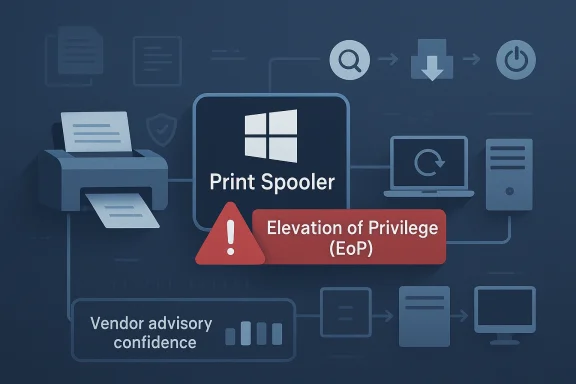 Why the confidence metric matters
A vulnerability advisory without solid technical confidence is still actionable, but it requires a different kind of operational response. If the vendor has confirmed the issue and provided a patch, defenders can prioritize remediation even when exploit details remain limited. If the bug is only partially understood, the best response is usually to reduce exposure, validate affected builds, and watch for indicators of exploitation rather than waiting for a full technical root cause.That is exactly why Microsoft’s report-confidence style signaling exists. It gives security teams a way to distinguish confirmed but underexplained problems from speculative reports. In the case of Print Spooler, that distinction matters because organizations often run the service for legitimate business reasons and cannot simply switch it off everywhere. The result is a defensive posture built on trust in the vendor’s confirmation and caution about the unknowns.
What an EoP flaw means in practice
Elevation of privilege is one of the most operationally dangerous bug classes in Windows. A successful exploit can let a standard user or an already compromised service account become SYSTEM or otherwise gain elevated rights. That is often enough to disable defenses, tamper with security tools, deploy malware, or dump credentials from memory.For organizations, the practical impact is often bigger than the wording suggests. A low-privilege workstation compromise can become a server breach if the attacker can reuse the same methodology on a more valuable host. On a domain-connected machine, privilege escalation can also unlock the secrets needed for password theft, token abuse, or service-account hijacking. In that sense, a single EoP bug can be a force multiplier for an intrusion.
Background
Windows printing is more than a user convenience feature. The Print Spooler service coordinates print jobs, driver interactions, device discovery, and multiple forms of local and remote communication. That operational breadth is also what makes it risky: the service lives at the intersection of user input, kernel-adjacent operations, and vendor-specific driver code. Even when Microsoft hardens one path, the broader ecosystem of print components remains complex and difficult to reason about.Historically, Print Spooler issues have been repeatedly attractive to attackers because they can provide a route to system-level execution or privilege escalation. Some flaws were local in nature, others were reachable through network pathways, and some were chained with other weaknesses to produce higher-value intrusions. The most damaging incidents did not just expose an implementation bug; they exposed the operational assumption that printing is low risk. Experience has shown the opposite.
The vendor response pattern is equally revealing. Microsoft typically publishes a formal CVE, a Security Update Guide entry, and servicing updates to address the flaw. Third-party trackers then mirror the advisory with varying degrees of completeness. When those sources line up, defenders get enough confidence to act decisively. When they do not, the advisory itself becomes part of the evidence that must be weighed against incomplete public detail.
That is where CVE-2026-33101 lands: public confirmation exists, but the technical narrative is still limited. This is increasingly common in modern vulnerability disclosure, where vendors may confirm that a bug exists and provide remediation before the underlying exploit research is fully public. For defenders, this is not a reason to delay. It is a reason to treat the patch as the authoritative artifact and the technical details as something to be refined later.
The broader context also includes the security industry’s growing sensitivity to patchability versus exposure. A Windows component like Print Spooler is difficult to retire in enterprise environments because it is embedded in business processes, print servers, and legacy workflows. That means a bug in the service is not just a code defect; it is a governance problem, a compatibility problem, and a risk-management problem all at once. The right response therefore combines patching, exposure reduction, and careful service inventory.
The long tail of printer-service risk
Printer services continue to matter because they are deeply integrated into Windows and often granted more trust than they deserve. That trust is not accidental. Businesses need printing to work, and printers are often tolerated in security architecture long after better-controlled services would have been segmented or removed.The downside is obvious once a vulnerability lands. A service that processes device interactions, drivers, and job metadata has a broad attack surface, and any memory-safety or authorization mistake can have consequences well beyond the printer queue. That is why Print Spooler vulnerabilities keep returning to the top of patch queues.
Why Microsoft disclosures can be sparse
Microsoft sometimes publishes enough detail to help defenders without handing attackers a recipe. That is especially likely when a flaw is newly discovered, under active review, or potentially exploitable in ways the vendor would rather not spell out. The result can be a CVE page that confirms the issue and its impact while withholding the exact technical mechanics.For administrators, this is not unusual. It simply means the vendor’s security response is ahead of the public research cycle. In practical terms, the patch exists because the risk is real, and the absence of a deep public write-up should not be mistaken for uncertainty about whether the issue matters.
The Vulnerability Signal
CVE-2026-33101 deserves attention first because it is tied to the Print Spooler, one of the most security-sensitive user-facing subsystems in Windows. The second reason is the category: elevation of privilege usually signals a flaw that becomes dangerous after an initial foothold. That may mean local access, a malicious document chain, or a compromised account that can then be pushed upward.The third reason is the advisory’s confidence framing. A high-confidence vendor signal tells defenders that Microsoft believes the issue is real and meaningful enough to publish, even if the finer technical details are still restrained. That distinction is especially important for patch triage because organzens of Windows CVEs in a single month and must decide which ones get emergency treatment. This one belongs high on the list precisely because the subsystem is so privileged and so widely deployed.
What can be inferred safely
We should be careful not to overstate what the public data proves. The advisory label alone does not tell us whether the bug is memory corruption, access-control failure, race condition, or driver interaction issue. It does, however, strongly suggest that the vulnerability is not a mere cosmetic defect. An elevation-of-privilege classification means the bug affects the boundary between unprivileged and privileged code execution.That is enough for operational response. Even when the root cause is opaque, defenders can still patch, inspect for affected SKUs, and reduce unnecessary exposure. In security work, confirmed impact beats speculative detail when the clock is ticking.
Why the label matters for defenders
The term “Print Spooler” tends to trigger well-earned caution across the Windows ecosystem. Administrators remember that vulnerabilities in this area have previously enabled privilege escalation and, in some cases, broader compromise. So even a sparse advisory can cause a significant response because it evokes a credible risk model backed by historical precedent.For defenders, the right question is not whether a proof of concept is public. The right question is whether a service that handles privileged operations needs immediate remediation. For CVE-2026-33101, the answer is yes.
Historical Patterns
Windows printing has been a recurring battleground because it combines legacy compatibility with privileged service behavior. The service must work with a wide range of drivers and devices, and that compatibility pressure creates long-lived complexity. Complexity is not a vulnerability by itself, but it is fertile ground for bugs that become security issues.Past Microsoft advisories on Print Spooler have shown how a flaw in parsing, permission checks, or impersonation can become a practical path to higher privilege. Public references to older Print Spooler bugs, including Microsoft’s own bulletins and notable incidents, reinforce the point that this subsystem has repeatedly carried outsize risk. The fact that new CVEs continue to land in this area suggests the attack surface is still difficult to fully tame.
Lessons from earlier print-service incidents
One of the main lessons from earlier incidents is that privilege boundaries in system services are fragile. When a service bridges user actions and system operations, any missing validation or incorrect impersonation can turn routine functionality into an escalation path. That has made Print Spooler one of the most closely watched services in the Windows platform.Another lesson is that fixes are often evolutionary rather than final. Microsoft can harden one avenue of abuse and still face a new flaw later because the service remains necessary and broad in scope. That means the defender’s job is never finished; it is managed risk, not permanent elimination.
Why old history still matters
Historical vulnerabilities shape attacker expectations. If a subsystem has a record of privilege escalation weaknesses, red teams and threat actors will naturally scrutinize it for similar opportunities. That does not mean every new CVE is exploit-ready, but it does mean the service attracts attention from skilled adversaries.For defenders, that history is a warning not to normalize Spooler risk. The presence of a patchable advisory is an opportunity to reduce exposure before the next campaign decides to probe this path again.
Enterprise Impact
For enterprises, CVE-2026-33101 is not just a workstation patch item. Print infrastructure often reaches into line-of-business workflows, domain authentication, print servers, and remote management paths. If the vulnerability is exploitable locally, an attacker who has already landed on a single endpoint may be able to convert that foothold into SYSTEM-level control and then pivot deeper into the environment.That is why the most important enterprise question is not simply “Is the patch available?” It is “Which machines stible service, and where could a local attacker leverage it fastest?” On laptops, that may mean user-session compromise becoming full machine compromise. On shared servers, it could mean one weak account becoming a foothold for broader administrative abuse.
Operational realities in managed environments
Enterprises rarely have the luxury of turning off printing everywhere. Shared offices, warehouse operations, healthcare deployments, and legacy business applications often depend on it. That creates a familiar risk calculus: keep the service on, but harden everything around it and patch aggressively.The operational burden extends beyond patching itself. Administrators must verify which Windows builds, editions, and server roles are affected. They also need to ensure that update management systems, maintenance windows, and downstream testing do not leave print servers exposed for longer than necessary. In larger organizations, those delays are exactly where attackers like to operate.
Printer services as lateral-movement enablers
A privilege escalation bug in Print Spooler can be especially valuable once an attacker has any code execution on a machine. That code does not have to start as admin. A standard user session, browser compromise, or service account misuse can be enough to begin the chain. From there, privilege escalation can reveal credentials, signed tokens, or cached secrets that accelerate lateral movement.The result is that a “local” vulnerability is often not local in effect. In a connected enterprise, one machine can become the first domino in a wider intrusion.
Consumer and Small-Business Impact
Consumers and small businesses often underestimate printer-related vulnerabilities because printing feels mundane and non-critical. But home office PCs, small-business workstations, and lightly managed servers can still expose the same Windows service pathways that larger enterprises worry about. For these users, a Print Spooler flaw can be the difference between a nuisance compromise and full device takeover.The practical difference is that small environments usually have less segmentation and weaker monitoring. That makes post-exploitation activity harder to detect and easier to complete. A local privilege escalation can therefore be especially damaging when no centralized security tooling is present.
Why consumer users should care
Many consumer machines are used for banking, identity, and personal document storage. If malware gains administrator-level control through a Windows service vulnerability, the attacker does not just get a printer problem; they get access to the rest of the system. That can include browser profiles, password managers, cloud session tokens, and locally stored files.Home users are also more likely to postpone patching because printing issues are not seen as urgent. That is a mistake with vulnerabilities like this. When the advisory points at a service that can materially increase attacker privilege, delay becomes exposure.
Small-business consequences
Small businesses often rely on a handful of Windows PCs that do multiple jobs. The owner’s workstation may also serve as an accounting machine, a print station, and a remote management node. A single unpatched elevation bug therefore has a disproportionate blast radius.In that environment, the fastest path to safety is not complex policy engineering. It is timely Windows Update deployment, service inventory, and confirmation that print-related devices are not left in a partially remediated state.
Attack Surface and Exploitation Considerations
Because the se, it is wise to avoid pretending we know the exact exploit primitive. What we do know is enough to reason about likely attacker value. A vulnerability in Print Spooler that leads to elevation of privilege is attractive because the service is deeply embedded and widely present, and because privilege escalation is one of the most reusable post-compromise steps.The likely attacker model is familiar: gain a foothold by phishing, exploit another endpoint weakness, or abuse a low-privilege account, then use the Print Spooler bug to cross the privilege boundary. That makes the issue especially relevant in environments with many interactive users or weak local admin hygiene. In other words, the exploit does not need to be internet-facing to be operationally important.
Likely preconditions
A local privilege escalation usually requires an attacker to already have some level of code execution or authorized access on the target. That can be a standard user account, an RDP foothold, a service context, or a compromised application running with user rights. Once inside, an EoP bug can be the step that converts access into control.That is why patching these flaws is not just a preventive measure. It also limits blast radius after the first compromise, which is increasingly the reality in modern incident response.
Why exploit details are often withheld
Vendors frequently limit early detail on underexplored bugs to reduce immediate abuse. That can frustrate analysts, but it also helps prevent rushed exploitation before customers have a realistic chance to patch. For defenders, the answer is not to wait for public proof. It is to assume the worst reasonable case within the given category.Here the category is clear enough: local privilege escalation in a core Windows service is serious, regardless of the missing exploit narrative.
Patch Management Priorities
The first priority is straightforward: apply the Microsoft update associated with CVas it is approved for your environment. Because the advisory is tied to a core service and framed as a privilege escalation issue, it should be treated as a high-priority patch rather than a routine monthly item. If your organization uses ring-based deployment, this is the kind of flaw that warrants a fast pilot and a rapid general rollout.The second priority is verification. Patching a Print Spooler issue is only useful if the affected systems actually received the right cumulative update and rebooted successfully. A surprising number of enterprises discover after the fact that a “deployed” patch was only staged, deferred, or blocked by local policy. For a vulnerability in a privileged subsystem, that false sense of completion is dangerous.
A practical response sequence
- Identify all Windows endpoints and servers with Print Spooler enabled.
- Map each system to the applicable Microsoft update package.
- Test the patch on a small but representative ring.
- Deploy quickly to production systems, prioritizing high-value hosts.
- Confirm reboot and post-update health, especially on print servers.
- Watch for help-desk reports that may indicate print regressions.
- Review local admin exposure in case the vulnerability is chained with other weaknesses.
Why print-server validation is non-negotiable
Print servers are often business-critical, which means administrators sometimes hesitate to patch them aggressively. That caution is understandable but must be balanced against the security value of privileged print infrastructure. The right strategy is to validate, patch, and then confirm service functionality rather than leaving vulnerable systems online because they are inconvenient to touch.The longer a privileged Print Spooler host stays unpatched, the more attractive it becomes as a target.
Strengths and Opportunities
Microsoft’s disclosure model gives defenders one important advantage: the vendor has already acknowledged the issue and tied it to a concrete remediation path. Even when technical detail is limited, that confirmation allows security teams to move with purpose rather than speculation. The advisory also reinforces a broader opportunity to revisit print-service exposure as a security control issue, not just an IT support issue.- Clear vendor acknowledgment lets teams prioritize the bug without waiting for third-party confirmation.
- High-value subsystem context makes the patch easy to rank above low-impact cosmetic fixes.
- Patchable by design means most organizations can reduce risk through existing Windows servicing processes.
- Good fit for ring deployment because the issue is serious enough to accelerate rollout but still manageable with testing.
- Opportunity to inventory print infrastructure and discover forgotten or overexposed services.
- Chance to harden local privilege boundaries across the fleet, not just on the affected service.
- Useful reminder for leadership that Windows security is often won or lost on core system components, not edge-case apps.
Risks and Concerns
The biggest concern is the familiar one: Print Spooler remains deeply embedded in environments that depend on it, which makes complete exposure elimination unrealistic. That means organizations will often rely on patching alone, and patching gaps are where trouble begins. The second concern is that a sparse advisory can lull teams into underestimating the seriousness of a confirmed EoP issue because there is no public exploit narrative to dramatize it.- Broad installed base increases the number of exposed machines.
- Local privilege escalation makes any foothold more dangerous.
- Sparse public detail can create a false sense of uncertainty.
- Legacy print dependencies make service reduction difficult.
- Patch delays are common on critical infrastructure like print servers.
- Lateral movement potential turns a single host issue into an enterprise issue.
- Human factors matter because users often ignore printer-related security alerts until after an incident.
What to Watch Next
The next phase will likely be about confirmation rather than invention. Defenders should watch for Microsoft to refine the advisory, for third-party trackers to mirror any additional technical detail, and for any sign that the issue is being paired with a chain or exploit proof in the wild. If exploitability information appears, the urgency will rise again, but the patch priority is already high enough to act on now.Another thing to watch is whether the advisory ends up mapping to broader servicing changes in later cumulative updates. Microsoft sometimes uses incremental hardening to close adjacent pathways after the initial fix, especially in legacy-rich services like printing. If that happens, administrators may need to re-validate printer behavior after installing the updates.
Key signals to monitor
- Updated Microsoft advisory text or severity metadata.
- Third-party vulnerability databases adding technical specifics.
- Evidence of exploitation in security community reporting.
- Follow-on patches that reference related print components.
- Help-desk spikes tied to printer failures after deployment.
- Endpoint detection alerts involving unusual Spooler activity.
- Changes in enterprise baseline guidance for disabling or restricting the service.
CVE-2026-33101 is therefore less a surprise than a confirmation of an old truth: the Print Spooler remains one of Windows’ most security-sensitive services, and any confirmed elevation-of-privilege flaw in it deserves immediate attention. If Microsoft’s confidence signal is saying the vulnerability is real, defenders should respond as though the only remaining question is how fast they can remove the exposure. In Windows security, speed of remediation is often the difference between a contained issue and an incident.
Source: MSRC Security Update Guide - Microsoft Security Response Center
