

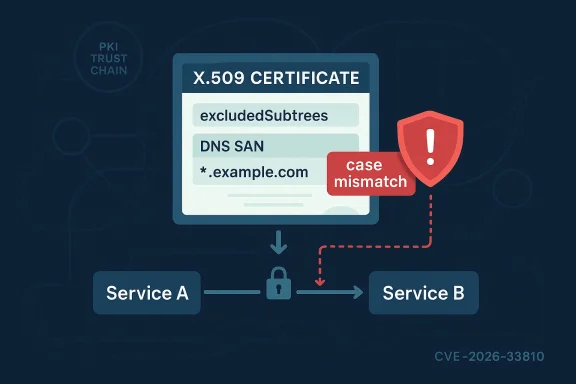
Microsoft’s latest security disclosure around CVE-2026-33810 is the kind of flaw that sounds narrow on paper but can have outsized consequences in real deployments. According to the update guide entry, the issue is a case-sensitive excludedSubtrees name-constraint bypass in crypto/x509, allowing an attacker to slip past certificate-based restrictions and potentially authenticate where they should not. That makes this a particularly important bug for organizations that rely on PKI trust chains, internal mTLS, or any workflow where certificate policy is used as an access gate. The danger is not just theoretical: name-constraint handling is one of those corners of certificate validation where small parsing mismatches can turn into big authorization failures.
The modern certificate ecosystem depends on more than signatures and expiration dates. In enterprise environments, X.509 validation often carries additional policy logic, including name constraints, subject alternative names, and issuing CA restrictions that determine whether a certificate is usable for a given identity or service. The purpose of those controls is straightforward: even if a certificate is technically valid, it should still be rejected if it falls outside an allowed namespace.
That is exactly why name-constraint bugs matter so much. A flaw in this layer does not merely produce a validation quirk; it can undermine the trust boundary that an entire authentication design assumes is reliable. Microsoft has previously highlighted how errors in name-constraint processing can cause dangerous behavior in certificate verification, including cases where validation logic accepts paths it should reject or rejects paths it should accept.
The new CVE entry, CVE-2026-33810, points to a bypass triggered by the handling of excludedSubtrees constraints when comparing names in a case-sensitive way. The phrasing matters. In PKI, constraints are supposed to be enforced against the canonical identity being checked, not the accidental casing of a specific field representation. If enforcement depends on whether one side says
Microsoft’s Security Update Guide has become the company’s central public channel for these disclosures, and the broader MSRC guidance ecosystem is designed to give customers a single place to track CVEs, advisories, and response actions. The Security Update Guide now serves as the authoritative source for these kinds of issues, while MSRC blogs and advisories provide additional context when the vulnerability does not fit neatly into the standard CVE format.
This vulnerability also lands in a security landscape where certificate validation bugs are once again a recurring theme rather than an isolated event. Over the past several years, the industry has repeatedly seen that edge cases in cryptographic libraries can produce memory corruption, denial of service, or logic bypasses, especially in code paths that deal with parsing, wildcard matching, and policy enforcement. The lesson is old but still underappreciated: cryptography is only as strong as the rules used to decide what counts as trustworthy.
That matters because certificate validation logic should normalize identities consistently before applying trust policy. DNS names are frequently treated in a case-insensitive manner in protocol and certificate contexts, so enforcement that relies on the exact letter case of a SAN or subtree entry can create an opening. In practical terms, an attacker may be able to present a certificate chain that should have been blocked by an excluded namespace but instead passes validation because the matching logic fails to compare the names in a consistent form. That is not a subtle bug for defenders; it is a policy failure.
The excludedSubtrees field is particularly sensitive because it acts like a denylist for certain namespaces. If an application says “do not trust certificates for this subtree,” then the verifier must be ruthless and exact in applying that restriction. A bypass here does not merely weaken defense in depth; it can invalidate the entire identity policy the system was built on.
The wildcard angle makes the issue even more concerning. Third-party descriptions indicate that the bypass shows up when a certificate chain contains excluded DNS constraints and wildcard SANs that differ in case from the constraint. That combination creates a nasty edge case because wildcard handling already broadens the scope of a certificate, and a matching bug can allow a broader identity to sneak past a rule that was meant to exclude it.
Key takeaways:
What makes CVE-2026-33810 especially significant is that it sounds like an authorization bug disguised as a parsing bug. That distinction matters because many organizations assume certificate problems are only exploitable in edge cases involving public CAs or malformed inputs. In fact, internal PKI environments can be just as exposed if they rely on strict subtree restrictions to separate services, tenants, or environments.
This is why certificate policy bugs often have broader blast radius than their CVSS summary suggests. An exploit may require a crafted certificate chain, but once that chain is accepted, the result can be elevated access, impersonation, or lateral movement. That is why defenders should treat auth-bypass certificate issues as identity infrastructure incidents, not just library patch notes.
The lesson from those earlier incidents is that policy logic is the attack surface. Developers often focus on key lengths, algorithms, or protocol versions, but the real fragility can live in the comparison rules, normalization behavior, and interpretation of extensions. A library can use industry-standard algorithms and still be vulnerable if it interprets identity metadata too loosely or too literally.
Another reason this category is recurring is that certificate data is messy. DNS names, wildcard labels, email names, distinguished names, and URI constraints each have their own handling rules. When different components in the stack normalize data differently, tiny inconsistencies can become exploitable behavior. That is one of the enduring costs of PKI’s long history: the rules are standardized, but implementations still have to get thousands of edge cases right.
For CVE-2026-33810, the reported failure centers on excludedSubtrees not being applied correctly when the wildcard DNS SAN differs in case from the constraint. That suggests the validator is comparing data in a way that fails to account for normalization. In security terms, the problem is not just that the comparison is wrong; it is that the comparison happens at a layer where correctness is a trust requirement.
This is especially dangerous in environments where certificate issuance is automated. DevOps systems frequently generate, renew, and distribute certificates at scale, which means a vulnerable chain can spread quickly if the same template or issuer logic is reused widely. The bug may be in the verifier, but the operational impact is distributed.
For administrators, the practical value of this model is speed and consistency. A centralized disclosure system reduces the chance that a critical auth-bypass bug is missed because it was mentioned in a blog post, a guide page, or an advisory update rather than in a patch note. In a world where patch windows are short and environments are sprawling, consolidation is not a cosmetic improvement; it is an operational necessity.
This is also where Microsoft’s ongoing emphasis on transparency helps. The more clearly a vendor identifies the affected mechanism, the easier it becomes for defenders to map the flaw to real dependency graphs. If a team can trace which workloads use vulnerable libraries, they can prioritize patches before attackers exploit the issue.
For consumer systems, the exposure depends on whether the vulnerable code path is present in software that ordinary users run. But in the enterprise, the more important question is whether a certificate accepted by one service can be used to impersonate another. That makes the issue relevant to identity platforms, management planes, internal APIs, and sensitive admin interfaces.
For developers, the key point is that certificate validation is not a passive dependency. You cannot simply call a library and assume all relevant policy is safely handled forever. When a bug affects the validation layer, the safest response is to update the runtime, rebuild where necessary, and verify that any custom certificate logic is not reintroducing the same weakness in application code.
That pattern suggests two things. First, the Go ecosystem remains a major target surface because so much cloud-native and service-side software depends on it. Second, certificate validation logic continues to be fertile ground for security defects because the rules are subtle and easy to implement incorrectly. The code may be small; the consequences are not.
Teams operating service meshes, internal gateways, or mTLS-heavy architectures should especially care. Those environments make heavy use of certificates, sometimes in ways that operators only partially understand. If a name-constraint bypass can slide through one of those layers, the resulting access may look legitimate to every component downstream.
The second step is to patch vendor-provided runtimes and rebuild affected applications where necessary. In many organizations, the runtime update and the application rollout are separate processes, which means a fix may not reach production automatically. That lag is where attackers often win. If the vulnerable logic lives in a statically linked service binary or an embedded runtime, the fix is not complete until the binary itself is updated.
There is also an opportunity here to harden trust infrastructure more broadly rather than just patching a single library. Organizations can use the incident to audit name-constraint usage, test wildcard handling, and reduce hidden assumptions in PKI policy.
Another risk is patch lag. Go-based services are often deployed in containerized environments with separate build and release schedules, which means the vulnerable runtime can linger long after a fix exists. If patching is not tied to inventory, the exposure window can remain open for weeks.
Security teams should also expect follow-on analysis from the wider community. As more researchers test edge cases around wildcard SANs and name-constraint normalization, additional implementation quirks may surface. That is not unusual after a logic-bypass CVE; the first fix often reveals adjacent assumptions that deserve attention.
In the end, CVE-2026-33810 is a classic example of how a small comparison mistake can become a security boundary failure. The patch may be narrow, but the lesson is broad: when the system’s trust decisions depend on exact certificate semantics, every normalization rule matters, and every exception can become an attack path.
Source: MSRC Security Update Guide - Microsoft Security Response Center
 Background
The modern certificate ecosystem depends on more than signatures and expiration dates. In enterprise environments, X.509 validation often carries additional policy logic, including name constraints, subject alternative names, and issuing CA restrictions that determine whether a certificate is usable for a given identity or service. The purpose of those controls is straightforward: even if a certificate is technically valid, it should still be rejected if it falls outside an allowed namespace.That is exactly why name-constraint bugs matter so much. A flaw in this layer does not merely produce a validation quirk; it can undermine the trust boundary that an entire authentication design assumes is reliable. Microsoft has previously highlighted how errors in name-constraint processing can cause dangerous behavior in certificate verification, including cases where validation logic accepts paths it should reject or rejects paths it should accept.
The new CVE entry, CVE-2026-33810, points to a bypass triggered by the handling of excludedSubtrees constraints when comparing names in a case-sensitive way. The phrasing matters. In PKI, constraints are supposed to be enforced against the canonical identity being checked, not the accidental casing of a specific field representation. If enforcement depends on whether one side says
DNS:Example.com and another says dns:example.com, the verification layer can end up treating equivalent identity information as different objects. That is exactly the sort of mismatch attackers love.Microsoft’s Security Update Guide has become the company’s central public channel for these disclosures, and the broader MSRC guidance ecosystem is designed to give customers a single place to track CVEs, advisories, and response actions. The Security Update Guide now serves as the authoritative source for these kinds of issues, while MSRC blogs and advisories provide additional context when the vulnerability does not fit neatly into the standard CVE format.
This vulnerability also lands in a security landscape where certificate validation bugs are once again a recurring theme rather than an isolated event. Over the past several years, the industry has repeatedly seen that edge cases in cryptographic libraries can produce memory corruption, denial of service, or logic bypasses, especially in code paths that deal with parsing, wildcard matching, and policy enforcement. The lesson is old but still underappreciated: cryptography is only as strong as the rules used to decide what counts as trustworthy.
What CVE-2026-33810 Appears to Do
At a high level, the bug is described as a certificate authentication bypass affectingcrypto/x509. The core issue is that excluded DNS constraints are not correctly enforced against wildcard DNS SANs when the case of the name differs from the constraint. Multiple third-party vulnerability entries echo that same mechanism, describing the issue as a case-sensitive mismatch in excludedSubtrees processing.That matters because certificate validation logic should normalize identities consistently before applying trust policy. DNS names are frequently treated in a case-insensitive manner in protocol and certificate contexts, so enforcement that relies on the exact letter case of a SAN or subtree entry can create an opening. In practical terms, an attacker may be able to present a certificate chain that should have been blocked by an excluded namespace but instead passes validation because the matching logic fails to compare the names in a consistent form. That is not a subtle bug for defenders; it is a policy failure.
Why name-constraint logic is so delicate
Name constraints are designed to define what a CA may and may not issue. The RFC 5280 framework explicitly warns that improper matching can result in invalid certification paths being accepted or valid ones being rejected. That warning exists for a reason: name matching spans multiple representations, multiple name forms, and multiple normalization rules.The excludedSubtrees field is particularly sensitive because it acts like a denylist for certain namespaces. If an application says “do not trust certificates for this subtree,” then the verifier must be ruthless and exact in applying that restriction. A bypass here does not merely weaken defense in depth; it can invalidate the entire identity policy the system was built on.
The wildcard angle makes the issue even more concerning. Third-party descriptions indicate that the bypass shows up when a certificate chain contains excluded DNS constraints and wildcard SANs that differ in case from the constraint. That combination creates a nasty edge case because wildcard handling already broadens the scope of a certificate, and a matching bug can allow a broader identity to sneak past a rule that was meant to exclude it.
Key takeaways:
- The flaw sits in verification logic, not in cipher strength.
- The bypass is about policy enforcement, not broken signatures.
- Wildcard DNS SANs make the situation more dangerous.
- Case handling is the likely trigger for the mismatch.
- The bug can undermine authentication and trust decisions.
Why This Is a Security Boundary Failure
Certificate validation is often treated as a binary outcome: valid or invalid. In reality, the chain-building process is a sequence of conditional checks, each of which may be policy-sensitive. A flaw in any one of those checks can be enough to turn a rejected certificate into an accepted one, and when that check sits in the trust layer, the result is often auth bypass rather than a simple crash.What makes CVE-2026-33810 especially significant is that it sounds like an authorization bug disguised as a parsing bug. That distinction matters because many organizations assume certificate problems are only exploitable in edge cases involving public CAs or malformed inputs. In fact, internal PKI environments can be just as exposed if they rely on strict subtree restrictions to separate services, tenants, or environments.
Where the risk lands in real systems
A name-constraint bypass can affect systems that use certificates to enforce:- service-to-service identity in mTLS,
- internal administrative access,
- tenant partitioning in multi-service infrastructure,
- VPN or zero-trust identity gates,
- application-layer mutual authentication.
This is why certificate policy bugs often have broader blast radius than their CVSS summary suggests. An exploit may require a crafted certificate chain, but once that chain is accepted, the result can be elevated access, impersonation, or lateral movement. That is why defenders should treat auth-bypass certificate issues as identity infrastructure incidents, not just library patch notes.
Historical Context: A Familiar Pattern in Crypto Libraries
The software industry has seen a steady drumbeat of certificate-validation problems across languages and libraries, and Go’scrypto/x509 package is no exception. Earlier Go and OpenSSL issues have repeatedly shown that implementation details in certificate handling can produce high-impact security failures even when the underlying cryptographic primitives remain sound. Microsoft itself noted in 2022 that OpenSSL name-constraint checking problems could lead to denial of service during X.509 validation, underscoring how dangerous this corner of the stack can be.The lesson from those earlier incidents is that policy logic is the attack surface. Developers often focus on key lengths, algorithms, or protocol versions, but the real fragility can live in the comparison rules, normalization behavior, and interpretation of extensions. A library can use industry-standard algorithms and still be vulnerable if it interprets identity metadata too loosely or too literally.
Why this bug feels different from a crash
Some crypto bugs are noisy. They crash services, trigger obvious errors, or produce immediate operational symptoms. Auth-bypass issues are quieter. The application keeps running, certificates still verify, and administrators may never notice that the trust boundary has been weakened until an attacker uses it. That makes these defects especially dangerous in compliance-heavy environments that assume PKI validation is either working or failing visibly.Another reason this category is recurring is that certificate data is messy. DNS names, wildcard labels, email names, distinguished names, and URI constraints each have their own handling rules. When different components in the stack normalize data differently, tiny inconsistencies can become exploitable behavior. That is one of the enduring costs of PKI’s long history: the rules are standardized, but implementations still have to get thousands of edge cases right.
A broader industry warning
The pattern here is not unique to Microsoft, Go, or OpenSSL. It reflects a larger truth about security engineering: edge-case validation logic is often the last place teams expect attackers to look and the first place attackers can profit. When a system’s trust model depends on a specific interpretation of a certificate extension, any mismatch between the spec and the code can become a bypass vector.The Role of Case Sensitivity
Case sensitivity sounds mundane, but in security it often decides whether a check is meaningful. If one side of a comparison treats DNS names as case-insensitive and the other side does not, then two strings that should represent the same identity may be handled differently. That is the sort of mismatch that can silently defeat exclusion logic.For CVE-2026-33810, the reported failure centers on excludedSubtrees not being applied correctly when the wildcard DNS SAN differs in case from the constraint. That suggests the validator is comparing data in a way that fails to account for normalization. In security terms, the problem is not just that the comparison is wrong; it is that the comparison happens at a layer where correctness is a trust requirement.
Why wildcard SANs magnify the problem
Wildcard SANs already make trust decisions broader. A certificate for*.example.com can cover many hostnames, which is useful for infrastructure but risky if name-constraint enforcement is incomplete. If excludedSubtrees is meant to block a class of names, a case-sensitive mismatch can create a hidden bypass around a rule that should have been absolute.This is especially dangerous in environments where certificate issuance is automated. DevOps systems frequently generate, renew, and distribute certificates at scale, which means a vulnerable chain can spread quickly if the same template or issuer logic is reused widely. The bug may be in the verifier, but the operational impact is distributed.
What defenders should remember
- Treat case handling as a security control, not a formatting detail.
- Assume wildcard SAN logic increases the impact of any matching flaw.
- Review whether your PKI tools normalize names consistently.
- Test certificate chains with edge-case casing in lab conditions.
- Do not assume internal-only PKI paths are inherently safe.
Microsoft’s Disclosure Model and Why It Matters
Microsoft’s Security Update Guide has evolved into a much more structured channel for tracking vulnerabilities and security advisories. That matters because customers need more than a one-line CVE summary; they need a reliable mechanism to see what changed, what was fixed, and which products are affected. Microsoft has also been increasingly explicit about publishing CVE data, advisories, and machine-readable formats to help teams automate response workflows.For administrators, the practical value of this model is speed and consistency. A centralized disclosure system reduces the chance that a critical auth-bypass bug is missed because it was mentioned in a blog post, a guide page, or an advisory update rather than in a patch note. In a world where patch windows are short and environments are sprawling, consolidation is not a cosmetic improvement; it is an operational necessity.
The implications for enterprise security teams
Enterprise teams should read a CVE like this as a signal to review any infrastructure that relies on certificate policy enforcement in the trust chain. That includes custom services built on Go, but also adjacent systems that consume certificates or front-end Go-based authentication gateways. Even if a service is not directly exposed to the internet, a bypass in an internal identity plane can still enable privilege escalation or lateral movement.This is also where Microsoft’s ongoing emphasis on transparency helps. The more clearly a vendor identifies the affected mechanism, the easier it becomes for defenders to map the flaw to real dependency graphs. If a team can trace which workloads use vulnerable libraries, they can prioritize patches before attackers exploit the issue.
Enterprise Impact
The enterprise impact of CVE-2026-33810 is likely to be stronger than the consumer impact, because large organizations are the ones most likely to rely on certificate policy as a core access mechanism. Enterprises often use certificate constraints to separate production from staging, isolate privileged services, or enforce client identity in zero-trust and internal-service scenarios. A bypass in that layer can allow access that should never have been granted.For consumer systems, the exposure depends on whether the vulnerable code path is present in software that ordinary users run. But in the enterprise, the more important question is whether a certificate accepted by one service can be used to impersonate another. That makes the issue relevant to identity platforms, management planes, internal APIs, and sensitive admin interfaces.
Practical enterprise consequences
A successful exploit could potentially:- bypass a restricted CA namespace,
- impersonate a service or user under certain trust models,
- weaken tenant isolation,
- enable unauthorized access to internal APIs,
- undermine compliance controls tied to certificate policy.
Consumer and Developer Impact
Consumer exposure is likely narrower, but developers using Go’s standard library should pay attention immediately. If an application depends oncrypto/x509 for certificate verification, then the bug may exist anywhere that code validates peer certificates or enforces custom trust rules. That includes CLI tools, back-end services, agents, and embedded systems.For developers, the key point is that certificate validation is not a passive dependency. You cannot simply call a library and assume all relevant policy is safely handled forever. When a bug affects the validation layer, the safest response is to update the runtime, rebuild where necessary, and verify that any custom certificate logic is not reintroducing the same weakness in application code.
Developer-facing risks to review
- Any code that calls
Certificate.Verify(). - Services that apply custom policy on top of
crypto/x509. - TLS client or server auth paths.
- Internal PKI tooling that generates constrained certificates.
- Products embedding a Go runtime with delayed patch cycles.
How This Bug Fits the Current Go Security Pattern
A notable aspect of recent Go security reporting is that the standard library has been under frequent scrutiny for certificate-handling edge cases. That is not unusual for a language runtime that serves as infrastructure for networking-heavy workloads, but it does mean defenders need to pay attention tocrypto/x509 updates with the same urgency they would assign to TLS or HTTP stack fixes. Third-party reports indicate that CVE-2026-33810 is part of a broader set of 2026 Go security issues, many of them centered on x509 validation behavior.That pattern suggests two things. First, the Go ecosystem remains a major target surface because so much cloud-native and service-side software depends on it. Second, certificate validation logic continues to be fertile ground for security defects because the rules are subtle and easy to implement incorrectly. The code may be small; the consequences are not.
Why this matters for cloud-native teams
Cloud-native teams often move faster than their certificate governance processes. They adopt libraries quickly, rely on automation, and assume standard crypto code is stable enough to ignore until the next major release. But when a vulnerability affects core trust decisions, the right response is closer to emergency identity maintenance than regular dependency hygiene.Teams operating service meshes, internal gateways, or mTLS-heavy architectures should especially care. Those environments make heavy use of certificates, sometimes in ways that operators only partially understand. If a name-constraint bypass can slide through one of those layers, the resulting access may look legitimate to every component downstream.
What Administrators Should Do Now
The first step is simple: identify wherecrypto/x509 is in use and whether any workloads rely on certificate name constraints or wildcard SAN enforcement. If your software stack includes Go-based services, agents, or SDKs, treat them as candidates for immediate review. Even if the vulnerability is eventually limited to specific verification conditions, you do not want to discover exposure after the fact.The second step is to patch vendor-provided runtimes and rebuild affected applications where necessary. In many organizations, the runtime update and the application rollout are separate processes, which means a fix may not reach production automatically. That lag is where attackers often win. If the vulnerable logic lives in a statically linked service binary or an embedded runtime, the fix is not complete until the binary itself is updated.
A practical response checklist
- Inventory all Go services and libraries in production.
- Check whether any service uses certificate-based authorization or mTLS.
- Review PKI profiles for excludedSubtrees or wildcard SAN dependencies.
- Apply the latest vendor patches for affected Go runtimes.
- Rebuild and redeploy applications that bundle the vulnerable code.
- Validate certificate behavior with case-variant test chains in staging.
Strengths and Opportunities
The good news is that this disclosure also highlights where security engineering has improved. Microsoft’s centralized update guidance, the broader visibility around CVEs, and the industry’s growing awareness of certificate-validation weaknesses all help defenders move faster than they did a decade ago. If teams respond promptly, this kind of bug is often very fixable.There is also an opportunity here to harden trust infrastructure more broadly rather than just patching a single library. Organizations can use the incident to audit name-constraint usage, test wildcard handling, and reduce hidden assumptions in PKI policy.
- Microsoft’s disclosure channels make the issue easier to track.
- The bug is precise enough to target with validation tests.
- PKI audits can uncover adjacent weaknesses.
- Automation can speed patch deployment in Go-heavy estates.
- The flaw reinforces the value of defense in depth for identity.
- Security teams can improve certificate test coverage.
- Incident response can be aligned with runtime upgrade workflows.
A chance to improve certificate testing
This is a moment for teams to add regression tests around certificate constraints, especially case-variant inputs and wildcard SANs. Those tests can become a durable control long after the patch is applied. In that sense, the vulnerability is also a forcing function for better engineering discipline.Risks and Concerns
The biggest concern is that auth-bypass bugs are easy to underestimate. Because the flaw does not necessarily crash systems or generate obvious alerts, organizations may keep running vulnerable builds until an incident exposes the problem. That silence is what makes validation bugs so dangerous.Another risk is patch lag. Go-based services are often deployed in containerized environments with separate build and release schedules, which means the vulnerable runtime can linger long after a fix exists. If patching is not tied to inventory, the exposure window can remain open for weeks.
- The bypass may not produce obvious operational symptoms.
- Internal services can be just as exposed as internet-facing ones.
- Static binaries may require full rebuilds, not just package updates.
- Certificate policy may be inconsistently documented across teams.
- Wildcard SANs can widen the practical blast radius.
- Case-variant test coverage is often missing in CI pipelines.
- Security tools may not flag the issue until exploit behavior is visible.
The hidden danger of “trusted internal” systems
Many organizations reserve the strongest certificate policy assumptions for internal systems, assuming outsiders cannot reach them. But lateral movement attacks regularly target internal trust boundaries. If an attacker gets a foothold anywhere in the environment, an auth bypass in PKI enforcement can become a stepping stone to deeper compromise. That is especially true in environments that use certificates as a substitute for stronger application-layer authorization.Looking Ahead
The next thing to watch is whether Microsoft or the Go project publishes more detail about fixed versions, affected releases, and the exact conditions needed to trigger the bypass. That information will determine how broadly teams need to move and whether workarounds exist beyond version upgrades. Until then, the safest assumption is that any deployment relying on certificate constraints should be treated as potentially exposed.Security teams should also expect follow-on analysis from the wider community. As more researchers test edge cases around wildcard SANs and name-constraint normalization, additional implementation quirks may surface. That is not unusual after a logic-bypass CVE; the first fix often reveals adjacent assumptions that deserve attention.
What to monitor next
- Official patch guidance and fixed Go versions.
- Any Microsoft-specific servicing notes tied to the CVE.
- Downstream vendor advisories for bundled Go runtimes.
- New test cases involving wildcard and case-variant SANs.
- Reports of failed certificate validation in constrained PKI setups.
In the end, CVE-2026-33810 is a classic example of how a small comparison mistake can become a security boundary failure. The patch may be narrow, but the lesson is broad: when the system’s trust decisions depend on exact certificate semantics, every normalization rule matters, and every exception can become an attack path.
Source: MSRC Security Update Guide - Microsoft Security Response Center
