

Microsoft’s wording for CVE-2026-35388 is a strong hint that the issue is not a simple one-shot remote exploit. By saying a successful attack depends on conditions beyond the attacker’s control, Microsoft is signaling that exploitation may require prior reconnaissance, environment shaping, or even network-path positioning before the vulnerable component can be reliably abused. That makes the vulnerability more nuanced than a generic CVE blurb suggests, but not necessarily less important for defenders. 2026-35388* sits in a category of vulnerabilities where the exploitability question matters as much as the bug itself. Microsoft’s advisory language is unusually descriptive, and that matters because it tells administrators what kind of attacker effort may be needed before the flaw can be exercised successfully. In practical terms, this is the sort of weakness that often lives in the gray zone between “not trivially exploitable” and “absolutely worth patching immediately.”
The phrasing about conditions beyond the attacker’s control is especially significant because it maps to several common attack preconditions: understanding the target environment, preparing the environment to improve exploit reliability, or inserting oneself into the logical traffic path. That is classic attack economics language, and defenders should read it that way. The issue may require more work to weaponize, but workable still means dangerous when the target is valuable or exposed.
Microsoft has increasingly used the Security Update Guide to provide richer vulnerability detail, including CVE pages, advisories, and machine-readable CSAF information. The company has also emphasized that the Security Update Guide is intended to be a centralized source for vulnerability details and remediation guidance, which is why these wording clues matter operationally.
In the absence of a full public exploit narrative, the most responsible reading is that CVE-2026-35388 should be treated as a context-sensitive* vulnerability. It may not be broadly automatable in the way a wormable bug is, but contextual limitations often evaporate in real environments where attackers can observe traffic, enumerate dependencies, or work through a misconfigured management plane.
When Microsoft says an attack depends on conditions beyond the attacker’s control, it is usually describing a vulnerability whose success depends on deployment reality, not just code quality. That can mean internal-only reachability, a handshake or parsing stage that must be reached first, or a need for precise timing and crafted input. Those details are not merely academic; they influence whether the issue is a mass-scan concern or a targeted intrusion concern.
This kind of language also tends to show up when the exploit chain is environmentally dependent. In other words, a security team should not assume that “remote” automatically means “easy,” nor should it assume that “needs conditions” means “safe to postpone.” Those are different risk statements.
That means the vulnerability is not just a patching item. It is also a hunting item. Security teams should think about whether logs, packet captures, and authentication records can reveal an attempted setup phase.
That matters because the industry has learned, repeatedly, that CVSS labels alone do not tell the whole story. A vulnerability may be rated in a way that implies a certain attack surface, while the narrative text reveals important constraints or deployment caveats. Microsoft’s modern update guide is built to reduce that ambiguity, and the language around CVE-2026-35388 appears to follow that same philosophy.
Historically, many serious vulnerabilities have required some amount of attacker preparation. That is true for targeted browser exploits, authentication bypasses, protocol parser bugs, and even some denial-of-service conditions. The difference is that modern disclosure practices are better at surfacing those hidden dependencies, which helps defenders separate theoretical reachability from real-world abuse potential.
The reason this matters so much in enterprise settings is simple: not every vulnerability needs to be broadly exploitable to create a significant operational problem. A bug that only works in a specific deployment can still be devastating if that deployment is common among the exact systems a company uses. Niche vulnerabilities can still have very broad blast radii when they sit in popular libraries, shared services, or management tooling.
For defenders, that means the advisory text should be read like a clue sheet. It may not disclose exploit code, but it often tells you where to look: network topology, authentication boundaries, affected workloads, or traffic patterns.
A lot of vulnerability triage fails because teams ask only, “Can it be exploited?” A better question is, “What would an attacker need to do first?” If the answer involves reconnaissance, lateral positioning, traffic interception, or target preparation, then the issue may be less commoditized but still very viable.
Microsoft’s example language mentions knowledge of the environment, reliability preparation, and man-in-the-middle positioning. Each of those clues implies a different defensive posture. The first is about asset and configuration visibility, the second about adversarial experimentation, and the third about the integrity of network paths and trust boundaries.
Environmental knowledge can also collapse the protection value of obscurity. In practice, many environments look unique only until an attacker understands the product family, the deployment pattern, and the default assumptions behind it. Once that happens, an exploit that seemed difficult may become surprisingly practical.
From a defender’s point of view, repeated failures may be as meaningful as success. A noisy attacker probing for the right shape of input may leave clues in logs, telemetry, or repeated anomalous requests. Low-confidence exploitation can still produce valuable indicators.
If a vulnerability depends on path control, then TLS, certificate validation, segmentation, and zero-trust principles become more relevant than ever. Even a perfect patch strategy can be undermined if the deployment itself assumes that adjacent network zones are inherently trustworthy.
This is where many organizations underestimate risk. They see an advisory that appears conditional and assume the issue is low priority. In reality, the conditions are often exactly the kind of things adversaries are good at creating, especially in systems with exposed management interfaces or complex proxy chains.
If the vulnerable component sits behind public-facing infrastructure, then the boundary between “hard to exploit” and “easy enough” may be thinner than the advisory implies. A little bit of exposure can go a long way when the attacker only needs one successful attempt.
A bug that would be annoying inside a tightly controlled enclave may become urgent when the same component is placed at the edge. That is why patch guidance has to be paired with asset visibility.
Authentication lowers risk only if identity assurance, session protection, and privilege boundaries are strong. If those controls are weak, the exploit conditions can become much easier to satisfy than the advisory language suggests.
That is why internal segmentation and service hardening are not optional. They are what keeps a difficult exploit from becoming a lateral movement tool.
That creates a familiar dynamic: a vulnerability that seems “not mass exploitable” on paper can still be highly attractive for targeted intrusion. Enterprises are rich in layered networks, privileged accounts, and workflow dependencies, all of which can help an attacker satisfy unusual preconditions. The issue becomes even more important if the affected component supports remote administration or infrastructure control.
The biggest risk for enterprises is complacency. Conditional exploitability is often mistaken for low operational relevance, when in fact it may just mean the attacker needs to be more deliberate. That is not a comfort; it is a warning.
The practical question for defenders is whether the affected component sits on a critical workflow path. If it does, then even intermittent exploitation can become a business problem, not merely a technical one.
That is why patch planning should be tied to asset classification. A vulnerability with narrow exploit conditions can still deserve top-tier treatment if the systems using it are high value.
Validation is equally important. Enterprises should verify not only that a patch is installed, but that the vulnerable code path is no longer reachable in the intended deployment scenario.
For consumers, the main issue is usually delay. Home users rarely inspect vulnerability advisories in detail, and patch rollout can depend on vendor firmware updates or auto-update behavior outside the user’s control. If the flaw sits in a device that receives infrequent updates, the exposure window can stretch far beyond the advisory date.
The consumer lesson is straightforward: if a device or app receives a security update, install it. If the device is at the edge of the home network or manages internet-facing services, the urgency rises quickly. Convenience does not equal safety.
Still, those hidden dependencies are exactly where serious problems live. If the consumer product is a gateway of any kind, its compromise can have consequences far beyond the individual device.
That is why consumers should pay attention to support status. An unpatched device that no longer receives updates can turn a manageable issue into a persistent exposure.
That is especially true in targeted operations. Nation-state groups, ransomware operators, and intrusion crews often have time, tooling, and patience. Harder does not mean safe in that world; it often just means the bug is less likely to show up in mass commodity scanning.
The second reason conditional vulnerabilities get weaponized is that defenders are often slower to react. If the advisory does not scream “wormable” or “unauthenticated RCE,” teams may downgrade it mentally. That gap between actual risk and perceived risk is where attackers win.
In many ways, quieter bugs are harder to defend because they do not always trigger broad alarm. They tend to blend into routine traffic until the attacker has already done the hard part.
That is why conditional vulnerabilities often sit on a shelf until they are ready to matter, then suddenly become very important. The absence of immediate public exploitation is not the same thing as the absence of threat.
The rule is simple: the conditions are the attack surface.
It is also an opportunity to improve how security teams think about risk. Conditional exploitability should trigger context-aware triage rather than panic or dismissal. If organizations use this moment to improve asset visibility and logging, the value extends well beyond one CVE.
There is also a risk that teams will patch without validating the real attack path. If the vulnerable service is still reachable through an overlooked proxy, tunnel, or management interface, the patch effort may not fully close the risk. Incomplete understanding of exposure is one of the most common reasons “fixed” vulnerabilities still matter.
It will also be worth watching whether the security community uncovers practical exploitation conditions that match Microsoft’s description. If researchers identify common deployment patterns that satisfy the preconditions, then the bug’s priority could rise quickly. Conversely, if the issue is confined to limited environments, the main defense remains disciplined patching and exposure review.
CVE-2026-35388 is a reminder that exploitability is not a binary yes-or-no question. Sometimes the most important part of a vulnerability is not whether it can be attacked, but what the attacker has to do first. Microsoft’s language suggests this flaw belongs in that category, and that means defenders should respond with the same seriousness they would give any condition-dependent weakness: patch promptly, verify exposure carefully, and assume that a motivated attacker may still be willing to do the work.
Source: MSRC Security Update Guide - Microsoft Security Response Center
The phrasing about conditions beyond the attacker’s control is especially significant because it maps to several common attack preconditions: understanding the target environment, preparing the environment to improve exploit reliability, or inserting oneself into the logical traffic path. That is classic attack economics language, and defenders should read it that way. The issue may require more work to weaponize, but workable still means dangerous when the target is valuable or exposed.
Microsoft has increasingly used the Security Update Guide to provide richer vulnerability detail, including CVE pages, advisories, and machine-readable CSAF information. The company has also emphasized that the Security Update Guide is intended to be a centralized source for vulnerability details and remediation guidance, which is why these wording clues matter operationally.
In the absence of a full public exploit narrative, the most responsible reading is that CVE-2026-35388 should be treated as a context-sensitive* vulnerability. It may not be broadly automatable in the way a wormable bug is, but contextual limitations often evaporate in real environments where attackers can observe traffic, enumerate dependencies, or work through a misconfigured management plane.
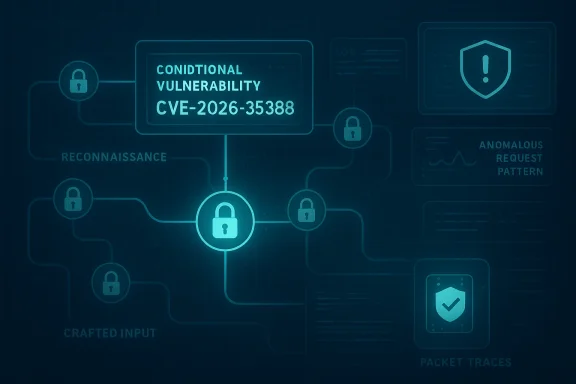 What Microsoft is really telling defenders
When Microsoft says an attack depends on conditions beyond the attacker’s control, it is usually describing a vulnerability whose success depends on deployment reality, not just code quality. That can mean internal-only reachability, a handshake or parsing stage that must be reached first, or a need for precise timing and crafted input. Those details are not merely academic; they influence whether the issue is a mass-scan concern or a targeted intrusion concern.This kind of language also tends to show up when the exploit chain is environmentally dependent. In other words, a security team should not assume that “remote” automatically means “easy,” nor should it assume that “needs conditions” means “safe to postpone.” Those are different risk statements.
Why this wording matters in incident response
For incident responders, the most useful part of Microsoft’s description is that it suggests the presence of observable prerequisites. If the attack relies on traffic-path control, for example, network telemetry may show unusual routing, proxying, or interception behavior. If it depends on target knowledge, then reconnaissance activity may precede exploitation.That means the vulnerability is not just a patching item. It is also a hunting item. Security teams should think about whether logs, packet captures, and authentication records can reveal an attempted setup phase.
Background
Microsoft’s Security Update Guide is now more than a monthly patch index; it is the primary public record where Microsoft explains vulnerability characteristics, severity, and in many cases the operational conditions that affect exploitability. Over the last several years, Microsoft has expanded that guide with richer CVE pages, advisories for security issues that do not fit the classic CVE pattern, and machine-readable CSAF delivery to help enterprises automate response workflows.That matters because the industry has learned, repeatedly, that CVSS labels alone do not tell the whole story. A vulnerability may be rated in a way that implies a certain attack surface, while the narrative text reveals important constraints or deployment caveats. Microsoft’s modern update guide is built to reduce that ambiguity, and the language around CVE-2026-35388 appears to follow that same philosophy.
Historically, many serious vulnerabilities have required some amount of attacker preparation. That is true for targeted browser exploits, authentication bypasses, protocol parser bugs, and even some denial-of-service conditions. The difference is that modern disclosure practices are better at surfacing those hidden dependencies, which helps defenders separate theoretical reachability from real-world abuse potential.
The reason this matters so much in enterprise settings is simple: not every vulnerability needs to be broadly exploitable to create a significant operational problem. A bug that only works in a specific deployment can still be devastating if that deployment is common among the exact systems a company uses. Niche vulnerabilities can still have very broad blast radii when they sit in popular libraries, shared services, or management tooling.
The security guide as a risk signal
Microsoft’s Security Update Guide is often more useful than a bare CVE entry because it can expose context such as prerequisites, mitigations, and the nature of the exploit path. Microsoft has also highlighted that the guide can be filtered by product, KB number, CVE, and release date, making it a practical operational reference rather than a static listing.For defenders, that means the advisory text should be read like a clue sheet. It may not disclose exploit code, but it often tells you where to look: network topology, authentication boundaries, affected workloads, or traffic patterns.
Why “conditions beyond the attacker’s control” is a big deal
That phrase implies that exploitability depends on more than remote access alone. In practice, it often translates to one or more of these realities:- the attacker needs to know something about the target beforehand;
- the attacker must wait for or create a specific environment state;
- the attacker may need to be on-path or otherwise influence communications;
- the vulnerability may only trigger in a particular protocol or workflow stage.
Exploitability and Pre-Conditions
The most interesting aspect of CVE-2026-35388 is not just that it is exploitable, but that Microsoft explicitly frames exploitation as conditional. That tells defenders to think in terms of prerequisites, not just patch availability. Those prerequisites are often where real-world attackers spend most of their effort, and that effort can be entirely invisible until it is nearly too late.A lot of vulnerability triage fails because teams ask only, “Can it be exploited?” A better question is, “What would an attacker need to do first?” If the answer involves reconnaissance, lateral positioning, traffic interception, or target preparation, then the issue may be less commoditized but still very viable.
Microsoft’s example language mentions knowledge of the environment, reliability preparation, and man-in-the-middle positioning. Each of those clues implies a different defensive posture. The first is about asset and configuration visibility, the second about adversarial experimentation, and the third about the integrity of network paths and trust boundaries.
Environmental knowledge
When attackers need to understand the environment first, they often probe for versioning, configuration, feature toggles, or workflow states. That means inventory quality becomes a security control, not just an IT hygiene issue. If you do not know where the vulnerable component sits, you cannot assess how much reconnaissance an attacker would need.Environmental knowledge can also collapse the protection value of obscurity. In practice, many environments look unique only until an attacker understands the product family, the deployment pattern, and the default assumptions behind it. Once that happens, an exploit that seemed difficult may become surprisingly practical.
Preparation to improve reliability
Some vulnerabilities are not “hard” in the sense of requiring an advanced payload; they are hard because they are flaky. An attacker may have to test payload variants, trigger edge cases repeatedly, or shape input to avoid crashes that would otherwise spoil the attempt. That kind of preparation is common with parser bugs, timing-sensitive flaws, and state-machine errors.From a defender’s point of view, repeated failures may be as meaningful as success. A noisy attacker probing for the right shape of input may leave clues in logs, telemetry, or repeated anomalous requests. Low-confidence exploitation can still produce valuable indicators.
Network-path positioning
Microsoft’s reference to a man-in-the-middle style scenario is especially important because it changes the threat model from “remote attacker” to “attacker with influence over transit.” That can include compromised Wi-Fi, rogue gateways, malicious proxies, or compromised internal segments.If a vulnerability depends on path control, then TLS, certificate validation, segmentation, and zero-trust principles become more relevant than ever. Even a perfect patch strategy can be undermined if the deployment itself assumes that adjacent network zones are inherently trustworthy.
- Environmental understanding can make exploitation far more repeatable.
- Preparation suggests the attacker may need test cycles, not just one packet.
- On-path positioning raises the stakes for internal trust boundaries.
- Poor segmentation can convert a niche bug into a practical breach path.
What the Wording Suggests About Attack Surface
The phraseology around CVE-2026-35388 strongly suggests a vulnerability whose reachability is shaped by deployment architecture. That is not the same as saying the flaw is rare. It means the same code path may be easy to hit in one environment and nearly irrelevant in another.This is where many organizations underestimate risk. They see an advisory that appears conditional and assume the issue is low priority. In reality, the conditions are often exactly the kind of things adversaries are good at creating, especially in systems with exposed management interfaces or complex proxy chains.
If the vulnerable component sits behind public-facing infrastructure, then the boundary between “hard to exploit” and “easy enough” may be thinner than the advisory implies. A little bit of exposure can go a long way when the attacker only needs one successful attempt.
Deployment topology matters
Network layout is often the deciding factor in whether an exploit is realistic. Public-facing endpoints, reverse proxies, load balancers, and segmented management planes all change the likelihood that an attacker can satisfy the preconditions Microsoft describes.A bug that would be annoying inside a tightly controlled enclave may become urgent when the same component is placed at the edge. That is why patch guidance has to be paired with asset visibility.
Authentication is not a magic shield
Some teams hear “needs conditions” and assume authentication solves the problem. That is not a safe assumption. Many vulnerabilities can still be abused after a legitimate login, through a compromised account, or via an internal foothold.Authentication lowers risk only if identity assurance, session protection, and privilege boundaries are strong. If those controls are weak, the exploit conditions can become much easier to satisfy than the advisory language suggests.
Internal exposure is still exposure
It is also important not to equate “not internet-facing” with “not exploitable.” Internal-only vulnerabilities are frequently abused after phishing, stolen credentials, VPN access, or a prior foothold. Once an attacker is inside, conditional bugs can become tailor-made opportunities.That is why internal segmentation and service hardening are not optional. They are what keeps a difficult exploit from becoming a lateral movement tool.
- Public exposure lowers the bar for abuse.
- Internal exposure still matters after initial compromise.
- Proxy layers can either protect or obscure the issue.
- Authentication only helps if identity controls are trustworthy.
Enterprise Impact
For enterprises, CVE-2026-35388 should be viewed through an operational-resilience lens. If the flaw is not trivially exploitable, that may slightly reduce the urgency of emergency containment — but it does not reduce the need to inventory, patch, and validate exposure quickly. Enterprises are precisely the kind of environments where attackers can spend time preparing an exploit path.That creates a familiar dynamic: a vulnerability that seems “not mass exploitable” on paper can still be highly attractive for targeted intrusion. Enterprises are rich in layered networks, privileged accounts, and workflow dependencies, all of which can help an attacker satisfy unusual preconditions. The issue becomes even more important if the affected component supports remote administration or infrastructure control.
The biggest risk for enterprises is complacency. Conditional exploitability is often mistaken for low operational relevance, when in fact it may just mean the attacker needs to be more deliberate. That is not a comfort; it is a warning.
Operational consequences
If the vulnerability is abused successfully, the enterprise may face impacts that go beyond the immediate product. Even a denial-of-service condition can cascade into authentication disruptions, job failures, failover churn, or degraded customer services. A targeted exploit path can also be used as a distraction while other activity occurs elsewhere in the environment.The practical question for defenders is whether the affected component sits on a critical workflow path. If it does, then even intermittent exploitation can become a business problem, not merely a technical one.
Prioritization logic
Enterprises should prioritize this kind of issue based on exposure, privilege, and reachability rather than the headline description alone. A vulnerable component behind strong segmentation and limited reach is a different case from the same component exposed through a management portal or supplier connection.That is why patch planning should be tied to asset classification. A vulnerability with narrow exploit conditions can still deserve top-tier treatment if the systems using it are high value.
Detection and validation
Because exploitability may depend on environment or path control, detection should focus on anomaly patterns rather than a single signature. Repeated malformed requests, unusual handshake sequences, or suspicious proxy behavior may all be indicators of reconnaissance or preparation.Validation is equally important. Enterprises should verify not only that a patch is installed, but that the vulnerable code path is no longer reachable in the intended deployment scenario.
- Inventory exact product usage, not just package names.
- Prioritize internet-facing and management-plane exposure.
- Watch for repeated probing and unusual request patterns.
- Validate post-patch behavior, not just patch presence.
Consumer Impact
Consumer impact depends heavily on where the affected code appears. If CVE-2026-35388 touches a product embedded in consumer software or home networking gear, the user may never know the component exists until something breaks. That is a common problem with library vulnerabilities: the component is invisible, but the impact is not.For consumers, the main issue is usually delay. Home users rarely inspect vulnerability advisories in detail, and patch rollout can depend on vendor firmware updates or auto-update behavior outside the user’s control. If the flaw sits in a device that receives infrequent updates, the exposure window can stretch far beyond the advisory date.
The consumer lesson is straightforward: if a device or app receives a security update, install it. If the device is at the edge of the home network or manages internet-facing services, the urgency rises quickly. Convenience does not equal safety.
Hidden dependencies
Many consumers only see the front-end app or device interface, not the underlying libraries. That means a vulnerability may affect a router, a remote access app, or a security appliance without the user ever realizing it shares code with other products. Hidden dependencies are one reason patch notes often look more important to security researchers than to end users.Still, those hidden dependencies are exactly where serious problems live. If the consumer product is a gateway of any kind, its compromise can have consequences far beyond the individual device.
Auto-update limitations
Auto-update helps, but it is not always enough. Devices may be offline, end-of-life, or dependent on vendor-specific firmware release cycles. In those cases, even a serious vulnerability can linger because there is no immediate path to remediation.That is why consumers should pay attention to support status. An unpatched device that no longer receives updates can turn a manageable issue into a persistent exposure.
Practical consumer takeaway
Consumers should treat any Microsoft or vendor advisory with conditional exploit language as a reminder that security is not just about technical severity. It is also about whether the affected device is exposed, embedded, and maintained. A vulnerable consumer endpoint behind a strong patch cycle is one thing; a vulnerable gateway that never gets updated is another.- Update devices as soon as vendor patches are available.
- Replace unsupported hardware before it becomes a liability.
- Check whether firmware updates are actually applied.
- Pay special attention to routers, VPNs, and admin portals.
Why Conditional Vulnerabilities Still Get Weaponized
It is tempting to think attackers prefer only the easiest bugs. In reality, they prefer the bugs that produce the best return on effort. A vulnerability that requires some preparation can still be highly attractive if the payoff is access, persistence, disruption, or stealth.That is especially true in targeted operations. Nation-state groups, ransomware operators, and intrusion crews often have time, tooling, and patience. Harder does not mean safe in that world; it often just means the bug is less likely to show up in mass commodity scanning.
The second reason conditional vulnerabilities get weaponized is that defenders are often slower to react. If the advisory does not scream “wormable” or “unauthenticated RCE,” teams may downgrade it mentally. That gap between actual risk and perceived risk is where attackers win.
Tradecraft over volume
A vulnerability that depends on certain conditions encourages tradecraft rather than volume. Attackers may test in lab environments, target specific versions, or wait until network placement improves. That makes the campaign quieter, but not less serious.In many ways, quieter bugs are harder to defend because they do not always trigger broad alarm. They tend to blend into routine traffic until the attacker has already done the hard part.
The attacker’s cost model
Security teams should think about exploit cost, not just exploit complexity. If the exploit requires knowledge of the target or a precise network position, that may be a barrier for opportunistic criminals but not for a motivated adversary. And once a successful method is found, it can be reused.That is why conditional vulnerabilities often sit on a shelf until they are ready to matter, then suddenly become very important. The absence of immediate public exploitation is not the same thing as the absence of threat.
Response implications
A smart response is to patch fast, but also to improve visibility around the prerequisite conditions. If the exploit needs on-path placement, then network controls matter. If it needs target knowledge, then inventory and exposure management matter. If it needs crafted inputs, then anomaly detection and request logging matter.The rule is simple: the conditions are the attack surface.
- Harder exploits can still be preferred by sophisticated actors.
- Quiet exploitation is often more dangerous than noisy scanning.
- Delayed weaponization is common in targeted campaigns.
- The preconditions tell defenders where to invest detection effort.
Strengths and Opportunities
The good news is that Microsoft’s phrasing gives defenders more to work with than a generic vulnerability label would. That makes it possible to build a smarter response that goes beyond simple patch deployment. A well-run environment can use this clue-rich advisory style to tighten segmentation, validate exposure, and reduce attacker leverage.It is also an opportunity to improve how security teams think about risk. Conditional exploitability should trigger context-aware triage rather than panic or dismissal. If organizations use this moment to improve asset visibility and logging, the value extends well beyond one CVE.
- Microsoft’s wording gives meaningful exploitability context.
- The advisory encourages environment-aware triage.
- Conditional attacks can be monitored through prerequisites.
- Patch programs can be improved by validating actual reachability.
- Network segmentation can directly reduce exploit feasibility.
- Logging and telemetry can reveal reconnaissance before exploitation.
- Security teams can refine how they rank “difficult” vulnerabilities.
Risks and Concerns
The biggest concern is that many organizations will underestimate the issue because it does not read like an instant mass-exploitation event. That would be a mistake. Condition-dependent vulnerabilities often become serious precisely because they are underweighted early, giving attackers time to prepare and strike selectively.There is also a risk that teams will patch without validating the real attack path. If the vulnerable service is still reachable through an overlooked proxy, tunnel, or management interface, the patch effort may not fully close the risk. Incomplete understanding of exposure is one of the most common reasons “fixed” vulnerabilities still matter.
- Conditional wording can create false reassurance.
- Attack paths may persist through forgotten proxies or tunnels.
- Internal-only services are often less visible to defenders.
- Inventory gaps can hide where the vulnerable component lives.
- An attacker with time can overcome many initial barriers.
- Detection may be weak if the exploit is quiet and targeted.
- Misconfiguration can make a difficult bug easy to abuse.
What to Watch Next
The most important thing to watch is whether Microsoft publishes additional details that clarify the exact component, attack vector, or mitigation path behind CVE-2026-35388. Additional guidance would help defenders distinguish between a narrow edge-case issue and a broader exposure in common deployments. In the meantime, the safest stance is to assume the vulnerability is operationally relevant wherever the affected component is exposed.It will also be worth watching whether the security community uncovers practical exploitation conditions that match Microsoft’s description. If researchers identify common deployment patterns that satisfy the preconditions, then the bug’s priority could rise quickly. Conversely, if the issue is confined to limited environments, the main defense remains disciplined patching and exposure review.
Items to track
- Any Microsoft follow-up advisory or FAQ update.
- Whether the affected product component is publicly identified.
- Evidence of exploitation attempts in telemetry or threat reporting.
- Common deployment patterns that make exploitation easier.
- Post-patch validation guidance from vendors or administrators.
CVE-2026-35388 is a reminder that exploitability is not a binary yes-or-no question. Sometimes the most important part of a vulnerability is not whether it can be attacked, but what the attacker has to do first. Microsoft’s language suggests this flaw belongs in that category, and that means defenders should respond with the same seriousness they would give any condition-dependent weakness: patch promptly, verify exposure carefully, and assume that a motivated attacker may still be willing to do the work.
Source: MSRC Security Update Guide - Microsoft Security Response Center
