

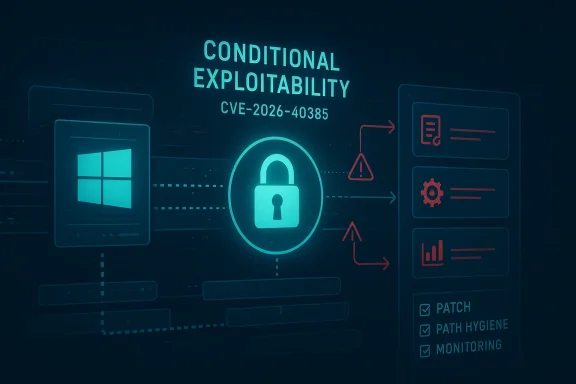
A successful attack against CVE-2026-40385 is not described by Microsoft as something an attacker can just fire off at will; instead, it depends on conditions outside the attacker’s control, such as knowledge of the environment, preparation to improve reliability, or, in some cases, positioning in the network path. That wording is important because it usually signals a vulnerability that is real and actionable, but not trivially mass-exploited in every deployment. In practical terms, Microsoft is telling defenders to think about where the vulnerable component sits, who can reach it, and what an attacker would need to know or manipulate before exploitation becomes likely. Microsoft’s own exploitability framing matches that pattern of conditional access and preparation.
Microsoft’s Security Response Center has spent the last several years making its vulnerability guidance more explicit about exploitability, not just severity. That matters because a CVSS score alone often fails to communicate whether a flaw is likely to be hit by opportunistic scanning or whether it is more of a targeted, context-dependent issue. Microsoft’s newer advisory language tries to close that gap by describing practical preconditions, especially when the attack path depends on environmental knowledge or attacker maneuvering. That is the lens through which CVE-2026-40385 should be read.
The specific wording attached to this CVE lines up with a broader Microsoft pattern: when an attack requires more than a simple request, the company often signals that some combination of network position, target preparation, or timing may be necessary. In the MSRC’s own recent guidance around path-redirection and unsafe junction traversal, Microsoft emphasized how exploitability can hinge on deployment context and conditions that are not always under direct attacker control. That is not the same as “safe”; it is a warning that the exploit chain may be narrower, more deliberate, and more dependent on local topology.
This is a meaningful distinction for Windows administrators because it changes the triage process. Vulnerabilities that are easily reachable from the internet attract broad scanning, noisy probing, and quick weaponization. Vulnerabilities that require specific environmental preconditioning may not spread as quickly, but they can be disproportionately valuable to a well-resourced attacker who can invest the time to shape the target environment. That is often the class of bug that slips past lazy patch prioritization because it does not look like an obvious “spray-and-pray” issue. Microsoft’s description suggests exactly that sort of nuance.
The user-provided language also matters because it describes attacker effort in concrete terms: gathering knowledge, preparing the target environment, or inserting into the logical network path. Those are classic preconditions in real-world intrusion chains, especially where traffic interception, target profiling, or staging is required before the actual exploit succeeds. The language is broad enough that defenders should avoid assuming a single product class or a single attack vector. Instead, it points to a vulnerability whose real-world risk is highly dependent on deployment and attacker sophistication.
The practical implication is that defenders need to ask whether the vulnerable component is exposed to untrusted users, whether it is reachable only on internal networks, and whether any proxying, relaying, or trust relationships could help an attacker satisfy the preconditions. If the answer is yes, the real-world risk may be much higher than the wording initially suggests. Microsoft’s own description points directly at those kinds of dependencies.
This is why internal segmentation cannot be treated as a decorative control. If an attacker must occupy a logical network position to make the exploit work, then reducing opportunities for interception and lateral positioning directly reduces exploitability. For many organizations, that means reviewing trust boundaries, proxy chains, and any service paths that let one system quietly mediate another. The issue is not only patching; it is path hygiene.
A key takeaway is that effortful attacks are still attacks. If the exploit requires the attacker to learn the target’s topology, gather environmental details, or wait for a favorable traffic condition, that only means the bar is higher, not that the flaw is harmless. Historically, many high-impact intrusions began with exactly that kind of investment. The more targeted the threat actor, the more comfortable they are with building the conditions that make exploitation succeed.
If CVE-2026-40385 affects a component that sits in a relay, proxy, authentication, or internal routing chain, then organizations with complex network architectures may face the greatest exposure. That is because complex environments tend to create the very preconditions the attacker needs: multiple hops, partial trust, and systems that are easier to influence from adjacent network zones. Complexity often becomes the attacker’s ally.
At an operational level, this means security teams should not only patch, but also inventory where the affected component is deployed and who can speak to it. If the attack depends on being in the network path, then architecture review becomes part of remediation. That includes segmentation, proxy placement, and any trust relationships that could simplify attacker positioning.
The consumer story is different from the enterprise story because home networks typically have fewer layered controls and fewer explicit trust boundaries. That can cut both ways. On one hand, an attacker may have fewer paths to stage the exploit in a home environment. On the other hand, consumers are often less likely to recognize or resist a malicious intermediary, rogue Wi‑Fi, or suspicious network activity. That makes the “conditions beyond the attacker’s control” language relevant in a different way: the attacker may need to create just enough local leverage to succeed.
The broader consumer lesson is that inconvenient exploitability is not a shield. It is simply a higher bar. Given enough time, attackers routinely look for the exact conditions they need, especially when the target population is large. That is why patching remains the decisive action even when the advisory language sounds qualified.
The advisory also hints that there may be multiple practical attack scenarios rather than one canonical exploit path. That is important because it means teams should not anchor on a single imagined method and dismiss the rest. Attackers adapt faster than policy documents. If the flaw can be exploited by staging the environment, then the real question is whether your deployment makes staging easy or hard.
This kind of disclosure also affects competitors in the broader endpoint and security ecosystem. If Microsoft signals that exploitation depends on environment knowledge or network positioning, third-party defenders need telemetry that can answer those questions quickly. That includes asset inventory, network path visibility, and segmentation analytics. Vendors that only surface “critical/high” without deployment context will look less useful as advisories become more nuanced.
The market implication is straightforward: security teams and vendors are moving toward exploitability-informed prioritization. That favors platforms that can correlate patch data with exposure data and trusted network mapping. It also means that security posture is increasingly about where something runs, not just whether it is patched.
Another concern is that environment-dependent bugs are often harder to detect in the wild. When exploitation requires staging, there may be fewer obvious fingerprints than in mass exploitation campaigns. That can delay detection, attribution, and remediation. It also means defenders may not notice abuse until the attacker has already succeeded in shaping the environment to their advantage.
It will also be worth watching whether the vulnerability gets tied to a broader class of issues, such as path manipulation, traffic mediation, or trust-boundary abuse. Microsoft has recently shown interest in closing entire categories of Windows weaknesses rather than only specific instances, and that suggests the company sees these patterns as recurring. If CVE-2026-40385 turns out to be part of a broader class, defenders should expect more advisories in the same family.
In the end, CVE-2026-40385 reads like a case study in why attack surface management matters as much as patch management. If the attacker needs knowledge, preparation, or network positioning, then the organization that understands its own paths, trust zones, and exposure points has a real advantage. The patch is necessary, but the architecture is what decides whether the vulnerability is merely present or genuinely dangerous.
Source: MSRC Security Update Guide - Microsoft Security Response Center
 Background
Microsoft’s Security Response Center has spent the last several years making its vulnerability guidance more explicit about exploitability, not just severity. That matters because a CVSS score alone often fails to communicate whether a flaw is likely to be hit by opportunistic scanning or whether it is more of a targeted, context-dependent issue. Microsoft’s newer advisory language tries to close that gap by describing practical preconditions, especially when the attack path depends on environmental knowledge or attacker maneuvering. That is the lens through which CVE-2026-40385 should be read.The specific wording attached to this CVE lines up with a broader Microsoft pattern: when an attack requires more than a simple request, the company often signals that some combination of network position, target preparation, or timing may be necessary. In the MSRC’s own recent guidance around path-redirection and unsafe junction traversal, Microsoft emphasized how exploitability can hinge on deployment context and conditions that are not always under direct attacker control. That is not the same as “safe”; it is a warning that the exploit chain may be narrower, more deliberate, and more dependent on local topology.
This is a meaningful distinction for Windows administrators because it changes the triage process. Vulnerabilities that are easily reachable from the internet attract broad scanning, noisy probing, and quick weaponization. Vulnerabilities that require specific environmental preconditioning may not spread as quickly, but they can be disproportionately valuable to a well-resourced attacker who can invest the time to shape the target environment. That is often the class of bug that slips past lazy patch prioritization because it does not look like an obvious “spray-and-pray” issue. Microsoft’s description suggests exactly that sort of nuance.
The user-provided language also matters because it describes attacker effort in concrete terms: gathering knowledge, preparing the target environment, or inserting into the logical network path. Those are classic preconditions in real-world intrusion chains, especially where traffic interception, target profiling, or staging is required before the actual exploit succeeds. The language is broad enough that defenders should avoid assuming a single product class or a single attack vector. Instead, it points to a vulnerability whose real-world risk is highly dependent on deployment and attacker sophistication.
What Microsoft Is Really Saying
The most important clue in the CVE description is not the vulnerability name itself, but the exploitability language. Microsoft is effectively saying this flaw is not a one-click remote compromise that works identically everywhere. The attack may require the attacker to know something about the environment, to influence the environment, or to interpose themselves in communications before the vulnerable behavior can be triggered successfully. That is a much narrower operational model than a straightforward public-facing RCE.Exploitability Versus Severity
A lot of defenders conflate severity with urgency, but those are not the same thing. A flaw can be severe and still require a tailored attack chain, and a flaw can be modestly rated yet still be a nightmare in the right environment. Microsoft’s language around CVE-2026-40385 suggests the latter category is plausible here: the bug may not be trivially automated, but a motivated attacker could still use it in a focused campaign. That is why conditional exploitability should be treated as risk reduction, not as reassurance.The practical implication is that defenders need to ask whether the vulnerable component is exposed to untrusted users, whether it is reachable only on internal networks, and whether any proxying, relaying, or trust relationships could help an attacker satisfy the preconditions. If the answer is yes, the real-world risk may be much higher than the wording initially suggests. Microsoft’s own description points directly at those kinds of dependencies.
- The attack may require environmental knowledge.
- The attacker may need to prepare the target environment.
- The attacker may need to position themselves in the network path.
- The exploit may be more practical in targeted rather than mass campaigns.
- Conditional does not mean benign.
Why Network Position Matters
Microsoft’s example language explicitly mentions a man-in-the-middle-style setup. That is significant because it moves the issue out of the “remote exploit from anywhere” bucket and into the “attack path engineering” bucket. In other words, the flaw may be reachable only if the adversary can observe, modify, or influence traffic in ways that are not trivial across the public internet. That often points to enterprise, branch-office, VPN, or segmented-network scenarios.This is why internal segmentation cannot be treated as a decorative control. If an attacker must occupy a logical network position to make the exploit work, then reducing opportunities for interception and lateral positioning directly reduces exploitability. For many organizations, that means reviewing trust boundaries, proxy chains, and any service paths that let one system quietly mediate another. The issue is not only patching; it is path hygiene.
Likely Threat Model
The threat model implied by Microsoft’s wording is familiar even if the specific component is not. It suggests a class of vulnerability that may become useful after initial access, during reconnaissance, or as part of a chained intrusion. This is the kind of issue that can be less attractive to commodity attackers but very attractive to skilled operators who are willing to do the extra work. Microsoft’s description strongly points toward that distinction.A key takeaway is that effortful attacks are still attacks. If the exploit requires the attacker to learn the target’s topology, gather environmental details, or wait for a favorable traffic condition, that only means the bar is higher, not that the flaw is harmless. Historically, many high-impact intrusions began with exactly that kind of investment. The more targeted the threat actor, the more comfortable they are with building the conditions that make exploitation succeed.
Chained Attacks Are the Real Concern
Microsoft’s language fits a classic chained-attack pattern: use one weakness to gain influence over the environment, then trigger the more specialized flaw when conditions are right. That is especially true in enterprise environments where internal services, management planes, and authentication layers create multiple opportunities for staging. A vulnerability that is awkward to exploit in isolation can become very practical once the attacker has a foothold.- Initial access may come from a separate weakness.
- The CVE may be most dangerous after foothold acquisition.
- Local network awareness can dramatically improve success rates.
- Traffic interception can turn a hard exploit into a workable one.
- Target preparation often indicates a higher-skill adversary.
Enterprise Impact
For enterprises, the main risk is not just a single compromised host. It is the possibility that a carefully prepared attack succeeds in a place where trust boundaries matter more than raw exposure. Internal apps, management tools, line-of-business services, and intermediary infrastructure are all more vulnerable to this sort of nuance than a consumer endpoint is. Microsoft’s exploitability language makes that enterprise context especially relevant.If CVE-2026-40385 affects a component that sits in a relay, proxy, authentication, or internal routing chain, then organizations with complex network architectures may face the greatest exposure. That is because complex environments tend to create the very preconditions the attacker needs: multiple hops, partial trust, and systems that are easier to influence from adjacent network zones. Complexity often becomes the attacker’s ally.
Where the Risk Concentrates
The highest-risk deployments are likely to be those where the vulnerable component is reachable from a semi-trusted zone, rather than from a fully isolated management network. Services exposed through reverse proxies, internal load balancers, or shared authentication flows can provide just enough leverage for an attacker who has already learned the landscape. In those environments, a vulnerability that depends on environmental conditions can still be highly exploitable.At an operational level, this means security teams should not only patch, but also inventory where the affected component is deployed and who can speak to it. If the attack depends on being in the network path, then architecture review becomes part of remediation. That includes segmentation, proxy placement, and any trust relationships that could simplify attacker positioning.
- Review trust boundaries around the affected component.
- Identify whether the service is internet-facing, internal-only, or brokered.
- Validate whether proxies or relays increase exploitability.
- Check whether authentication or session flows can be influenced.
- Treat internal exposure as real exposure, not a safe default.
Consumer Impact
Consumer users will usually care less about topology and more about whether the vulnerable component is present on their systems at all. If this CVE affects a Windows feature used in everyday workflows, the main consumer concern will be whether the patch arrives automatically and whether the machine is kept current. For most home users, the best mitigation is still the oldest one: install the update promptly. Microsoft’s guidance indicates the flaw is still worth taking seriously even if it is not trivially exploitable in every scenario.The consumer story is different from the enterprise story because home networks typically have fewer layered controls and fewer explicit trust boundaries. That can cut both ways. On one hand, an attacker may have fewer paths to stage the exploit in a home environment. On the other hand, consumers are often less likely to recognize or resist a malicious intermediary, rogue Wi‑Fi, or suspicious network activity. That makes the “conditions beyond the attacker’s control” language relevant in a different way: the attacker may need to create just enough local leverage to succeed.
Why Home Users Should Still Patch Quickly
Even when exploitation is awkward, unpatched consumer systems are bad bets. Attackers frequently test broad populations for weak configurations, outdated builds, and misbehaving network conditions that happen to satisfy the preconditions. Home users often have no visibility into that process, which means they are dependent on timely vendor remediation. If Microsoft has issued a fix, the safest assumption is that someone will eventually try to make the exploit work.The broader consumer lesson is that inconvenient exploitability is not a shield. It is simply a higher bar. Given enough time, attackers routinely look for the exact conditions they need, especially when the target population is large. That is why patching remains the decisive action even when the advisory language sounds qualified.
- Keep Windows Update enabled.
- Reboot promptly after security updates.
- Avoid untrusted networks when possible.
- Be cautious with unusual prompts or traffic interception.
- Don’t assume “hard to exploit” means “safe to ignore.”
How Defenders Should Read the Advisory
The right way to interpret Microsoft’s wording is as a prioritization signal, not as an excuse to delay. If the exploit depends on environmental control, then understanding your own environment becomes part of your defense. That means mapping exposure, verifying which systems are reachable, and understanding whether the attacker could realistically create the necessary conditions. Microsoft’s own description points in that direction.The advisory also hints that there may be multiple practical attack scenarios rather than one canonical exploit path. That is important because it means teams should not anchor on a single imagined method and dismiss the rest. Attackers adapt faster than policy documents. If the flaw can be exploited by staging the environment, then the real question is whether your deployment makes staging easy or hard.
A Practical Triage Checklist
Start by asking whether the affected component is internet-facing. Then determine whether it is reachable from internal segments that might be less strictly monitored. After that, assess whether proxies, relays, or intermediary services might permit traffic observation or modification. Finally, confirm whether any compensating controls — such as segmentation, authentication, or strict source restrictions — reduce the attacker’s ability to satisfy the preconditions.- Identify affected assets and versions.
- Determine network exposure and trust relationships.
- Review whether attacker positioning would be feasible.
- Apply the vendor fix as soon as possible.
- Monitor for unusual traffic paths, staging activity, or configuration drift.
Competitive and Market Implications
Microsoft’s advisory style also has a market effect. When vendors get more explicit about real exploit preconditions, they make it harder for security tooling to rely on simplistic severity scores alone. That pushes customers toward context-aware vulnerability management, where asset topology and exposure matter as much as the CVE label. In the long run, that is good for mature security operations and uncomfortable for lazy compliance.This kind of disclosure also affects competitors in the broader endpoint and security ecosystem. If Microsoft signals that exploitation depends on environment knowledge or network positioning, third-party defenders need telemetry that can answer those questions quickly. That includes asset inventory, network path visibility, and segmentation analytics. Vendors that only surface “critical/high” without deployment context will look less useful as advisories become more nuanced.
Why Context Beats Raw Severity
Raw severity scores remain useful, but they are incomplete. A high severity score on a bug that is difficult to operationalize may be less urgent than a moderate-severity issue that is present on thousands of exposed systems. Conversely, a context-dependent flaw like CVE-2026-40385 may be ignored by organizations that do not understand their own topology, even though it could be devastating once conditions align. That tension is exactly why Microsoft keeps refining its advisory language.The market implication is straightforward: security teams and vendors are moving toward exploitability-informed prioritization. That favors platforms that can correlate patch data with exposure data and trusted network mapping. It also means that security posture is increasingly about where something runs, not just whether it is patched.
- Context-aware prioritization is becoming table stakes.
- Exposure mapping matters as much as patch status.
- Network-path telemetry is increasingly valuable.
- Compliance-only programs will miss the nuance.
- Advisory language is getting more operational, not less.
Strengths and Opportunities
Microsoft’s disclosure style has real strengths because it helps defenders think like attackers without forcing them to reverse engineer the bug themselves. The main opportunity here is better prioritization: if teams understand the preconditions, they can focus on the systems most likely to satisfy them. That is a major improvement over treating every CVE as identical. Better signal means better action.- Encourages risk-based patching instead of blanket panic.
- Helps defenders focus on topology-sensitive assets.
- Reinforces the value of segmentation and trust zoning.
- Makes vulnerability management more operationally honest.
- Supports faster decisions when the exploit path is conditional rather than obvious.
- Gives SOC teams a clue about what to hunt for in logs and traffic.
- Helps enterprises align patching with exposure, not just CVSS.
Risks and Concerns
The biggest risk is that teams will misread conditional exploitability as low priority. That is dangerous because sophisticated attackers routinely do the extra work needed to turn a difficult vulnerability into a reliable one. If the flaw can be made to work through preparation or network positioning, then a motivated adversary may simply invest the time. Harder is not the same as hard enough.Another concern is that environment-dependent bugs are often harder to detect in the wild. When exploitation requires staging, there may be fewer obvious fingerprints than in mass exploitation campaigns. That can delay detection, attribution, and remediation. It also means defenders may not notice abuse until the attacker has already succeeded in shaping the environment to their advantage.
- Teams may downgrade the bug too aggressively.
- Attackers may exploit weak segmentation to create the needed conditions.
- Detection may be harder because exploitation is not one-size-fits-all.
- Network-path assumptions can be silently wrong in complex enterprises.
- Proxy or relay infrastructure may become an unexpected attack enabler.
- Patching alone may not address exposure if architecture remains permissive.
- Incident responders may miss the preparation phase if they only look for the final exploit.
Looking Ahead
The next thing to watch is whether Microsoft publishes further clarification on the affected component, exploitation mode, or mitigations. That kind of follow-up often determines whether defenders can apply a temporary workaround or must move straight to patching only. If more technical detail emerges, it will help teams separate theoretical exposure from practical exposure. Until then, the conservative assumption is that the flaw deserves active attention.It will also be worth watching whether the vulnerability gets tied to a broader class of issues, such as path manipulation, traffic mediation, or trust-boundary abuse. Microsoft has recently shown interest in closing entire categories of Windows weaknesses rather than only specific instances, and that suggests the company sees these patterns as recurring. If CVE-2026-40385 turns out to be part of a broader class, defenders should expect more advisories in the same family.
What Security Teams Should Monitor
- Any Microsoft clarification about exploit prerequisites.
- Patch availability and servicing-channel coverage.
- Signs of targeted probing rather than broad scanning.
- Network paths that allow interception or mediation.
- Related advisories that suggest the same bug class is recurring.
In the end, CVE-2026-40385 reads like a case study in why attack surface management matters as much as patch management. If the attacker needs knowledge, preparation, or network positioning, then the organization that understands its own paths, trust zones, and exposure points has a real advantage. The patch is necessary, but the architecture is what decides whether the vulnerability is merely present or genuinely dangerous.
Source: MSRC Security Update Guide - Microsoft Security Response Center
Last edited:
