

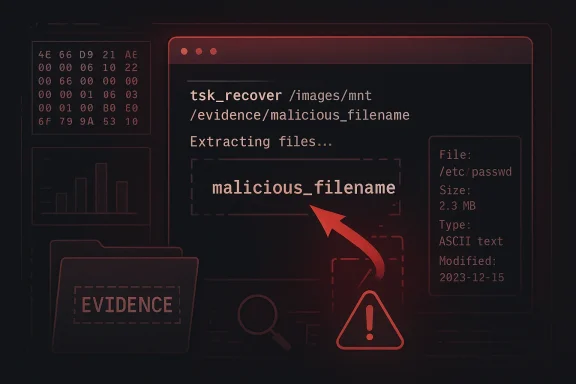
CVE-2026-40024 is a path traversal vulnerability in The Sleuth Kit’s tsk_recover tool that can let an attacker write files outside the intended recovery directory by abusing crafted filenames or directory paths inside a filesystem image. Public vulnerability databases describe the issue as affecting The Sleuth Kit through 4.14.0, with the core risk being arbitrary file placement rather than a classic memory corruption crash.
What makes this bug worth attention is that it sits in a tool designed for forensic recovery, where analysts expect hostile filenames and damaged metadata to be handled safely. A recovery utility that trusts path components too much can accidentally turn an evidence-processing workflow into a file-write primitive, which is exactly the kind of bug that can undermine both investigation integrity and system safety.
Microsoft has now listed the CVE in its Update Guide, which is often where defenders first discover that a third-party component in a broader Windows workflow needs attention. Even if the vulnerable code is not part of Windows itself, the security impact can still matter to incident response teams, DFIR labs, and vendors that bundle Sleuth Kit into larger products.
The Sleuth Kit is one of the best-known open-source collections for disk and filesystem analysis, and tsk_recover is a natural fit for workflows that need to extract files from images. That is also why a path traversal flaw in this tool class is so awkward: the application is meant to process untrusted evidence, yet it must do so without allowing that evidence to influence where recovered files land on disk.
Path traversal bugs are not new, but they remain stubbornly relevant because they exploit a simple trust failure. If a program accepts a path from an attacker-controlled source and then uses that path without strict canonicalization and boundary checks, the attacker can escape a sandbox, overwrite files, or plant content where it does not belong. The Sleuth Kit issue follows that familiar pattern, only in a domain where file integrity is especially sensitive.
This matters for forensic tooling because recovery software often runs with elevated access to mounted images, working directories, and evidence stores. A flaw that seems “only” to allow file writes can become more serious when the write target is a shared case folder, an automation path, or a privileged location on an analyst workstation. The practical risk is not just corruption of recovered data; it is contamination of the surrounding environment.
The vulnerable version ceiling also matters. The Sleuth Kit 4.14.0 release is recent enough that many environments may have adopted it for compatibility or feature reasons, which means a sizable number of installations could still be on an affected build path if they have not already moved past it. That is especially true in bundled or appliance-style deployments where the operator may not even realize the component is present.
That reality changes the security bar. A utility that simply “does not crash” is not enough if it can be tricked into writing outside the intended recovery tree. With recovery tools, a write outside bounds can taint evidence, interfere with other investigations, or even create a secondary compromise path on an analyst host.
That means the attacker’s leverage is not necessarily code execution in the traditional sense. Instead, the attacker can potentially direct file output, which is dangerous enough when the destination can be a startup location, a script path, a configuration directory, or a shared evidence workspace. In security work, malicious file placement is often the first step in a much larger chain.
The most important nuance is that the vulnerability is about where the recovered content lands, not what the content is. A file that was supposed to be recovered into a quarantined directory becomes a liability if it can be written into a place where later tools, services, or humans will trust it. That is why path traversal remains a high-value bug class even when the technical description sounds modest.
The severity also depends on the permissions of the process running tsk_recover. If analysts or automation jobs run the tool with elevated rights, the blast radius grows immediately. That is why path traversal in a recovery utility is not merely a “bad filename” problem; it is a privilege and trust-boundary problem.
The Sleuth Kit has a broad security history like many mature parsing-heavy tools, and the release cadence around version 4.14.0 shows an active project still evolving. That’s normal for a codebase that has to keep up with newer filesystems, formats, and platform expectations, but it also means edge cases can survive longer than users expect.
Microsoft’s Security Update Guide has become an important aggregation point for this type of third-party vulnerability disclosure, especially when enterprises need a single place to see what affects their wider Windows-adjacent environment. The fact that CVE-2026-40024 is surfaced there reinforces an important reality: not every important vulnerability ships in a Microsoft binary, but Microsoft still tracks many of the components that matter to enterprise operations.
There is also a broader lesson here about forensic and security utilities. When software is built to ingest untrusted artifacts, developers have to assume adversarial naming, structure abuse, and broken canonical forms from day one. Anything less is wishful thinking.
Security teams should also think in terms of workflow trust. A vulnerable recovery tool sitting on an analyst desktop is one thing; the same tool embedded in an unattended job that processes external images or shared evidence is another. The latter is where path traversal often becomes a real exploit path rather than a theoretical issue.
The Microsoft listing is useful because it puts the issue on the radar of organizations that do not track Sleuth Kit advisories directly. That matters in large environments where vulnerability management relies on centralized feeds and asset inventories rather than one-off GitHub watchlists.
A second step is workflow review. If the tool is used to process external evidence, verify whether recovered files are isolated from active workspaces. A write outside the intended folder can become a supply-chain-like problem inside the local environment, especially if downstream scripts automatically ingest the recovered files.
For enterprises, the picture is more serious. Forensic utilities often live in SOCs, DFIR labs, MSP stacks, and internal IT recovery workflows, and those environments routinely process data from untrusted sources. When a path traversal flaw lands in that context, it can affect evidence integrity, workstation safety, and the trustworthiness of downstream handling.
There is also a practical issue of deployment opacity. Enterprise teams frequently inherit tools through packages, scripts, Docker images, or vendor bundles, which means the vulnerable version can hide in places no one checks unless a CVE forces a search. That is how “niche” bugs become enterprise problems.
Consumer impact is therefore more about edge cases, while enterprise impact is about scale and privilege. In a business environment, one vulnerable utility can touch many evidence sets, many endpoints, or many analysts’ workspaces. That multiplies the value of a bug that, on paper, looks like “just” a path traversal.
Beyond patching, the real defensive gain comes from tightening the recovery workflow. If the tool is allowed to write anywhere outside a dedicated directory, then the environment itself is too permissive. Path traversal bugs are much harder to exploit when the surrounding permissions, mount options, and job accounts are already constrained.
That is why remediation should not stop at version numbers. A patched binary inside a sloppy workflow can still produce bad outcomes if recovered files are automatically moved, indexed, or executed by follow-on scripts. Security teams should fix both the software and the assumptions around it.
The reason this type of issue keeps returning is that file paths look harmless. They are small strings, easy to parse, and often overlooked in security reviews compared with memory handling or authentication code. But once a path controls a write location, it becomes a security primitive, and that is where the danger starts.
Microsoft’s inclusion of the issue also underlines the growing importance of ecosystem visibility. Even when a CVE belongs to open-source software, enterprises benefit from seeing it in the same place they track Windows and Microsoft-adjacent risks. Unified visibility is often the difference between a quick patch and a forgotten dependency.
That expectation matters for competitors too. Vendors that bundle forensic or recovery libraries will need to prove that their wrappers enforce confinement, because upstream fixes alone may not be enough if downstream logic reintroduces the same bug class. The weakest link is often the integration layer.
We should also expect more internal audits of forensic workflows. Whenever a bug like this surfaces, mature security teams usually use it as a trigger to review every place they unpack, recover, or sanitize filenames from untrusted data. That is the right move, because the underlying design mistake is rarely unique to one project.
The larger industry lesson is simple: path handling is not a housekeeping detail. It is a security control, and tools that work with hostile images, archives, or metadata must prove they can keep attacker-controlled names inside a narrow corridor. If they cannot, the product may still be useful, but it is no longer trustworthy by default.
Source: MSRC Security Update Guide - Microsoft Security Response Center
What makes this bug worth attention is that it sits in a tool designed for forensic recovery, where analysts expect hostile filenames and damaged metadata to be handled safely. A recovery utility that trusts path components too much can accidentally turn an evidence-processing workflow into a file-write primitive, which is exactly the kind of bug that can undermine both investigation integrity and system safety.
Microsoft has now listed the CVE in its Update Guide, which is often where defenders first discover that a third-party component in a broader Windows workflow needs attention. Even if the vulnerable code is not part of Windows itself, the security impact can still matter to incident response teams, DFIR labs, and vendors that bundle Sleuth Kit into larger products.
 Background
The Sleuth Kit is one of the best-known open-source collections for disk and filesystem analysis, and tsk_recover is a natural fit for workflows that need to extract files from images. That is also why a path traversal flaw in this tool class is so awkward: the application is meant to process untrusted evidence, yet it must do so without allowing that evidence to influence where recovered files land on disk.Path traversal bugs are not new, but they remain stubbornly relevant because they exploit a simple trust failure. If a program accepts a path from an attacker-controlled source and then uses that path without strict canonicalization and boundary checks, the attacker can escape a sandbox, overwrite files, or plant content where it does not belong. The Sleuth Kit issue follows that familiar pattern, only in a domain where file integrity is especially sensitive.
This matters for forensic tooling because recovery software often runs with elevated access to mounted images, working directories, and evidence stores. A flaw that seems “only” to allow file writes can become more serious when the write target is a shared case folder, an automation path, or a privileged location on an analyst workstation. The practical risk is not just corruption of recovered data; it is contamination of the surrounding environment.
The vulnerable version ceiling also matters. The Sleuth Kit 4.14.0 release is recent enough that many environments may have adopted it for compatibility or feature reasons, which means a sizable number of installations could still be on an affected build path if they have not already moved past it. That is especially true in bundled or appliance-style deployments where the operator may not even realize the component is present.
Why forensic tools are unusually exposed
Forensic software regularly touches hostile input by design. That means the code must interpret malformed structures, broken offsets, odd filenames, and inconsistent directory entries without assuming the data is cooperative. In other words, the attack surface is not accidental; it is the whole job.That reality changes the security bar. A utility that simply “does not crash” is not enough if it can be tricked into writing outside the intended recovery tree. With recovery tools, a write outside bounds can taint evidence, interfere with other investigations, or even create a secondary compromise path on an analyst host.
- Evidence-processing tools must treat metadata as hostile.
- Recovery paths need strict canonicalization.
- Output directories must be enforced, not assumed.
- Shared case repositories amplify any bad write.
- Automated pipelines can spread the impact quickly.
What the Vulnerability Does
The core problem in tsk_recover is straightforward: crafted filesystem names can persuade the tool to write files somewhere other than the intended recovery folder. Public summaries describe this as path traversal via malicious filenames or directory paths embedded in a filesystem image.That means the attacker’s leverage is not necessarily code execution in the traditional sense. Instead, the attacker can potentially direct file output, which is dangerous enough when the destination can be a startup location, a script path, a configuration directory, or a shared evidence workspace. In security work, malicious file placement is often the first step in a much larger chain.
The most important nuance is that the vulnerability is about where the recovered content lands, not what the content is. A file that was supposed to be recovered into a quarantined directory becomes a liability if it can be written into a place where later tools, services, or humans will trust it. That is why path traversal remains a high-value bug class even when the technical description sounds modest.
Why arbitrary file writes are dangerous
An arbitrary write outside a sandbox can alter application behavior in subtle ways. A planted configuration file might redirect a service, a dropped script might be executed later, and an overwritten document might hide the real evidence trail. In enterprise settings, these secondary effects are often more important than the initial file write itself.The severity also depends on the permissions of the process running tsk_recover. If analysts or automation jobs run the tool with elevated rights, the blast radius grows immediately. That is why path traversal in a recovery utility is not merely a “bad filename” problem; it is a privilege and trust-boundary problem.
- The attacker controls filesystem metadata.
- The tool trusts that metadata too much.
- Recovery output can escape the target directory.
- Overwrites may affect configs or scripts.
- The impact increases with privilege.
Historical Context
Directory traversal vulnerabilities have long haunted archive extractors, upload handlers, backup tools, and any software that transforms untrusted names into real paths. The pattern is old because filesystem APIs are deceptively simple: once a path is joined incorrectly, the bug can be hard to notice in testing but trivial to exploit in practice.The Sleuth Kit has a broad security history like many mature parsing-heavy tools, and the release cadence around version 4.14.0 shows an active project still evolving. That’s normal for a codebase that has to keep up with newer filesystems, formats, and platform expectations, but it also means edge cases can survive longer than users expect.
Microsoft’s Security Update Guide has become an important aggregation point for this type of third-party vulnerability disclosure, especially when enterprises need a single place to see what affects their wider Windows-adjacent environment. The fact that CVE-2026-40024 is surfaced there reinforces an important reality: not every important vulnerability ships in a Microsoft binary, but Microsoft still tracks many of the components that matter to enterprise operations.
There is also a broader lesson here about forensic and security utilities. When software is built to ingest untrusted artifacts, developers have to assume adversarial naming, structure abuse, and broken canonical forms from day one. Anything less is wishful thinking.
The recurring security lesson
The recurring lesson is that filename trust is a security boundary, not a convenience feature. If the application consumes metadata from a hostile source, it must normalize, validate, and confine every write. That is a boring rule until the day a real-world CVE makes it painfully concrete.- Old bug class, new product surface.
- File recovery tools are naturally high-risk.
- Bundled utilities can hide exposure.
- Elevated permissions magnify impact.
- Aggregators like Microsoft’s guide improve visibility.
Impact on Security Teams
For defenders, the most immediate question is not academic severity but operational placement: where is The Sleuth Kit used, and who runs it? If it lives inside an incident response toolkit, an automated evidence pipeline, or a vendor appliance, the risk may be wider than a standalone installation suggests.Security teams should also think in terms of workflow trust. A vulnerable recovery tool sitting on an analyst desktop is one thing; the same tool embedded in an unattended job that processes external images or shared evidence is another. The latter is where path traversal often becomes a real exploit path rather than a theoretical issue.
The Microsoft listing is useful because it puts the issue on the radar of organizations that do not track Sleuth Kit advisories directly. That matters in large environments where vulnerability management relies on centralized feeds and asset inventories rather than one-off GitHub watchlists.
What defenders should review first
A sensible response starts with inventory. You need to know whether the affected version is present, whether it is bundled into another product, and whether output paths are locked down by policy or by user habit. Habit is the dangerous part, because security assumptions often live in the person running the tool rather than in the code itself.A second step is workflow review. If the tool is used to process external evidence, verify whether recovered files are isolated from active workspaces. A write outside the intended folder can become a supply-chain-like problem inside the local environment, especially if downstream scripts automatically ingest the recovered files.
- Identify where Sleuth Kit is installed.
- Confirm whether 4.14.0 or earlier is in use.
- Review whether outputs are isolated.
- Check for automated post-processing.
- Prioritize systems with elevated privileges.
Enterprise vs Consumer Exposure
For consumers, direct exposure is likely narrower. Most home users do not routinely run forensic recovery tools against attacker-controlled filesystem images, and they rarely integrate tsk_recover into automated workflows. That lowers the odds of casual exploitation, though it does not eliminate the risk in niche technical environments.For enterprises, the picture is more serious. Forensic utilities often live in SOCs, DFIR labs, MSP stacks, and internal IT recovery workflows, and those environments routinely process data from untrusted sources. When a path traversal flaw lands in that context, it can affect evidence integrity, workstation safety, and the trustworthiness of downstream handling.
There is also a practical issue of deployment opacity. Enterprise teams frequently inherit tools through packages, scripts, Docker images, or vendor bundles, which means the vulnerable version can hide in places no one checks unless a CVE forces a search. That is how “niche” bugs become enterprise problems.
Why automation changes the risk
Automation changes the risk because it removes human friction. A manually run tool may at least prompt an analyst to inspect suspicious output, but a scheduled job may just write the file and move on. If the path escape lands in a watched directory, the malicious file can become an execution seed for later compromise.Consumer impact is therefore more about edge cases, while enterprise impact is about scale and privilege. In a business environment, one vulnerable utility can touch many evidence sets, many endpoints, or many analysts’ workspaces. That multiplies the value of a bug that, on paper, looks like “just” a path traversal.
- Consumer use is comparatively limited.
- Enterprise workflows create larger blast radius.
- Automation reduces human scrutiny.
- Privileged jobs can write into sensitive places.
- Bundles and containers hide exposure.
Mitigation and Fix Strategy
The best mitigation is to move to a fixed version as soon as one is available in your distribution or vendor stack. Public reporting identifies The Sleuth Kit through 4.14.0 as affected, so any deployment at or below that ceiling should be treated as suspect until verified otherwise.Beyond patching, the real defensive gain comes from tightening the recovery workflow. If the tool is allowed to write anywhere outside a dedicated directory, then the environment itself is too permissive. Path traversal bugs are much harder to exploit when the surrounding permissions, mount options, and job accounts are already constrained.
That is why remediation should not stop at version numbers. A patched binary inside a sloppy workflow can still produce bad outcomes if recovered files are automatically moved, indexed, or executed by follow-on scripts. Security teams should fix both the software and the assumptions around it.
Practical response checklist
- Verify the Sleuth Kit version in every environment.
- Replace affected builds with a fixed release or vendor patch.
- Restrict recovery jobs to non-privileged accounts where possible.
- Write outputs only into dedicated, isolated directories.
- Review scripts that consume recovered files automatically.
- Reassess whether the tool needs direct access to shared workspaces.
- Patch the affected version promptly.
- Reduce privileges for recovery jobs.
- Isolate output folders.
- Audit post-processing scripts.
- Validate file movement rules.
Why This CVE Matters Beyond One Tool
CVE-2026-40024 is not just a Sleuth Kit story. It is a reminder that tooling built for trust-heavy workflows can become a liability if it does not treat filenames and directory components as hostile input. That lesson applies equally to archive extractors, backup agents, image processors, and forensic utilities.The reason this type of issue keeps returning is that file paths look harmless. They are small strings, easy to parse, and often overlooked in security reviews compared with memory handling or authentication code. But once a path controls a write location, it becomes a security primitive, and that is where the danger starts.
Microsoft’s inclusion of the issue also underlines the growing importance of ecosystem visibility. Even when a CVE belongs to open-source software, enterprises benefit from seeing it in the same place they track Windows and Microsoft-adjacent risks. Unified visibility is often the difference between a quick patch and a forgotten dependency.
The broader market implication
The broader market implication is that security tooling vendors will increasingly be judged on how safely they handle hostile artifacts, not just on how well they parse them. Customers now expect recovery, inspection, and triage utilities to contain bad data by default. Anything less can turn a defensive product into an attack surface.That expectation matters for competitors too. Vendors that bundle forensic or recovery libraries will need to prove that their wrappers enforce confinement, because upstream fixes alone may not be enough if downstream logic reintroduces the same bug class. The weakest link is often the integration layer.
- Security tools are judged by containment.
- Path handling is a security boundary.
- Downstream wrappers can reintroduce risk.
- Visibility across ecosystems reduces blind spots.
- Defensive software must assume hostile inputs.
Strengths and Opportunities
The good news is that this is a highly understandable vulnerability class, which makes it easier to prioritize, communicate, and remediate. The other advantage is that a path traversal bug in a recovery tool is often fixable with a combination of patching and workflow hardening rather than a full architectural rebuild. That gives defenders a rare chance to get ahead of the problem quickly.- Easy to explain to non-specialists.
- Patch path is straightforward.
- Workflow hardening can reduce residual risk.
- Inventory efforts improve asset visibility.
- Bundled-tool reviews can uncover other hidden CVEs.
- Better path validation improves overall software quality.
- The issue creates momentum for safer recovery design.
A chance to clean house
This kind of CVE often exposes more than one flaw. Once teams start asking where Sleuth Kit is installed, they frequently uncover stale packages, old imaging scripts, and unattended lab utilities that have not been reviewed in years. That cleanup work is a security win all by itself.Risks and Concerns
The biggest risk is underestimating the issue because it sounds like “just” a path traversal. In reality, file writes outside a sandbox can become persistence, tampering, or privilege-abuse vectors if the surrounding workflow is loose enough. That is especially concerning in forensic and incident-response environments, where trust boundaries matter more than average.- Analysts may assume evidence tools are inherently safe.
- Bundled versions may go unnoticed.
- Privileged jobs can amplify impact.
- Automated workflows can spread bad files.
- Shared workspaces increase cross-contamination risk.
- Patch lag can leave old images exposed.
- Post-processing scripts may inherit the same trust flaw.
Operational blind spots
The hardest environments to fix are often the ones with the least visibility. Embedded tools, vendor bundles, and one-off analyst scripts are easy to forget until a security advisory makes them urgent again. That delay is where attackers usually find their opening.Looking Ahead
The immediate next step will be confirmation of fixed releases in downstream distributions and vendor products that ship The Sleuth Kit as a component. That matters because many organizations do not consume upstream tarballs directly; they consume whatever their platform vendor, package manager, or appliance maker provides.We should also expect more internal audits of forensic workflows. Whenever a bug like this surfaces, mature security teams usually use it as a trigger to review every place they unpack, recover, or sanitize filenames from untrusted data. That is the right move, because the underlying design mistake is rarely unique to one project.
The larger industry lesson is simple: path handling is not a housekeeping detail. It is a security control, and tools that work with hostile images, archives, or metadata must prove they can keep attacker-controlled names inside a narrow corridor. If they cannot, the product may still be useful, but it is no longer trustworthy by default.
- Watch for vendor advisories and package updates.
- Verify whether appliances embed Sleuth Kit.
- Re-audit recovery and extraction pipelines.
- Restrict who can write into case folders.
- Track whether follow-on tools trust recovered files.
Source: MSRC Security Update Guide - Microsoft Security Response Center
