

CISA on May 19, 2026, republished ABB’s advisory for CVE-2025-3465, a high-severity path traversal flaw in CoreSense HM and CoreSense M10 that affects worldwide deployments in food and agriculture, commercial facilities, and critical manufacturing when vulnerable local web interfaces are reachable. The bug is not the sort of internet-scale disaster that sends scanners racing across IPv4 space. It is instead the kind of industrial weakness that matters because the blast radius begins after an attacker has already crossed a boundary defenders often assume is solid. ABB has fixes available, but the advisory’s real lesson is about localhost trust, plant-floor segmentation, and the uncomfortable persistence of simple file-handling mistakes in critical environments.
The affected products, ABB CoreSense HM and CoreSense M10, sit in the unglamorous but essential world of equipment monitoring. These are not consumer PCs, cloud dashboards, or developer toys; they belong to operational environments where availability, maintenance visibility, and conservative change control often matter more than shiny feature velocity. That is precisely why a path traversal advisory deserves more attention than its familiar CWE number might suggest.
CVE-2025-3465 is described as an improper limitation of a pathname to a restricted directory. In plainer English, the vulnerable software accepted a file parameter without sufficiently ensuring that the requested file stayed inside the directory it was supposed to serve. If an attacker can influence that path, the application may be tricked into reaching outside its intended sandbox and reading files it should never expose.
The advisory says successful exploitation could allow unauthenticated users to access restricted directories, with the potential for complete system compromise and exposure of sensitive information. That phrasing is severe, but it is paired with an important constraint: ABB says exploitation requires local access to the machine hosting the web application, effectively access to localhost. This is the tension at the heart of the advisory. The vulnerability is high impact, but the attack path depends on whether “local” really means trusted in the customer’s environment.
That distinction will divide readers into two camps. One camp will see “not remotely exploitable” and move on. The other, usually the people who have had to investigate real industrial incidents, will hear an alarm bell: local-only bugs become remote problems when jump boxes are shared, maintenance laptops are dirty, firewalls are misconfigured, remote access is overbroad, or malware lands on a system node.
For CoreSense HM, the advisory identifies versions through 2.3.1 as affected and points customers to version 2.3.4 as the corrected release. For CoreSense M10, versions through 1.4.1.12 are affected and version 1.4.1.31 is listed as the corrected release. The advisory text also references those fixed versions in the affected-version summary, which is slightly awkward but not unusual in converted security notices where “affected,” “fixed,” and “known affected” product states can appear side by side.
The CVSS v3.1 score is 7.1, with a local attack vector, low complexity, no privileges required, no user interaction, changed scope, high confidentiality impact, and no integrity or availability impact. That vector tells the practical story better than the headline severity. The bug is not scored as a remote code execution event; it is scored as a confidentiality break across a trust boundary.
Still, confidentiality in an industrial system is not merely about private documents. Configuration files, logs, credentials, service tokens, device identifiers, network layouts, and maintenance artifacts can all become stepping stones. A file read vulnerability can be the first useful primitive in a longer chain, especially in environments where service accounts are reused and operational systems are expected to stay online for years.
Industrial defenders have spent years being told to minimize exposure, isolate control networks, place devices behind firewalls, and avoid internet-facing control interfaces. Those are still sound practices. But the ABB advisory demonstrates why network exposure is not a binary state. A service can be “not internet-facing” and still be reachable by too many people, too many tools, or too many adjacent systems.
The local-access caveat also matters for Windows administrators because the Windows endpoint is often the bridge between corporate IT and operational technology. Engineering workstations, remote desktop hosts, historian servers, browser-based maintenance tools, and vendor utilities frequently run on Windows or are accessed from Windows-managed environments. A localhost-scoped web application may feel invisible to the outside world, but it is not invisible to malware, browser pivots, misconfigured proxies, or users with too much access on the host.
That is why this advisory should not be filed away as “ABB patch, OT team only.” It belongs in the same conversation as privileged access management, application control, remote support hygiene, and endpoint hardening. The vulnerable component may be an industrial product, but the exploitation preconditions often live in the Windows-admin layer around it.
The revision history tells an unusual chronology. ABB’s initial advisory dates to April 16, 2025, with later revisions in September and October 2025, while CISA’s republication lands on May 19, 2026. The result is a vulnerability that is not new in the vendor ecosystem but may be newly visible to organizations whose intake processes key off CISA ICS bulletins. For those shops, the practical question is not “why now?” but “did we already patch this when ABB first said to?”
That gap between vendor release and broader operational visibility is a recurring problem in industrial security. Asset owners often depend on integrators, maintenance windows, vendor portals, and internal risk committees before software updates are approved. By the time an advisory appears in a more widely consumed channel, some sites may have already remediated while others may be discovering the issue for the first time.
CISA repeats the standard defensive guidance: minimize network exposure for control system devices, keep them off the public internet, isolate control networks from business networks, use secure remote access methods when remote access is required, and assess impact before deploying defensive measures. None of that is novel. The point is that the basics remain necessary because the same primitive keeps appearing: an input string that should have been constrained but was not.
Yet the persistence of CWE-22 in modern products shows that “straightforward” is not the same as “extinct.” File download handlers, log viewers, report exporters, diagnostic bundles, backup utilities, and web-based maintenance interfaces are all fertile ground for this mistake. Industrial products add another wrinkle: they often preserve compatibility across long product lifecycles and may embed web interfaces that were designed for trusted operational contexts rather than hostile input.
The ABB advisory says the vulnerable file parameter lacked sufficient validation and verification. That is an ordinary sentence with extraordinary implications. If a monitoring product can be convinced to disclose restricted files, an attacker may gain the information needed to widen access, impersonate services, understand plant topology, or prepare a more targeted intrusion.
This is why defenders should resist the urge to judge vulnerabilities only by whether they provide immediate code execution. In real intrusions, especially inside operational networks, reconnaissance and credential discovery are often as valuable as direct exploitation. A high-confidence file read in the right place can be the difference between a stalled foothold and a meaningful compromise path.
The affected sectors listed by the advisory — food and agriculture, commercial facilities, and critical manufacturing — also widen the concern. These are environments with varied maturity levels, distributed sites, vendor-managed systems, and sometimes lean IT or OT teams. A large manufacturer may have formal asset inventory and staged patch testing. A smaller facility may have a maintenance contractor, a shared admin password, and an update process that depends on whether anyone knows the product is installed.
That is where the advisory’s local-access requirement becomes operationally messy. Local access in a plant does not always map cleanly to a single trusted administrator sitting at a console. It may include vendor technicians, remote sessions, shared terminals, service accounts, or software running on a host for reasons no one has fully documented since commissioning.
The right response is not panic. It is inventory, verification, and containment. Organizations need to know whether CoreSense HM or CoreSense M10 is deployed, which versions are running, who can access the host, whether the local web application is reachable beyond the host, and whether remote access paths unintentionally expose it to broader networks.
If a CoreSense interface is administered from a Windows workstation, that workstation’s posture matters. If remote desktop is used for maintenance, the RDP access model matters. If a browser session on an engineering host can reach localhost services with elevated trust, browser and endpoint controls matter. If credentials are stored in scripts, shortcuts, password managers, or configuration files on the host, a file disclosure bug can have consequences beyond the product’s own directory.
This is also a useful moment to revisit application allowlisting and least privilege on engineering systems. An unauthenticated local web bug is less useful if untrusted users cannot log into the host, cannot run arbitrary code, cannot create port forwards, and cannot pivot from ordinary user sessions into operational tooling. Conversely, it becomes more useful in environments where “maintenance access” quietly means broad local administrator rights.
The Windows lesson is therefore practical rather than philosophical. Treat OT-adjacent Windows hosts as part of the control boundary, not as ordinary office endpoints. Patch management, remote access controls, local firewall rules, service exposure checks, and monitoring should be aligned with the fact that these machines may be one localhost request away from sensitive industrial data.
But the advisory also illustrates the limits of many industrial security notices. “Complete system compromise” appears in the impact language, while the CVSS vector lists no integrity or availability impact and describes the attack vector as local. That does not make the notice wrong, but it does require careful reading. Complete compromise may be possible through chaining, exposed sensitive files, or environment-specific consequences rather than through the path traversal flaw alone.
The “could not be exploited remotely” answer in the FAQ also needs context. If “remote” means directly over the internet to the vulnerable service, ABB says no. If “remote” means an attacker with malware on a host, access through a remote support channel, or a foothold on a system that can interact with the local service, the practical answer becomes more complicated. Security advisories often draw boundaries that real networks blur.
More transparent advisories would spell out what kinds of files could be exposed, whether credentials are at risk, whether arbitrary file read is confirmed, whether write paths exist, and whether default configurations bind only to loopback. Vendors may avoid that level of detail to reduce exploitability, but defenders need enough specificity to prioritize patches and compensating controls intelligently.
That does not justify ignoring the issue. A high-severity local path traversal flaw with no required privileges and no user interaction should be triaged promptly, especially where the host is shared, remotely administered, or reachable from less trusted networks. The presence or absence of known exploitation should influence urgency, not create complacency.
Organizations that cannot patch immediately should focus on narrowing access. ABB’s own mitigation advice is to restrict local access to authorized users only and ensure untrusted users cannot interact directly with the application on the host. In practice, that means reviewing local accounts, remote access groups, firewall rules, service bindings, browser access paths, and any tooling that can relay requests to localhost.
There is also a detection angle. While the advisory does not provide indicators of compromise, defenders can still look for unusual file download requests, suspicious traversal patterns in application logs, unexpected access to sensitive directories, and anomalous activity on engineering hosts. The absence of a public exploit does not mean the absence of probing, especially once an advisory becomes easier to discover.
For Windows and infrastructure teams working near industrial environments, the ABB CoreSense advisory is a reminder that the boundary between IT and OT is not a diagram — it is a set of machines, accounts, sessions, and assumptions. A path traversal bug in a local web interface becomes serious when those assumptions are stale. The patch closes the specific hole, but the durable defense is a cleaner operational model in which “local” once again means something defenders can trust.
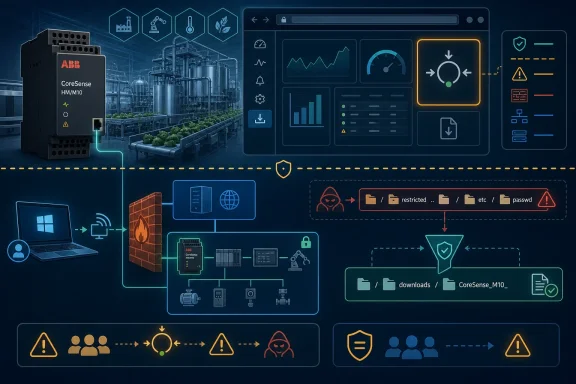 ABB’s Quiet Sensor Bug Is Really a Boundary Failure
The affected products, ABB CoreSense HM and CoreSense M10, sit in the unglamorous but essential world of equipment monitoring. These are not consumer PCs, cloud dashboards, or developer toys; they belong to operational environments where availability, maintenance visibility, and conservative change control often matter more than shiny feature velocity. That is precisely why a path traversal advisory deserves more attention than its familiar CWE number might suggest.CVE-2025-3465 is described as an improper limitation of a pathname to a restricted directory. In plainer English, the vulnerable software accepted a file parameter without sufficiently ensuring that the requested file stayed inside the directory it was supposed to serve. If an attacker can influence that path, the application may be tricked into reaching outside its intended sandbox and reading files it should never expose.
The advisory says successful exploitation could allow unauthenticated users to access restricted directories, with the potential for complete system compromise and exposure of sensitive information. That phrasing is severe, but it is paired with an important constraint: ABB says exploitation requires local access to the machine hosting the web application, effectively access to localhost. This is the tension at the heart of the advisory. The vulnerability is high impact, but the attack path depends on whether “local” really means trusted in the customer’s environment.
That distinction will divide readers into two camps. One camp will see “not remotely exploitable” and move on. The other, usually the people who have had to investigate real industrial incidents, will hear an alarm bell: local-only bugs become remote problems when jump boxes are shared, maintenance laptops are dirty, firewalls are misconfigured, remote access is overbroad, or malware lands on a system node.
The Patch Fixes a File Parameter, but the Exposure Starts Earlier
ABB says the vulnerability is caused by unchecked input data in the file parameter in the affected CoreSense products. The fix restricts file downloads to a designated directory for downloadable content and adds stricter input validation and path sanitization. That is the expected engineering response: define where files may be served from, normalize paths, reject traversal attempts, and avoid letting user-supplied strings decide filesystem boundaries.For CoreSense HM, the advisory identifies versions through 2.3.1 as affected and points customers to version 2.3.4 as the corrected release. For CoreSense M10, versions through 1.4.1.12 are affected and version 1.4.1.31 is listed as the corrected release. The advisory text also references those fixed versions in the affected-version summary, which is slightly awkward but not unusual in converted security notices where “affected,” “fixed,” and “known affected” product states can appear side by side.
The CVSS v3.1 score is 7.1, with a local attack vector, low complexity, no privileges required, no user interaction, changed scope, high confidentiality impact, and no integrity or availability impact. That vector tells the practical story better than the headline severity. The bug is not scored as a remote code execution event; it is scored as a confidentiality break across a trust boundary.
Still, confidentiality in an industrial system is not merely about private documents. Configuration files, logs, credentials, service tokens, device identifiers, network layouts, and maintenance artifacts can all become stepping stones. A file read vulnerability can be the first useful primitive in a longer chain, especially in environments where service accounts are reused and operational systems are expected to stay online for years.
“Localhost Only” Is Not the Comfort Blanket It Used to Be
The advisory’s most important mitigating factor is also its most dangerous phrase: the path traversal vulnerability is only exploitable when the attacker has local access to the machine hosting the web application. In a well-designed deployment, that means an attacker must already be on the host or able to interact directly with the local service. In a messy deployment, that may mean a contractor’s laptop, a remote support tunnel, a shared engineering workstation, or a compromised box on the same operational network.Industrial defenders have spent years being told to minimize exposure, isolate control networks, place devices behind firewalls, and avoid internet-facing control interfaces. Those are still sound practices. But the ABB advisory demonstrates why network exposure is not a binary state. A service can be “not internet-facing” and still be reachable by too many people, too many tools, or too many adjacent systems.
The local-access caveat also matters for Windows administrators because the Windows endpoint is often the bridge between corporate IT and operational technology. Engineering workstations, remote desktop hosts, historian servers, browser-based maintenance tools, and vendor utilities frequently run on Windows or are accessed from Windows-managed environments. A localhost-scoped web application may feel invisible to the outside world, but it is not invisible to malware, browser pivots, misconfigured proxies, or users with too much access on the host.
That is why this advisory should not be filed away as “ABB patch, OT team only.” It belongs in the same conversation as privileged access management, application control, remote support hygiene, and endpoint hardening. The vulnerable component may be an industrial product, but the exploitation preconditions often live in the Windows-admin layer around it.
CISA’s Republication Turns a Vendor Notice Into an Operational Checklist
The CISA posting is a republication of ABB advisory 3KXG200000R4801 using the Common Security Advisory Framework format. That detail sounds bureaucratic, but it matters. Vendor advisories can be missed by customers who do not regularly monitor every supplier portal, while CISA’s ICS advisory feed is watched by asset owners, MSSPs, vulnerability teams, and compliance staff.The revision history tells an unusual chronology. ABB’s initial advisory dates to April 16, 2025, with later revisions in September and October 2025, while CISA’s republication lands on May 19, 2026. The result is a vulnerability that is not new in the vendor ecosystem but may be newly visible to organizations whose intake processes key off CISA ICS bulletins. For those shops, the practical question is not “why now?” but “did we already patch this when ABB first said to?”
That gap between vendor release and broader operational visibility is a recurring problem in industrial security. Asset owners often depend on integrators, maintenance windows, vendor portals, and internal risk committees before software updates are approved. By the time an advisory appears in a more widely consumed channel, some sites may have already remediated while others may be discovering the issue for the first time.
CISA repeats the standard defensive guidance: minimize network exposure for control system devices, keep them off the public internet, isolate control networks from business networks, use secure remote access methods when remote access is required, and assess impact before deploying defensive measures. None of that is novel. The point is that the basics remain necessary because the same primitive keeps appearing: an input string that should have been constrained but was not.
Path Traversal Remains Boring Until It Isn’t
Path traversal is one of those bug classes that security people sometimes treat as solved because everyone knows the pattern. A user supplies a filename. The application joins it to a directory. The attacker adds traversal sequences or otherwise manipulates the path. The application serves or touches something outside the intended location. The fix, conceptually, is straightforward.Yet the persistence of CWE-22 in modern products shows that “straightforward” is not the same as “extinct.” File download handlers, log viewers, report exporters, diagnostic bundles, backup utilities, and web-based maintenance interfaces are all fertile ground for this mistake. Industrial products add another wrinkle: they often preserve compatibility across long product lifecycles and may embed web interfaces that were designed for trusted operational contexts rather than hostile input.
The ABB advisory says the vulnerable file parameter lacked sufficient validation and verification. That is an ordinary sentence with extraordinary implications. If a monitoring product can be convinced to disclose restricted files, an attacker may gain the information needed to widen access, impersonate services, understand plant topology, or prepare a more targeted intrusion.
This is why defenders should resist the urge to judge vulnerabilities only by whether they provide immediate code execution. In real intrusions, especially inside operational networks, reconnaissance and credential discovery are often as valuable as direct exploitation. A high-confidence file read in the right place can be the difference between a stalled foothold and a meaningful compromise path.
The Industrial Risk Is Not Just the Device; It Is the Maintenance Model
ABB says functional safety is not affected by exploitation of this vulnerability. That is reassuring, but it should not be overread. “Functional safety” is a specific claim about safety functions, not a promise that operations, confidentiality, or downstream security posture are unaffected. A vulnerability can leave the safety case intact while still creating a serious cyber risk.The affected sectors listed by the advisory — food and agriculture, commercial facilities, and critical manufacturing — also widen the concern. These are environments with varied maturity levels, distributed sites, vendor-managed systems, and sometimes lean IT or OT teams. A large manufacturer may have formal asset inventory and staged patch testing. A smaller facility may have a maintenance contractor, a shared admin password, and an update process that depends on whether anyone knows the product is installed.
That is where the advisory’s local-access requirement becomes operationally messy. Local access in a plant does not always map cleanly to a single trusted administrator sitting at a console. It may include vendor technicians, remote sessions, shared terminals, service accounts, or software running on a host for reasons no one has fully documented since commissioning.
The right response is not panic. It is inventory, verification, and containment. Organizations need to know whether CoreSense HM or CoreSense M10 is deployed, which versions are running, who can access the host, whether the local web application is reachable beyond the host, and whether remote access paths unintentionally expose it to broader networks.
Windows Shops Should Treat This as an Endpoint and Segmentation Test
For WindowsForum readers, the obvious question is where Windows enters the story. The answer is not that Windows itself is vulnerable because ABB’s advisory is about ABB products. The answer is that Windows environments often provide the administrative surface around industrial products, and that surface determines whether a local-only vulnerability remains local.If a CoreSense interface is administered from a Windows workstation, that workstation’s posture matters. If remote desktop is used for maintenance, the RDP access model matters. If a browser session on an engineering host can reach localhost services with elevated trust, browser and endpoint controls matter. If credentials are stored in scripts, shortcuts, password managers, or configuration files on the host, a file disclosure bug can have consequences beyond the product’s own directory.
This is also a useful moment to revisit application allowlisting and least privilege on engineering systems. An unauthenticated local web bug is less useful if untrusted users cannot log into the host, cannot run arbitrary code, cannot create port forwards, and cannot pivot from ordinary user sessions into operational tooling. Conversely, it becomes more useful in environments where “maintenance access” quietly means broad local administrator rights.
The Windows lesson is therefore practical rather than philosophical. Treat OT-adjacent Windows hosts as part of the control boundary, not as ordinary office endpoints. Patch management, remote access controls, local firewall rules, service exposure checks, and monitoring should be aligned with the fact that these machines may be one localhost request away from sensitive industrial data.
The Advisory’s Language Leaves Room for Better Vendor Transparency
ABB’s notice does several things right. It names the affected products and versions, provides fixed versions, identifies the weakness class, gives a CVSS vector, states the exploitation precondition, and says ABB had not received reports of exploitation when the advisory was originally issued. It also explains the broad nature of the fix: restrict downloads to a designated directory and sanitize paths.But the advisory also illustrates the limits of many industrial security notices. “Complete system compromise” appears in the impact language, while the CVSS vector lists no integrity or availability impact and describes the attack vector as local. That does not make the notice wrong, but it does require careful reading. Complete compromise may be possible through chaining, exposed sensitive files, or environment-specific consequences rather than through the path traversal flaw alone.
The “could not be exploited remotely” answer in the FAQ also needs context. If “remote” means directly over the internet to the vulnerable service, ABB says no. If “remote” means an attacker with malware on a host, access through a remote support channel, or a foothold on a system that can interact with the local service, the practical answer becomes more complicated. Security advisories often draw boundaries that real networks blur.
More transparent advisories would spell out what kinds of files could be exposed, whether credentials are at risk, whether arbitrary file read is confirmed, whether write paths exist, and whether default configurations bind only to loopback. Vendors may avoid that level of detail to reduce exploitability, but defenders need enough specificity to prioritize patches and compensating controls intelligently.
The Fix Should Be Easy; The Change Window May Not Be
ABB recommends applying the update at the earliest convenience. In IT, that phrase often means the next patch cycle. In OT, it can mean the next maintenance window, the next vendor visit, or the next planned outage. Even when an update is technically simple, production realities can slow deployment.That does not justify ignoring the issue. A high-severity local path traversal flaw with no required privileges and no user interaction should be triaged promptly, especially where the host is shared, remotely administered, or reachable from less trusted networks. The presence or absence of known exploitation should influence urgency, not create complacency.
Organizations that cannot patch immediately should focus on narrowing access. ABB’s own mitigation advice is to restrict local access to authorized users only and ensure untrusted users cannot interact directly with the application on the host. In practice, that means reviewing local accounts, remote access groups, firewall rules, service bindings, browser access paths, and any tooling that can relay requests to localhost.
There is also a detection angle. While the advisory does not provide indicators of compromise, defenders can still look for unusual file download requests, suspicious traversal patterns in application logs, unexpected access to sensitive directories, and anomalous activity on engineering hosts. The absence of a public exploit does not mean the absence of probing, especially once an advisory becomes easier to discover.
The Real Patch Is Smaller Than the Real Work
The most concrete actions here are not complicated, which is good news for teams already buried under advisory volume. The complication is making sure the actions happen in the right operational context.- Organizations running CoreSense HM should verify whether any deployed instance is at version 2.3.1 or earlier and plan an update to version 2.3.4.
- Organizations running CoreSense M10 should verify whether any deployed instance is at version 1.4.1.12 or earlier and plan an update to version 1.4.1.31.
- Administrators should treat the “local access only” condition as a segmentation test, not as a reason to defer remediation indefinitely.
- OT and Windows teams should review who can log into or remotely access hosts that run the affected web application.
- Sites unable to patch immediately should restrict local and remote interaction with the host, confirm the service is not exposed beyond intended boundaries, and monitor for suspicious file access patterns.
CISA’s Republished Warning Is a Small Test of Industrial Security Discipline
CVE-2025-3465 will probably not become a household vulnerability name. It has no catchy brand, no internet-wide worm narrative, and no evidence in the advisory of active exploitation at the time ABB first issued it. But that is exactly why it is useful as a measure of security discipline. The organizations that handle this well will not be the ones that panic; they will be the ones that can quickly answer what they run, where it is reachable, who can touch it, and how fast they can move from advisory to verified remediation.For Windows and infrastructure teams working near industrial environments, the ABB CoreSense advisory is a reminder that the boundary between IT and OT is not a diagram — it is a set of machines, accounts, sessions, and assumptions. A path traversal bug in a local web interface becomes serious when those assumptions are stale. The patch closes the specific hole, but the durable defense is a cleaner operational model in which “local” once again means something defenders can trust.
References
- Primary source: CISA
Published: 2026-05-19T12:00:00+00:00

ABB CoreSense HM and CoreSense M10 | CISA
www.cisa.gov
- Related coverage: app.opencve.io
Coresense CVEs and Security Vulnerabilities - OpenCVE
Explore the latest vulnerabilities and security issues of Coresense in the CVE databaseapp.opencve.io - Related coverage: db.gcve.eu
Vulnerability-Lookup
Vulnerability-Lookup - Fast vulnerability lookup correlation from different sources.db.gcve.eu
