

Microsoft published CVE-2026-40358, a Microsoft Office remote code execution vulnerability, in its Security Update Guide for the May 12, 2026 security release, framing the flaw as a credible Office attack path that administrators should treat as patch-now material rather than theoretical noise. The important detail is not simply that Office has another RCE; it is that Microsoft’s own advisory language places the bug inside the machinery enterprises use to judge certainty, exploitability, and deployment urgency. In other words, this is a vulnerability where the confidence signal matters almost as much as the headline severity.
Microsoft Office remains one of the most durable attack surfaces in Windows environments because it sits at the intersection of trust, habit, and business process. Users open documents because their jobs require it. Administrators harden Office because they know that same workflow is an attacker’s dream.
CVE-2026-40358 lands in that familiar territory: an Office remote code execution vulnerability. That phrase has a specific operational meaning. It does not necessarily mean an attacker can spray packets at a laptop and instantly own it; in the Office world, “remote” often describes the attacker’s position and the delivery path, while exploitation may still depend on a user opening or previewing a crafted file.
That distinction is not pedantry. It is the reason Office vulnerabilities can be both less wormable than network-service bugs and still extremely dangerous. A malicious document does not need to beat a firewall if it can ride through email, Teams, SharePoint, OneDrive, a helpdesk ticket, or a supplier portal.
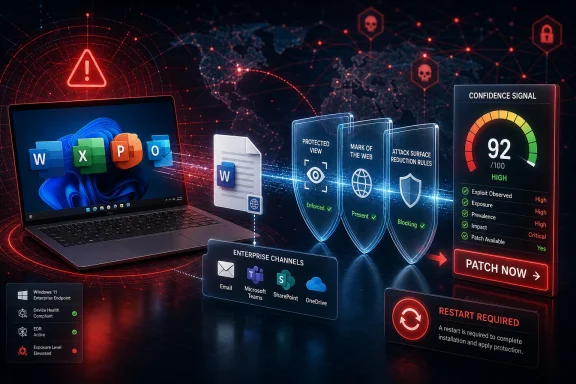
The Office security story in 2026 is therefore not “macros are back” or “macros are dead.” It is that attackers keep looking for ways around the layers Microsoft has built since the bad old days of macro malware: Protected View, Mark of the Web, OLE mitigations, file-block policies, Attack Surface Reduction rules, and cloud detonation. Every new Office RCE is a test of how well those layers hold when the vulnerable code path is not the one defenders expected.
A vulnerability can begin life as a vague claim, a crash report, a suspicious exploit sample, or a vendor-confirmed defect. Those are not equivalent. A bug acknowledged by the affected vendor is different from a claim circulating through threat-intel chatter with no root cause, no affected builds, and no reproducible trigger.
For defenders, confidence changes the patching conversation. Low-confidence items may still deserve monitoring, especially in sensitive environments, but they compete poorly against confirmed vulnerabilities with available updates. A Microsoft-confirmed Office RCE should move out of the “watch list” bucket and into the “deployment plan” bucket.
That is the core of CVE-2026-40358. The existence of the advisory means Microsoft has accepted the issue into its vulnerability response process. Even if public exploit details remain limited, the vendor has supplied enough information to justify remediation. For most organizations, that is the point at which waiting for proof-of-concept code becomes a mistake.
Modern exploit development often starts from patch diffing, telemetry, and pattern recognition. Once updates ship, attackers can compare patched and unpatched binaries, identify changed code paths, and work backward toward the bug. Office is a particularly attractive target for that process because the payload delivery model is mature and cheap.
The confidence metric also cuts both ways. It tells defenders that the vulnerability is real, but it may also tell offensive researchers that the advisory is worth reverse engineering. The absence of public exploit code on release day is not the same as the absence of exploitability next week.
This is why “not known exploited” should not be read as “safe to defer indefinitely.” It is a snapshot, not a guarantee. Office bugs have a long shelf life because many endpoints lag behind monthly patch cycles, especially where legacy add-ins, virtual desktop images, kiosk systems, and tightly controlled change windows slow adoption.
They thrive on targeting. A crafted document can be sent to finance, legal, HR, engineering, procurement, or an executive assistant with a plausible pretext. The attacker does not need universal reach if the right person opens the right file.
That makes Office RCE especially relevant to organizations that have strong perimeter controls but weaker controls around user content. A well-run company may patch VPNs quickly and still have document workflows that allow untrusted files to reach endpoints with minimal friction. This is where Windows hardening policy, Microsoft Defender configuration, and user-mode application controls become part of the patch story rather than optional extras.
The strongest posture is layered. Patch Office, but also assume that some users will receive weaponized files before every endpoint is remediated. That means blocking child-process creation from Office where possible, restricting script abuse, inspecting attachments in cloud mail flows, and making sure Protected View and Mark of the Web are not being quietly undermined by business exceptions.
That matters for CVE-2026-40358 because Office vulnerabilities are usually exploited in the applications people leave open all day: Word, Excel, PowerPoint, Outlook, and sometimes the shared components that sit beneath them. Administrators should care not only whether the update is offered, but whether the vulnerable binaries are no longer running.
Enterprises should check their update channels, deployment rings, and restart behavior. Current Channel devices may receive fixes quickly, while Monthly Enterprise Channel and semi-annual servicing models can introduce deliberate delay. That delay may be acceptable for feature churn; it is harder to justify when the item is an RCE in a document-handling suite.
The uncomfortable truth is that Office patch compliance is often less visible than Windows cumulative update compliance. Many dashboards tell teams whether the OS is current while leaving Office build drift harder to see. CVE-2026-40358 is a reminder that application servicing deserves the same seriousness as operating system servicing.
That restraint is defensible. Vendors have to balance transparency with exploit enablement. Publishing a detailed exploit path on patch day may help defenders validate exposure, but it can also accelerate weaponization against organizations that cannot patch immediately.
The downside is that defenders must make decisions under partial information. They may not know whether exploitation depends on a particular file type, a preview handler, a legacy parser, or a shared Office component. They may not know whether Protected View meaningfully reduces risk or merely changes the path to exploitation.
That uncertainty argues for conservative action. When a vulnerability affects Office and carries remote code execution impact, the prudent assumption is that untrusted documents are the delivery vehicle until Microsoft or credible researchers say otherwise. Treat the advisory as a call to reduce document-handling risk broadly, not merely to chase one mysterious code path.
The organizations that handle it well will not be the ones that hold the longest meeting. They will be the ones that already know which Office builds they run, which update channels apply, which devices are outside normal management, and which mitigations are enforced by policy rather than wishful thinking.
The organizations that struggle will ask basic inventory questions after the patch has shipped. They will discover unmanaged Office installs, stale VDI images, users who never restart, and exceptions granted years ago for add-ins nobody owns. The vulnerability may be new, but the operational failure mode is old.
This is where WindowsForum readers should resist the temptation to treat CVE entries as isolated events. Each Office RCE is a small audit of endpoint management maturity. If the answer to “Are we exposed?” requires a spreadsheet hunt, the patch is only part of the problem.
Source: MSRC Security Update Guide - Microsoft Security Response Center
 Microsoft’s Office Risk Is Still a Document Problem
Microsoft Office remains one of the most durable attack surfaces in Windows environments because it sits at the intersection of trust, habit, and business process. Users open documents because their jobs require it. Administrators harden Office because they know that same workflow is an attacker’s dream.CVE-2026-40358 lands in that familiar territory: an Office remote code execution vulnerability. That phrase has a specific operational meaning. It does not necessarily mean an attacker can spray packets at a laptop and instantly own it; in the Office world, “remote” often describes the attacker’s position and the delivery path, while exploitation may still depend on a user opening or previewing a crafted file.
That distinction is not pedantry. It is the reason Office vulnerabilities can be both less wormable than network-service bugs and still extremely dangerous. A malicious document does not need to beat a firewall if it can ride through email, Teams, SharePoint, OneDrive, a helpdesk ticket, or a supplier portal.
The Office security story in 2026 is therefore not “macros are back” or “macros are dead.” It is that attackers keep looking for ways around the layers Microsoft has built since the bad old days of macro malware: Protected View, Mark of the Web, OLE mitigations, file-block policies, Attack Surface Reduction rules, and cloud detonation. Every new Office RCE is a test of how well those layers hold when the vulnerable code path is not the one defenders expected.
The Confidence Metric Is the Part Administrators Should Not Skip
The text accompanying CVE-2026-40358 points to a metric that measures confidence in the vulnerability’s existence and in the reliability of the known technical details. That sounds dry, but it is one of the more useful signals in a security advisory because it helps separate rumor from validated risk.A vulnerability can begin life as a vague claim, a crash report, a suspicious exploit sample, or a vendor-confirmed defect. Those are not equivalent. A bug acknowledged by the affected vendor is different from a claim circulating through threat-intel chatter with no root cause, no affected builds, and no reproducible trigger.
For defenders, confidence changes the patching conversation. Low-confidence items may still deserve monitoring, especially in sensitive environments, but they compete poorly against confirmed vulnerabilities with available updates. A Microsoft-confirmed Office RCE should move out of the “watch list” bucket and into the “deployment plan” bucket.
That is the core of CVE-2026-40358. The existence of the advisory means Microsoft has accepted the issue into its vulnerability response process. Even if public exploit details remain limited, the vendor has supplied enough information to justify remediation. For most organizations, that is the point at which waiting for proof-of-concept code becomes a mistake.
Attackers Do Not Need Full Public Details to Move
Security teams sometimes treat limited technical disclosure as a comfort. If Microsoft has not published a root-cause essay, exploit pseudocode, or crash trace, the thinking goes, attackers are also in the dark. That assumption has aged badly.Modern exploit development often starts from patch diffing, telemetry, and pattern recognition. Once updates ship, attackers can compare patched and unpatched binaries, identify changed code paths, and work backward toward the bug. Office is a particularly attractive target for that process because the payload delivery model is mature and cheap.
The confidence metric also cuts both ways. It tells defenders that the vulnerability is real, but it may also tell offensive researchers that the advisory is worth reverse engineering. The absence of public exploit code on release day is not the same as the absence of exploitability next week.
This is why “not known exploited” should not be read as “safe to defer indefinitely.” It is a snapshot, not a guarantee. Office bugs have a long shelf life because many endpoints lag behind monthly patch cycles, especially where legacy add-ins, virtual desktop images, kiosk systems, and tightly controlled change windows slow adoption.
Office RCE Has a Different Shape Than Server RCE
The industry tends to reserve its loudest alarms for unauthenticated server-side RCEs, and for good reason. A flaw in a public-facing service can become mass exploitation in hours. But Office vulnerabilities operate through a different economy.They thrive on targeting. A crafted document can be sent to finance, legal, HR, engineering, procurement, or an executive assistant with a plausible pretext. The attacker does not need universal reach if the right person opens the right file.
That makes Office RCE especially relevant to organizations that have strong perimeter controls but weaker controls around user content. A well-run company may patch VPNs quickly and still have document workflows that allow untrusted files to reach endpoints with minimal friction. This is where Windows hardening policy, Microsoft Defender configuration, and user-mode application controls become part of the patch story rather than optional extras.
The strongest posture is layered. Patch Office, but also assume that some users will receive weaponized files before every endpoint is remediated. That means blocking child-process creation from Office where possible, restricting script abuse, inspecting attachments in cloud mail flows, and making sure Protected View and Mark of the Web are not being quietly undermined by business exceptions.
The Real Risk Is the Gap Between Release and Restart
For Microsoft 365 Apps, patching Office is often less dramatic than the old MSI era, but it is not magic. Click-to-Run servicing, update channels, and cloud-managed policies all help, yet users still keep Office applications open for days. A patched build that has not actually replaced the running process is a paper defense.That matters for CVE-2026-40358 because Office vulnerabilities are usually exploited in the applications people leave open all day: Word, Excel, PowerPoint, Outlook, and sometimes the shared components that sit beneath them. Administrators should care not only whether the update is offered, but whether the vulnerable binaries are no longer running.
Enterprises should check their update channels, deployment rings, and restart behavior. Current Channel devices may receive fixes quickly, while Monthly Enterprise Channel and semi-annual servicing models can introduce deliberate delay. That delay may be acceptable for feature churn; it is harder to justify when the item is an RCE in a document-handling suite.
The uncomfortable truth is that Office patch compliance is often less visible than Windows cumulative update compliance. Many dashboards tell teams whether the OS is current while leaving Office build drift harder to see. CVE-2026-40358 is a reminder that application servicing deserves the same seriousness as operating system servicing.
Public Detail Is Scarce by Design, Not by Accident
Microsoft’s Security Update Guide has become increasingly structured around machine-readable fields, CVSS vectors, affected products, and terse FAQs. That is useful for automation, but it can frustrate readers looking for a narrative explanation of what broke. CVE-2026-40358 appears in that modern advisory style: enough to classify and remediate, not enough to hand attackers a recipe.That restraint is defensible. Vendors have to balance transparency with exploit enablement. Publishing a detailed exploit path on patch day may help defenders validate exposure, but it can also accelerate weaponization against organizations that cannot patch immediately.
The downside is that defenders must make decisions under partial information. They may not know whether exploitation depends on a particular file type, a preview handler, a legacy parser, or a shared Office component. They may not know whether Protected View meaningfully reduces risk or merely changes the path to exploitation.
That uncertainty argues for conservative action. When a vulnerability affects Office and carries remote code execution impact, the prudent assumption is that untrusted documents are the delivery vehicle until Microsoft or credible researchers say otherwise. Treat the advisory as a call to reduce document-handling risk broadly, not merely to chase one mysterious code path.
Patch Tuesday Is a Process Test, Not a Calendar Event
May 12, 2026 is not just a date on Microsoft’s release calendar. It is a test of whether organizations can turn advisory data into action without waiting for social-media panic. CVE-2026-40358 is exactly the sort of vulnerability that exposes weak patch governance because it is serious, familiar, and easy to under-prioritize.The organizations that handle it well will not be the ones that hold the longest meeting. They will be the ones that already know which Office builds they run, which update channels apply, which devices are outside normal management, and which mitigations are enforced by policy rather than wishful thinking.
The organizations that struggle will ask basic inventory questions after the patch has shipped. They will discover unmanaged Office installs, stale VDI images, users who never restart, and exceptions granted years ago for add-ins nobody owns. The vulnerability may be new, but the operational failure mode is old.
This is where WindowsForum readers should resist the temptation to treat CVE entries as isolated events. Each Office RCE is a small audit of endpoint management maturity. If the answer to “Are we exposed?” requires a spreadsheet hunt, the patch is only part of the problem.
The Practical Reading of CVE-2026-40358
CVE-2026-40358 should be treated as a Microsoft-confirmed Office remote code execution issue requiring prompt Office updates across supported installations. The available public detail may be limited, but the confidence signal and product class are enough to justify action.- Organizations should deploy the relevant Microsoft Office security updates through their normal patch-management tooling without waiting for public exploit code.
- Administrators should verify the installed Office build after deployment rather than assuming Windows Update compliance proves Office compliance.
- Users should be prompted or forced to restart Office applications where servicing requires a process restart to complete protection.
- Security teams should review Attack Surface Reduction rules and document-handling controls for Office, especially rules that block child processes and script abuse.
- Mail, collaboration, and file-sharing systems should treat unexpected Office attachments as higher-risk until patch coverage is confirmed.
- Legacy Office installations, unmanaged endpoints, and nonstandard update channels should be pulled into the remediation plan early because they are where patch gaps usually survive.
The Lesson Is Bigger Than One Office Bug
The most useful way to read CVE-2026-40358 is not as another entry in the endless Patch Tuesday ledger, but as a reminder that certainty is itself a security signal. Microsoft has identified an Office RCE, assigned it a CVE, and placed it in the framework defenders use to judge urgency. That does not mean panic; it means the opposite. It means doing the boring, disciplined work before attackers convert a terse advisory into a working lure, a malicious document, and another preventable compromise.Source: MSRC Security Update Guide - Microsoft Security Response Center
