

Microsoft disclosed CVE-2026-40382, a Windows Telephony Service elevation-of-privilege vulnerability, in its Security Update Guide on May 12, 2026, identifying the affected component as part of Windows and giving administrators enough confidence to treat the issue as real even if exploit mechanics remain sparse. The quietness of the advisory is the point. This is not a splashy remote-code-execution bug with public proof-of-concept code and screenshots; it is the kind of Windows plumbing flaw that matters because attackers so often win by chaining modest-looking privilege bugs after an initial foothold.
The notable thing about CVE-2026-40382 is not that Microsoft has published a cinematic story of exploitation. It has not. The advisory, as presented through the Security Update Guide, frames the bug as an elevation-of-privilege issue in the Windows Telephony Service, which means the center of gravity is not initial compromise but post-compromise leverage.
That distinction is often misunderstood outside enterprise security teams. A privilege-escalation flaw does not usually get an attacker through the front door by itself. It becomes dangerous after phishing, stolen credentials, exposed services, malicious documents, or another weakness has already given an intruder limited execution or access.
For defenders, that makes the bug less theatrical but not less important. Modern attacks rarely rely on a single vulnerability from start to finish. They are campaigns of accumulation: obtain a foothold, escalate rights, disable defenses, move laterally, and then steal or encrypt what matters.
The Windows Telephony Service also sits in the uncomfortable category of legacy-sounding components that remain present because Windows has decades of compatibility obligations. Telephony APIs, remote access assumptions, modems, call-control abstractions, and enterprise integration points may sound like artifacts from another computing era, but Windows’ attack surface is often made of precisely these old commitments.
In practical terms, a Microsoft acknowledgement carries more weight than rumor, paste-site chatter, or a third-party scanner entry. If the vendor names the vulnerable component and ships an update, administrators should assume the vulnerability is real. What may remain uncertain is the precise root cause, exploit path, and operational difficulty.
That uncertainty cuts both ways. It means defenders should avoid inventing details Microsoft has not provided. But it also means they should not treat the absence of public exploit notes as evidence of safety.
Attackers do not need a vendor blog post to learn from a patch. Once binaries are updated, skilled researchers and criminal teams can compare old and new code, inspect changed functions, and infer the vulnerable pattern. The gap between “not publicly exploited” and “understood well enough to weaponize” can be shorter than many patch calendars assume.
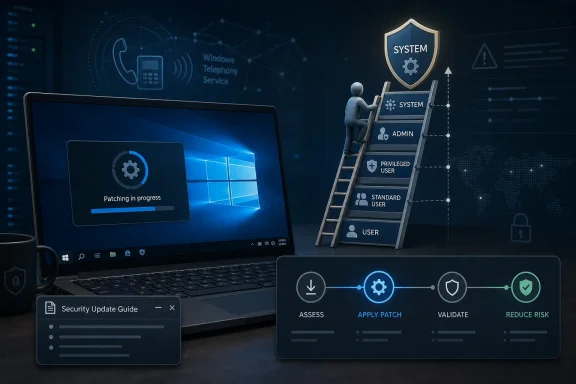
A low-privileged user context is a cage. A successful elevation-of-privilege exploit can turn that cage into a workstation takeover, a service-level compromise, or a path to credential material. On Windows, the difference between a normal user and SYSTEM is the difference between annoyance and control.
This is why security teams track EoP bugs alongside remote-code-execution flaws. RCE may provide entry, but EoP helps establish dominance. In ransomware intrusions, espionage operations, and hands-on-keyboard compromises, the middle step is often where the defender loses the ability to contain the attacker cleanly.
CVE-2026-40382’s placement in the Telephony Service also deserves attention because services frequently run with elevated privileges and expose local interfaces that ordinary users or processes can reach. Even when the exploit is local, the affected service boundary may provide the privilege transition attackers want.
That does not make those components useless. It makes them difficult to reason about. Code paths that are rarely touched by consumers may still be present on endpoints, servers, virtual desktops, and specialized business systems.
The security challenge is that legacy-facing components often sit below the user’s line of sight. A person may never knowingly use the Windows Telephony Service, yet the component may still be installed, registered, or reachable depending on configuration and edition. For administrators, “we do not use that feature” is not the same as “that feature cannot be attacked.”
This is the recurring Windows bargain. Compatibility keeps organizations running, but compatibility also preserves attack surface. Microsoft’s patching machinery exists because the operating system cannot simply amputate every old subsystem that looks unfashionable in 2026.
The harder part is operational. Enterprises need to know which systems are covered by normal update rings, which are delayed by application testing, which are governed by maintenance windows, and which are stranded because they are out of support or dependent on fragile line-of-business software.
This is where vulnerability management becomes less about CVSS theater and more about asset truth. A Telephony Service EoP bug on a fully managed laptop fleet may be absorbed into routine Patch Tuesday deployment. The same bug on kiosk systems, call-center desktops, virtual desktop pools, or old server images may linger for months.
Administrators should also resist the temptation to solve every Windows component vulnerability by disabling services blindly. If a service is genuinely unnecessary and can be disabled safely, reduction of attack surface is sensible. But service changes should be tested, documented, and deployed through policy rather than improvised after a CVE headline.
A criminal operator does not need every victim to be vulnerable. They need enough laggards. If a bug becomes incorporated into a post-exploitation kit, the attacker’s question is not whether the advisory was dramatic; it is whether the target’s endpoint build is old enough.
This is why patch latency matters. A vulnerability that is merely theoretical on release day can become routine tradecraft after patch diffing, exploit development, and toolchain integration. The public record may stay quiet while private exploitation matures.
For defenders, the correct posture is measured urgency. CVE-2026-40382 should not trigger panic if there is no evidence of active exploitation or public weaponization. But it should not be waved away as obscure simply because the component is unglamorous.
The vulnerability also reinforces the value of least privilege. If users routinely operate with local administrator rights, an elevation-of-privilege bug loses some of its practical distinction because the environment has already surrendered the boundary. If users are properly constrained, EoP bugs become more important precisely because they are one of the ways attackers try to break that constraint.
Endpoint detection and response tooling may help identify suspicious behavior around service abuse, token manipulation, unusual child processes, or post-exploitation activity. But detection should be treated as a compensating control, not a substitute for patching. Once a vendor fix exists, the cleanest mitigation is still to remove the vulnerable code path.
Security teams should also review whether their vulnerability scanners and patch dashboards correctly surface this CVE. Microsoft’s Security Update Guide is authoritative, but organizations often consume its data through layers of tooling, and those layers can lag, misclassify, or bury an issue among dozens of monthly fixes.
Source: MSRC Security Update Guide - Microsoft Security Response Center
 Microsoft’s Sparse Advisory Still Says Plenty
The notable thing about CVE-2026-40382 is not that Microsoft has published a cinematic story of exploitation. It has not. The advisory, as presented through the Security Update Guide, frames the bug as an elevation-of-privilege issue in the Windows Telephony Service, which means the center of gravity is not initial compromise but post-compromise leverage.That distinction is often misunderstood outside enterprise security teams. A privilege-escalation flaw does not usually get an attacker through the front door by itself. It becomes dangerous after phishing, stolen credentials, exposed services, malicious documents, or another weakness has already given an intruder limited execution or access.
For defenders, that makes the bug less theatrical but not less important. Modern attacks rarely rely on a single vulnerability from start to finish. They are campaigns of accumulation: obtain a foothold, escalate rights, disable defenses, move laterally, and then steal or encrypt what matters.
The Windows Telephony Service also sits in the uncomfortable category of legacy-sounding components that remain present because Windows has decades of compatibility obligations. Telephony APIs, remote access assumptions, modems, call-control abstractions, and enterprise integration points may sound like artifacts from another computing era, but Windows’ attack surface is often made of precisely these old commitments.
The Confidence Metric Is a Warning Against Overreading the Silence
The user-supplied MSRC text describes a metric that measures confidence in the existence of a vulnerability and in the credibility of known technical details. That language matters because it reminds readers that a CVE is not a complete technical dossier. Sometimes it is a vendor-confirmed statement that a flaw exists, not an invitation to reverse-engineer the patch in public prose.In practical terms, a Microsoft acknowledgement carries more weight than rumor, paste-site chatter, or a third-party scanner entry. If the vendor names the vulnerable component and ships an update, administrators should assume the vulnerability is real. What may remain uncertain is the precise root cause, exploit path, and operational difficulty.
That uncertainty cuts both ways. It means defenders should avoid inventing details Microsoft has not provided. But it also means they should not treat the absence of public exploit notes as evidence of safety.
Attackers do not need a vendor blog post to learn from a patch. Once binaries are updated, skilled researchers and criminal teams can compare old and new code, inspect changed functions, and infer the vulnerable pattern. The gap between “not publicly exploited” and “understood well enough to weaponize” can be shorter than many patch calendars assume.
Elevation of Privilege Is the Attack Chain’s Middle Gear
Privilege-escalation vulnerabilities are easy to underrate because they do not usually read like disaster headlines. They often require local access, existing code execution, or a foothold that defenders would already classify as a failure. But in real intrusions, that is exactly why they matter.A low-privileged user context is a cage. A successful elevation-of-privilege exploit can turn that cage into a workstation takeover, a service-level compromise, or a path to credential material. On Windows, the difference between a normal user and SYSTEM is the difference between annoyance and control.
This is why security teams track EoP bugs alongside remote-code-execution flaws. RCE may provide entry, but EoP helps establish dominance. In ransomware intrusions, espionage operations, and hands-on-keyboard compromises, the middle step is often where the defender loses the ability to contain the attacker cleanly.
CVE-2026-40382’s placement in the Telephony Service also deserves attention because services frequently run with elevated privileges and expose local interfaces that ordinary users or processes can reach. Even when the exploit is local, the affected service boundary may provide the privilege transition attackers want.
The Old Windows Surface Keeps Becoming New Again
Windows is not one operating system so much as a living museum of enterprise requirements. APIs built for dial-up networking, fax services, PBX integration, remote access, smart cards, print workflows, management agents, and compatibility layers can persist long after most users forget they exist.That does not make those components useless. It makes them difficult to reason about. Code paths that are rarely touched by consumers may still be present on endpoints, servers, virtual desktops, and specialized business systems.
The security challenge is that legacy-facing components often sit below the user’s line of sight. A person may never knowingly use the Windows Telephony Service, yet the component may still be installed, registered, or reachable depending on configuration and edition. For administrators, “we do not use that feature” is not the same as “that feature cannot be attacked.”
This is the recurring Windows bargain. Compatibility keeps organizations running, but compatibility also preserves attack surface. Microsoft’s patching machinery exists because the operating system cannot simply amputate every old subsystem that looks unfashionable in 2026.
The Patch Is the Mitigation, but Inventory Is the Discipline
The immediate action for CVE-2026-40382 is straightforward: apply the relevant Microsoft security updates for supported Windows versions. That is not a glamorous recommendation, but it is the one that closes the vendor-confirmed flaw.The harder part is operational. Enterprises need to know which systems are covered by normal update rings, which are delayed by application testing, which are governed by maintenance windows, and which are stranded because they are out of support or dependent on fragile line-of-business software.
This is where vulnerability management becomes less about CVSS theater and more about asset truth. A Telephony Service EoP bug on a fully managed laptop fleet may be absorbed into routine Patch Tuesday deployment. The same bug on kiosk systems, call-center desktops, virtual desktop pools, or old server images may linger for months.
Administrators should also resist the temptation to solve every Windows component vulnerability by disabling services blindly. If a service is genuinely unnecessary and can be disabled safely, reduction of attack surface is sensible. But service changes should be tested, documented, and deployed through policy rather than improvised after a CVE headline.
Attackers Love the Bugs That Administrators Defer
The most dangerous vulnerabilities are not always the ones with the highest score. They are the ones that fit into the attacker’s workflow and remain unpatched long enough to be useful. Elevation-of-privilege bugs in common operating-system components often satisfy both conditions.A criminal operator does not need every victim to be vulnerable. They need enough laggards. If a bug becomes incorporated into a post-exploitation kit, the attacker’s question is not whether the advisory was dramatic; it is whether the target’s endpoint build is old enough.
This is why patch latency matters. A vulnerability that is merely theoretical on release day can become routine tradecraft after patch diffing, exploit development, and toolchain integration. The public record may stay quiet while private exploitation matures.
For defenders, the correct posture is measured urgency. CVE-2026-40382 should not trigger panic if there is no evidence of active exploitation or public weaponization. But it should not be waved away as obscure simply because the component is unglamorous.
Where Windows Admins Should Put This in the Queue
CVE-2026-40382 belongs in the normal Windows security-update priority lane, with extra attention for systems where privilege escalation would produce outsized damage. Domain-joined endpoints, administrator workstations, jump boxes, remote-access hosts, VDI images, and shared machines deserve particular care.The vulnerability also reinforces the value of least privilege. If users routinely operate with local administrator rights, an elevation-of-privilege bug loses some of its practical distinction because the environment has already surrendered the boundary. If users are properly constrained, EoP bugs become more important precisely because they are one of the ways attackers try to break that constraint.
Endpoint detection and response tooling may help identify suspicious behavior around service abuse, token manipulation, unusual child processes, or post-exploitation activity. But detection should be treated as a compensating control, not a substitute for patching. Once a vendor fix exists, the cleanest mitigation is still to remove the vulnerable code path.
Security teams should also review whether their vulnerability scanners and patch dashboards correctly surface this CVE. Microsoft’s Security Update Guide is authoritative, but organizations often consume its data through layers of tooling, and those layers can lag, misclassify, or bury an issue among dozens of monthly fixes.
The Practical Reading of CVE-2026-40382
The most useful interpretation of this advisory is not that every Windows system is on fire. It is that Microsoft has confirmed another privilege boundary problem in a Windows service, and that the fix should move through the same disciplined patch process organizations claim to have built for exactly this situation.- Microsoft has identified CVE-2026-40382 as an elevation-of-privilege vulnerability in the Windows Telephony Service.
- The advisory should be treated as credible because it comes through Microsoft’s own Security Update Guide, even if public technical detail is limited.
- The bug is most relevant as part of an attack chain after an adversary has gained some level of access to a Windows system.
- Administrators should prioritize supported Windows systems where higher privileges would expose credentials, management tools, sensitive data, or lateral-movement paths.
- The absence of public exploit detail should not be confused with low risk, because patch diffing can turn sparse advisories into usable attacker knowledge.
- The right response is prompt patch deployment, validation through update tooling, and cautious service-hardening only where testing confirms it will not break business workflows.
Source: MSRC Security Update Guide - Microsoft Security Response Center
