

Microsoft lists CVE-2026-42825 as a Windows Telephony Service elevation-of-privilege vulnerability in the Security Update Guide, but the publicly accessible record currently offers little beyond the product area, vulnerability class, and Microsoft’s own confidence framing for how much technical detail is known. That scarcity is the story. For administrators, the immediate question is not whether Telephony Service sounds obscure enough to ignore, but whether a Windows component with privilege implications can be safely left to normal patch cadence. The answer, as usual with Windows internals, is that “obscure” and “low-risk” are not synonyms.
The entry for CVE-2026-42825 sits in a familiar category: Windows elevation of privilege. These bugs rarely produce the cinematic first compromise that grabs headlines, but they often matter in the middle of an intrusion, where an attacker has a foothold and wants to become more powerful, more persistent, or harder to remove.
The submitted Microsoft text is about report confidence, a CVSS environmental metric that tries to describe how certain the industry is that a vulnerability exists and how credible the available technical details are. That is not trivia. In patch triage, confidence changes the way defenders should read uncertainty: a vague report from an unverified source is different from a vendor-confirmed flaw, even when both receive the same severity label.
For CVE-2026-42825, the most important practical point is that Microsoft has placed the vulnerability in its Security Update Guide under Windows Telephony Service. That means defenders should treat it as a vendor-acknowledged Windows issue, not as speculative chatter. The absence of exploit code, root-cause notes, or public proof-of-concept material should reduce panic, not reduce priority.
That is precisely why it matters. Attackers do not need a component to be glamorous; they need it to be reachable, privileged, under-monitored, or poorly understood. Services that sit outside the everyday attention of desktop users can become attractive because defenders often lack crisp inventories of where and why they are enabled.
Elevation-of-privilege vulnerabilities in such components are especially uncomfortable. They imply that the attacker may already need some position on or near the target system, but once there, the vulnerable service can become a rung on the ladder. In real incidents, that ladder matters as much as the front door.
When confidence is high, defenders should assume the flaw is real and that enough information exists for capable attackers to reason about it. When confidence is lower, defenders still may need to act, but they should distinguish between “we have a confirmed patchable bug” and “we have a plausible report with limited technical detail.”
That distinction matters for CVE-2026-42825 because the public detail appears constrained. Microsoft’s acknowledgement gives the issue credibility, while the limited technical disclosure means most administrators cannot independently model the bug from first principles. In that gap, patch management becomes less about debating exploit mechanics and more about reducing exposure to a confirmed weakness.
A phishing payload running as a standard user is bad. The same payload that can climb into a service context, disable protections, dump credentials, or implant itself under a higher-privilege account is worse by an order of magnitude. EoP bugs are the accelerants of post-compromise activity.
This is why Windows EoP vulnerabilities routinely deserve attention even when they are not publicly exploited on day one. They are useful in chains. They pair with browser bugs, document-parser flaws, stolen credentials, misconfigured remote access, and living-off-the-land techniques. The attacker’s path is rarely one vulnerability wide.
But scarcity also means administrators have less to validate. They cannot easily determine whether a particular configuration is exposed, whether a compensating control blocks the vulnerable path, or whether a service can be safely disabled without affecting applications. In Windows environments, that uncertainty usually favors patching over clever workaround design.
This is especially true for broadly deployed components. A niche flaw in a clearly optional product can be isolated with inventory. A flaw in an operating-system service, even one many users never knowingly touch, is harder to reason about across fleets. The risk is not that every machine is equally vulnerable in practice; it is that many organizations will not know which machines matter until after the update window has passed.
For well-managed endpoints, that means normal security update deployment, validation against critical applications, and monitoring for installation failures. For servers, it means checking whether Telephony Service is enabled or required, but not using that check as an excuse to defer updates indefinitely. For legacy systems, it means acknowledging the uncomfortable truth that every unsupported or slow-patched Windows build turns ordinary EoP bugs into long-term operational debt.
The organizations most at risk are not necessarily the ones with the most Telephony usage. They are the ones with inconsistent patch visibility. A vulnerability like this punishes uncertainty: unknown service state, unknown build level, unknown reboot status, unknown exceptions.
CVE-2026-42825 is a reminder that vulnerability management is not just scoring and sorting. A medium-looking or merely “important” Windows flaw can become strategically relevant if it lands on machines that are poorly governed. Attackers are good at finding the systems that the dashboard treats as edge cases.
The Telephony Service angle sharpens that point because few executives are asking for a monthly TAPI exposure report. Yet old Windows services often persist because removing them is harder than ignoring them. That asymmetry is one of the oldest security problems in enterprise computing.
That review should be careful rather than performative. Windows services can have dependencies, and enterprise applications sometimes use dusty APIs in ways nobody remembers until they break. The right approach is staged testing, change control, and documentation, not a weekend purge.
Still, the broader principle holds: every enabled service is part of the attack surface. The fact that a component ships with Windows does not mean every workload needs it. Security baselines exist because defaults are designed for compatibility, not for the narrowest possible exposure.
That does not make Windows uniquely doomed; it makes Windows consequential. A flaw in a little-used Linux daemon matters to the systems that run it. A flaw in a Windows service can matter across desktops, servers, virtual desktops, industrial terminals, and management jump boxes simply because Windows is everywhere.
The mature reading of CVE-2026-42825 is therefore neither alarmist nor dismissive. It is one more entry in the ledger showing that defenders cannot secure Windows by paying attention only to the famous components. The boring services are part of the platform too.
In this case, Microsoft’s own advisory presence should carry more weight than the lack of public reverse-engineering detail. Vendor acknowledgement changes the burden of proof. Defenders do not need a blog post with call stacks to justify installing a security update for a Windows service.
At the same time, the lack of public technical detail should restrain overclaiming. Without confirmed exploitation status, exploit prerequisites, or a published root-cause analysis, nobody should pretend to know exactly how CVE-2026-42825 will be used in the wild. The honest posture is practical caution: patch it, verify it, and avoid building a mythology around it.
Security teams should also watch for the secondary effects that often accompany Windows patching. Failed installations, supersedence confusion, offline devices, stale WSUS approvals, and maintenance-window collisions can leave pockets of exposure. Those pockets are where attackers and auditors both tend to find leverage.
For smaller environments, the advice is simpler: do not skip the monthly Windows security update because the service name sounds irrelevant. Many users have no idea which Windows services are active on their machines. That is why the platform’s cumulative update model exists.
Source: MSRC Security Update Guide - Microsoft Security Response Center
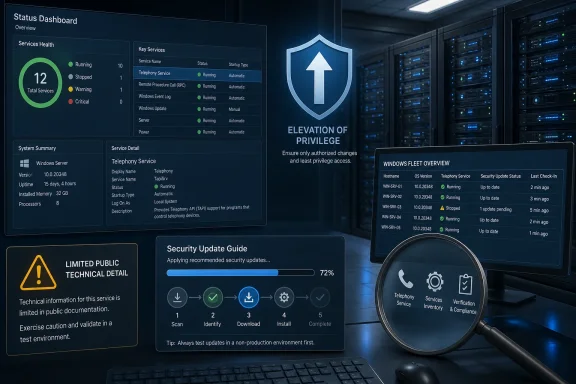 Microsoft’s Sparse Advisory Still Carries a Clear Operational Message
The entry for CVE-2026-42825 sits in a familiar category: Windows elevation of privilege. These bugs rarely produce the cinematic first compromise that grabs headlines, but they often matter in the middle of an intrusion, where an attacker has a foothold and wants to become more powerful, more persistent, or harder to remove.The submitted Microsoft text is about report confidence, a CVSS environmental metric that tries to describe how certain the industry is that a vulnerability exists and how credible the available technical details are. That is not trivia. In patch triage, confidence changes the way defenders should read uncertainty: a vague report from an unverified source is different from a vendor-confirmed flaw, even when both receive the same severity label.
For CVE-2026-42825, the most important practical point is that Microsoft has placed the vulnerability in its Security Update Guide under Windows Telephony Service. That means defenders should treat it as a vendor-acknowledged Windows issue, not as speculative chatter. The absence of exploit code, root-cause notes, or public proof-of-concept material should reduce panic, not reduce priority.
The Telephony Service Is Legacy Plumbing That Still Deserves Modern Threat Modeling
Windows Telephony Service is not a fashionable attack surface. It belongs to the long tail of Windows subsystems that exist because enterprises have decades of compatibility requirements, management integrations, and application assumptions layered into the operating system.That is precisely why it matters. Attackers do not need a component to be glamorous; they need it to be reachable, privileged, under-monitored, or poorly understood. Services that sit outside the everyday attention of desktop users can become attractive because defenders often lack crisp inventories of where and why they are enabled.
Elevation-of-privilege vulnerabilities in such components are especially uncomfortable. They imply that the attacker may already need some position on or near the target system, but once there, the vulnerable service can become a rung on the ladder. In real incidents, that ladder matters as much as the front door.
Report Confidence Is a Triage Signal, Not a Comfort Blanket
The report-confidence language Microsoft surfaces is easy to skim past because it sounds like standards-body prose. It is actually one of the more honest parts of vulnerability scoring. It admits that public vulnerability data exists on a spectrum: rumor, partial analysis, researcher claim, exploit observation, and vendor confirmation.When confidence is high, defenders should assume the flaw is real and that enough information exists for capable attackers to reason about it. When confidence is lower, defenders still may need to act, but they should distinguish between “we have a confirmed patchable bug” and “we have a plausible report with limited technical detail.”
That distinction matters for CVE-2026-42825 because the public detail appears constrained. Microsoft’s acknowledgement gives the issue credibility, while the limited technical disclosure means most administrators cannot independently model the bug from first principles. In that gap, patch management becomes less about debating exploit mechanics and more about reducing exposure to a confirmed weakness.
Elevation of Privilege Is Where Small Windows Bugs Become Big Incidents
Security teams often prioritize remote code execution above all else, and for understandable reasons. A remotely exploitable unauthenticated bug can create a race against the internet. But elevation of privilege is the category that often turns a contained compromise into a domain problem.A phishing payload running as a standard user is bad. The same payload that can climb into a service context, disable protections, dump credentials, or implant itself under a higher-privilege account is worse by an order of magnitude. EoP bugs are the accelerants of post-compromise activity.
This is why Windows EoP vulnerabilities routinely deserve attention even when they are not publicly exploited on day one. They are useful in chains. They pair with browser bugs, document-parser flaws, stolen credentials, misconfigured remote access, and living-off-the-land techniques. The attacker’s path is rarely one vulnerability wide.
The Absence of Public Exploit Detail Cuts Both Ways
There is a temptation to interpret missing public detail as good news. Sometimes it is. If no exploit is public, no active exploitation is reported, and the technical root cause is not widely described, defenders may reasonably avoid emergency theatrics.But scarcity also means administrators have less to validate. They cannot easily determine whether a particular configuration is exposed, whether a compensating control blocks the vulnerable path, or whether a service can be safely disabled without affecting applications. In Windows environments, that uncertainty usually favors patching over clever workaround design.
This is especially true for broadly deployed components. A niche flaw in a clearly optional product can be isolated with inventory. A flaw in an operating-system service, even one many users never knowingly touch, is harder to reason about across fleets. The risk is not that every machine is equally vulnerable in practice; it is that many organizations will not know which machines matter until after the update window has passed.
Administrators Should Read This as a Patch-Cadence Test
The correct response to CVE-2026-42825 is not to rip Telephony Service out of Windows or to declare another forgotten subsystem a crisis. The correct response is to ask whether the organization’s Windows update process can absorb a vendor-confirmed EoP without drama.For well-managed endpoints, that means normal security update deployment, validation against critical applications, and monitoring for installation failures. For servers, it means checking whether Telephony Service is enabled or required, but not using that check as an excuse to defer updates indefinitely. For legacy systems, it means acknowledging the uncomfortable truth that every unsupported or slow-patched Windows build turns ordinary EoP bugs into long-term operational debt.
The organizations most at risk are not necessarily the ones with the most Telephony usage. They are the ones with inconsistent patch visibility. A vulnerability like this punishes uncertainty: unknown service state, unknown build level, unknown reboot status, unknown exceptions.
The Real Exposure Is the Windows Estate You Cannot Describe
Every Windows security update cycle eventually becomes an inventory story. Which builds are still present? Which machines missed last month’s cumulative update? Which servers are pinned for vendor support reasons? Which endpoints are outside management because they belong to a lab, a contractor, or a forgotten kiosk?CVE-2026-42825 is a reminder that vulnerability management is not just scoring and sorting. A medium-looking or merely “important” Windows flaw can become strategically relevant if it lands on machines that are poorly governed. Attackers are good at finding the systems that the dashboard treats as edge cases.
The Telephony Service angle sharpens that point because few executives are asking for a monthly TAPI exposure report. Yet old Windows services often persist because removing them is harder than ignoring them. That asymmetry is one of the oldest security problems in enterprise computing.
The Patch Is the Minimum; Service Hygiene Is the Lesson
Patching should be the first move, but it should not be the only lesson. After the update is deployed, administrators should review whether Telephony Service is necessary on sensitive servers and managed endpoints. If it is not required, disabling or restricting unnecessary services remains a basic hardening measure.That review should be careful rather than performative. Windows services can have dependencies, and enterprise applications sometimes use dusty APIs in ways nobody remembers until they break. The right approach is staged testing, change control, and documentation, not a weekend purge.
Still, the broader principle holds: every enabled service is part of the attack surface. The fact that a component ships with Windows does not mean every workload needs it. Security baselines exist because defaults are designed for compatibility, not for the narrowest possible exposure.
The Signal Beneath CVE-2026-42825 Is Bigger Than One Bug
Microsoft’s Windows security model is now a balancing act between legacy compatibility and modern hardening. The company has made real progress in memory protections, credential isolation, kernel attack-surface reduction, and default security posture. Yet the operating system remains vast, and vast systems generate obscure vulnerabilities.That does not make Windows uniquely doomed; it makes Windows consequential. A flaw in a little-used Linux daemon matters to the systems that run it. A flaw in a Windows service can matter across desktops, servers, virtual desktops, industrial terminals, and management jump boxes simply because Windows is everywhere.
The mature reading of CVE-2026-42825 is therefore neither alarmist nor dismissive. It is one more entry in the ledger showing that defenders cannot secure Windows by paying attention only to the famous components. The boring services are part of the platform too.
The CVSS Fine Print Is Trying to Tell Administrators How Much to Trust the Story
The report-confidence metric exists because vulnerability records often travel faster than full understanding. Early advisories may tell defenders that a flaw exists before they explain precisely why it exists. That is frustrating, but it is also part of coordinated disclosure.In this case, Microsoft’s own advisory presence should carry more weight than the lack of public reverse-engineering detail. Vendor acknowledgement changes the burden of proof. Defenders do not need a blog post with call stacks to justify installing a security update for a Windows service.
At the same time, the lack of public technical detail should restrain overclaiming. Without confirmed exploitation status, exploit prerequisites, or a published root-cause analysis, nobody should pretend to know exactly how CVE-2026-42825 will be used in the wild. The honest posture is practical caution: patch it, verify it, and avoid building a mythology around it.
The Patch Queue Should Treat This as a Confirmed Windows Risk
The concrete response is straightforward, even if the underlying Windows internals are not. Organizations should identify affected Windows builds through their normal update tooling, deploy the relevant cumulative security updates, and confirm that machines actually reach the fixed build state. In Windows servicing, “approved” is not the same as “installed,” and “installed” is not always the same as “successfully rebooted.”Security teams should also watch for the secondary effects that often accompany Windows patching. Failed installations, supersedence confusion, offline devices, stale WSUS approvals, and maintenance-window collisions can leave pockets of exposure. Those pockets are where attackers and auditors both tend to find leverage.
For smaller environments, the advice is simpler: do not skip the monthly Windows security update because the service name sounds irrelevant. Many users have no idea which Windows services are active on their machines. That is why the platform’s cumulative update model exists.
The Practical Reading for WindowsForum Readers
CVE-2026-42825 is not the kind of vulnerability that should send administrators into public-exploit panic based on the information currently visible. It is, however, exactly the kind of Windows flaw that rewards disciplined patch operations and punishes hand-waving.- Microsoft’s listing makes CVE-2026-42825 a vendor-recognized Windows Telephony Service elevation-of-privilege issue, not an unverified rumor.
- The public technical detail appears limited, so defenders should avoid assuming either exploitability or safety beyond what the advisory establishes.
- Elevation-of-privilege bugs matter because they often strengthen an attacker’s position after initial access rather than serving as the initial entry point.
- Telephony Service should be reviewed as part of service-hardening work, especially on systems where it has no clear business purpose.
- The most important operational task is to verify successful installation of the relevant Windows security update across the fleet, including systems that routinely miss maintenance windows.
- Organizations with unmanaged legacy Windows systems should treat this as another reminder that unsupported or poorly inventoried machines convert routine vulnerabilities into durable risk.
Source: MSRC Security Update Guide - Microsoft Security Response Center
