

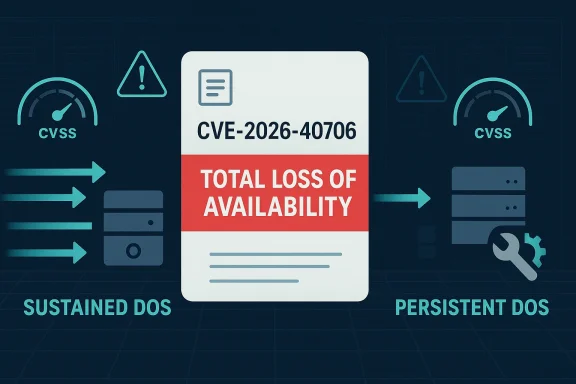
CVE-2026-40706 is a denial-of-service issue in Microsoft’s Security Update Guide classification, and the wording Microsoft uses matters as much as the CVE itself. The description indicates that an attacker can cause a total loss of availability in the impacted component, either while the attack is actively running or in a way that persists after the attack ends. In practical terms, that puts the vulnerability in the category of availability failures with real operational consequences, not just a nuisance crash. Microsoft’s Security Update Guide has, for years, framed CVE entries in CVSS-style language so administrators can understand the impact quickly and compare it across products and releases.
Microsoft’s move to standardize vulnerability descriptions was not cosmetic. The Security Update Guide now aims to make each CVE readable through the same lens security teams already use for triage: attack vector, privileges required, user interaction, and impact. That means a sentence like the one attached to CVE-2026-40706 is designed to tell defenders, at a glance, whether the primary risk is confidentiality, integrity, or availability, and whether the effect is temporary or persistent.
For availability bugs, the distinction is often operationally decisive. A transient outage during an active attack can still be serious, but a persistent condition that survives the attack window changes the problem from a network event into an incident-response event. In Microsoft’s CVSS-aligned wording, that is exactly what the description emphasizes: either the attacker can keep the component down continuously, or the attacker can trigger a recurring condition that results in complete unavailability over time.
This is also the kind of language Microsoft uses when the exploit does not necessarily need to break into the whole system to be damaging. A component can be critical even if the blast radius is narrow, because total loss of availability in the wrong service can still take down user workflows, dependent applications, or an entire management plane. That is why Microsoft’s Security Update Guide focuses on impact, not just exploit mechanics.
From a response standpoint, the most important takeaway is simple: if your environment includes the impacted component, treat this as a service-stability issue first and a pure vulnerability second. In enterprise settings, that often means patching, validating failover, and checking whether upstream systems depend on the vulnerable component in ways that multiply the outage. Microsoft’s own guidance around security updates repeatedly stresses minimizing customer disruption while maximizing protection, which is exactly the balance an availability CVE forces organizations to think about.
That evolution matters because a CVE number alone rarely tells the whole story. Security teams need to know whether the issue is remote, local, authenticated, or user-triggered; whether it affects a single service or multiple versions; and whether the outcome is data theft, code execution, privilege escalation, or denial of service. Microsoft’s documentation model is intended to compress that analysis into a format defenders can consume quickly, especially during patch cycles.
CVE-2026-40706 fits that model, but the important nuance is the impact description itself. Microsoft’s phrasing says the attacker can cause “total loss of availability” in the impacted component, which strongly suggests a service interruption vulnerability rather than an exploit that directly steals data or executes code. In security operations, that kind of issue can be underestimated because it may not look dramatic in a malware sense, yet it can still be highly disruptive in production.
Historically, availability bugs have often created the biggest friction when they hit infrastructure services, update services, identity systems, or management endpoints. Even when the vulnerability is narrow, the downstream effect can be broad if other systems depend on that component’s uptime. That is why Microsoft’s own update guidance and blog posts repeatedly frame patching as part of a broader resilience strategy, not just a security checkbox.
The broader context is also Microsoft’s growing transparency around vulnerability metadata. In recent years, Microsoft has added CWE information, machine-readable CSAF files, and other publication improvements to the Security Update Guide ecosystem. That tells us the company wants defenders to make faster, more accurate decisions from published CVE records, and availability-impact CVEs benefit enormously from that clarity because their real-world danger depends on how central the affected component is to business operations.
Microsoft’s description also covers two flavors of availability damage. One is sustained denial, where the attacker must keep sending malicious traffic or requests to hold the component down. The other is persistent denial, where the component remains broken even after the attack has stopped. That second category is particularly dangerous because it can turn a security incident into a prolonged operational outage.
A persistent condition is more troubling. If a single exploit leaves the component in a bad state, then restarting the attack is not necessary; remediation becomes about restoring normal operation, not just stopping traffic. In that sense, persistence multiplies the operational cost, because teams must investigate why the component failed and whether the failure can recur after reboot or restart.
For administrators, those distinctions affect both patch prioritization and recovery planning. A sustained outage may be mitigated with traffic controls and failover, but a persistent one may require service rebuilds, configuration cleanup, or even broader environmental changes. That is why Microsoft’s wording is so explicit: it tells defenders to think beyond a simple “block the source” mindset.
The wording also indicates that the vulnerability is not necessarily about breaching confidentiality or integrity. That matters because the remediation strategy is different. Instead of hunting for stolen credentials or code injection artifacts, defenders may need to look for outage signatures, service crashes, repeated restart loops, or component-level exhaustion.
If the impacted component is part of infrastructure, the blast radius can be much larger than the component name suggests. Microsoft has previously noted in other vulnerability contexts that an issue in one place can affect systems that merely interact with it, not just the host that contains it. That pattern is one reason administrators should read “impacted component” as a warning sign for dependencies, not just a product label.
The practical response is to map upstream and downstream reliance before the next maintenance window. If the vulnerable component underpins desktop access, management tooling, or a central service, the outage risk is no longer confined to one server or one endpoint. In enterprise environments, that is exactly how a supposedly narrow CVE becomes a business continuity issue.
Organizations should treat a published availability CVE as a reason to review maintenance windows, cluster resilience, and rollback plans immediately. If the component is clustered or load-balanced, teams should verify whether the patch can be applied without taking all nodes down at once. If the component is not redundant, the patch may need to be paired with a contingency plan to preserve service during remediation.
There is also an enterprise communications angle. Availability incidents create visible pressure from operations, leadership, and end users, which means security and IT teams need a crisp message about whether they are dealing with an attack, a defect, or both. Microsoft’s increasingly structured vulnerability publishing is useful here because it gives teams standardized language to explain the issue without overclaiming.
For enterprises, the stakes are much higher because the same impacted component may support multiple users, multiple sites, or multiple business processes. If the vulnerable service sits in an identity path, a backup path, a management path, or a delivery path, one outage can quickly spread into a wider operational event. That is why enterprise patch teams should not treat availability CVEs as second-tier issues.
The larger lesson is that security and reliability are converging disciplines. A bug that denies service is not merely “less severe” than code execution; it can be more disruptive in organizations that value uptime above all else. Microsoft’s own update strategy reflects that reality by emphasizing both customer protection and operational continuity.
In some cases, the difference between a crash bug and a persistent outage is whether the damaged component can recover cleanly. If the exploit corrupts state, depletes a resource, or triggers a condition that survives restart, the remediation path becomes more complicated than a straightforward restart. That is why the Microsoft wording carefully covers both transient and persistent outcomes.
That analysis matters because mitigation differs by bug class. Crash bugs may be blocked by reducing exposure or filtering specific inputs. Exhaustion bugs may need throttling, quotas, or load-balancing changes. Logic bugs often need a patch and a careful review of any workaround to ensure it does not create a new failure mode.
It is also worth noting that Microsoft has invested heavily in making its vulnerability reporting more useful for precisely this kind of analysis. The company’s publication of root-cause data via CWE standards and its expanding machine-readable feeds suggest a future where defenders can sort availability issues more intelligently by class, not just by product. That trend is likely to make CVE response faster and less error-prone over time.
That transparency matters even more for availability defects because the operational context can be very different from the headline. A security team needs to know whether a bug is remotely triggerable, whether it requires authentication, whether the effect persists, and which products are affected. Microsoft’s documentation ecosystem is increasingly structured to answer those questions consistently.
That translation layer is one of the most important jobs in security journalism and security operations alike. It turns a CVE identifier into a decision: patch now, patch in the next window, or isolate while validating. Microsoft’s documentation improvements help make that decision faster and more defensible.
It is also worth watching whether the vulnerability is linked to a broader class of stability issues. Microsoft’s recent transparency work around CWE, CSAF, and structured security guidance suggests that future CVE pages may make root-cause analysis easier to automate and compare. That would be particularly useful for availability bugs, which often require defenders to correlate product behavior, service logs, and operational impact before the full story is clear.
Source: MSRC Security Update Guide - Microsoft Security Response Center
 Overview
Microsoft’s move to standardize vulnerability descriptions was not cosmetic. The Security Update Guide now aims to make each CVE readable through the same lens security teams already use for triage: attack vector, privileges required, user interaction, and impact. That means a sentence like the one attached to CVE-2026-40706 is designed to tell defenders, at a glance, whether the primary risk is confidentiality, integrity, or availability, and whether the effect is temporary or persistent.For availability bugs, the distinction is often operationally decisive. A transient outage during an active attack can still be serious, but a persistent condition that survives the attack window changes the problem from a network event into an incident-response event. In Microsoft’s CVSS-aligned wording, that is exactly what the description emphasizes: either the attacker can keep the component down continuously, or the attacker can trigger a recurring condition that results in complete unavailability over time.
This is also the kind of language Microsoft uses when the exploit does not necessarily need to break into the whole system to be damaging. A component can be critical even if the blast radius is narrow, because total loss of availability in the wrong service can still take down user workflows, dependent applications, or an entire management plane. That is why Microsoft’s Security Update Guide focuses on impact, not just exploit mechanics.
From a response standpoint, the most important takeaway is simple: if your environment includes the impacted component, treat this as a service-stability issue first and a pure vulnerability second. In enterprise settings, that often means patching, validating failover, and checking whether upstream systems depend on the vulnerable component in ways that multiply the outage. Microsoft’s own guidance around security updates repeatedly stresses minimizing customer disruption while maximizing protection, which is exactly the balance an availability CVE forces organizations to think about.
Background
Microsoft’s Security Update Guide has evolved into more than a bulletin board for patch data. It is now a structured feed of vulnerability intelligence that includes CVE records, CVSS-style scoring, and machine-readable release information so organizations can automate triage and reporting. Microsoft explicitly described that transition when it shifted the guide to CVSS-based vulnerability descriptions, noting that the goal was to give customers a precise method for understanding the attack conditions and effects.That evolution matters because a CVE number alone rarely tells the whole story. Security teams need to know whether the issue is remote, local, authenticated, or user-triggered; whether it affects a single service or multiple versions; and whether the outcome is data theft, code execution, privilege escalation, or denial of service. Microsoft’s documentation model is intended to compress that analysis into a format defenders can consume quickly, especially during patch cycles.
CVE-2026-40706 fits that model, but the important nuance is the impact description itself. Microsoft’s phrasing says the attacker can cause “total loss of availability” in the impacted component, which strongly suggests a service interruption vulnerability rather than an exploit that directly steals data or executes code. In security operations, that kind of issue can be underestimated because it may not look dramatic in a malware sense, yet it can still be highly disruptive in production.
Historically, availability bugs have often created the biggest friction when they hit infrastructure services, update services, identity systems, or management endpoints. Even when the vulnerability is narrow, the downstream effect can be broad if other systems depend on that component’s uptime. That is why Microsoft’s own update guidance and blog posts repeatedly frame patching as part of a broader resilience strategy, not just a security checkbox.
The broader context is also Microsoft’s growing transparency around vulnerability metadata. In recent years, Microsoft has added CWE information, machine-readable CSAF files, and other publication improvements to the Security Update Guide ecosystem. That tells us the company wants defenders to make faster, more accurate decisions from published CVE records, and availability-impact CVEs benefit enormously from that clarity because their real-world danger depends on how central the affected component is to business operations.
What the Availability Language Really Means
The phrase “total loss of availability” is the heart of the issue. In plain English, it means the attacker can make the impacted component stop serving its intended function entirely, not merely slow it down or degrade performance slightly. That may sound obvious, but in vulnerability management the difference between degradation and full outage changes urgency, escalation, and business continuity planning.Microsoft’s description also covers two flavors of availability damage. One is sustained denial, where the attacker must keep sending malicious traffic or requests to hold the component down. The other is persistent denial, where the component remains broken even after the attack has stopped. That second category is particularly dangerous because it can turn a security incident into a prolonged operational outage.
Sustained versus persistent impact
A sustained attack is the more intuitive case. If the adversary keeps hammering the service, the service stays unavailable as long as the hostile traffic continues. That still forces defenders into a live-response posture, because mitigation may involve rate limiting, filtering, failover, or temporarily isolating the affected component.A persistent condition is more troubling. If a single exploit leaves the component in a bad state, then restarting the attack is not necessary; remediation becomes about restoring normal operation, not just stopping traffic. In that sense, persistence multiplies the operational cost, because teams must investigate why the component failed and whether the failure can recur after reboot or restart.
For administrators, those distinctions affect both patch prioritization and recovery planning. A sustained outage may be mitigated with traffic controls and failover, but a persistent one may require service rebuilds, configuration cleanup, or even broader environmental changes. That is why Microsoft’s wording is so explicit: it tells defenders to think beyond a simple “block the source” mindset.
- Sustained denial means the attack must continue to keep the service down.
- Persistent denial means the attacker can leave the component broken after the attack stops.
- Both forms can justify emergency patching if the impacted component is business-critical.
- Persistent failures often demand stronger recovery and validation steps than simple blocking.
- Availability loss becomes most severe when the component is upstream of many other services.
Why Microsoft’s Wording Matters for Defenders
Security teams often treat availability issues as lower priority than remote code execution, but that can be a mistake. A service that customers, employees, or internal applications rely on can become a single point of failure, and a denial-of-service bug can exploit that dependency at exactly the wrong moment. Microsoft’s language is calibrated to help defenders see that risk without waiting for exploit proof-of-concept details.The wording also indicates that the vulnerability is not necessarily about breaching confidentiality or integrity. That matters because the remediation strategy is different. Instead of hunting for stolen credentials or code injection artifacts, defenders may need to look for outage signatures, service crashes, repeated restart loops, or component-level exhaustion.
Operational consequences
In a consumer context, a denial-of-service defect may look like an app freeze, failed login, or feature outage. In enterprise environments, however, the same defect can interrupt automation, authentication, patch distribution, or device management. That is the hidden cost of availability bugs: their surface symptom is downtime, but their real impact is the collapse of dependent workflows.If the impacted component is part of infrastructure, the blast radius can be much larger than the component name suggests. Microsoft has previously noted in other vulnerability contexts that an issue in one place can affect systems that merely interact with it, not just the host that contains it. That pattern is one reason administrators should read “impacted component” as a warning sign for dependencies, not just a product label.
The practical response is to map upstream and downstream reliance before the next maintenance window. If the vulnerable component underpins desktop access, management tooling, or a central service, the outage risk is no longer confined to one server or one endpoint. In enterprise environments, that is exactly how a supposedly narrow CVE becomes a business continuity issue.
Patch Management Implications
When a CVE is classified around availability, the patching question becomes less about “can attackers steal or execute?” and more about “how fast can this component be taken out of the line of fire?” That framing often accelerates patching because uptime losses are visible to the business in a way that abstract security risk sometimes is not. Microsoft’s update philosophy has long emphasized balancing customer disruption with protection, which is especially relevant when the vulnerability itself can disrupt service.Organizations should treat a published availability CVE as a reason to review maintenance windows, cluster resilience, and rollback plans immediately. If the component is clustered or load-balanced, teams should verify whether the patch can be applied without taking all nodes down at once. If the component is not redundant, the patch may need to be paired with a contingency plan to preserve service during remediation.
Recommended triage sequence
- Identify whether the impacted component is customer-facing, internal, or administrative.
- Check whether the service has redundancy, failover, or maintenance-mode support.
- Determine whether the vulnerability causes a crash, lockup, resource exhaustion, or persistent fault.
- Prioritize patching based on business criticality, not just CVSS labels.
- Test restoration procedures so a persistent failure does not become a prolonged outage.
There is also an enterprise communications angle. Availability incidents create visible pressure from operations, leadership, and end users, which means security and IT teams need a crisp message about whether they are dealing with an attack, a defect, or both. Microsoft’s increasingly structured vulnerability publishing is useful here because it gives teams standardized language to explain the issue without overclaiming.
Enterprise Risk Versus Consumer Risk
For consumers, a denial-of-service vulnerability usually translates to inconvenience: an app won’t open, a service stalls, or a feature becomes unreliable. That is still painful, but the impact tends to be localized unless the service is a dependency for everything else on the device. The consumer side of the equation is often about availability of a single experience.For enterprises, the stakes are much higher because the same impacted component may support multiple users, multiple sites, or multiple business processes. If the vulnerable service sits in an identity path, a backup path, a management path, or a delivery path, one outage can quickly spread into a wider operational event. That is why enterprise patch teams should not treat availability CVEs as second-tier issues.
Where the biggest risk usually shows up
- Centralized services with many downstream dependencies.
- Remote management or orchestration components.
- Authentication-adjacent services that gate access to other systems.
- Infrastructure exposed to broad internal traffic.
- Systems without seamless failover or high availability.
The larger lesson is that security and reliability are converging disciplines. A bug that denies service is not merely “less severe” than code execution; it can be more disruptive in organizations that value uptime above all else. Microsoft’s own update strategy reflects that reality by emphasizing both customer protection and operational continuity.
What This Suggests About the Underlying Bug Class
Even without a public exploit chain, Microsoft’s description tells us something about the likely bug class. Availability-only vulnerabilities often emerge from input handling problems, resource exhaustion, crash conditions, state corruption, or logic errors that leave a service unable to continue. The exact mechanism matters for patching, but the security posture begins with understanding that the failure mode is service interruption.In some cases, the difference between a crash bug and a persistent outage is whether the damaged component can recover cleanly. If the exploit corrupts state, depletes a resource, or triggers a condition that survives restart, the remediation path becomes more complicated than a straightforward restart. That is why the Microsoft wording carefully covers both transient and persistent outcomes.
How defenders should think about root cause
If the issue is crash-based, defenders should expect repeatable service failures under malformed input or unusual request patterns. If it is exhaustion-based, they should look for memory, handle, thread, or connection pressure that grows over time. If it is logic-based, they should expect a specific sequence of actions that puts the component into an unrecoverable state.That analysis matters because mitigation differs by bug class. Crash bugs may be blocked by reducing exposure or filtering specific inputs. Exhaustion bugs may need throttling, quotas, or load-balancing changes. Logic bugs often need a patch and a careful review of any workaround to ensure it does not create a new failure mode.
It is also worth noting that Microsoft has invested heavily in making its vulnerability reporting more useful for precisely this kind of analysis. The company’s publication of root-cause data via CWE standards and its expanding machine-readable feeds suggest a future where defenders can sort availability issues more intelligently by class, not just by product. That trend is likely to make CVE response faster and less error-prone over time.
Microsoft’s Transparency Trend and Why It Helps
Microsoft has been steadily improving how it discloses vulnerability information. The company has discussed its transition to CVSS-based descriptions, its adoption of CWE identifiers, and its publication of machine-readable CSAF files as part of a broader transparency effort. Those changes are not merely administrative; they make vulnerability management more actionable for security operations centers and patching teams.That transparency matters even more for availability defects because the operational context can be very different from the headline. A security team needs to know whether a bug is remotely triggerable, whether it requires authentication, whether the effect persists, and which products are affected. Microsoft’s documentation ecosystem is increasingly structured to answer those questions consistently.
Why standardized metadata is useful
- It makes triage faster.
- It helps automation tools classify urgency.
- It supports consistent reporting across teams.
- It reduces ambiguity in vulnerability ownership.
- It improves patch scheduling and exception handling.
That translation layer is one of the most important jobs in security journalism and security operations alike. It turns a CVE identifier into a decision: patch now, patch in the next window, or isolate while validating. Microsoft’s documentation improvements help make that decision faster and more defensible.
Strengths and Opportunities
Microsoft’s description of CVE-2026-40706 has a few clear strengths from a defender’s perspective, even before deeper exploit details are available. Most importantly, the wording gives security teams enough signal to act on availability risk without waiting for a long postmortem. It also fits into Microsoft’s broader trend of making security advisories easier to consume at scale.- The impact is clearly framed as availability loss, which simplifies triage.
- The language distinguishes sustained from persistent disruption.
- Microsoft’s CVSS-aligned guide makes cross-CVE comparison easier.
- The advisory model supports faster patch prioritization in enterprise environments.
- Standardized metadata helps automation and reporting tools.
- Defenders can map the issue more easily to business continuity concerns.
- The description avoids ambiguity about the seriousness of the outcome.
Risks and Concerns
The main concern with a vulnerability like CVE-2026-40706 is that availability issues are easy to underestimate until they start interrupting real workloads. If the impacted component sits in a critical path, even a narrow bug can cascade into outages that look larger than the CVE description suggests. Persistent failure modes are especially worrisome because recovery may take longer than simply stopping an attack.- A service outage can quickly become a business outage.
- Persistent conditions may survive after the attacker stops.
- Dependent systems can amplify the blast radius.
- Monitoring may miss the issue until users complain.
- Temporary workarounds can create false confidence.
- Non-redundant deployments face the highest operational risk.
- Recovery may require more than a basic restart or patch.
Looking Ahead
The most important thing to watch next is whether Microsoft publishes additional technical detail that identifies the affected component, the trigger conditions, and whether the attack is remote or local. Those details will determine how aggressively defenders need to prioritize the update and whether they can mitigate exposure with filtering or isolation. For now, the impact language alone already justifies attention in any environment that depends on the affected service.It is also worth watching whether the vulnerability is linked to a broader class of stability issues. Microsoft’s recent transparency work around CWE, CSAF, and structured security guidance suggests that future CVE pages may make root-cause analysis easier to automate and compare. That would be particularly useful for availability bugs, which often require defenders to correlate product behavior, service logs, and operational impact before the full story is clear.
Key things to monitor
- Final CVSS scoring and vector details.
- Affected product and version scope.
- Whether the issue is remote or requires local access.
- Any published mitigations or workarounds.
- Signs of persistence after service restart.
- Whether Microsoft updates the advisory with exploitation context.
Source: MSRC Security Update Guide - Microsoft Security Response Center
