

CVE-2026-42304 is a high-severity denial-of-service vulnerability in Twisted’s
The presence of CVE-2026-42304 in Microsoft’s vulnerability ecosystem is a useful reminder that the modern Windows stack is no longer just Windows. A Windows Server shop may run Python services in IIS-adjacent automation, containerized workloads, Azure-hosted microservices, developer workstations, CI runners, monitoring systems, or internal DNS-adjacent utilities. The vulnerable code lives in Twisted, a long-running event-driven networking framework for Python, not in the Windows DNS Server role.
That distinction matters, but it should not become an excuse for complacency. Microsoft’s security tracking increasingly reflects the reality that enterprise exposure is assembled from operating systems, language runtimes, package managers, cloud services, and open-source libraries. A CVE can be operationally relevant to a Windows administrator even when the vulnerable function is buried inside a Python dependency rather than a DLL shipped through Windows Update.
This particular flaw affects
The result is denial of service rather than code execution. That makes it less cinematic, but not necessarily less disruptive. A service that cannot accept new connections, process I/O, or respond to existing requests is still down, regardless of whether the attacker gained a shell.
That is why this bug is classified under both uncontrolled resource consumption and inefficient algorithmic complexity. The attacker does not need credentials, local access, or user interaction. The exploit condition is triggered by the parser doing what parsers do: accepting input and trying to make sense of it.
The ugly part is Twisted’s execution model. Twisted is built around a reactor, an event loop that multiplexes work cooperatively. That design is efficient when each piece of work yields quickly. It is fragile when one handler spends several seconds chewing on a malicious input.
In a threaded server, a pathological request may tie up one worker. In a single-threaded event loop, a pathological request can freeze the entire loop. That means the attack is not merely “make this one DNS request slow.” It is closer to “make the process stop being a server for the duration of the parse.”
This is why a single malformed TCP packet matters. The packet is not large in the way a volumetric DDoS flood is large. It is large in consequence, because it converts a small network event into a long CPU-bound stall inside the main event loop.
But any pointer mechanism brings parser risk. The parser must decide where the pointer goes, whether it loops, whether it points somewhere sane, how many times it may be followed, and whether repeated references should be cached or bounded. A pointer that merely saves space for a cooperative sender can become a computational maze when crafted by an attacker.
Twisted had prior loop-prevention logic. According to the advisory, a visited set was added years ago to detect infinite compression loops. That is the kind of mitigation that closes the most obvious door: do not follow the same pointer forever. CVE-2026-42304 shows the narrower but still dangerous gap left behind: avoiding an infinite loop is not the same as bounding total work.
The reported issue is that there was no effective limit on the number of pointer dereferences per message, and state used to detect visited offsets could be reset across records. The attacker could use many questions that point into the same long chain, making the parser repeat expensive work rather than rejecting the message early.
That is the uncomfortable lesson for parser designers. “It eventually terminates” is not a security property when the attacker controls how expensive “eventually” becomes. Safe parsing needs ceilings, not just correctness.
CVE-2026-42304 is a clean example of what happens when that discipline breaks at the protocol edge. The DNS parser receives data from the network and performs decompression inside the server’s processing path. When decompression becomes artificially expensive, the reactor is occupied. While it is occupied, everything else sharing that loop waits.
That waiting is the security impact. The process may not crash. It may not leak secrets. It may not corrupt data. It simply becomes unavailable, repeatedly and remotely, as long as the attacker can keep delivering the triggering input.
This is why availability severity can look deceptively abstract in CVSS language. “A:H” is easy to skim past during triage, especially when confidentiality and integrity are both marked none. In real operations, high availability impact means pagers, customer-visible failures, failed health checks, cascading retries, and supervisors killing or restarting processes that appear hung.
For Windows administrators, the practical issue is not whether the affected service is “a DNS server” in the Active Directory sense. It is whether any Python application in the environment imports Twisted and exposes the vulnerable DNS parsing path. That could be a bespoke internal resolver, a testing harness promoted into production, a monitoring component, an old appliance-like application, or a dependency pulled in by a larger Python package.
But the listing is still valuable because it forces a broader inventory conversation. Windows shops often have an excellent view of OS build numbers and a weaker view of Python package versions. They know which servers are missing cumulative updates, but not which virtual environments contain
That gap is where this class of vulnerability lives. A server can be fully patched at the operating-system layer and still carry a vulnerable library inside an application folder, a service account profile, a container image, a developer toolchain, or a frozen executable built months earlier. Traditional Windows patch compliance does not prove application dependency hygiene.
The fix for CVE-2026-42304 is conceptually simple: upgrade Twisted to a fixed release. The operational problem is proving where Twisted exists, whether the vulnerable module is reachable, who owns the application, and whether upgrading Twisted changes behavior. Security teams can say “update the package” in a sentence. Production teams may need a week of dependency review and regression testing.
That is not a reason to delay. It is a reason to build better maps.
The “rc” detail is worth pausing on. Security fixes sometimes land first in release candidates because maintainers need to move quickly while preserving release process. Some organizations hesitate to deploy release candidates in production, and that is usually sensible. But once a stable release containing the fix is available, the argument shifts from “should we deploy an RC?” to “why are we still carrying the vulnerable branch?”
Python dependency management makes this more complicated than it sounds. A system may have Twisted installed globally, inside multiple virtual environments, inside Conda environments, inside containers, or vendored into application bundles. Windows developer machines may also carry old Twisted versions through test tools or legacy automation.
Administrators should not assume that
The reachable-code question also matters. If Twisted is present but
That is precisely why it is important. Attackers do not care whether a vulnerable component is serviced by Windows Update, pip, npm, a container registry, a vendor appliance updater, or a forgotten installer. They care whether the vulnerable code is reachable from the network.
The right mental model is not “is this a Microsoft patch?” It is “is this in my service path?” If a Windows-hosted Python application exposes Twisted DNS handling on a network interface, the risk is real. If a container running on a Windows Server host includes the vulnerable version and listens for DNS-over-TCP-like input, the Windows host’s patch state is beside the point.
There is also a monitoring implication. A service frozen by an event-loop stall may look different from a crashed service. Logs may be sparse because the process never reaches the logging path. CPU may spike. Health probes may fail. Connection queues may back up. Supervisors may restart the process, creating an apparent flapping condition rather than a clean fault.
That is one of the reasons denial-of-service vulnerabilities can be hard to diagnose. The root cause may be a single malicious message, but the visible symptom is a generic outage.
CVE-2026-42304 is not proof that the earlier fix was foolish. It is proof that parser hardening is iterative because adversarial inputs evolve from “make it loop forever” to “make it do too much finite work.” The second problem is subtler because it can pass through logic designed to stop the first.
This is the difference between safety and liveness in practical software security. A parser can be memory-safe, terminate correctly, and still be operationally unsafe if the worst-case path is cheap for the attacker and expensive for the server. The best fix is not just “detect loops.” It is “define a budget.”
Budgets are not glamorous, but they are often the difference between robust network code and outage-prone network code. A DNS message should be allowed only so many pointer resolutions. A parser should reject unreasonable question counts before doing expensive work. Shared state should prevent repeated resolution of the same chain across records in a single message.
That is the shape of the remediation described for this flaw: limit pointer resolutions, share resolved-offset state across a message, and validate question counts before the decoder commits to a costly loop. Those are engineering controls that turn an attacker’s clever packet back into a rejected packet.
The easiest wins come from dependency scanning. If teams already generate software bills of materials, CVE-2026-42304 should show up against Twisted. If they use GitHub Dependabot, GitLab dependency scanning, Snyk, Safety, pip-audit, or similar tools, this is the sort of bug those systems are designed to flag. The problem is coverage: scanning the main application repository does not help if the vulnerable package lives in an old deployment image or manually maintained script directory.
For Windows administrators, PowerShell can help locate Python environments, but it will not interpret every packaging layout by itself. The better approach is coordinated: ask application owners for package manifests, query endpoint inventory for Python installations, inspect container images, and compare deployed artifacts against source-controlled dependency files. If nobody owns a Python service, that is itself a finding.
Network exposure should drive priority. Internet-facing services using Twisted DNS functionality should move first. Internal services should not be ignored, because low-complexity unauthenticated denial-of-service flaws are useful to attackers who already have a foothold. A compromised workstation or low-privilege internal host may be enough to disrupt a vulnerable internal service.
Mitigations can buy time but should not become the final answer. Filtering unexpected DNS-over-TCP traffic, limiting access to trusted sources, rate-limiting suspicious inputs, and isolating affected services can reduce exposure. They do not correct the vulnerable parser.
Network attack vector, low complexity, no privileges, and no user interaction is the classic combination that should make defenders lean forward. The absence of confidentiality and integrity impact keeps it out of the catastrophic RCE category. But availability-only bugs can still be business-critical when they affect authentication, name resolution, monitoring, provisioning, messaging, or customer-facing APIs.
There is also an asymmetry problem. The attacker’s cost can be low enough to repeat. If one packet stalls the event loop for seconds, a modest cadence of malicious packets can keep a service degraded or unavailable. That does not require a botnet in the traditional flood-the-link sense. It requires reachability and patience.
The best way to think about this flaw is not “can it own the server?” but “can it remove this service from the network?” For many internal systems, removal is enough. A build pipeline blocked at dependency resolution, a monitoring system unable to process events, or a control-plane service stuck in a reactor loop can create secondary failures far beyond the vulnerable process.
This is where security and reliability merge. The same bug that a security database calls uncontrolled resource consumption is, to an operations team, an incident pattern: elevated CPU, stalled event loop, timeouts, retries, restarts, and confused dashboards.
In Azure-heavy environments, the vulnerability may surface in hosted Linux containers managed from Windows workstations, built by GitHub Actions, deployed through Azure DevOps, and monitored by Microsoft security products. That is still part of the WindowsForum world because it is the world Windows administrators now operate in.
The fix path in containers is rebuild, redeploy, and verify. Updating a base image is not enough if Twisted is installed later by an application layer. Updating
For packaged third-party products, customers may not be able to update Twisted directly. In that case, the right move is to ask the vendor whether Twisted is present, whether
This is also where SBOMs stop being a compliance checkbox and start being useful. A current SBOM can answer whether Twisted exists in a product. A stale SBOM can create false confidence. No SBOM leaves defenders grepping images and hoping they found every copy.
Administrators should treat CVE-2026-42304 as a dependency-response exercise rather than a Windows Update exercise. That means pairing security inventory with application ownership and deployment reality. If the organization cannot answer where Twisted is installed, this CVE is a useful test case for improving that answer before the next library flaw is worse.
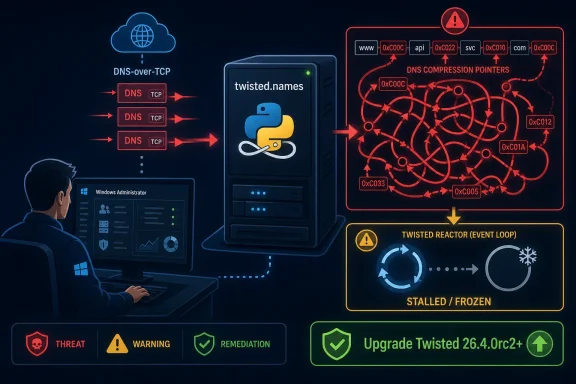
twisted.names DNS code, disclosed in late April 2026 and tracked by Microsoft’s Security Update Guide, that lets an unauthenticated remote attacker stall vulnerable services with a crafted TCP DNS packet. The bug is not a Windows flaw in the traditional Patch Tuesday sense, but it absolutely belongs on the WindowsForum radar because Python infrastructure, developer tooling, automation stacks, and internal services routinely cross the Windows-Linux boundary. Its lesson is blunt: availability bugs in widely embedded open-source components can matter as much as headline-grabbing remote code execution when they sit in the request path. The fix is straightforward — move to Twisted 26.4.0rc2 or later — but finding every copy of Twisted in the estate is the harder part.
 A Python Networking Bug Lands in Microsoft’s Security Orbit
The presence of CVE-2026-42304 in Microsoft’s vulnerability ecosystem is a useful reminder that the modern Windows stack is no longer just Windows. A Windows Server shop may run Python services in IIS-adjacent automation, containerized workloads, Azure-hosted microservices, developer workstations, CI runners, monitoring systems, or internal DNS-adjacent utilities. The vulnerable code lives in Twisted, a long-running event-driven networking framework for Python, not in the Windows DNS Server role.That distinction matters, but it should not become an excuse for complacency. Microsoft’s security tracking increasingly reflects the reality that enterprise exposure is assembled from operating systems, language runtimes, package managers, cloud services, and open-source libraries. A CVE can be operationally relevant to a Windows administrator even when the vulnerable function is buried inside a Python dependency rather than a DLL shipped through Windows Update.
This particular flaw affects
twisted.names, Twisted’s DNS implementation. The vulnerable path is DNS name decompression, the part of the parser that interprets compressed labels inside DNS messages. In normal DNS traffic, compression is a space-saving feature. In the hostile version described by the advisory, compression pointers become a way to force the parser into excessive repeated work.The result is denial of service rather than code execution. That makes it less cinematic, but not necessarily less disruptive. A service that cannot accept new connections, process I/O, or respond to existing requests is still down, regardless of whether the attacker gained a shell.
The Attack Is Small Because the Work Is Large
The core of CVE-2026-42304 is an old security pattern wearing DNS clothing: the attacker sends a compact input that causes the target to perform disproportionate computation. The advisory describes a crafted TCP DNS packet containing deeply chained compression pointers. Twisted’s parser follows those pointers during decompression, and under the vulnerable behavior it can be driven into millions of recursive or repeated lookups.That is why this bug is classified under both uncontrolled resource consumption and inefficient algorithmic complexity. The attacker does not need credentials, local access, or user interaction. The exploit condition is triggered by the parser doing what parsers do: accepting input and trying to make sense of it.
The ugly part is Twisted’s execution model. Twisted is built around a reactor, an event loop that multiplexes work cooperatively. That design is efficient when each piece of work yields quickly. It is fragile when one handler spends several seconds chewing on a malicious input.
In a threaded server, a pathological request may tie up one worker. In a single-threaded event loop, a pathological request can freeze the entire loop. That means the attack is not merely “make this one DNS request slow.” It is closer to “make the process stop being a server for the duration of the parse.”
This is why a single malformed TCP packet matters. The packet is not large in the way a volumetric DDoS flood is large. It is large in consequence, because it converts a small network event into a long CPU-bound stall inside the main event loop.
DNS Compression Was Designed for Efficiency, Not Hostility
DNS compression is one of those protocol features that looks harmless until it meets adversarial input. Instead of repeating domain-name suffixes throughout a message, DNS permits pointers to earlier locations in the packet. That saves bytes, which mattered in the protocol’s original operating environment and still matters in packet-constrained designs.But any pointer mechanism brings parser risk. The parser must decide where the pointer goes, whether it loops, whether it points somewhere sane, how many times it may be followed, and whether repeated references should be cached or bounded. A pointer that merely saves space for a cooperative sender can become a computational maze when crafted by an attacker.
Twisted had prior loop-prevention logic. According to the advisory, a visited set was added years ago to detect infinite compression loops. That is the kind of mitigation that closes the most obvious door: do not follow the same pointer forever. CVE-2026-42304 shows the narrower but still dangerous gap left behind: avoiding an infinite loop is not the same as bounding total work.
The reported issue is that there was no effective limit on the number of pointer dereferences per message, and state used to detect visited offsets could be reset across records. The attacker could use many questions that point into the same long chain, making the parser repeat expensive work rather than rejecting the message early.
That is the uncomfortable lesson for parser designers. “It eventually terminates” is not a security property when the attacker controls how expensive “eventually” becomes. Safe parsing needs ceilings, not just correctness.
The Reactor Turns a Parser Stall Into a Service Outage
Twisted’s reactor model is not the villain here. Event-driven networking is a proven design, and the same general idea powers huge parts of modern infrastructure. The tradeoff is that event loops require discipline: handlers must not block, parsers must not wander, and CPU-heavy work must be bounded or moved away from the loop.CVE-2026-42304 is a clean example of what happens when that discipline breaks at the protocol edge. The DNS parser receives data from the network and performs decompression inside the server’s processing path. When decompression becomes artificially expensive, the reactor is occupied. While it is occupied, everything else sharing that loop waits.
That waiting is the security impact. The process may not crash. It may not leak secrets. It may not corrupt data. It simply becomes unavailable, repeatedly and remotely, as long as the attacker can keep delivering the triggering input.
This is why availability severity can look deceptively abstract in CVSS language. “A:H” is easy to skim past during triage, especially when confidentiality and integrity are both marked none. In real operations, high availability impact means pagers, customer-visible failures, failed health checks, cascading retries, and supervisors killing or restarting processes that appear hung.
For Windows administrators, the practical issue is not whether the affected service is “a DNS server” in the Active Directory sense. It is whether any Python application in the environment imports Twisted and exposes the vulnerable DNS parsing path. That could be a bespoke internal resolver, a testing harness promoted into production, a monitoring component, an old appliance-like application, or a dependency pulled in by a larger Python package.
Microsoft’s Listing Makes the Supply Chain Visible
Microsoft’s Security Update Guide has become a place where Windows administrators encounter vulnerabilities that do not map neatly to Windows Update. That can be frustrating. Admins want to know whether WSUS, Intune, Configuration Manager, or Azure Update Manager will handle the problem. For open-source package CVEs, the answer is often no.But the listing is still valuable because it forces a broader inventory conversation. Windows shops often have an excellent view of OS build numbers and a weaker view of Python package versions. They know which servers are missing cumulative updates, but not which virtual environments contain
Twisted<=25.5.0.That gap is where this class of vulnerability lives. A server can be fully patched at the operating-system layer and still carry a vulnerable library inside an application folder, a service account profile, a container image, a developer toolchain, or a frozen executable built months earlier. Traditional Windows patch compliance does not prove application dependency hygiene.
The fix for CVE-2026-42304 is conceptually simple: upgrade Twisted to a fixed release. The operational problem is proving where Twisted exists, whether the vulnerable module is reachable, who owns the application, and whether upgrading Twisted changes behavior. Security teams can say “update the package” in a sentence. Production teams may need a week of dependency review and regression testing.
That is not a reason to delay. It is a reason to build better maps.
The Version Boundary Is Clear, but Real Estates Are Messy
The affected range is broad: versions before the fixed 26.4.0 release candidate line are vulnerable according to the advisory data, with GitHub identifying affected versions up to and including 25.5.0 and patched status beginning at 26.4.0rc2. PyPI later carried Twisted 26.4.0 as a stable release. In plain operational terms, anything older than the fixed 26.4.0 line deserves scrutiny.The “rc” detail is worth pausing on. Security fixes sometimes land first in release candidates because maintainers need to move quickly while preserving release process. Some organizations hesitate to deploy release candidates in production, and that is usually sensible. But once a stable release containing the fix is available, the argument shifts from “should we deploy an RC?” to “why are we still carrying the vulnerable branch?”
Python dependency management makes this more complicated than it sounds. A system may have Twisted installed globally, inside multiple virtual environments, inside Conda environments, inside containers, or vendored into application bundles. Windows developer machines may also carry old Twisted versions through test tools or legacy automation.
Administrators should not assume that
pip list in one shell answers the estate-wide question. The relevant package may be installed under a different interpreter, different user profile, service-specific virtual environment, or container layer. On Windows, long-lived Python applications are often installed once and then forgotten because they are “just scripts” that became infrastructure.The reachable-code question also matters. If Twisted is present but
twisted.names is never used, the immediate exploitability is lower. But dependency triage should be careful with that distinction. “Not currently reachable” is a snapshot, not a permanent guarantee, especially when libraries are reused across tools and environments.This Is Not a Patch Tuesday Bug, Yet It Belongs in Patch Tuesday Thinking
The Windows ecosystem has trained administrators to think in monthly cycles. Microsoft ships updates, vendors publish guidance, admins test rings, and production deployment follows. CVE-2026-42304 does not fit neatly into that rhythm. It is an open-source library fix that may require application rebuilds rather than a cumulative update.That is precisely why it is important. Attackers do not care whether a vulnerable component is serviced by Windows Update, pip, npm, a container registry, a vendor appliance updater, or a forgotten installer. They care whether the vulnerable code is reachable from the network.
The right mental model is not “is this a Microsoft patch?” It is “is this in my service path?” If a Windows-hosted Python application exposes Twisted DNS handling on a network interface, the risk is real. If a container running on a Windows Server host includes the vulnerable version and listens for DNS-over-TCP-like input, the Windows host’s patch state is beside the point.
There is also a monitoring implication. A service frozen by an event-loop stall may look different from a crashed service. Logs may be sparse because the process never reaches the logging path. CPU may spike. Health probes may fail. Connection queues may back up. Supervisors may restart the process, creating an apparent flapping condition rather than a clean fault.
That is one of the reasons denial-of-service vulnerabilities can be hard to diagnose. The root cause may be a single malicious message, but the visible symptom is a generic outage.
The Old Loop Fix Did Its Job, Just Not Enough of It
One of the more interesting details in the advisory is historical. Twisted had a prior protection against compression loops, added long before this CVE. That protection was not useless. It addressed a real class of parser failure: direct or indirect loops that would otherwise never terminate.CVE-2026-42304 is not proof that the earlier fix was foolish. It is proof that parser hardening is iterative because adversarial inputs evolve from “make it loop forever” to “make it do too much finite work.” The second problem is subtler because it can pass through logic designed to stop the first.
This is the difference between safety and liveness in practical software security. A parser can be memory-safe, terminate correctly, and still be operationally unsafe if the worst-case path is cheap for the attacker and expensive for the server. The best fix is not just “detect loops.” It is “define a budget.”
Budgets are not glamorous, but they are often the difference between robust network code and outage-prone network code. A DNS message should be allowed only so many pointer resolutions. A parser should reject unreasonable question counts before doing expensive work. Shared state should prevent repeated resolution of the same chain across records in a single message.
That is the shape of the remediation described for this flaw: limit pointer resolutions, share resolved-offset state across a message, and validate question counts before the decoder commits to a costly loop. Those are engineering controls that turn an attacker’s clever packet back into a rejected packet.
Windows Shops Need to Hunt Dependencies, Not Just Services
The immediate advice to “upgrade Twisted” is necessary, but incomplete. A Windows-heavy organization needs to search in places that its normal patch tooling may not cover. That means application repositories, build manifests, SBOMs, virtual environments, container images, artifact registries, developer workstations, jump boxes, and servers running internal automation.The easiest wins come from dependency scanning. If teams already generate software bills of materials, CVE-2026-42304 should show up against Twisted. If they use GitHub Dependabot, GitLab dependency scanning, Snyk, Safety, pip-audit, or similar tools, this is the sort of bug those systems are designed to flag. The problem is coverage: scanning the main application repository does not help if the vulnerable package lives in an old deployment image or manually maintained script directory.
For Windows administrators, PowerShell can help locate Python environments, but it will not interpret every packaging layout by itself. The better approach is coordinated: ask application owners for package manifests, query endpoint inventory for Python installations, inspect container images, and compare deployed artifacts against source-controlled dependency files. If nobody owns a Python service, that is itself a finding.
Network exposure should drive priority. Internet-facing services using Twisted DNS functionality should move first. Internal services should not be ignored, because low-complexity unauthenticated denial-of-service flaws are useful to attackers who already have a foothold. A compromised workstation or low-privilege internal host may be enough to disrupt a vulnerable internal service.
Mitigations can buy time but should not become the final answer. Filtering unexpected DNS-over-TCP traffic, limiting access to trusted sources, rate-limiting suspicious inputs, and isolating affected services can reduce exposure. They do not correct the vulnerable parser.
The Severity Score Understates the Pager Impact
A CVSS 7.5 high score is a familiar number. Many administrators have learned, not entirely wrongly, that high-severity CVEs vary wildly in practical urgency. Some require obscure configurations; some need local access; some affect unused components. CVE-2026-42304 earns attention because the exploit preconditions are light when the vulnerable code is exposed.Network attack vector, low complexity, no privileges, and no user interaction is the classic combination that should make defenders lean forward. The absence of confidentiality and integrity impact keeps it out of the catastrophic RCE category. But availability-only bugs can still be business-critical when they affect authentication, name resolution, monitoring, provisioning, messaging, or customer-facing APIs.
There is also an asymmetry problem. The attacker’s cost can be low enough to repeat. If one packet stalls the event loop for seconds, a modest cadence of malicious packets can keep a service degraded or unavailable. That does not require a botnet in the traditional flood-the-link sense. It requires reachability and patience.
The best way to think about this flaw is not “can it own the server?” but “can it remove this service from the network?” For many internal systems, removal is enough. A build pipeline blocked at dependency resolution, a monitoring system unable to process events, or a control-plane service stuck in a reactor loop can create secondary failures far beyond the vulnerable process.
This is where security and reliability merge. The same bug that a security database calls uncontrolled resource consumption is, to an operations team, an incident pattern: elevated CPU, stalled event loop, timeouts, retries, restarts, and confused dashboards.
The Cloud and Container Angle Makes Ownership Blurry
Many affected deployments will not be hand-installed Python services on a single Windows Server. They will be containers, serverless-adjacent workloads, CI jobs, or vendor-packaged applications. That complicates remediation because the person responsible for Windows patching may not control the application image, and the person responsible for the application may assume platform security owns CVE triage.In Azure-heavy environments, the vulnerability may surface in hosted Linux containers managed from Windows workstations, built by GitHub Actions, deployed through Azure DevOps, and monitored by Microsoft security products. That is still part of the WindowsForum world because it is the world Windows administrators now operate in.
The fix path in containers is rebuild, redeploy, and verify. Updating a base image is not enough if Twisted is installed later by an application layer. Updating
requirements.txt is not enough if production still runs an old image digest. Updating the image is not enough if Kubernetes, App Service, or a custom orchestrator keeps old replicas alive.For packaged third-party products, customers may not be able to update Twisted directly. In that case, the right move is to ask the vendor whether Twisted is present, whether
twisted.names is reachable, which version is included, and when a fixed build will ship. “We use Python” is not a sufficient answer. “We ship Twisted 26.4.0 or later” is.This is also where SBOMs stop being a compliance checkbox and start being useful. A current SBOM can answer whether Twisted exists in a product. A stale SBOM can create false confidence. No SBOM leaves defenders grepping images and hoping they found every copy.
The Practical Playbook Is Smaller Than the Blast Radius
For all the architectural nuance, the action plan is fairly compact. The hard part is execution across messy estates, not deciding what good looks like. The vulnerable code should be upgraded, exposed paths should be prioritized, and compensating controls should be temporary.Administrators should treat CVE-2026-42304 as a dependency-response exercise rather than a Windows Update exercise. That means pairing security inventory with application ownership and deployment reality. If the organization cannot answer where Twisted is installed, this CVE is a useful test case for improving that answer before the next library flaw is worse.
The Twisted DNS Flaw Leaves Five Jobs for Defenders
This bug is not the biggest vulnerability of 2026, and it is not trying to be. Its importance lies in how neatly it exposes the weak seam between package-level security and service-level availability.- Organizations should upgrade Twisted to 26.4.0rc2 or later, preferably a stable fixed release where production policy allows it.
- Teams should inventory Python environments, containers, and packaged applications rather than relying only on operating-system patch status.
- Network-facing services that use
twisted.namesshould be prioritized because the attack is remote, unauthenticated, and low-complexity. - Temporary controls such as access restrictions, rate limits, and traffic filtering should be treated as exposure reduction, not remediation.
- Application owners should verify deployed artifacts, not just source manifests, because old images and virtual environments often outlive the code that created them.
References
- Primary source: MSRC
Published: 2026-06-03T01:40:11-07:00
Security Update Guide - Microsoft Security Response Center
 msrc.microsoft.com
- Related coverage: advisories.gitlab.com
Twisted has a Denial of Service (DoS) in twisted.names via Crafted DNS Compression Pointer Chains | GitLab Advisory Database (GLAD)
CVE-2026-42304 Twisted has a Denial of Service (DoS) in twisted.names via Crafted DNS Compression Pointer Chains: A single malformed TCP packet is sufficient to block the Twisted reactor's event loop for several seconds. Because Twisted …advisories.gitlab.com - Related coverage: sentinelone.com
CVE-2026-42304: Twisted DNS Module DoS Vulnerability
CVE-2026-42304 is a denial of service vulnerability in Twisted framework. Learn about its impact, affected versions, and mitigation methods.www.sentinelone.com
- Related coverage: dbugs.ptsecurity.com
CVE-2026-42304 — DoS in Twisted+2 Twisted+2 | dbugs
Details on CVE-2026-42304: DoS in Twisted+2 Twisted+2. Exploited in the wild. Includes CVSS score, affected versions, and references.dbugs.ptsecurity.com - Related coverage: feed.craftedsignal.io

Twisted DNS Server Denial of Service via Crafted Compression Pointers – CraftedSignal Threat Feed
A denial-of-service vulnerability exists in the twisted.names module, where an unauthenticated attacker can send a crafted TCP DNS packet with deeply chained compression pointers, causing the Twisted reactor to hang while processing recursive lookups and effectively freezing the server.
feed.craftedsignal.io
- Related coverage: osv.dev

OSV - Open Source Vulnerabilities
Comprehensive vulnerability database for your open source projects and dependencies.
osv.dev
- Related coverage: docs.twistedmatrix.com
- Related coverage: docs.twisted.org
- Related coverage: newreleases.io
twisted/twisted twisted-26.4.0rc2 on GitHub
New release twisted/twisted version twisted-26.4.0rc2 Twisted 26.4.0rc2 on GitHub. newreleases.io
- Related coverage: security.snyk.io
twisted package versions | Snyk
Security vulnerabilities and package health score for pip package twisted security.snyk.io
- Related coverage: pypi.org
- Related coverage: twisted.readthedocs.io
- Related coverage: app.readthedocs.org
