

CVE-2026-42923 is a medium-severity DNSSEC validation flaw disclosed in May 2026 affecting NLnet Labs Unbound through version 1.25.0, where specially crafted NSEC3 records can force excessive hash calculations and degrade resolver availability over the network. It is not the sort of bug that hands an attacker a shell, steals credentials, or instantly drops a DNS service on the floor. Its significance is subtler and, for infrastructure operators, more familiar: a small piece of protocol machinery can become a tax on every lookup path that depends on it. For Windows administrators, the lesson is not “panic about Unbound,” but “stop treating DNSSEC performance bugs as someone else’s plumbing.”
DNSSEC is supposed to answer a hard question with cryptographic confidence: not only “does this name exist?” but also “can I prove that this name does not exist?” NSEC3 is one of the mechanisms DNSSEC uses for authenticated denial of existence, designed partly to avoid easy zone walking by hashing names rather than publishing them in plain sequence. That privacy improvement comes with computational work, because validating a negative answer may require repeated hash calculations.
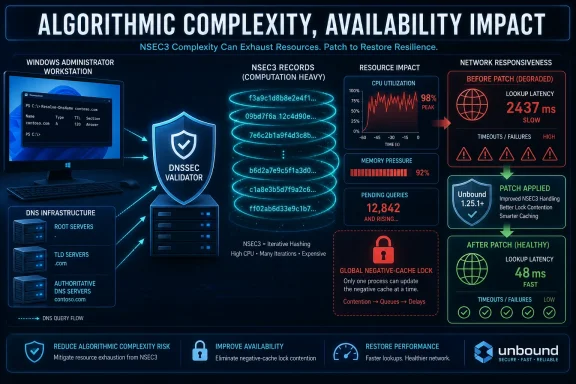
CVE-2026-42923 is a failure to consistently bound that work. In affected Unbound versions, the DNSSEC validator’s path for consulting the negative cache for DS records does not honor the NSEC3 hash-calculation limit introduced in an earlier mitigation. An attacker who controls a DNSSEC-signed zone can use records with high but acceptable iteration counts, then query a vulnerable resolver in a way that keeps it doing more hashing than it should.
The result is described as degradation of service rather than clean denial of service. That distinction matters. The published impact language says performance is reduced or resource availability is interrupted, but legitimate users are not necessarily locked out entirely. In operational terms, that can look like slow lookups, intermittent stalls, elevated CPU, queueing under load, and customer complaints that do not immediately map to an obvious outage.
This is why DNS bugs so often evade executive attention until they become incidents. DNS is not glamorous infrastructure, but it is the first dependency of nearly everything else. When a resolver slows down, the symptom may appear in browsers, mail delivery, endpoint agents, package managers, VPN clients, cloud connectors, and authentication flows before anyone blames the resolver.
This does not make NSEC3 “bad” in the cartoon sense. It makes it an example of a security feature whose safety depends on implementation limits, protocol guidance, and operational restraint. When those limits are bypassed in one code path, the feature still appears to be doing the right thing cryptographically while quietly exhausting the system expected to verify it.
CVE-2026-42923 is especially interesting because the vulnerable behavior is not simply “Unbound forgot to limit hashes.” The project had already introduced a limit in version 1.19.1, after the broader industry learned hard lessons about NSEC3 validation costs. The flaw is that a particular path involving negative-cache lookup for DS records did not take that limit into account.
That is the kind of bug mature software accumulates: not a missing security idea, but an inconsistent application of that idea. The mitigation exists. The boundary exists. One path around the building still forgot to check the badge.
But medium severity is not the same thing as medium operational relevance. A resolver that becomes intermittently sluggish under crafted traffic can create a sprawling incident because DNS is shared infrastructure. A few milliseconds of extra validation work repeated at scale can become seconds of perceived application failure, especially when upstream retries and client timeouts amplify the delay.
The advisory language is careful: repeated exploitation is possible, but the attacker does not have the ability to completely deny service to legitimate users. That means defenders should resist both overstatement and complacency. This is not a remote-code-execution fire drill, but it is also not paperwork.
The worst bugs for operations teams are often the ones that live between “working” and “down.” Monitoring stays green until it does not. Packet captures show traffic flowing. Recursive resolution still succeeds, except when it does not. The degradation pattern makes the incident look environmental, overloaded, or transient, which gives the attacker the most valuable thing in reliability engineering: time.
Locks are not inherently bad; they are how software protects shared state. But in a high-throughput resolver, holding a global lock while doing expensive computation is the kind of design interaction that can turn one hostile input into broader service drag. It is the difference between “this query is expensive” and “this expensive query makes other queries wait.”
For administrators, that detail helps explain why the vulnerability is more than an academic DNSSEC corner case. A resolver does not have to consume every CPU core to become unreliable. It only has to serialize the wrong operation at the wrong time, under enough request pressure, in a component used by all the other threads.
The vendor’s fix in Unbound 1.25.1 bounds the vulnerable path with the existing NSEC3 hash-calculation limit. That is a narrow fix, and that is good. Security patches that reduce algorithmic exposure without changing the product’s behavior wholesale are the ones operators can deploy with relatively high confidence.
Windows Server’s own DNS role has its own DNSSEC controls, including settings for NSEC versus NSEC3 and NSEC3 iteration behavior. That does not mean CVE-2026-42923 is automatically a Windows DNS Server vulnerability. It means Windows administrators already live in an ecosystem where NSEC3 is not exotic. The knobs exist, the records exist, and DNSSEC validation paths matter.
This is where patch management gets messy. A Windows shop may have pristine monthly cumulative update compliance and still run vulnerable recursive DNS infrastructure because the resolver is not patched by Windows Update. It may be installed from a third-party package, embedded in a security gateway, bundled into a Kubernetes add-on, or managed by a network team that does not attend the same change meetings as endpoint engineering.
The practical question is not “did Patch Tuesday fix this?” The practical question is “where do we perform DNSSEC validation, what code performs it, and who owns the update path?” In many environments, the honest answer will be uncomfortable.
CVE-2026-42923 is categorized under inefficient algorithmic complexity. That label is bland, but accurate. The weakness is not that Unbound believes bad data, nor that it accepts forged answers, nor that it discloses secrets. The weakness is that a legitimate-looking validation task can become too expensive relative to the attacker’s effort.
This asymmetry is the heart of many modern denial and degradation attacks. The attacker sends a cheap request or controls a cheap configuration. The defender performs expensive validation, parsing, decompression, database lookup, or cryptographic work. The system may be correct in the formal sense and still vulnerable in the economic sense.
DNS resolvers are particularly exposed to this pattern because they are built to answer on behalf of many clients and to interact with arbitrary zones on the internet. A recursive resolver cannot simply pretrust the world. It has to ask, verify, cache, and move on. When “verify” becomes unbounded, the entire bargain changes.
The harder work is discovering all the places Unbound exists indirectly. It is widely used because it is fast, capable, and embeddable. That means it can show up in firewall distributions, privacy DNS stacks, lab environments, container images, recursive resolver farms, and developer workstations. The vulnerable resolver may not be the one listed in the corporate CMDB as “DNS.”
This is where Windows-oriented organizations often trip. Their asset tools are tuned to Windows builds, Defender status, installed MSI packages, and domain-joined server roles. They may be weaker at enumerating Linux-based DNS appliances, WSL-adjacent tooling, network virtual appliances, and container images that perform recursive resolution for internal services.
If you operate a mixed environment, this CVE should be treated as a small inventory test. Ask for the authoritative list of recursive resolvers. Ask which ones validate DNSSEC. Ask what software and version each resolver runs. If the answer takes more than a few minutes, the vulnerability has already taught you something useful.
That is an important threat-modeling point. Security teams sometimes discount DNS flaws because they imagine the attacker must already be inside the network or must own a heavily used domain. In this case, the attacker’s leverage comes from controlling authoritative DNS content and inducing recursive validation work. The resolver’s trust model obliges it to evaluate data from the DNS ecosystem.
The phrase “acceptably high iterations” also matters. This is not necessarily about malformed nonsense that any sane implementation would reject. The dangerous input can sit within protocol-acceptable boundaries while still imposing too much work on a specific implementation path. That is the signature of a mature protocol under stress: compliance alone does not guarantee resilience.
Coordinated attacks could reportedly raise the impact toward denial of service. That caveat should be read carefully. It does not mean every home lab resolver is one packet away from collapse. It means the degradation primitive can scale when many queries, many clients, or multiple attacker-controlled domains are used to keep the vulnerable path busy.
The blast radius depends on topology. A single pair of recursive resolvers serving a large campus has a different risk profile from segmented resolvers per site, per cloud environment, or per security zone. Forwarders complicate the picture further: a Windows DNS server may forward external queries to Unbound, which performs DNSSEC validation upstream. In that architecture, the Windows server is not vulnerable in the same way, but users behind it still experience the slowdown.
Caching also cuts both ways. Negative caching can reduce repeated work for ordinary nonexistent names, but this vulnerability specifically involves the negative cache consultation path for DS records. That makes casual intuition about “the cache will save us” less reliable. The cache is part of the affected machinery, not merely a shield around it.
Capacity planning matters as well. A resolver fleet with spare CPU, thread headroom, and sensible rate limiting may absorb degradation that would cripple a smaller deployment. But spare capacity is not a substitute for a bound on algorithmic work. It only buys time.
Small deployments often have weaker observability. If the resolver spikes CPU or stalls under weird traffic, the user sees “the internet is flaky.” There may be no metrics, no query logs retained long enough to investigate, and no alerting on validation latency. A small box with limited CPU can also have less tolerance for expensive hashing than a server-class resolver.
The good news is that remediation is usually easier in these environments. Updating the package or appliance firmware may be enough, assuming the vendor has shipped Unbound 1.25.1 or backported the fix. The danger is appliance lag. If your firewall distribution or DNS appliance bundles Unbound, the version number inside the GUI may not tell the whole story unless the vendor exposes package details.
For hobbyists and small-business admins, the practical move is simple: check the resolver version, check the appliance advisory stream, and update when the patched build is available. If the device cannot be updated promptly and DNSSEC validation is not a hard requirement for the environment, disabling validation temporarily may be a risk decision worth considering, but it should not become the permanent answer.
Start with the actual flow of queries. Which clients point at Windows DNS? Which Windows DNS servers forward externally? Which forwarders validate DNSSEC? Which cloud VNets, containers, branch offices, VPN clients, and guest networks bypass the central path? In many environments, DNS diagrams are either stale or focused on Active Directory zones, while recursive resolution to the public internet is treated as a secondary detail.
Then look at version provenance. A package installed from a distribution repository may have a backported patch without changing the upstream version string in an obvious way. An appliance may carry a vendor patch level instead of an Unbound release number. A container image may lag even though the host is current. Version checking must be tied to the vendor’s packaging model.
Finally, monitor the symptom that matters: resolver latency under negative DNSSEC answers, CPU load, thread saturation, lock contention where available, and SERVFAIL or timeout rates. You do not need perfect telemetry to improve your odds. Even basic dashboards can separate “WAN is slow” from “recursive validation is choking.”
A degradation bug punishes that fragmentation. No one team sees the whole failure at first. The resolver is technically up. The network is technically passing packets. The application is technically healthy. The certificate chain is technically valid. Yet users wait, retries multiply, and eventually the incident channel fills with theories.
This is why DNS should be part of resilience planning, not just configuration hygiene. Organizations should know their recursive resolver software, capacity, validation policy, upstreams, and patch ownership. They should also know what happens when DNSSEC validation becomes expensive or unreliable. Does traffic fail closed? Does it fall back to another resolver? Does the fallback preserve security policy or silently bypass it?
CVE-2026-42923 is not dramatic enough to force that conversation by itself. But it is exactly the sort of bug that exposes whether the conversation has already happened.
Open-source DNS software sits under enormous public and private infrastructure, and it receives scrutiny accordingly. Bugs in this layer are inevitable because DNSSEC is complex, interoperability constraints are real, and performance boundaries are hard to prove exhaustively. The important question is whether projects respond with clear fixes and whether downstream vendors ship them quickly.
The downstream piece is where users should apply pressure. If your appliance, distribution, or managed DNS component bundles Unbound, the vendor should be able to say whether CVE-2026-42923 is fixed, not applicable, mitigated, or pending. Silence is not a mitigation.
The same goes for managed service providers. A customer should not have to reverse-engineer the recursive resolver stack behind a service contract. If DNSSEC validation is part of the offering, availability bugs in the validator are part of the service’s risk surface.
 The Vulnerability Lives in the Gap Between Correctness and Cost
DNSSEC is supposed to answer a hard question with cryptographic confidence: not only “does this name exist?” but also “can I prove that this name does not exist?” NSEC3 is one of the mechanisms DNSSEC uses for authenticated denial of existence, designed partly to avoid easy zone walking by hashing names rather than publishing them in plain sequence. That privacy improvement comes with computational work, because validating a negative answer may require repeated hash calculations.CVE-2026-42923 is a failure to consistently bound that work. In affected Unbound versions, the DNSSEC validator’s path for consulting the negative cache for DS records does not honor the NSEC3 hash-calculation limit introduced in an earlier mitigation. An attacker who controls a DNSSEC-signed zone can use records with high but acceptable iteration counts, then query a vulnerable resolver in a way that keeps it doing more hashing than it should.
The result is described as degradation of service rather than clean denial of service. That distinction matters. The published impact language says performance is reduced or resource availability is interrupted, but legitimate users are not necessarily locked out entirely. In operational terms, that can look like slow lookups, intermittent stalls, elevated CPU, queueing under load, and customer complaints that do not immediately map to an obvious outage.
This is why DNS bugs so often evade executive attention until they become incidents. DNS is not glamorous infrastructure, but it is the first dependency of nearly everything else. When a resolver slows down, the symptom may appear in browsers, mail delivery, endpoint agents, package managers, VPN clients, cloud connectors, and authentication flows before anyone blames the resolver.
NSEC3 Was Built to Hide Names, Not to Be Free
The uncomfortable truth behind this CVE is that NSEC3’s security property has always had a cost profile. Hashing names makes it harder to enumerate a signed zone, but repeated hashing also gives validators real work to do. A feature created to improve one dimension of DNSSEC can become an availability liability when the validator’s accounting is incomplete.This does not make NSEC3 “bad” in the cartoon sense. It makes it an example of a security feature whose safety depends on implementation limits, protocol guidance, and operational restraint. When those limits are bypassed in one code path, the feature still appears to be doing the right thing cryptographically while quietly exhausting the system expected to verify it.
CVE-2026-42923 is especially interesting because the vulnerable behavior is not simply “Unbound forgot to limit hashes.” The project had already introduced a limit in version 1.19.1, after the broader industry learned hard lessons about NSEC3 validation costs. The flaw is that a particular path involving negative-cache lookup for DS records did not take that limit into account.
That is the kind of bug mature software accumulates: not a missing security idea, but an inconsistent application of that idea. The mitigation exists. The boundary exists. One path around the building still forgot to check the badge.
A Medium Score Can Still Hurt the Help Desk
The vulnerability’s CVSS 3.1 score of 5.3 and CVSS 4.0 base score of 6.9 put it squarely in the medium range. That is a fair classification if one reads the metrics narrowly: network attack vector, low complexity, no privileges, no user interaction, no confidentiality impact, no integrity impact, and low availability impact. Nothing about that says “drop everything before lunch.”But medium severity is not the same thing as medium operational relevance. A resolver that becomes intermittently sluggish under crafted traffic can create a sprawling incident because DNS is shared infrastructure. A few milliseconds of extra validation work repeated at scale can become seconds of perceived application failure, especially when upstream retries and client timeouts amplify the delay.
The advisory language is careful: repeated exploitation is possible, but the attacker does not have the ability to completely deny service to legitimate users. That means defenders should resist both overstatement and complacency. This is not a remote-code-execution fire drill, but it is also not paperwork.
The worst bugs for operations teams are often the ones that live between “working” and “down.” Monitoring stays green until it does not. Packet captures show traffic flowing. Recursive resolution still succeeds, except when it does not. The degradation pattern makes the incident look environmental, overloaded, or transient, which gives the attacker the most valuable thing in reliability engineering: time.
The Lock Is the Tell
The most revealing detail is the global lock around the negative cache. During the excessive NSEC3 hashing, Unbound may hold a lock that blocks other threads needing to consult that cache. That turns a computational cost in one validation path into a concurrency problem for unrelated work.Locks are not inherently bad; they are how software protects shared state. But in a high-throughput resolver, holding a global lock while doing expensive computation is the kind of design interaction that can turn one hostile input into broader service drag. It is the difference between “this query is expensive” and “this expensive query makes other queries wait.”
For administrators, that detail helps explain why the vulnerability is more than an academic DNSSEC corner case. A resolver does not have to consume every CPU core to become unreliable. It only has to serialize the wrong operation at the wrong time, under enough request pressure, in a component used by all the other threads.
The vendor’s fix in Unbound 1.25.1 bounds the vulnerable path with the existing NSEC3 hash-calculation limit. That is a narrow fix, and that is good. Security patches that reduce algorithmic exposure without changing the product’s behavior wholesale are the ones operators can deploy with relatively high confidence.
Microsoft’s Presence Makes This a Windows Story, Even When the Bug Is Not in Windows
The user-facing source here is Microsoft’s Security Update Guide, but the vulnerable product identified publicly is NLnet Labs Unbound. That distinction is important for WindowsForum readers because Microsoft’s security ecosystem increasingly aggregates and surfaces vulnerabilities that may affect Windows-adjacent deployments without necessarily being Windows platform bugs. If you run Unbound on Windows, package it into an appliance, deploy it in a container on Windows Server, or depend on a resolver maintained by another team, the risk can still land on your desk.Windows Server’s own DNS role has its own DNSSEC controls, including settings for NSEC versus NSEC3 and NSEC3 iteration behavior. That does not mean CVE-2026-42923 is automatically a Windows DNS Server vulnerability. It means Windows administrators already live in an ecosystem where NSEC3 is not exotic. The knobs exist, the records exist, and DNSSEC validation paths matter.
This is where patch management gets messy. A Windows shop may have pristine monthly cumulative update compliance and still run vulnerable recursive DNS infrastructure because the resolver is not patched by Windows Update. It may be installed from a third-party package, embedded in a security gateway, bundled into a Kubernetes add-on, or managed by a network team that does not attend the same change meetings as endpoint engineering.
The practical question is not “did Patch Tuesday fix this?” The practical question is “where do we perform DNSSEC validation, what code performs it, and who owns the update path?” In many environments, the honest answer will be uncomfortable.
DNSSEC Keeps Producing Availability Bugs Because Validation Is Work
The industry has seen this movie before. DNSSEC’s negative-answer machinery, especially around NSEC3, has repeatedly drawn scrutiny because attackers can craft conditions that make validators do disproportionate work. The phrase algorithmic complexity sounds like a classroom topic until the algorithm sits on the hot path of name resolution for thousands of clients.CVE-2026-42923 is categorized under inefficient algorithmic complexity. That label is bland, but accurate. The weakness is not that Unbound believes bad data, nor that it accepts forged answers, nor that it discloses secrets. The weakness is that a legitimate-looking validation task can become too expensive relative to the attacker’s effort.
This asymmetry is the heart of many modern denial and degradation attacks. The attacker sends a cheap request or controls a cheap configuration. The defender performs expensive validation, parsing, decompression, database lookup, or cryptographic work. The system may be correct in the formal sense and still vulnerable in the economic sense.
DNS resolvers are particularly exposed to this pattern because they are built to answer on behalf of many clients and to interact with arbitrary zones on the internet. A recursive resolver cannot simply pretrust the world. It has to ask, verify, cache, and move on. When “verify” becomes unbounded, the entire bargain changes.
The Patch Is Straightforward; The Inventory Is Not
Unbound 1.25.1 contains the fix for CVE-2026-42923. For operators who knowingly run Unbound, the remediation path is refreshingly direct: identify affected versions from 1.19.1 through 1.25.0, test the update, and deploy 1.25.1 or later. If DNSSEC validation is enabled and the resolver is reachable by untrusted clients or exposed to high-volume query patterns, the update deserves prompt scheduling.The harder work is discovering all the places Unbound exists indirectly. It is widely used because it is fast, capable, and embeddable. That means it can show up in firewall distributions, privacy DNS stacks, lab environments, container images, recursive resolver farms, and developer workstations. The vulnerable resolver may not be the one listed in the corporate CMDB as “DNS.”
This is where Windows-oriented organizations often trip. Their asset tools are tuned to Windows builds, Defender status, installed MSI packages, and domain-joined server roles. They may be weaker at enumerating Linux-based DNS appliances, WSL-adjacent tooling, network virtual appliances, and container images that perform recursive resolution for internal services.
If you operate a mixed environment, this CVE should be treated as a small inventory test. Ask for the authoritative list of recursive resolvers. Ask which ones validate DNSSEC. Ask what software and version each resolver runs. If the answer takes more than a few minutes, the vulnerability has already taught you something useful.
The Attacker Needs a Zone, Not a Foothold
The exploit scenario is notable because it does not require the attacker to compromise the resolver. The adversary can control a DNSSEC-signed zone and craft records with high acceptable NSEC3 iterations for child delegations. The vulnerable resolver does the rest when queried.That is an important threat-modeling point. Security teams sometimes discount DNS flaws because they imagine the attacker must already be inside the network or must own a heavily used domain. In this case, the attacker’s leverage comes from controlling authoritative DNS content and inducing recursive validation work. The resolver’s trust model obliges it to evaluate data from the DNS ecosystem.
The phrase “acceptably high iterations” also matters. This is not necessarily about malformed nonsense that any sane implementation would reject. The dangerous input can sit within protocol-acceptable boundaries while still imposing too much work on a specific implementation path. That is the signature of a mature protocol under stress: compliance alone does not guarantee resilience.
Coordinated attacks could reportedly raise the impact toward denial of service. That caveat should be read carefully. It does not mean every home lab resolver is one packet away from collapse. It means the degradation primitive can scale when many queries, many clients, or multiple attacker-controlled domains are used to keep the vulnerable path busy.
Enterprise DNS Architecture Determines the Blast Radius
In a small environment, a vulnerable resolver may simply make web browsing feel broken. In an enterprise, recursive DNS often sits beneath identity, device management, telemetry, software deployment, email routing, cloud access, and incident response. A degraded resolver can therefore produce failures that look unrelated until someone notices they share name resolution as a dependency.The blast radius depends on topology. A single pair of recursive resolvers serving a large campus has a different risk profile from segmented resolvers per site, per cloud environment, or per security zone. Forwarders complicate the picture further: a Windows DNS server may forward external queries to Unbound, which performs DNSSEC validation upstream. In that architecture, the Windows server is not vulnerable in the same way, but users behind it still experience the slowdown.
Caching also cuts both ways. Negative caching can reduce repeated work for ordinary nonexistent names, but this vulnerability specifically involves the negative cache consultation path for DS records. That makes casual intuition about “the cache will save us” less reliable. The cache is part of the affected machinery, not merely a shield around it.
Capacity planning matters as well. A resolver fleet with spare CPU, thread headroom, and sensible rate limiting may absorb degradation that would cripple a smaller deployment. But spare capacity is not a substitute for a bound on algorithmic work. It only buys time.
Home Labs and Small Businesses Should Not Shrug
WindowsForum has plenty of readers running Unbound in places that do not look like enterprise DNS: on pfSense or OPNsense boxes, Raspberry Pi privacy stacks, local recursive resolvers for ad-blocking, homelab Kubernetes clusters, or small-office gateways. Those users may be tempted to dismiss a medium CVE as an enterprise concern. That would be the wrong instinct.Small deployments often have weaker observability. If the resolver spikes CPU or stalls under weird traffic, the user sees “the internet is flaky.” There may be no metrics, no query logs retained long enough to investigate, and no alerting on validation latency. A small box with limited CPU can also have less tolerance for expensive hashing than a server-class resolver.
The good news is that remediation is usually easier in these environments. Updating the package or appliance firmware may be enough, assuming the vendor has shipped Unbound 1.25.1 or backported the fix. The danger is appliance lag. If your firewall distribution or DNS appliance bundles Unbound, the version number inside the GUI may not tell the whole story unless the vendor exposes package details.
For hobbyists and small-business admins, the practical move is simple: check the resolver version, check the appliance advisory stream, and update when the patched build is available. If the device cannot be updated promptly and DNSSEC validation is not a hard requirement for the environment, disabling validation temporarily may be a risk decision worth considering, but it should not become the permanent answer.
The Windows Admin’s Playbook Is Broader Than Windows Update
The standard Windows patching rhythm will not fully answer this class of problem. A disciplined administrator should still apply Microsoft security updates, of course, but CVE-2026-42923 sits in the broader supply chain of DNS infrastructure. Treat it as a reminder to map recursive resolution as an application dependency, not merely a network service.Start with the actual flow of queries. Which clients point at Windows DNS? Which Windows DNS servers forward externally? Which forwarders validate DNSSEC? Which cloud VNets, containers, branch offices, VPN clients, and guest networks bypass the central path? In many environments, DNS diagrams are either stale or focused on Active Directory zones, while recursive resolution to the public internet is treated as a secondary detail.
Then look at version provenance. A package installed from a distribution repository may have a backported patch without changing the upstream version string in an obvious way. An appliance may carry a vendor patch level instead of an Unbound release number. A container image may lag even though the host is current. Version checking must be tied to the vendor’s packaging model.
Finally, monitor the symptom that matters: resolver latency under negative DNSSEC answers, CPU load, thread saturation, lock contention where available, and SERVFAIL or timeout rates. You do not need perfect telemetry to improve your odds. Even basic dashboards can separate “WAN is slow” from “recursive validation is choking.”
The CVE Exposes a Governance Problem Hiding in DNS
The most interesting part of CVE-2026-42923 may be organizational rather than technical. DNS usually crosses boundaries that corporate structures do not. Security cares about DNSSEC. Network teams own resolvers. Windows admins own AD-integrated DNS. Cloud teams create private zones. Developers ship containers with their own resolvers. Help desks receive the first complaints when name resolution gets weird.A degradation bug punishes that fragmentation. No one team sees the whole failure at first. The resolver is technically up. The network is technically passing packets. The application is technically healthy. The certificate chain is technically valid. Yet users wait, retries multiply, and eventually the incident channel fills with theories.
This is why DNS should be part of resilience planning, not just configuration hygiene. Organizations should know their recursive resolver software, capacity, validation policy, upstreams, and patch ownership. They should also know what happens when DNSSEC validation becomes expensive or unreliable. Does traffic fail closed? Does it fall back to another resolver? Does the fallback preserve security policy or silently bypass it?
CVE-2026-42923 is not dramatic enough to force that conversation by itself. But it is exactly the sort of bug that exposes whether the conversation has already happened.
The Fix Also Shows Open-Source Maintenance Working
It is worth noting the positive side. The vulnerable behavior was identified, assigned a CVE, documented with affected versions, and fixed in Unbound 1.25.1. The public description is specific enough for operators to understand the vulnerable path and the expected impact. That is what responsible infrastructure maintenance looks like.Open-source DNS software sits under enormous public and private infrastructure, and it receives scrutiny accordingly. Bugs in this layer are inevitable because DNSSEC is complex, interoperability constraints are real, and performance boundaries are hard to prove exhaustively. The important question is whether projects respond with clear fixes and whether downstream vendors ship them quickly.
The downstream piece is where users should apply pressure. If your appliance, distribution, or managed DNS component bundles Unbound, the vendor should be able to say whether CVE-2026-42923 is fixed, not applicable, mitigated, or pending. Silence is not a mitigation.
The same goes for managed service providers. A customer should not have to reverse-engineer the recursive resolver stack behind a service contract. If DNSSEC validation is part of the offering, availability bugs in the validator are part of the service’s risk surface.
The Practical Signal Inside This NSEC3 Noise
CVE-2026-42923 is narrow enough to patch and broad enough to learn from. It rewards administrators who treat DNS as shared infrastructure with measurable behavior, owned software, and explicit update paths.- Unbound versions from 1.19.1 through 1.25.0 should be treated as affected unless a downstream vendor documents a backported fix.
- Unbound 1.25.1 or a vendor build carrying the equivalent patch is the clean remediation path.
- The vulnerability affects availability, not confidentiality or integrity, but DNS availability failures can cascade into many unrelated-looking services.
- Windows environments may still be exposed when Windows DNS forwards to Unbound or when Unbound appears in appliances, containers, labs, and branch infrastructure.
- DNSSEC validation should be monitored for latency and failure behavior, not merely enabled and forgotten.
- Medium-severity algorithmic-complexity bugs deserve priority when the affected component sits on a shared, high-volume path.
References
- Primary source: MSRC
Published: 2026-05-23T01:40:27-07:00
Security Update Guide - Microsoft Security Response Center
 msrc.microsoft.com
- Official source: learn.microsoft.com
Set-DnsServerDnsSecZoneSetting (DnsServer) | Microsoft Learn
Use this topic to help manage Windows and Windows Server technologies with Windows PowerShell.learn.microsoft.com - Related coverage: dbugs.ptsecurity.com
CVE-2026-42923 — DoS in Nlnet+3 Unbound+3 | dbugs
Details on CVE-2026-42923: DoS in Nlnet+3 Unbound+3. Includes CVSS score, affected versions, and references.dbugs.ptsecurity.com - Related coverage: wiz.io
CVE-2023-50868 Impact, Exploitability, and Mitigation Steps | Wiz
Understand the critical aspects of CVE-2023-50868 with a detailed vulnerability assessment, exploitation potential, affected technologies, and remediation guidance.www.wiz.io - Related coverage: sentinelone.com
CVE-2026-33258: DNS Server DoS Vulnerability via Cache
CVE-2026-33258 is a denial of service vulnerability in DNS servers. Learn about its impact, affected versions, and mitigation methods.www.sentinelone.com
- Related coverage: harrisonm.com
