

CVE-2026-42959 is a denial-of-service vulnerability disclosed in May 2026 in NLnet Labs Unbound, where malicious upstream DNSSEC validation content can crash the resolver and interrupt DNS service for clients that depend on it. The practical story is not remote code execution or data theft; it is the more prosaic but often more painful failure mode of DNS simply disappearing. For Windows-heavy environments that tuck Unbound behind domain controllers, Pi-hole deployments, VPN concentrators, firewalls, or lab networks, that distinction may not be comforting. When recursive DNS is the dependency beneath everything else, “just a crash” can look a lot like an outage.
The uncomfortable part of CVE-2026-42959 is that it sits inside the DNSSEC validation path, the part of the resolver that is supposed to make DNS more trustworthy rather than more fragile. DNSSEC is designed to let resolvers validate that answers have not been tampered with on the way from an authoritative server to the client. In this case, the validating resolver can be pushed into a crash while processing malicious content during that validation process.
That makes the vulnerability feel familiar to anyone who has watched security features become availability risks. The same additional parsing, cryptographic checking, and state tracking that make a system harder to spoof also create more code paths where malformed input can do damage. DNSSEC does not merely add signatures; it adds complexity, and complexity is where denial-of-service bugs like to hide.
Public vulnerability summaries describe the issue as affecting Unbound up to and including version 1.25.0, with the fix arriving in 1.25.1. The reported impact is a process crash triggered by malicious upstream replies during DNSSEC validation. The attacker’s goal is not to own the box but to make the resolver fall over, repeatedly if necessary.
For sysadmins, that difference matters operationally. A resolver crash may be automatically restarted by systemd, a service wrapper, a container orchestrator, or a Windows service manager. But if the hostile input remains reachable and the same query path can be induced again, restart becomes a metronome, not a mitigation.
That is why denial of service in a recursive resolver deserves more attention than the phrase often receives. A web server crash takes down a web server. A resolver crash can make unrelated services appear broken because name resolution is the first dependency they all quietly share.
In Windows environments, the blast radius can be particularly confusing because DNS is already layered. Active Directory-integrated DNS may handle internal zones while forwarding unknown names to another resolver. Small offices may run Unbound behind Pi-hole. Security-conscious home labs may run it as a local validating resolver. MSPs may deploy it in appliances or virtual machines without clients ever knowing its name.
CVE-2026-42959 does not need to be a Windows kernel bug to become a Windows outage. It only needs to sit on the recursive path that Windows endpoints, servers, browsers, update agents, and authentication workflows rely on. If a resolver becomes unavailable, Windows will dutifully try the next configured resolver, if one exists and if policy allows it. If that fallback is missing, misconfigured, filtered, or equally vulnerable, the outage becomes visible fast.
Recursive resolvers exist to ask strangers on the internet questions. If an attacker can cause a target resolver to look up a name under attacker-controlled DNS infrastructure, the attacker gets a chance to return the kind of answer that exercises the vulnerable validation code. In many environments, forcing lookups is not difficult. Email, web content, logs, document previews, telemetry, and user browsing all generate DNS queries as a side effect.
That is the old DNS problem in miniature: the protocol is both infrastructure and input surface. A resolver is not just a passive cache. It is a network client that walks delegation chains, talks to authoritative servers, processes glue and additional records, and tries to determine whether the resulting data should be trusted.
The reported failure mechanism involves the resolver mishandling state while constructing validation-related reply data, leading to use of an uninitialized pointer and a crash. The details matter to developers, but administrators can translate it into a simpler operational sentence: a specially crafted DNSSEC validation scenario can terminate the resolver process.
A good DNS availability plan assumes individual resolvers fail. Clients should have more than one resolver, resolvers should not all share the same vulnerable version, and forwarding chains should not collapse into a single hidden dependency. Too many networks look redundant on endpoint configuration screens but converge on one upstream recursive service in practice.
For enterprises, this is where asset management becomes security work. It is not enough to know that domain controllers are patched. Teams need to know whether Unbound is running inside a firewall, a Linux VM, a Kubernetes sidecar, a DNS filtering product, a branch-office appliance, a developer workstation, or a “temporary” lab server that somehow became production.
Home labs and small offices have their own version of the same problem. The increasingly popular Pi-hole-plus-Unbound pattern gives users privacy, local control, and DNSSEC validation, but it also creates a single recursive choke point if there is only one box. If that box crashes, the fix may not be obvious to everyone in the house or office; it just looks like Wi-Fi stopped working.
The old habit of sorting vulnerabilities into “Windows” and “not Windows” buckets is less useful than it used to be. If a vulnerable resolver sits between Windows clients and the internet, then it is part of the Windows user experience. If it supports authentication, update retrieval, certificate checks, package downloads, or SaaS access, then it is part of the operational perimeter.
Microsoft’s security tooling and advisories increasingly surface problems in third-party components because that is how real environments are built. Defender, vulnerability management platforms, SBOM-driven inventory, and cloud security tools do not get to care only about code Microsoft wrote. They have to care about the software customers actually run.
That is especially true for DNS. Windows Server DNS remains common, but it is far from the only resolver in Windows shops. Unbound often appears because an administrator wanted validating recursion, local caching, encrypted DNS options, or a clean separation between authoritative internal DNS and recursive external lookup. Those are defensible architecture choices. They still come with patch obligations.
That trade-off is worth making in many environments. DNS without validation remains vulnerable to classes of spoofing and cache poisoning that the industry has spent years trying to reduce. But security controls have to be engineered with failure in mind. A validating resolver that can be crashed by malicious validation content becomes a paradox: stronger assurance when it works, broader outage when it fails.
This is the same lesson enterprises have learned with TLS inspection boxes, endpoint agents, identity brokers, and secure web gateways. Security middleware sits on the critical path. If it is robust, it reduces risk invisibly. If it fails, everyone notices at once.
The best response is not to abandon validation. It is to patch quickly, diversify carefully, and monitor resolvers like production infrastructure rather than background plumbing. DNS is too foundational to be treated as a set-and-forget service.
Package versioning can also complicate the picture. A distribution may backport a security fix without changing the upstream version number in a way that looks obvious to a scanner. Conversely, a system may appear current because the operating system is patched while an appliance, container image, or manually installed binary remains stale. Administrators should verify the vendor’s security status for the actual package they run, not just compare strings casually.
Windows users running Unbound directly should be especially attentive to where it came from. NLnet Labs provides Windows builds, but some users deploy older binaries copied from previous setups and rarely revisit them. In a lab, that may be inconvenient. In a small business where Unbound is the only recursive resolver for every workstation, it is a business continuity issue.
The upgrade should be paired with a restart test and a resolution test. DNS services are famous for failing quietly after configuration drift, permission changes, stale trust anchors, or firewall rules surface during a restart. A patched resolver that does not come back cleanly is not a fix; it is a different outage.
Useful telemetry will be mundane. Service restart counts, core dumps, Windows Event Log entries for service termination, systemd journal messages, container restart counters, resolver logs, and upstream query patterns can all help distinguish a one-off fault from a repeatable trigger. The earlier a team notices that DNS is flapping, the less likely it is to waste time debugging browsers, VPNs, or application servers.
Network monitoring should also recognize DNS dependency failures. If every outage begins with end-user tickets, the environment is already behind. Synthetic DNS checks from multiple subnets can reveal whether recursion is healthy before users pile into the help desk queue.
Security teams should avoid overstating what they can detect from network traffic alone. The malicious content is in DNS protocol behavior and validation state, not necessarily in a payload that looks like malware. Resolver-side visibility is therefore more important than trying to spot a universal signature at the perimeter.
That does not require exotic design. Two or more recursive resolvers, maintained independently enough that they do not all fail from the same local misconfiguration, can eliminate many avoidable outages. Clients should be configured to use real alternatives, not a primary resolver and a secondary address that silently forwards back to the same broken host.
Enterprises should also be wary of monocultures hidden behind load balancers. A virtual IP in front of several identical vulnerable Unbound instances may help with hardware failure, but it will not help much if the same crafted query crashes every backend. Diversity can mean staggered patch timing, different resolver implementations in limited roles, or at least careful blast-radius isolation between user networks, server networks, and sensitive production systems.
There is a balance to strike. Too much resolver diversity can become an operational mess, especially where DNSSEC behavior, filtering policy, split-horizon zones, and logging requirements must stay consistent. But no diversity at all turns every resolver vulnerability into a full-environment risk.
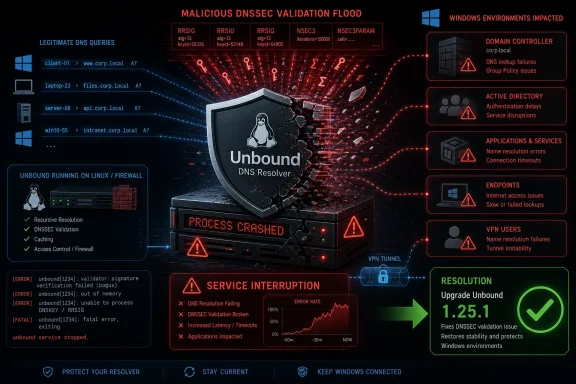 The Bug Lives Where Trust Is Supposed to Be Enforced
The uncomfortable part of CVE-2026-42959 is that it sits inside the DNSSEC validation path, the part of the resolver that is supposed to make DNS more trustworthy rather than more fragile. DNSSEC is designed to let resolvers validate that answers have not been tampered with on the way from an authoritative server to the client. In this case, the validating resolver can be pushed into a crash while processing malicious content during that validation process.That makes the vulnerability feel familiar to anyone who has watched security features become availability risks. The same additional parsing, cryptographic checking, and state tracking that make a system harder to spoof also create more code paths where malformed input can do damage. DNSSEC does not merely add signatures; it adds complexity, and complexity is where denial-of-service bugs like to hide.
Public vulnerability summaries describe the issue as affecting Unbound up to and including version 1.25.0, with the fix arriving in 1.25.1. The reported impact is a process crash triggered by malicious upstream replies during DNSSEC validation. The attacker’s goal is not to own the box but to make the resolver fall over, repeatedly if necessary.
For sysadmins, that difference matters operationally. A resolver crash may be automatically restarted by systemd, a service wrapper, a container orchestrator, or a Windows service manager. But if the hostile input remains reachable and the same query path can be induced again, restart becomes a metronome, not a mitigation.
DNS Outages Rarely Stay in the DNS Lane
DNS failures have a special way of misleading incident responders. Users do not report that a recursive resolver is dereferencing a bad pointer while building validation state; they report that “the internet is down,” that Teams cannot sign in, that a software updater fails, that printers vanish, or that line-of-business apps suddenly cannot reach licensing endpoints.That is why denial of service in a recursive resolver deserves more attention than the phrase often receives. A web server crash takes down a web server. A resolver crash can make unrelated services appear broken because name resolution is the first dependency they all quietly share.
In Windows environments, the blast radius can be particularly confusing because DNS is already layered. Active Directory-integrated DNS may handle internal zones while forwarding unknown names to another resolver. Small offices may run Unbound behind Pi-hole. Security-conscious home labs may run it as a local validating resolver. MSPs may deploy it in appliances or virtual machines without clients ever knowing its name.
CVE-2026-42959 does not need to be a Windows kernel bug to become a Windows outage. It only needs to sit on the recursive path that Windows endpoints, servers, browsers, update agents, and authentication workflows rely on. If a resolver becomes unavailable, Windows will dutifully try the next configured resolver, if one exists and if policy allows it. If that fallback is missing, misconfigured, filtered, or equally vulnerable, the outage becomes visible fast.
The Attack Model Is Narrower Than the Impact
The vulnerability is not best understood as “anyone on the internet can send one packet and kill your DNS.” The public descriptions point to malicious upstream replies and an attacker with influence over DNS content, such as control over a DNSSEC-signed domain or an authoritative response path that the vulnerable resolver can be made to query. That narrows the attack path, but it does not make it academic.Recursive resolvers exist to ask strangers on the internet questions. If an attacker can cause a target resolver to look up a name under attacker-controlled DNS infrastructure, the attacker gets a chance to return the kind of answer that exercises the vulnerable validation code. In many environments, forcing lookups is not difficult. Email, web content, logs, document previews, telemetry, and user browsing all generate DNS queries as a side effect.
That is the old DNS problem in miniature: the protocol is both infrastructure and input surface. A resolver is not just a passive cache. It is a network client that walks delegation chains, talks to authoritative servers, processes glue and additional records, and tries to determine whether the resulting data should be trusted.
The reported failure mechanism involves the resolver mishandling state while constructing validation-related reply data, leading to use of an uninitialized pointer and a crash. The details matter to developers, but administrators can translate it into a simpler operational sentence: a specially crafted DNSSEC validation scenario can terminate the resolver process.
“High Availability” Means More Than Restarting the Daemon
The common defensive instinct after a resolver crash bug is to ask whether the service restarts automatically. That is a useful question, but it is not the end of the analysis. A process supervisor can reduce downtime after a single crash; it cannot guarantee availability against repeatable input that keeps producing the crash.A good DNS availability plan assumes individual resolvers fail. Clients should have more than one resolver, resolvers should not all share the same vulnerable version, and forwarding chains should not collapse into a single hidden dependency. Too many networks look redundant on endpoint configuration screens but converge on one upstream recursive service in practice.
For enterprises, this is where asset management becomes security work. It is not enough to know that domain controllers are patched. Teams need to know whether Unbound is running inside a firewall, a Linux VM, a Kubernetes sidecar, a DNS filtering product, a branch-office appliance, a developer workstation, or a “temporary” lab server that somehow became production.
Home labs and small offices have their own version of the same problem. The increasingly popular Pi-hole-plus-Unbound pattern gives users privacy, local control, and DNSSEC validation, but it also creates a single recursive choke point if there is only one box. If that box crashes, the fix may not be obvious to everyone in the house or office; it just looks like Wi-Fi stopped working.
Microsoft’s Listing Is a Reminder That the Windows Perimeter Is Porous
The source material here comes through Microsoft’s vulnerability ecosystem, but the affected component is Unbound, an open-source recursive DNS resolver maintained by NLnet Labs. That distinction is important because modern Windows environments are not Windows-only environments. They are hybrids of Microsoft services, Linux appliances, open-source infrastructure, identity providers, endpoint agents, and cloud glue.The old habit of sorting vulnerabilities into “Windows” and “not Windows” buckets is less useful than it used to be. If a vulnerable resolver sits between Windows clients and the internet, then it is part of the Windows user experience. If it supports authentication, update retrieval, certificate checks, package downloads, or SaaS access, then it is part of the operational perimeter.
Microsoft’s security tooling and advisories increasingly surface problems in third-party components because that is how real environments are built. Defender, vulnerability management platforms, SBOM-driven inventory, and cloud security tools do not get to care only about code Microsoft wrote. They have to care about the software customers actually run.
That is especially true for DNS. Windows Server DNS remains common, but it is far from the only resolver in Windows shops. Unbound often appears because an administrator wanted validating recursion, local caching, encrypted DNS options, or a clean separation between authoritative internal DNS and recursive external lookup. Those are defensible architecture choices. They still come with patch obligations.
DNSSEC Keeps Proving That Security Protocols Need Availability Budgets
CVE-2026-42959 lands in a longer line of DNSSEC-related availability concerns. Some past incidents and vulnerabilities have involved algorithmic complexity, where validation work could be inflated until resolvers spent too much CPU. Others have involved implementation bugs, where malformed or unexpected signed data hit fragile parsing paths. The common thread is not that DNSSEC is bad; it is that DNSSEC shifts part of DNS security into a more complex resolver runtime.That trade-off is worth making in many environments. DNS without validation remains vulnerable to classes of spoofing and cache poisoning that the industry has spent years trying to reduce. But security controls have to be engineered with failure in mind. A validating resolver that can be crashed by malicious validation content becomes a paradox: stronger assurance when it works, broader outage when it fails.
This is the same lesson enterprises have learned with TLS inspection boxes, endpoint agents, identity brokers, and secure web gateways. Security middleware sits on the critical path. If it is robust, it reduces risk invisibly. If it fails, everyone notices at once.
The best response is not to abandon validation. It is to patch quickly, diversify carefully, and monitor resolvers like production infrastructure rather than background plumbing. DNS is too foundational to be treated as a set-and-forget service.
Patch Management Has to Reach the Quiet Resolvers
The obvious remediation is to move affected Unbound deployments to a fixed release, with public reports pointing to 1.25.1 as the corrected version. That sounds simple until you count the places Unbound may be hiding. Some organizations compile it directly. Others inherit it from Linux distributions, BSD base systems, network products, containers, or control panels.Package versioning can also complicate the picture. A distribution may backport a security fix without changing the upstream version number in a way that looks obvious to a scanner. Conversely, a system may appear current because the operating system is patched while an appliance, container image, or manually installed binary remains stale. Administrators should verify the vendor’s security status for the actual package they run, not just compare strings casually.
Windows users running Unbound directly should be especially attentive to where it came from. NLnet Labs provides Windows builds, but some users deploy older binaries copied from previous setups and rarely revisit them. In a lab, that may be inconvenient. In a small business where Unbound is the only recursive resolver for every workstation, it is a business continuity issue.
The upgrade should be paired with a restart test and a resolution test. DNS services are famous for failing quietly after configuration drift, permission changes, stale trust anchors, or firewall rules surface during a restart. A patched resolver that does not come back cleanly is not a fix; it is a different outage.
Detection Will Look Boring Until It Saves the Day
There is no glamour in watching a DNS daemon crash, but there is real value in alerting on exactly that. Administrators should treat unexpected resolver restarts as security signals, not merely service hygiene. A crash loop after unusual DNS queries deserves investigation, especially when the resolver performs DNSSEC validation and is exposed to arbitrary recursive lookups.Useful telemetry will be mundane. Service restart counts, core dumps, Windows Event Log entries for service termination, systemd journal messages, container restart counters, resolver logs, and upstream query patterns can all help distinguish a one-off fault from a repeatable trigger. The earlier a team notices that DNS is flapping, the less likely it is to waste time debugging browsers, VPNs, or application servers.
Network monitoring should also recognize DNS dependency failures. If every outage begins with end-user tickets, the environment is already behind. Synthetic DNS checks from multiple subnets can reveal whether recursion is healthy before users pile into the help desk queue.
Security teams should avoid overstating what they can detect from network traffic alone. The malicious content is in DNS protocol behavior and validation state, not necessarily in a payload that looks like malware. Resolver-side visibility is therefore more important than trying to spot a universal signature at the perimeter.
Resilience Beats Heroic Recovery
The better long-term response to CVE-2026-42959 is architectural humility. Assume resolvers will crash, updates will lag, and validation code will occasionally encounter hostile input that developers did not anticipate. Then build DNS service so that one component’s failure is survivable.That does not require exotic design. Two or more recursive resolvers, maintained independently enough that they do not all fail from the same local misconfiguration, can eliminate many avoidable outages. Clients should be configured to use real alternatives, not a primary resolver and a secondary address that silently forwards back to the same broken host.
Enterprises should also be wary of monocultures hidden behind load balancers. A virtual IP in front of several identical vulnerable Unbound instances may help with hardware failure, but it will not help much if the same crafted query crashes every backend. Diversity can mean staggered patch timing, different resolver implementations in limited roles, or at least careful blast-radius isolation between user networks, server networks, and sensitive production systems.
There is a balance to strike. Too much resolver diversity can become an operational mess, especially where DNSSEC behavior, filtering policy, split-horizon zones, and logging requirements must stay consistent. But no diversity at all turns every resolver vulnerability into a full-environment risk.
The Practical Read for WindowsForum Readers
The useful response to this CVE is neither panic nor dismissal. It is a reminder to inventory the DNS path with the same seriousness usually reserved for identity and endpoint security. If Unbound is on that path, it needs to be updated, monitored, and treated as production infrastructure.- Organizations running Unbound versions up to and including 1.25.0 should verify whether their vendor or package source has shipped the CVE-2026-42959 fix and should move to a fixed build promptly.
- Windows environments can be affected even when the vulnerable resolver runs on Linux, BSD, a firewall, a container, or a small appliance, because Windows clients still depend on that resolver for name resolution.
- Automatic service restart reduces the pain of a single crash but does not solve a repeatable denial-of-service condition if the malicious DNSSEC validation path can be triggered again.
- DNS resolver redundancy should be tested, not assumed, because many networks that appear to have multiple DNS servers ultimately depend on the same upstream recursive component.
- Resolver logs, crash reports, service restart alerts, and synthetic DNS checks are the most practical early-warning signals for this class of vulnerability.
- Disabling DNSSEC validation may reduce exposure in some emergency scenarios, but it trades away a security property and should be treated as a temporary risk decision rather than a clean fix.
References
- Primary source: MSRC
Published: 2026-05-23T01:39:27-07:00
Security Update Guide - Microsoft Security Response Center
 msrc.microsoft.com
- Related coverage: sentinelone.com
CVE-2026-42959: Nlnetlabs Unbound DOS Vulnerability
CVE-2026-42959 is a denial of service vulnerability in Nlnetlabs Unbound. Learn about its impact, affected versions, and mitigation methods.www.sentinelone.com
- Official source: microsoft.com
Active attack: Dirty Frag Linux vulnerability expands post-compromise risk | Microsoft Security Blog
Dirty Frag is a newly disclosed Linux local privilege escalation vulnerability affecting kernel networking and memory-fragment handling components including esp4, esp6, and rxrpc. The vulnerability enables reliable escalation from an unprivileged user to root and may be leveraged after initial...www.microsoft.com - Related coverage: dbugs.ptsecurity.com
CVE-2026-42959 — DoS in Nlnet+4 Unbound+4 | dbugs
Details on CVE-2026-42959: DoS in Nlnet+4 Unbound+4. Includes CVSS score, affected versions, and references.dbugs.ptsecurity.com - Related coverage: securityonline.info
Unbound DNSSEC Validation Vulnerability Fixed
NLnet Labs patches a critical Unbound DNSSEC validation vulnerability allowing unauthenticated remote code execution. Update to 1.25.1.securityonline.info - Related coverage: hivepro.com
- Related coverage: isomer-user-content.by.gov.sg
