

CVE-2026-42960 is a high-severity DNS cache-poisoning flaw in NLnet Labs Unbound through version 1.25.0, disclosed in May 2026 and patched in Unbound 1.25.1, with Microsoft’s Security Update Guide mirroring the advisory for environments that consume the resolver through Microsoft-managed or Microsoft-tracked software channels. The bug is not a flashy remote-code-execution headline, but it lands in a part of the stack where quiet corruption can be more operationally dangerous than a crash. If a resolver believes the wrong answer, everything above it can make the wrong decision with confidence.
DNS cache poisoning has always occupied an awkward place in security triage. It does not look like ransomware, it does not drop a web shell, and it may not even register as a traditional outage. The service keeps responding; the problem is that it may be responding with answers an attacker helped write.
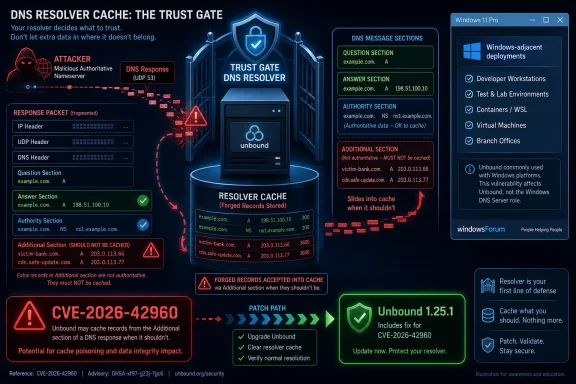
That is why CVE-2026-42960 deserves more attention than its terse advisory language suggests. The issue involves “promiscuous” records in the authority section of DNS replies, where Unbound could be tricked into caching records that should not have earned that level of trust. In plain terms, the resolver could accept extra baggage in a DNS response and later serve that poisoned baggage as if it were legitimate.
The immediate fix is simple enough: update to Unbound 1.25.1 or a vendor package that backports the patch. The larger lesson is less tidy. Modern infrastructure still assumes DNS is a boring utility until the moment it becomes the control plane for web access, mail routing, certificate validation, package retrieval, identity flows, and internal service discovery.
CVE-2026-42960 sits in that boundary. The vulnerable behavior involved Unbound accepting certain resource record sets that complemented replies in the authority section, then caching associated address records from the additional section when the authority data appeared to carry enough trust. The advisory’s example is telling: records other than name-server records, such as MX records, could be paired with address data and become part of the resolver’s cache under the right conditions.
That is a subtle failure mode. An attacker still needs to get a malicious response into the resolver’s path, which generally points to spoofed DNS packets, fragmentation games, or other network-positioning tricks. But DNS cache poisoning has never required magic; it requires exploiting the resolver’s assumptions about timing, entropy, delegation, and relevance.
The patch in Unbound 1.25.1 narrows that trust decision. Address records from the additional section are disregarded unless they are explicitly relevant to authority NS records. That is the conservative posture resolvers increasingly need: do less with unsolicited data, even when the protocol tradition says accepting it might save a round trip.
The impacted software here is NLnet Labs Unbound, a widely used validating, recursive, and caching DNS resolver. It is common in Linux and BSD environments, embedded appliances, lab networks, privacy-focused DNS deployments, and cloud or containerized infrastructure. Windows shops may still have exposure if Unbound is running beside Windows workloads, inside network appliances, in developer environments, or as part of a Linux-based resolver tier supporting Microsoft-centric estates.
That distinction matters because the wrong mental model leads to the wrong response. A Windows administrator who searches only for a Windows cumulative update may miss the actual resolver instance. A Linux administrator who assumes “MSRC means Windows” may ignore an advisory that applies directly to a package in their estate.
The practical inventory question is not “Do we run Windows DNS?” It is “Where do clients, servers, containers, VPN users, lab machines, mail systems, and cloud workloads send recursive DNS queries?” In many organizations, the answer is messier than the diagram.
That does not mean availability is irrelevant. If poisoned records prevent clients from reaching real resources, the operational effect may look like an outage. Users cannot reach a service, mail cannot route cleanly, package managers fail, or internal applications resolve to dead endpoints. From the help desk’s point of view, “DNS is broken” and “the site is down” are often indistinguishable.
But defenders should not stop at availability. A poisoned cache can also redirect users to attacker-controlled infrastructure, interfere with mail delivery, undermine service discovery, or create confusing split-brain behavior where only some clients see the wrong answer. The danger is not merely that access can be denied; it is that access can be misdirected.
This is why cache poisoning remains such a durable class of vulnerability. It attacks the shared memory of the network. Once bad data lands in a recursive resolver, many downstream clients can inherit the attacker’s answer without ever seeing the original malicious packet.
Still, dismissing the flaw because exploitation has prerequisites would be a mistake. DNS is a protocol where attackers have spent decades turning small resolver behaviors into practical attacks. Fragmentation, source-port prediction, side channels, lame delegations, and delegation-following edge cases have all been part of the historical playbook.
The most important operational fact is that a successful attack can have effects beyond the single transaction that carried it. Cache lifetime turns a brief win into a shared lie. Even if only a subset of records can be poisoned under particular delegation conditions, the resolver’s role as a multiplier raises the stakes.
This is also why DNSSEC changes the risk discussion but does not erase it everywhere. Validating resolvers and signed zones reduce the space for successful forgery, but DNSSEC deployment remains uneven, and many operational paths still depend on unsigned names or local trust exceptions. A resolver bug that mishandles cacheable context is still worth patching even in environments that have made serious DNSSEC investments.
That density should shape how administrators approach the update. Treating 1.25.1 as a narrow patch for one cache issue undersells the release. It is more accurately a hardening release across several resolver attack surfaces, many of them centered on malformed or strategically crafted DNS content.
For WindowsForum readers, the Windows angle is also notable: NLnet Labs publishes Windows builds of Unbound, including installers and ZIP packages, not just source tarballs for Unix-like systems. That means small offices, home labs, privacy enthusiasts, and hybrid Windows/Linux environments may be running Unbound directly on Windows even if enterprise documentation tends to discuss it as a Unix daemon.
The upgrade path should be boring, which is exactly what DNS operators want. Update the package, restart or reload the resolver according to your platform’s service model, confirm the running version, and flush cache where appropriate. The hard part is usually not applying the patch; it is finding every resolver that matters.
The risk profile is different at home, but not imaginary. A poisoned resolver could interfere with banking, software updates, email, smart-home cloud services, or VPN connectivity. Even a partial failure can be maddening because DNS problems often masquerade as browser bugs, ISP issues, certificate errors, or random application instability.
Small deployments also tend to be more exposed to configuration drift. Someone installs Unbound from source, another instance ships inside an appliance, a container image pins an older version, and a firewall distribution backports fixes without changing the upstream-looking version number. The only safe assumption is that the resolver layer needs explicit inventory.
This is where enthusiasts can borrow from enterprise discipline without turning the homelab into a compliance program. Know which box answers DNS. Know how it updates. Know whether it validates DNSSEC. Know how to flush or restart it without taking the household offline for an afternoon.
That complexity makes CVE-2026-42960 an inventory problem before it is a patching problem. Security teams need to identify Unbound instances by package, container image, appliance firmware, and managed service dependency. Sysadmins need to know whether the vulnerable code is directly under their control or hidden behind a vendor’s update cycle.
The most dangerous resolver is the one nobody owns. It may sit in a forgotten VM, a branch-office firewall, a lab subnet, a jump host, or a DNS filtering appliance. It may not appear in endpoint vulnerability scans because it is not a traditional workstation or server workload.
There is also a monitoring gap. Many organizations log DNS queries, but fewer record enough resolver behavior to spot cache poisoning symptoms. If a resolver suddenly serves unexpected MX-associated addresses, inconsistent answers across peers, or odd additional-section-derived data, that may not trigger an alert unless DNS integrity is already part of the detection model.
Internet-facing recursive resolvers deserve fast action, especially if they serve broad client populations or accept queries from networks that are not tightly controlled. So do resolvers that support mail infrastructure, identity providers, software repositories, CI/CD systems, or security tooling. Poisoning DNS for a build environment can be a supply-chain problem in disguise.
Internal-only resolvers should not be ignored. Many attacks begin from a foothold inside the network, and a resolver trusted by internal systems is an attractive pivot point. If an attacker can influence DNS answers for internal clients, they may be able to steer authentication, update, telemetry, or service-discovery traffic in ways that complicate incident response.
The cleanest operational move is to patch all Unbound instances to 1.25.1 or the vendor-fixed equivalent. Where immediate patching is not possible, administrators should reduce exposure, restrict who can query the resolver, prefer TCP or fragmentation-resistant configurations where appropriate, monitor for suspicious response patterns, and review whether DNSSEC validation is enabled and functioning. Those mitigations are not substitutes for the fix, but they can shrink the window.
That creates friction for administrators who want a binary answer: vulnerable or not vulnerable. The answer may depend on whether the distribution has backported the specific patch, not whether the upstream version number is higher than 1.25.0. Security teams need to read vendor package changelogs, not just compare raw versions.
This is especially important in Microsoft-heavy shops now running more Linux than their org charts admit. Azure workloads, containers, WSL-based development, security appliances, and open-source infrastructure often sit beside Windows Server and Active Directory. MSRC’s presence in the story is a reminder that “Microsoft environment” no longer means “Microsoft code only.”
The better model is dependency stewardship. If your organization depends on a component to make trust decisions, you track it even when it is not glamorous. DNS resolvers, certificate libraries, compression libraries, XML parsers, logging agents, and container base images all live in that category.
The security problem is that caches convert a momentary validation failure into durable state. A bad answer can outlive the packet that delivered it. It can be served to users who were never part of the original attack. It can make incident responders chase symptoms across unrelated systems.
DNS is particularly sensitive because it sits before the connection. If the name resolves incorrectly, the client’s next security decision may happen against the wrong host. TLS and application-layer checks can blunt some attacks, but not every protocol, workflow, or internal service has perfect certificate validation and pinning. Mail routing, legacy systems, and automation scripts are often less forgiving than browsers.
That is the broader argument for treating CVE-2026-42960 seriously. It is not just an Unbound bug. It is a reminder that resolver strictness is a security control, and permissive interpretation of “helpful” DNS records can become an attacker’s write primitive into shared network memory.
The most concrete checks are also the least glamorous:
The likely future of resolver security is stricter parsing, less trust in opportunistic additional data, and more pressure on vendors to make DNS behavior observable rather than mystical. CVE-2026-42960 will fade into package changelogs soon enough, but the architectural lesson will not: when the resolver gets tricked, the network does not merely lose an answer — it inherits a false one.
 A Resolver Bug Becomes a Trust Problem
DNS cache poisoning has always occupied an awkward place in security triage. It does not look like ransomware, it does not drop a web shell, and it may not even register as a traditional outage. The service keeps responding; the problem is that it may be responding with answers an attacker helped write.That is why CVE-2026-42960 deserves more attention than its terse advisory language suggests. The issue involves “promiscuous” records in the authority section of DNS replies, where Unbound could be tricked into caching records that should not have earned that level of trust. In plain terms, the resolver could accept extra baggage in a DNS response and later serve that poisoned baggage as if it were legitimate.
The immediate fix is simple enough: update to Unbound 1.25.1 or a vendor package that backports the patch. The larger lesson is less tidy. Modern infrastructure still assumes DNS is a boring utility until the moment it becomes the control plane for web access, mail routing, certificate validation, package retrieval, identity flows, and internal service discovery.
The Authority Section Was Doing Too Much Work
DNS responses are not just a single question and answer. They contain sections that give context, delegation information, and sometimes additional records meant to make resolution faster. That efficiency is also a security boundary: a resolver must decide which records are relevant, which are helpful, and which are untrusted clutter.CVE-2026-42960 sits in that boundary. The vulnerable behavior involved Unbound accepting certain resource record sets that complemented replies in the authority section, then caching associated address records from the additional section when the authority data appeared to carry enough trust. The advisory’s example is telling: records other than name-server records, such as MX records, could be paired with address data and become part of the resolver’s cache under the right conditions.
That is a subtle failure mode. An attacker still needs to get a malicious response into the resolver’s path, which generally points to spoofed DNS packets, fragmentation games, or other network-positioning tricks. But DNS cache poisoning has never required magic; it requires exploiting the resolver’s assumptions about timing, entropy, delegation, and relevance.
The patch in Unbound 1.25.1 narrows that trust decision. Address records from the additional section are disregarded unless they are explicitly relevant to authority NS records. That is the conservative posture resolvers increasingly need: do less with unsolicited data, even when the protocol tradition says accepting it might save a round trip.
Microsoft’s Name on the Page Does Not Make This a Windows DNS Server Bug
The MSRC listing will cause some understandable confusion among Windows admins. Microsoft’s Security Update Guide often tracks vulnerabilities that affect Microsoft products, components, services, Linux distributions, containers, or supply-chain dependencies. A CVE appearing there does not automatically mean the Windows Server DNS role is vulnerable in the same way.The impacted software here is NLnet Labs Unbound, a widely used validating, recursive, and caching DNS resolver. It is common in Linux and BSD environments, embedded appliances, lab networks, privacy-focused DNS deployments, and cloud or containerized infrastructure. Windows shops may still have exposure if Unbound is running beside Windows workloads, inside network appliances, in developer environments, or as part of a Linux-based resolver tier supporting Microsoft-centric estates.
That distinction matters because the wrong mental model leads to the wrong response. A Windows administrator who searches only for a Windows cumulative update may miss the actual resolver instance. A Linux administrator who assumes “MSRC means Windows” may ignore an advisory that applies directly to a package in their estate.
The practical inventory question is not “Do we run Windows DNS?” It is “Where do clients, servers, containers, VPN users, lab machines, mail systems, and cloud workloads send recursive DNS queries?” In many organizations, the answer is messier than the diagram.
Availability Language Hides an Integrity-Centered Attack
The user-facing severity text around availability can read as if this is primarily a denial-of-service issue. That framing is incomplete. The heart of CVE-2026-42960 is cache poisoning, which is fundamentally an integrity failure: the resolver may store and serve attacker-influenced DNS data.That does not mean availability is irrelevant. If poisoned records prevent clients from reaching real resources, the operational effect may look like an outage. Users cannot reach a service, mail cannot route cleanly, package managers fail, or internal applications resolve to dead endpoints. From the help desk’s point of view, “DNS is broken” and “the site is down” are often indistinguishable.
But defenders should not stop at availability. A poisoned cache can also redirect users to attacker-controlled infrastructure, interfere with mail delivery, undermine service discovery, or create confusing split-brain behavior where only some clients see the wrong answer. The danger is not merely that access can be denied; it is that access can be misdirected.
This is why cache poisoning remains such a durable class of vulnerability. It attacks the shared memory of the network. Once bad data lands in a recursive resolver, many downstream clients can inherit the attacker’s answer without ever seeing the original malicious packet.
The Exploit Path Is Narrower Than the Blast Radius
CVE-2026-42960 should not be described as “anyone on the internet can instantly take over DNS.” The attacker has to attach malicious records to a reply that the resolver will accept, and the advisory points toward spoofed packets or fragmentation attacks as plausible routes. That is not the same thing as a simple HTTP request against an exposed web service.Still, dismissing the flaw because exploitation has prerequisites would be a mistake. DNS is a protocol where attackers have spent decades turning small resolver behaviors into practical attacks. Fragmentation, source-port prediction, side channels, lame delegations, and delegation-following edge cases have all been part of the historical playbook.
The most important operational fact is that a successful attack can have effects beyond the single transaction that carried it. Cache lifetime turns a brief win into a shared lie. Even if only a subset of records can be poisoned under particular delegation conditions, the resolver’s role as a multiplier raises the stakes.
This is also why DNSSEC changes the risk discussion but does not erase it everywhere. Validating resolvers and signed zones reduce the space for successful forgery, but DNSSEC deployment remains uneven, and many operational paths still depend on unsigned names or local trust exceptions. A resolver bug that mishandles cacheable context is still worth patching even in environments that have made serious DNSSEC investments.
Unbound 1.25.1 Is a Security Release Wearing a Maintenance Jacket
Unbound 1.25.1, released on May 20, 2026, is not a one-CVE cleanup. The release notes list a cluster of security fixes, including issues involving DNSSEC validation crashes, EDNS option handling, DNSCrypt denial-of-service behavior, ghost-domain variants, NSEC3 hash calculation costs, jostle-logic bypass, name compression degradation, RPZ use-after-free, and CVE-2026-42960’s cache-poisoning path.That density should shape how administrators approach the update. Treating 1.25.1 as a narrow patch for one cache issue undersells the release. It is more accurately a hardening release across several resolver attack surfaces, many of them centered on malformed or strategically crafted DNS content.
For WindowsForum readers, the Windows angle is also notable: NLnet Labs publishes Windows builds of Unbound, including installers and ZIP packages, not just source tarballs for Unix-like systems. That means small offices, home labs, privacy enthusiasts, and hybrid Windows/Linux environments may be running Unbound directly on Windows even if enterprise documentation tends to discuss it as a Unix daemon.
The upgrade path should be boring, which is exactly what DNS operators want. Update the package, restart or reload the resolver according to your platform’s service model, confirm the running version, and flush cache where appropriate. The hard part is usually not applying the patch; it is finding every resolver that matters.
The Home-Lab Crowd Is Not Exempt
Unbound is popular in home labs because it is fast, standards-oriented, and pairs well with tools such as Pi-hole, OPNsense, pfSense, and various self-hosted privacy stacks. That same popularity means CVE-2026-42960 is not just an enterprise advisory. A home network can absolutely have a serious dependency on a recursive resolver that nobody has updated in months.The risk profile is different at home, but not imaginary. A poisoned resolver could interfere with banking, software updates, email, smart-home cloud services, or VPN connectivity. Even a partial failure can be maddening because DNS problems often masquerade as browser bugs, ISP issues, certificate errors, or random application instability.
Small deployments also tend to be more exposed to configuration drift. Someone installs Unbound from source, another instance ships inside an appliance, a container image pins an older version, and a firewall distribution backports fixes without changing the upstream-looking version number. The only safe assumption is that the resolver layer needs explicit inventory.
This is where enthusiasts can borrow from enterprise discipline without turning the homelab into a compliance program. Know which box answers DNS. Know how it updates. Know whether it validates DNSSEC. Know how to flush or restart it without taking the household offline for an afternoon.
Enterprise DNS Is a Dependency Graph, Not a Server Role
In enterprise environments, recursive DNS is rarely a single product. A Windows Server DNS role may forward to an Unbound tier, which may forward to an ISP, a cloud resolver, a security-filtering service, or an internal split-horizon layer. Kubernetes clusters may have their own DNS path. Developer laptops may use VPN-assigned resolvers. Cloud workloads may use provider defaults unless overridden.That complexity makes CVE-2026-42960 an inventory problem before it is a patching problem. Security teams need to identify Unbound instances by package, container image, appliance firmware, and managed service dependency. Sysadmins need to know whether the vulnerable code is directly under their control or hidden behind a vendor’s update cycle.
The most dangerous resolver is the one nobody owns. It may sit in a forgotten VM, a branch-office firewall, a lab subnet, a jump host, or a DNS filtering appliance. It may not appear in endpoint vulnerability scans because it is not a traditional workstation or server workload.
There is also a monitoring gap. Many organizations log DNS queries, but fewer record enough resolver behavior to spot cache poisoning symptoms. If a resolver suddenly serves unexpected MX-associated addresses, inconsistent answers across peers, or odd additional-section-derived data, that may not trigger an alert unless DNS integrity is already part of the detection model.
Patch Priority Should Follow Resolver Reach
The right urgency depends on where Unbound sits. An isolated resolver serving a lab VLAN has a different blast radius from a recursive resolver serving thousands of users, mail gateways, build systems, and production services. CVSS scores are useful; dependency maps are better.Internet-facing recursive resolvers deserve fast action, especially if they serve broad client populations or accept queries from networks that are not tightly controlled. So do resolvers that support mail infrastructure, identity providers, software repositories, CI/CD systems, or security tooling. Poisoning DNS for a build environment can be a supply-chain problem in disguise.
Internal-only resolvers should not be ignored. Many attacks begin from a foothold inside the network, and a resolver trusted by internal systems is an attractive pivot point. If an attacker can influence DNS answers for internal clients, they may be able to steer authentication, update, telemetry, or service-discovery traffic in ways that complicate incident response.
The cleanest operational move is to patch all Unbound instances to 1.25.1 or the vendor-fixed equivalent. Where immediate patching is not possible, administrators should reduce exposure, restrict who can query the resolver, prefer TCP or fragmentation-resistant configurations where appropriate, monitor for suspicious response patterns, and review whether DNSSEC validation is enabled and functioning. Those mitigations are not substitutes for the fix, but they can shrink the window.
The Patch Also Tests Vendor Trust
One uncomfortable feature of modern security operations is that the same CVE can arrive through multiple channels with slightly different emphasis. NLnet Labs describes the resolver behavior and the fix. NVD and vulnerability databases assign or display scores. Microsoft mirrors the issue through MSRC for its ecosystem. Linux distributions may backport the patch into packages whose version strings do not obviously match upstream 1.25.1.That creates friction for administrators who want a binary answer: vulnerable or not vulnerable. The answer may depend on whether the distribution has backported the specific patch, not whether the upstream version number is higher than 1.25.0. Security teams need to read vendor package changelogs, not just compare raw versions.
This is especially important in Microsoft-heavy shops now running more Linux than their org charts admit. Azure workloads, containers, WSL-based development, security appliances, and open-source infrastructure often sit beside Windows Server and Active Directory. MSRC’s presence in the story is a reminder that “Microsoft environment” no longer means “Microsoft code only.”
The better model is dependency stewardship. If your organization depends on a component to make trust decisions, you track it even when it is not glamorous. DNS resolvers, certificate libraries, compression libraries, XML parsers, logging agents, and container base images all live in that category.
The Cache Is Where Small Mistakes Become Shared Reality
The phrase “cache poisoning” can sound almost quaint, like an attack class from the early broadband era. That nostalgia is misleading. Caches are more important now, not less, because modern systems are layered with them: browser caches, CDN caches, package caches, resolver caches, identity-token caches, container image caches, and API gateways all trade freshness for speed.The security problem is that caches convert a momentary validation failure into durable state. A bad answer can outlive the packet that delivered it. It can be served to users who were never part of the original attack. It can make incident responders chase symptoms across unrelated systems.
DNS is particularly sensitive because it sits before the connection. If the name resolves incorrectly, the client’s next security decision may happen against the wrong host. TLS and application-layer checks can blunt some attacks, but not every protocol, workflow, or internal service has perfect certificate validation and pinning. Mail routing, legacy systems, and automation scripts are often less forgiving than browsers.
That is the broader argument for treating CVE-2026-42960 seriously. It is not just an Unbound bug. It is a reminder that resolver strictness is a security control, and permissive interpretation of “helpful” DNS records can become an attacker’s write primitive into shared network memory.
The Practical Reading for WindowsForum Readers
For Windows enthusiasts and IT pros, the actionable path is narrower than the theory but broader than Windows Update. If Unbound is present anywhere in your resolution path, confirm whether it is patched to 1.25.1 or carries the vendor backport for CVE-2026-42960. Do not assume the absence of a Windows Server DNS advisory means the environment is unaffected.The most concrete checks are also the least glamorous:
- Confirm whether any Windows, Linux, BSD, firewall, NAS, lab, container, or appliance deployment is running NLnet Labs Unbound through version 1.25.0.
- Update Unbound to 1.25.1 or install the relevant vendor package that backports the CVE-2026-42960 fix.
- Restart or reload resolver services after patching, and flush cached data where operationally appropriate.
- Prioritize resolvers that serve many clients, forward enterprise traffic, support mail or identity infrastructure, or sit in production cloud networks.
- Review DNSSEC validation, query access controls, resolver exposure, and logging so future poisoning attempts are easier to prevent and investigate.
The likely future of resolver security is stricter parsing, less trust in opportunistic additional data, and more pressure on vendors to make DNS behavior observable rather than mystical. CVE-2026-42960 will fade into package changelogs soon enough, but the architectural lesson will not: when the resolver gets tricked, the network does not merely lose an answer — it inherits a false one.
References
- Primary source: MSRC
Published: 2026-05-23T01:39:17-07:00
Security Update Guide - Microsoft Security Response Center
 msrc.microsoft.com
- Related coverage: sentinelone.com
CVE-2026-42960: Nlnetlabs Unbound DNS Poisoning Vulnerability
CVE-2026-42960 is a DNS cache poisoning vulnerability in Nlnetlabs Unbound. Learn about its impact, affected versions, and mitigation methods.www.sentinelone.com
- Related coverage: endorlabs.com
- Related coverage: echelongraph.io
CVE-2026-42960: Possible cache poisoning via… | EchelonGraph
[Medium] Microsoft Security Response Center (MSRC) security advisory CVE-2026-42960 — CVE-2026-42960. Possible cache poisoning via promiscuous records f…echelongraph.io
- Related coverage: dbugs.ptsecurity.com
CVE-2026-42960 — DoS in Nlnet+3 Unbound+3 | dbugs
Details on CVE-2026-42960: DoS in Nlnet+3 Unbound+3. Includes CVSS score, affected versions, and references.dbugs.ptsecurity.com - Official source: microsoft.com
MSRC - Microsoft Security Response Center
The Microsoft Security Response Center is part of the defender community and on the front line of security response evolution. For over twenty years, we have been engaged with security researchers working to protect customers and the broader ecosystem.www.microsoft.com

- Related coverage: cs.ucr.edu
- Official source: techcommunity.microsoft.com
- Related coverage: hivepro.com
- Related coverage: cirt.gy
