

That distinction matters. This is not a remote-code-execution panic button, and it is not the kind of vulnerability that lets an attacker walk away with secrets. But for the WindowsForum audience, it is exactly the sort of infrastructure flaw that can be underestimated until a resolver quietly becomes the slowest and most fragile part of the network.
Microsoft’s Advisory Is a Signpost, Not the Center of the Story
The Microsoft Security Response Center entry gives this vulnerability a Windows-adjacent visibility boost, but the affected component is Unbound, the widely deployed recursive, validating, caching DNS resolver maintained by NLnet Labs. That makes the advisory easy to misread. This is not a flaw in Windows DNS Server itself, nor does the MSRC listing automatically mean every Windows client is exposed.
The reason Microsoft’s catalog still matters is practical: many administrators track vulnerability exposure through Microsoft’s ecosystem, even when the vulnerable code is open source or third-party. The Security Update Guide has become less of a Windows-only patch ledger and more of a risk dashboard for software that may matter to Microsoft customers, cloud workloads, developer environments, and enterprise estates.
That is the correct lens for CVE-2026-44390. If you run Unbound on Windows, ship it inside an appliance, depend on it in a container, or use it as a recursive resolver for office, lab, VPN, or edge networks, the vulnerability belongs in your patch queue. If you do not run Unbound, the MSRC page is a heads-up about the DNS ecosystem, not a call to patch Windows Update.
The awkward part is that DNS resolvers often sit in the mental category of set and forget. They are not glamorous, they are not usually exposed through flashy dashboards, and they frequently survive multiple infrastructure refresh cycles untouched. That makes a low-availability-impact bug more consequential than its severity label suggests.
The Bug Lives in the Resolver’s Workload, Not in the User’s Browser
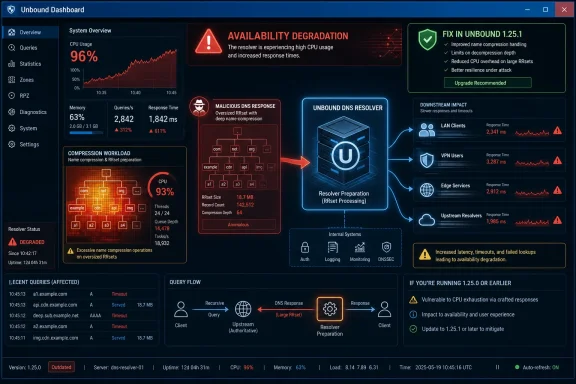
At the technical level, CVE-2026-44390 concerns Unbound’s handling of DNS replies with very large RRsets that require name compression before the resolver sends a response downstream. DNS name compression is a space-saving mechanism, but in this case the problem is not compression as a concept. The problem is that certain response shapes can push the resolver into doing too much work.
The scenario described by the vulnerability record involves records that do not share a useful suffix above the DNS root. That matters because an earlier compression limit did not fully account for a code path where compression tree lookup failed. The result was an unbounded operation in a case that should have been bounded.
In plain English: an attacker can arrange for a resolver to ask about maliciously crafted DNS content, receive a burdensome answer from an upstream source, and then spend excessive CPU time preparing the downstream reply. The resolver is not being tricked into executing hostile code. It is being made to work too hard on a legitimate-looking task.
That is why the impact description lands on degradation rather than total compromise. The resource hit may slow responses, interrupt availability, or make the service unreliable under repeated exploitation. It does not, on its own, hand over administrative access, alter DNS records in cache, or expose private data.
For defenders, however, resource exhaustion is still a real attack class. DNS is dependency infrastructure. If name resolution becomes slow, everything else becomes slow in ways that users describe imprecisely: “the internet is down,” “VPN is broken,” “Teams is lagging,” “the app is timing out.” A resolver that is only partially available can still generate a full day of help desk noise.
The Severity Is Low, but the Blast Radius Can Be Annoyingly Broad
The vulnerability has a low availability impact in the common scoring language, and that is probably fair. It requires a crafted DNS situation, it does not create a direct confidentiality or integrity failure, and the public description frames the consequence as service degradation rather than complete denial of service.
But severity scoring has always struggled with infrastructure software that is individually modest and collectively vital. A single resolver under strain may be an inconvenience. A shared recursive resolver under strain during business hours can look like a network incident. A resolver embedded in a product or virtual appliance can be harder to inventory than the operating system beneath it.
This is where administrators should resist the temptation to treat “low” as “ignore.” Low severity means prioritize intelligently, not indefinitely. If Unbound is exposed to untrusted clients, used by a large internal population, or positioned where resolver latency cascades into authentication, endpoint management, software updates, or cloud access, the operational risk deserves attention.
There is also a subtle asymmetry here. An attacker does not need to make the resolver vanish from the network to create pain. They only need to make it unreliable enough that retries, fallbacks, and application timeouts start compounding. Modern software stacks are not always graceful when DNS becomes intermittently slow.
The result is an incident that may not look like a vulnerability at first. It may look like packet loss, bad Wi-Fi, a firewall issue, a tired VM, or a cloud provider hiccup. That diagnostic ambiguity is part of the cost.
Unbound’s Strength Is Also Why This Bug Deserves Notice
Unbound has earned its place in serious networks because it is fast, standards-focused, validating, and widely portable. It runs across Unix-like systems and Windows, appears in package repositories, and is used by people who care about DNSSEC validation, privacy features, local recursion, and reducing dependence on external public resolvers.
That footprint makes a resolver flaw worth watching even when the exploit impact is bounded. The DNS stack is one of the few pieces of infrastructure that can touch almost every transaction without being visible to end users. A laptop may not know the name Unbound, but it will know when the resolver behind its network gets sluggish.
For Windows-heavy shops, Unbound often appears at the edges rather than the center. It may be used by security teams, homelabbers, privacy-conscious users, development environments, local network appliances, or branch-office setups. It may sit next to Windows DNS rather than replace it, forwarding some zones while recursively resolving others.
That mixed deployment pattern is exactly what makes inventory hard. The Windows admin who knows every domain controller may not know which firewall image, Docker stack, WSL lab, or monitoring appliance includes Unbound. The Linux admin who owns the resolver may not be the person who reads MSRC alerts. Vulnerability management often breaks at those seams.
The practical answer is not panic. It is boring, necessary inventory discipline: find where Unbound exists, determine whether it is version 1.25.0 or older, and update to a fixed release where applicable. The machines most worth checking are the ones that serve many clients or accept DNS queries from networks with less trust.
This Is a Patch for a Boundary Condition, Not a Product Meltdown
NLnet Labs’ fix in Unbound 1.25.1 addresses the accounting gap by making the compression counter advance even when the lookup takes the path that previously escaped the intended limit. That kind of patch is not dramatic, but it is exactly how mature infrastructure software gets safer: a limit that existed in one path is extended to another path that behaved differently.
The history matters because the advisory describes this as complementary to CVE-2024-8508, an earlier Unbound issue involving large RRsets and name compression. In other words, the maintainers had already constrained this general class of expensive operation, but a corner case remained. That is not unusual in parsers, protocol implementations, and network software that must process adversary-controlled inputs.
The phrase “unbounded operation” tends to sound abstract until you translate it into infrastructure terms. It means the software may spend more time or CPU than expected on a request because the amount of work is not properly capped. In a resolver, that cost is especially sensitive because the service is designed to answer many small questions quickly.
This is the same family of problem that has haunted other protocol stacks: not a single catastrophic instruction, but an algorithmic trap. The attacker arranges input that is cheap to send but expensive to process. The defender pays the CPU bill.
That framing also explains why the vulnerability is not best understood as a “DNS is broken” story. DNS is doing what DNS does: asking, answering, compressing, and forwarding. The flaw is in how one implementation bounded work under a specific set of conditions.
The Windows Angle Is Mostly About Operations
For Windows users, the most important sentence is also the least exciting: this is not a vulnerability in the Windows DNS Client service. Ordinary Windows desktops that simply obtain DNS settings from DHCP and query a corporate or ISP resolver are not directly vulnerable because of the MSRC listing.
The relevant Windows exposure appears when Unbound is actually installed or bundled. NLnet Labs provides Windows builds, and Unbound is sometimes used by enthusiasts and administrators who want a local validating resolver, a privacy-oriented DNS setup, or a controlled recursive resolver outside the Windows Server DNS role. Those are perfectly legitimate deployments, but they need the same patch hygiene as any other network daemon.
Windows Server administrators should also think about dependency chains. A Windows domain may rely on Microsoft DNS for Active Directory while forwarding unresolved queries to another recursive resolver. If that recursive resolver is Unbound, a slowdown there can still affect user-visible behavior even though the Windows DNS service itself is not the vulnerable component.
The same applies to developer workstations and lab environments. DNS resolvers are frequently pulled into container stacks, test harnesses, security labs, and appliance images. A vulnerability scanner may flag CVE-2026-44390 not because Windows is broken, but because an installed package, image, or service contains Unbound.
That distinction matters for remediation. You are not looking for a Windows cumulative update that magically fixes this everywhere. You are looking for the Unbound version in the place where Unbound runs.
Availability Bugs Punish the Teams With the Least Visibility
The uncomfortable thing about DNS availability bugs is that the people who suffer first are often not the people who can diagnose them fastest. End users see slow websites, failed logins, intermittent application launches, delayed endpoint policy refreshes, or broken package downloads. The resolver sees CPU spikes and odd query patterns.
Between those two views is usually a swamp of misleading symptoms. Application logs show timeouts. Security tools show retries. Network monitors show latency. Help desk tickets say “everything is slow.” Only after someone correlates resolver performance with the timeline does DNS become the suspect.
CVE-2026-44390 is not guaranteed to create that kind of incident. It is a vulnerability with constrained impact and a known fix. But it lives in the precise layer where small degradations can become noisy.
That is why organizations should treat resolver telemetry as first-class operational data. Query volume, response latency, SERVFAIL rates, CPU usage, and upstream behavior are not luxuries. They are the difference between discovering a resolver under stress in five minutes and spending half a day blaming the WAN.
For home labs and small offices, the same principle applies at a smaller scale. If a local Unbound instance runs on a low-power box, virtual machine, firewall, NAS, or Raspberry Pi-class device, CPU-bound resolver behavior may be more visible than it would be on a large server. Hardware headroom is part of the risk calculation.
Patch Management Has to Include the Quiet Open-Source Plumbing
One of the recurring lessons from modern vulnerability management is that the operating system is no longer the boundary of responsibility. A Windows estate can depend on Linux containers. A Microsoft-heavy business can route DNS through open-source resolvers. A commercial appliance can include third-party components that appear nowhere in the admin’s mental map.
CVE-2026-44390 is a small example of that larger truth. The fix is straightforward for anyone who controls the Unbound installation: move to the patched release or apply the vendor patch where appropriate. The harder work is knowing where the affected code exists.
That is especially important because Unbound may arrive through different channels. Some administrators install from NLnet Labs directly. Others rely on distribution packages. Some inherit it through appliances or security products. The right remediation path depends on that supply chain.
For Linux and BSD systems, package maintainers may backport fixes without changing the visible upstream version number in the way a casual admin expects. For Windows builds downloaded directly from NLnet Labs, the version number is more obvious. For appliances, the vendor’s firmware or software update channel is the one that matters.
The correct question is therefore not merely “Do we have Unbound 1.25.1?” It is “Has the CVE-2026-44390 fix reached the instance of Unbound that our clients actually use?” Those are not always the same thing.
Exploitability Is Real, but the Attacker’s Prize Is Limited
The public description makes clear that exploitation involves querying Unbound for specially crafted contents of a malicious zone with very large RRsets. That means the attacker needs to influence the resolver into processing a hostile DNS response. This is not the same as sending a single magic packet to every resolver on the internet and instantly taking them down.
Still, recursive DNS resolvers are designed to ask questions on behalf of clients. If an attacker can cause clients to query names under a malicious domain, the resolver may do the rest of the work. In many environments, that bar is not impossibly high. Links, scripts, ads, malware, email content, test tools, and browser behavior can all generate DNS lookups.
The limitation is impact. The vulnerability is about availability degradation, not takeover. An attacker may burn resolver CPU and cause interruptions, but the advisory language does not support claims of data theft, privilege escalation, cache poisoning, or remote code execution.
That should shape response messaging. Security teams should not oversell this as an emergency breach scenario. They should also not undersell it as irrelevant because it is “only DoS.” In infrastructure, only DoS can still mean business interruption.
The best posture is calm urgency: patch exposed or shared resolvers promptly, monitor for odd resolver load, and fold the issue into existing DNS hardening work rather than treating it as an isolated fire drill.
The Resolver Checklist Writes Itself This Time
CVE-2026-44390 is narrow enough that the response can be concrete. The risk is not mysterious; the affected product is known; the fixed release is available; and the consequence is operational degradation rather than compromise.
- Organizations should identify every Unbound deployment, including Windows installs, Unix packages, containers, appliances, lab systems, and resolver images maintained outside the central Windows server inventory.
- Administrators should update affected Unbound instances to a patched build, with Unbound 1.25.1 identified as the release containing the fix.
- Teams should prioritize resolvers that accept queries from many clients, sit at network boundaries, serve VPN users, or provide recursive DNS for production workloads.
- Security staff should avoid treating the MSRC listing as proof of a Windows DNS Server flaw, because the vulnerable component is Unbound.
- Operations teams should watch resolver CPU, latency, and failure-rate telemetry after disclosure, since exploitation would likely appear first as degraded DNS performance rather than a clean security alert.
- Appliance and software vendors that bundle Unbound should be checked for firmware or package updates, because the visible operating system version may not reveal the embedded resolver state.
This is the rare advisory where the answer is neither dramatic nor dismissive. It is a reminder that DNS remains one of the internet’s most trusted pieces of shared machinery, and that small accounting mistakes in performance-sensitive code can become reliability problems at the worst possible layer. The forward path is simple: patch the resolver, verify the inventory, and keep treating open-source network plumbing as production infrastructure rather than background scenery.
References
- CVE-2026-44390 Unbounded name compression in certain cases causes degradation of service MSRC · 2026-05-23T01:40:45-07:00