

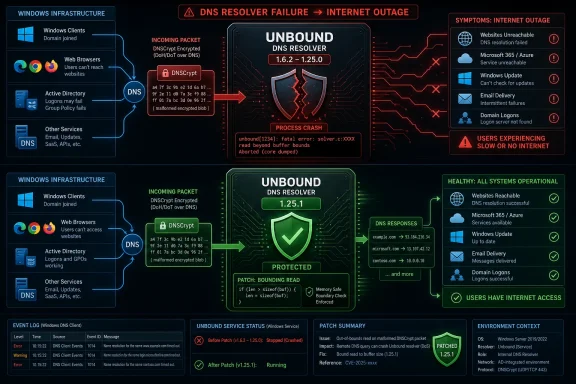
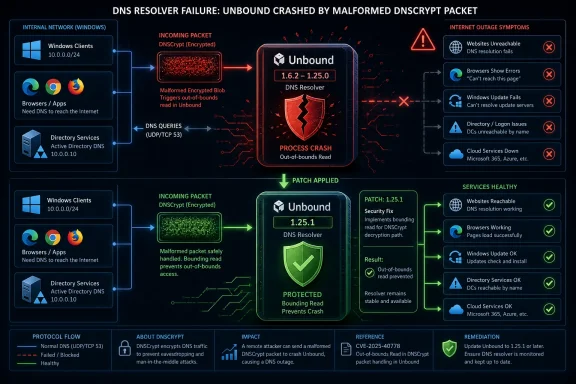
CVE-2026-32792 is a newly published denial-of-service flaw in NLnet Labs Unbound, disclosed on May 20, 2026, affecting versions 1.6.2 through 1.25.0 when the resolver is built with DNSCrypt support and exposed to a malformed encrypted DNS query. The bug is not a Windows vulnerability in the narrow Patch Tuesday sense, but it matters to WindowsForum readers because DNS is infrastructure, and infrastructure fails sideways. A resolver crash may look like “the Internet is down,” even when the endpoint, browser, firewall, and ISP are all technically behaving. The lesson is less about one packet than about the fragility hiding inside optional privacy plumbing.
Security teams tend to sort vulnerabilities into two emotional bins: the ones that can own the box, and the ones that merely make life miserable. CVE-2026-32792 lives in the second bin. It is rated as a medium-severity availability issue, not a confidentiality breach and not an integrity failure, because the plausible outcome is a crash or interruption rather than stolen data or silent manipulation.
That distinction is accurate, but it can also be misleading. DNS availability is one of those dependencies whose failure propagates faster than its severity score suggests. Users do not care whether the resolver crashed because of a memory-safety edge case, a bad upstream, or a power event; they experience the same thing: websites stop resolving, applications hang, telemetry becomes noisy, and help desks start receiving tickets with no obvious common cause.
The advisory language is deliberately restrained. Repeated exploitation may be possible, but the attacker is not expected to completely deny service to legitimate users in the strongest sense. Resources remain partially available all the time, or fully available only some of the time. That is the clinical phrasing of the Common Vulnerability Scoring System, and it is doing its job.
But real networks are not scored in isolation. A resolver that intermittently falls over can trigger failover storms, monitoring alerts, retries, and secondary outages in systems that were never part of the original vulnerability. Medium severity is not the same thing as low operational impact.
According to the public description, the dangerous packet is unusually specific. Its decrypted plaintext consists entirely of zero bytes and omits an expected marker byte. Unbound’s DNSCrypt packet reading procedure can then underflow and continue reading more bytes than it should while looking for a non-zero value. Depending on memory layout and allocator behavior, that out-of-bounds read can become a heap overflow while reading, followed by a crash.
That last dependency matters. The advisory explicitly says the likelihood of a crash is low because the outcome depends heavily on allocator behavior and memory arrangement. If the heap overflow does not occur, later packet validation should reject the malformed packet. In other words, this is not a universal “send packet, drop resolver” button for every deployment.
Still, the phrase “single bad DNSCrypt query” is the part that will make administrators pay attention. A bug that requires local access, authentication, or an elaborate sequence of state changes is one kind of problem. A network-reachable parser flaw that can be tickled with one crafted input is another, even when the real-world crash probability is uncertain.
For many Windows-centric environments, that qualifier will be decisive. Microsoft’s built-in Windows DNS Server is not Unbound, and CVE-2026-32792 should not be read as a native Windows DNS Server advisory. The affected component is NLnet Labs Unbound, a widely used validating, recursive, caching resolver that often appears in Linux, BSD, appliance, container, and edge-network roles.
That does not make it irrelevant to Windows shops. Plenty of Windows estates depend on non-Windows DNS infrastructure. A domain-joined laptop may be pure Windows from the user’s perspective while its DNS path passes through a Linux resolver, a pfSense or OPNsense appliance, a containerized recursive resolver, or a privacy-forward DNS stack someone deployed years ago and then forgot about.
The practical challenge is inventory. Administrators need to know not only whether they run Unbound, but how it was built. Package names alone may not reveal whether DNSCrypt support is enabled. In managed distributions, the vendor’s security advisory and package changelog may answer that question. In self-compiled deployments, the build flags and service configuration are the evidence.
That distinction is important because misclassification wastes time. If an administrator treats CVE-2026-32792 as a Windows Server DNS patch issue, they may spend hours checking domain controllers that are not exposed to this bug at all. If they dismiss it because “we are a Windows shop,” they may miss the Unbound resolver quietly serving branch offices, lab networks, VPN clients, or developer environments.
The modern Windows estate is rarely Windows-only. It is Entra ID and Active Directory, yes, but also Linux containers, Kubernetes clusters, edge firewalls, cloud appliances, third-party resolvers, DNS forwarders, and local caching layers. DNS sits at the seam between all of them. A vulnerability in a non-Windows resolver can still show up as a Windows outage.
That is why MSRC visibility should be treated as a routing signal, not a root-cause declaration. It tells Windows administrators, “This may touch your environment.” It does not automatically tell them, “This is patched by Windows Update.”
That means internet-wide panic would be misplaced. Many Unbound deployments do not expose DNSCrypt at all. Some use Unbound strictly as a local recursive resolver on loopback. Others accept DNS only from trusted internal networks. Still others sit behind firewalls that would never pass DNSCrypt traffic to the service in the first place.
The more interesting risk is concentrated exposure. A public resolver advertising DNSCrypt support has a very different profile from a home lab resolver bound to localhost. A campus network, managed service provider, privacy DNS operator, or small ISP using Unbound with DNSCrypt enabled should move faster than an enterprise that uses Unbound only as an internal forwarder without that feature.
The result is a vulnerability that rewards specificity. The right question is not “Do we have CVE-2026-32792?” It is “Do we run Unbound versions before 1.25.1, compiled with DNSCrypt support, reachable by untrusted clients, and important enough that resolver crashes would hurt?”
But availability failures expose architecture with brutal efficiency. If one recursive resolver can interrupt authentication, browsing, endpoint management, VPN access, and cloud application reachability, the vulnerability is not the only problem. The architecture has turned a medium bug into a broad operational dependency.
This is especially true in mixed Windows environments. Active Directory leans heavily on DNS for domain controller discovery, service records, and general name resolution. Client management platforms, software deployment tools, EDR agents, certificate checks, browser security features, and SaaS logins all assume DNS is boring and present. When DNS becomes intermittently unreliable, symptoms scatter across the estate.
That scattering is what makes resolver bugs expensive. A clean crash may be easy to detect if logs are intact and monitoring is tuned. Intermittent resolution failures, retries, and failovers are harder. They produce the kind of brownout that sends teams searching through proxy logs, endpoint updates, browser changes, firewall rules, and ISP status pages before anyone asks whether the recursive resolver is restarting.
The problem is that infrastructure rarely fails at component boundaries. DNS is a dependency amplifier. The resolver may be only partially unavailable, but the services depending on it may be brittle, misconfigured, or slow to fail over. A brief crash can be absorbed if clients have alternate resolvers and sane retry behavior. The same crash can become a business incident if all paths converge on one resolver instance.
This is where security and operations should meet instead of arguing. Security teams should not inflate the bug into a catastrophic breach. Operations teams should not wave it away because the score says medium. The appropriate response is to patch exposed systems and use the event as a reason to inspect resolver redundancy, monitoring, and feature exposure.
The most mature reaction to CVE-2026-32792 is almost boring: identify affected builds, update them, confirm DNSCrypt exposure, and test resolver failover. Boring is good. Boring is what keeps a malformed packet from becoming an afternoon-long outage.
This is a common source of confusion. A scanner may flag “Unbound 1.19.x” as vulnerable because it is numerically below 1.25.1, while the distribution has already backported the fix into that older package line. Conversely, a custom build may claim to be recent enough in some superficial inventory system while still lacking the relevant patch if it was compiled from an unpatched source tree.
For Windows administrators who live mostly in KB numbers and cumulative updates, the Linux packaging model can feel unnecessarily indirect. The right evidence is the vendor advisory, package changelog, and installed build metadata, not just the upstream version string. If the resolver is part of an appliance, the appliance vendor’s firmware or security bulletin becomes the source of truth.
This is also where vulnerability management tools can generate noise. A useful scanner should distinguish upstream vulnerable ranges from distribution-fixed packages. A less careful one may create false positives or false reassurance. Either failure is dangerous: false positives waste scarce maintenance windows, while false negatives leave a resolver exposed because the inventory view was too shallow.
CVE-2026-32792 is a reminder that optional features expand the attack surface even when their purpose is defensive. That does not mean administrators should disable privacy features by reflex. It means those features need the same lifecycle discipline as the core resolver: patching, exposure control, logging, rate limiting, and a clear reason for being enabled.
The enterprise calculus differs from the consumer one. A privacy-focused public resolver may enable DNSCrypt because it is part of the service promise. A corporate internal resolver may have no need to accept DNSCrypt from arbitrary clients, especially if endpoint DNS policy is managed through other channels. A home lab may enable it for experimentation and then forget that it is listening on an interface reachable from the broader LAN.
The secure default is not “turn everything off.” It is “turn on only what you understand, monitor what you expose, and patch what you operate.” DNS privacy is valuable, but it is not magic armor. It is another protocol surface.
The same pattern applies to Windows Server environments. Domain controllers may forward external lookups to Unbound. VPN concentrators may hand out Unbound-backed DNS settings to remote clients. Developer workstations using WSL, containers, or local network appliances may rely on resolvers outside the Microsoft stack. Hybrid environments make this even messier, because cloud DNS, on-prem forwarding, and endpoint policy often interact in ways no single team fully owns.
Administrators should therefore avoid two unhelpful extremes. The first is assuming that every Windows system needs emergency patching for this CVE. The second is assuming Windows fleets can ignore it because the vulnerable project is not Microsoft’s DNS Server. Both positions miss the dependency layer where real incidents happen.
The practical Windows question is: where do Windows clients and servers send DNS queries, and what software answers them? If any answer is “Unbound with DNSCrypt enabled,” CVE-2026-32792 belongs on the maintenance board.
In a well-designed environment, the answer is uneventful. The service manager restarts Unbound. Health checks detect the event. Clients have an alternate resolver. Logs preserve enough context to investigate. Rate limits or firewall rules reduce repeated triggering. The incident becomes a ticket, not a crisis.
In a fragile environment, the answer is ugly. All clients point at the same resolver. The resolver restarts but immediately receives more bad traffic. Monitoring reports generic DNS failures without process-level context. Help desk staff collect symptoms faster than infrastructure teams collect evidence. Someone changes unrelated firewall or DHCP settings in the scramble.
That is why availability vulnerabilities are useful audits. They ask whether the environment can tolerate failure in components everyone assumed were boring. DNS, NTP, certificate validation, identity endpoints, and package repositories often live in this category. They are invisible until they are not.
After the patch, the better work begins. Document where Unbound is deployed. Record whether DNSCrypt is enabled. Confirm which interfaces and networks can reach it. Validate failover behavior from Windows clients, domain controllers, VPN clients, and critical servers. Make sure resolver logs are retained long enough to reconstruct incidents.
This is not glamorous work, but it is the difference between security theater and operational security. A CVE entry is a point event. Asset knowledge is durable. The organizations that handle this smoothly will be the ones that already know which resolvers they run and why.
The organizations that struggle will not struggle because CVE-2026-32792 is the worst bug of the year. They will struggle because DNS ownership is fragmented across networking, security, infrastructure, cloud, and endpoint teams. The packet will be small; the org chart will be large.
 A Medium-Severity Bug With High Operational Annoyance
Security teams tend to sort vulnerabilities into two emotional bins: the ones that can own the box, and the ones that merely make life miserable. CVE-2026-32792 lives in the second bin. It is rated as a medium-severity availability issue, not a confidentiality breach and not an integrity failure, because the plausible outcome is a crash or interruption rather than stolen data or silent manipulation.That distinction is accurate, but it can also be misleading. DNS availability is one of those dependencies whose failure propagates faster than its severity score suggests. Users do not care whether the resolver crashed because of a memory-safety edge case, a bad upstream, or a power event; they experience the same thing: websites stop resolving, applications hang, telemetry becomes noisy, and help desks start receiving tickets with no obvious common cause.
The advisory language is deliberately restrained. Repeated exploitation may be possible, but the attacker is not expected to completely deny service to legitimate users in the strongest sense. Resources remain partially available all the time, or fully available only some of the time. That is the clinical phrasing of the Common Vulnerability Scoring System, and it is doing its job.
But real networks are not scored in isolation. A resolver that intermittently falls over can trigger failover storms, monitoring alerts, retries, and secondary outages in systems that were never part of the original vulnerability. Medium severity is not the same thing as low operational impact.
DNSCrypt Turns a Parser Bug Into a Remote Trigger
The vulnerability sits in Unbound’s handling of DNSCrypt packets. DNSCrypt is one of the older approaches to encrypting DNS traffic between a client and resolver, intended to protect DNS queries from casual observation and tampering on the path. In this case, the encrypted wrapper is not the real villain; the trouble begins after a malicious query is decrypted and handed to the packet-reading logic.According to the public description, the dangerous packet is unusually specific. Its decrypted plaintext consists entirely of zero bytes and omits an expected marker byte. Unbound’s DNSCrypt packet reading procedure can then underflow and continue reading more bytes than it should while looking for a non-zero value. Depending on memory layout and allocator behavior, that out-of-bounds read can become a heap overflow while reading, followed by a crash.
That last dependency matters. The advisory explicitly says the likelihood of a crash is low because the outcome depends heavily on allocator behavior and memory arrangement. If the heap overflow does not occur, later packet validation should reject the malformed packet. In other words, this is not a universal “send packet, drop resolver” button for every deployment.
Still, the phrase “single bad DNSCrypt query” is the part that will make administrators pay attention. A bug that requires local access, authentication, or an elaborate sequence of state changes is one kind of problem. A network-reachable parser flaw that can be tickled with one crafted input is another, even when the real-world crash probability is uncertain.
The Patch Is Simple; Finding Exposure May Not Be
NLnet Labs fixed the issue in Unbound 1.25.1 by bounding the read to the available buffer space. That is the sort of fix security engineers like to see: not a vague mitigation, not a configuration workaround masquerading as a cure, but a direct correction to the parser’s assumptions. The vulnerable range is broad — from 1.6.2 through 1.25.0 — but the feature requirement narrows the practical exposure to builds compiled with DNSCrypt support.For many Windows-centric environments, that qualifier will be decisive. Microsoft’s built-in Windows DNS Server is not Unbound, and CVE-2026-32792 should not be read as a native Windows DNS Server advisory. The affected component is NLnet Labs Unbound, a widely used validating, recursive, caching resolver that often appears in Linux, BSD, appliance, container, and edge-network roles.
That does not make it irrelevant to Windows shops. Plenty of Windows estates depend on non-Windows DNS infrastructure. A domain-joined laptop may be pure Windows from the user’s perspective while its DNS path passes through a Linux resolver, a pfSense or OPNsense appliance, a containerized recursive resolver, or a privacy-forward DNS stack someone deployed years ago and then forgot about.
The practical challenge is inventory. Administrators need to know not only whether they run Unbound, but how it was built. Package names alone may not reveal whether DNSCrypt support is enabled. In managed distributions, the vendor’s security advisory and package changelog may answer that question. In self-compiled deployments, the build flags and service configuration are the evidence.
Microsoft’s Name in the Feed Does Not Make This a Windows Bug
The user-facing wrinkle here is that the vulnerability appears in the Microsoft Security Response Center update guide, which naturally pulls it into the orbit of Windows admins. That does not mean the bug is in Windows, nor does it mean Microsoft shipped the vulnerable code in every Windows deployment. MSRC tracks and publishes security information across a wide ecosystem, and vulnerability feeds increasingly blur the line between first-party platform flaws and third-party components that matter to Microsoft customers.That distinction is important because misclassification wastes time. If an administrator treats CVE-2026-32792 as a Windows Server DNS patch issue, they may spend hours checking domain controllers that are not exposed to this bug at all. If they dismiss it because “we are a Windows shop,” they may miss the Unbound resolver quietly serving branch offices, lab networks, VPN clients, or developer environments.
The modern Windows estate is rarely Windows-only. It is Entra ID and Active Directory, yes, but also Linux containers, Kubernetes clusters, edge firewalls, cloud appliances, third-party resolvers, DNS forwarders, and local caching layers. DNS sits at the seam between all of them. A vulnerability in a non-Windows resolver can still show up as a Windows outage.
That is why MSRC visibility should be treated as a routing signal, not a root-cause declaration. It tells Windows administrators, “This may touch your environment.” It does not automatically tell them, “This is patched by Windows Update.”
The Attack Surface Is Smaller Than the Name Suggests
“Packet of death” is a wonderful headline phrase and a terrible risk model. It evokes the old lore of network stacks keeling over when handed malformed ICMP, TCP, or fragment data. CVE-2026-32792 belongs to that family in spirit, but not in scale. The bug requires DNSCrypt support, a malformed DNSCrypt query, and runtime conditions that make the out-of-bounds behavior crash the process.That means internet-wide panic would be misplaced. Many Unbound deployments do not expose DNSCrypt at all. Some use Unbound strictly as a local recursive resolver on loopback. Others accept DNS only from trusted internal networks. Still others sit behind firewalls that would never pass DNSCrypt traffic to the service in the first place.
The more interesting risk is concentrated exposure. A public resolver advertising DNSCrypt support has a very different profile from a home lab resolver bound to localhost. A campus network, managed service provider, privacy DNS operator, or small ISP using Unbound with DNSCrypt enabled should move faster than an enterprise that uses Unbound only as an internal forwarder without that feature.
The result is a vulnerability that rewards specificity. The right question is not “Do we have CVE-2026-32792?” It is “Do we run Unbound versions before 1.25.1, compiled with DNSCrypt support, reachable by untrusted clients, and important enough that resolver crashes would hurt?”
Availability Bugs Are Where Architecture Shows
There is a habit in security reporting to treat denial-of-service vulnerabilities as lesser creatures. They do not carry the cinematic drama of remote code execution or credential theft. No shell pops. No database spills. No ransomware note appears. A resolver simply becomes unavailable, perhaps only sometimes.But availability failures expose architecture with brutal efficiency. If one recursive resolver can interrupt authentication, browsing, endpoint management, VPN access, and cloud application reachability, the vulnerability is not the only problem. The architecture has turned a medium bug into a broad operational dependency.
This is especially true in mixed Windows environments. Active Directory leans heavily on DNS for domain controller discovery, service records, and general name resolution. Client management platforms, software deployment tools, EDR agents, certificate checks, browser security features, and SaaS logins all assume DNS is boring and present. When DNS becomes intermittently unreliable, symptoms scatter across the estate.
That scattering is what makes resolver bugs expensive. A clean crash may be easy to detect if logs are intact and monitoring is tuned. Intermittent resolution failures, retries, and failovers are harder. They produce the kind of brownout that sends teams searching through proxy logs, endpoint updates, browser changes, firewall rules, and ISP status pages before anyone asks whether the recursive resolver is restarting.
The CVSS Score Captures the Component, Not the Dependency Graph
The NVD assessment lists CVSS 3.1 characteristics that match a network-triggerable, unauthenticated, no-user-interaction availability impact. The availability impact is low in that scoring model, and there is no confidentiality or integrity impact. That is reasonable as a component-level assessment. It describes what the vulnerability does to Unbound itself.The problem is that infrastructure rarely fails at component boundaries. DNS is a dependency amplifier. The resolver may be only partially unavailable, but the services depending on it may be brittle, misconfigured, or slow to fail over. A brief crash can be absorbed if clients have alternate resolvers and sane retry behavior. The same crash can become a business incident if all paths converge on one resolver instance.
This is where security and operations should meet instead of arguing. Security teams should not inflate the bug into a catastrophic breach. Operations teams should not wave it away because the score says medium. The appropriate response is to patch exposed systems and use the event as a reason to inspect resolver redundancy, monitoring, and feature exposure.
The most mature reaction to CVE-2026-32792 is almost boring: identify affected builds, update them, confirm DNSCrypt exposure, and test resolver failover. Boring is good. Boring is what keeps a malformed packet from becoming an afternoon-long outage.
Distribution Patches Matter More Than Upstream Version Numbers
Upstream says Unbound 1.25.1 contains the fix, but many administrators will not actually deploy upstream 1.25.1. They will install a distribution-specific backport. Ubuntu, for example, published updates for multiple supported releases, with package versions that do not necessarily match the upstream fixed version number because distributions routinely patch older branches.This is a common source of confusion. A scanner may flag “Unbound 1.19.x” as vulnerable because it is numerically below 1.25.1, while the distribution has already backported the fix into that older package line. Conversely, a custom build may claim to be recent enough in some superficial inventory system while still lacking the relevant patch if it was compiled from an unpatched source tree.
For Windows administrators who live mostly in KB numbers and cumulative updates, the Linux packaging model can feel unnecessarily indirect. The right evidence is the vendor advisory, package changelog, and installed build metadata, not just the upstream version string. If the resolver is part of an appliance, the appliance vendor’s firmware or security bulletin becomes the source of truth.
This is also where vulnerability management tools can generate noise. A useful scanner should distinguish upstream vulnerable ranges from distribution-fixed packages. A less careful one may create false positives or false reassurance. Either failure is dangerous: false positives waste scarce maintenance windows, while false negatives leave a resolver exposed because the inventory view was too shallow.
DNS Privacy Features Deserve the Same Hardening as Core DNS
DNSCrypt, DNS-over-TLS, and DNS-over-HTTPS exist because plaintext DNS leaks too much. The privacy case remains strong. Encrypting DNS traffic can reduce passive observation, prevent certain forms of tampering, and give users or organizations more control over resolver trust. But privacy features are still parsers, network services, and code paths.CVE-2026-32792 is a reminder that optional features expand the attack surface even when their purpose is defensive. That does not mean administrators should disable privacy features by reflex. It means those features need the same lifecycle discipline as the core resolver: patching, exposure control, logging, rate limiting, and a clear reason for being enabled.
The enterprise calculus differs from the consumer one. A privacy-focused public resolver may enable DNSCrypt because it is part of the service promise. A corporate internal resolver may have no need to accept DNSCrypt from arbitrary clients, especially if endpoint DNS policy is managed through other channels. A home lab may enable it for experimentation and then forget that it is listening on an interface reachable from the broader LAN.
The secure default is not “turn everything off.” It is “turn on only what you understand, monitor what you expose, and patch what you operate.” DNS privacy is valuable, but it is not magic armor. It is another protocol surface.
The Windows Angle Is Dependency, Not Direct Vulnerability
For WindowsForum readers, the most useful framing is dependency mapping. Windows clients may be unaffected at the code level but still affected at the service level. If a Windows 11 machine uses a local router running Unbound, and that router crashes its resolver process after receiving a malformed DNSCrypt query, the Windows machine experiences the outage.The same pattern applies to Windows Server environments. Domain controllers may forward external lookups to Unbound. VPN concentrators may hand out Unbound-backed DNS settings to remote clients. Developer workstations using WSL, containers, or local network appliances may rely on resolvers outside the Microsoft stack. Hybrid environments make this even messier, because cloud DNS, on-prem forwarding, and endpoint policy often interact in ways no single team fully owns.
Administrators should therefore avoid two unhelpful extremes. The first is assuming that every Windows system needs emergency patching for this CVE. The second is assuming Windows fleets can ignore it because the vulnerable project is not Microsoft’s DNS Server. Both positions miss the dependency layer where real incidents happen.
The practical Windows question is: where do Windows clients and servers send DNS queries, and what software answers them? If any answer is “Unbound with DNSCrypt enabled,” CVE-2026-32792 belongs on the maintenance board.
A One-Packet Crash Is Still a Resilience Test
The most revealing phrase in this vulnerability is not “heap overflow” or “DNSCrypt.” It is “single bad DNSCrypt query.” Even with caveats, that phrase forces a resilience question. If one malformed request can plausibly crash a resolver process, what happens next?In a well-designed environment, the answer is uneventful. The service manager restarts Unbound. Health checks detect the event. Clients have an alternate resolver. Logs preserve enough context to investigate. Rate limits or firewall rules reduce repeated triggering. The incident becomes a ticket, not a crisis.
In a fragile environment, the answer is ugly. All clients point at the same resolver. The resolver restarts but immediately receives more bad traffic. Monitoring reports generic DNS failures without process-level context. Help desk staff collect symptoms faster than infrastructure teams collect evidence. Someone changes unrelated firewall or DHCP settings in the scramble.
That is why availability vulnerabilities are useful audits. They ask whether the environment can tolerate failure in components everyone assumed were boring. DNS, NTP, certificate validation, identity endpoints, and package repositories often live in this category. They are invisible until they are not.
Patch Now, Then Remove the Mystery
The immediate remediation is straightforward: update Unbound to a fixed build, or apply the relevant distribution or appliance vendor update. If DNSCrypt is enabled and not needed, disable it. If it is needed, restrict access to intended clients and ensure the service is monitored for restarts and crash loops. The vulnerability does not require a grand redesign before patching.After the patch, the better work begins. Document where Unbound is deployed. Record whether DNSCrypt is enabled. Confirm which interfaces and networks can reach it. Validate failover behavior from Windows clients, domain controllers, VPN clients, and critical servers. Make sure resolver logs are retained long enough to reconstruct incidents.
This is not glamorous work, but it is the difference between security theater and operational security. A CVE entry is a point event. Asset knowledge is durable. The organizations that handle this smoothly will be the ones that already know which resolvers they run and why.
The organizations that struggle will not struggle because CVE-2026-32792 is the worst bug of the year. They will struggle because DNS ownership is fragmented across networking, security, infrastructure, cloud, and endpoint teams. The packet will be small; the org chart will be large.
The Signal Hidden in This DNSCrypt Advisory
This is the part administrators should carry into the next maintenance window.- CVE-2026-32792 affects NLnet Labs Unbound versions 1.6.2 through 1.25.0 only when built with DNSCrypt support.
- The expected impact is denial of service through a possible Unbound crash, not data theft or direct code execution.
- Unbound 1.25.1 contains the upstream fix, while Linux distributions and appliances may deliver the correction through backported package updates.
- Windows DNS Server is not the vulnerable component, but Windows clients and servers can still be affected if they depend on an exposed Unbound resolver.
- The highest-priority systems are public or untrusted-client-facing resolvers that accept DNSCrypt traffic.
- The right operational response is to patch, verify DNSCrypt exposure, and test resolver redundancy instead of relying on the medium severity score alone.
References
- Primary source: MSRC
Published: 2026-05-23T01:39:08-07:00
Security Update Guide - Microsoft Security Response Center
 msrc.microsoft.com
- Official source: microsoft.com
MSRC - Microsoft Security Response Center
The Microsoft Security Response Center is part of the defender community and on the front line of security response evolution. For over twenty years, we have been engaged with security researchers working to protect customers and the broader ecosystem.www.microsoft.com
- Related coverage: sentinelone.com
CVE-2026-33593: DNSCrypt Denial of Service Vulnerability
CVE-2026-33593 is a denial of service vulnerability in DNSCrypt. Learn about its impact, affected versions, and mitigation methods.www.sentinelone.com
- Related coverage: indico.dns-oarc.net
Attachments
Last edited:
