 The Vulnerability Is Small, but the Failure Mode Is Not
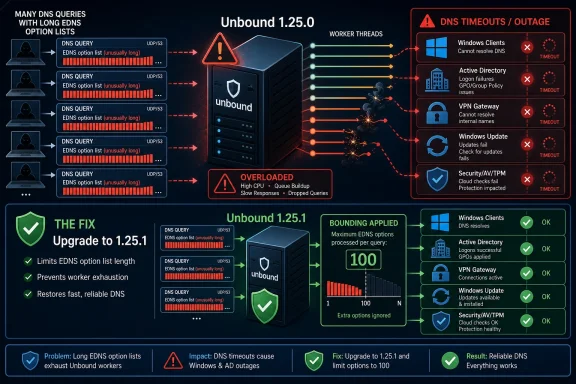
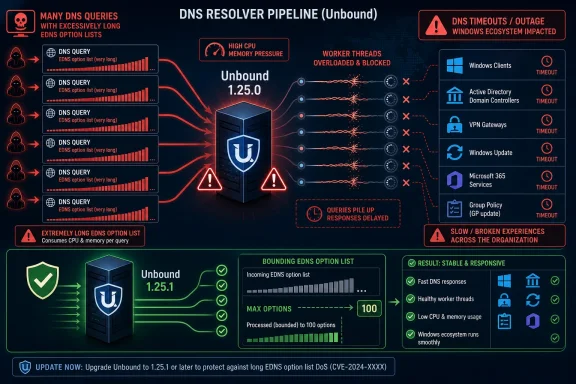
CVE-2026-41292 is not a flashy remote-code-execution bug. It does not promise shell access, domain compromise, or a spectacular exploit chain with screenshots. Its mechanics are more mundane: an attacker sends DNS queries with too many EDNS options, and Unbound spends too much time parsing them and building internal structures.
That makes it easy to underrate. Security teams tend to triage by drama, and denial-of-service bugs often lose budget fights to credential theft, privilege escalation, and ransomware precursors. But DNS availability has a special property in enterprise networks: when it fails, everything else gets blamed first.
The impacted component here is Unbound, the widely used validating, recursive, and caching DNS resolver from NLnet Labs. The vulnerable range is clear: versions through 1.25.0 are affected, while 1.25.1 introduces a limit on acceptable incoming EDNS options. That limit matters because the bug is not merely that Unbound accepts a malformed packet; it is that a valid-enough packet can demand disproportionate work.
The CVSS framing captures the operational seriousness. The vulnerability is network-accessible, requires low attack complexity, needs no privileges or user interaction, and affects availability rather than confidentiality or integrity. In CVSS 3.1 terms, that maps to a high availability impact; in CVSS 4.0, NLnet Labs rated it medium, with high vulnerable-system availability impact.
That apparent severity mismatch is a reminder that scoring systems compress messy operational reality into a number. A resolver going soft under load may be “medium” in a universal taxonomy and still be a page-at-2-a.m. incident for the admin whose VPN, authentication stack, update infrastructure, and SaaS access all start timing out.
EDNS Turned DNS Into a Bigger Target Than Its Original Shape
To understand why this bug matters, you have to start with EDNS, or Extension Mechanisms for DNS. Classic DNS was designed for a smaller Internet, smaller answers, and smaller expectations. EDNS extended the protocol so resolvers and authoritative servers could signal larger UDP payload sizes and carry additional options without replacing DNS itself.
That flexibility has been indispensable. DNSSEC, modern resolver behavior, client subnet signaling, padding, cookies, and other extensions either depend on EDNS or live in its orbit. The Internet did not replace DNS; it kept stretching it.
Stretching old protocols has consequences. Every extension point is a negotiation between compatibility and complexity, and complexity is where attackers hunt for leverage. A resolver that must parse a long chain of options before it can reject, answer, or forward a query has already spent time on the attacker’s behalf.
CVE-2026-41292 sits in that exact space. The attacker does not need to poison a cache or forge an answer. The attacker only needs to present enough EDNS option material that the resolver’s parsing path becomes expensive at scale. The attack is not about making one packet lethal; it is about making many packets inefficient.
That is why the phrase “long list of incoming EDNS options” should not lull anyone into thinking this is an edge-case cleanliness bug. Protocol edges are now production surfaces. A long option list is not just malformed noise if the server dutifully walks it, allocates around it, and ties up worker threads in the process.
The Thread Is the Resource Attackers Want
The advisory language is revealing: attackers can hold Unbound threads hostage while the resolver parses and creates internal data structures for the options. That is a resource-exhaustion story, but not necessarily the crude kind where memory vanishes instantly or a process crashes. It is closer to forcing the resolver to waste its most precious service resource: time.
Recursive resolvers live and die by concurrency. They must absorb bursts, cache aggressively, chase upstream answers, validate when configured to do so, and return answers fast enough that applications never expose DNS as the hidden dependency it is. A resolver under thread pressure does not always fall over neatly; it may become erratic.
That erratic failure mode is what makes DNS denial-of-service so painful to diagnose. Users report that “the Internet is slow,” applications throw authentication errors, software updates hang, and monitoring systems mark unrelated services as degraded. If the resolver is still answering some queries, the problem can look like packet loss, a firewall issue, a WAN issue, or a cloud outage.
A coordinated attack makes the asymmetry worse. One abusive client may be noisy and easy to rate-limit. Many sources, or spoof-resistant traffic from distributed hosts, can produce a pattern that resembles load until someone examines query shape. The exploit is not magic; it is arithmetic. If each query causes too much parsing work, the attacker wins by repetition.
The fix in Unbound 1.25.1 is correspondingly pragmatic: limit acceptable incoming EDNS options to 100. That is not a grand redesign of DNS. It is the sort of defensive bound that should exist wherever untrusted input can become unbounded internal work.
Microsoft’s Appearance in the Story Is a Signal, Not the Center
The user-facing source for many Windows admins may be the Microsoft Security Response Center entry, but this is not a “Windows DNS Server is broken” story. The affected product is NLnet Labs Unbound, and the remediation path runs through Unbound packaging, vendor appliances, Linux distributions, container images, and any Windows-adjacent stack that embeds or fronts it.
That distinction matters because Microsoft’s security ecosystem has become a dashboard for far more than Windows itself. MSRC entries often appear in vulnerability feeds, enterprise scanners, and security portals used by teams that manage mixed estates. A Microsoft page can cause a Windows admin to notice a non-Microsoft component sitting in the path of Windows authentication and application access.
In many organizations, that is exactly the right kind of confusion. The resolver that supports a Windows domain may not be Microsoft DNS. It may be Unbound on a firewall, an internal Linux appliance, a Kubernetes node, a lab server, a branch-office gateway, or a security product that uses Unbound internally. The user impact still lands on Windows endpoints.
Active Directory environments are particularly sensitive to DNS health. Domain joins, Kerberos flows, Group Policy processing, certificate enrollment, service discovery, and hybrid identity plumbing all assume name resolution is fast and boring. When DNS becomes slow, Windows does not always produce an error that says, “Your recursive resolver is wasting CPU parsing EDNS option lists.”
That is why CVE-2026-41292 belongs on WindowsForum.com even though the vulnerable code is not Windows code. The modern Windows estate is an ecosystem, not a single operating system image. If the non-Windows resolver beneath it degrades, the Windows experience degrades with it.
The Severity Debate Misses the Practical Blast Radius
The vulnerability’s labels invite a familiar debate. Is this high because denial of service can be total? Is it medium because there is no code execution and the attack requires sustained traffic? Is it less urgent if the resolver is not exposed to the public Internet?
Those are useful questions, but they are not the same as risk. A public recursive resolver, an ISP resolver, or an enterprise resolver exposed to broad client populations has a different profile from a tightly controlled internal cache. A lab resolver serving a handful of machines is not the same as the DNS tier supporting thousands of remote users.
The most important variable is not the CVSS number but the resolver’s position in the dependency graph. If Unbound sits between users and everything they need to reach, availability is a first-order security property. If it is one of several redundant resolvers behind health checks and rate limits, the practical risk is lower.
That nuance should not become complacency. Denial-of-service vulnerabilities age differently from many memory-safety flaws. They may not require a weaponized exploit kit, and their proof is often visible in performance collapse rather than compromise artifacts. If an attacker can produce the condition with ordinary network traffic, defenders should assume the exploitability bar is not exotic.
There is also the matter of internal attackers. Enterprise security conversations often focus on hostile Internet sources, but compromised endpoints, guest networks, malware-infected IoT devices, and misbehaving containers can all generate abusive DNS traffic from inside the perimeter. A resolver that is “internal only” is still exposed to every system allowed to ask it questions.
Patch Management Gets Hardest Where DNS Is Embedded
The clean remediation is simple: update to Unbound 1.25.1 or later. The messy part is finding every place Unbound exists. In 2026, DNS resolvers are often not installed as obvious, hand-managed packages on a server with a name like DNS01.
Unbound can be part of a firewall distribution, a router image, a privacy gateway, an ad-blocking stack, a containerized service, a recursive resolver tier, or a security appliance whose interface never says “Unbound” in large letters. It can be pinned in a base image, inherited from a Linux distribution, or bundled behind a vendor update train. The risk is not that admins do not know how to patch; it is that they do not know what they own.
Windows shops have a particular blind spot here. The authoritative DNS for Active Directory may still be Microsoft DNS, while recursive forwarding, branch resolution, lab networks, DevOps clusters, or privacy filtering are delegated to non-Microsoft resolvers. That split can be rational and well-engineered, but it complicates vulnerability response.
Inventory should therefore start with behavior, not branding. Which systems answer recursive DNS queries? Which resolvers are handed out by DHCP or VPN profiles? Which appliances forward on behalf of clients? Which containers or sidecars perform local caching? Which monitoring tools assume a particular resolver is healthy?
Once those paths are mapped, the remediation decision becomes less abstract. Patch where possible, constrain exposure where necessary, and verify that upstream vendors have incorporated the 1.25.1 fix. Where patching is delayed, rate limiting and access controls can reduce risk, but they should be treated as compensating controls rather than a substitute for the bound introduced in the fixed release.
The Real Patch Is a Boundary Around Parser Work
The technical fix is notable because it is conceptually modest. Unbound 1.25.1 limits acceptable incoming EDNS options to 100. That number may sound arbitrary to non-DNS specialists, but the principle is the important part: untrusted protocol metadata must have a ceiling before it becomes internal work.
This is the same design lesson that recurs across parsers, decompression libraries, XML processors, regular-expression engines, image decoders, and network daemons. If the input format allows nesting, repetition, extension, or negotiation, an attacker will eventually ask how much processing can be induced before the server says no. Security engineering is often the art of saying no early enough.
EDNS is especially suited to this class of bug because it is meant to be extensible. Extensibility is useful when honest parties need room to evolve. It is dangerous when the receiving side treats every extension as something that deserves careful processing before applying policy.
The phrase algorithmic complexity captures part of the issue. A system can be correct in the narrow sense and still be exploitable if the cost of correct behavior is attacker-controlled. A resolver that parses an enormous option list exactly as written may be doing what the code says, while failing what the service requires.
This is why performance bugs increasingly deserve security treatment. Availability is not merely an operations metric when the trigger is remote, unauthenticated, and repeatable. A slow path reachable over the network is a vulnerability if an attacker can turn it into service denial.
Windows Administrators Should Look Below the DNS Console
For admins who live in Windows Server Manager, DNS Manager, PowerShell, and Group Policy, the temptation is to ask whether Microsoft DNS is affected. Based on the available advisory information, CVE-2026-41292 is an Unbound vulnerability, not a Windows DNS Server vulnerability. But stopping there would miss the operational question.
Many Windows environments use forwarding chains. A Windows DNS server may forward external queries to an Unbound resolver. Client VPNs may hand out a resolver backed by Unbound. Remote offices may resolve through firewall appliances that use Unbound under the hood. Developer networks may use local caching resolvers in containers or WSL-adjacent workflows.
If any of those layers degrade, Windows clients will exhibit symptoms even though the Windows DNS service itself is not vulnerable. Troubleshooting will be easier if admins know the resolver chain before the incident. The worst time to discover that the “DNS server” is really three forwarding layers and a vendor appliance is during a live availability event.
Monitoring should also become more protocol-aware. CPU, memory, and process uptime are necessary but insufficient. Query latency, SERVFAIL rates, timeout rates, queue depth, thread utilization, and unusual EDNS option patterns are more directly relevant to this bug class. A resolver can be alive, patched into the service manager, and still effectively unavailable to users.
There is also a logging tradeoff. DNS logs at full fidelity can be expensive, noisy, and privacy-sensitive. But short retention of query metadata, sampled packet captures during incidents, or resolver-specific telemetry can make the difference between guessing and knowing. If the attack surface is the shape of the query, defenders need some way to see the shape.
Exposure Is a Policy Choice, Not a Default Setting
The first practical defense is to ask who is allowed to query the resolver at all. Recursive DNS should rarely be open to the world unless it is explicitly operated as a public resolver with the capacity and protections that implies. Open recursion has been a bad idea for years, and vulnerabilities like this only make the cost clearer.
Internal exposure needs the same scrutiny. If a resolver only serves a site-to-site VPN, it should not accept traffic from every VLAN. If it supports endpoints, it may not need to accept queries from server networks. If it fronts a container platform, it should be scoped to that platform. Flat trust turns every compromised host into a possible load generator.
Rate limiting can help, but it is not a silver bullet. A vulnerability based on per-query parsing cost may still be exploitable below crude packet-per-second thresholds, especially if the resolver is already busy or the attacker is distributed. Rate limits are best viewed as part of a layered defense: useful, measurable, and incomplete.
Redundancy helps too, provided it is real redundancy. Two vulnerable resolvers behind the same exposure policy can fail together. Health checks that only test whether port 53 answers may keep sending clients to a degraded node. A resilient design tests latency and successful resolution of representative names, not just socket availability.
The higher-level policy is straightforward: DNS should be treated as a production application tier. It deserves version tracking, capacity planning, controlled exposure, alerting, and rollback procedures. The days when recursive resolution could be left as a quiet daemon in the corner are over.
The Cloud and Appliance Angle Will Decide How Fast This Gets Fixed
For self-managed Unbound installations, the update path is direct. For everyone else, the timing depends on maintainers. Linux distributions need to package the fix. Appliance vendors need to import it. Container maintainers need to rebuild images. Managed service providers need to decide whether their customers need action or simply assurance.
That supply-chain lag is where many “simple” infrastructure vulnerabilities linger. The upstream project can fix the issue quickly, but production estates often consume upstream code indirectly. A security bulletin may say the patched version is available while the device in the rack remains several firmware releases away from shipping it.
This is especially relevant for small and midsize organizations that rely on turnkey network gear. A firewall or DNS-filtering appliance may expose a friendly web UI while hiding its resolver implementation. The admin sees a firmware version, not Unbound 1.25.0. The only reliable answer may come from the vendor’s security advisory or a direct support request.
Cloud environments add another layer of ambiguity. If an organization runs Unbound on its own instances, containers, or Kubernetes nodes, it owns the patch. If DNS is consumed as a managed platform service, the provider owns the underlying implementation but the customer still owns architecture, failover, and monitoring. Shared responsibility does not mean shared visibility.
The right response is to turn CVE-2026-41292 into an inventory exercise. Not a panic, not a ticket-closing ritual, but a search for recursive resolvers and embedded dependencies. The organizations that can answer “where do we run Unbound?” quickly are the ones that will handle the next DNS vulnerability quickly as well.
Availability Bugs Are Becoming Security’s Middle Child
Availability has always been part of the CIA triad, but in practice it often receives the least glamorous treatment. Confidentiality breaches produce headlines. Integrity failures suggest sabotage. Availability failures are too easily filed under operations, even when an attacker caused them.
CVE-2026-41292 is a good example of why that division is obsolete. A resolver degraded by malicious EDNS traffic is experiencing a security incident and an operations incident at the same time. The user impact is operational; the trigger is adversarial. Treating only one side guarantees a partial response.
This matters because modern attackers do not need every exploit to end in persistence. Denial of service can be used for extortion, distraction, competitive disruption, or as cover for other activity. Even when there is no broader campaign, the cost to defenders is real: lost productivity, noisy incident response, and degraded trust in core infrastructure.
DNS-specific denial of service has an additional psychological effect. Users do not experience DNS as DNS. They experience it as “Outlook is broken,” “the intranet is down,” “the VPN is unstable,” or “Windows updates are stuck.” That ambiguity buys attackers time and burns administrator attention.
Security programs should therefore stop treating resolver availability as a niche network concern. If DNS is required for identity, endpoint management, SaaS access, logging, and patch distribution, then DNS resilience is part of the security baseline. A vulnerability that degrades it belongs in the same risk conversation as more theatrical bugs.
The Useful Action Is Boring, Which Is Why It Works
The fix list for CVE-2026-41292 will not impress anyone looking for novelty. Upgrade Unbound. Confirm embedded products. Restrict resolver access. Watch for abnormal query patterns. Test failover. Document the chain.
That is exactly why it is useful. Infrastructure security often improves through unromantic controls that reduce blast radius before anyone gets clever. The most effective response is not to write a custom detector for one CVE and then forget the resolver exists; it is to make sure DNS is inventoried, bounded, patched, and observable.
There is a temptation to wait for exploitation chatter before prioritizing a denial-of-service bug. That is a poor fit for this class of issue. By the time exploitation is obvious, the symptom may be degraded service rather than a neat alert. The absence of public exploit drama should not be confused with the absence of exploitability.
For Windows administrators, the immediate test is whether any supported service path depends on vulnerable Unbound. That may require conversations with network teams, Linux teams, security appliance vendors, cloud platform owners, and MSPs. The answer is unlikely to live entirely in Active Directory Users and Computers or the DNS Manager console.
The better long-term test is whether the organization can simulate resolver failure without chaos. If one recursive layer slows down, do clients fail over cleanly? Do help desk dashboards distinguish DNS latency from application failure? Do monitoring systems alert on resolution health before users do? Those questions will outlast this CVE.
A Resolver Bug With a Wider Message for Windows Estates
CVE-2026-41292 gives admins a narrow patch and a broader warning. The narrow patch is Unbound 1.25.1 or later. The broader warning is that extensible, compatibility-heavy infrastructure protocols can produce serious availability failures without anything resembling a classic intrusion.
For Windows-heavy environments, the operational dependency is the point. A vulnerability in a Linux resolver can delay Windows logons, break SaaS access, disrupt management agents, and send application teams chasing ghosts. The platform boundary is less important than the resolution path.
The concrete takeaways are few, but they are worth acting on:
- Unbound versions up to and including 1.25.0 should be treated as vulnerable to CVE-2026-41292 and updated to 1.25.1 or later wherever possible.
- The fixed release limits acceptable incoming EDNS options, which directly addresses the unbounded parsing work described in the advisory.
- Windows DNS Server is not identified as the affected product, but Windows clients and domains can still suffer if their resolver chain depends on vulnerable Unbound systems.
- Resolver exposure should be reviewed so recursive DNS is available only to the clients and networks that genuinely need it.
- Monitoring should include DNS latency, timeout behavior, and resolver health rather than relying only on process uptime or port availability.
- Embedded Unbound deployments in appliances, containers, gateways, and distribution packages may require vendor confirmation rather than a simple package update.
The story of CVE-2026-41292 is ultimately not that EDNS is bad or that Unbound is uniquely fragile; it is that the Internet’s quietest dependencies keep accumulating complexity, and complexity must be bounded before attackers bound it for us. The organizations that come out ahead will be the ones that treat DNS as critical infrastructure, not background plumbing, and use this patch cycle to make the next resolver failure less mysterious, less contagious, and less disruptive.