

CVE-2026-44608 is a denial-of-service vulnerability disclosed in May 2026 in NLnet Labs Unbound 1.14.0 through 1.25.0, triggered under specific multi-threaded Response Policy Zone transfer conditions and fixed in Unbound 1.25.1. The bug is not a Windows kernel flaw, not a typical Microsoft Patch Tuesday headline, and not a remote-code-execution fire alarm. It is more interesting than that for WindowsForum readers: it is a reminder that the stability of modern Windows networks often depends on open-source DNS plumbing sitting just outside the Microsoft spotlight. When that plumbing falls over, everything above it starts to look broken.
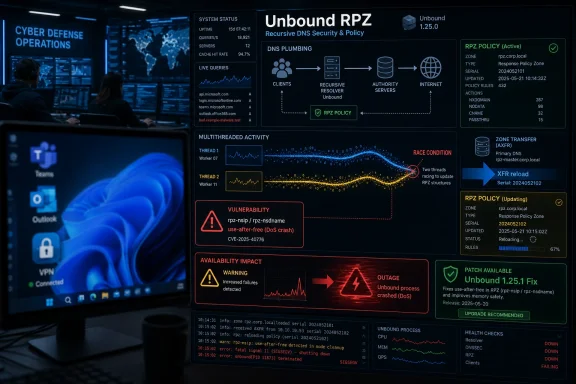
The practical impact of CVE-2026-44608 is availability, not data theft. Under the right conditions, an attacker can cause Unbound to crash by exploiting a use-after-free condition in the RPZ code path. In plain English, a resolver thread may try to walk memory that another thread has already freed while a Response Policy Zone is being reloaded through a zone transfer.
That sounds narrow because it is narrow. The affected resolver must be multi-threaded, it must be using RPZ, the RPZ zone must include
But narrow does not mean irrelevant. DNS failures rarely announce themselves as DNS failures to end users. They surface as Teams not signing in, Outlook freezing at “trying to connect,” Windows Update failing, browsers throwing vague name-resolution errors, VPN clients timing out, and authentication flows that mysteriously degrade. A crash in the resolver layer can look like an application problem until someone finally asks whether names are resolving.
That is why availability-only bugs in recursive DNS deserve more respect than their CVSS summaries usually receive. A working resolver is not a convenience layer. It is a prerequisite for almost every modern endpoint experience, including Windows sign-in dependencies, certificate validation, cloud identity lookups, software distribution, telemetry, management agents, and security filtering.
That portability is exactly why the feature matters in enterprise environments. A security team can subscribe to an external policy feed, transfer it into resolvers, and let the DNS layer become a first checkpoint for malware, phishing, command-and-control infrastructure, and undesirable destinations. In the best case, RPZ is boring, fast, and centrally managed.
CVE-2026-44608 lives in the less glamorous part of that design: reloading policy while queries continue to flow. A resolver is not a static database. It is a high-concurrency service answering live requests while zones are refreshed, rules are updated, cache entries age out, and worker threads operate in parallel. The bug described here is a locking inconsistency, which is another way of saying that the code’s idea of “safe to read” and “safe to free” did not always line up.
That class of failure is especially uncomfortable in infrastructure software because it punishes success. The more a resolver is treated as a central, multi-threaded, policy-enforcing service, the more likely it is to run the kinds of workloads that expose subtle concurrency mistakes. A single-threaded toy deployment and a busy enterprise resolver are not living the same life.
The vulnerable path requires RPZ zone transfers and specific trigger types:
The XFR detail also matters. An XFR is a DNS zone transfer, the mechanism by which one server can receive a zone from another. In an RPZ deployment, that can be useful because it lets a resolver consume policy updates from an external source. The vulnerable scenario appears when such a transfer reloads the RPZ while another thread is reading that same policy zone.
This is why the advisory’s note about local RPZ files is important. If an organization uses static local RPZ files and reloads them outside the vulnerable transfer path, its exposure may be materially different from an organization consuming live RPZ feeds through zone transfers. The same feature name, RPZ, can describe very different operational risk.
For administrators, the key lesson is not “panic if you use Unbound.” It is “inventory how you use Unbound.” Version numbers matter, but configuration matters just as much. A vulnerable version with none of the required conditions is not the same as a vulnerable version sitting at the center of an enterprise DNS filtering pipeline.
In CVE-2026-44608, the publicly described impact is an eventual crash of Unbound, which makes denial of service the headline. That distinction is important. Not every use-after-free is automatically a remote-code-execution exploit, and responsible coverage should not inflate a resolver crash into a Hollywood breach scenario.
At the same time, administrators should not dismiss the phrase simply because the observed impact is availability. Memory-safety bugs in network-facing infrastructure are exactly the kind of defects defenders prefer to remove quickly rather than study indefinitely. A resolver that can be crashed at attacker-chosen times is already a serious operational problem, even if the exploit does nothing more exotic.
The concurrency angle makes exploitation less straightforward than a malformed packet that crashes a daemon every time. The timing has to line up: one thread reading, another applying a transfer, and the lock not held long enough to protect the objects being accessed. That complexity reduces broad exploitability, but it does not erase the concern for environments where the required conditions occur regularly.
Unbound may be present in appliances, Linux servers, containerized DNS services, network security products, recursive resolver farms, lab environments, and cloud-adjacent infrastructure that Windows clients depend on every day. A Windows desktop does not care whether its resolver runs on Windows Server DNS, BIND, Unbound, PowerDNS, a firewall appliance, a Pi-hole stack, or a managed service. It only cares that the names come back quickly and correctly.
That is where mixed estates get tricky. The endpoint team may patch Windows quickly and still suffer from resolver instability maintained by another group. The network team may own DNS infrastructure but not know which RPZ feeds the security team has enabled. The SOC may depend on DNS filtering but not own the upgrade path for the resolver enforcing it. CVE-2026-44608 is the kind of advisory that exposes those seams.
For Windows-heavy organizations, the immediate operational question is not whether Windows Update contains a fix. It is whether any resolver serving Windows endpoints is running Unbound 1.14.0 through 1.25.0 with the vulnerable RPZ transfer configuration. If yes, Unbound 1.25.1 or the vendor-provided patch belongs in the change queue.
That reluctance is rational. A failed resolver upgrade can instantly break large swaths of user experience. Even a short restart can be visible if clients are poorly configured, if resolver pools lack redundancy, or if applications retry badly. DNS is one of those services where everyone agrees redundancy is essential and then discovers, during maintenance, that some legacy subnet still points to a single resolver.
The right patch plan therefore starts with topology. Identify which Unbound instances are authoritative for client recursive resolution, which are forwarders, which sit behind load balancers, and which consume RPZ via transfer. Confirm whether the deployment uses multiple worker threads. Confirm whether the RPZ content includes
Where packaging lags behind upstream, administrators may need to watch their operating-system vendor, appliance vendor, container image maintainer, or firewall distribution for backported fixes. The fixed behavior may arrive as “Unbound 1.25.1,” or it may arrive as a patched build that keeps an older package version number. This is why relying only on a visible upstream version can mislead scanners and humans alike.
One possible operational mitigation is to avoid the vulnerable RPZ transfer path if the environment can safely do so. Another is to remove or avoid the trigger types implicated in the bug until patched. A third is to reduce exposure by ensuring resolver redundancy and process supervision can absorb a crash without turning into an outage. None of those is as satisfying as applying the fix.
The dangerous version of mitigation is the undocumented quick edit. Someone comments out a feed, changes a reload mechanism, or disables part of a policy zone to stop crashes, and months later the organization discovers its DNS filtering no longer blocks categories it assumed were covered. Temporary DNS mitigations have a habit of becoming permanent because they are invisible when everything appears to work.
For that reason, the cleanest answer remains patching. If an organization cannot patch immediately, it should record the compensating control, define an expiration date, and validate that DNS security coverage remains acceptable. Availability and protection should not be treated as rival goals unless a real incident forces the trade-off.
A resolver is an intermediary. Its own outage is rarely the final complaint. The final complaint is “the internet is down,” “the app is broken,” “the printer cannot be found,” “VPN is unreliable,” or “authentication is slow.” DNS does not get blamed first because DNS failures masquerade as everything else.
That is why scoring alone is a poor prioritization tool for infrastructure bugs. CVE-2026-44608 has high attack complexity and environmental prerequisites. For a home user running Unbound without RPZ transfers, it may be noise. For a security-conscious enterprise that built DNS enforcement around multi-threaded Unbound and transferred RPZ feeds, it may be a scheduled maintenance item with real urgency.
The more important risk signal is architectural dependency. If Unbound is in the critical path for thousands of Windows endpoints, a crash loop is an enterprise incident. If it sits behind a redundant pool with health checks, automatic restart, and multiple upstream options, the same vulnerability becomes a contained service risk. Vulnerability management should know the difference.
This pattern appears across infrastructure. TLS inspection adds certificate and proxy complexity. EDR adds kernel drivers, user-mode hooks, and cloud dependencies. DNS filtering adds policy feeds, reload paths, and resolver logic. The control reduces one class of risk while introducing another class of operational dependency.
Mature operations do not respond by abandoning controls. They respond by treating controls as production systems. That means version tracking, staged rollouts, regression testing, monitoring, rollback plans, and ownership. A DNS filtering feed should not be less governed than a line-of-business application simply because it lives in a resolver configuration file.
CVE-2026-44608 is a useful case study because it is not sensational. There is no known mass exploitation wave in the available public description, no ransomware brand to name, and no Windows zero-day drama. There is only a precise bug in a precise feature under precise timing conditions. That is what much of real infrastructure security looks like.
That means a Windows administrator’s patch awareness cannot stop at cumulative updates. DNS resolvers, DHCP services, VPN appliances, reverse proxies, certificate infrastructure, Linux jump boxes, container hosts, and identity-adjacent services all shape whether Windows clients behave correctly. A failure in any of them can become a Windows support incident.
For smaller shops, Unbound often appears in less formal ways. It may be part of a Pi-hole deployment, a firewall distribution, a recursive resolver used by a lab, or a privacy-minded DNS setup maintained by one knowledgeable admin. Those environments are less likely to use the specific RPZ XFR features implicated here, but they are also less likely to have formal inventory.
For larger shops, the risk is not ignorance of Unbound’s existence but fragmentation of ownership. The DNS team may know the resolver version. The security team may know the RPZ feed. The platform team may know the package source. The incident team may know the symptoms. CVE-2026-44608 asks whether those groups can connect their facts before users connect the outage to “Windows being broken.”
Many organizations discover during incidents that their DNS redundancy is more decorative than functional. The secondary resolver may exist, but clients may stick to a dead primary longer than expected. A load balancer may front multiple resolvers, but its health check may only test whether a port is open, not whether useful recursion works. A resolver may restart automatically, but repeated crashes may still create intermittent failures that look like packet loss.
CVE-2026-44608 also invites a policy audit. If RPZ is deployed, administrators should know where feeds originate, how often they transfer, what trigger types they contain, and who approves changes. DNS security policies should be observable, not folklore.
The ideal outcome is not merely “we installed 1.25.1.” The ideal outcome is “we confirmed which resolvers were exposed, patched them, validated RPZ behavior, tested failover, and improved monitoring.” That is the difference between vulnerability response and infrastructure hygiene.
 The DNS Outage You Do Not See Coming Is Still an Outage
The practical impact of CVE-2026-44608 is availability, not data theft. Under the right conditions, an attacker can cause Unbound to crash by exploiting a use-after-free condition in the RPZ code path. In plain English, a resolver thread may try to walk memory that another thread has already freed while a Response Policy Zone is being reloaded through a zone transfer.That sounds narrow because it is narrow. The affected resolver must be multi-threaded, it must be using RPZ, the RPZ zone must include
rpz-nsip or rpz-nsdname triggers, and an RPZ XFR reload must be happening at the wrong moment. Local RPZ files are not described as triggering the vulnerability. This is not the kind of bug that lights up every home lab running a default recursive resolver.But narrow does not mean irrelevant. DNS failures rarely announce themselves as DNS failures to end users. They surface as Teams not signing in, Outlook freezing at “trying to connect,” Windows Update failing, browsers throwing vague name-resolution errors, VPN clients timing out, and authentication flows that mysteriously degrade. A crash in the resolver layer can look like an application problem until someone finally asks whether names are resolving.
That is why availability-only bugs in recursive DNS deserve more respect than their CVSS summaries usually receive. A working resolver is not a convenience layer. It is a prerequisite for almost every modern endpoint experience, including Windows sign-in dependencies, certificate validation, cloud identity lookups, software distribution, telemetry, management agents, and security filtering.
RPZ Turns DNS Into a Policy Engine, and Policy Engines Have Sharp Edges
Response Policy Zones exist because administrators wanted DNS resolvers to do more than answer questions. RPZ lets operators encode local policy into DNS, commonly for blocking known-bad domains, redirecting malicious lookups, enforcing internal controls, or consuming threat-intelligence feeds. Instead of each resolver vendor inventing its own format, RPZ gives security teams a portable policy mechanism.That portability is exactly why the feature matters in enterprise environments. A security team can subscribe to an external policy feed, transfer it into resolvers, and let the DNS layer become a first checkpoint for malware, phishing, command-and-control infrastructure, and undesirable destinations. In the best case, RPZ is boring, fast, and centrally managed.
CVE-2026-44608 lives in the less glamorous part of that design: reloading policy while queries continue to flow. A resolver is not a static database. It is a high-concurrency service answering live requests while zones are refreshed, rules are updated, cache entries age out, and worker threads operate in parallel. The bug described here is a locking inconsistency, which is another way of saying that the code’s idea of “safe to read” and “safe to free” did not always line up.
That class of failure is especially uncomfortable in infrastructure software because it punishes success. The more a resolver is treated as a central, multi-threaded, policy-enforcing service, the more likely it is to run the kinds of workloads that expose subtle concurrency mistakes. A single-threaded toy deployment and a busy enterprise resolver are not living the same life.
The “Special Conditions” Are the Whole Story
Security advisories often use the phrase “under certain conditions” as a sedative. It can make a vulnerability sound theoretical, almost academic. Here, those conditions are not incidental; they define the entire risk model.The vulnerable path requires RPZ zone transfers and specific trigger types:
rpz-nsip and rpz-nsdname. Those triggers are not the ordinary “block this domain name” pattern most casual users imagine when they think of DNS filtering. They apply policy based on nameserver IPs or nameserver names, which means the resolver has to evaluate more contextual data while resolving answers. That added policy richness creates more state to protect during concurrent reloads.The XFR detail also matters. An XFR is a DNS zone transfer, the mechanism by which one server can receive a zone from another. In an RPZ deployment, that can be useful because it lets a resolver consume policy updates from an external source. The vulnerable scenario appears when such a transfer reloads the RPZ while another thread is reading that same policy zone.
This is why the advisory’s note about local RPZ files is important. If an organization uses static local RPZ files and reloads them outside the vulnerable transfer path, its exposure may be materially different from an organization consuming live RPZ feeds through zone transfers. The same feature name, RPZ, can describe very different operational risk.
For administrators, the key lesson is not “panic if you use Unbound.” It is “inventory how you use Unbound.” Version numbers matter, but configuration matters just as much. A vulnerable version with none of the required conditions is not the same as a vulnerable version sitting at the center of an enterprise DNS filtering pipeline.
Use-After-Free Still Means Memory Safety, Even When the Payload Is a Crash
A use-after-free bug is one of the classic memory-safety failures. Software allocates memory, releases it, and later attempts to use it again as if it were still valid. Depending on timing, allocator behavior, and what has happened to that memory region since, the result can be a crash, corruption, exploitable control flow, or frustratingly inconsistent behavior.In CVE-2026-44608, the publicly described impact is an eventual crash of Unbound, which makes denial of service the headline. That distinction is important. Not every use-after-free is automatically a remote-code-execution exploit, and responsible coverage should not inflate a resolver crash into a Hollywood breach scenario.
At the same time, administrators should not dismiss the phrase simply because the observed impact is availability. Memory-safety bugs in network-facing infrastructure are exactly the kind of defects defenders prefer to remove quickly rather than study indefinitely. A resolver that can be crashed at attacker-chosen times is already a serious operational problem, even if the exploit does nothing more exotic.
The concurrency angle makes exploitation less straightforward than a malformed packet that crashes a daemon every time. The timing has to line up: one thread reading, another applying a transfer, and the lock not held long enough to protect the objects being accessed. That complexity reduces broad exploitability, but it does not erase the concern for environments where the required conditions occur regularly.
This Is Not a Microsoft Bug, but Windows Shops Still Own the Blast Radius
The user-facing source here is Microsoft’s Security Response Center entry, but the affected component is NLnet Labs Unbound. That distinction matters because Windows administrators often treat the MSRC guide as a Microsoft-products dashboard. In reality, vulnerability management now crosses vendor boundaries constantly.Unbound may be present in appliances, Linux servers, containerized DNS services, network security products, recursive resolver farms, lab environments, and cloud-adjacent infrastructure that Windows clients depend on every day. A Windows desktop does not care whether its resolver runs on Windows Server DNS, BIND, Unbound, PowerDNS, a firewall appliance, a Pi-hole stack, or a managed service. It only cares that the names come back quickly and correctly.
That is where mixed estates get tricky. The endpoint team may patch Windows quickly and still suffer from resolver instability maintained by another group. The network team may own DNS infrastructure but not know which RPZ feeds the security team has enabled. The SOC may depend on DNS filtering but not own the upgrade path for the resolver enforcing it. CVE-2026-44608 is the kind of advisory that exposes those seams.
For Windows-heavy organizations, the immediate operational question is not whether Windows Update contains a fix. It is whether any resolver serving Windows endpoints is running Unbound 1.14.0 through 1.25.0 with the vulnerable RPZ transfer configuration. If yes, Unbound 1.25.1 or the vendor-provided patch belongs in the change queue.
The Patch Is Simple; the Deployment Path May Not Be
NLnet Labs fixed the issue in Unbound 1.25.1. On paper, that is clean: update Unbound, restart or roll the resolver service, and remove the vulnerable locking behavior. In practice, DNS resolvers are among the infrastructure components administrators are most reluctant to touch during business hours.That reluctance is rational. A failed resolver upgrade can instantly break large swaths of user experience. Even a short restart can be visible if clients are poorly configured, if resolver pools lack redundancy, or if applications retry badly. DNS is one of those services where everyone agrees redundancy is essential and then discovers, during maintenance, that some legacy subnet still points to a single resolver.
The right patch plan therefore starts with topology. Identify which Unbound instances are authoritative for client recursive resolution, which are forwarders, which sit behind load balancers, and which consume RPZ via transfer. Confirm whether the deployment uses multiple worker threads. Confirm whether the RPZ content includes
rpz-nsip or rpz-nsdname triggers. Then patch or mitigate the systems that actually match the advisory.Where packaging lags behind upstream, administrators may need to watch their operating-system vendor, appliance vendor, container image maintainer, or firewall distribution for backported fixes. The fixed behavior may arrive as “Unbound 1.25.1,” or it may arrive as a patched build that keeps an older package version number. This is why relying only on a visible upstream version can mislead scanners and humans alike.
The Mitigation Conversation Belongs in Change Control, Not Chat
Because the vulnerable conditions are specific, some organizations may be tempted to mitigate by changing RPZ behavior rather than immediately upgrading. That can be reasonable in tightly controlled environments, but it should not be improvised. DNS policy is security policy, and disabling or altering RPZ feeds can create its own exposure.One possible operational mitigation is to avoid the vulnerable RPZ transfer path if the environment can safely do so. Another is to remove or avoid the trigger types implicated in the bug until patched. A third is to reduce exposure by ensuring resolver redundancy and process supervision can absorb a crash without turning into an outage. None of those is as satisfying as applying the fix.
The dangerous version of mitigation is the undocumented quick edit. Someone comments out a feed, changes a reload mechanism, or disables part of a policy zone to stop crashes, and months later the organization discovers its DNS filtering no longer blocks categories it assumed were covered. Temporary DNS mitigations have a habit of becoming permanent because they are invisible when everything appears to work.
For that reason, the cleanest answer remains patching. If an organization cannot patch immediately, it should record the compensating control, define an expiration date, and validate that DNS security coverage remains acceptable. Availability and protection should not be treated as rival goals unless a real incident forces the trade-off.
CVSS Cannot Tell You Whether Your Help Desk Will Melt
The advisory language around availability is severe: total loss of availability is possible for the impacted component while the attack continues, or the condition may persist after exploitation depending on how the service behaves. That is the right lens for a resolver crash, but it still undersells the user-visible pain.A resolver is an intermediary. Its own outage is rarely the final complaint. The final complaint is “the internet is down,” “the app is broken,” “the printer cannot be found,” “VPN is unreliable,” or “authentication is slow.” DNS does not get blamed first because DNS failures masquerade as everything else.
That is why scoring alone is a poor prioritization tool for infrastructure bugs. CVE-2026-44608 has high attack complexity and environmental prerequisites. For a home user running Unbound without RPZ transfers, it may be noise. For a security-conscious enterprise that built DNS enforcement around multi-threaded Unbound and transferred RPZ feeds, it may be a scheduled maintenance item with real urgency.
The more important risk signal is architectural dependency. If Unbound is in the critical path for thousands of Windows endpoints, a crash loop is an enterprise incident. If it sits behind a redundant pool with health checks, automatic restart, and multiple upstream options, the same vulnerability becomes a contained service risk. Vulnerability management should know the difference.
The Quiet Pattern: DNS Security Features Become DNS Risk Surfaces
There is an irony here that security teams should not miss. RPZ is often deployed to make networks safer, but the implementation of that security feature created a crash path in the resolver. That does not mean RPZ is a bad idea. It means security controls are software, and software carries its own failure modes.This pattern appears across infrastructure. TLS inspection adds certificate and proxy complexity. EDR adds kernel drivers, user-mode hooks, and cloud dependencies. DNS filtering adds policy feeds, reload paths, and resolver logic. The control reduces one class of risk while introducing another class of operational dependency.
Mature operations do not respond by abandoning controls. They respond by treating controls as production systems. That means version tracking, staged rollouts, regression testing, monitoring, rollback plans, and ownership. A DNS filtering feed should not be less governed than a line-of-business application simply because it lives in a resolver configuration file.
CVE-2026-44608 is a useful case study because it is not sensational. There is no known mass exploitation wave in the available public description, no ransomware brand to name, and no Windows zero-day drama. There is only a precise bug in a precise feature under precise timing conditions. That is what much of real infrastructure security looks like.
Windows Administrators Should Read This as a Dependency Warning
The Windows world has become much more heterogeneous than its branding suggests. Entra ID, Microsoft 365, Defender, Intune, Windows Update, hybrid identity, VPN, proxying, DNS filtering, and cloud-delivered management all depend on non-Windows network services at one point or another. Even when the endpoint is Windows, the control plane is distributed.That means a Windows administrator’s patch awareness cannot stop at cumulative updates. DNS resolvers, DHCP services, VPN appliances, reverse proxies, certificate infrastructure, Linux jump boxes, container hosts, and identity-adjacent services all shape whether Windows clients behave correctly. A failure in any of them can become a Windows support incident.
For smaller shops, Unbound often appears in less formal ways. It may be part of a Pi-hole deployment, a firewall distribution, a recursive resolver used by a lab, or a privacy-minded DNS setup maintained by one knowledgeable admin. Those environments are less likely to use the specific RPZ XFR features implicated here, but they are also less likely to have formal inventory.
For larger shops, the risk is not ignorance of Unbound’s existence but fragmentation of ownership. The DNS team may know the resolver version. The security team may know the RPZ feed. The platform team may know the package source. The incident team may know the symptoms. CVE-2026-44608 asks whether those groups can connect their facts before users connect the outage to “Windows being broken.”
The Fix Window Is Also a Chance to Audit Resolver Resilience
A resolver patch is an opportunity to ask uncomfortable but useful questions. Are clients configured with more than one resolver, and do those resolvers really fail over? Are health checks removing crashed nodes from service? Are resolver processes supervised and restarted? Are RPZ transfers monitored? Are crashes alerting the right team?Many organizations discover during incidents that their DNS redundancy is more decorative than functional. The secondary resolver may exist, but clients may stick to a dead primary longer than expected. A load balancer may front multiple resolvers, but its health check may only test whether a port is open, not whether useful recursion works. A resolver may restart automatically, but repeated crashes may still create intermittent failures that look like packet loss.
CVE-2026-44608 also invites a policy audit. If RPZ is deployed, administrators should know where feeds originate, how often they transfer, what trigger types they contain, and who approves changes. DNS security policies should be observable, not folklore.
The ideal outcome is not merely “we installed 1.25.1.” The ideal outcome is “we confirmed which resolvers were exposed, patched them, validated RPZ behavior, tested failover, and improved monitoring.” That is the difference between vulnerability response and infrastructure hygiene.
The Resolver Bug Hiding Behind the Advisory Text
The short version is that CVE-2026-44608 is a configuration-sensitive Unbound crash flaw, and the long version is that DNS policy infrastructure deserves the same operational discipline as any other security platform.- Organizations running Unbound 1.14.0 through 1.25.0 should check whether they use multi-threading, RPZ transfers, and
rpz-nsiporrpz-nsdnametriggers. - Unbound 1.25.1 contains the upstream fix for the locking issue, though downstream vendors may deliver the repair through backported packages.
- Local RPZ files are not described as triggering the vulnerability, which makes configuration review essential before assigning urgency.
- The expected impact is denial of service through resolver crash, not a publicly described remote-code-execution path.
- Windows environments remain exposed if Windows clients depend on affected Unbound resolvers, even though the vulnerable component is not Windows itself.
- Any temporary mitigation that changes RPZ behavior should be documented, time-limited, and reviewed for security-policy side effects.
References
- Primary source: MSRC
Published: 2026-05-23T01:39:36-07:00
Security Update Guide - Microsoft Security Response Center
 msrc.microsoft.com
- Official source: microsoft.com
MSRC - Microsoft Security Response Center
The Microsoft Security Response Center is part of the defender community and on the front line of security response evolution. For over twenty years, we have been engaged with security researchers working to protect customers and the broader ecosystem.www.microsoft.com - Official source: msrc-ppe.microsoft.com
- Related coverage: datacomm.com
- Related coverage: sentinelone.com
CVE-2026-33259: DNS Recursor Use-After-Free Vulnerability
CVE-2026-33259 is a use-after-free vulnerability in DNS recursors via RPZ transfers. Learn about its impact, affected versions, and mitigation methods.www.sentinelone.com
- Related coverage: bleepingcomputer.com
Microsoft February 2026 Patch Tuesday fixes 6 zero-days, 58 flaws
Today is Microsoft's February 2026 Patch Tuesday with security updates for 58 flaws, including 6 actively exploited and three publicly disclosed zero-day vulnerabilities.www.bleepingcomputer.com
- Related coverage: sra.io
- Related coverage: cert.gov.vu
Advisory 117 CVE 2026 20805 Microsoft Windows Information Disclosure Vulnerability
PDF documentcert.gov.vu
