

Microsoft has listed CVE-2026-42923, disclosed on May 20, 2026, as a degradation-of-service flaw in NLnet Labs Unbound, where vulnerable DNSSEC validation can spend excessive time on NSEC3 hash calculations and intermittently reduce resolver availability under attacker-controlled conditions. The bug is not the kind of Windows vulnerability that drops shells or steals credentials, but it is exactly the sort of infrastructure weakness that makes administrators unpopular at 9:04 a.m. It turns a mathematical corner of DNSSEC into a performance choke point, and it reminds us that availability bugs rarely need drama to be operationally serious.
CVE-2026-42923 sits in a strange place for a Microsoft audience. The affected software is Unbound, the widely used open-source recursive DNS resolver maintained by NLnet Labs, not a Windows kernel component or a Microsoft 365 service. Yet its appearance in Microsoft’s Security Update Guide is a useful signal: the modern Windows estate is no longer neatly bounded by what ships on the Windows installation media.
DNS resolution is one of those services that becomes visible only when it fails. Users do not say “our recursive resolver appears CPU-bound while validating DNSSEC negative answers.” They say Teams is broken, Outlook is slow, the VPN is unreliable, or “the internet is down.” The distance between those complaints and an NSEC3 hash loop is precisely why this class of vulnerability deserves attention.
The severity rating is medium, and that is probably fair in the narrow language of CVSS. The vulnerability does not hand an attacker confidentiality or integrity. It does not, by itself, produce a guaranteed total outage. But “medium” is a poor emotional description for a resolver that becomes sluggish or intermittently unavailable under load, because DNS latency propagates upward into almost every business workflow.
The important fact is not that CVE-2026-42923 can theoretically be exploited over the network. The important fact is that it targets the validator’s work budget, and work budgets are where security protocols often become operational liabilities.
Negative answers are harder. If a user asks for a name that does not exist, the DNS system still needs a trustworthy way to prove the absence of that name. DNSSEC uses records such as NSEC and NSEC3 to provide authenticated denial of existence, which is a fancy way of saying “this name is not here, and here is signed evidence that it is not here.”
NSEC3 adds hashing to that proof, partly to reduce the zone-walking problem that plain NSEC can expose. Instead of openly listing adjacent names, NSEC3 works with hashed names and may include iterations that require repeated hash calculations. That design can be useful, but it also introduces a familiar security engineering tradeoff: making enumeration harder can make validation more expensive.
This is where the vulnerability lives. Unbound had previously introduced a limit on NSEC3 hash calculations, a mitigation meant to prevent DNSSEC validation from being dragged down an excessively expensive path. CVE-2026-42923 is a bypass of that spirit, not necessarily by violating the limit everywhere, but by reaching a code path that did not apply the existing bound in the same way.
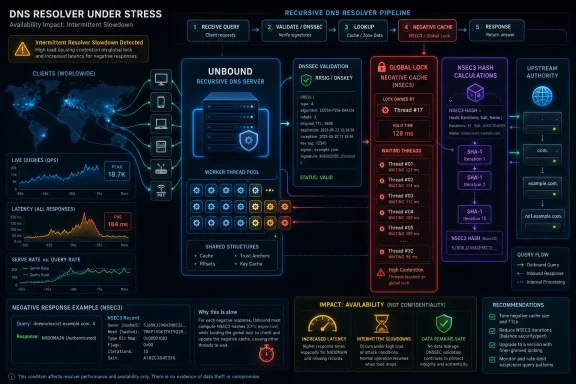
The affected path involves consulting the negative cache for DS records. DS records are part of the delegation chain in DNSSEC, connecting a child zone to its parent. If that sounds obscure, it is because it is. But the operational consequence is not obscure at all: a resolver can spend too much time doing NSEC3 work while holding a global lock tied to the negative cache.
That global lock detail is the sharp edge. Hash calculations are already expensive enough in the wrong pattern, but holding a lock while doing them means other threads can be stalled while waiting to consult the same shared structure. A vulnerability that begins as “too much CPU for one query” can therefore become “other legitimate resolver work is delayed behind the expensive query.”
That matters because this is not magic internet background radiation alone. It is not every malformed packet from every botnet node. The adversary needs to set up the conditions inside a zone they control, then use queries to cause vulnerable resolvers to do disproportionate validation work.
But “narrower” is not the same as “comforting.” DNS is deliberately open, recursive resolvers are often reachable by large client populations, and attackers have spent years learning how to convert small protocol asymmetries into availability problems. If the cost to the attacker is low and the cost to the resolver is repeatedly high, the imbalance is enough.
The vulnerability description uses the phrase degradation of service, which is careful language. It says performance is reduced or resource availability is interrupted, but the attacker does not necessarily gain the ability to completely deny service to legitimate users. That distinction matters for scoring, but it can understate real-world pain.
A resolver that is partially available all the time or fully available only some of the time can still break applications. Modern clients retry, fail over, cache, and hide errors until they cannot. By the time the help desk sees symptoms, the initial cause may be buried under application timeouts, authentication delays, and user-side superstition.
This is the nature of availability bugs in infrastructure. They do not always create a spectacular cliff. Sometimes they create a slope steep enough that everything feels unreliable.
The affected range is important. NVD lists vulnerable configurations as Unbound versions from 1.19.1 up to, but not including, 1.25.1. That detail may surprise administrators who remember 1.19.1 as the version that introduced mitigations for earlier NSEC3-related CPU exhaustion concerns. A mitigation can be real and still incomplete.
This should shape how sysadmins treat the update. If you run Unbound directly on Linux, BSD, a firewall appliance, a DNS appliance, a hosting control panel, or a Pi-hole-style home lab resolver, the question is not whether you run Windows. The question is whether your resolver package, container, appliance firmware, or vendor bundle has picked up 1.25.1 or a backported patch.
For Windows-heavy shops, the exposure is often indirect. Active Directory-integrated DNS may not be Unbound, but many organizations forward queries to upstream resolvers, security gateways, recursive DNS clusters, or managed appliances that use open-source resolver components under the hood. The person responsible for Windows endpoints may not own those systems, but Windows endpoints will experience the failure.
That is why Microsoft’s inclusion of a third-party CVE is not noise. It is a reminder that the Windows user experience depends on upstream open-source infrastructure, and patch management has to follow the dependency chain rather than the vendor logo.
The more useful conclusion is that DNSSEC is security machinery with moving parts, and moving parts create maintenance obligations. NSEC3, in particular, has repeatedly been a place where protocol intent and resolver cost meet awkwardly. Hash iterations that are acceptable under the standard can still be expensive in aggregate, especially when attackers can choose the shape of the zone and the query stream.
The industry has seen this pattern before. Defensive cryptography can be turned into a resource exhaustion primitive when one side can force the other to perform expensive checks at scale. TLS handshakes, password hashing, XML signature validation, compressed payloads, and certificate path building have all had their moments in this genre.
What makes DNSSEC validation especially sensitive is its position in the request path. A web server under stress affects the site it serves. A recursive resolver under stress affects every site, service, API, login flow, package repository, update channel, and telemetry endpoint that depends on it. DNS is not one application; it is the substrate beneath the applications.
The right response is not to abandon DNSSEC validation. It is to treat validator performance as a security property. A resolver that validates correctly but can be coerced into spending unbounded time on validation has not fully solved the security problem; it has moved the failure from authenticity to availability.
That is a reasonable mechanical description. It is not a deployment risk assessment. A medium availability flaw in a resolver serving a few lab machines is a maintenance item. The same flaw in a recursive DNS layer serving a university, hosting provider, MSP, corporate campus, or VPN concentrator is a different operational event.
The vulnerability also has a coordinated-attack caveat. The public description says coordinated attacks could raise the issue to denial of service. That is not a guarantee of catastrophe, but it is a warning against treating the bug as merely theoretical. If multiple clients, bot nodes, or query streams can keep driving the expensive path, the difference between degradation and denial may become a matter of capacity.
Availability attacks rarely map cleanly to single-host severity. They are shaped by topology. A resolver behind aggressive rate limiting, strict access controls, and ample CPU headroom may ride out abusive traffic. An exposed or broadly shared resolver with weaker controls may show symptoms quickly.
This is why asset inventory matters more than headline severity. The security team does not need to panic over every Unbound instance, but it does need to know where those instances are, who depends on them, and how quickly the package can be updated when resolver advisories land.
CVE-2026-42923 is a good prompt to map that path. Where do Windows clients send queries when they are on the LAN? What changes when they are on VPN? What changes when they are remote and using a secure DNS client? Which systems perform DNSSEC validation, and which merely forward? Which components are appliances whose internals are updated only through vendor firmware?
The answer is often messier than expected. A Windows laptop may use corporate DNS on-site, a VPN resolver off-site, an endpoint security agent for certain categories, and browser-level secure DNS depending on policy. Each layer can hide or amplify resolver behavior.
Unbound is common in places Windows admins may not inspect daily. It appears in Linux resolver clusters, BSD-based firewalls, network appliances, hosting stacks, recursive DNS services, and home-lab deployments. Some products expose the version clearly. Others bury it in firmware notes or backport fixes without changing the visible upstream version number.
That last point is important. Not every patched system will advertise “Unbound 1.25.1” in the same way. Linux distributions and appliance vendors often backport security fixes into older package versions. Administrators should verify vendor advisories and changelogs rather than relying only on the upstream version string.
Negative caching is supposed to improve performance. When a resolver learns that a name or record does not exist, it can cache that negative answer for a period of time rather than repeating the full lookup. That is sensible behavior in a noisy internet where clients constantly ask for mistyped domains, nonexistent subdomains, tracking endpoints, and service discovery names.
But caches are shared data structures, and shared data structures need concurrency control. A lock is a promise that the data will not be corrupted by simultaneous access. It is also a bottleneck if the code inside the locked region takes too long.
That is the deeper lesson. Security fixes often focus on bounding the obviously expensive calculation, but the placement of the calculation matters just as much. An expensive function outside a lock is a CPU problem. The same function inside a lock can become a system-wide contention problem.
For resolver operators, the symptom may not look like one core pegged at 100 percent. It may look like increased tail latency, worker threads waiting, intermittent stalls, or a resolver that appears alive but slow. This is the kind of failure that can evade simplistic uptime checks while still degrading user experience.
That should not be read as a failure of NLnet Labs uniquely. It is a common pattern in mature network software. Once a protocol has many state transitions, caches, exceptional cases, and performance shortcuts, a mitigation must be applied consistently across all relevant paths. One missed path can preserve the vulnerability in a narrower but still exploitable form.
There is a difference between “the product had no defense” and “one code path failed to apply the defense.” The latter is better, but it is still operationally meaningful. Attackers do not care whether the expensive path is the main road or the service entrance.
This is also why regression testing for security performance is difficult. Functional tests can confirm that validation succeeds or fails correctly. Performance-security tests must ask whether an adversarial input causes too much work, in the wrong place, under the wrong lock, across enough repetitions to matter. That is a higher bar.
The industry is slowly learning to treat algorithmic complexity as a vulnerability class in its own right. CVE-2026-42923’s CWE assignment reflects that: this is about inefficient algorithmic complexity, not memory corruption or authentication bypass. That category deserves more respect than it usually receives.
The stakes differ, but the failure mode rhymes. A home user may see browsing delays, smart-home weirdness, or intermittent failures that seem to vanish when switching to a public DNS provider. An enterprise may see authentication delays, SaaS access complaints, package update failures, or VPN ticket spikes. In both cases, DNS is blamed last because everything else looks more visible.
Home labs also matter because they often run closer to the edge of capacity. A small ARM board performing DNSSEC validation may have far less CPU headroom than an enterprise resolver cluster. A degradation bug that is tolerable on a large server can be very noticeable on a constrained device.
Enterprise environments, meanwhile, have a different problem: shared dependence. A resolver cluster may be well provisioned, but it serves thousands of users and systems. Small increases in latency can turn into broad application drag, especially when authentication, endpoint management, and cloud services all stack DNS lookups into their startup paths.
The shared advice is simple but often ignored: know what resolves your names. DNS is too foundational to be treated as an appliance-shaped mystery.
Operational mitigations are still useful. Recursive resolvers should not be open to the internet unless they are intentionally operated as public resolvers with the engineering controls that implies. Access control lists, rate limiting, response policy, monitoring, and capacity planning all reduce the blast radius of abuse.
But architectural hygiene should not become an excuse to delay the patch. Access controls reduce who can trigger the bug; they do not remove the vulnerable path. Internal clients can be compromised, VPN users can be abused, and upstream-forwarding arrangements can still create unexpected exposure.
Monitoring should focus on resolver latency and saturation, not just process liveness. A DNS service can be technically up while failing its users. Useful signals include query response time, SERVFAIL rates, worker thread behavior, CPU utilization, lock contention if exposed, cache metrics, and spikes in DNSSEC validation work.
The most mature shops will use this CVE as a tabletop prompt. If recursive DNS degrades for 30 minutes, who notices first? Which dashboards show it? Which applications fail loudly? Which teams can change forwarders, adjust traffic routing, or roll out emergency resolver updates? A medium CVE is an inexpensive excuse to answer those questions before a high-severity incident asks them for you.
That is the real patch reality in 2026. Windows estates depend on open-source packages, Linux appliances, containerized infrastructure, cloud services, identity brokers, DNS forwarders, reverse proxies, and vendor-managed agents. The security boundary is not the operating system; it is the workflow.
For IT teams, this changes how advisories should be consumed. A Microsoft Security Update Guide entry may not always mean “deploy this Windows cumulative update.” Sometimes it means “check the adjacent component that Windows relies on.” That is less convenient, but it is closer to how systems actually fail.
The risk is that administrators filter too aggressively. If a CVE does not list Windows as the affected product, it may be dismissed by endpoint teams. If it appears in a Microsoft feed but concerns Unbound, it may be dismissed by network teams as a Microsoft issue. Between those two assumptions lies the outage.
A good vulnerability process assigns ownership by function, not branding. DNS resolver issues belong to whoever owns recursive resolution, regardless of whether the advisory arrived through Microsoft, NVD, a Linux distribution, an appliance vendor, or an open-source mailing list.
The most exposed systems are those that accept queries from broad or untrusted client sets. Public recursive resolvers, ISP resolvers, hosting environments, campus networks, MSP shared infrastructure, and large corporate VPN resolvers deserve faster attention than isolated lab instances. But isolated lab instances should still be updated, because resolver bugs have a habit of being rediscovered during unrelated troubleshooting months later.
Administrators should also be careful with version assumptions. If a distribution backports the patch, the package may not say 1.25.1. If an appliance vendor bundles Unbound, the visible firmware version may be the only supported indicator. If a container image pins an older Unbound release, rebuilding the host will not fix the resolver until the image changes.
For Windows administrators, the action item is to trace dependencies. Ask whether any DNS forwarders, conditional forwarders, security gateways, or cloud-adjacent resolver layers use Unbound. If the answer is “we don’t know,” that is the first vulnerability to fix.
 A Medium CVE Lands in the Part of the Stack Everyone Assumes Is Boring
CVE-2026-42923 sits in a strange place for a Microsoft audience. The affected software is Unbound, the widely used open-source recursive DNS resolver maintained by NLnet Labs, not a Windows kernel component or a Microsoft 365 service. Yet its appearance in Microsoft’s Security Update Guide is a useful signal: the modern Windows estate is no longer neatly bounded by what ships on the Windows installation media.DNS resolution is one of those services that becomes visible only when it fails. Users do not say “our recursive resolver appears CPU-bound while validating DNSSEC negative answers.” They say Teams is broken, Outlook is slow, the VPN is unreliable, or “the internet is down.” The distance between those complaints and an NSEC3 hash loop is precisely why this class of vulnerability deserves attention.
The severity rating is medium, and that is probably fair in the narrow language of CVSS. The vulnerability does not hand an attacker confidentiality or integrity. It does not, by itself, produce a guaranteed total outage. But “medium” is a poor emotional description for a resolver that becomes sluggish or intermittently unavailable under load, because DNS latency propagates upward into almost every business workflow.
The important fact is not that CVE-2026-42923 can theoretically be exploited over the network. The important fact is that it targets the validator’s work budget, and work budgets are where security protocols often become operational liabilities.
NSEC3 Turns Proof of Nonexistence Into a Cost Center
To understand the flaw, start with DNSSEC’s job. DNSSEC lets resolvers validate that DNS answers have not been forged, using cryptographic signatures and chains of trust. That is straightforward enough when the answer exists: a domain has a record, the zone signs it, and the resolver verifies the signature.Negative answers are harder. If a user asks for a name that does not exist, the DNS system still needs a trustworthy way to prove the absence of that name. DNSSEC uses records such as NSEC and NSEC3 to provide authenticated denial of existence, which is a fancy way of saying “this name is not here, and here is signed evidence that it is not here.”
NSEC3 adds hashing to that proof, partly to reduce the zone-walking problem that plain NSEC can expose. Instead of openly listing adjacent names, NSEC3 works with hashed names and may include iterations that require repeated hash calculations. That design can be useful, but it also introduces a familiar security engineering tradeoff: making enumeration harder can make validation more expensive.
This is where the vulnerability lives. Unbound had previously introduced a limit on NSEC3 hash calculations, a mitigation meant to prevent DNSSEC validation from being dragged down an excessively expensive path. CVE-2026-42923 is a bypass of that spirit, not necessarily by violating the limit everywhere, but by reaching a code path that did not apply the existing bound in the same way.
The affected path involves consulting the negative cache for DS records. DS records are part of the delegation chain in DNSSEC, connecting a child zone to its parent. If that sounds obscure, it is because it is. But the operational consequence is not obscure at all: a resolver can spend too much time doing NSEC3 work while holding a global lock tied to the negative cache.
That global lock detail is the sharp edge. Hash calculations are already expensive enough in the wrong pattern, but holding a lock while doing them means other threads can be stalled while waiting to consult the same shared structure. A vulnerability that begins as “too much CPU for one query” can therefore become “other legitimate resolver work is delayed behind the expensive query.”
The Attacker Does Not Need to Break DNSSEC; They Need to Make It Work Too Hard
The attacker model for this flaw is narrower than a generic packet flood. According to the public description, the attacker needs to control a DNSSEC-signed zone and sign NSEC3 records with acceptably high iterations for child delegations. Then the attacker queries a vulnerable Unbound resolver in ways that drive it into the affected validation path.That matters because this is not magic internet background radiation alone. It is not every malformed packet from every botnet node. The adversary needs to set up the conditions inside a zone they control, then use queries to cause vulnerable resolvers to do disproportionate validation work.
But “narrower” is not the same as “comforting.” DNS is deliberately open, recursive resolvers are often reachable by large client populations, and attackers have spent years learning how to convert small protocol asymmetries into availability problems. If the cost to the attacker is low and the cost to the resolver is repeatedly high, the imbalance is enough.
The vulnerability description uses the phrase degradation of service, which is careful language. It says performance is reduced or resource availability is interrupted, but the attacker does not necessarily gain the ability to completely deny service to legitimate users. That distinction matters for scoring, but it can understate real-world pain.
A resolver that is partially available all the time or fully available only some of the time can still break applications. Modern clients retry, fail over, cache, and hide errors until they cannot. By the time the help desk sees symptoms, the initial cause may be buried under application timeouts, authentication delays, and user-side superstition.
This is the nature of availability bugs in infrastructure. They do not always create a spectacular cliff. Sometimes they create a slope steep enough that everything feels unreliable.
The Patch Is Simple; The Lesson Is Not
The direct fix is to move to Unbound 1.25.1 or apply the vendor patch that bounds the vulnerable code path using the existing NSEC3 hash calculation limit. In other words, the resolver already had the conceptual mitigation; this CVE is about a path that escaped it. That is a classic software maintenance story: the first fix addresses the known expensive route, and later review discovers another entrance to the same expensive room.The affected range is important. NVD lists vulnerable configurations as Unbound versions from 1.19.1 up to, but not including, 1.25.1. That detail may surprise administrators who remember 1.19.1 as the version that introduced mitigations for earlier NSEC3-related CPU exhaustion concerns. A mitigation can be real and still incomplete.
This should shape how sysadmins treat the update. If you run Unbound directly on Linux, BSD, a firewall appliance, a DNS appliance, a hosting control panel, or a Pi-hole-style home lab resolver, the question is not whether you run Windows. The question is whether your resolver package, container, appliance firmware, or vendor bundle has picked up 1.25.1 or a backported patch.
For Windows-heavy shops, the exposure is often indirect. Active Directory-integrated DNS may not be Unbound, but many organizations forward queries to upstream resolvers, security gateways, recursive DNS clusters, or managed appliances that use open-source resolver components under the hood. The person responsible for Windows endpoints may not own those systems, but Windows endpoints will experience the failure.
That is why Microsoft’s inclusion of a third-party CVE is not noise. It is a reminder that the Windows user experience depends on upstream open-source infrastructure, and patch management has to follow the dependency chain rather than the vendor logo.
DNSSEC’s Security Value Keeps Colliding With Its Operational Complexity
There is a temptation to read vulnerabilities like CVE-2026-42923 as an indictment of DNSSEC. That would be too easy and not especially useful. DNSSEC solves a real problem: without validation, DNS remains vulnerable to certain classes of spoofing, cache poisoning, and trust-chain manipulation.The more useful conclusion is that DNSSEC is security machinery with moving parts, and moving parts create maintenance obligations. NSEC3, in particular, has repeatedly been a place where protocol intent and resolver cost meet awkwardly. Hash iterations that are acceptable under the standard can still be expensive in aggregate, especially when attackers can choose the shape of the zone and the query stream.
The industry has seen this pattern before. Defensive cryptography can be turned into a resource exhaustion primitive when one side can force the other to perform expensive checks at scale. TLS handshakes, password hashing, XML signature validation, compressed payloads, and certificate path building have all had their moments in this genre.
What makes DNSSEC validation especially sensitive is its position in the request path. A web server under stress affects the site it serves. A recursive resolver under stress affects every site, service, API, login flow, package repository, update channel, and telemetry endpoint that depends on it. DNS is not one application; it is the substrate beneath the applications.
The right response is not to abandon DNSSEC validation. It is to treat validator performance as a security property. A resolver that validates correctly but can be coerced into spending unbounded time on validation has not fully solved the security problem; it has moved the failure from authenticity to availability.
The Word “Medium” Hides the Blast Radius
CVSS scores are useful because they impose structure. They are also dangerous because they can flatten context. CVE-2026-42923 receives a medium score under CVSS 3.1, with network attack vector, low attack complexity, no privileges required, no user interaction, unchanged scope, no confidentiality impact, no integrity impact, and low availability impact.That is a reasonable mechanical description. It is not a deployment risk assessment. A medium availability flaw in a resolver serving a few lab machines is a maintenance item. The same flaw in a recursive DNS layer serving a university, hosting provider, MSP, corporate campus, or VPN concentrator is a different operational event.
The vulnerability also has a coordinated-attack caveat. The public description says coordinated attacks could raise the issue to denial of service. That is not a guarantee of catastrophe, but it is a warning against treating the bug as merely theoretical. If multiple clients, bot nodes, or query streams can keep driving the expensive path, the difference between degradation and denial may become a matter of capacity.
Availability attacks rarely map cleanly to single-host severity. They are shaped by topology. A resolver behind aggressive rate limiting, strict access controls, and ample CPU headroom may ride out abusive traffic. An exposed or broadly shared resolver with weaker controls may show symptoms quickly.
This is why asset inventory matters more than headline severity. The security team does not need to panic over every Unbound instance, but it does need to know where those instances are, who depends on them, and how quickly the package can be updated when resolver advisories land.
Windows Shops Should Look Past the Domain Controller
For many Windows administrators, DNS means the DNS Server role on a domain controller. That is still central in Active Directory environments, but it is only part of the picture. Enterprise name resolution now commonly passes through forwarders, split-horizon DNS services, secure web gateways, endpoint protection resolvers, cloud DNS services, and local caching layers.CVE-2026-42923 is a good prompt to map that path. Where do Windows clients send queries when they are on the LAN? What changes when they are on VPN? What changes when they are remote and using a secure DNS client? Which systems perform DNSSEC validation, and which merely forward? Which components are appliances whose internals are updated only through vendor firmware?
The answer is often messier than expected. A Windows laptop may use corporate DNS on-site, a VPN resolver off-site, an endpoint security agent for certain categories, and browser-level secure DNS depending on policy. Each layer can hide or amplify resolver behavior.
Unbound is common in places Windows admins may not inspect daily. It appears in Linux resolver clusters, BSD-based firewalls, network appliances, hosting stacks, recursive DNS services, and home-lab deployments. Some products expose the version clearly. Others bury it in firmware notes or backport fixes without changing the visible upstream version number.
That last point is important. Not every patched system will advertise “Unbound 1.25.1” in the same way. Linux distributions and appliance vendors often backport security fixes into older package versions. Administrators should verify vendor advisories and changelogs rather than relying only on the upstream version string.
The Negative Cache Becomes a Contention Point
The most interesting engineering detail in CVE-2026-42923 is the interaction between hashing and locking. The bug is not merely that Unbound performs NSEC3 calculations. It is that, in this path, the work can occur while a global lock for the negative cache is held, blocking other threads that need the same cache.Negative caching is supposed to improve performance. When a resolver learns that a name or record does not exist, it can cache that negative answer for a period of time rather than repeating the full lookup. That is sensible behavior in a noisy internet where clients constantly ask for mistyped domains, nonexistent subdomains, tracking endpoints, and service discovery names.
But caches are shared data structures, and shared data structures need concurrency control. A lock is a promise that the data will not be corrupted by simultaneous access. It is also a bottleneck if the code inside the locked region takes too long.
That is the deeper lesson. Security fixes often focus on bounding the obviously expensive calculation, but the placement of the calculation matters just as much. An expensive function outside a lock is a CPU problem. The same function inside a lock can become a system-wide contention problem.
For resolver operators, the symptom may not look like one core pegged at 100 percent. It may look like increased tail latency, worker threads waiting, intermittent stalls, or a resolver that appears alive but slow. This is the kind of failure that can evade simplistic uptime checks while still degrading user experience.
The Old NSEC3 Warnings Were Not Fully Retired
The timing of this CVE is notable because Unbound 1.19.1 already introduced limits intended to mitigate NSEC3 hash calculation attacks. That earlier work followed broader industry concern about DNSSEC validators being pushed into CPU-intensive paths by crafted negative responses. CVE-2026-42923 is not a brand-new category so much as a reminder that complex mitigations have edges.That should not be read as a failure of NLnet Labs uniquely. It is a common pattern in mature network software. Once a protocol has many state transitions, caches, exceptional cases, and performance shortcuts, a mitigation must be applied consistently across all relevant paths. One missed path can preserve the vulnerability in a narrower but still exploitable form.
There is a difference between “the product had no defense” and “one code path failed to apply the defense.” The latter is better, but it is still operationally meaningful. Attackers do not care whether the expensive path is the main road or the service entrance.
This is also why regression testing for security performance is difficult. Functional tests can confirm that validation succeeds or fails correctly. Performance-security tests must ask whether an adversarial input causes too much work, in the wrong place, under the wrong lock, across enough repetitions to matter. That is a higher bar.
The industry is slowly learning to treat algorithmic complexity as a vulnerability class in its own right. CVE-2026-42923’s CWE assignment reflects that: this is about inefficient algorithmic complexity, not memory corruption or authentication bypass. That category deserves more respect than it usually receives.
The Home Lab and the Enterprise Share the Same Failure Mode
One reason this CVE will resonate with WindowsForum readers is that Unbound lives in both professional and enthusiast environments. The same resolver that appears in provider infrastructure may also sit behind a Pi-hole instance on a Raspberry Pi, a pfSense or OPNsense firewall, a small office gateway, or a lab DNSSEC validation setup.The stakes differ, but the failure mode rhymes. A home user may see browsing delays, smart-home weirdness, or intermittent failures that seem to vanish when switching to a public DNS provider. An enterprise may see authentication delays, SaaS access complaints, package update failures, or VPN ticket spikes. In both cases, DNS is blamed last because everything else looks more visible.
Home labs also matter because they often run closer to the edge of capacity. A small ARM board performing DNSSEC validation may have far less CPU headroom than an enterprise resolver cluster. A degradation bug that is tolerable on a large server can be very noticeable on a constrained device.
Enterprise environments, meanwhile, have a different problem: shared dependence. A resolver cluster may be well provisioned, but it serves thousands of users and systems. Small increases in latency can turn into broad application drag, especially when authentication, endpoint management, and cloud services all stack DNS lookups into their startup paths.
The shared advice is simple but often ignored: know what resolves your names. DNS is too foundational to be treated as an appliance-shaped mystery.
Mitigation Is Patch First, Architecture Second
The immediate remediation for CVE-2026-42923 is not exotic. Update Unbound to 1.25.1 or obtain the patched package from the operating system or appliance vendor. If the resolver is embedded in a product, track the vendor’s security release rather than assuming the upstream tarball timeline maps directly to your environment.Operational mitigations are still useful. Recursive resolvers should not be open to the internet unless they are intentionally operated as public resolvers with the engineering controls that implies. Access control lists, rate limiting, response policy, monitoring, and capacity planning all reduce the blast radius of abuse.
But architectural hygiene should not become an excuse to delay the patch. Access controls reduce who can trigger the bug; they do not remove the vulnerable path. Internal clients can be compromised, VPN users can be abused, and upstream-forwarding arrangements can still create unexpected exposure.
Monitoring should focus on resolver latency and saturation, not just process liveness. A DNS service can be technically up while failing its users. Useful signals include query response time, SERVFAIL rates, worker thread behavior, CPU utilization, lock contention if exposed, cache metrics, and spikes in DNSSEC validation work.
The most mature shops will use this CVE as a tabletop prompt. If recursive DNS degrades for 30 minutes, who notices first? Which dashboards show it? Which applications fail loudly? Which teams can change forwarders, adjust traffic routing, or roll out emergency resolver updates? A medium CVE is an inexpensive excuse to answer those questions before a high-severity incident asks them for you.
Microsoft’s Advisory Role Reflects the New Patch Reality
There is a subtle but important distinction in Microsoft surfacing this vulnerability. Microsoft is not saying that every Windows machine is directly vulnerable because Unbound is present. It is acknowledging that Microsoft customers operate in ecosystems where third-party components affect Microsoft workloads, identities, services, and endpoints.That is the real patch reality in 2026. Windows estates depend on open-source packages, Linux appliances, containerized infrastructure, cloud services, identity brokers, DNS forwarders, reverse proxies, and vendor-managed agents. The security boundary is not the operating system; it is the workflow.
For IT teams, this changes how advisories should be consumed. A Microsoft Security Update Guide entry may not always mean “deploy this Windows cumulative update.” Sometimes it means “check the adjacent component that Windows relies on.” That is less convenient, but it is closer to how systems actually fail.
The risk is that administrators filter too aggressively. If a CVE does not list Windows as the affected product, it may be dismissed by endpoint teams. If it appears in a Microsoft feed but concerns Unbound, it may be dismissed by network teams as a Microsoft issue. Between those two assumptions lies the outage.
A good vulnerability process assigns ownership by function, not branding. DNS resolver issues belong to whoever owns recursive resolution, regardless of whether the advisory arrived through Microsoft, NVD, a Linux distribution, an appliance vendor, or an open-source mailing list.
The Practical Read for Administrators Is Narrow but Urgent
This is not a sky-is-falling bug. It does not justify emergency weekend maintenance for every organization. It does justify prompt inventory and patch planning for any environment running Unbound in a recursive DNS role, especially if DNSSEC validation is enabled and the resolver serves a meaningful client population.The most exposed systems are those that accept queries from broad or untrusted client sets. Public recursive resolvers, ISP resolvers, hosting environments, campus networks, MSP shared infrastructure, and large corporate VPN resolvers deserve faster attention than isolated lab instances. But isolated lab instances should still be updated, because resolver bugs have a habit of being rediscovered during unrelated troubleshooting months later.
Administrators should also be careful with version assumptions. If a distribution backports the patch, the package may not say 1.25.1. If an appliance vendor bundles Unbound, the visible firmware version may be the only supported indicator. If a container image pins an older Unbound release, rebuilding the host will not fix the resolver until the image changes.
For Windows administrators, the action item is to trace dependencies. Ask whether any DNS forwarders, conditional forwarders, security gateways, or cloud-adjacent resolver layers use Unbound. If the answer is “we don’t know,” that is the first vulnerability to fix.
The Resolver Checklist This CVE Forces Onto the Desk
CVE-2026-42923 is best treated as a compact test of DNS operational maturity. The bug itself has a patch, but the surrounding questions reveal whether DNS is being managed as critical infrastructure or merely tolerated until it breaks.- Confirm whether Unbound is deployed anywhere in the recursive DNS path used by Windows clients, servers, VPN users, cloud workloads, or management infrastructure.
- Verify that affected Unbound deployments are updated to 1.25.1 or have received an equivalent vendor backport for CVE-2026-42923.
- Treat appliance and distribution advisories as authoritative when they backport fixes without changing the visible upstream version number.
- Review whether recursive resolvers are limited to intended clients and protected by access controls, rate limits, and sensible exposure boundaries.
- Monitor resolver latency, DNSSEC validation behavior, CPU pressure, and error rates rather than relying only on service-up checks.
- Use this incident to document who owns recursive DNS during an outage, because Windows symptoms will often arrive before DNS root cause is obvious.
References
- Primary source: MSRC
Published: 2026-05-23T01:40:27-07:00
Security Update Guide - Microsoft Security Response Center
 msrc.microsoft.com
- Official source: microsoft.com
MSRC - Microsoft Security Response Center
The Microsoft Security Response Center is part of the defender community and on the front line of security response evolution. For over twenty years, we have been engaged with security researchers working to protect customers and the broader ecosystem.www.microsoft.com
- Related coverage: dbugs.ptsecurity.com
CVE-2026-42923 — DoS in Nlnet+3 Unbound+3 | dbugs
Details on CVE-2026-42923: DoS in Nlnet+3 Unbound+3. Includes CVSS score, affected versions, and references.dbugs.ptsecurity.com - Related coverage: sentinelone.com
CVE-2026-33258: DNS Server DoS Vulnerability via Cache
CVE-2026-33258 is a denial of service vulnerability in DNS servers. Learn about its impact, affected versions, and mitigation methods.www.sentinelone.com
- Related coverage: wiz.io
CVE-2023-50868 Impact, Exploitability, and Mitigation Steps | Wiz
Understand the critical aspects of CVE-2023-50868 with a detailed vulnerability assessment, exploitation potential, affected technologies, and remediation guidance.www.wiz.io - Official source: learn.microsoft.com
Security Advisories and Bulletins
learn.microsoft.com
- Related coverage: aha.org
202409131200_HC3 August Monthly Vulnerability Bulletin_TLPCLEAR
</rdf:Alt> </dc:description> <dc:creator> <rdf:Seq> <rdf:li>HC3www.aha.org
- Related coverage: thehackerwire.com
CVE-2026-42923 - Medium Vulnerability
CVE-2026-42923 is a Medium severity vulnerability (CVSS 5.3). NLnet Labs Unbound up to and including version 1.25.0 has a vulnerability in the DNSSEC validator where the code path...www.thehackerwire.com
- Related coverage: nlnetlabs.nl
