

Overview
The vulnerability was publicly disclosed on June 9, 2026, and is tracked as CVE-2026-42770: FFC-DH Peer Validation Uses Attacker-Supplied q. It affects OpenSSL versions from 3.0.0 through, but not including, 3.0.21; from 3.4.0 through, but not including, 3.4.6; from 3.5.0 through, but not including, 3.5.7; from 3.6.0 through, but not including, 3.6.3; and OpenSSL 4.0.0 before 4.0.1.
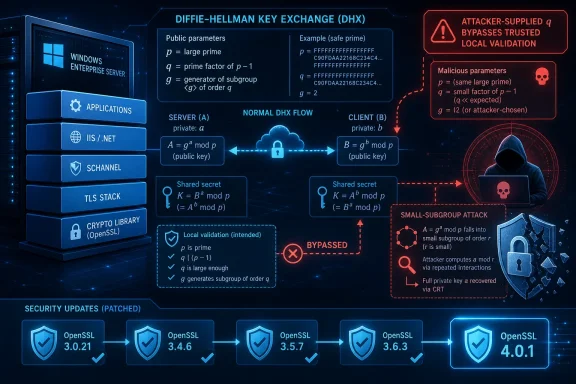
At a high level, the issue is a validation mistake in the EVP_PKEY_derive_set_peer() interface when an application performs a Diffie-Hellman exchange using DHX, OpenSSL’s X9.42-based finite-field Diffie-Hellman key type. The vulnerable code checked whether a remote public value belonged to an expected mathematical subgroup. However, it used the remote key’s supplied q subgroup-order value in that check, while failing to ensure that q matched the local key’s trusted parameters.
That distinction is not cosmetic. In cryptographic protocol design, a public key is never merely a large number. It is a number that must live in the correct group and, more specifically in this case, in the intended subgroup. The subgroup constraint prevents an attacker from forcing a victim’s private exponent into a small and predictable mathematical space.
Microsoft’s Security Update Guide description correctly highlights that exploitation requires conditions outside an attacker’s automatic control. In practical terms, an attacker needs to become a peer in the vulnerable exchange or manipulate the connection so that they can substitute malicious key material. That makes the attack more demanding than a simple unauthenticated network scan, but it does not make the defect theoretical for applications that accept DHX peer keys from untrusted systems.
The key takeaway for Windows environments
For WindowsForum readers, the most important fact is that this is an OpenSSL library vulnerability, not a vulnerability in the Windows Schannel TLS stack. Windows itself relies on its own Cryptography API and Schannel components for the operating system’s native TLS implementation. Nevertheless, OpenSSL is commonly bundled with Windows applications, development tools, network appliances, container workloads, embedded agents, VPN clients, cross-platform servers, and custom line-of-business software.
The exposure question is therefore not “Does my Windows PC use OpenSSL?” It is more precise:
- Does an installed application ship a vulnerable OpenSSL 3.x or 4.0.0 library?
- Does that application directly use DHX/X9.42 finite-field Diffie-Hellman through OpenSSL’s EVP interfaces?
- Can an attacker provide or replace the peer’s public key during a key-establishment operation?
- Are local DH private keys reused across exchanges, allowing repeated observations to expose additional information?
For ordinary desktop users, the answer will usually be no. For enterprises operating bespoke cryptographic services, legacy interoperability systems, hardware-management consoles, secure gateways, certificate infrastructure, or custom Windows server applications, the answer may require deliberate investigation.
Background
Diffie-Hellman key exchange is one of the foundational ideas in modern cryptography. It allows two parties to establish a shared secret over an untrusted network without transmitting that secret directly. The method is conceptually elegant: each party combines a private value with shared public mathematical parameters, exchanges a public result, and independently calculates the same secret.
The security of the exchange depends on more than selecting large numbers. Both participants must agree on safe domain parameters and must verify that the other party’s public value satisfies the requirements of those parameters. If a public value is malformed, belongs to the wrong subgroup, or is crafted to have a deliberately small order, the mathematics that protects the private exponent can collapse into a much smaller search problem.
From classic DH to finite-field cryptography
Classic finite-field Diffie-Hellman operates in the multiplicative group of integers modulo a large prime, conventionally called p. A generator, g, identifies the portion of the group used for the exchange. In configurations with a prime-order subgroup, q represents the subgroup order.
A simplified view looks like this:
- The system defines public domain parameters:
p,q, andg. - Alice chooses a private exponent
aand publishesg^a mod p. - Bob chooses a private exponent
band publishesg^b mod p. - Alice calculates
(g^b)^a mod p. - Bob calculates
(g^a)^b mod p. - Both sides derive the same shared secret.
The real-world implementation includes authentication, key derivation functions, protocol framing, error handling, certificate validation, side-channel protections, and other safeguards. But the central rule remains: the received public value must be validated against the trusted domain parameters.
Why q matters
The parameter q determines the size of the subgroup in which valid public keys should reside. A sound implementation checks that a received public key Y has the correct order relationship, commonly expressed as:
Y^q mod p = 1
That test is meaningful only if q is the legitimate subgroup order for the local key’s domain parameters. If an attacker gets to choose q, they can choose a much smaller value associated with a small subgroup. The validation then becomes a test that the attacker’s malicious value passes under attacker-selected rules.
CVE-2026-42770 is fundamentally a trust-boundary bug. The OpenSSL code performed a mathematically valid calculation, but it relied on a parameter that should have been treated as untrusted input. In security engineering, that is one of the most dangerous categories of implementation failure: a correct check attached to the wrong source of truth.
The Technical Failure
The affected path involves DHX keys, which use the X9.42 representation for finite-field Diffie-Hellman parameters. Unlike older PKCS#3 DH representations that carry p and g but not necessarily q, the DHX format includes the subgroup-order parameter. That provides useful context for stricter validation, but it also creates a new obligation: the implementation must verify that the peer’s supplied parameter set is genuinely the same set expected by the local key.
OpenSSL’s vulnerable behavior performed the subgroup membership test using the peer key’s q. Later checks compared the peer’s p and g against the local private key’s parameters, but did not adequately compare q. Therefore, a peer could present the correct p and g, provide a forged small q, and supply a public value constructed to pass the resulting weak test.
The attacker’s parameter substitution
The attacker does not need to replace every domain parameter. In fact, the exploit condition is more subtle. The attacker reuses the victim’s legitimate p and g, which helps the remote key appear compatible with the local configuration. The attacker then chooses a small prime factor, often described as r, from the cofactor associated with the group.
The forged peer key effectively says: “Use the same prime field and generator, but validate my public value against this smaller subgroup order.” If the victim accepts the altered q, the attacker’s specially constructed public key can fall into a subgroup with only a small number of possible shared-secret outcomes.
That produces leakage. Instead of the shared secret reflecting the full hardness of the victim’s private exponent, the exchange reveals information about that exponent modulo the attacker-selected small factor. Repeating the operation with suitable factors can disclose enough modular residues to reconstruct the private exponent through standard number-theoretic techniques.
Why this is called a small-subgroup attack
A small-subgroup attack exploits the fact that a group can contain subgroups whose orders divide the total group order. If a victim multiplies its secret exponent by a malicious peer public value that has small order, the result can reveal the secret exponent modulo that small order.
Imagine a lock with a million possible combinations, but a malicious test mechanism reveals whether the first digit is one of only five values. One observation does not open the lock. But repeated tests, each designed to reveal different portions of the combination, can reduce the unknowns until the whole secret becomes recoverable.
The cryptographic equivalent is more precise and more powerful. A malicious peer key can make the resulting shared secret belong to a small set of possibilities. By observing or deriving which result occurred, the attacker obtains a congruence such as a mod r. Multiple congruences can be combined, potentially reconstructing the private exponent if enough information is gathered.
Why the Attack Is Not Automatically Easy
The published assessment assigns CVE-2026-42770 a low CVSS severity score, reflecting its high attack complexity and limited direct impact. That rating should be interpreted carefully. “Low” does not mean “irrelevant”; it means the vulnerability does not satisfy the conditions associated with broadly automated, one-shot compromise.
The attacker must generally have an active role in the key establishment. They may need to impersonate a peer, operate a malicious server, control a peer device, inject themselves into the logical path between the client and server, or exploit an application protocol that accepts untrusted DHX public keys without sufficient authentication.
Authentication changes the threat model
Properly authenticated protocols are harder to attack because an attacker cannot simply replace peer key material without also defeating the authentication layer. For example, a well-designed protocol might sign the key exchange, bind it to an authenticated certificate, and reject changes made by an intermediary.
However, cryptographic implementations cannot assume that every caller has built the protocol correctly. OpenSSL’s EVP interfaces are deliberately general-purpose. They are used in contexts beyond mainstream TLS, including custom protocols, machine-to-machine systems, proprietary secure channels, hardware-management workflows, and interoperability layers.
A library-level defect matters because applications may depend on the library to enforce basic key validity. If the library validates the wrong parameter set, a developer can write what appears to be defensible code and still inherit a flaw below the application’s abstraction boundary.
Reuse makes the exposure more serious
The impact improves for an attacker when the victim reuses the same DH private key across multiple exchanges. Reuse allows the attacker to collect multiple residues related to the same secret exponent. If every exchange uses a fresh ephemeral private key and the application correctly disposes of it, leakage from one exchange does not directly reveal the next private key.
That does not eliminate all risk. A transient private key can still protect a sensitive session, and an attacker may have enough interaction opportunities to exploit a repeatedly used key in a poorly designed service. But it is an important differentiator when triaging real systems.
No evidence of broad exploitation
As of July 21, 2026, public vulnerability tracking data does not indicate known exploitation of CVE-2026-42770 in the wild. The available assessment also characterizes exploitation as not readily automatable. Organizations should welcome that context while still patching affected software; absence of known exploitation is not evidence that a targeted attacker cannot use the flaw in a suitable environment.
Affected OpenSSL Releases
OpenSSL addressed CVE-2026-42770 in the coordinated June 9, 2026 release set. The fixed versions are:
- OpenSSL 3.0.21 for the 3.0 long-term-support branch.
- OpenSSL 3.4.6 for the 3.4 branch.
- OpenSSL 3.5.7 for the 3.5 branch.
- OpenSSL 3.6.3 for the 3.6 branch.
- OpenSSL 4.0.1 for the 4.0 branch.
The vulnerable range begins with OpenSSL 3.0.0. Organizations using the now older 3.0 branch should note that its scheduled support horizon ends in September 2026. Updating to 3.0.21 resolves this specific issue, but maintaining an aging branch indefinitely creates a recurring operational problem as future advisories arrive.
The FIPS nuance
One notable aspect of CVE-2026-42770 is that it is listed as relevant to OpenSSL’s FIPS provider. That deserves attention from regulated organizations because FIPS mode is often mistakenly treated as a universal shield against implementation mistakes.
FIPS validation is important, but it is not a substitute for timely vulnerability management. A validated module can implement approved algorithms while a defect exists in how a caller invokes a supported operation or how an interface binds untrusted inputs to trusted parameters. Organizations with FIPS requirements should update according to their vendor’s supported package path and document the remediation in their cryptographic module governance process.
Why branches matter on Windows
Windows deployments frequently obtain OpenSSL through another product rather than from OpenSSL directly. A vendor may statically link the library into an executable, bundle its own DLLs, place a private copy beside a service binary, or ship a complete runtime environment inside a development tool or appliance-management application.
This means that Windows Update alone may not remediate the problem. The required update normally comes from the application vendor, package maintainer, container image publisher, or internal development team responsible for the product that embedded OpenSSL.
Windows Exposure: What Is and Is Not at Risk
The CVE title can create understandable confusion for Windows users because Microsoft’s vulnerability portal carries an entry for the issue. That should not be read as confirmation that Windows’ native TLS stack is affected.
CVE-2026-42770 is primarily an OpenSSL issue. The relevant vulnerable component is OpenSSL’s finite-field DHX peer-validation implementation, not Schannel, Windows CryptoAPI, Microsoft Edge’s cryptography stack, or the standard Windows TLS plumbing used by most first-party services.
Consumer Windows systems
Most consumer PCs are unlikely to face a practical direct risk from this CVE. Modern browsers and mainstream consumer applications generally use TLS stacks and key-exchange mechanisms that do not map to the vulnerable DHX API path. TLS 1.3, for example, uses different key-agreement designs and does not negotiate legacy finite-field DHX through this OpenSSL interface.
Still, consumers who install developer tools, self-hosting platforms, VPN products, cryptocurrency-related software, network utilities, or open-source server packages should not assume that a Windows machine is unaffected simply because Windows itself is not the vulnerable vendor. A third-party application can bring its own cryptographic library.
Enterprise Windows systems
Enterprise exposure is more plausible, particularly where Windows hosts run cross-platform software. Examples include:
- Custom Windows services that use OpenSSL directly for device enrollment, secure messaging, or proprietary key establishment.
- Java, Python, Node.js, PHP, Ruby, or C/C++ application stacks that bundle native dependencies or invoke OpenSSL-adjacent components.
- Containerized workloads running Linux userlands on Windows Server hosts, Kubernetes nodes, or developer workstations.
- Network-management applications that communicate with older appliances, industrial systems, or specialized hardware using nonstandard cryptographic protocols.
- Security products and VPN gateways that maintain private OpenSSL copies rather than using a centrally managed operating-system library.
The most exposed systems are not necessarily the newest or largest. They are the systems where a protocol was implemented years ago, rarely revisited, and designed around static finite-field DH parameters for interoperability.
Finding the Vulnerable Dependency
The immediate challenge is software inventory. A version check is only useful after an organization identifies which OpenSSL instances actually exist. This is harder on Windows than it sounds because an application can use a shared DLL, bundle a renamed library, statically link OpenSSL, or include it inside a container or installation archive.
A mature response starts with asset discovery rather than manually checking one openssl.exe command output on an administrator workstation.
A practical investigation sequence
- Inventory externally reachable and cryptography-sensitive applications. Prioritize internet-facing services, remote-access systems, identity platforms, device-management servers, secure messaging products, and proprietary middleware.
- Identify vendor-bundled OpenSSL components. Review software bills of materials, endpoint-management inventories, vulnerability-scanner findings, product release notes, and installation directories for OpenSSL DLLs or library references.
- Ask vendors about DHX exposure specifically. A vulnerable OpenSSL version alone does not establish exploitability. The decisive question is whether the product invokes DHX/X9.42 peer derivation through the affected OpenSSL APIs.
- Patch to the corrected vendor release. Prefer a supported vendor package rather than dropping a replacement DLL into an application directory. ABI compatibility, FIPS configuration, service startup behavior, and code-signing expectations can all complicate an ad hoc library replacement.
- Validate after deployment. Confirm that the updated binary or package is loaded by the running service, restart services during an approved window, and review telemetry for failed key exchanges or unexpected interoperability regressions.
Static linking complicates scanning
A static build does not necessarily expose an obvious libcrypto DLL or OpenSSL version string. Software composition analysis products can help, but organizations should also interrogate vendors and examine build records for internally developed software.
The operational lesson is broader than this CVE: cryptographic libraries must be treated as first-class dependencies. Teams often track application frameworks and operating-system patches carefully while overlooking the crypto toolkit compiled into a service years earlier.
Mitigation Before Patching
Updating OpenSSL is the preferred remediation. If an immediate update is impossible because of vendor certification, change-control timing, or compatibility testing, organizations can reduce exposure by narrowing the conditions that make the attack viable.
The OpenSSL guidance for this issue identifies a direct application-level workaround: compare remote and local parameters with EVP_PKEY_parameters_eq() before performing the key exchange. This is especially relevant to developers maintaining applications that deliberately use DHX keys.
Defensive measures for application developers
A secure application design should ensure that the peer’s domain parameters do not silently redefine the local cryptographic policy. The local application must establish what parameters are trusted and reject a peer whose parameters fail to match.
Developers should consider the following controls:
- Use patched OpenSSL versions whenever possible, because application workarounds should not become permanent substitutes for a corrected dependency.
- Compare the full domain parameter set before invoking the derive operation, including the subgroup order where applicable.
- Use named, modern groups where protocol and interoperability requirements permit, reducing the complexity of custom parameter handling.
- Avoid long-term reuse of finite-field DH private exponents, particularly when the protocol allows remote peers to initiate repeated exchanges.
- Authenticate key exchanges and bind the exchange transcript to the authenticated identity, preventing an active intermediary from replacing public values.
- Fail closed on parameter-validation errors, rather than silently retrying with relaxed checks or alternate legacy paths.
Network containment is helpful but incomplete
Network segmentation, mutual authentication, certificate pinning, and strict peer allowlists reduce the likelihood that an attacker can become a malicious key-exchange participant. They are sensible compensating controls, especially for internal control networks or appliance-management services.
But these measures do not correct the underlying cryptographic validation failure. A compromised authorized peer, a malicious insider with valid network access, or a protocol-level impersonation flaw elsewhere in the stack could still create the conditions for exploitation. Patch planning should therefore proceed even when temporary mitigations are in place.
Why This Matters Beyond DHX
DHX is a niche technology compared with mainstream elliptic-curve key exchange, TLS 1.3, and contemporary hybrid post-quantum migration efforts. It would be easy to dismiss CVE-2026-42770 as an edge-case defect in an aging branch of cryptographic functionality.
That would miss its value as a case study. The vulnerability illustrates why cryptographic APIs need clear ownership rules for every parameter involved in a calculation. A mathematical validation check has no security value if an attacker can influence the criteria used to validate themselves.
The parameter-binding principle
Security-critical code needs to distinguish between:
- Trusted local policy, including the approved domain parameters, algorithms, and group selections.
- Untrusted peer input, including public keys, certificates, negotiation messages, and claimed parameter sets.
- Authenticated context, including which identity is permitted to use which policy and whether the exchange transcript is bound to that identity.
CVE-2026-42770 blurred the first two categories. The peer’s q should have been treated as a claim to compare against the local configuration, not as an authority for deciding whether the peer’s key belonged to the required subgroup.
The challenge of flexible cryptographic APIs
General-purpose libraries are valuable because they support legacy protocols, regulated deployments, custom key formats, hardware security modules, and applications that need more than a browser-grade TLS connection. Flexibility, however, expands the number of ways an application can misbind inputs and assumptions.
The industry trend toward named groups, high-level protocol APIs, and opinionated defaults is partly a response to this problem. Every time developers manually transport primes, generators, subgroup orders, and raw public integers across application boundaries, they inherit a large amount of cryptographic validation responsibility.
Strengths and Opportunities
CVE-2026-42770 arrives with several factors that make a disciplined remediation effort practical.
- The affected code path is relatively specialized. Most organizations can prioritize systems using custom DHX/X9.42 exchanges rather than treating every OpenSSL deployment as equally exposed.
- Fixed releases are already available across active branches. Organizations have a clear upgrade destination for OpenSSL 3.0, 3.4, 3.5, 3.6, and 4.0 deployments.
- The vulnerability has a concrete application-level workaround. Developers who cannot immediately update can compare peer and local parameters before deriving a shared secret.
- The public technical description is unusually specific. Security teams can ask vendors focused questions about DHX usage, peer-key handling, exponent reuse, and the relevant EVP interface.
- The issue can improve dependency governance. Using this event to identify bundled and statically linked cryptographic libraries will reduce response time for future OpenSSL advisories.
- Modernization can reduce long-term risk. Where business requirements allow, retiring bespoke finite-field DH configurations in favor of modern, well-supported protocol stacks can eliminate entire categories of parameter-management errors.
Risks and Concerns
The vulnerability’s low numerical severity should not encourage underestimation of cryptographic key exposure.
- Private-key leakage is qualitatively serious. The flaw is not a simple availability issue; successful exploitation can reveal information about a secret exponent used in key establishment.
- Repeated interaction may be sufficient. A determined attacker who can repeatedly trigger exchanges against a reused private key can accumulate the modular information needed for recovery.
- Custom protocols are hard to inventory. The most likely affected implementations may be undocumented, vendor-specific, or deployed in environments with limited software composition data.
- FIPS environments may face slower remediation. Compliance requirements, vendor support matrices, and validation constraints can make cryptographic library updates more operationally complex.
- A patched library does not fix unsafe protocol design. Applications that accept unauthenticated peer keys, reuse long-term DH secrets, or use weak legacy parameter sets may retain other risks after the update.
- Windows hosts can conceal the dependency. Bundled DLLs, private runtimes, containers, and static linking can leave vulnerable code in place even after administrators update a separately installed OpenSSL command-line package.
What to Watch Next
The near-term task is straightforward: watch for vendor advisories and updated packages that incorporate OpenSSL 3.0.21, 3.4.6, 3.5.7, 3.6.3, or 4.0.1. Product teams should be ready for vendor notices that do not prominently mention “DHX” or “X9.42,” since many vendors summarize fixes only by CVE number or bundled OpenSSL version.
Security teams should also monitor whether additional research turns this vulnerability from a high-complexity cryptographic condition into a more repeatable exploit pattern against specific protocols. The public record currently does not show known exploitation, but attack practicality can change when researchers identify common applications that reuse keys, expose a suitable oracle, or permit malicious peer negotiation.
Questions enterprises should ask vendors
Vendor outreach should go beyond “Are you vulnerable?” The more useful questions are:
- Does the product include OpenSSL in an affected version range?
- Does the product use DHX or X9.42 finite-field Diffie-Hellman key exchange?
- Can an untrusted remote peer supply the DHX public key used with
EVP_PKEY_derive_set_peer()? - Are local DH private keys reused across multiple sessions or requests?
- Does the product authenticate and bind the key exchange to the peer identity?
- Which released or planned version includes the corrected OpenSSL dependency?
- Are there required configuration changes, service restarts, or FIPS-specific instructions after upgrading?
A broader modernization signal
This CVE also fits into a wider transition in enterprise cryptography. Organizations are simultaneously retiring obsolete protocol versions, reducing dependence on hand-assembled cryptographic primitives, adopting stronger defaults, and preparing for post-quantum cryptography. The immediate reason to update is a peer-validation defect; the strategic reason is to reduce dependence on fragile, custom key-agreement paths that are difficult to test and even harder to audit.
Looking Ahead
CVE-2026-42770 will probably not become a household-name vulnerability, and for many Windows users it will never create a visible incident. Its importance lies elsewhere: it demonstrates how a single parameter-comparison omission can invalidate a foundational cryptographic guarantee. The remediation is clear—identify affected OpenSSL deployments, update to the corrected release supplied by the relevant vendor, and review any application that performs DHX key establishment against untrusted peers. For Windows enterprises in particular, this is an opportunity to look past the operating system patch level, uncover the cryptographic libraries embedded in their application estate, and ensure that trusted local security policy is never silently replaced by data supplied by the party being validated.
References
- CVE-2026-42770 FFC-DH Peer Validation Uses Attacker-Supplied q MSRC · 2026-07-21T01:05:50-07:00