

Microsoft has listed CVE-2026-42824 as an M365 Copilot information disclosure vulnerability in the Security Update Guide, describing a flaw whose practical risk turns less on code execution than on whether Copilot can be induced to expose data it should not reveal. That phrasing matters because Copilot is not a single executable sitting on a desktop; it is a cloud-connected assistant wired into Microsoft 365 identity, files, email, chat, search, and permissions. The vulnerability is therefore less a traditional Windows patch story than a warning about the new security boundary Microsoft is asking enterprises to trust. In the Copilot era, “information disclosure” is becoming the category where the most uncomfortable AI security questions are being filed.
For years, enterprise software security had a familiar rhythm. A vendor disclosed a CVE, administrators checked whether they owned the affected product, patches were staged, dashboards turned green, and everyone moved on to the next Tuesday. That workflow was never perfect, but it assumed a relatively stable relationship between software, data, and exploitability.
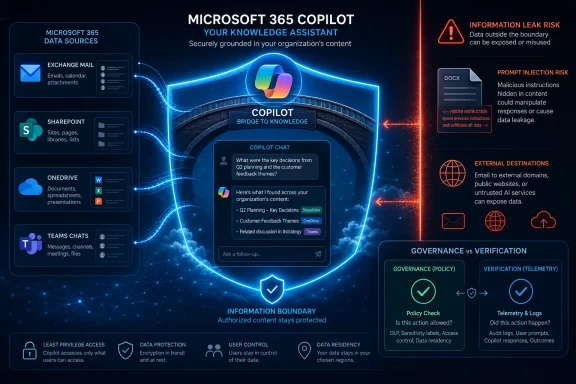
M365 Copilot scrambles that relationship. It is not merely another Office feature with a vulnerable DLL or a misbehaving web endpoint. It is an orchestration layer that retrieves organizational context, interprets user prompts, reasons over content, and generates answers from material scattered across Exchange, SharePoint, OneDrive, Teams, and Microsoft Graph.
That makes the words “information disclosure vulnerability” unusually loaded. In an ordinary application, disclosure might mean a file path, a token, a memory fragment, or a document that can be accessed through a broken authorization check. In Copilot, disclosure can mean the assistant itself becomes the delivery mechanism for information a user, attacker, or prompt should not have been able to surface.
The result is a security category that feels deceptively mild. No ransomware detonates. No domain controller falls over. No exploit chain necessarily ends in shell access. Yet the thing at risk is often the entire reason an enterprise hesitated before deploying generative AI in the first place: sensitive business context leaking through a system explicitly designed to understand and summarize sensitive business context.
That ambiguity leaves administrators in an awkward position. They need to answer practical questions — whether their tenants were exposed, whether logs show suspicious activity, whether compensating controls helped, and whether users need guidance — but the advisory language may not give them enough detail to model the attack precisely.
The user-facing metric text attached to this kind of vulnerability record is useful precisely because it acknowledges this gap. Microsoft’s own scoring framework distinguishes between a vulnerability whose existence is merely publicized, one whose technical details are partially corroborated, and one confirmed by the vendor or author of the affected technology. In plain English: confidence is not just about whether a bug exists, but about how much the world knows about how it works.
That distinction is crucial for Copilot vulnerabilities. Attackers do not need a traditional exploit kit if the core weakness involves prompt handling, retrieval boundaries, downstream interpretation, or unintended disclosure through generated output. Technical detail can become weaponizable very quickly because the “payload” may look less like shellcode and more like a carefully crafted instruction embedded in content that Copilot later reads.
Generative AI systems do not eliminate those classes, but they add a new layer of interpretation. A model is not just processing input; it is absorbing instructions, context, formatting, hidden text, retrieved documents, policy constraints, user intent, and tool outputs into a single interaction. That gives attackers new places to hide influence.
The unsettling part is that many AI disclosure bugs look like normal product behavior until they do not. Copilot is supposed to summarize documents. It is supposed to answer questions from enterprise data. It is supposed to reason across mail, meetings, files, and chats. The line between helpful retrieval and improper disclosure can be thin, especially when organizations have years of overshared SharePoint sites, permissive Teams channels, stale guest access, and inconsistent sensitivity labels.
That is why information disclosure in Copilot cannot be dismissed as a second-tier vulnerability class. If the assistant can be steered into revealing confidential data from a user’s reachable context, the attacker may not need to breach the data store directly. They can attack the interface that speaks on the data store’s behalf.
A human employee with access to ten documents may understand that one is confidential, one is draft legal strategy, and one is an obsolete planning memo. A language model sees a context window, retrieval results, system instructions, policies, and a user request. The product’s safety architecture must bridge that gap.
That bridge is where CVEs like CVE-2026-42824 become important. The vulnerability is not interesting merely because it carries a Microsoft identifier. It is interesting because it points to a class of failures that enterprise AI vendors will have to spend years hardening: the boundary between authorized retrieval and safe disclosure.
For administrators, this means “Copilot respects permissions” should be read as the beginning of a control discussion, not the end. If permissions are messy, Copilot may make the mess more visible. If prompts or embedded content can influence output in unexpected ways, permissions alone may not prevent exposure. If downstream components consume generated output unsafely, a harmless-looking response can become part of a larger attack surface.
But cloud fixes also make customer assurance harder. If the vulnerable code lived in Microsoft’s service, administrators may not receive a familiar KB number, patch binary, or local version check. They may see a Security Update Guide entry, perhaps a tenant notification if Microsoft determines impact, and a general statement that the issue has been addressed.
That is operationally efficient but emotionally unsatisfying for security teams. The question “are we patched?” becomes “has Microsoft remediated the service for our tenant, and do we have enough telemetry to know whether anything happened before that remediation?” Those are harder questions to answer from inside a customer environment.
This is the direction enterprise software has been moving for a decade, but AI makes the stakes sharper. With Copilot, the service is not just hosting mailboxes or documents. It is mediating access to knowledge. If a disclosure vulnerability exists, the incident response questions quickly become qualitative: what could the assistant have seen, what could it have said, and who could have caused it to say that?
But CVSS can flatten the business reality of AI assistants. A medium-scored bug in a niche utility may be less urgent than a similarly scored issue in a system connected to a company’s entire document corpus. In the Copilot world, deployment context changes everything.
A successful disclosure attack against Copilot may expose material that was technically accessible to someone but practically buried. It may turn a weak permission model into an easy natural-language search interface for sensitive data. It may surface internal strategy, regulated information, legal communications, credentials accidentally pasted into files, or proprietary engineering notes. The score may say “information disclosure,” but the organization hears “knowledge spill.”
That is not an argument to panic over every Copilot CVE. It is an argument to stop reading AI vulnerability severity as if the affected component were a standalone app. Copilot’s value proposition is reach. Its risk follows the same path.
SharePoint sites with broad access, Teams channels created for temporary projects, old OneDrive links, inherited folder permissions, abandoned groups, and inconsistent data labeling all become more consequential when users can ask an assistant to find and summarize information across them. Copilot does not need to break the rules to make bad rules painful.
A vulnerability adds an adversarial layer to that problem. If Copilot can be manipulated into disclosing information across a network, then the difference between “overshared internally” and “leaked externally” becomes the quality of Microsoft’s defenses, tenant configuration, and the attacker’s path into the interaction.
This is why security teams should treat CVE-2026-42824 as a prompt to audit assumptions, not merely as a resolved item in a feed. The question is not only whether Microsoft fixed this particular issue. The deeper question is whether the tenant is prepared for the next one.
Prompt injection is the Copilot-era version of that tension. The term can sound abstract, but the concept is simple enough. If an AI assistant treats untrusted content as instructions rather than data, an attacker may be able to influence what the assistant does or reveals.
In a consumer chatbot, that might produce embarrassing output. In an enterprise assistant connected to Microsoft Graph, the stakes are higher. A malicious instruction embedded in a document, email, meeting invite, web page, or shared file may be encountered later by a user’s AI assistant. The user may never perceive the malicious content directly; the assistant becomes the interpreter.
That does not mean every Copilot information disclosure flaw is prompt injection. It does mean the security community now has to think in terms of instruction channels, context contamination, retrieval trust, and output handling. Those are not exotic research concerns anymore. They are product security concerns inside mainstream business software.
It also means Microsoft’s AI security decisions become de facto enterprise standards. When Microsoft designs a retrieval boundary, millions of users inherit that design. When it fixes a Copilot disclosure vulnerability service-side, thousands of administrators may have to trust that the fix landed. When it describes a flaw in abstract terms, the whole ecosystem reads between the lines.
This is not unique to Microsoft in principle. Google, Salesforce, ServiceNow, Adobe, Atlassian, and others are all embedding AI into systems that hold enterprise data. But Microsoft’s footprint across Windows, Office, Entra ID, Defender, Purview, SharePoint, Exchange, Teams, and Azure makes its version of the problem especially consequential.
WindowsForum readers will recognize the pattern. Microsoft rarely introduces a new platform capability without eventually turning it into an administrative discipline. Group Policy, Intune, Defender, Conditional Access, Purview, and now Copilot governance all follow the same arc: initial excitement, messy deployment reality, security incidents, then a long period of tooling catch-up.
But administrators should translate governance into verification. It is not enough to have labels; teams need to know whether labels are applied consistently and enforced in the contexts Copilot uses. It is not enough to have DLP policies; teams need to know whether those policies affect AI retrieval and summarization as expected. It is not enough to trust permissions; teams need to test what users can actually surface through Copilot.
This is where red-team style validation becomes practical rather than theatrical. Security teams should create benign test data, apply different labels and permissions, and ask Copilot targeted questions from accounts with different roles. They should test stale access, guest scenarios, project groups, executive content, HR material, legal folders, and confidential mail patterns.
The aim is not to trick Copilot for sport. The aim is to discover whether the assistant’s behavior matches the organization’s mental model. CVE-2026-42824 is a reminder that the product’s actual behavior is the only model that counts.
If an information disclosure vulnerability affects an AI assistant, investigators need to understand which users interacted with the system, what prompts were submitted, what content was retrieved, what responses were generated, whether external content influenced the exchange, and whether any generated output left the tenant. Some of that telemetry may be available. Some may be restricted, incomplete, expensive, or retained for too short a period.
This is where administrators should press vendors for better auditability. AI assistants that operate over enterprise data should produce enterprise-grade logs. Security teams need more than a post-fix assurance that a cloud service was remediated. They need enough evidence to scope exposure when something goes wrong.
The Windows world has learned this lesson repeatedly. Event logs improved because administrators needed them. Defender telemetry improved because security teams demanded it. Cloud audit logs became table stakes because SaaS incidents made blind trust unacceptable. AI assistants will go through the same evolution, and CVEs like this accelerate the demand.
Copilot adoption should be a security maturity test. If an organization cannot answer who has access to sensitive SharePoint sites, which Teams are externally shared, whether confidential labels are reliable, how guest access is governed, and what Copilot audit logs are retained, then the organization is not ready to treat AI assistance as a neutral productivity layer.
This does not mean enterprises should freeze AI deployment indefinitely. It means Copilot should be rolled out with the same seriousness once reserved for email, identity, and endpoint management. The assistant is becoming part of the business operating system. That status deserves controls proportional to its reach.
CVE-2026-42824 therefore lands in a moment when many organizations are still shifting from AI experimentation to AI operations. The vulnerability is not just another item for a security bulletin. It is a stress test of whether enterprises have updated their mental model for what Microsoft 365 now is.
 Microsoft’s Copilot Problem Is No Longer Theoretical
For years, enterprise software security had a familiar rhythm. A vendor disclosed a CVE, administrators checked whether they owned the affected product, patches were staged, dashboards turned green, and everyone moved on to the next Tuesday. That workflow was never perfect, but it assumed a relatively stable relationship between software, data, and exploitability.M365 Copilot scrambles that relationship. It is not merely another Office feature with a vulnerable DLL or a misbehaving web endpoint. It is an orchestration layer that retrieves organizational context, interprets user prompts, reasons over content, and generates answers from material scattered across Exchange, SharePoint, OneDrive, Teams, and Microsoft Graph.
That makes the words “information disclosure vulnerability” unusually loaded. In an ordinary application, disclosure might mean a file path, a token, a memory fragment, or a document that can be accessed through a broken authorization check. In Copilot, disclosure can mean the assistant itself becomes the delivery mechanism for information a user, attacker, or prompt should not have been able to surface.
The result is a security category that feels deceptively mild. No ransomware detonates. No domain controller falls over. No exploit chain necessarily ends in shell access. Yet the thing at risk is often the entire reason an enterprise hesitated before deploying generative AI in the first place: sensitive business context leaking through a system explicitly designed to understand and summarize sensitive business context.
The CVE Record Says Less Than Administrators Want, And That Is Part of the Story
The public description of CVE-2026-42824 is sparse, and sparse advisories are not unusual in Microsoft’s ecosystem. Vendors routinely limit technical detail at disclosure time to avoid handing attackers a reproducible recipe before mitigations are fully deployed. With cloud services, the situation becomes even murkier because the fix may happen inside Microsoft’s infrastructure rather than through a customer-installed patch.That ambiguity leaves administrators in an awkward position. They need to answer practical questions — whether their tenants were exposed, whether logs show suspicious activity, whether compensating controls helped, and whether users need guidance — but the advisory language may not give them enough detail to model the attack precisely.
The user-facing metric text attached to this kind of vulnerability record is useful precisely because it acknowledges this gap. Microsoft’s own scoring framework distinguishes between a vulnerability whose existence is merely publicized, one whose technical details are partially corroborated, and one confirmed by the vendor or author of the affected technology. In plain English: confidence is not just about whether a bug exists, but about how much the world knows about how it works.
That distinction is crucial for Copilot vulnerabilities. Attackers do not need a traditional exploit kit if the core weakness involves prompt handling, retrieval boundaries, downstream interpretation, or unintended disclosure through generated output. Technical detail can become weaponizable very quickly because the “payload” may look less like shellcode and more like a carefully crafted instruction embedded in content that Copilot later reads.
AI Has Turned Information Disclosure Into An Execution Path
Classic vulnerability taxonomies were built for software that followed relatively deterministic paths. Inputs were parsed, permissions were checked, memory was allocated, and outputs were returned. Bugs happened when those mechanisms failed in recognizable ways: buffer overflows, injection flaws, cross-site scripting, path traversal, broken access control.Generative AI systems do not eliminate those classes, but they add a new layer of interpretation. A model is not just processing input; it is absorbing instructions, context, formatting, hidden text, retrieved documents, policy constraints, user intent, and tool outputs into a single interaction. That gives attackers new places to hide influence.
The unsettling part is that many AI disclosure bugs look like normal product behavior until they do not. Copilot is supposed to summarize documents. It is supposed to answer questions from enterprise data. It is supposed to reason across mail, meetings, files, and chats. The line between helpful retrieval and improper disclosure can be thin, especially when organizations have years of overshared SharePoint sites, permissive Teams channels, stale guest access, and inconsistent sensitivity labels.
That is why information disclosure in Copilot cannot be dismissed as a second-tier vulnerability class. If the assistant can be steered into revealing confidential data from a user’s reachable context, the attacker may not need to breach the data store directly. They can attack the interface that speaks on the data store’s behalf.
The Security Boundary Is Now Part Policy, Part Prompt, Part Product Design
Microsoft has repeatedly positioned M365 Copilot as respecting existing Microsoft 365 permissions. That is the right baseline, and it is also not enough to settle the security question. Permissions define what data a user or service may access; they do not fully define how an AI assistant should combine, summarize, transform, or expose that data under adversarial conditions.A human employee with access to ten documents may understand that one is confidential, one is draft legal strategy, and one is an obsolete planning memo. A language model sees a context window, retrieval results, system instructions, policies, and a user request. The product’s safety architecture must bridge that gap.
That bridge is where CVEs like CVE-2026-42824 become important. The vulnerability is not interesting merely because it carries a Microsoft identifier. It is interesting because it points to a class of failures that enterprise AI vendors will have to spend years hardening: the boundary between authorized retrieval and safe disclosure.
For administrators, this means “Copilot respects permissions” should be read as the beginning of a control discussion, not the end. If permissions are messy, Copilot may make the mess more visible. If prompts or embedded content can influence output in unexpected ways, permissions alone may not prevent exposure. If downstream components consume generated output unsafely, a harmless-looking response can become part of a larger attack surface.
The Patch Model Is Cleaner For Microsoft Than For Its Customers
Cloud-first security updates create a peculiar asymmetry. Microsoft can fix service-side vulnerabilities quickly and, in many cases, without asking customers to deploy anything. That is good news compared with the old world of unpatched servers lingering for years behind brittle change-control processes.But cloud fixes also make customer assurance harder. If the vulnerable code lived in Microsoft’s service, administrators may not receive a familiar KB number, patch binary, or local version check. They may see a Security Update Guide entry, perhaps a tenant notification if Microsoft determines impact, and a general statement that the issue has been addressed.
That is operationally efficient but emotionally unsatisfying for security teams. The question “are we patched?” becomes “has Microsoft remediated the service for our tenant, and do we have enough telemetry to know whether anything happened before that remediation?” Those are harder questions to answer from inside a customer environment.
This is the direction enterprise software has been moving for a decade, but AI makes the stakes sharper. With Copilot, the service is not just hosting mailboxes or documents. It is mediating access to knowledge. If a disclosure vulnerability exists, the incident response questions quickly become qualitative: what could the assistant have seen, what could it have said, and who could have caused it to say that?
CVSS Was Not Built For The Copilot Blast Radius
Traditional severity scoring is still useful. Attack vector, privileges required, user interaction, confidentiality impact, integrity impact, and availability impact all matter. A network-reachable disclosure flaw with no required privileges is plainly different from a local issue requiring an already compromised account.But CVSS can flatten the business reality of AI assistants. A medium-scored bug in a niche utility may be less urgent than a similarly scored issue in a system connected to a company’s entire document corpus. In the Copilot world, deployment context changes everything.
A successful disclosure attack against Copilot may expose material that was technically accessible to someone but practically buried. It may turn a weak permission model into an easy natural-language search interface for sensitive data. It may surface internal strategy, regulated information, legal communications, credentials accidentally pasted into files, or proprietary engineering notes. The score may say “information disclosure,” but the organization hears “knowledge spill.”
That is not an argument to panic over every Copilot CVE. It is an argument to stop reading AI vulnerability severity as if the affected component were a standalone app. Copilot’s value proposition is reach. Its risk follows the same path.
The Real Exposure Often Starts Before The Vulnerability
One uncomfortable truth about Copilot security is that many organizations were already exposed before any CVE appeared. Not necessarily to an external attacker, but to their own internal data sprawl. Copilot’s ability to retrieve and synthesize enterprise content can reveal that the real problem was not the AI model; it was years of permissive collaboration defaults.SharePoint sites with broad access, Teams channels created for temporary projects, old OneDrive links, inherited folder permissions, abandoned groups, and inconsistent data labeling all become more consequential when users can ask an assistant to find and summarize information across them. Copilot does not need to break the rules to make bad rules painful.
A vulnerability adds an adversarial layer to that problem. If Copilot can be manipulated into disclosing information across a network, then the difference between “overshared internally” and “leaked externally” becomes the quality of Microsoft’s defenses, tenant configuration, and the attacker’s path into the interaction.
This is why security teams should treat CVE-2026-42824 as a prompt to audit assumptions, not merely as a resolved item in a feed. The question is not only whether Microsoft fixed this particular issue. The deeper question is whether the tenant is prepared for the next one.
Prompt Injection Has Become The New Macro Warning
Veteran Windows administrators have seen this movie before. Macros were once sold as productivity glue, then became one of the most abused delivery mechanisms in enterprise security. PowerShell was built for administration, then became an attacker favorite because it was powerful, trusted, and already present. Office add-ins, browser extensions, and OAuth consent flows all followed the same pattern: convenience expands the attack surface.Prompt injection is the Copilot-era version of that tension. The term can sound abstract, but the concept is simple enough. If an AI assistant treats untrusted content as instructions rather than data, an attacker may be able to influence what the assistant does or reveals.
In a consumer chatbot, that might produce embarrassing output. In an enterprise assistant connected to Microsoft Graph, the stakes are higher. A malicious instruction embedded in a document, email, meeting invite, web page, or shared file may be encountered later by a user’s AI assistant. The user may never perceive the malicious content directly; the assistant becomes the interpreter.
That does not mean every Copilot information disclosure flaw is prompt injection. It does mean the security community now has to think in terms of instruction channels, context contamination, retrieval trust, and output handling. Those are not exotic research concerns anymore. They are product security concerns inside mainstream business software.
Microsoft’s Scale Makes Copilot Vulnerabilities Everyone’s Problem
Microsoft has an advantage that few vendors can match: Copilot sits where work already happens. It is integrated into the productivity suite that many enterprises use by default. That distribution gives Microsoft enormous power to normalize AI assistance across business workflows.It also means Microsoft’s AI security decisions become de facto enterprise standards. When Microsoft designs a retrieval boundary, millions of users inherit that design. When it fixes a Copilot disclosure vulnerability service-side, thousands of administrators may have to trust that the fix landed. When it describes a flaw in abstract terms, the whole ecosystem reads between the lines.
This is not unique to Microsoft in principle. Google, Salesforce, ServiceNow, Adobe, Atlassian, and others are all embedding AI into systems that hold enterprise data. But Microsoft’s footprint across Windows, Office, Entra ID, Defender, Purview, SharePoint, Exchange, Teams, and Azure makes its version of the problem especially consequential.
WindowsForum readers will recognize the pattern. Microsoft rarely introduces a new platform capability without eventually turning it into an administrative discipline. Group Policy, Intune, Defender, Conditional Access, Purview, and now Copilot governance all follow the same arc: initial excitement, messy deployment reality, security incidents, then a long period of tooling catch-up.
The Vendor Message Is Governance; The Admin Message Is Verification
Microsoft’s preferred answer to Copilot risk is governance. Use least privilege. Configure sensitivity labels. Deploy Purview. Review sharing. Monitor activity. Educate users. Keep the service current. Those are good recommendations, and they are not merely marketing. In a Copilot environment, governance controls genuinely matter.But administrators should translate governance into verification. It is not enough to have labels; teams need to know whether labels are applied consistently and enforced in the contexts Copilot uses. It is not enough to have DLP policies; teams need to know whether those policies affect AI retrieval and summarization as expected. It is not enough to trust permissions; teams need to test what users can actually surface through Copilot.
This is where red-team style validation becomes practical rather than theatrical. Security teams should create benign test data, apply different labels and permissions, and ask Copilot targeted questions from accounts with different roles. They should test stale access, guest scenarios, project groups, executive content, HR material, legal folders, and confidential mail patterns.
The aim is not to trick Copilot for sport. The aim is to discover whether the assistant’s behavior matches the organization’s mental model. CVE-2026-42824 is a reminder that the product’s actual behavior is the only model that counts.
Incident Response Needs An AI Column
Most organizations still handle AI incidents as a subcategory of cloud incidents, data incidents, or endpoint incidents. That will not hold. Copilot and similar tools require incident response teams to ask new questions that do not fit neatly into old forms.If an information disclosure vulnerability affects an AI assistant, investigators need to understand which users interacted with the system, what prompts were submitted, what content was retrieved, what responses were generated, whether external content influenced the exchange, and whether any generated output left the tenant. Some of that telemetry may be available. Some may be restricted, incomplete, expensive, or retained for too short a period.
This is where administrators should press vendors for better auditability. AI assistants that operate over enterprise data should produce enterprise-grade logs. Security teams need more than a post-fix assurance that a cloud service was remediated. They need enough evidence to scope exposure when something goes wrong.
The Windows world has learned this lesson repeatedly. Event logs improved because administrators needed them. Defender telemetry improved because security teams demanded it. Cloud audit logs became table stakes because SaaS incidents made blind trust unacceptable. AI assistants will go through the same evolution, and CVEs like this accelerate the demand.
Copilot Adoption Now Carries A Security Maturity Test
The easiest mistake is to treat Copilot deployment as a license assignment exercise. Buy seats, enable the service, publish a usage policy, and let productivity bloom. That approach may work for a pilot, but it is reckless at scale.Copilot adoption should be a security maturity test. If an organization cannot answer who has access to sensitive SharePoint sites, which Teams are externally shared, whether confidential labels are reliable, how guest access is governed, and what Copilot audit logs are retained, then the organization is not ready to treat AI assistance as a neutral productivity layer.
This does not mean enterprises should freeze AI deployment indefinitely. It means Copilot should be rolled out with the same seriousness once reserved for email, identity, and endpoint management. The assistant is becoming part of the business operating system. That status deserves controls proportional to its reach.
CVE-2026-42824 therefore lands in a moment when many organizations are still shifting from AI experimentation to AI operations. The vulnerability is not just another item for a security bulletin. It is a stress test of whether enterprises have updated their mental model for what Microsoft 365 now is.
The Copilot CVE That Should Change The Checklist
The practical lesson from CVE-2026-42824 is not that M365 Copilot is uniquely unsafe or that every tenant should disable AI tomorrow. The lesson is that AI disclosure flaws turn ordinary Microsoft 365 hygiene into a front-line security control, and that administrators need to treat Copilot as a privileged interface over organizational knowledge.- Organizations should confirm whether Microsoft has marked the vulnerability as remediated for the affected Copilot service rather than waiting for a traditional endpoint patch artifact.
- Security teams should review Copilot availability, licensing scope, and user groups to ensure the assistant is not enabled more broadly than intended.
- Administrators should audit high-risk SharePoint, OneDrive, Teams, and Exchange permissions because Copilot can magnify existing oversharing even when no vulnerability is present.
- Purview labels, DLP rules, and retention policies should be tested against real Copilot prompts instead of assumed to work because they exist on paper.
- Incident response plans should include AI-specific logging questions, including prompts, retrieved content, generated responses, and tenant notifications.
- Executives should understand that an “information disclosure” CVE in Copilot may carry business impact beyond what the phrase suggests in older vulnerability categories.
References
- Primary source: MSRC
Published: 2026-06-04T07:00:00-07:00
Security Update Guide - Microsoft Security Response Center
 msrc.microsoft.com
- Related coverage: datacomm.com
- Related coverage: threats.kaspersky.com
Kaspersky Threats — KLA91072
threats.kaspersky.com
- Related coverage: labs.cloudsecurityalliance.org
Copirate 365: M365 Copilot Command Injection at Scale – Lab Space
Copirate 365: M365 Copilot Command Injection at Scale Key Takeaways CVE-2026-24299 is a medium-severity command injection vulnerability (CVSS 3.1: 5.3; AV:N/AC:H/PR:N/UI:R) in Microsoft 365 Copilot that allows a network-based attacker to disclose sensitive organizational information without...labs.cloudsecurityalliance.org - Related coverage: vulnerability.circl.lu
Vulnerability-Lookup
Vulnerability-Lookup - Fast vulnerability lookup correlation from different sources.vulnerability.circl.lu - Related coverage: sentinelone.com
CVE-2026-24307: M365 Copilot Information Disclosure Flaw
CVE-2026-24307 is an information disclosure vulnerability in M365 Copilot. Learn about its impact, affected versions, and mitigation methods.www.sentinelone.com
- Related coverage: techradar.com
Microsoft admits an Office bug exposed confidential user emails to Copilot | TechRadar
Copilot was ignoring 'confidential' email flagswww.techradar.com - Related coverage: cve.imfht.com

Microsoft 365 Copilot Vulnerabilities (11 CVEs) | Shenlong CVE Platform
All 11 CVE vulnerabilities found in Microsoft 365 Copilot, with AI-generated Chinese analysis, references, and POCs.
cve.imfht.com
- Related coverage: appsecure.security
CVE-2023-42824 | High Vulnerability in Apple iOS and iPadOS
High-severity privilege escalation in Apple iOS and iPadOS. Local exploit with low complexity. Patch immediately to prevent unauthorized access.www.appsecure.security
