

CVE-2026-43088 is a Linux kernel information-disclosure flaw published on May 6, 2026, in which PF_KEY export messages can expose four uninitialized padding bytes from IPv6 sockaddr data in specific IPsec-related paths, according to the kernel.org CVE record mirrored by Microsoft’s Security Update Guide. The bug is not a Windows kernel vulnerability, but it lands squarely in the messy overlap between Windows estates, Linux workloads, WSL, appliances, containers, and vendor kernels. Its severity is still formally unsettled, because NVD has not yet enriched the record with CVSS scoring. The larger lesson is that modern infrastructure risk increasingly hides in the seams: compatibility code, deprecated protocols, and “small” memory hygiene mistakes that rarely make dramatic headlines.
The immediate technical story is narrow. PF_KEY export code reserves 32 bytes for an IPv6 sockaddr payload, because the kernel’s sizing helper accounts for aligned wire format. The corresponding fill routine initializes only the first 28 bytes of
That is the sort of bug that can look almost comically small until one remembers where it lives. This is kernel memory crossing outward into messages consumed by user space. The flaw is not described as code execution, privilege escalation, or remote compromise; it is an information disclosure caused by uninitialized padding in a kernel networking subsystem.
The affected paths are also specific rather than universal. The CVE text calls out
That distinction matters. Security teams are exhausted by vulnerability feeds that flatten every flaw into the same urgent red rectangle. CVE-2026-43088 is not a reason to panic, but it is a reason to patch kernels that expose the relevant code paths and to ask why this class of leak still appears in 2026.
The problem with mature kernel interfaces is that they acquire a strange kind of invisibility. Nobody builds a quarterly executive dashboard around PF_KEY. Yet distributions still ship it, IPsec stacks may still interact with it, and embedded or appliance vendors often preserve old networking capabilities because removing them is riskier than leaving them alone.
That is why “deprecated” should never be read as “irrelevant.” Deprecation is a signal about architectural preference, not a guarantee that code has vanished from real systems. In kernel land, especially, old interfaces can persist for years because compatibility is a feature customers quietly depend on until the day it becomes a liability.
CVE-2026-43088 is a reminder that the long tail of protocol support is part of the attack surface. The attacker does not care whether a subsystem feels modern. They care whether it can be reached, whether it returns data, and whether the data contains anything useful.
That is often how real bugs survive. The dangerous pattern is not “developers forgot security altogether.” It is that one helper understands alignment, another helper understands structure size, and a third call path assumes the two line up perfectly. The four-byte tail exists in the gap between those assumptions.
IPv6 makes the example especially clean. A
The fix is correspondingly modest: clear only the aligned sockaddr tail after
That should not make administrators dismiss it. The best kernel fixes often look boring because the maintainers have correctly localized the blast radius. Boring fixes are still fixes.
Microsoft today is not merely a Windows vendor. It ships and supports Linux in multiple contexts, operates a hyperscale cloud full of Linux workloads, maintains Linux-based components in parts of its platform story, and serves customers who run mixed estates. A Linux kernel CVE appearing in Microsoft’s orbit is no longer strange; it is a reflection of the world Microsoft’s customers actually inhabit.
That world includes Azure virtual machines, container hosts, Kubernetes nodes, network appliances, developer workstations running WSL, security products with embedded Linux components, and third-party vendor images that IT teams may not treat as first-class Linux systems. A vulnerability like CVE-2026-43088 may not threaten a Windows 11 desktop directly, but it can still matter to a Windows shop.
This is where vulnerability management has outgrown operating-system tribalism. The old mental model — Windows patches on Patch Tuesday, Linux patches somewhere else, firmware whenever procurement remembers — is no longer adequate. Enterprises run platforms, not mascots.
A four-byte information leak from specific PF_KEY paths is unlikely to rank beside a wormable remote code execution flaw. It does not read like the sort of bug that should trigger emergency maintenance windows across every Linux fleet. But scoring systems have always struggled with kernel information disclosures, because exploitability depends on reachability, local privilege requirements, workload configuration, and whether the leak can be composed with other primitives.
The right move is to classify it by exposure, not by drama. Systems that do not build or load PF_KEY support, do not run IPsec tooling that reaches the affected paths, or receive vendor kernels where the fix is already backported have a different risk profile from systems that actively use IPsec key-management plumbing. Appliances and long-lived servers deserve closer attention than ephemeral lab boxes.
NVD enrichment will eventually put a number on the record. That number will be useful for reporting. It will not replace understanding the path from vulnerable code to reachable system.
Kernel code raises the stakes. A user-space program leaking four bytes from its own heap may be embarrassing. A kernel exporting four bytes it did not intentionally initialize crosses a privilege boundary, and privilege boundaries are where “small” bugs become security bugs.
This is especially true when the leak occurs in a structured protocol. Attackers love repeatability. A single four-byte disclosure may be noise; a reachable path that can be triggered repeatedly under controlled conditions is a different animal, depending on what memory can be influenced or observed.
The CVE text does not claim that CVE-2026-43088 leaks secrets in a practical exploit chain. Responsible coverage should not invent one. But defenders should recognize the pattern: padding bytes, alignment gaps, and partially initialized structures are exactly the kind of mundane implementation detail that hardening efforts are meant to stamp out.
The industry has spent years moving toward memory-safe languages, compiler-assisted initialization, hardened allocators, and static analysis for precisely this reason. Yet the Linux kernel, like Windows, BSD, and every other large systems codebase, carries decades of C code where correctness depends on disciplined manual handling. CVE-2026-43088 is not a spectacular failure; it is a small invoice from that design era.
That creates the familiar patching paradox. The systems most likely to have relevant exposure may also be systems administrators least want to reboot impulsively. Firewalls, VPN concentrators, hardened gateways, site-to-site routers, and specialized network appliances are often maintained conservatively because downtime is visible and failure modes are ugly.
For commodity Linux servers, the operational answer is easier: take the vendor kernel update when it arrives, reboot into the fixed kernel, and verify the running version rather than merely the installed package. For appliances, the answer depends on the vendor’s cadence. For self-built kernels, the answer is to apply the stable commits or pick up a release that contains them.
The hidden danger is the “set and forget” IPsec box in the corner. It may not appear in endpoint dashboards, may not be managed by the Windows team, and may not trigger the same vulnerability SLA as a domain controller or SQL Server. That is exactly why mixed-infrastructure inventories matter.
WSL has trained many Windows users to think of Linux as an app-like layer. That is convenient but misleading. WSL 2 is a lightweight virtualized Linux environment with a real kernel, and kernel vulnerabilities in that environment need to be treated as kernel vulnerabilities, even when their impact is constrained by the WSL boundary.
For most desktop users, this CVE is unlikely to be the most urgent item on the patch list. Browser vulnerabilities, Office exploitation chains, credential theft, exposed RDP, malicious packages, and unpatched Windows components are more plausible everyday risks. Still, “unlikely” is not the same as “irrelevant,” particularly in development shops where WSL instances are used for secrets, build systems, cloud tooling, and administrative scripts.
The sensible posture is boring: let WSL update, keep Windows current, avoid assuming developer machines are low-value, and remember that local development environments often contain production credentials. CVE-2026-43088 may not be a WSL fire drill, but it is another reminder that developer endpoints are now miniature hybrid estates.
A better internal advisory would say something plainer: this is a Linux kernel PF_KEY/IPsec-adjacent information leak involving four uninitialized bytes in selected export messages; patch when your Linux vendor ships the fix; prioritize systems using IPsec, PF_KEY, or vendor network appliances; do not treat it as a Windows kernel bug. That sentence does more work than a severity color.
The challenge is that vulnerability programs are built around aggregation, while actual remediation depends on specificity. A CVE feed is a starting gun, not a diagnosis. Someone still has to map the flaw to products, kernels, configurations, and business services.
That mapping is where mature IT teams separate themselves. They know which Linux kernels are running under their Windows-centric management umbrella. They know whether security appliances are maintained by network engineering or forgotten by everyone. They know whether a Microsoft advisory requires Windows Update, a Linux repo update, a vendor firmware release, or simply a note in the risk register.
The normal path is distribution backporting. Red Hat, Ubuntu, Debian, SUSE, Oracle, Amazon, Microsoft, and appliance vendors often apply specific fixes to older kernel versions without changing the visible kernel version to a brand-new upstream release. That means a simplistic “is my kernel newer than X?” test may be wrong.
The better test is vendor advisory status and package changelog confirmation. If the distribution says its kernel package includes the CVE fix, that is usually the authoritative answer for that platform. If the platform is an appliance, the appliance vendor owns the integration burden.
This is also why scanners sometimes confuse customers. A scanner may flag a kernel as vulnerable because it sees an older version string, even after the vendor has backported the patch. Conversely, a scanner may miss exposure on an appliance because it cannot interrogate the underlying kernel properly. CVE-2026-43088 is exactly the kind of flaw where asset context beats blind version comparison.
But kernel information disclosures are rarely evaluated only in isolation. In modern exploitation, small leaks can help defeat address randomization, expose fragments of adjacent state, or provide a side channel that becomes more interesting when paired with another bug. That does not mean this CVE is secretly critical; it means defenders should resist the opposite mistake of treating every non-RCE flaw as decorative paperwork.
The relevant question is whether an attacker who already has some local capability, or access to a process interacting with PF_KEY, can extract useful data repeatedly. The answer may vary by kernel build, workload, and surrounding mitigations. Without a public exploit narrative, there is no need to dramatize it.
There is, however, a clear engineering lesson: kernel exports should not carry uninitialized padding. The fix is cheap. The consequence of not fixing is uncertainty. In security operations, uncertainty is often more expensive than the patch.
A Windows-first organization may run Linux in places it does not culturally recognize as Linux. The Kubernetes worker node is Linux. The network appliance is Linux. The EDR backend appliance might be Linux. The NAS, camera gateway, VPN concentrator, build agent, and backup proxy may all carry Linux kernels under branded management interfaces.
That matters because CVE handling follows ownership lines. If nobody owns “Linux” as a first-class asset class, kernel CVEs become ambient noise. They appear in dashboards, get waived as not applicable, and resurface months later during audits or incidents.
CVE-2026-43088 is useful precisely because it is not apocalyptic. Organizations can use it as a low-drama test of whether their vulnerability process can answer basic questions: Where do we run Linux kernels? Which of those expose IPsec or PF_KEY functionality? Which vendors owe us fixes? Which systems have actually rebooted into patched kernels?
If the answer is a shrug, the issue is bigger than this CVE.
CVE-2026-43088 will probably pass through the ecosystem as a minor kernel hygiene fix, absorbed into stable updates and vendor kernels with little fanfare. But its quietness is the point: the future of infrastructure security will be decided less by spectacular bugs everyone can see than by whether organizations can continuously find, understand, and retire the obscure seams where old code still meets modern production.
Source: NVD / Linux Kernel Security Update Guide - Microsoft Security Response Center
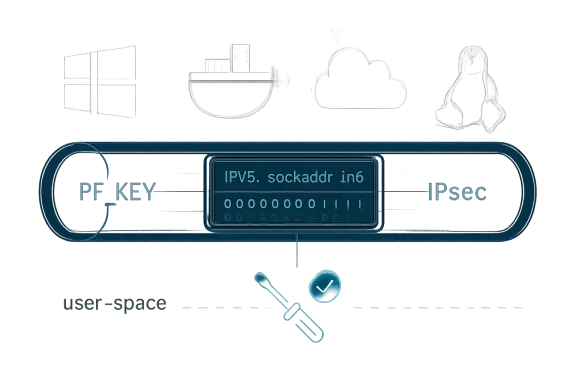 A Four-Byte Leak Is Still a Kernel Boundary Failure
The immediate technical story is narrow. PF_KEY export code reserves 32 bytes for an IPv6 sockaddr payload, because the kernel’s sizing helper accounts for aligned wire format. The corresponding fill routine initializes only the first 28 bytes of struct sockaddr_in6, leaving the remaining four aligned bytes untouched in several exported message paths.That is the sort of bug that can look almost comically small until one remembers where it lives. This is kernel memory crossing outward into messages consumed by user space. The flaw is not described as code execution, privilege escalation, or remote compromise; it is an information disclosure caused by uninitialized padding in a kernel networking subsystem.
The affected paths are also specific rather than universal. The CVE text calls out
SADB_ACQUIRE, SADB_X_NAT_T_NEW_MAPPING, and SADB_X_MIGRATE, while noting that state and policy dump builders already zero the full message buffer before sockaddr payloads are filled. In other words, the kernel was already doing the safe thing in some PF_KEY paths and failed to do it consistently in others.That distinction matters. Security teams are exhausted by vulnerability feeds that flatten every flaw into the same urgent red rectangle. CVE-2026-43088 is not a reason to panic, but it is a reason to patch kernels that expose the relevant code paths and to ask why this class of leak still appears in 2026.
PF_KEY Is Old Plumbing, and Old Plumbing Still Carries Production Traffic
PF_KEY is not the glamorous part of Linux networking. It is the old key-management socket API historically associated with IPsec Security Association management, and in many deployments it exists as compatibility infrastructure rather than a feature administrators consciously think about. That makes it easy to ignore and hard to inventory.The problem with mature kernel interfaces is that they acquire a strange kind of invisibility. Nobody builds a quarterly executive dashboard around PF_KEY. Yet distributions still ship it, IPsec stacks may still interact with it, and embedded or appliance vendors often preserve old networking capabilities because removing them is riskier than leaving them alone.
That is why “deprecated” should never be read as “irrelevant.” Deprecation is a signal about architectural preference, not a guarantee that code has vanished from real systems. In kernel land, especially, old interfaces can persist for years because compatibility is a feature customers quietly depend on until the day it becomes a liability.
CVE-2026-43088 is a reminder that the long tail of protocol support is part of the attack surface. The attacker does not care whether a subsystem feels modern. They care whether it can be reached, whether it returns data, and whether the data contains anything useful.
The Bug Is Small Because the Kernel Got Most of It Right
There is an almost positive reading of this CVE: the Linux kernel’s message builders were already defensive in several related areas. State and policy dump builders zeroed the full message buffer before writing sockaddr payloads, which is why the CVE description explicitly excludes those paths. The issue was not a total absence of memory hygiene but an inconsistency in how aligned payloads were appended.That is often how real bugs survive. The dangerous pattern is not “developers forgot security altogether.” It is that one helper understands alignment, another helper understands structure size, and a third call path assumes the two line up perfectly. The four-byte tail exists in the gap between those assumptions.
IPv6 makes the example especially clean. A
sockaddr_in6 structure is 28 bytes in the relevant context, while the PF_KEY export format reserves 32 bytes on the wire. If the buffer is not cleared before or after filling, the trailing alignment space may contain whatever happened to be in memory. That is not a protocol feature; it is an accident leaving the machine.The fix is correspondingly modest: clear only the aligned sockaddr tail after
pfkey_sockaddr_fill() in the affected export paths. This is not a redesign of PF_KEY, not a removal of IPsec support, and not a sweeping memory allocator change. It is a surgical patch for a surgical flaw.That should not make administrators dismiss it. The best kernel fixes often look boring because the maintainers have correctly localized the blast radius. Boring fixes are still fixes.
Microsoft’s Presence in the Record Says More About the Ecosystem Than the Bug
The user-facing source here is Microsoft’s Security Update Guide, but the vulnerability itself is assigned from kernel.org and concerns the Linux kernel. That distinction will matter for WindowsForum readers, because “MSRC page” can easily be mistaken for “Windows is vulnerable.” In this case, the Microsoft listing is better understood as part of a broader vulnerability-tracking and customer-guidance ecosystem.Microsoft today is not merely a Windows vendor. It ships and supports Linux in multiple contexts, operates a hyperscale cloud full of Linux workloads, maintains Linux-based components in parts of its platform story, and serves customers who run mixed estates. A Linux kernel CVE appearing in Microsoft’s orbit is no longer strange; it is a reflection of the world Microsoft’s customers actually inhabit.
That world includes Azure virtual machines, container hosts, Kubernetes nodes, network appliances, developer workstations running WSL, security products with embedded Linux components, and third-party vendor images that IT teams may not treat as first-class Linux systems. A vulnerability like CVE-2026-43088 may not threaten a Windows 11 desktop directly, but it can still matter to a Windows shop.
This is where vulnerability management has outgrown operating-system tribalism. The old mental model — Windows patches on Patch Tuesday, Linux patches somewhere else, firmware whenever procurement remembers — is no longer adequate. Enterprises run platforms, not mascots.
The Absence of a CVSS Score Is Not the Absence of Risk
At publication, NVD had marked CVE-2026-43088 as awaiting enrichment, with no CVSS 4.0, 3.x, or 2.0 base score available from NIST. That is administratively important because many ticketing systems, compliance dashboards, and patch-prioritization workflows still revolve around severity numbers. But in this case, the missing score should slow automation, not thinking.A four-byte information leak from specific PF_KEY paths is unlikely to rank beside a wormable remote code execution flaw. It does not read like the sort of bug that should trigger emergency maintenance windows across every Linux fleet. But scoring systems have always struggled with kernel information disclosures, because exploitability depends on reachability, local privilege requirements, workload configuration, and whether the leak can be composed with other primitives.
The right move is to classify it by exposure, not by drama. Systems that do not build or load PF_KEY support, do not run IPsec tooling that reaches the affected paths, or receive vendor kernels where the fix is already backported have a different risk profile from systems that actively use IPsec key-management plumbing. Appliances and long-lived servers deserve closer attention than ephemeral lab boxes.
NVD enrichment will eventually put a number on the record. That number will be useful for reporting. It will not replace understanding the path from vulnerable code to reachable system.
The Real Security Debt Is Uninitialized Memory, Not This One CVE
Uninitialized memory disclosures are among the oldest classes of systems bugs, and they persist because performance-oriented code often treats padding as harmless. In C, padding is everywhere: structure alignment, wire-format compatibility, architecture-specific layout, and helper functions that know just enough about their own contract to be dangerous elsewhere.Kernel code raises the stakes. A user-space program leaking four bytes from its own heap may be embarrassing. A kernel exporting four bytes it did not intentionally initialize crosses a privilege boundary, and privilege boundaries are where “small” bugs become security bugs.
This is especially true when the leak occurs in a structured protocol. Attackers love repeatability. A single four-byte disclosure may be noise; a reachable path that can be triggered repeatedly under controlled conditions is a different animal, depending on what memory can be influenced or observed.
The CVE text does not claim that CVE-2026-43088 leaks secrets in a practical exploit chain. Responsible coverage should not invent one. But defenders should recognize the pattern: padding bytes, alignment gaps, and partially initialized structures are exactly the kind of mundane implementation detail that hardening efforts are meant to stamp out.
The industry has spent years moving toward memory-safe languages, compiler-assisted initialization, hardened allocators, and static analysis for precisely this reason. Yet the Linux kernel, like Windows, BSD, and every other large systems codebase, carries decades of C code where correctness depends on disciplined manual handling. CVE-2026-43088 is not a spectacular failure; it is a small invoice from that design era.
IPsec Makes the Bug Operationally Awkward
The affected PF_KEY paths relate to IPsec behavior, including acquisition, NAT traversal mapping, and migration messages. That does not mean every IPsec deployment is practically exploitable, but it does mean the vulnerability sits in a part of the stack that security teams may be reluctant to disturb. VPNs and encrypted tunnels are not optional plumbing in many environments.That creates the familiar patching paradox. The systems most likely to have relevant exposure may also be systems administrators least want to reboot impulsively. Firewalls, VPN concentrators, hardened gateways, site-to-site routers, and specialized network appliances are often maintained conservatively because downtime is visible and failure modes are ugly.
For commodity Linux servers, the operational answer is easier: take the vendor kernel update when it arrives, reboot into the fixed kernel, and verify the running version rather than merely the installed package. For appliances, the answer depends on the vendor’s cadence. For self-built kernels, the answer is to apply the stable commits or pick up a release that contains them.
The hidden danger is the “set and forget” IPsec box in the corner. It may not appear in endpoint dashboards, may not be managed by the Windows team, and may not trigger the same vulnerability SLA as a domain controller or SQL Server. That is exactly why mixed-infrastructure inventories matter.
WSL Is Probably Not the Main Event, but It Belongs in the Conversation
For Windows enthusiasts and developers, the obvious question is whether Windows Subsystem for Linux is implicated. The careful answer is that CVE-2026-43088 concerns the Linux kernel, and WSL 2 uses a Microsoft-supplied Linux kernel, so administrators should keep WSL kernels updated. But the practical exposure depends on kernel configuration, available networking features, privileges, and whether the affected PF_KEY paths are reachable in that environment.WSL has trained many Windows users to think of Linux as an app-like layer. That is convenient but misleading. WSL 2 is a lightweight virtualized Linux environment with a real kernel, and kernel vulnerabilities in that environment need to be treated as kernel vulnerabilities, even when their impact is constrained by the WSL boundary.
For most desktop users, this CVE is unlikely to be the most urgent item on the patch list. Browser vulnerabilities, Office exploitation chains, credential theft, exposed RDP, malicious packages, and unpatched Windows components are more plausible everyday risks. Still, “unlikely” is not the same as “irrelevant,” particularly in development shops where WSL instances are used for secrets, build systems, cloud tooling, and administrative scripts.
The sensible posture is boring: let WSL update, keep Windows current, avoid assuming developer machines are low-value, and remember that local development environments often contain production credentials. CVE-2026-43088 may not be a WSL fire drill, but it is another reminder that developer endpoints are now miniature hybrid estates.
This Is Where Patch Management Needs Better Language
Security teams often communicate vulnerabilities using labels that obscure more than they clarify. “Linux kernel information disclosure” is technically accurate but operationally incomplete. “MSRC-listed CVE” is true in context but can mislead Windows-only readers. “No CVSS yet” is factual but risks being interpreted as “no risk yet.”A better internal advisory would say something plainer: this is a Linux kernel PF_KEY/IPsec-adjacent information leak involving four uninitialized bytes in selected export messages; patch when your Linux vendor ships the fix; prioritize systems using IPsec, PF_KEY, or vendor network appliances; do not treat it as a Windows kernel bug. That sentence does more work than a severity color.
The challenge is that vulnerability programs are built around aggregation, while actual remediation depends on specificity. A CVE feed is a starting gun, not a diagnosis. Someone still has to map the flaw to products, kernels, configurations, and business services.
That mapping is where mature IT teams separate themselves. They know which Linux kernels are running under their Windows-centric management umbrella. They know whether security appliances are maintained by network engineering or forgotten by everyone. They know whether a Microsoft advisory requires Windows Update, a Linux repo update, a vendor firmware release, or simply a note in the risk register.
Kernel Stable Fixes Are the Part That Matters
The CVE record lists two kernel stable commit references, indicating that fixes have been placed into stable branches. For administrators, those commit hashes are less important than the route by which the fix reaches their systems. Most organizations should not cherry-pick kernel networking patches by hand unless they already operate that kind of engineering workflow.The normal path is distribution backporting. Red Hat, Ubuntu, Debian, SUSE, Oracle, Amazon, Microsoft, and appliance vendors often apply specific fixes to older kernel versions without changing the visible kernel version to a brand-new upstream release. That means a simplistic “is my kernel newer than X?” test may be wrong.
The better test is vendor advisory status and package changelog confirmation. If the distribution says its kernel package includes the CVE fix, that is usually the authoritative answer for that platform. If the platform is an appliance, the appliance vendor owns the integration burden.
This is also why scanners sometimes confuse customers. A scanner may flag a kernel as vulnerable because it sees an older version string, even after the vendor has backported the patch. Conversely, a scanner may miss exposure on an appliance because it cannot interrogate the underlying kernel properly. CVE-2026-43088 is exactly the kind of flaw where asset context beats blind version comparison.
The Threat Model Is Composite, Not Catastrophic
Nothing in the public description suggests that CVE-2026-43088 is a standalone catastrophe. It is not described as remotely exploitable over the open internet. It is not described as allowing arbitrary code execution. It is not described as compromising confidentiality at scale without local or subsystem-specific access.But kernel information disclosures are rarely evaluated only in isolation. In modern exploitation, small leaks can help defeat address randomization, expose fragments of adjacent state, or provide a side channel that becomes more interesting when paired with another bug. That does not mean this CVE is secretly critical; it means defenders should resist the opposite mistake of treating every non-RCE flaw as decorative paperwork.
The relevant question is whether an attacker who already has some local capability, or access to a process interacting with PF_KEY, can extract useful data repeatedly. The answer may vary by kernel build, workload, and surrounding mitigations. Without a public exploit narrative, there is no need to dramatize it.
There is, however, a clear engineering lesson: kernel exports should not carry uninitialized padding. The fix is cheap. The consequence of not fixing is uncertainty. In security operations, uncertainty is often more expensive than the patch.
The Windows Shop’s Linux Blind Spot Is Now a Board-Level Problem
WindowsForum readers know this story from the other direction. For years, Linux administrators watched Windows shops struggle with legacy protocols, SMB exposure, Active Directory complexity, and patch windows dictated by business politics rather than technical merit. Now the hybrid estate has made everyone inherit everyone else’s mess.A Windows-first organization may run Linux in places it does not culturally recognize as Linux. The Kubernetes worker node is Linux. The network appliance is Linux. The EDR backend appliance might be Linux. The NAS, camera gateway, VPN concentrator, build agent, and backup proxy may all carry Linux kernels under branded management interfaces.
That matters because CVE handling follows ownership lines. If nobody owns “Linux” as a first-class asset class, kernel CVEs become ambient noise. They appear in dashboards, get waived as not applicable, and resurface months later during audits or incidents.
CVE-2026-43088 is useful precisely because it is not apocalyptic. Organizations can use it as a low-drama test of whether their vulnerability process can answer basic questions: Where do we run Linux kernels? Which of those expose IPsec or PF_KEY functionality? Which vendors owe us fixes? Which systems have actually rebooted into patched kernels?
If the answer is a shrug, the issue is bigger than this CVE.
The Small Padding Bug That Teaches the Right Patch Lesson
This CVE should not send administrators sprinting through data centers. It should send them through inventories, ownership maps, and kernel update channels. The concrete work is modest, but it is still work.- Systems running Linux kernels with PF_KEY support should be checked against vendor advisories for CVE-2026-43088.
- Hosts or appliances using IPsec-related functionality deserve higher priority than ordinary desktops or lab systems with no realistic PF_KEY exposure.
- Administrators should verify the running kernel after patching, because installing a fixed package without rebooting may leave the vulnerable kernel active.
- Windows teams should not confuse the MSRC listing with a Windows kernel flaw, but they should consider WSL, Azure-hosted Linux, appliances, and mixed infrastructure.
- Security teams should avoid waiting passively for a CVSS score before classifying exposure in environments where the affected subsystem is known to be reachable.
CVE-2026-43088 will probably pass through the ecosystem as a minor kernel hygiene fix, absorbed into stable updates and vendor kernels with little fanfare. But its quietness is the point: the future of infrastructure security will be decided less by spectacular bugs everyone can see than by whether organizations can continuously find, understand, and retire the obscure seams where old code still meets modern production.
Source: NVD / Linux Kernel Security Update Guide - Microsoft Security Response Center
