

CVE-2026-43319 was published on May 8, 2026, for a Linux kernel spidev deadlock in which competing
The affected code lives in
The vulnerability record describes a classic AB-BA locking problem. One path took
That distinction matters. Security teams often triage by CVSS score, exploitability language, and whether the phrase “remote attacker” appears in the advisory. CVE-2026-43319 arrived without an NVD severity score, which makes it tempting to shove into the “later” bucket. But a reproducible kernel-driver deadlock triggered from userspace is not nothing, especially on systems where SPI access is part of a control loop, manufacturing line, monitoring appliance, or unattended edge deployment.
This is the sort of vulnerability that punishes asset owners who only patch when the internet is on fire. It will not dominate Patch Tuesday chatter. It will not become the next wormable enterprise catastrophe. But if it affects the one embedded Linux board that feeds telemetry into a Windows-managed environment, the impact will feel very real to the admin who has to explain why the sensor stack stopped responding.
In this case, the
The important phrase in the disclosure is that the issue can cause “real deadlocks.” This is not merely a theoretical warning produced by a paranoid validator. According to the vulnerability description, a simple userspace program can reproduce the condition by issuing
Multithreaded userspace code talking to hardware is common. One thread may be streaming data while another adjusts mode, speed, or device configuration. A developer may not think of that design as security-sensitive at all; it is simply how an application keeps the hardware busy while remaining responsive. CVE-2026-43319 turns that ordinary concurrency pattern into a kernel-level availability failure.
The fix is elegant because it removes the source of complexity rather than papering over it. The kernel patch eliminates
If an SPI-connected device freezes because its userspace controller deadlocks the kernel path, the consequence depends entirely on what that device does. On a hobby board, maybe someone power-cycles it and loses an afternoon. In a test lab, it might invalidate a run. In an industrial environment, it could blind a monitoring component or stall a peripheral used by a larger automation process.
The Linux kernel CVE program has also changed the texture of vulnerability management. Kernel fixes that once might have been treated as ordinary bug fixes are now more likely to arrive with CVE identifiers. That is good for visibility, but it creates a second-order problem: defenders must distinguish between internet-facing emergencies and low-level flaws that are quietly important only on certain assets.
CVE-2026-43319 sits in that second category. It is unlikely to matter to the average laptop. It may matter a lot to a Raspberry Pi-class controller, an embedded gateway, an appliance running a vendor Linux image, or a custom board where
For Windows administrators, that framing is increasingly familiar. Many Windows shops now own Linux whether they planned to or not. Linux appears in WSL development environments, Azure workloads, Kubernetes nodes, security appliances, storage controllers, network gear, OT gateways, and vendor-managed hardware. A vulnerability in a Linux SPI driver may never touch a Windows endpoint, but it can still affect the Windows-run business.
That can confuse readers. Seeing an MSRC page attached to a Linux CVE may suggest a Microsoft product flaw, when the more careful interpretation is that Microsoft is surfacing the record because customers may encounter affected Linux components in Microsoft-adjacent contexts. Azure, Defender vulnerability management, container scanning, Linux distributions running on Hyper-V, and hybrid estates all make “Linux CVE in a Microsoft portal” a normal sight.
For WindowsForum’s audience, the practical reading is straightforward. Do not look for a Windows Update that fixes
This is where modern vulnerability management gets awkward. Traditional patch dashboards are excellent at counting missing updates on desktops and servers. They are less good at identifying a field device running a customized kernel, a lab appliance pinned to an old vendor image, or a build farm board where SPI access is part of hardware validation. CVE-2026-43319 is not difficult to understand technically, but it may be difficult to find operationally.
The Microsoft listing is therefore useful less as a remediation document and more as a signal. It tells administrators that this kernel issue has entered the broader vulnerability data stream. Once a CVE appears in NVD-linked tooling, scanners, dashboards, procurement questionnaires, and compliance workflows may start asking about it — even before NVD has assigned a severity score.
A more useful first-pass assessment starts with three questions. Is the vulnerable code present? Is it reachable by local userspace? Is the system doing something where a hang matters? For this CVE, those questions are more informative than a generic severity number.
The exploit condition is local and specific. An attacker or buggy application needs access to the spidev file descriptor and must exercise competing operations in a way that triggers the lock inversion. That limits the blast radius. But on many embedded systems, the application talking to spidev is the core workload, and a local reliability failure in that workload can be equivalent to a service outage.
There is also a difference between malicious exploitation and accidental self-denial. A vulnerability can be security-relevant even if no adversary is involved. Multithreaded control software could stumble into this pattern unintentionally. In that scenario, the CVE label helps administrators connect an intermittent hang to a known kernel bug rather than chasing phantom hardware faults.
That is especially important for edge and IoT deployments, where debugging is expensive. A device that occasionally stops responding in the field may be blamed on power, cabling, flaky peripherals, or application logic. A known kernel deadlock gives operators a concrete thing to test and patch.
The patch also preserves userspace ABI and behavior. That is critical for
There is an implicit tradeoff in consolidating locks. A single lock can be coarser than two specialized locks, which can reduce concurrency in some designs. But the patch rationale indicates that
That lesson travels beyond this one driver. Concurrency bugs often survive because each local decision seems reasonable. A buffer lock protects buffers. A device lock protects the device pointer. An ioctl path wants to prevent configuration changes from racing with I/O. The bug emerges when those reasonable decisions compose badly.
Kernel development has spent decades building tools to detect exactly this kind of failure, and lockdep’s warning language is famously blunt. The value of that tooling is not merely that it catches theoretical problems; it gives maintainers a map of where future production hangs may come from. CVE-2026-43319 is a case study in turning that map into a smaller, safer design.
That is why SPI matters. It is a bus used to connect processors to peripheral devices at board level. When Linux userspace talks through
Many organizations also treat embedded Linux as an appliance problem rather than a server problem. If a device was bought from a vendor, it may not appear in Linux patch inventories. If it was built internally by an engineering team, it may sit outside the corporate vulnerability management process. If it runs in a lab, it may be exempted from normal controls because “it is not production,” right up until production depends on its output.
CVE-2026-43319 should push teams to ask a boring but valuable question: which of our Linux systems expose spidev, and who owns patching them? The answer will often be “not many,” and that is fine. The point is to replace assumption with knowledge.
There is also a supply-chain dimension. Vendors who ship Linux-based appliances may need to pick up the stable kernel fix, rebuild their images, and publish firmware or software updates. Customers may have little visibility into whether that happened. In that world, CVE identifiers become negotiation tools as much as technical facts.
That is especially true for organizations using Windows as the management plane. A Windows admin may be responsible for the server that collects data from Linux gateways, the SIEM that ingests their logs, the Defender portal that flags their CVEs, or the Hyper-V host that runs their guest images. The Linux kernel bug may be “someone else’s stack,” but the outage lands in the same ticket queue.
WSL deserves a careful mention here. Typical WSL usage on developer workstations is unlikely to involve direct
The more relevant Windows-adjacent environments are Hyper-V-hosted Linux VMs, Azure Linux workloads, IoT and OT devices integrated into Microsoft monitoring, and vendor appliances whose vulnerability data appears in Defender or procurement scans. Those systems may be administratively downstream of Windows teams even if they are technically Linux systems.
A mature response starts by separating exposure from noise. If a Linux system does not include
But the answer is not to ignore kernel CVEs. The answer is better context. CVE-2026-43319 is a perfect example because the context is unusually clear. The affected subsystem is
That clarity lets defenders make a rational decision. A cloud VM with no SPI use can be deprioritized. An embedded gateway using spidev should be patched when a vendor or distribution update is available. A developer board running a custom kernel should be checked against the upstream commit or stable backport. A vendor appliance should prompt a support inquiry if it uses Linux and SPI-connected hardware.
The security tooling industry is still catching up to that kind of nuance. Too many vulnerability views flatten everything into identifiers and scores. An unscored CVE can be invisible; a high-scored but unreachable CVE can dominate. Administrators need tooling that understands kernel configuration, loaded modules, hardware exposure, device nodes, container boundaries, and application behavior.
Until then, the human layer matters. Someone has to read the advisory, understand the subsystem, and decide whether the affected code is in the path of anything important. That is not glamorous work, but it is the work that prevents low-drama bugs from becoming high-drama outages.
Administrators should resist the urge to treat this as a universal emergency. A blanket response wastes time and trains teams to ignore the next advisory. The better move is targeted verification: identify systems using spidev, determine whether their kernel includes the fix, and prioritize devices where a deadlock would interrupt a real workflow.
That verification may require different tactics depending on the environment. On a conventional Linux host, teams can inspect device nodes, kernel versions, distribution advisories, and package changelogs. On an appliance, they may need a vendor statement. On an internally built image, they may need to compare the kernel tree against the upstream fix.
The lack of userspace ABI change is good news for deployment. Applications should not need modification simply because the kernel lock model changed. That reduces regression risk and makes the patch easier to justify, especially in environments where hardware-control software is old, fragile, or vendor-supplied.
Still, any kernel update on embedded systems deserves testing. SPI timing, device behavior, and board-specific patches can make upgrades more delicate than on commodity servers. The fix itself is contained, but the act of moving to a new vendor kernel or stable release may bring unrelated changes. Sensible teams will test the full image, not just the CVE.
Source: NVD / Linux Kernel Security Update Guide - Microsoft Security Response Center
read()/write() and ioctl() paths could acquire spi_lock and buf_lock in opposite orders, allowing a userspace program to hang SPI device access. The bug is not a flashy remote-code-execution story, and that is precisely why it deserves attention. It is a reminder that kernel security is often less about cinematic exploitation and more about whether real systems keep doing the boring work they were deployed to do. For WindowsForum readers, the lesson is not that Windows desktops are suddenly at risk; it is that modern Windows estates increasingly depend on Linux components, embedded controllers, IoT gateways, lab gear, and cloud-hosted Linux workloads whose failure modes do not respect the neat boundary between “Windows” and “not Windows.”
 A Small Driver Bug Exposes a Bigger Operational Truth
The affected code lives in spidev, the Linux driver that lets userspace applications talk to devices on an SPI bus. SPI is not the kind of subsystem that dominates consumer security headlines, but it is everywhere in embedded boards, industrial controllers, sensors, displays, ADCs, TPM-adjacent hardware designs, test rigs, and hobbyist platforms. When a userspace process opens /dev/spidev*, it is often acting as the bridge between software and some physical device that matters.The vulnerability record describes a classic AB-BA locking problem. One path took
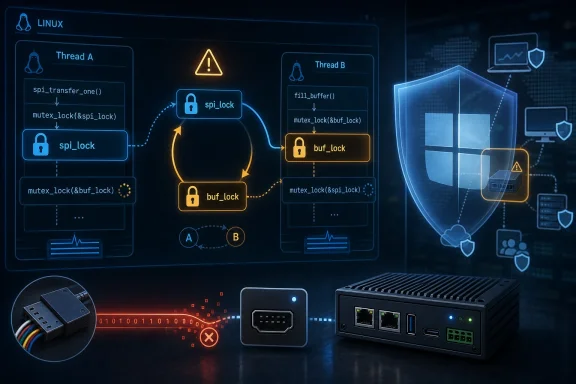
buf_lock and then spi_lock; another took spi_lock and then buf_lock. If two threads arrived at the wrong time, each could wait forever for the lock held by the other. The result is not privilege escalation or memory corruption, but a deadlock — and in operational environments, a deadlock can be just as disruptive as a crash.That distinction matters. Security teams often triage by CVSS score, exploitability language, and whether the phrase “remote attacker” appears in the advisory. CVE-2026-43319 arrived without an NVD severity score, which makes it tempting to shove into the “later” bucket. But a reproducible kernel-driver deadlock triggered from userspace is not nothing, especially on systems where SPI access is part of a control loop, manufacturing line, monitoring appliance, or unattended edge deployment.
This is the sort of vulnerability that punishes asset owners who only patch when the internet is on fire. It will not dominate Patch Tuesday chatter. It will not become the next wormable enterprise catastrophe. But if it affects the one embedded Linux board that feeds telemetry into a Windows-managed environment, the impact will feel very real to the admin who has to explain why the sensor stack stopped responding.
The Deadlock Was the Bug, Not the Symptom
Lock inversion is one of those kernel-development hazards that sounds academic until it lands in production. Locks exist to prevent concurrent access from corrupting shared state. But when two locks are acquired in inconsistent order, the defensive machinery becomes the trap.In this case, the
spidev driver used two mutexes. The read and write paths acquired the buffer lock first and then the SPI lock. The ioctl path acquired the SPI lock first and then the buffer lock. Each order was defensible when viewed locally; together, they formed the circular dependency that Linux’s lockdep tooling is designed to catch.The important phrase in the disclosure is that the issue can cause “real deadlocks.” This is not merely a theoretical warning produced by a paranoid validator. According to the vulnerability description, a simple userspace program can reproduce the condition by issuing
write() calls and SPI_IOC_WR_MAX_SPEED_HZ ioctl operations from separate threads on the same spidev file descriptor. That is a narrow trigger, but it is not exotic.Multithreaded userspace code talking to hardware is common. One thread may be streaming data while another adjusts mode, speed, or device configuration. A developer may not think of that design as security-sensitive at all; it is simply how an application keeps the hardware busy while remaining responsive. CVE-2026-43319 turns that ordinary concurrency pattern into a kernel-level availability failure.
The fix is elegant because it removes the source of complexity rather than papering over it. The kernel patch eliminates
buf_lock, makes callers serialize access through spi_lock, and stops spidev_sync() from taking its own lock internally. That consolidation matters: fewer locks mean fewer possible lock orders, and fewer lock orders mean fewer ways to get stuck.This Is Availability Security, and Enterprises Still Underrate It
The security industry has become very good at panicking over code execution and very uneven at responding to reliability flaws with security consequences. A denial-of-service issue in a local driver does not sound urgent in the same way a browser sandbox escape does. Yet availability is one of the three pillars in the old confidentiality-integrity-availability model for a reason.If an SPI-connected device freezes because its userspace controller deadlocks the kernel path, the consequence depends entirely on what that device does. On a hobby board, maybe someone power-cycles it and loses an afternoon. In a test lab, it might invalidate a run. In an industrial environment, it could blind a monitoring component or stall a peripheral used by a larger automation process.
The Linux kernel CVE program has also changed the texture of vulnerability management. Kernel fixes that once might have been treated as ordinary bug fixes are now more likely to arrive with CVE identifiers. That is good for visibility, but it creates a second-order problem: defenders must distinguish between internet-facing emergencies and low-level flaws that are quietly important only on certain assets.
CVE-2026-43319 sits in that second category. It is unlikely to matter to the average laptop. It may matter a lot to a Raspberry Pi-class controller, an embedded gateway, an appliance running a vendor Linux image, or a custom board where
/dev/spidev* is exposed to an application stack. The right response is not panic; it is asset-aware patching.For Windows administrators, that framing is increasingly familiar. Many Windows shops now own Linux whether they planned to or not. Linux appears in WSL development environments, Azure workloads, Kubernetes nodes, security appliances, storage controllers, network gear, OT gateways, and vendor-managed hardware. A vulnerability in a Linux SPI driver may never touch a Windows endpoint, but it can still affect the Windows-run business.
The Microsoft Angle Is About Visibility, Not Ownership
The submitted source points to Microsoft’s Security Update Guide entry for CVE-2026-43319, but the underlying vulnerability is in the Linux kernel and was sourced from kernel.org. That distinction matters. Microsoft’s listing does not make this a Windows kernel bug; it reflects the reality that Microsoft’s security ecosystem tracks vulnerabilities beyond the traditional Windows desktop boundary.That can confuse readers. Seeing an MSRC page attached to a Linux CVE may suggest a Microsoft product flaw, when the more careful interpretation is that Microsoft is surfacing the record because customers may encounter affected Linux components in Microsoft-adjacent contexts. Azure, Defender vulnerability management, container scanning, Linux distributions running on Hyper-V, and hybrid estates all make “Linux CVE in a Microsoft portal” a normal sight.
For WindowsForum’s audience, the practical reading is straightforward. Do not look for a Windows Update that fixes
spidev on your Windows 11 PC. Instead, look at the Linux systems you manage, the vendor appliances in your inventory, and the embedded devices that might be invisible to normal endpoint patch workflows. If they run a kernel with the vulnerable driver and expose spidev to userspace workloads, they belong in the triage conversation.This is where modern vulnerability management gets awkward. Traditional patch dashboards are excellent at counting missing updates on desktops and servers. They are less good at identifying a field device running a customized kernel, a lab appliance pinned to an old vendor image, or a build farm board where SPI access is part of hardware validation. CVE-2026-43319 is not difficult to understand technically, but it may be difficult to find operationally.
The Microsoft listing is therefore useful less as a remediation document and more as a signal. It tells administrators that this kernel issue has entered the broader vulnerability data stream. Once a CVE appears in NVD-linked tooling, scanners, dashboards, procurement questionnaires, and compliance workflows may start asking about it — even before NVD has assigned a severity score.
No CVSS Score Does Not Mean No Risk
At publication, the NVD entry did not include a CVSS 4.0, 3.x, or 2.0 score from NIST. That is not unusual for newly published CVEs, especially when enrichment is still pending. But the absence of a score can distort triage if organizations treat “N/A” as a synonym for “not important.”A more useful first-pass assessment starts with three questions. Is the vulnerable code present? Is it reachable by local userspace? Is the system doing something where a hang matters? For this CVE, those questions are more informative than a generic severity number.
The exploit condition is local and specific. An attacker or buggy application needs access to the spidev file descriptor and must exercise competing operations in a way that triggers the lock inversion. That limits the blast radius. But on many embedded systems, the application talking to spidev is the core workload, and a local reliability failure in that workload can be equivalent to a service outage.
There is also a difference between malicious exploitation and accidental self-denial. A vulnerability can be security-relevant even if no adversary is involved. Multithreaded control software could stumble into this pattern unintentionally. In that scenario, the CVE label helps administrators connect an intermittent hang to a known kernel bug rather than chasing phantom hardware faults.
That is especially important for edge and IoT deployments, where debugging is expensive. A device that occasionally stops responding in the field may be blamed on power, cabling, flaky peripherals, or application logic. A known kernel deadlock gives operators a concrete thing to test and patch.
The Patch Chooses Simplicity Over Cleverness
The kernel fix removesbuf_lock and relies on spi_lock to serialize the paths that need serialization. That is the kind of change maintainers like because it shrinks the locking model. Security fixes often add checks, barriers, counters, or special cases; this one removes a mutex and reduces the number of legal states the driver can occupy.The patch also preserves userspace ABI and behavior. That is critical for
spidev, because userspace applications depend on stable device semantics. A fix that required application changes would have been harder to backport and slower to deploy. By keeping the interface the same, the kernel can repair the internal synchronization bug without forcing developers to rewrite hardware-control software.There is an implicit tradeoff in consolidating locks. A single lock can be coarser than two specialized locks, which can reduce concurrency in some designs. But the patch rationale indicates that
spi_lock already covered the relevant functionality. If the second lock is not buying meaningful parallelism, it is only buying complexity.That lesson travels beyond this one driver. Concurrency bugs often survive because each local decision seems reasonable. A buffer lock protects buffers. A device lock protects the device pointer. An ioctl path wants to prevent configuration changes from racing with I/O. The bug emerges when those reasonable decisions compose badly.
Kernel development has spent decades building tools to detect exactly this kind of failure, and lockdep’s warning language is famously blunt. The value of that tooling is not merely that it catches theoretical problems; it gives maintainers a map of where future production hangs may come from. CVE-2026-43319 is a case study in turning that map into a smaller, safer design.
Embedded Linux Is Where “Low” Bugs Become High-Impact Incidents
On paper, a local deadlock in an SPI userspace driver sounds modest. In embedded environments, modest kernel bugs can become operational incidents because the affected system is often single-purpose. A general-purpose server has multiple services, remote management, logs, watchdogs, orchestration, and people watching dashboards. A small controller may have one job, one application, and a vendor image that nobody has patched since installation.That is why SPI matters. It is a bus used to connect processors to peripheral devices at board level. When Linux userspace talks through
spidev, it may be reaching sensors, converters, radio modules, displays, secure elements, or custom logic. The data path may be physically close to the machine but logically central to the service.Many organizations also treat embedded Linux as an appliance problem rather than a server problem. If a device was bought from a vendor, it may not appear in Linux patch inventories. If it was built internally by an engineering team, it may sit outside the corporate vulnerability management process. If it runs in a lab, it may be exempted from normal controls because “it is not production,” right up until production depends on its output.
CVE-2026-43319 should push teams to ask a boring but valuable question: which of our Linux systems expose spidev, and who owns patching them? The answer will often be “not many,” and that is fine. The point is to replace assumption with knowledge.
There is also a supply-chain dimension. Vendors who ship Linux-based appliances may need to pick up the stable kernel fix, rebuild their images, and publish firmware or software updates. Customers may have little visibility into whether that happened. In that world, CVE identifiers become negotiation tools as much as technical facts.
Windows Shops Need a Linux Peripheral Inventory
The phrase “Windows shop” no longer means what it did 15 years ago. A company can run Windows endpoints, Active Directory, Microsoft 365, Intune, Defender, and Azure while still depending on Linux at the edge. The operating system boundary has become an administrative boundary, not a risk boundary.That is especially true for organizations using Windows as the management plane. A Windows admin may be responsible for the server that collects data from Linux gateways, the SIEM that ingests their logs, the Defender portal that flags their CVEs, or the Hyper-V host that runs their guest images. The Linux kernel bug may be “someone else’s stack,” but the outage lands in the same ticket queue.
WSL deserves a careful mention here. Typical WSL usage on developer workstations is unlikely to involve direct
/dev/spidev* access, and WSL’s kernel configuration is not the same as a Raspberry Pi or industrial Linux image. This CVE should not be read as a reason to alarm every developer using WSL. But it is a reason to remember that Linux compatibility layers, virtual machines, and containers complicate the question “are we affected?”The more relevant Windows-adjacent environments are Hyper-V-hosted Linux VMs, Azure Linux workloads, IoT and OT devices integrated into Microsoft monitoring, and vendor appliances whose vulnerability data appears in Defender or procurement scans. Those systems may be administratively downstream of Windows teams even if they are technically Linux systems.
A mature response starts by separating exposure from noise. If a Linux system does not include
spidev, has no SPI hardware, does not expose spidev device nodes, or runs no userspace code that touches them, this CVE is probably irrelevant. If a system does use spidev in a multithreaded control application, the patch deserves more attention than its missing CVSS score might suggest.The CVE Pipeline Is Getting Noisier, and That Is Not All Bad
The Linux kernel’s CVE stream has become more visible and, to many admins, more exhausting. A large operating system kernel receives constant fixes, and not every fix represents a realistic threat to every deployment. The result is alert fatigue: dashboards fill with kernel CVEs that look urgent until someone reads the affected subsystem.But the answer is not to ignore kernel CVEs. The answer is better context. CVE-2026-43319 is a perfect example because the context is unusually clear. The affected subsystem is
spidev. The trigger involves concurrent userspace operations on the same spidev file descriptor. The impact is deadlock. The fix is a stable-friendly locking simplification with no intended ABI change.That clarity lets defenders make a rational decision. A cloud VM with no SPI use can be deprioritized. An embedded gateway using spidev should be patched when a vendor or distribution update is available. A developer board running a custom kernel should be checked against the upstream commit or stable backport. A vendor appliance should prompt a support inquiry if it uses Linux and SPI-connected hardware.
The security tooling industry is still catching up to that kind of nuance. Too many vulnerability views flatten everything into identifiers and scores. An unscored CVE can be invisible; a high-scored but unreachable CVE can dominate. Administrators need tooling that understands kernel configuration, loaded modules, hardware exposure, device nodes, container boundaries, and application behavior.
Until then, the human layer matters. Someone has to read the advisory, understand the subsystem, and decide whether the affected code is in the path of anything important. That is not glamorous work, but it is the work that prevents low-drama bugs from becoming high-drama outages.
The Practical Patch Story Is About Ownership
For mainstream Linux distributions, the fix should arrive through normal kernel update channels once maintainers pull in the relevant stable patches. For custom kernels, embedded boards, and vendor images, the story is messier. The presence of upstream fixes does not mean the device in your rack, closet, factory, or lab has received them.Administrators should resist the urge to treat this as a universal emergency. A blanket response wastes time and trains teams to ignore the next advisory. The better move is targeted verification: identify systems using spidev, determine whether their kernel includes the fix, and prioritize devices where a deadlock would interrupt a real workflow.
That verification may require different tactics depending on the environment. On a conventional Linux host, teams can inspect device nodes, kernel versions, distribution advisories, and package changelogs. On an appliance, they may need a vendor statement. On an internally built image, they may need to compare the kernel tree against the upstream fix.
The lack of userspace ABI change is good news for deployment. Applications should not need modification simply because the kernel lock model changed. That reduces regression risk and makes the patch easier to justify, especially in environments where hardware-control software is old, fragile, or vendor-supplied.
Still, any kernel update on embedded systems deserves testing. SPI timing, device behavior, and board-specific patches can make upgrades more delicate than on commodity servers. The fix itself is contained, but the act of moving to a new vendor kernel or stable release may bring unrelated changes. Sensible teams will test the full image, not just the CVE.
The Most Important Lessons Are Smaller Than the CVE Number
This vulnerability is not a Windows crisis, not a remote compromise headline, and not a reason to rewrite every SPI application. Its value is as a precise warning about where modern infrastructure hides risk. Small drivers, local interfaces, and embedded workloads can sit below the visibility line until a deadlock, hang, or hardware outage forces them into view.- CVE-2026-43319 affects the Linux kernel’s
spidevdriver and centers on a lock inversion betweenspi_lockandbuf_lock. - The known impact is a reproducible local deadlock, not remote code execution or privilege escalation.
- Systems that do not use spidev or expose SPI device access are unlikely to have meaningful exposure.
- Embedded Linux, IoT gateways, lab devices, and vendor appliances deserve more attention than ordinary Windows desktops for this issue.
- The upstream fix simplifies the driver’s locking model by removing
buf_lockand serializing the relevant paths withspi_lock. - The absence of an NVD score at publication should not be mistaken for proof that affected operational systems can safely ignore the patch.
Source: NVD / Linux Kernel Security Update Guide - Microsoft Security Response Center
