

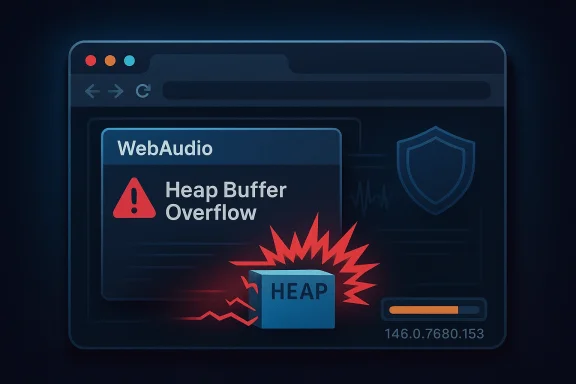
Chromium’s CVE-2026-4443 is the kind of browser flaw that immediately changes patch priorities because it sits at the intersection of reachability, memory corruption, and user interaction. According to the advisory material surfaced in Microsoft’s Security Update Guide, the bug is a heap buffer overflow in WebAudio that affects Google Chrome prior to 146.0.7680.153 and can let a remote attacker execute code inside the browser sandbox via a crafted HTML page. Google classifies the issue as High severity, which is a strong signal that defenders should treat it as a serious exposure even before public exploitation details mature. The downstream Microsoft entry also shows the flaw in the broader Chromium-to-Edge security pipeline, where one browser vendor’s upstream fix becomes another vendor’s customer guidance. mium security issues like this one matter because modern browsers are not just document renderers; they are large, multi-process application platforms that parse media, graphics, scripting, networking, and sandbox policy all at once. A weakness in WebAudio is especially interesting because audio handling sits in a part of the browser that most users perceive as passive, yet it is still fed by complex, attacker-controlled content from the web. That combination often makes media subsystems a durable target for exploitation research, because they are broadly deployed and deeply integrated into the rendering pipeline.
The Chrome release plain why a vulnerability like CVE-2026-4443 can matter so quickly. Google’s stable-channel notes routinely bundle security fixes into point updates, and the company often keeps bug details restricted until most users have had time to update. That pattern is visible across recent Chrome releases, where security fixes are delivered in tight cadence and sometimes paired with explicit warnings when exploits are known to exist in the wild. The same update mechanism that protects billions of users also creates a narrow window in which attackers can race defenders between disclosure and patch adoption. (chromereleases.googleblog.com)
This vulnerability also fits a familiar browser-security pattern: memory corruption in a complex subsystem, reachable from the web, with code execution inside a sandbox as the likely endgame. Sandboxed code execution is not harmless simply because it is sandboxed; it often gives an attacker a foothold for chaining into renderer escapes, profile theft, session hijacking, or follow-on exploitation of browser extensions and local services. In practical terms, the sandbox is a mitigatintee of safety.
Microsoft’s inclusion of the CVE in its guidance matters for enterprise teams because Edge is Chromium-based, and Microsoft uses the Security Update Guide to surface Chromium-origin vulnerabilities that affect downstream Edge builds. That does not mean Microsoft wrote the bug; it means Microsoft is telling Windows administrators when an upstream Chromium fix is relevant to the browser they actually deploy. In an enterprise estate, that distinction is essential, because patch verification often depends on knowing whether the browser version in use has ingested the upstream fix.
At its core, heap buffer overflow means the browser likely wrote beyond the bounds of an allocated memory region while processing WebAudio data or related structures. In a browser, that kind of flaw can become far more dangerous than a simple crash because heap corruption may be shaped by an attacker into controlled memory writes, control-flow disruption, or deterministic process termination. Even when exploitation is difficult, the presence of a heap overflow usually signals a bug class that security researchers and exploit developers know how to pressure-test aggressively.
The fact that e through a crafted HTML page is just as important as the overflow itself. That means the attack surface is not some obscure local parser or admin tool; it is the ordinary browser intake path that processes untrusted web content. For consumers, this is the classic “visit a page, get owned” risk model. For enterprises, it is the kind of bug that can bypass normal security intuition because users do not have to download a file or install software for exposure to begin.
Key implications include:
Google’s release cadence also helps explain why defenders should move quickly even when details are sparse. Recent stable-channel posts have shown how Chrome security updates can shift from routine maintenance to urgent remediation with very little warning. When a vendor tightens the loop around disclosures, defenders have less time to wait for a “full story” before acting. The practical lesson is simple: patch first, analyze later.
What changes over time is not the existence of bugs but the cost of exploitation and the speed of patch delivery. Modern exploit chains may need multiple flaws, timing tricks, or post-exploitation steps, but a reliable browser memory bug is still a valuable primitive. The reason security teams care is not only the bug itself, but what it can enable when combined with phishing, watering-hole campaigns, or extension abuse. Browser vulnerabilities arvents.
A practical enterprise takeaway is that browser update policy needs to be treated like endpoint protection policy, not a casual convenience setting. If the browser is a primary delivery mechanism for productivity, identity, and web applications, then Chrome patch compliance is part of security posture, not a desktop hygiene issue. That is especially true for Windows fleets where browser update delays can leave entire business units exposed to a bug that is one malicious page away from becoming an incident.
This matters because Windows environments often standardize on Edge even when Chrome is present in the background for specific line-of-business or compatibility needs. In those environments, patching cannot stop at “Chrome is updated.” Teams need to verify whether Edge has received the corresponding upstream Chromium bits, especially when security governance is tied to Microsoft’s own reporting dashboards. The Security Update Guide is, effectively, the cross-vendor ledger.
The implication for managed Windows endpoints is straightforward: browser version management should be treated as a compliance control, not a best-effort update preference. Security teams should know which channel each browser is on, whether auto-update is enabled, and how long it takes for the update to actually land after release. A CVE like this becomes much more dangerous when organizations assume “the browser usually updates itself” and stop checking.
At the same time, downstream visibility should not be mistaken for downstream independence. Microsoft is not fixing Chromium’s engine logic here; it is documenting when its build pipeline has absorbed the upstream correction. That distinction is critical because it tells defenders where to look for remediation and which vendor’s release notes determine the real exposure window.
Phishing and malicious advertising are natural delivery vectors for a bug like this. An attacker does not need to convince the victim to install software; they need only to get the victim to load a page or embedded browser control that exercises the vulnerable path. In the browser threat model, that is enough to make the vulnerability strategically important.
There is also a broader operational concern: browsers increasingly carry identity tokens, SSO sessions, and access to internal web applications. A browser compromise in a managed environment may therefore translate into a foothold on business resources, not just a broken tab. That is why browser CVEs deserve a response posture closer to endpoint exploit remediation than to routine application patching.
At the same time, the bug demonstrates how security improvements have changed the attacker’s job. A sandboxed browser process i full system compromise than a single-process application ever was. That is good news for defenders, but it also means attackers are willing to spend more time refining the exploit chain once they have a reliable entry point. Defensive depth raises cost, not immunity.
That tradeoff is why each Chromium security advisory remains relevant beyond the immediate bug. Every heap overflow becomes another data point in the industry’s long transition awaex native code in attack-prone components. The lesson is not just “patch faster,” but “design systems that make the next heap overflow less exploitable.”
For enterprises, the correct response is a blend of policy enforcement, device inventory, and patch validation. For consumers, the answer is simpler but no less important: restart the browser after updating, and do not pos when the release notes contain security fixes. In both cases, the difference between a patched version number and a patched machine can be the difference between safety and compromise.
There is also a subtle but important difference between this bug and some other browser CVEs. Not every flaw is about security UI, policy bypass, or side-channel leakage; some are plain memory corruption bugs that may yield direct execution primitives. Those bugs tend to carry an especially high operational priority because they can be easier to weaponize than logic flaws, even if exploitation still requires skill.
The “WebAudio” tag also helps narrow likely exposure scenarios. Teams running Chrome as a desktop browser for general web access, media-heavy internal portals, conferencing tools, or learning platforms are likely morements where browser use is tightly constrained. Context matters, and this CVE lands in a part of the browser that many modern workflows now touch by default.
For Windows administrators, this means “patched Chrome” and “patched Edge” may be related but not identical statements. The right question is not just whether the browser family is affected, but whether the installed build has crossed the exact fixed version threshold. In this case, that threshold is clearly stated for Chrome as 146.0.7680.153.
Security teams should expect browser vendors to keep leaning into rapid release response, because the pace of attack development leaves little room for slow-moving updates. That trend is already visible in Chrome’s recent release notes, which show a browser security program operating more like a continuous patch service than a quarterly maintenance cycle. In that world, old habits such as postponing restarts or treating browser updates as optional become increasingly risky.
Watch these items closely:
Source: NVD / Chromium Security Update Guide - Microsoft Security Response Center
The Chrome release plain why a vulnerability like CVE-2026-4443 can matter so quickly. Google’s stable-channel notes routinely bundle security fixes into point updates, and the company often keeps bug details restricted until most users have had time to update. That pattern is visible across recent Chrome releases, where security fixes are delivered in tight cadence and sometimes paired with explicit warnings when exploits are known to exist in the wild. The same update mechanism that protects billions of users also creates a narrow window in which attackers can race defenders between disclosure and patch adoption. (chromereleases.googleblog.com)
This vulnerability also fits a familiar browser-security pattern: memory corruption in a complex subsystem, reachable from the web, with code execution inside a sandbox as the likely endgame. Sandboxed code execution is not harmless simply because it is sandboxed; it often gives an attacker a foothold for chaining into renderer escapes, profile theft, session hijacking, or follow-on exploitation of browser extensions and local services. In practical terms, the sandbox is a mitigatintee of safety.
Microsoft’s inclusion of the CVE in its guidance matters for enterprise teams because Edge is Chromium-based, and Microsoft uses the Security Update Guide to surface Chromium-origin vulnerabilities that affect downstream Edge builds. That does not mean Microsoft wrote the bug; it means Microsoft is telling Windows administrators when an upstream Chromium fix is relevant to the browser they actually deploy. In an enterprise estate, that distinction is essential, because patch verification often depends on knowing whether the browser version in use has ingested the upstream fix.
 What the Vulnerability Means
At its core, heap buffer overflow means the browser likely wrote beyond the bounds of an allocated memory region while processing WebAudio data or related structures. In a browser, that kind of flaw can become far more dangerous than a simple crash because heap corruption may be shaped by an attacker into controlled memory writes, control-flow disruption, or deterministic process termination. Even when exploitation is difficult, the presence of a heap overflow usually signals a bug class that security researchers and exploit developers know how to pressure-test aggressively.The fact that e through a crafted HTML page is just as important as the overflow itself. That means the attack surface is not some obscure local parser or admin tool; it is the ordinary browser intake path that processes untrusted web content. For consumers, this is the classic “visit a page, get owned” risk model. For enterprises, it is the kind of bug that can bypass normal security intuition because users do not have to download a file or install software for exposure to begin.
Why WebAudio is a meaningful taigh-value target because it handles a broad mix of real-time audio graphs, decoding paths, and structured input flows. That means the code is not just parsing static data; it may be coordinating timing-sensitive, stateful operations in a performance-critical part of the browser. Attackers love those conditions because complex state transitions tend to hide edge cases, especially when the system has to balance security, compatibility, and low latency. In browser security, complexity is often the vulnerability multiplier.
Another reason WebAudio bugs matter is that browser engi the line between ordinary page content and application-like behavior. Sites use audio APIs for games, editors, conferencing, AI features, and interactive demos, which means the surface is both broad and modern. That makes it harder to dismiss an audio bug as niche; if the subsystem is ubiquitous enough to power common site features, then it becomes an attractive route for attackers seeking scale.Key implications include:
- Remote reachability through ordinary web trauption** with possible code execution potential.
- Sandboxed impact, which is still serious in chained attacks.
- Broad exposure because WebAudio is part of mainstream browser behavior.
- High urgency for fleets that delay browser restarts or control updates loosely.
Why This Fits the Current Chrome Security Pattern
Chrome in early 2026 has already shf high-severity browser fixes, including emergency updates and warnings about active exploitation in other CVEs. That context matters because attackers often probe adjacent subsystems once a browser vendor has demonstrated a weakness class or shipped a major mitigation cycle. A new heap overflow in a media subsystem reinforces the view that browser hardening is an ongoing race, not a one-time cleanup. (chromereleases.googleblog.com)Google’s release cadence also helps explain why defenders should move quickly even when details are sparse. Recent stable-channel posts have shown how Chrome security updates can shift from routine maintenance to urgent remediation with very little warning. When a vendor tightens the loop around disclosures, defenders have less time to wait for a “full story” before acting. The practical lesson is simple: patch first, analyze later.
The memory-safety problem is not going away
The browser industry has spent years adding isolation, sandboxing, and hardened compilation techniques, yet memory corruption continues to appear because the codebase remains enormous and performance-sensitive. WebAudio sits in exactly that sweet spot where speed, compatibility, and complex input handling collide. That is why a heap buffer overflow here is not a surprising cat the exact trigger is novel.What changes over time is not the existence of bugs but the cost of exploitation and the speed of patch delivery. Modern exploit chains may need multiple flaws, timing tricks, or post-exploitation steps, but a reliable browser memory bug is still a valuable primitive. The reason security teams care is not only the bug itself, but what it can enable when combined with phishing, watering-hole campaigns, or extension abuse. Browser vulnerabilities arvents.
Historical rhythm matters
Chrome has repeatedly used security advisories to stage fixes before details are fully public. That has two effects. First, it helps reduce exploitation of newly discovered bugs. Second, it implicitly tells defenders that details are intentionally limited for a reason, so the absence of a PoC should not be mistaken for the absence of risk. (chromereleases.googleblog.com)A practical enterprise takeaway is that browser update policy needs to be treated like endpoint protection policy, not a casual convenience setting. If the browser is a primary delivery mechanism for productivity, identity, and web applications, then Chrome patch compliance is part of security posture, not a desktop hygiene issue. That is especially true for Windows fleets where browser update delays can leave entire business units exposed to a bug that is one malicious page away from becoming an incident.
Chrome, Edge, and the Downstream Patch Chain
The Microsoft Security Update Guide entry is important because it highlights how Chromium vulnerabilities propagate beyond Google Chrome. Microsoft Edge inherits the Chromium engine, so a browser CVE may appear in Microsoft’s advisory system as a downstream tracking item rather than an original Microsoft bug. For administrators, that means one fix can have two operational lives: an upstream Chrome release and a downstream Edge update confirmation.This matters because Windows environments often standardize on Edge even when Chrome is present in the background for specific line-of-business or compatibility needs. In those environments, patching cannot stop at “Chrome is updated.” Teams need to verify whether Edge has received the corresponding upstream Chromium bits, especially when security governance is tied to Microsoft’s own reporting dashboards. The Security Update Guide is, effectively, the cross-vendor ledger.
Enterprise admins should care about both browsers
In consumer settings, a Chrome update often solves the problem directly. In enterprise settings, the same fix may need to be validated in multiple browser channels, managed through group policy, and confirmed across device rings. If a fleet uses both Chrome and Edge, the same vulnerability can have two deployment paths, two telemetry signals, and two potential sources of delay. That makes change management more important than the raw severity score alone.The implication for managed Windows endpoints is straightforward: browser version management should be treated as a compliance control, not a best-effort update preference. Security teams should know which channel each browser is on, whether auto-update is enabled, and how long it takes for the update to actually land after release. A CVE like this becomes much more dangerous when organizations assume “the browser usually updates itself” and stop checking.
Downstream visibility improves response
Microsoft’s practice of surfacing Chromium CVEs is valuable because it reduces ambiguity. Administrators can see when a Chromium-origin issue affects Edge and can align patch validation across browser families. That transparency is a meaningful improvement in a world where most enterprises do not have separate security staff just for browsers. (msrc.microsoft.com)At the same time, downstream visibility should not be mistaken for downstream independence. Microsoft is not fixing Chromium’s engine logic here; it is documenting when its build pipeline has absorbed the upstream correction. That distinction is critical because it tells defenders where to look for remediation and which vendor’s release notes determine the real exposure window.
Attack Scenarios and Likely Abuse Pathsbuse path is a malicious webpage that coerces Chrome into processing WebAudio data in a way that overruns a heap buffer. From there, attackers would likely seek process compromise, code execution inside the sandbox, or a crash that can be chained with another flaw. The browser sandbox makes the path harder, but not impossible, and exploit developers typically treat sandbox escape as a secondary objective once code execution is achieved.
The better the attacker can shape the heap, the more practical the explns features like repeated page loads, user interaction prompts, multiple audio objects, or crafted media state may all become part of the attack recipe. As with many browser memory bugs, the real danger is often not the headline class but the engineering effort an attacker can invest in converting a corrupt state into reliable execution. Memory bugs are leverage, not just defects.Consumer exposure is broad, even if invisible
Consumers are the easiest target because content and often postpone browser restarts. They may not notice that Chrome downloaded a fix but is still waiting for a relaunch before the patched code is active. That creates a dangerous gap between “update available” and “update actually in use.” (chromereleases.googleblog.com)Phishing and malicious advertising are natural delivery vectors for a bug like this. An attacker does not need to convince the victim to install software; they need only to get the victim to load a page or embedded browser control that exercises the vulnerable path. In the browser threat model, that is enough to make the vulnerability strategically important.
Enterprise exposuce and lag
In business environments, the danger is often slower patch latency rather than user behavior. Managed devices may be updated on schedules, held back by rings, or prevented from relaunching because a user leaves the browser open all day. That means enterprise exposure can persist longer than consumer exposure, even when policy is technically in place.There is also a broader operational concern: browsers increasingly carry identity tokens, SSO sessions, and access to internal web applications. A browser compromise in a managed environment may therefore translate into a foothold on business resources, not just a broken tab. That is why browser CVEs deserve a response posture closer to endpoint exploit remediation than to routine application patching.
Numbered response priorities
- **Patch Chrome to 146.0.7680.153 or lctical.
- Verify Edge’s Chromium build status if your organization uses Microsoft’s browser.
- Force browser restarts so the patched process actually loads.
- Review endpoint update telemetry for devices that lag behind policy.
- Treat suspicious browser crashes as security signals, not mere stability bugs.
The Security Engineering Lesson
CVE-2026-4443 is a reminder that browser vendors are still fighting the oldest class of software flaw in some of the newest code paths. Heap overflows remain dangerous because they bridge the gap between a malformed input and a corrupted execution state. Even in 2026, that gap is wide enough for attackers to build real campaigns around it.At the same time, the bug demonstrates how security improvements have changed the attacker’s job. A sandboxed browser process i full system compromise than a single-process application ever was. That is good news for defenders, but it also means attackers are willing to spend more time refining the exploit chain once they have a reliable entry point. Defensive depth raises cost, not immunity.
Why memory-safe ecosystems still matter
The persistence of bugs like this strengthens the case for safer implementation strategies across the browser stack. Memory-safe languages, stronger compartmentalization, and narrower API boundaries all help reduce the blast radius of a defect that does slip through. The challenge is that browsers must still interface with decades of legacy C and C++ code, performance-critical paths, and third-party dependencies.That tradeoff is why each Chromium security advisory remains relevant beyond the immediate bug. Every heap overflow becomes another data point in the industry’s long transition awaex native code in attack-prone components. The lesson is not just “patch faster,” but “design systems that make the next heap overflow less exploitable.”
Security teams should adjust their posture
Defenders should not wait for exploit telemetry before prioritizing this kind of issue. A remote, user-triggered browser memory corruption bug is the sorat often becomes attractive quickly because it is easy to reach and hard to fully eliminate from the attack surface. If the vendor says High, assume the operational significance is high until proven otherwise.For enterprises, the correct response is a blend of policy enforcement, device inventory, and patch validation. For consumers, the answer is simpler but no less important: restart the browser after updating, and do not pos when the release notes contain security fixes. In both cases, the difference between a patched version number and a patched machine can be the difference between safety and compromise.
How This Compares to Other Chrome Security Fixes
Chrome’s March 2026 security cycle has already shown that high-severity issues can arrive in clusters, sometimes with active exploitation warnings and sometimes with less public context. CVE-2026-4443 sits in that broader pattern: a high-impact bug in a core subsystem, patched through the stable channel, with enough severity to justify immediate attention. That continuity matters because it normalizes fast response as the expected operating model for browser security. (chromereleases.googleblog.com)There is also a subtle but important difference between this bug and some other browser CVEs. Not every flaw is about security UI, policy bypass, or side-channel leakage; some are plain memory corruption bugs that may yield direct execution primitives. Those bugs tend to carry an especially high operational priority because they can be easier to weaponize than logic flaws, even if exploitation still requires skill.
Why the label matters
The label “heap buffer overflow” is a warning sign that security teams understand immediately. Unlike many ambiguity-heavy vulnerability descriptions, this one says ers that the defect affects memory integrity, not just behavior or privacy. That makes it easier to prioritize in a triage queue where dozens of CVEs may be competing for the same patch window.The “WebAudio” tag also helps narrow likely exposure scenarios. Teams running Chrome as a desktop browser for general web access, media-heavy internal portals, conferencing tools, or learning platforms are likely morements where browser use is tightly constrained. Context matters, and this CVE lands in a part of the browser that many modern workflows now touch by default.
Vendor coordination is part of the story
Google’s fix and Microsoft’s downstream tracking together illustrate how modern vulnerability handling works in platform ecosystems. The upstream vendor identifies and patches the bug; downstrhow their own products inherit and resolve the issue. That shared process is a strength because it reduces ambiguity, but it also underscores the importance of version-specific verification rather than broad assumptions about safety.For Windows administrators, this means “patched Chrome” and “patched Edge” may be related but not identical statements. The right question is not just whether the browser family is affected, but whether the installed build has crossed the exact fixed version threshold. In this case, that threshold is clearly stated for Chrome as 146.0.7680.153.
Strengths and Opportunities
The upside of a clearly described browser CVE is that it gives defenders a crisp line between vulnerable and patched. That makes it easier to build detection logic, update baselines, and compliance checks around a specific version target. It also helpsnicate urgency without overexplaining the underlying exploit mechanics.- Clear affected-version boundary simplifies patch verification.
- Upstream and downstream guidance improve cross-vendor coordination.
- High-severity classification helps elevate browser patching in enterprise queues.
- WebAudio exposure maps well to real-world browser usage.
- Sandboxed execution context suggests layered mitigation still has value.
- Versioned remediation supports automation in patch management tools.
- Security teams can use this event to review browser restart compliance.
Risks and Concerns
The biggest concern is that a browser memory corruption bug can be exploited through ordinary browsing behavior, making it broadly reachable and hard to police at the user layer. Another worry is patch latency: many users see browser updates but do not relaunch quickly enough for the fix to actually take effect. In enterprise environments, managed restart delays can leave thousands of endpoints effectively unpatched for hours or days.- Remote reachability means exposure begins with web content.
- Heap corruption raises the chance of code execution or crash chaining.
- User interaction may be minimal or only indirectly required.
- Delayed browser restarts can leave fixes dormant.
- Enterprise patch rings may extend the exposure window.
- Edge and Chrome divergence can confuse remediation tracking.
- Attackers may chain this flaw with sandbox escapes or phishing lures.
Looking Ahead
The next few weeks will tell us less about the bug’s technical novelty than about how fast organizations can close the update gap. If Chrome’s stable channel reaches most users quickly and Edge follows downstream without delay, this CVE will likely fade into the usual browser-patch churn. If not, then the vulnerability could become another example of how a known fix remains operationally dangerous simply because deployment lags behind disclosure. (chromereleases.googleblog.com)Security teams should expect browser vendors to keep leaning into rapid release response, because the pace of attack development leaves little room for slow-moving updates. That trend is already visible in Chrome’s recent release notes, which show a browser security program operating more like a continuous patch service than a quarterly maintenance cycle. In that world, old habits such as postponing restarts or treating browser updates as optional become increasingly risky.
Watch these items closely:
- Chrome adoption of 146.0.7680.153 or later across managed fleets.
- Edge downstream ingestion of the corresponding Chromium fix.
- Any follow-up disclosure that clarifies exploitation or bounty details.
- Enterprise restart compliance after browser updates are applied.
- Telemetry for unusual browser crashes tied to media-heavy pages.
Source: NVD / Chromium Security Update Guide - Microsoft Security Response Center
Last edited:
