

The Chrome security ecosystem is once again dealing with a memory-corruption flaw that matters far beyond a single browser tab. CVE-2026-4463, a heap buffer overflow in WebRTC, affects Google Chrome versions prior to 146.0.7680.153 and can be triggered by a crafted HTML page that induces heap corruption in the browser process. Microsoft’s Security Update Guide also tracks the issue, underscoring how quickly Chromium defects propagate into downstream products such as Microsoft Edge and enterprise-managed browser fleets. mium security advisories are no longer just browser news; they are enterprise infrastructure signals. When Google assigns a CVE to a memory-safety bug in a core browser component like WebRTC, the practical effect reaches far beyond consumer browsing because the same engine underpins corporate workflows, collaboration tools, embedded web views, and managed browser deployments. The CPE configuration published in the vulnerability record includes Google Chrome as well as operating system platforms such as Windows, Linux, and macOS, reflecting the broad distribution surface that modern browsers occupy.
WebRTC is especiallt sits at the intersection of browser rendering, real-time media, and complex parsing logic. That combination increases the chances that malformed input can reach deeply nested code paths before validation catches it. In security terms, a heap-based buffer overflow in such a subsystem is never a trivial bug, even if the immediate description sounds like “just a crash.” Heap corruption can become a launchpad for arbitrary code execution if an attacker can reliably shape memory layout, bypass mitigations, and chain the flaw with another weakness.
The severity picture also matters. The re High in Chromium’s own severity terminology, and the NVD enrichment notes a CISA-ADP base score of 8.8 HIGH under CVSS 3.1 with the vector AV:N/AC:L/PR:N/UI:R/S:U/C:H/I:H/A:H. That combination is important because it tells defenders this is a network-reachable issue that does not require credentials, though it does require user interaction. In other words, the attack chain is not abstract: it depends on a target visiting or rendering malicious content, which is exactly the kind of browser exposure defenders must treat as routine rather than exceptional.
Google’s remediation in the Chrome 146 line fits a broader paepeatedly had to address memory safety in high-use subsystems, and browser vendors often hold back public detail until enough users are updated. That is not secrecy for its own sake; it is a containment tactic. When the flaw can be reached by an ordinary HTML page, prematurely detailed exploitation guidance would do more harm than good.
CVE-2026-4463 is not simply another line item in a monthly patch listat browser security remains a moving target, especially when a browser implements the modern web’s most interactive features. WebRTC was built to enable voice, video, and real-time communication without plugins, but those gains came with a larger parser and more complex memory-management responsibilities. Complex code tends to attract complex bugs, and heap corruption remains one of the most dangerous bug classes on any platform.
The issue was received from Chrome on March 19, 2026, and NVD’s initial analysis followed on Marcmeline suggests the vulnerability moved rapidly from vendor disclosure into the public tracking ecosystem. Fast movement is good for defenders, but it also means security teams need to be disciplined about how they interpret early records: some fields are still provisional, and the NVD page itself indicates that certain assessments were not yet provided** at the time of publication.
Microsoft’s inclusion of the CVE in its own update guide is just as significant as Google’s fix. Edge is Chromium-based, so rome’s upstream engine generally translates into a fix Microsoft must ingest and ship downstream. That means the operational question is not whether the bug “belongs” to Google or Microsoft. It is whether every browser build in the environment has passed the version threshold where the vulnerable code has been replaced.
This is where Chromium CVEs differ from isolated application bugs. One vendor patch can flow through multiple products, and each product can have its own rollout schedule, enterprise controls, and update latency. A consumer can often solve the problem by relaunching the browser. A managed enterprise may have to synchronize patch rings, software distribution policies, and exception handling. That gap between a released fix and a fully patched fleet is where attackers often look for leverage.
A heap buffer overflow in WebRTC is especially concerning because heaps are where browsers keep lots of structured data close together. If a write overruns its intended boundary, it may corrupt adjacent me, or pointers. That can cause a clean crash, but it can also create conditions for exploitation if the attacker can predict the allocation pattern and steer execution toward useful memory artifacts. The exact exploitability depends on the surrounding defenses, but the bug class is inherently dangerous.
That broadness is what makes browser memory bugs so valuable to attackers. They are user-driven, scalable, and often deliver an exploit primitive without requiring a complicated precondition. Even if the final payload is not reliable code execution, a heap corruption bug can still be useful as a crash primitive, a denial-of-service tool, or a stepping stone in a multi-bug chain.
Google’s release machinery often stages updates across populations, which can be helpful for stability but annoying from a security standpoint. That means a browser may exist in a nominally updated family while still sitting on a vulnerable build for a short time. In practice, *version verification beats assumption every tint includes pinned packages, deferred auto-update, or ring-based rollout, the vulnerable window can stay open longer than many users expect.
A practical response sequence looks like this:
The vector also matters. AV:N means network attack vector, and UI:R means user interaction is required. That combination is common in browser exploits because the browser is the user interaction layer. But “requires user interaction” should not be mistaken for low risk. For a browser bug, user interaction can be as simple as visiting a page or loading a page element, which is a far less meaningful barrier than a complex local privilege escah Is the Right Mental Model
Security teams sometimes underrate browser bugs because they do not immediately imply system compromise. That is a mistake. Browser exploitation often starts with a memory safety flaw, then moves to sandbox escape or privilege chaining, and only then reaches durable compromise. The first bug in the chain does not need to do everything; it only needs to do enough.
The CVE’s wording about “potentially exploit heap corruption” is avoids overclaiming while still signaling the right level of concern. We do not yet have public proof that the flaw was weaponized, and the record does not say a public exploit exists. But absence of a published exploit is not the same as absence of risk. On browser vulnerabilities, defenders should assume active research pressure even when public exploit code has not surfaced.
That downstream relationship is easy to underestimate. Enterprises often think in terms of “Chrome users” and “Edge users,” but the that a large portion of the browser market runs on shared Chromium plumbing. So a Chrome CVE can affect an Edge environment even when no Chrome executable is installed at all. That is one reason Microsoft surfaces Chromium CVEs in its update guide: it lets administrators trace upstream risk into a Microsoft-managed product lifecycle.
This is also where patch validation gets tricky. A security team may have one branch of devices on Chrome, another on Edge, and a third on Chromium-based web shells or Electron-style applications. Even when the browser itself is patched, an embedded web engine can lag behind because it ships as part of another application’s release cadence. The weakest Chromium consumer in the estate defines the real risk posture.
Enterprise environments are more complicated. Policies that improve stability can also delay remediation, especially when updates are staged, paused, or subject to compatibility testing. If the browser is managed through endpoint tools, the patch may already exist upstream while the local endpoint remains on an old build due to validation or user uptime constraints. That mismatch is where a “fixed” vulnerability stays exploitable.
This is particularly true in hybrid Windows environments, where users may move between office desktops, laptops, VDI sessions, and remote work setups. Each context can have a different update moment and a different trust level. If a remote user launches a browser from an older image or a delayed update channel, they can reintroduce the vulnerable build into what appears to be a modern, centrally managed environment.
The history is also instructive because it shows how exploit chains evolve. Attackers often do not need a single perfect bug; they need one reliable primitive and one secondary escalation path. Heap corruption, even when not immediately weaponized, is often the primitive that makes a full compromise feasible. That is why browser vendors treat memory safety with a level of urgency that might seem disproportionate to casual users. It is not disproportionate at all.
This is where the Chrome 146 fix matters as a milestone. Versioned remediation lets administrators align their compliance policies with concrete build numbers instead of vague “we patched recently” claims. In a threat landscape where browser exploitation can begin with a single page load, precise remediation criteria are not paperwork; they are operational controls.
The second line is behavioral awareness. A vulnerability that is triggered by a crafted HTML page means suspicious browsing activity, unusual media-handling promrowser crashes should be examined in context. Not every crash will be CVE-2026-4463, but browser crashes during page rendering deserve faster triage when a fresh heap overflow is public.
Where possible, administrators should also check browser-extension policies, web filtering controls, and external site restrictions. Those controls will not “fix” the bug, but they can reduce exposure by shrinking the universe of pages that can be loaded in the first place. In defensive terms, that is not a substitute for patching; it is a delay tactic that buys time while rollout completes.
Security teams should also watch for related Chromium advisories in adjacent subsystems. A fresh heap overflow in WebRTC can sometimes coexist with other browser memory issues in the same release cycle, and attackers may prefer the easiest chain rather than the most famous CVE. That means the broader lesson is not just “patch this one bug,” but “treat the entire Chromium update train as a priority event.”
Source: NVD / Chromium Security Update Guide - Microsoft Security Response Center
WebRTC is especiallt sits at the intersection of browser rendering, real-time media, and complex parsing logic. That combination increases the chances that malformed input can reach deeply nested code paths before validation catches it. In security terms, a heap-based buffer overflow in such a subsystem is never a trivial bug, even if the immediate description sounds like “just a crash.” Heap corruption can become a launchpad for arbitrary code execution if an attacker can reliably shape memory layout, bypass mitigations, and chain the flaw with another weakness.
The severity picture also matters. The re High in Chromium’s own severity terminology, and the NVD enrichment notes a CISA-ADP base score of 8.8 HIGH under CVSS 3.1 with the vector AV:N/AC:L/PR:N/UI:R/S:U/C:H/I:H/A:H. That combination is important because it tells defenders this is a network-reachable issue that does not require credentials, though it does require user interaction. In other words, the attack chain is not abstract: it depends on a target visiting or rendering malicious content, which is exactly the kind of browser exposure defenders must treat as routine rather than exceptional.
Google’s remediation in the Chrome 146 line fits a broader paepeatedly had to address memory safety in high-use subsystems, and browser vendors often hold back public detail until enough users are updated. That is not secrecy for its own sake; it is a containment tactic. When the flaw can be reached by an ordinary HTML page, prematurely detailed exploitation guidance would do more harm than good.
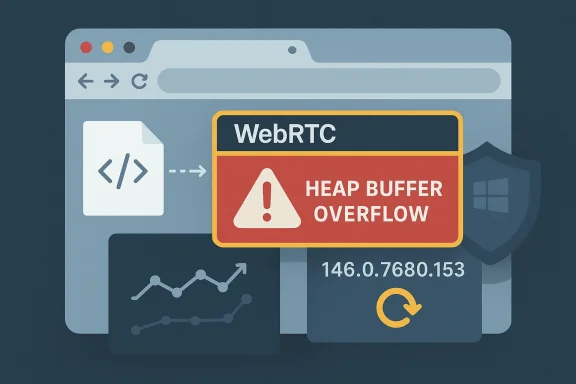 Overview
CVE-2026-4463 is not simply another line item in a monthly patch listat browser security remains a moving target, especially when a browser implements the modern web’s most interactive features. WebRTC was built to enable voice, video, and real-time communication without plugins, but those gains came with a larger parser and more complex memory-management responsibilities. Complex code tends to attract complex bugs, and heap corruption remains one of the most dangerous bug classes on any platform.The issue was received from Chrome on March 19, 2026, and NVD’s initial analysis followed on Marcmeline suggests the vulnerability moved rapidly from vendor disclosure into the public tracking ecosystem. Fast movement is good for defenders, but it also means security teams need to be disciplined about how they interpret early records: some fields are still provisional, and the NVD page itself indicates that certain assessments were not yet provided** at the time of publication.
Microsoft’s inclusion of the CVE in its own update guide is just as significant as Google’s fix. Edge is Chromium-based, so rome’s upstream engine generally translates into a fix Microsoft must ingest and ship downstream. That means the operational question is not whether the bug “belongs” to Google or Microsoft. It is whether every browser build in the environment has passed the version threshold where the vulnerable code has been replaced.
This is where Chromium CVEs differ from isolated application bugs. One vendor patch can flow through multiple products, and each product can have its own rollout schedule, enterprise controls, and update latency. A consumer can often solve the problem by relaunching the browser. A managed enterprise may have to synchronize patch rings, software distribution policies, and exception handling. That gap between a released fix and a fully patched fleet is where attackers often look for leverage.
Why WebRTC Bugs Are So Sensitive
WebRTC is designed to deliver real-time media with minimal friction, which makes it both powerful and risky. The engine needs to handle signaling, codecs, packet timing, network adaptation, and media state transitions while still remaining fast enough for interactive use. Any subsystem that has to ingest attacker-influenced data at this depth becomes a high-value target for memory corruption research.A heap buffer overflow in WebRTC is especially concerning because heaps are where browsers keep lots of structured data close together. If a write overruns its intended boundary, it may corrupt adjacent me, or pointers. That can cause a clean crash, but it can also create conditions for exploitation if the attacker can predict the allocation pattern and steer execution toward useful memory artifacts. The exact exploitability depends on the surrounding defenses, but the bug class is inherently dangerous.
Why the Attack Surface Is Broad
The phrase “crafted HTML page” is deceptively compact. It implies that an attacker may not need a special protocol stack, a compromised server, or a locally installed component. If the browser he vulnerable WebRTC path through normal web content, the exposure is broad enough to affect ordinary browsing scenarios, embedded content, and potentially in-product communication flows.That broadness is what makes browser memory bugs so valuable to attackers. They are user-driven, scalable, and often deliver an exploit primitive without requiring a complicated precondition. Even if the final payload is not reliable code execution, a heap corruption bug can still be useful as a crash primitive, a denial-of-service tool, or a stepping stone in a multi-bug chain.
- Remote reachability increases operational risk.
- User interaction lowers the technical bar for delivery.
- Heap corruption raises the stakes well beyond a simple crash.
- Browser ubiquity turns one defect into a fleet-wide concern.
- **Cross-vendor inhetream products must patch quickly.
Patch Thresholds and Version Discipline
The key remediation milestone here is simple: Chrome versions before 146.0.7680.153 are vulnerable. That version boundary matters because browser patching is no longer about “latest major release” thinking; it is about exact build numbers and release rings. Security teams need to verify not just that the browser says “146,” but that the deployed build actually meets or exceeds the fix threshold.Google’s release machinery often stages updates across populations, which can be helpful for stability but annoying from a security standpoint. That means a browser may exist in a nominally updated family while still sitting on a vulnerable build for a short time. In practice, *version verification beats assumption every tint includes pinned packages, deferred auto-update, or ring-based rollout, the vulnerable window can stay open longer than many users expect.
What Administrators Should Verify
Administrators should treat the version threshold as the first audit control, not the last. Confirming Chrome and Chromium-based browser versions is only part of the job, because enterprise environments often include multiple browser channels, managed profiles, and side-loaded applications with embedded wein one ring can update while another remains stale for policy reasons, leaving inconsistent exposure across the same tenant.A practical response sequence looks like this:
- Inventory all Chromium-based browsers and embedded WebView consumers.
- Confirm whether any instance is below 146.0.7680.153.
- Force or accelerate update deployment where policy permits.
- Validate post-update build numbers, not just browser labels.
- Recheck managed endpoints after restart enforcement.
What the Severity Rating Really Means
Chromium’s own High designation tells us the team considered the issue serious enough to warrant urgent correction. The NVD record had not yet finalized all fields, but the CISA-ADP contribution gave it a CVSS 3.1 score of 8.8, with confidentiality, integrity, and availability all marked as potentially high impact. That is the sort of score that forces a vulnerability out otegory and into active response.The vector also matters. AV:N means network attack vector, and UI:R means user interaction is required. That combination is common in browser exploits because the browser is the user interaction layer. But “requires user interaction” should not be mistaken for low risk. For a browser bug, user interaction can be as simple as visiting a page or loading a page element, which is a far less meaningful barrier than a complex local privilege escah Is the Right Mental Model
Security teams sometimes underrate browser bugs because they do not immediately imply system compromise. That is a mistake. Browser exploitation often starts with a memory safety flaw, then moves to sandbox escape or privilege chaining, and only then reaches durable compromise. The first bug in the chain does not need to do everything; it only needs to do enough.
The CVE’s wording about “potentially exploit heap corruption” is avoids overclaiming while still signaling the right level of concern. We do not yet have public proof that the flaw was weaponized, and the record does not say a public exploit exists. But absence of a published exploit is not the same as absence of risk. On browser vulnerabilities, defenders should assume active research pressure even when public exploit code has not surfaced.
- High severity meaation.
- User interaction required still fits normal browsing behavior.
- Heap corruption can escalate beyond a crash.
- Network reachability broadens exposure dramatically.
- Incomplete NVD enrichment means early caution is warranted.
Microsoft Edge and the Downstream Problem
Microsoft’s Security Update Guide entry matters because it reflects how Chromium vulnerabilities are consumed downstream. Edge does not invent the bug, but it does inthe fix, and the deployment obligation. For Windows administrators, that means browser patching is a vendor-coordinated event, not a single update from one company.That downstream relationship is easy to underestimate. Enterprises often think in terms of “Chrome users” and “Edge users,” but the that a large portion of the browser market runs on shared Chromium plumbing. So a Chrome CVE can affect an Edge environment even when no Chrome executable is installed at all. That is one reason Microsoft surfaces Chromium CVEs in its update guide: it lets administrators trace upstream risk into a Microsoft-managed product lifecycle.
Why the Microsoft Listing Matters
Microsoft’s entry does not necessarily mean Edge is uniquely vulnerable in some different way. Instead, it is a signal that the downstream product line has relevance to the upstream fix. In practical terms, that helps administrators answer a critical question: has the Edge build in my environment ingested the fix yet? That is the question that determines whether the fleet is still exposed.This is also where patch validation gets tricky. A security team may have one branch of devices on Chrome, another on Edge, and a third on Chromium-based web shells or Electron-style applications. Even when the browser itself is patched, an embedded web engine can lag behind because it ships as part of another application’s release cadence. The weakest Chromium consumer in the estate defines the real risk posture.
- Edge inherits Chromium fixes through upstream ingestion.
- Build verification is required across all browser channels.
- Embedded Chromium engines can remain vulnerable even when browsers update.
- Enterprise fleets often contain mixed deployment patterns.
- Security Update Guide entries are operationally useful, not just informational.
Enterprise Exposure vs Consumer Exposure
For consumers, CVE-2026-4463 is mostly a matter of staying current and letting Chrome auto-update. Most users do not think about build numbers, and in a well-behaved consumer setup, they usually do not need to. The risk is still meaningful, but the response path is short: update, restart, and keep the browser on the supported channel.Enterprise environments are more complicated. Policies that improve stability can also delay remediation, especially when updates are staged, paused, or subject to compatibility testing. If the browser is managed through endpoint tools, the patch may already exist upstream while the local endpoint remains on an old build due to validation or user uptime constraints. That mismatch is where a “fixed” vulnerability stays exploitable.
Fleet Management Realities
Browser updates are not just software deployments; they are behavior changes. Some environments force immediate relaunches, while others let users defer until convenient. A vulnerability like this exposes the cost of that convenience because the vulnerable code pa for days or weeks in a managed estate if enforcement is weak. The lesson is blunt: patching policy is part of the security perimeter.This is particularly true in hybrid Windows environments, where users may move between office desktops, laptops, VDI sessions, and remote work setups. Each context can have a different update moment and a different trust level. If a remote user launches a browser from an older image or a delayed update channel, they can reintroduce the vulnerable build into what appears to be a modern, centrally managed environment.
- Consumers mainly need the latest browser build.
- Enterprises need version control, policy enforcement, and inventory accuracy.
- VDI and image-based deployments can lag behind live patch channels.
- User restart behavior remains a hidden exposure factor.
- Operational exceptions can preserve vulnerable code long after disclosure.
Why Memory Safety Keeps Returning
The browser world has spent years trying to reduce the number of exploitable memory corruption bugs, but the problem is stubborn because the attack surface is huge and the code is performance-sensitive. WebRTC, like graphics, parsing, and JavaScript engines, tends to sit in the parts of the browser where speed and complexity collide. That collision produces the kinds of mistakes that are hard to eradicate with simple code review alone.The history is also instructive because it shows how exploit chains evolve. Attackers often do not need a single perfect bug; they need one reliable primitive and one secondary escalation path. Heap corruption, even when not immediately weaponized, is often the primitive that makes a full compromise feasible. That is why browser vendors treat memory safety with a level of urgency that might seem disproportionate to casual users. It is not disproportionate at all.
Why WebRTC Recurs in Security Reports
WebRTC is not the first browser subsystem to draw security attention, and it will not be the last. Any feature that processes structured external input at scale can become a recurring source of vulnerabilities. The important part is not that bugs exist — all large codebases have bugs — but that vendors can detect, assign, and ship fixes quickly enough to stion.This is where the Chrome 146 fix matters as a milestone. Versioned remediation lets administrators align their compliance policies with concrete build numbers instead of vague “we patched recently” claims. In a threat landscape where browser exploitation can begin with a single page load, precise remediation criteria are not paperwork; they are operational controls.
- Memory safety bugs remain common in large C/C++ browser codebases.
- **Performance-seare especially difficult to harden.
- Exploit chains often need only one foothold bug.
- Rapid vendor response is the main defense against weaponization.
- Version thresholds are more reliable than general reassurance.
Detection, Monitoring, and Response
The first line of defense is patching, but monitoring still matters because not every endpoint updates on schedule. Security teams should use asset invery Chromium-based browser and any application that embeds a browser engine. If a system can render HTML and process WebRTC-capable content, it deserves the same attention as an ordinary browser installation.The second line is behavioral awareness. A vulnerability that is triggered by a crafted HTML page means suspicious browsing activity, unusual media-handling promrowser crashes should be examined in context. Not every crash will be CVE-2026-4463, but browser crashes during page rendering deserve faster triage when a fresh heap overflow is public.
Practical Security Actions
The response does not have to be exotic. Most organizations already have the tools needed; they simply need to prioritize thorchestration, endpoint compliance reports, browser version telemetry, and crash monitoring together form a useful picture. If a system is still below the fixed build, it is still in scope.Where possible, administrators should also check browser-extension policies, web filtering controls, and external site restrictions. Those controls will not “fix” the bug, but they can reduce exposure by shrinking the universe of pages that can be loaded in the first place. In defensive terms, that is not a substitute for patching; it is a delay tactic that buys time while rollout completes.
- Confirm all browser builds against the fixed version.
- Push relaunches where update adoption is delayed.
- Review crash telemetry for browser-rendering anomalies.
- Validate embedded Chromium consumers, not just browsers.
- Tighten or high-risk user groups.
Strengths and Opportunities
The good news is that this is a well-understood class of problem with a clear vendor fix path. Chrome has already crossed the vulnerable threshold, Microsoft is tracking the issue downstream, and the public record is sufficiently specific to let defenders focus on version hygiene rather than guesswork. Thnizations a real opportunity to tighten browser governance in ways that will help beyond this one CVE.- Clear fixed version makes remediation straightforward.
- High-severity labeling helps prioritize executive attention.
- Downstream Microsoft tracking improves visibility for Edge estates.
- Version-based triage can be automated in endpoint tooling.
- Browser telemetry c quickly.
- User education can reinforce restart compliance.
- Patch validation discipline improves readiness for future Chromium CVEs.
Risks and Concerns
The biggest concern is that browser vulnerabilities have a long history of moving from disclosure to exploitation quickly, especially when the bug sits in a high-value component and the trigger is as generic as a web page. Even without public exploit code, attackers are highly motivated to study fresh Chromium memory bugs because the return on investment can be substantial. The other concern is operational: managed environments often leave a nontrivial tail of unpatched devices behind policy, travel, or user behavior.- Heap corruption can become code execution under the right conditions.
- User interaction is not a meaningful shield in browser threat models.
- Delayed restarts can leave patched machines functionally vulnerable.
- Embedded browser engines often lag behind browser updates.
- Mixed Chrome/Edge estates complicate compliance tracking.
- Incomplete enrichment can delay precise severity interpretation.
- Public exploit research may emerge after the initial disclosure window.
Looking Ahead
The next questions are straightforward: how quickly do downstream vendors absorb the fix, how many endpoints remain below the safe build number, and whether any exploitation attempts appear once the bug is widely known. Those answers will matter more than the headline severity because they determine whether the issue stays theoretical or becomes operational. Browser security is increasingly a race between vendor patch velocity and attacker reverse engineering.Security teams should also watch for related Chromium advisories in adjacent subsystems. A fresh heap overflow in WebRTC can sometimes coexist with other browser memory issues in the same release cycle, and attackers may prefer the easiest chain rather than the most famous CVE. That means the broader lesson is not just “patch this one bug,” but “treat the entire Chromium update train as a priority event.”
- Track Chrome and Edge build numbers until every ring is current.
- Monitor crash reports for suspicious browser instability.
- Check embedded Chromium consumers and web-view hosts.
- Watch for exploit chatter in the days after patch disclosure.
- Treat all Chromium security relmaintenance events.
Source: NVD / Chromium Security Update Guide - Microsoft Security Response Center
