

Microsoft’s June 9, 2026 security update lists CVE-2026-45653 as an Important Windows Kernel elevation-of-privilege vulnerability, one of several kernel-class fixes in a record-sized Patch Tuesday release affecting Windows client and server systems. The important word is not merely kernel; it is confidence. Microsoft is telling administrators that this is a real bug with credible technical detail behind it, even if the public advisory does not hand defenders a neat exploit narrative.
That distinction matters because elevation-of-privilege flaws rarely arrive alone in modern intrusions. They are the second act: the move from a phished user, a hijacked browser process, a poisoned developer workstation, or a weakly permissioned service account into the part of Windows where the attacker can turn persistence into ownership. CVE-2026-45653 is not the noisiest bug in June’s enormous update bundle, but it is exactly the kind of vulnerability that makes patch triage uncomfortable.
June 2026 Patch Tuesday is already being framed as a scale event. Reports around the release put the number of Microsoft-fixed flaws at roughly 200, with dozens of critical issues and three publicly disclosed zero-days in the broader set. In that crowd, a single Important-rated Windows Kernel elevation-of-privilege vulnerability can look like one more row in a spreadsheet.
That is the wrong way to read it. Kernel EoP vulnerabilities are not generally the opening punch from across the internet; they are the lockpick used after an attacker already has a foothold. A remote code execution flaw gets the headlines because it suggests entry. A kernel elevation bug earns operational attention because it can decide whether entry becomes full compromise.
CVE-2026-45653 sits in the Windows Kernel bucket alongside other kernel and NT OS Kernel issues fixed in the same release. Microsoft has not publicly described it as exploited in the wild, and the advisory title does not reveal a root cause such as use-after-free, race condition, integer overflow, or improper access control. That absence of detail is not unusual for MSRC advisories, but it creates the classic Patch Tuesday dilemma: defenders must act on sparse public information while attackers reverse-engineer the patch at their own pace.
The user-supplied MSRC text about report confidence is unusually helpful here. It explains that Microsoft’s metric is about the degree of confidence in both the existence of the vulnerability and the credibility of known technical details. In plain English, the issue is not speculative vapor. It has enough substance behind it that Microsoft assigned a CVE, shipped a fix, and placed it into the security update flow.
That sounds bureaucratic until you remember how vulnerability intelligence actually arrives. Sometimes there is a crash dump and a hunch. Sometimes there is a researcher report without a complete root-cause analysis. Sometimes there is proof-of-concept code, a vendor reproduction, and a patch. Sometimes there is only a rumor amplified by scanners hungry for CVE-shaped content.
For CVE-2026-45653, Microsoft’s inclusion in the Security Update Guide is itself an acknowledgement that the vulnerability cleared the vendor’s bar. The available public material does not appear to include exploit code or detailed technical write-ups, but the report-confidence framing says defenders should treat the underlying issue as credible. That is enough to move it out of the “watch” pile and into the “patch on schedule, faster for high-risk systems” pile.
The uncomfortable corollary is that confidence benefits both sides. The more certain the industry is that a kernel bug exists, the more likely professional attackers are to examine the changed binaries. A thin advisory does not mean a thin vulnerability. It may simply mean the technical detail is being withheld while the patch window opens.
A kernel elevation-of-privilege flaw is one way out of that box. If an attacker can execute code as a low-privileged user and then trigger a kernel bug, the prize may be SYSTEM-level execution, kernel memory access, security product tampering, credential theft, or deeper persistence. The details vary by flaw, but the strategic role is consistent: it converts limited execution into platform authority.
That is why “local” does not mean “low risk.” Local privilege escalation usually requires the attacker to already run code on the machine, but in 2026 that requirement is not a comfort. Initial access can come from stolen VPN credentials, malicious OAuth consent, a poisoned npm package, a macro-less document chain, a vulnerable line-of-business app, or a help desk remote-control session gone wrong. Once an attacker lands, privilege escalation becomes the difference between a contained incident and a domain problem.
For administrators, the kernel label should also trigger a compatibility reflex. Kernel changes can affect drivers, endpoint protection tools, virtualization stacks, backup agents, storage filters, and older hardware support. That does not argue against patching. It argues for knowing which machines are fragile before the maintenance window starts.
That opacity is partly defensive. Microsoft often withholds technical specifics to reduce copycat exploitation during the patch uptake period. In theory, that gives defenders time. In practice, it also means enterprise teams must make deployment decisions without the detail they would prefer.
This is where Patch Tuesday discipline matters more than advisory drama. If an organization waits for exploit chatter before patching kernel elevation issues, it is outsourcing triage to attackers and public researchers. By the time exploit notes appear, the window has already shifted from prevention to exposure management.
The better approach is to treat CVE-2026-45653 as part of a cluster: Windows kernel, local elevation, Important severity, credible vendor-confirmed vulnerability, fixed in the June 2026 cumulative update stream. It does not need to be the first patch applied across every estate, but it belongs in the standard high-priority Windows rollout, especially on endpoints where users browse, open documents, install tools, or handle external content.
CVE-2026-45653 is exactly that kind of link. A phishing payload that lands in user space is more dangerous if it can pair with a kernel EoP. A compromised developer workstation is more dangerous if local admin boundaries can be bypassed. A virtual desktop pool is more dangerous if a low-integrity session can be turned into system-level control. A kiosk, jump box, or shared workstation is more dangerous if local privilege separation becomes unreliable.
This is why kernel EoP bugs are often prized even when they are not independently flashy. Attackers do not need every vulnerability to be a front door. They need one vulnerability to enter, another to elevate, another to move laterally, and another to persist. Defenders who triage each CVE as if it exists alone will underestimate the utility of the middle links.
The record size of the June 2026 release makes this worse. With so many CVEs competing for attention, teams are likely to prioritize critical RCEs, publicly disclosed zero-days, and internet-facing services first. That is rational. But it also means local elevation bugs can become the long tail of exposure on the very machines most likely to be touched by users and attackers.
User endpoints should move early. Laptops and desktops are where initial compromise most often becomes interactive attacker activity, and they are also where local privilege boundaries matter most. Developer workstations deserve special attention because they combine broad tooling, secrets, package managers, elevated workflows, and access to source code or deployment systems.
Servers require a slightly different lens. A domain controller, virtualization host, RDS host, file server, or management server does not need casual browsing exposure to be sensitive. If an attacker reaches local execution on one of those systems, a kernel EoP may drastically raise the stakes. The operational risk of patching must be balanced against the security cost of leaving a privilege-escalation primitive in place.
Then there are the in-between systems: jump boxes, admin workstations, build agents, monitoring servers, EDR consoles, and remote-support machines. These often become the soft connective tissue of enterprise compromise. They may not be internet-facing, but they sit close to power. Kernel elevation flaws on those systems deserve more respect than their severity label alone may imply.
Patch diffing has narrowed the gap between vendor release and attacker understanding. Once a cumulative update ships, researchers and adversaries can compare binaries, inspect changed code paths, and infer what Microsoft fixed. Kernel bugs are harder to weaponize than many application bugs, but they are also worth the effort because the payoff is high.
That is why the phrase “not known to be exploited” should be read carefully. It means Microsoft is not publicly saying it has seen exploitation. It does not mean nobody can exploit it. It does not mean nobody is trying. And it certainly does not mean the bug should wait until the next convenient quarterly maintenance cycle.
For home users, the guidance is simpler: install the June 2026 cumulative updates as soon as practical, after backing up important data and allowing for normal reboot time. For managed environments, the guidance is more procedural: test quickly, deploy in rings, monitor for driver or endpoint-agent regressions, and accelerate rollout to high-risk device groups.
Unsupported or under-supported Windows systems are not just missing features. They gradually become collections of known defects with uneven remediation paths. If CVE-2026-45653 affects a Windows build that is not receiving normal updates in a given environment, the patch question becomes an asset-management question. Which systems are still there, why are they still there, and what compensating controls actually stand between them and attacker-controlled code?
The Windows 10 transition was never going to be clean. Hardware eligibility, app compatibility, budget cycles, industrial systems, medical devices, and long-lived line-of-business dependencies all slow migration. But security advisories like this one expose the cost of drift. The kernel does not care that a machine is politically hard to replace.
Windows 11 and supported Windows Server releases do not make kernel bugs disappear, but they do keep organizations inside the normal servicing lane. That matters. The first control for a vendor-fixed vulnerability is still the vendor fix, and the systems least able to consume that fix are the ones that require the most compensating attention.
That is one reason administrators sometimes slow-roll kernel updates. They remember blue screens caused by fragile drivers. They remember EDR agents that needed an update before Windows could be patched safely. They remember storage filter conflicts, VPN breakage, and vendor support cases that consumed a weekend.
Those memories are valid, but they can become institutional superstition. The answer is not to avoid kernel patches. The answer is to maintain a representative test ring, keep driver and firmware inventories current, watch vendor advisories, and know which machines have unusual kernel-mode dependencies. A patch process that cannot safely absorb kernel fixes is itself a security weakness.
CVE-2026-45653 should be used as another prompt to audit that readiness. If your organization cannot say which endpoints run non-Microsoft kernel drivers, which servers depend on legacy filter drivers, or which security tools require minimum Windows build levels, the next kernel vulnerability will create the same panic. Patch Tuesday is monthly; improvisation should not be.
That is dangerous for Important-rated issues. “Important” in Microsoft’s taxonomy does not mean “optional.” It often means the vulnerability has meaningful security impact but lacks the wormable, unauthenticated, or broadly remote characteristics that push it into Critical. For elevation-of-privilege vulnerabilities, Important is a common rating because the attacker usually needs some prior access.
But prior access is abundant. Commodity malware, infostealer ecosystems, malicious browser extensions, fake software installers, remote monitoring tool abuse, and identity compromise all create local execution opportunities. In that world, privilege escalation is not a theoretical postscript. It is a normal step in the intrusion playbook.
CVE-2026-45653 therefore belongs to a broader pattern: Windows hardening has made single-step compromise harder, but it has increased the value of reliable chain components. A kernel EoP does not have to be dramatic to be useful. It only has to work after the first foothold.
The patch gap is not merely the time between release and installation. It is the time between public availability of a fix and public or private understanding of how to exploit the fixed flaw. For some bugs, that gap is long. For others, it can be uncomfortably short. The difference depends on code complexity, patch clarity, exploit reliability, mitigations, and attacker motivation.
Kernel vulnerabilities are not always easy to weaponize, but Windows is a high-value target and kernel privilege is a high-value outcome. That makes even sparsely described bugs attractive research targets. Organizations should assume that technical detail may increase after the update ships, not before.
This is why waiting for a blog post is backwards. By the time a public technical analysis appears, defenders should ideally be measuring patch coverage, not deciding whether the issue matters. CVE-2026-45653 may never become a headline exploit, but the right posture is to close the gap before someone else makes it operationally interesting.
There are still practical precautions. Back up important files before major update cycles. Keep device drivers current through reputable vendor channels. Avoid unsigned utilities that demand administrator access. Be wary of “optimizer,” “debloater,” and hardware-monitoring tools that install low-level components without a clear vendor trust story.
The temptation in enthusiast circles is to treat every kernel advisory as a puzzle to solve manually. That can be educational, but it should not delay patching. If a system is supported and the update is available, the sane default is to install it.
For users running unsupported Windows builds, the answer is less comfortable. If updates are not available through normal channels, the risk is not confined to CVE-2026-45653. The machine is on the wrong side of the servicing model. At that point, upgrading, enrolling in a legitimate extended update path where available, isolating the device, or retiring it becomes the real mitigation conversation.
Start with exposure tiers. Internet-facing servers and critical RCEs may still go first, but user endpoints, admin workstations, developer machines, and privileged access workstations should not be allowed to drift. Kernel EoP risk concentrates where attackers can gain initial user-mode execution and where local privilege boundaries protect valuable credentials or management rights.
Next, watch for quality signals. Windows cumulative updates sometimes carry known issues, and enterprise teams should monitor Microsoft’s release health notes, vendor advisories for endpoint agents, and early pilot-ring telemetry. The goal is not zero risk; it is fast detection of deployment problems before they become estate-wide outages.
Finally, measure actual installation, not just approval. A patch approved in WSUS, Intune, Configuration Manager, or another management platform is not the same as a rebooted and remediated machine. Kernel fixes generally require restart semantics to matter. Compliance dashboards should distinguish pending reboot from completed remediation.
That flatness leads to crude patching. Everything becomes either “all devices” or “critical servers,” with little recognition that a developer laptop may be more strategically sensitive than a lightly used file server. Kernel elevation bugs punish that simplification because their impact depends heavily on what an attacker can reach after privilege escalation.
A better inventory marks privilege adjacency. Which machines are used by domain admins? Which systems can push software? Which endpoints have access to production cloud subscriptions? Which build agents can sign code or publish packages? Which jump boxes bridge network zones? Those are the machines where local elevation deserves accelerated attention.
CVE-2026-45653 should be read through that lens. Not every Windows device has equal consequence, but every Windows device can become a stepping stone. The job of asset management is to know which stepping stones lead uphill.
That distinction matters because elevation-of-privilege flaws rarely arrive alone in modern intrusions. They are the second act: the move from a phished user, a hijacked browser process, a poisoned developer workstation, or a weakly permissioned service account into the part of Windows where the attacker can turn persistence into ownership. CVE-2026-45653 is not the noisiest bug in June’s enormous update bundle, but it is exactly the kind of vulnerability that makes patch triage uncomfortable.
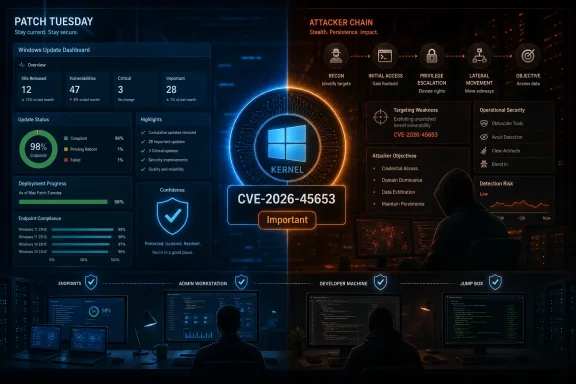 Microsoft’s Quiet Kernel Bug Lands Inside a Loud Patch Tuesday
June 2026 Patch Tuesday is already being framed as a scale event. Reports around the release put the number of Microsoft-fixed flaws at roughly 200, with dozens of critical issues and three publicly disclosed zero-days in the broader set. In that crowd, a single Important-rated Windows Kernel elevation-of-privilege vulnerability can look like one more row in a spreadsheet.That is the wrong way to read it. Kernel EoP vulnerabilities are not generally the opening punch from across the internet; they are the lockpick used after an attacker already has a foothold. A remote code execution flaw gets the headlines because it suggests entry. A kernel elevation bug earns operational attention because it can decide whether entry becomes full compromise.
CVE-2026-45653 sits in the Windows Kernel bucket alongside other kernel and NT OS Kernel issues fixed in the same release. Microsoft has not publicly described it as exploited in the wild, and the advisory title does not reveal a root cause such as use-after-free, race condition, integer overflow, or improper access control. That absence of detail is not unusual for MSRC advisories, but it creates the classic Patch Tuesday dilemma: defenders must act on sparse public information while attackers reverse-engineer the patch at their own pace.
The user-supplied MSRC text about report confidence is unusually helpful here. It explains that Microsoft’s metric is about the degree of confidence in both the existence of the vulnerability and the credibility of known technical details. In plain English, the issue is not speculative vapor. It has enough substance behind it that Microsoft assigned a CVE, shipped a fix, and placed it into the security update flow.
Report Confidence Is the Signal Hiding in the Fine Print
Security advisories are full of numbers that invite false precision. CVSS scores, severity labels, exploitability assessments, and attack complexity fields all attempt to compress messy engineering facts into fields that can be sorted by a vulnerability management system. Report confidence is different. It is less about blast radius and more about whether the industry should trust that the thing exists.That sounds bureaucratic until you remember how vulnerability intelligence actually arrives. Sometimes there is a crash dump and a hunch. Sometimes there is a researcher report without a complete root-cause analysis. Sometimes there is proof-of-concept code, a vendor reproduction, and a patch. Sometimes there is only a rumor amplified by scanners hungry for CVE-shaped content.
For CVE-2026-45653, Microsoft’s inclusion in the Security Update Guide is itself an acknowledgement that the vulnerability cleared the vendor’s bar. The available public material does not appear to include exploit code or detailed technical write-ups, but the report-confidence framing says defenders should treat the underlying issue as credible. That is enough to move it out of the “watch” pile and into the “patch on schedule, faster for high-risk systems” pile.
The uncomfortable corollary is that confidence benefits both sides. The more certain the industry is that a kernel bug exists, the more likely professional attackers are to examine the changed binaries. A thin advisory does not mean a thin vulnerability. It may simply mean the technical detail is being withheld while the patch window opens.
Kernel Elevation Is Where Initial Access Becomes Control
Windows kernel vulnerabilities are so persistent in attacker tradecraft because they solve a practical problem. Modern Windows has become much harder to own outright from a single user-mode bug. Browser sandboxes, application isolation, credential protections, virtualization-based security, Defender hardening, and least-privilege defaults all try to keep compromise in a smaller box.A kernel elevation-of-privilege flaw is one way out of that box. If an attacker can execute code as a low-privileged user and then trigger a kernel bug, the prize may be SYSTEM-level execution, kernel memory access, security product tampering, credential theft, or deeper persistence. The details vary by flaw, but the strategic role is consistent: it converts limited execution into platform authority.
That is why “local” does not mean “low risk.” Local privilege escalation usually requires the attacker to already run code on the machine, but in 2026 that requirement is not a comfort. Initial access can come from stolen VPN credentials, malicious OAuth consent, a poisoned npm package, a macro-less document chain, a vulnerable line-of-business app, or a help desk remote-control session gone wrong. Once an attacker lands, privilege escalation becomes the difference between a contained incident and a domain problem.
For administrators, the kernel label should also trigger a compatibility reflex. Kernel changes can affect drivers, endpoint protection tools, virtualization stacks, backup agents, storage filters, and older hardware support. That does not argue against patching. It argues for knowing which machines are fragile before the maintenance window starts.
The Advisory Says Less Than Admins Want, but Enough to Act
The most frustrating thing about CVE-2026-45653 is also the most normal thing about it: the public description is minimal. “Windows Kernel Elevation of Privilege Vulnerability” tells us the component and impact class, but not the exploitation path. We do not get a public function name, a vulnerable subsystem, or a reliable affected-scenario narrative.That opacity is partly defensive. Microsoft often withholds technical specifics to reduce copycat exploitation during the patch uptake period. In theory, that gives defenders time. In practice, it also means enterprise teams must make deployment decisions without the detail they would prefer.
This is where Patch Tuesday discipline matters more than advisory drama. If an organization waits for exploit chatter before patching kernel elevation issues, it is outsourcing triage to attackers and public researchers. By the time exploit notes appear, the window has already shifted from prevention to exposure management.
The better approach is to treat CVE-2026-45653 as part of a cluster: Windows kernel, local elevation, Important severity, credible vendor-confirmed vulnerability, fixed in the June 2026 cumulative update stream. It does not need to be the first patch applied across every estate, but it belongs in the standard high-priority Windows rollout, especially on endpoints where users browse, open documents, install tools, or handle external content.
The Real Risk Is the Chain, Not the Single CVE
Security teams often ask whether a vulnerability is “exploitable remotely” because remote bugs are easier to justify in emergency change meetings. That question is useful, but incomplete. The better question is whether the vulnerability helps complete an attack chain that is already plausible in your environment.CVE-2026-45653 is exactly that kind of link. A phishing payload that lands in user space is more dangerous if it can pair with a kernel EoP. A compromised developer workstation is more dangerous if local admin boundaries can be bypassed. A virtual desktop pool is more dangerous if a low-integrity session can be turned into system-level control. A kiosk, jump box, or shared workstation is more dangerous if local privilege separation becomes unreliable.
This is why kernel EoP bugs are often prized even when they are not independently flashy. Attackers do not need every vulnerability to be a front door. They need one vulnerability to enter, another to elevate, another to move laterally, and another to persist. Defenders who triage each CVE as if it exists alone will underestimate the utility of the middle links.
The record size of the June 2026 release makes this worse. With so many CVEs competing for attention, teams are likely to prioritize critical RCEs, publicly disclosed zero-days, and internet-facing services first. That is rational. But it also means local elevation bugs can become the long tail of exposure on the very machines most likely to be touched by users and attackers.
Endpoint Fleets Are the Front Line, Not the Afterthought
For WindowsForum readers, the most practical question is not whether CVE-2026-45653 is interesting. It is where it should land in a deployment plan. The answer depends less on the CVE entry itself than on the role of the affected machines.User endpoints should move early. Laptops and desktops are where initial compromise most often becomes interactive attacker activity, and they are also where local privilege boundaries matter most. Developer workstations deserve special attention because they combine broad tooling, secrets, package managers, elevated workflows, and access to source code or deployment systems.
Servers require a slightly different lens. A domain controller, virtualization host, RDS host, file server, or management server does not need casual browsing exposure to be sensitive. If an attacker reaches local execution on one of those systems, a kernel EoP may drastically raise the stakes. The operational risk of patching must be balanced against the security cost of leaving a privilege-escalation primitive in place.
Then there are the in-between systems: jump boxes, admin workstations, build agents, monitoring servers, EDR consoles, and remote-support machines. These often become the soft connective tissue of enterprise compromise. They may not be internet-facing, but they sit close to power. Kernel elevation flaws on those systems deserve more respect than their severity label alone may imply.
Exploitability Labels Are Helpful Until They Become an Excuse
Microsoft’s exploitability assessments can be useful, especially when they identify vulnerabilities more likely to be exploited. But they should not become a permission slip for delay. The absence of known exploitation is a snapshot, not a guarantee.Patch diffing has narrowed the gap between vendor release and attacker understanding. Once a cumulative update ships, researchers and adversaries can compare binaries, inspect changed code paths, and infer what Microsoft fixed. Kernel bugs are harder to weaponize than many application bugs, but they are also worth the effort because the payoff is high.
That is why the phrase “not known to be exploited” should be read carefully. It means Microsoft is not publicly saying it has seen exploitation. It does not mean nobody can exploit it. It does not mean nobody is trying. And it certainly does not mean the bug should wait until the next convenient quarterly maintenance cycle.
For home users, the guidance is simpler: install the June 2026 cumulative updates as soon as practical, after backing up important data and allowing for normal reboot time. For managed environments, the guidance is more procedural: test quickly, deploy in rings, monitor for driver or endpoint-agent regressions, and accelerate rollout to high-risk device groups.
Windows 10’s Long Goodbye Raises the Stakes
June 2026 also lands in the shadow of Windows 10’s post-mainstream reality. With Windows 10 already beyond its October 2025 end-of-support milestone for standard consumer servicing, many environments are now operating under extended security arrangements, migration exceptions, or informal risk acceptance. That changes the meaning of every Windows kernel advisory.Unsupported or under-supported Windows systems are not just missing features. They gradually become collections of known defects with uneven remediation paths. If CVE-2026-45653 affects a Windows build that is not receiving normal updates in a given environment, the patch question becomes an asset-management question. Which systems are still there, why are they still there, and what compensating controls actually stand between them and attacker-controlled code?
The Windows 10 transition was never going to be clean. Hardware eligibility, app compatibility, budget cycles, industrial systems, medical devices, and long-lived line-of-business dependencies all slow migration. But security advisories like this one expose the cost of drift. The kernel does not care that a machine is politically hard to replace.
Windows 11 and supported Windows Server releases do not make kernel bugs disappear, but they do keep organizations inside the normal servicing lane. That matters. The first control for a vendor-fixed vulnerability is still the vendor fix, and the systems least able to consume that fix are the ones that require the most compensating attention.
The Kernel Is Also a Driver Ecosystem Problem
Windows kernel security is never only Microsoft’s problem. The operating system sits in a dense ecosystem of third-party drivers, hardware utilities, security agents, VPN clients, storage tools, anti-cheat systems, backup filters, and management software. Every kernel patch therefore lives at the intersection of security and compatibility.That is one reason administrators sometimes slow-roll kernel updates. They remember blue screens caused by fragile drivers. They remember EDR agents that needed an update before Windows could be patched safely. They remember storage filter conflicts, VPN breakage, and vendor support cases that consumed a weekend.
Those memories are valid, but they can become institutional superstition. The answer is not to avoid kernel patches. The answer is to maintain a representative test ring, keep driver and firmware inventories current, watch vendor advisories, and know which machines have unusual kernel-mode dependencies. A patch process that cannot safely absorb kernel fixes is itself a security weakness.
CVE-2026-45653 should be used as another prompt to audit that readiness. If your organization cannot say which endpoints run non-Microsoft kernel drivers, which servers depend on legacy filter drivers, or which security tools require minimum Windows build levels, the next kernel vulnerability will create the same panic. Patch Tuesday is monthly; improvisation should not be.
AI-Era Vulnerability Discovery Makes “Important” Feel Smaller Than It Is
One of the larger stories around recent Patch Tuesday cycles is volume. Security researchers, automated analysis, fuzzing, and increasingly AI-assisted discovery are pushing more bugs into vendor pipelines. The result is a paradox: the more vulnerabilities Microsoft fixes, the easier it becomes for each individual CVE to feel less urgent.That is dangerous for Important-rated issues. “Important” in Microsoft’s taxonomy does not mean “optional.” It often means the vulnerability has meaningful security impact but lacks the wormable, unauthenticated, or broadly remote characteristics that push it into Critical. For elevation-of-privilege vulnerabilities, Important is a common rating because the attacker usually needs some prior access.
But prior access is abundant. Commodity malware, infostealer ecosystems, malicious browser extensions, fake software installers, remote monitoring tool abuse, and identity compromise all create local execution opportunities. In that world, privilege escalation is not a theoretical postscript. It is a normal step in the intrusion playbook.
CVE-2026-45653 therefore belongs to a broader pattern: Windows hardening has made single-step compromise harder, but it has increased the value of reliable chain components. A kernel EoP does not have to be dramatic to be useful. It only has to work after the first foothold.
The Patch Window Is a Race Against Reverse Engineering
Once Microsoft ships a fix, the vulnerability enters a new phase. Before the patch, only the reporter, Microsoft, and perhaps a small number of other parties may understand the bug. After the patch, every interested researcher can study what changed. This is the familiar but often underappreciated patch gap.The patch gap is not merely the time between release and installation. It is the time between public availability of a fix and public or private understanding of how to exploit the fixed flaw. For some bugs, that gap is long. For others, it can be uncomfortably short. The difference depends on code complexity, patch clarity, exploit reliability, mitigations, and attacker motivation.
Kernel vulnerabilities are not always easy to weaponize, but Windows is a high-value target and kernel privilege is a high-value outcome. That makes even sparsely described bugs attractive research targets. Organizations should assume that technical detail may increase after the update ships, not before.
This is why waiting for a blog post is backwards. By the time a public technical analysis appears, defenders should ideally be measuring patch coverage, not deciding whether the issue matters. CVE-2026-45653 may never become a headline exploit, but the right posture is to close the gap before someone else makes it operationally interesting.
Home Users Should Not Overthink the Severity Label
For individual Windows users, the response should be boring. Let Windows Update install the June 2026 security update, reboot when prompted, and avoid trying to manually cherry-pick CVEs. Kernel elevation vulnerabilities are not something most home users can mitigate with a browser setting or a registry tweak.There are still practical precautions. Back up important files before major update cycles. Keep device drivers current through reputable vendor channels. Avoid unsigned utilities that demand administrator access. Be wary of “optimizer,” “debloater,” and hardware-monitoring tools that install low-level components without a clear vendor trust story.
The temptation in enthusiast circles is to treat every kernel advisory as a puzzle to solve manually. That can be educational, but it should not delay patching. If a system is supported and the update is available, the sane default is to install it.
For users running unsupported Windows builds, the answer is less comfortable. If updates are not available through normal channels, the risk is not confined to CVE-2026-45653. The machine is on the wrong side of the servicing model. At that point, upgrading, enrolling in a legitimate extended update path where available, isolating the device, or retiring it becomes the real mitigation conversation.
Admins Need a Deployment Story, Not a Severity Sort
The most effective response to CVE-2026-45653 is not a special emergency ritual. It is a mature monthly patch process that can handle kernel-class risk without either panic or paralysis. That means prioritization, telemetry, rollback planning, and communication.Start with exposure tiers. Internet-facing servers and critical RCEs may still go first, but user endpoints, admin workstations, developer machines, and privileged access workstations should not be allowed to drift. Kernel EoP risk concentrates where attackers can gain initial user-mode execution and where local privilege boundaries protect valuable credentials or management rights.
Next, watch for quality signals. Windows cumulative updates sometimes carry known issues, and enterprise teams should monitor Microsoft’s release health notes, vendor advisories for endpoint agents, and early pilot-ring telemetry. The goal is not zero risk; it is fast detection of deployment problems before they become estate-wide outages.
Finally, measure actual installation, not just approval. A patch approved in WSUS, Intune, Configuration Manager, or another management platform is not the same as a rebooted and remediated machine. Kernel fixes generally require restart semantics to matter. Compliance dashboards should distinguish pending reboot from completed remediation.
The June Kernel Fixes Expose the Cost of Flat Inventories
One reason CVE-2026-45653 is hard to prioritize is that many inventories are too flat. They know operating system versions, but not business role. They know device names, but not whether a machine is used for administration. They know patch status, but not whether the endpoint stores credentials, source code, certificates, or remote access tooling.That flatness leads to crude patching. Everything becomes either “all devices” or “critical servers,” with little recognition that a developer laptop may be more strategically sensitive than a lightly used file server. Kernel elevation bugs punish that simplification because their impact depends heavily on what an attacker can reach after privilege escalation.
A better inventory marks privilege adjacency. Which machines are used by domain admins? Which systems can push software? Which endpoints have access to production cloud subscriptions? Which build agents can sign code or publish packages? Which jump boxes bridge network zones? Those are the machines where local elevation deserves accelerated attention.
CVE-2026-45653 should be read through that lens. Not every Windows device has equal consequence, but every Windows device can become a stepping stone. The job of asset management is to know which stepping stones lead uphill.
The Practical Read on CVE-2026-45653
The CVE entry does not give defenders enough public detail to build a bespoke mitigation, and that is the point. This is a patch-management issue first, a reverse-engineering curiosity second. The useful conclusions are concrete.- CVE-2026-45653 is a Microsoft-confirmed Windows Kernel elevation-of-privilege vulnerability fixed in the June 9, 2026 security update cycle.
- The public advisory does not describe known exploitation, but the report-confidence language means the vulnerability should be treated as credible rather than speculative.
- The most important affected systems to prioritize are user endpoints, administrator workstations, developer machines, jump boxes, and servers where local code execution would be especially consequential.
- The risk is greatest as part of an attack chain, where a separate initial-access bug or credential compromise is followed by local privilege escalation.
- Organizations should verify completed installation and reboot status, not merely update approval, because kernel fixes do not protect systems that are still waiting to restart.
- Unsupported or irregularly serviced Windows systems require separate risk handling, because a vendor-fixed kernel vulnerability is only useful to defenders who can actually deploy the vendor fix.
References
- Primary source: MSRC
Published: 2026-06-09T07:00:00-07:00
Security Update Guide - Microsoft Security Response Center
 msrc.microsoft.com
- Related coverage: aha.org
- Official source: microsoft.com
Active attack: Dirty Frag Linux vulnerability expands post-compromise risk | Microsoft Security Blog
Dirty Frag is a newly disclosed Linux local privilege escalation vulnerability affecting kernel networking and memory-fragment handling components including esp4, esp6, and rxrpc. The vulnerability enables reliable escalation from an unprivileged user to root and may be leveraged after initial...www.microsoft.com - Related coverage: datacomm.com
- Related coverage: rapid7.com
Rapid7 Vulnerability Database
Rapid7's VulnDB is curated repository of vetted computer software exploits and exploitable vulnerabilities.www.rapid7.com - Related coverage: sentinelone.com
CVE-2026-34331: Windows 10 1607 Privilege Escalation Flaw
CVE-2026-34331 is a privilege escalation vulnerability in Windows 10 1607. Learn about its impact, affected versions, and mitigation methods.www.sentinelone.com
- Related coverage: absolute.com
- Related coverage: computerweekly.com
Microsoft smashes record for biggest ever Patch Tuesday update | Computer Weekly
Microsoft has not only broken but obliterated the record for the largest ever Patch Tuesday drop, with its June 2026 update addressing approximately 200 flaws, and three zero-days.www.computerweekly.com - Related coverage: bleepingcomputer.com
Microsoft June 2026 Patch Tuesday fixes 6 zero-days, 200 flaws
Today is Microsoft's June 2026 Patch Tuesday, with security updates for 200 flaws, including five publicly disclosed zero-day vulnerabilities and one actively exploited in attacks.www.bleepingcomputer.com - Related coverage: windowsreport.com
Microsoft fixes 51 vulnerabilities in the June 2026 Patch Tuesday update
Microsoft released the June Patch Tuesday updates that cover 51 CVEs including a critical zero day flaw. Here is all about them. windowsreport.com
- Related coverage: securityweek.com
Microsoft Patches 200 Vulnerabilities - SecurityWeek
Microsoft’s June 2026 Patch Tuesday updates fix roughly 200 vulnerabilities discovered in the company’s products.www.securityweek.com
- Related coverage: cez.gov.pl
- Related coverage: tdgsupport.com

Microsoft - Security Advisories - TDG Inc.
tdgsupport.com
- Related coverage: lansweeper.com
Microsoft Patch Tuesday – March 2026 - Lansweeper
Which vulnerabilities, issues, and other things did Microsoft update? Discover what's new using Lansweeper's Patch Tuesday March 2026 summary.www.lansweeper.com - Related coverage: sra.io
