

CVE-2026-46132 is a Linux kernel information-disclosure flaw published by NVD on May 28, 2026, after kernel.org reported that rtnetlink could leak up to 26 bytes of uninitialized kernel stack data per virtual function in certain SR-IOV network interface queries. The bug is not a Windows vulnerability, but it lands squarely in the WindowsForum orbit because modern Windows shops increasingly run Linux in WSL, Hyper-V guests, Kubernetes clusters, Azure images, storage appliances, firewalls, and mixed virtualization stacks. Its practical lesson is blunt: the kernel’s smallest memory-hygiene mistakes still matter when they sit on interfaces that local users can reach repeatedly.
This is not the kind of CVE that arrives with a logo, a catchy exploit name, or an instant dashboard panic. It is a one-line class of fix in a deep networking path: zero a stack structure before copying a short hardware address into a larger field. But those quiet bugs are often the ones that separate disciplined kernel engineering from wishful thinking, because they expose how much trust the operating system places in old conventions about who can ask the kernel for state and how clean that state will be when it is serialized back to userspace.
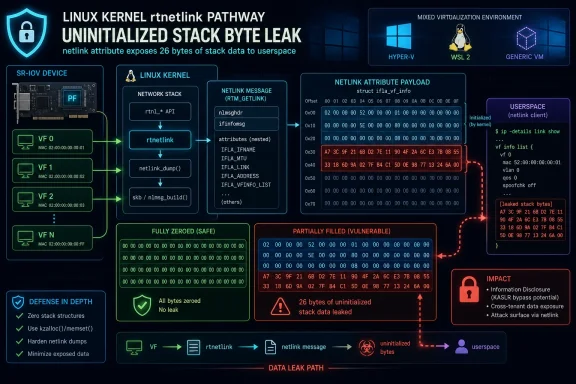
The vulnerability sits in the Linux kernel’s rtnetlink code, the route-netlink subsystem used by user-space tools to ask the kernel about network interfaces, routing state, link attributes, and device configuration. In the affected path,
At the center is a deceptively ordinary structure:
That partially filled structure was then sent to userspace through a netlink attribute. The result was an information leak: not a write primitive, not a crash, not a remote-code execution path, but a repeatable disclosure of kernel stack residue. In isolation, 26 bytes sounds trivial. In kernel exploitation, 26 bytes can be a breadcrumb.
The bug’s reachability is what gives it weight. According to the CVE description, an unprivileged local process can open
For many desktop users, that sounds distant. For administrators running Linux hosts under virtualization, container platforms, network appliances, or cloud images, it sounds familiar. The machines most likely to have SR-IOV networking are not hobby boxes; they are the systems where performance, isolation, and tenant density matter.
Kernel code routinely constructs ABI-facing data structures on the stack, fills fields, and passes those structures to copy-out routines. When every byte is deliberately initialized, this is fast and fine. When a structure is larger than the data being copied into it, the unwritten bytes become a tunnel from privileged memory into userspace.
The CVE text notes that neighboring structures in the same function were already explicitly cleared with
That is the uncomfortable part for kernel maintainers and downstream vendors alike. Mature codebases do not fail only because engineers misunderstand the rules; they fail because the rules are applied unevenly across years of edits, backports, hardware support, and API expansion. A single missed initializer can survive because everything around it looks routine.
This is also why information leaks remain so persistent in systems software. Languages like C give developers precise control over layout and performance, but they also make absence a security property. If no one writes to a byte, the byte still exists, still travels, and may still describe something the caller should never have seen.
That design creates a recurring security tension. The kernel needs to tell userspace enough to manage the system. But every attribute it emits must be treated as a boundary crossing, because even read-only metadata can reveal privileged implementation details. An information leak is still a leak when it arrives inside a legitimate management response.
The CVE’s path through
That does not mean every extended attribute should be harmless. SR-IOV virtual-function metadata belongs to the part of the system where host hardware, virtualization policy, and guest isolation meet. When that code accidentally serializes stack residue, a routine inventory request becomes a side channel.
The uncomfortable lesson is that “local only” should not be read as “low importance” on shared systems. A local user on a developer workstation is one thing. A local process inside a multi-user compute node, a container host, or a build farm is another. In 2026, “local” often means “already inside one layer of a much larger platform.”
That is why this vulnerability’s dependency on virtual functions cuts both ways. It limits exposure on ordinary laptops and basic VMs that do not expose SR-IOV details. But it concentrates relevance among the systems that tend to be more valuable: virtualization hosts, NFV platforms, private clouds, Kubernetes worker nodes with accelerated networking, and enterprise Linux machines running high-end NICs.
The leak is described as up to 26 bytes per VF per request. Multiply that by a host with many virtual functions and a process that can query repeatedly, and the bug stops looking like a single accidental disclosure and starts looking like a sampling mechanism. The leaked bytes are not guaranteed to contain secrets, but kernel stack residue can include pointers, return addresses, previous structure contents, or transient data that helps defeat other protections.
Modern exploitation often depends on chaining weak primitives. An info leak may be paired with a separate memory-corruption flaw to bypass address-space layout randomization. It may help an attacker infer kernel layout, identify build characteristics, or improve reliability. On hardened systems, disclosure bugs are not glamorous, but they can be the difference between a theoretical exploit and a practical one.
That does not mean every affected host is one step away from compromise. It means administrators should resist the old habit of ranking vulnerabilities only by whether they hand over root by themselves. Kernel security is cumulative. The leak you patch today may be the prerequisite an attacker needed for tomorrow’s exploit chain.
In recent years, kernel CVE records have often appeared quickly, sometimes before downstream distributions have finished mapping affected versions, advisories, and package updates. That produces an awkward window for administrators: the vulnerability is public, the upstream patch exists, but the enterprise advisory ecosystem may still be catching up. Security teams that rely only on scanner severity fields can miss the point during that window.
This is one reason kernel CVEs demand a different reading discipline than application CVEs. The interesting questions are not only “what score did NVD assign?” but “is this code present in my kernel line, did my vendor backport the fix, does my hardware expose the relevant path, and can unprivileged code reach it?” Those answers often arrive from distribution advisories and kernel changelogs rather than the first CVE stub.
There is also a naming trap. The phrase “information disclosure” sounds smaller than “privilege escalation,” and in many cases it is. But the Linux kernel sits below containers, hypervisors, sandboxing layers, and security products. If it discloses privileged memory repeatedly, the finding deserves operational attention even before a polished severity label appears.
The better posture is to treat the NVD entry as a pointer, not the whole story. It tells defenders that a class of bug has been acknowledged and patched upstream. The actual remediation decision belongs to the kernel vendor, distribution maintainer, appliance supplier, or platform team responsible for the running system.
The important engineering point is consistency. The CVE description says nearby virtual-function structures were already cleared before use. That pattern exists because netlink attributes commonly serialize fixed-size structures even when only part of the logical data is meaningful for a given device. In other words, the patch aligns
This is also the kind of fix that backports cleanly in many cases. The referenced stable commits indicate that the change was propagated across supported kernel lines. Downstream distributions may still package it under their own kernel release numbers, but administrators should expect the remediation to arrive as a normal kernel update rather than as a configuration workaround.
There is little reason to wait for drama. If your systems receive vendor kernels through Red Hat, Ubuntu, Debian, SUSE, Oracle, Canonical cloud images, appliance firmware, or a managed Kubernetes node image, the practical answer is to track the vendor’s update channel and reboot into the fixed kernel once available. Live patching may or may not cover a bug like this depending on provider support, but the universal remediation remains the same: run a kernel with the fix.
The harder part is asset awareness. Many organizations do not have a clean inventory of where SR-IOV is enabled, which tenants can reach which host interfaces, or which specialized Linux appliances are pinned to old kernels. CVE-2026-46132 is a reminder that hardware acceleration is not just a performance feature. It is part of the attack surface.
WSL puts Linux kernels on developer endpoints. Hyper-V hosts may run Linux guests for build systems, security tools, or internal services. Azure estates often mix Windows Server workloads with Linux-based appliances, AKS nodes, firewalls, proxies, and observability stacks. Even organizations that are “mostly Windows” frequently depend on Linux-based network gear and storage controllers whose update cycles are less visible than Patch Tuesday.
CVE-2026-46132 is not, by itself, a reason to panic about WSL on a laptop. The SR-IOV-specific path makes ordinary WSL exposure unlikely in typical consumer and developer configurations. But it is absolutely a reason for Windows-centric teams to verify that their Linux estate is actually part of vulnerability management rather than an exception handled by tribal memory.
The same is true for virtualization hosts. If a Windows admin team owns Hyper-V while a Linux platform team owns guest images, SR-IOV configuration can fall between organizational seams. The hardware setting lives with the host. The vulnerable code may live in the Linux guest or host depending on deployment. The remediation may be a kernel package, a node-image refresh, or a firmware-style appliance update.
Security boundaries do not care which team’s spreadsheet owns the acronym. If unprivileged code can make a kernel expose uninitialized memory, the relevant question is where that code can run and what the leaked context might help it attack next.
That distinction matters because many organizations are more permissive with local execution than they are with interactive login. Build runners execute untrusted code by design. Container platforms run images assembled from sprawling software supply chains. Developer boxes run package scripts, test harnesses, and language tooling with alarming confidence. A local information leak is therefore not confined to someone already sitting at a terminal.
The risk still depends on namespace, device exposure, and kernel configuration. Not every container can see the relevant host network state. Not every VM has access to SR-IOV virtual-function attributes. Not every unprivileged process will be in a position to harvest meaningful bytes. But those are environmental facts that need checking, not assumptions that make the CVE disappear.
One reason kernel info leaks draw attention is that attackers can automate patience. A leak of 26 bytes per VF sounds small to a human reading an advisory, but a loop issuing repeated requests can collect samples quickly. Even noisy, inconsistent leaks can become useful if the attacker knows what patterns to search for.
That is why the right mitigation conversation is not “can this single bug own the box?” It is “does this bug give untrusted code a repeatable read of privileged memory on systems where we rely on kernel isolation?” For multi-tenant Linux infrastructure, that is enough to justify urgency.
The better process is to combine scanner output with vendor kernel tracking. For Linux, upstream commit presence is only part of the answer. Enterprise kernels often carry backported fixes without changing the base version string in a way casual checks understand. Conversely, a system can report a newer-looking kernel while still missing a specific stable patch if it comes from a custom or delayed vendor branch.
Administrators should therefore avoid simplistic version comparisons unless they know the distribution’s packaging model. On Red Hat-family systems, the package changelog and advisory stream usually matter more than the upstream kernel version number. On Ubuntu and Debian systems, the security tracker and package revision tell the story. On appliances, the vendor firmware or platform release note may be the only reliable source.
The SR-IOV dependency also complicates prioritization. A generic scanner may flag every Linux kernel in sight. A risk-based team should then elevate machines with accelerated NICs, virtualization roles, tenant workloads, or untrusted local execution. The patch should still roll broadly, but the order of operations should reflect where the reachable path is most plausible.
This is where Windows administrators can borrow a lesson from Linux operations: kernel remediation is not complete until the machine has actually booted the fixed kernel. Installing a package and postponing the reboot leaves the vulnerable code running. In mixed estates, reboot orchestration is often the real security control.
Linux has steadily adopted tooling to catch these classes of errors, including sanitizers such as KMSAN and KASAN configurations that can flag uninitialized reads or memory misuse in test environments. The CVE text itself notes that instrumented builds can detect the
Compiler-assisted automatic variable initialization has also been a recurring mitigation topic across operating systems. Initializing stack variables by default can reduce the blast radius of missed initializers, though it comes with performance and compatibility tradeoffs that kernel developers scrutinize heavily. The long-term direction is clear: rely less on every call site getting every byte right by hand.
Still, no mitigation erases the need for careful ABI design. Fixed-size structures are convenient, stable, and easy to parse, but they invite over-disclosure when only part of the structure is meaningful. Netlink is flexible enough to carry length-tagged attributes, yet once an attribute’s userspace ABI exists, compatibility becomes a constraint. Security fixes must preserve behavior while removing unintended data.
That is the kernel developer’s bind. The operating system must be fast, stable, compatible, debuggable, and secure all at once. CVE-2026-46132 is small because one field was not zeroed. It is important because every kernel boundary is made of thousands of small fields like it.
Kernel.org can publish the fix, but most organizations do not run vanilla upstream kernels. They run vendor kernels with backports, support promises, and packaging conventions. That is generally good; vendors absorb complexity and test compatibility. But it means remediation is mediated through each supplier’s cadence.
Cloud users face another layer. Managed Kubernetes nodes, marketplace images, and virtual appliances may all receive kernel updates differently. Some update automatically only after node rotation. Some require image redeployment. Some require a maintenance window controlled by a platform owner who may not read Linux kernel advisories because their official role says “Windows infrastructure.”
The practical move is not to create a special CVE-2026-46132 panic board. It is to use this event to test whether your kernel update pipeline can answer basic questions quickly: which systems run Linux kernels, which expose SR-IOV or virtual-function metadata, which allow untrusted local workloads, which have received the fixed package, and which have rebooted.
If the answer requires three teams, two CMDB exports, and a Slack archaeology project, the vulnerability has already done you a favor. It has revealed that your exposure model is slower than your attack surface.
But underselling it would be just as wrong. Repeatable kernel information leaks are exactly the kind of primitive exploit developers look for when trying to make another bug reliable. They can erode kernel address randomization, disclose stale pointers, or reveal contextual data that should remain privileged. On hardened systems, a disclosure flaw can be the hinge.
This is especially relevant in the wake of other 2026 Linux kernel networking vulnerabilities that drew more public attention for privilege escalation and container-escape potential. Even when bugs are unrelated, attackers do not experience them as separate newspaper clippings. They experience them as a toolbox.
Security teams should therefore treat information leaks as part of exploitability management, not merely confidentiality paperwork. A patched memory disclosure may close off a path that no one has publicly chained yet. Waiting until a chain is demonstrated is a strategy for learning from incident reports instead of advisories.
The kernel community’s response here appears straightforward: identify the uninitialized structure, zero it, and propagate the fix through stable branches. That is exactly what defenders should want. The remaining question is whether downstream consumers move with equal directness.
CVE-2026-46132 will probably not be remembered as one of the defining security events of 2026, and that is precisely why it is worth studying. It is a small leak in a privileged subsystem, reachable by ordinary local code, corrected by a minimal patch, and meaningful mostly because modern infrastructure is layered enough for small primitives to matter. The future of kernel security will not be won only by spectacular exploit mitigations; it will also be won by making sure that every structure crossing into userspace is boring, fully initialized, and patched before attackers can combine it with something louder.
This is not the kind of CVE that arrives with a logo, a catchy exploit name, or an instant dashboard panic. It is a one-line class of fix in a deep networking path: zero a stack structure before copying a short hardware address into a larger field. But those quiet bugs are often the ones that separate disciplined kernel engineering from wishful thinking, because they expose how much trust the operating system places in old conventions about who can ask the kernel for state and how clean that state will be when it is serialized back to userspace.
 A Linux Networking Bug With a Windows-Adjacent Blast Radius
The vulnerability sits in the Linux kernel’s rtnetlink code, the route-netlink subsystem used by user-space tools to ask the kernel about network interfaces, routing state, link attributes, and device configuration. In the affected path, rtnl_fill_vfinfo() builds information about virtual functions, the slices of a physical NIC exposed by SR-IOV hardware to virtual machines or workloads. That makes the bug especially relevant to hosts and appliances that treat high-performance networking as infrastructure rather than decoration.At the center is a deceptively ordinary structure:
ifla_vf_broadcast, which contains a 32-byte broadcast-address array. The code copied dev->broadcast into that array using dev->addr_len as the length. On Ethernet devices, addr_len is normally 6 bytes, which means the first six bytes were legitimate broadcast-address data and the remaining 26 bytes were whatever happened to be sitting on the kernel stack.That partially filled structure was then sent to userspace through a netlink attribute. The result was an information leak: not a write primitive, not a crash, not a remote-code execution path, but a repeatable disclosure of kernel stack residue. In isolation, 26 bytes sounds trivial. In kernel exploitation, 26 bytes can be a breadcrumb.
The bug’s reachability is what gives it weight. According to the CVE description, an unprivileged local process can open
AF_NETLINK with NETLINK_ROUTE and issue an RTM_GETLINK request carrying an extension mask that asks for virtual-function details. If the host has relevant SR-IOV virtual functions, the kernel can walk them and emit the broadcast attribute, leaking data per VF per request.For many desktop users, that sounds distant. For administrators running Linux hosts under virtualization, container platforms, network appliances, or cloud images, it sounds familiar. The machines most likely to have SR-IOV networking are not hobby boxes; they are the systems where performance, isolation, and tenant density matter.
The One Missing Zero That Turned Metadata Into Memory Disclosure
The fix is almost comically small: initialize the stack object before partially copying into it. That does not make the vulnerability silly. It makes it representative.Kernel code routinely constructs ABI-facing data structures on the stack, fills fields, and passes those structures to copy-out routines. When every byte is deliberately initialized, this is fast and fine. When a structure is larger than the data being copied into it, the unwritten bytes become a tunnel from privileged memory into userspace.
The CVE text notes that neighboring structures in the same function were already explicitly cleared with
memset(). That detail matters because it undercuts the idea that this was an obscure coding pattern nobody had anticipated. The code already knew this class of bug existed. It handled the same risk nearby. The broadcast structure appears to have been added or maintained without inheriting the same defensive habit.That is the uncomfortable part for kernel maintainers and downstream vendors alike. Mature codebases do not fail only because engineers misunderstand the rules; they fail because the rules are applied unevenly across years of edits, backports, hardware support, and API expansion. A single missed initializer can survive because everything around it looks routine.
This is also why information leaks remain so persistent in systems software. Languages like C give developers precise control over layout and performance, but they also make absence a security property. If no one writes to a byte, the byte still exists, still travels, and may still describe something the caller should never have seen.
Rtnetlink Is Supposed to Be Boring, Which Is Why This Matters
Rtnetlink is one of those kernel interfaces that administrators depend on constantly without thinking about it. Tools likeip link, orchestration agents, network managers, container runtimes, and monitoring daemons all rely on netlink-style conversations to inspect or configure the network stack. The point of the interface is to expose structured kernel state in a way userspace can consume.That design creates a recurring security tension. The kernel needs to tell userspace enough to manage the system. But every attribute it emits must be treated as a boundary crossing, because even read-only metadata can reveal privileged implementation details. An information leak is still a leak when it arrives inside a legitimate management response.
The CVE’s path through
RTM_GETLINK is particularly interesting because it is a discovery operation. Asking the kernel what links exist is a normal thing to do. On many Linux systems, unprivileged users can make route-netlink queries because not every network inspection operation is supposed to require administrator rights.That does not mean every extended attribute should be harmless. SR-IOV virtual-function metadata belongs to the part of the system where host hardware, virtualization policy, and guest isolation meet. When that code accidentally serializes stack residue, a routine inventory request becomes a side channel.
The uncomfortable lesson is that “local only” should not be read as “low importance” on shared systems. A local user on a developer workstation is one thing. A local process inside a multi-user compute node, a container host, or a build farm is another. In 2026, “local” often means “already inside one layer of a much larger platform.”
The SR-IOV Angle Makes This More Than a Lab Curiosity
SR-IOV exists to let one physical PCIe device present multiple virtual functions that can be assigned directly to VMs or workloads. For networking, that can mean lower overhead and better throughput than purely emulated devices. It is common in environments where latency and packet rate justify the added operational complexity.That is why this vulnerability’s dependency on virtual functions cuts both ways. It limits exposure on ordinary laptops and basic VMs that do not expose SR-IOV details. But it concentrates relevance among the systems that tend to be more valuable: virtualization hosts, NFV platforms, private clouds, Kubernetes worker nodes with accelerated networking, and enterprise Linux machines running high-end NICs.
The leak is described as up to 26 bytes per VF per request. Multiply that by a host with many virtual functions and a process that can query repeatedly, and the bug stops looking like a single accidental disclosure and starts looking like a sampling mechanism. The leaked bytes are not guaranteed to contain secrets, but kernel stack residue can include pointers, return addresses, previous structure contents, or transient data that helps defeat other protections.
Modern exploitation often depends on chaining weak primitives. An info leak may be paired with a separate memory-corruption flaw to bypass address-space layout randomization. It may help an attacker infer kernel layout, identify build characteristics, or improve reliability. On hardened systems, disclosure bugs are not glamorous, but they can be the difference between a theoretical exploit and a practical one.
That does not mean every affected host is one step away from compromise. It means administrators should resist the old habit of ranking vulnerabilities only by whether they hand over root by themselves. Kernel security is cumulative. The leak you patch today may be the prerequisite an attacker needed for tomorrow’s exploit chain.
NVD’s “Awaiting Enrichment” Label Is Not a Comfort Blanket
The NVD record for CVE-2026-46132 was awaiting enrichment at publication, with no NVD-assigned CVSS score yet. That is a bureaucratic state, not a risk assessment. The absence of a score should not be confused with the absence of impact.In recent years, kernel CVE records have often appeared quickly, sometimes before downstream distributions have finished mapping affected versions, advisories, and package updates. That produces an awkward window for administrators: the vulnerability is public, the upstream patch exists, but the enterprise advisory ecosystem may still be catching up. Security teams that rely only on scanner severity fields can miss the point during that window.
This is one reason kernel CVEs demand a different reading discipline than application CVEs. The interesting questions are not only “what score did NVD assign?” but “is this code present in my kernel line, did my vendor backport the fix, does my hardware expose the relevant path, and can unprivileged code reach it?” Those answers often arrive from distribution advisories and kernel changelogs rather than the first CVE stub.
There is also a naming trap. The phrase “information disclosure” sounds smaller than “privilege escalation,” and in many cases it is. But the Linux kernel sits below containers, hypervisors, sandboxing layers, and security products. If it discloses privileged memory repeatedly, the finding deserves operational attention even before a polished severity label appears.
The better posture is to treat the NVD entry as a pointer, not the whole story. It tells defenders that a class of bug has been acknowledged and patched upstream. The actual remediation decision belongs to the kernel vendor, distribution maintainer, appliance supplier, or platform team responsible for the running system.
The Fix Is Small Because the Security Model Is Large
A one-line zeroing fix can look unsatisfying to people trained to expect vulnerability patches to rewrite whole subsystems. But memory-initialization bugs are often patched exactly this way. The security property is binary: either the bytes are initialized before leaving the kernel, or they are not.The important engineering point is consistency. The CVE description says nearby virtual-function structures were already cleared before use. That pattern exists because netlink attributes commonly serialize fixed-size structures even when only part of the logical data is meaningful for a given device. In other words, the patch aligns
ifla_vf_broadcast with an already established defensive convention.This is also the kind of fix that backports cleanly in many cases. The referenced stable commits indicate that the change was propagated across supported kernel lines. Downstream distributions may still package it under their own kernel release numbers, but administrators should expect the remediation to arrive as a normal kernel update rather than as a configuration workaround.
There is little reason to wait for drama. If your systems receive vendor kernels through Red Hat, Ubuntu, Debian, SUSE, Oracle, Canonical cloud images, appliance firmware, or a managed Kubernetes node image, the practical answer is to track the vendor’s update channel and reboot into the fixed kernel once available. Live patching may or may not cover a bug like this depending on provider support, but the universal remediation remains the same: run a kernel with the fix.
The harder part is asset awareness. Many organizations do not have a clean inventory of where SR-IOV is enabled, which tenants can reach which host interfaces, or which specialized Linux appliances are pinned to old kernels. CVE-2026-46132 is a reminder that hardware acceleration is not just a performance feature. It is part of the attack surface.
Windows Shops Should Read This as a Platform Story, Not a Foreign Incident
It is tempting for Windows administrators to file a Linux kernel CVE under “somebody else’s problem.” That instinct is increasingly obsolete. The average enterprise Windows environment now contains Linux in more places than its asset labels admit.WSL puts Linux kernels on developer endpoints. Hyper-V hosts may run Linux guests for build systems, security tools, or internal services. Azure estates often mix Windows Server workloads with Linux-based appliances, AKS nodes, firewalls, proxies, and observability stacks. Even organizations that are “mostly Windows” frequently depend on Linux-based network gear and storage controllers whose update cycles are less visible than Patch Tuesday.
CVE-2026-46132 is not, by itself, a reason to panic about WSL on a laptop. The SR-IOV-specific path makes ordinary WSL exposure unlikely in typical consumer and developer configurations. But it is absolutely a reason for Windows-centric teams to verify that their Linux estate is actually part of vulnerability management rather than an exception handled by tribal memory.
The same is true for virtualization hosts. If a Windows admin team owns Hyper-V while a Linux platform team owns guest images, SR-IOV configuration can fall between organizational seams. The hardware setting lives with the host. The vulnerable code may live in the Linux guest or host depending on deployment. The remediation may be a kernel package, a node-image refresh, or a firmware-style appliance update.
Security boundaries do not care which team’s spreadsheet owns the acronym. If unprivileged code can make a kernel expose uninitialized memory, the relevant question is where that code can run and what the leaked context might help it attack next.
Local Attackers Are Not Always Human Users
The CVE description emphasizes that any unprivileged local process can reach the netlink route socket path. That wording should be read broadly. In a modern Linux environment, “process” can mean a shell user, a compromised web service, a container workload, a CI job, an observability agent, or a third-party binary running inside a tenant-controlled namespace.That distinction matters because many organizations are more permissive with local execution than they are with interactive login. Build runners execute untrusted code by design. Container platforms run images assembled from sprawling software supply chains. Developer boxes run package scripts, test harnesses, and language tooling with alarming confidence. A local information leak is therefore not confined to someone already sitting at a terminal.
The risk still depends on namespace, device exposure, and kernel configuration. Not every container can see the relevant host network state. Not every VM has access to SR-IOV virtual-function attributes. Not every unprivileged process will be in a position to harvest meaningful bytes. But those are environmental facts that need checking, not assumptions that make the CVE disappear.
One reason kernel info leaks draw attention is that attackers can automate patience. A leak of 26 bytes per VF sounds small to a human reading an advisory, but a loop issuing repeated requests can collect samples quickly. Even noisy, inconsistent leaks can become useful if the attacker knows what patterns to search for.
That is why the right mitigation conversation is not “can this single bug own the box?” It is “does this bug give untrusted code a repeatable read of privileged memory on systems where we rely on kernel isolation?” For multi-tenant Linux infrastructure, that is enough to justify urgency.
Scanner Scores Will Lag Behind Real Exposure
Security scanners are useful, but kernel CVEs expose their weakest habit: presenting incomplete public metadata as finished risk. A CVE awaiting NVD enrichment may show up without CVSS, without a clean affected-version matrix, and without distribution-specific state. That can make dashboards look calmer than the underlying situation.The better process is to combine scanner output with vendor kernel tracking. For Linux, upstream commit presence is only part of the answer. Enterprise kernels often carry backported fixes without changing the base version string in a way casual checks understand. Conversely, a system can report a newer-looking kernel while still missing a specific stable patch if it comes from a custom or delayed vendor branch.
Administrators should therefore avoid simplistic version comparisons unless they know the distribution’s packaging model. On Red Hat-family systems, the package changelog and advisory stream usually matter more than the upstream kernel version number. On Ubuntu and Debian systems, the security tracker and package revision tell the story. On appliances, the vendor firmware or platform release note may be the only reliable source.
The SR-IOV dependency also complicates prioritization. A generic scanner may flag every Linux kernel in sight. A risk-based team should then elevate machines with accelerated NICs, virtualization roles, tenant workloads, or untrusted local execution. The patch should still roll broadly, but the order of operations should reflect where the reachable path is most plausible.
This is where Windows administrators can borrow a lesson from Linux operations: kernel remediation is not complete until the machine has actually booted the fixed kernel. Installing a package and postponing the reboot leaves the vulnerable code running. In mixed estates, reboot orchestration is often the real security control.
Memory Hygiene Remains the Kernel’s Most Expensive Cheap Problem
The embarrassing thing about uninitialized memory bugs is that they are easy to explain after the fact. Clear the structure. Copy the data. Do not send whatever else was on the stack. The hard part is preventing that mistake across millions of lines of performance-sensitive C.Linux has steadily adopted tooling to catch these classes of errors, including sanitizers such as KMSAN and KASAN configurations that can flag uninitialized reads or memory misuse in test environments. The CVE text itself notes that instrumented builds can detect the
nla_put() behavior when reproduced. That is encouraging, but it also illustrates the gap between what debug tooling can find and what production kernels historically ship.Compiler-assisted automatic variable initialization has also been a recurring mitigation topic across operating systems. Initializing stack variables by default can reduce the blast radius of missed initializers, though it comes with performance and compatibility tradeoffs that kernel developers scrutinize heavily. The long-term direction is clear: rely less on every call site getting every byte right by hand.
Still, no mitigation erases the need for careful ABI design. Fixed-size structures are convenient, stable, and easy to parse, but they invite over-disclosure when only part of the structure is meaningful. Netlink is flexible enough to carry length-tagged attributes, yet once an attribute’s userspace ABI exists, compatibility becomes a constraint. Security fixes must preserve behavior while removing unintended data.
That is the kernel developer’s bind. The operating system must be fast, stable, compatible, debuggable, and secure all at once. CVE-2026-46132 is small because one field was not zeroed. It is important because every kernel boundary is made of thousands of small fields like it.
The Patch Cycle Is the Product Now
For enterprise users, the interesting timeline is not just when the CVE was published. It is when the patch entered the stable trees, when distributions consumed it, when cloud images picked it up, when appliances shipped it, and when running systems rebooted. That chain is the modern operating system supply chain in miniature.Kernel.org can publish the fix, but most organizations do not run vanilla upstream kernels. They run vendor kernels with backports, support promises, and packaging conventions. That is generally good; vendors absorb complexity and test compatibility. But it means remediation is mediated through each supplier’s cadence.
Cloud users face another layer. Managed Kubernetes nodes, marketplace images, and virtual appliances may all receive kernel updates differently. Some update automatically only after node rotation. Some require image redeployment. Some require a maintenance window controlled by a platform owner who may not read Linux kernel advisories because their official role says “Windows infrastructure.”
The practical move is not to create a special CVE-2026-46132 panic board. It is to use this event to test whether your kernel update pipeline can answer basic questions quickly: which systems run Linux kernels, which expose SR-IOV or virtual-function metadata, which allow untrusted local workloads, which have received the fixed package, and which have rebooted.
If the answer requires three teams, two CMDB exports, and a Slack archaeology project, the vulnerability has already done you a favor. It has revealed that your exposure model is slower than your attack surface.
The Real Risk Lives in Chains, Not Headlines
CVE-2026-46132 should not be oversold. The public description does not describe remote exploitation, arbitrary write, privilege escalation by itself, or guaranteed disclosure of secrets. The bug leaks a small amount of uninitialized kernel stack data through a reachable local netlink path under specific networking conditions.But underselling it would be just as wrong. Repeatable kernel information leaks are exactly the kind of primitive exploit developers look for when trying to make another bug reliable. They can erode kernel address randomization, disclose stale pointers, or reveal contextual data that should remain privileged. On hardened systems, a disclosure flaw can be the hinge.
This is especially relevant in the wake of other 2026 Linux kernel networking vulnerabilities that drew more public attention for privilege escalation and container-escape potential. Even when bugs are unrelated, attackers do not experience them as separate newspaper clippings. They experience them as a toolbox.
Security teams should therefore treat information leaks as part of exploitability management, not merely confidentiality paperwork. A patched memory disclosure may close off a path that no one has publicly chained yet. Waiting until a chain is demonstrated is a strategy for learning from incident reports instead of advisories.
The kernel community’s response here appears straightforward: identify the uninitialized structure, zero it, and propagate the fix through stable branches. That is exactly what defenders should want. The remaining question is whether downstream consumers move with equal directness.
The Quiet CVE That Tests Your Linux Inventory
This is the part administrators can act on without turning a small kernel bug into theater. CVE-2026-46132 is most useful as a checklist for whether Linux is governed with the same seriousness as Windows in mixed estates.- Systems with SR-IOV-capable network hardware or virtual-function exposure should be prioritized for fixed kernel packages and reboot scheduling.
- Multi-tenant hosts, container workers, CI runners, and virtualization platforms deserve higher urgency than single-user lab machines.
- The lack of an NVD CVSS score at publication should not delay vendor-kernel tracking or internal exposure analysis.
- Version checks should follow distribution and appliance advisories, because enterprise kernels may carry backported fixes without obvious upstream version changes.
- Installing a fixed kernel package is not enough if the system has not booted into that kernel.
- Windows-focused teams should include Linux guests, WSL deployments, Azure images, network appliances, and managed-node pools in the same vulnerability workflow rather than treating them as edge exceptions.
CVE-2026-46132 will probably not be remembered as one of the defining security events of 2026, and that is precisely why it is worth studying. It is a small leak in a privileged subsystem, reachable by ordinary local code, corrected by a minimal patch, and meaningful mostly because modern infrastructure is layered enough for small primitives to matter. The future of kernel security will not be won only by spectacular exploit mitigations; it will also be won by making sure that every structure crossing into userspace is boring, fully initialized, and patched before attackers can combine it with something louder.
References
- Primary source: NVD / Linux Kernel
Published: 2026-05-29T01:05:59-07:00
NVD - CVE-2026-46132
 nvd.nist.gov
- Security advisory: MSRC
Published: 2026-05-29T01:05:59-07:00
Original feed URL
Security Update Guide - Microsoft Security Response Center
 msrc.microsoft.com
- Related coverage: lore-kernel.gnuweeb.org
- Related coverage: rapid7.com
Rapid7 Vulnerability Database
Rapid7's VulnDB is curated repository of vetted computer software exploits and exploitable vulnerabilities.www.rapid7.com - Related coverage: security.utoronto.ca
"Copy Fail" Linux kernel LPE and container escape - Information Security at University of Toronto
We’ve been notified of this local privilege escalation vulnerability, in Linux kernel 4.14 (introduced in 2017), that affects most flavours of Linux.security.utoronto.ca - Related coverage: kernel.googlesource.com
