

CVE-2026-50393 exposes supported Windows 11 and Windows Server 2025 systems to local privilege escalation through a use-after-free flaw in a Windows kernel-mode driver. Microsoft addressed the vulnerability in its July 14, 2026 security rollout for most affected systems, while its published version data indicates that some Windows 11 26H1 devices received the relevant protection in an earlier cumulative update.
Detailed in Microsoft’s Security Update Guide and the Microsoft-authored CVE record, the flaw requires an attacker to possess local access and low-level privileges before attempting exploitation. It is therefore not a drive-by or network-reachable compromise, but successful exploitation could let an attacker escape the restrictions imposed on an ordinary account and gain substantially greater control over the machine.
Microsoft classifies CVE-2026-50393 as an Important elevation-of-privilege vulnerability. The current Microsoft CNA record assigns it a CVSS 3.1 base score of 7.0, with a vector indicating local access, low privileges, no user interaction and high potential impact to confidentiality, integrity and availability.
CVE-2026-50393 is categorized as CWE-416, or use after free. This class of memory-safety defect occurs when code continues to reference an object after the memory assigned to that object has been released.
In a kernel-mode driver, that mistake is especially sensitive. Kernel-mode components operate with privileges unavailable to normal desktop applications, and corruption at that boundary can potentially be turned into execution in a more trusted security context.
Microsoft’s public description remains narrow: an authorized attacker can exploit the use-after-free condition locally to elevate privileges. The company has not publicly identified the specific driver, the affected kernel object or the sequence required to trigger the defect. There is consequently not enough public information to derive a reliable detection signature from the vulnerability description alone.
The CVSS vector rates attack complexity as high. That suggests exploitation depends on conditions beyond simply launching a malicious executable, such as manipulating memory state, winning a timing-sensitive sequence or arranging kernel objects in a useful layout. High complexity reduces expected reliability, but it does not make a successful attack harmless.
No separate user interaction is required once the attacker can execute code under a low-privileged account. That distinction matters for shared workstations, remote desktop hosts, developer systems and servers where an adversary may already have obtained limited credentials through phishing, password reuse or exploitation of another application.
CVE-2026-50393 is best understood as a second-stage vulnerability. It does not provide the initial path onto a computer, but it could turn a restricted foothold into administrative or system-level control.
Administrators can use the published fixed-build thresholds to check exposure:
Windows Server 2025 receives build 26100.33158 through KB5099536. The same fixed-build requirement applies to the full desktop installation and Server Core.
Windows 11 26H1 requires closer attention because Microsoft’s affected-version boundary points to build 28000.2269, which was released on June 9 through KB5095051. Microsoft also issued July’s KB5101649 for 26H1, advancing that branch to build 28000.2525. Installing the current cumulative update remains the simplest way to ensure a 26H1 device contains both the earlier correction and July’s subsequent security fixes.
The absence of Windows 11 23H2, Windows 10 and older Windows Server releases from the current affected-product data should not be interpreted as evidence that those systems no longer need July updates. It means Microsoft has not listed those products as vulnerable to this specific CVE. Their cumulative updates address separate vulnerabilities released in the same Patch Tuesday cycle.
A status of Confirmed means the issue has been verified through detailed reporting, reproducible behavior, available code or vendor acknowledgement. In this case, Microsoft is the assigning CVE authority and has published affected-version ranges and fixed-build boundaries, so the existence of the flaw is not speculative.
That metric is easy to misread as an estimate of whether attackers are likely to exploit the vulnerability. It is not. Report Confidence says something about the reliability of the vulnerability report, not whether exploit code is circulating or whether active attacks have been observed.
The CVSS exploit-maturity component makes a similar distinction. A vulnerability can be confirmed while no public proof of concept is available, and a confirmed vulnerability can still be difficult to exploit because of memory-layout requirements or platform mitigations.
The National Vulnerability Database was still awaiting its own enrichment when the record appeared on July 14. Its current entry reproduces Microsoft’s description, CWE classification, score and affected-version information rather than adding an independent technical analysis.
This leaves defenders with high confidence that the bug is real but limited visibility into its internal mechanics. That is common at initial Patch Tuesday publication, particularly for kernel vulnerabilities where detailed disclosure could accelerate exploit development before organizations have deployed the update.
The practical risk rises sharply after an initial compromise. A low-privileged account ordinarily limits access to other users’ data, protected services, security controls and system configuration. Kernel-level privilege escalation can dismantle those boundaries and give an intruder the authority needed to establish persistence, extract credentials or interfere with endpoint protection.
Windows Server 2025 systems warrant particular attention because “local” does not necessarily mean an attacker is physically present. Code execution through a compromised service account, management interface, remote application session or another vulnerability may provide the foothold needed to attempt a local escalation.
Organizations should deploy KB5101650 to Windows 11 24H2 and 25H2 fleets and KB5099536 to Windows Server 2025 after their normal expedited validation. Windows 11 26H1 devices should be checked for at least build 28000.2269, although moving directly to July’s build 28000.2525 is the more defensible target.
Build verification can be performed through
Because Microsoft has not exposed the vulnerable driver or exploitation sequence, there is no CVE-specific workaround that offers the same assurance as updating. Restricting interactive logon, reducing local administrator membership and preventing untrusted executable launches can make the required foothold harder to obtain, but those controls do not remove the underlying kernel defect.
For most managed environments, the decision is therefore straightforward: test the July cumulative updates against critical drivers and line-of-business applications, then move affected Windows 11 and Server 2025 systems beyond Microsoft’s fixed-build thresholds.
Detailed in Microsoft’s Security Update Guide and the Microsoft-authored CVE record, the flaw requires an attacker to possess local access and low-level privileges before attempting exploitation. It is therefore not a drive-by or network-reachable compromise, but successful exploitation could let an attacker escape the restrictions imposed on an ordinary account and gain substantially greater control over the machine.
Microsoft classifies CVE-2026-50393 as an Important elevation-of-privilege vulnerability. The current Microsoft CNA record assigns it a CVSS 3.1 base score of 7.0, with a vector indicating local access, low privileges, no user interaction and high potential impact to confidentiality, integrity and availability.
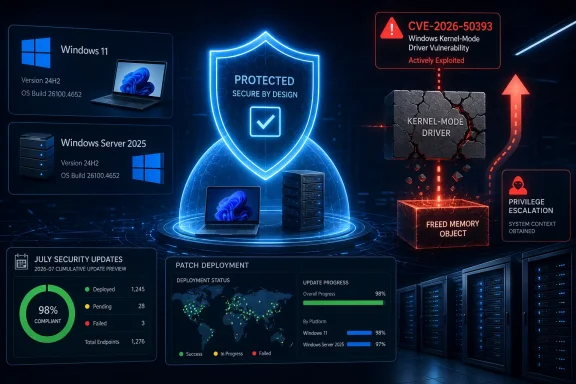 A Freed Kernel Object Becomes the Attack Surface
CVE-2026-50393 is categorized as CWE-416, or use after free. This class of memory-safety defect occurs when code continues to reference an object after the memory assigned to that object has been released.In a kernel-mode driver, that mistake is especially sensitive. Kernel-mode components operate with privileges unavailable to normal desktop applications, and corruption at that boundary can potentially be turned into execution in a more trusted security context.
Microsoft’s public description remains narrow: an authorized attacker can exploit the use-after-free condition locally to elevate privileges. The company has not publicly identified the specific driver, the affected kernel object or the sequence required to trigger the defect. There is consequently not enough public information to derive a reliable detection signature from the vulnerability description alone.
The CVSS vector rates attack complexity as high. That suggests exploitation depends on conditions beyond simply launching a malicious executable, such as manipulating memory state, winning a timing-sensitive sequence or arranging kernel objects in a useful layout. High complexity reduces expected reliability, but it does not make a successful attack harmless.
No separate user interaction is required once the attacker can execute code under a low-privileged account. That distinction matters for shared workstations, remote desktop hosts, developer systems and servers where an adversary may already have obtained limited credentials through phishing, password reuse or exploitation of another application.
CVE-2026-50393 is best understood as a second-stage vulnerability. It does not provide the initial path onto a computer, but it could turn a restricted foothold into administrative or system-level control.
The Affected List Centers on Microsoft’s Newest Windows Branches
The Microsoft-authored data currently identifies Windows 11 24H2, Windows 11 25H2, Windows 11 26H1 and Windows Server 2025 as affected. Both x64 and Arm64 Windows 11 systems are included, while the Server 2025 entry covers x64 installations, including Server Core.Administrators can use the published fixed-build thresholds to check exposure:
- Windows 11 24H2 should be updated to OS build 26100.8875 or later.
- Windows 11 25H2 should be updated to OS build 26200.8875 or later.
- Windows 11 26H1 should be running OS build 28000.2269 or later.
- Windows Server 2025 should be updated to OS build 26100.33158 or later.
Windows Server 2025 receives build 26100.33158 through KB5099536. The same fixed-build requirement applies to the full desktop installation and Server Core.
Windows 11 26H1 requires closer attention because Microsoft’s affected-version boundary points to build 28000.2269, which was released on June 9 through KB5095051. Microsoft also issued July’s KB5101649 for 26H1, advancing that branch to build 28000.2525. Installing the current cumulative update remains the simplest way to ensure a 26H1 device contains both the earlier correction and July’s subsequent security fixes.
The absence of Windows 11 23H2, Windows 10 and older Windows Server releases from the current affected-product data should not be interpreted as evidence that those systems no longer need July updates. It means Microsoft has not listed those products as vulnerable to this specific CVE. Their cumulative updates address separate vulnerabilities released in the same Patch Tuesday cycle.
Report Confidence Does Not Measure Exploit Activity
The “Report Confidence” explanation shown in Microsoft’s advisory is part of the CVSS temporal-scoring framework. It describes how certain the vendor is that the vulnerability exists and how credible the available technical information is.A status of Confirmed means the issue has been verified through detailed reporting, reproducible behavior, available code or vendor acknowledgement. In this case, Microsoft is the assigning CVE authority and has published affected-version ranges and fixed-build boundaries, so the existence of the flaw is not speculative.
That metric is easy to misread as an estimate of whether attackers are likely to exploit the vulnerability. It is not. Report Confidence says something about the reliability of the vulnerability report, not whether exploit code is circulating or whether active attacks have been observed.
The CVSS exploit-maturity component makes a similar distinction. A vulnerability can be confirmed while no public proof of concept is available, and a confirmed vulnerability can still be difficult to exploit because of memory-layout requirements or platform mitigations.
The National Vulnerability Database was still awaiting its own enrichment when the record appeared on July 14. Its current entry reproduces Microsoft’s description, CWE classification, score and affected-version information rather than adding an independent technical analysis.
This leaves defenders with high confidence that the bug is real but limited visibility into its internal mechanics. That is common at initial Patch Tuesday publication, particularly for kernel vulnerabilities where detailed disclosure could accelerate exploit development before organizations have deployed the update.
Local Privilege Escalation Still Deserves Fast Server Patching
CVE-2026-50393 is less immediately dangerous than an unauthenticated remote-code-execution flaw. An attacker must already be able to run code locally, and Microsoft’s scoring indicates that successful exploitation involves additional complexity.The practical risk rises sharply after an initial compromise. A low-privileged account ordinarily limits access to other users’ data, protected services, security controls and system configuration. Kernel-level privilege escalation can dismantle those boundaries and give an intruder the authority needed to establish persistence, extract credentials or interfere with endpoint protection.
Windows Server 2025 systems warrant particular attention because “local” does not necessarily mean an attacker is physically present. Code execution through a compromised service account, management interface, remote application session or another vulnerability may provide the foothold needed to attempt a local escalation.
Organizations should deploy KB5101650 to Windows 11 24H2 and 25H2 fleets and KB5099536 to Windows Server 2025 after their normal expedited validation. Windows 11 26H1 devices should be checked for at least build 28000.2269, although moving directly to July’s build 28000.2525 is the more defensible target.
Build verification can be performed through
winver, Settings, PowerShell inventory, Microsoft Intune, Configuration Manager or an organization’s endpoint-management platform. Security teams should verify the resulting OS build rather than relying only on an update job reporting that installation was attempted.Because Microsoft has not exposed the vulnerable driver or exploitation sequence, there is no CVE-specific workaround that offers the same assurance as updating. Restricting interactive logon, reducing local administrator membership and preventing untrusted executable launches can make the required foothold harder to obtain, but those controls do not remove the underlying kernel defect.
For most managed environments, the decision is therefore straightforward: test the July cumulative updates against critical drivers and line-of-business applications, then move affected Windows 11 and Server 2025 systems beyond Microsoft’s fixed-build thresholds.
References
- Primary source: MSRC
Published: 2026-07-14T07:00:00-07:00
Security Update Guide - Microsoft Security Response Center
 msrc.microsoft.com
- Related coverage: aha.org
