

Microsoft has patched CVE-2026-50526, a high-severity .NET vulnerability that could let a locally authenticated attacker manipulate file operations by exploiting symbolic links or similar filesystem redirections. The flaw carries a CVSS 3.1 score of 7.0 and affects older releases of .NET 8, .NET 9, .NET 10, Visual Studio 2022, and Visual Studio 2026.
Detailed in Microsoft’s Security Update Guide on July 14, 2026, the vulnerability is classified as a tampering issue caused by improper link resolution before file access. Administrators should update affected runtimes, SDKs, build agents, and Visual Studio installations rather than treating this solely as a developer-workstation problem.
The National Vulnerability Database is still awaiting its own enrichment analysis, but its record reproduces Microsoft’s affected-version data and technical assessment. There is currently no indication of public exploitation, and Microsoft’s scoring describes an attack that requires local access, existing low-level privileges, and a high-complexity setup.
CVE-2026-50526 is associated with CWE-59, Improper Link Resolution Before File Access, commonly called link following. This class of vulnerability appears when an application validates or selects a file path without securely accounting for symbolic links, junctions, hard links, mount points, or other redirections that may alter where the operation ultimately lands.
In a typical attack pattern, a privileged process expects to read, write, replace, or delete a harmless file. An attacker with access to the local filesystem arranges for that path to resolve to a different target, potentially causing the process to modify data outside the intended directory.
This is closely related to a time-of-check to time-of-use problem. Even if the application checks a pathname before acting, an attacker may be able to change the link or its destination between validation and access unless the software binds the operation securely to the validated object.
Microsoft has also mapped CVE-2026-50526 to CWE-345, Insufficient Verification of Data Authenticity. That classification reinforces the central issue: .NET could perform a sensitive filesystem operation without obtaining sufficient assurance that the final object was the one the software intended to access.
Microsoft’s advisory describes the result as local tampering rather than privilege escalation or remote code execution. However, the CVSS vector assigns high potential impact to confidentiality, integrity, and availability, indicating that a successful attack could affect more than a disposable temporary file.
For .NET 8 and .NET 9, the corrective servicing levels are 8.0.29 and 9.0.18 respectively. Those versions matter for self-contained applications because installing a new shared runtime does not replace the runtime packaged inside an already published deployment.
Visual Studio’s inclusion also broadens the inventory task. Updating the standalone .NET runtime on a server does not prove that developer machines, build systems, or Visual Studio-managed components have received the relevant fix. Visual Studio 2022 users must be on at least 17.12.22 or 17.14.36 for the respective servicing channel, while Visual Studio 2026 18.7 users need version 18.7.4 or later.
Those constraints make CVE-2026-50526 less urgent than an unauthenticated network vulnerability in an internet-facing ASP.NET Core service. It is not, based on currently published information, a drive-by compromise path into an otherwise protected Windows PC.
The potential payoff is still substantial. Microsoft rates the possible confidentiality, integrity, and availability consequences as high, while CISA’s automated SSVC assessment lists the technical impact as total. CISA also records no known exploitation and considers the attack non-automatable, which argues against panic but not against routine deployment of the patches.
The more realistic concern is an attacker who already has a foothold on a shared system and wants to influence a more trusted .NET process. Build servers, multi-user development hosts, automation workers, self-hosted CI runners, and servers that process files from less-trusted accounts warrant particular scrutiny because they often combine writable directories with elevated services.
Temporary directories and predictable file locations are common ingredients in link-following attacks. Security teams should therefore examine .NET services that ingest archives, generate deployment artifacts, rotate files, create temporary output, or move data between user-writable and protected locations.
Administrators can use
For production response, teams should account for four separate layers:
Visual Studio should be updated through the Visual Studio Installer or the organization’s normal enterprise servicing mechanism. Administrators controlling update channels should confirm that the installed build numbers meet the fixed releases instead of relying on a generic “up to date” status that may reflect an intentionally delayed channel.
That lack of exploit code supports normal staged deployment rather than an emergency shutdown. Internet-facing remote-code-execution patches and actively exploited Windows vulnerabilities should remain ahead of this issue where change windows force prioritization.
CVE-2026-50526 nevertheless belongs in the July patch cycle, especially on systems where less-trusted users or workloads share storage with privileged .NET processes. Updating Visual Studio alone is insufficient, and patching the host runtime does not remediate self-contained executables or stale container layers.
The concrete finish line is .NET 8.0.29, .NET 9.0.18, .NET 10.0.6 or later, Visual Studio 2022 17.12.22 or 17.14.36, and Visual Studio 2026 18.7.4. Organizations should then rebuild self-contained applications and containers, because those artifacts can preserve the vulnerable runtime long after the underlying Windows host has been serviced.
Detailed in Microsoft’s Security Update Guide on July 14, 2026, the vulnerability is classified as a tampering issue caused by improper link resolution before file access. Administrators should update affected runtimes, SDKs, build agents, and Visual Studio installations rather than treating this solely as a developer-workstation problem.
The National Vulnerability Database is still awaiting its own enrichment analysis, but its record reproduces Microsoft’s affected-version data and technical assessment. There is currently no indication of public exploitation, and Microsoft’s scoring describes an attack that requires local access, existing low-level privileges, and a high-complexity setup.
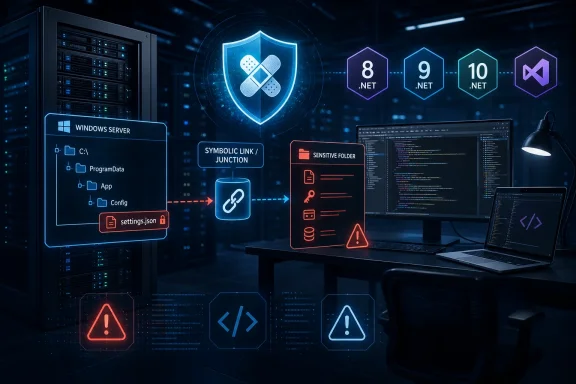 A Filesystem Check Happens Too Late
CVE-2026-50526 is associated with CWE-59, Improper Link Resolution Before File Access, commonly called link following. This class of vulnerability appears when an application validates or selects a file path without securely accounting for symbolic links, junctions, hard links, mount points, or other redirections that may alter where the operation ultimately lands.In a typical attack pattern, a privileged process expects to read, write, replace, or delete a harmless file. An attacker with access to the local filesystem arranges for that path to resolve to a different target, potentially causing the process to modify data outside the intended directory.
This is closely related to a time-of-check to time-of-use problem. Even if the application checks a pathname before acting, an attacker may be able to change the link or its destination between validation and access unless the software binds the operation securely to the validated object.
Microsoft has also mapped CVE-2026-50526 to CWE-345, Insufficient Verification of Data Authenticity. That classification reinforces the central issue: .NET could perform a sensitive filesystem operation without obtaining sufficient assurance that the final object was the one the software intended to access.
Microsoft’s advisory describes the result as local tampering rather than privilege escalation or remote code execution. However, the CVSS vector assigns high potential impact to confidentiality, integrity, and availability, indicating that a successful attack could affect more than a disposable temporary file.
The Patch Line Differs Across .NET Releases
Microsoft identifies the following version boundaries in the CVE record:- .NET 8 releases earlier than 8.0.29 are affected.
- .NET 9 releases earlier than 9.0.18 are affected.
- .NET 10 releases earlier than 10.0.6 are affected.
- Visual Studio 2022 17.12 releases earlier than 17.12.22 are affected.
- Visual Studio 2022 17.14 releases earlier than 17.14.36 are affected.
- Visual Studio 2026 18.7 releases earlier than 18.7.4 are affected.
For .NET 8 and .NET 9, the corrective servicing levels are 8.0.29 and 9.0.18 respectively. Those versions matter for self-contained applications because installing a new shared runtime does not replace the runtime packaged inside an already published deployment.
Visual Studio’s inclusion also broadens the inventory task. Updating the standalone .NET runtime on a server does not prove that developer machines, build systems, or Visual Studio-managed components have received the relevant fix. Visual Studio 2022 users must be on at least 17.12.22 or 17.14.36 for the respective servicing channel, while Visual Studio 2026 18.7 users need version 18.7.4 or later.
Local Access Lowers Reach, Not Necessarily Impact
Microsoft’s CVSS vector isAV:L/AC:H/PR:L/UI:N/S:U/C:H/I:H/A:H. In practical terms, the attacker must already be able to run code or manipulate resources locally, must possess some privileges, and must satisfy conditions that Microsoft considers difficult to arrange. The attack does not require another user to open a document, click a link, or approve a prompt.Those constraints make CVE-2026-50526 less urgent than an unauthenticated network vulnerability in an internet-facing ASP.NET Core service. It is not, based on currently published information, a drive-by compromise path into an otherwise protected Windows PC.
The potential payoff is still substantial. Microsoft rates the possible confidentiality, integrity, and availability consequences as high, while CISA’s automated SSVC assessment lists the technical impact as total. CISA also records no known exploitation and considers the attack non-automatable, which argues against panic but not against routine deployment of the patches.
The more realistic concern is an attacker who already has a foothold on a shared system and wants to influence a more trusted .NET process. Build servers, multi-user development hosts, automation workers, self-hosted CI runners, and servers that process files from less-trusted accounts warrant particular scrutiny because they often combine writable directories with elevated services.
Temporary directories and predictable file locations are common ingredients in link-following attacks. Security teams should therefore examine .NET services that ingest archives, generate deployment artifacts, rotate files, create temporary output, or move data between user-writable and protected locations.
Runtime Inventory Is the Real Deployment Challenge
A simple check of Windows Update history will not cover every affected environment. Modern .NET can arrive through standalone installers, Visual Studio, package managers, container images, cloud build images, application bundles, and self-contained publishing.Administrators can use
dotnet --list-runtimes and dotnet --list-sdks as an initial local check. Those commands reveal installed shared frameworks and SDKs, but they do not enumerate runtimes embedded in self-contained applications or necessarily identify every copy used by an isolated build tool.For production response, teams should account for four separate layers:
- Shared .NET runtimes must meet Microsoft’s corrected version boundaries.
- SDK installations on workstations and build agents must be updated so new artifacts are produced with serviced components.
- Self-contained applications must be rebuilt, republished, and redeployed with a corrected runtime.
- Container images must be rebuilt from serviced Microsoft .NET base images rather than merely restarted.
Visual Studio should be updated through the Visual Studio Installer or the organization’s normal enterprise servicing mechanism. Administrators controlling update channels should confirm that the installed build numbers meet the fixed releases instead of relying on a generic “up to date” status that may reflect an intentionally delayed channel.
No Public Exploit Changes the Order, Not the Outcome
As of July 15, 2026, neither Microsoft’s CVE data nor CISA’s assessment indicates that CVE-2026-50526 is being exploited. The National Vulnerability Database has also not completed independent enrichment, and public technical details remain limited to the weakness classifications, version ranges, and Microsoft’s attack assessment.That lack of exploit code supports normal staged deployment rather than an emergency shutdown. Internet-facing remote-code-execution patches and actively exploited Windows vulnerabilities should remain ahead of this issue where change windows force prioritization.
CVE-2026-50526 nevertheless belongs in the July patch cycle, especially on systems where less-trusted users or workloads share storage with privileged .NET processes. Updating Visual Studio alone is insufficient, and patching the host runtime does not remediate self-contained executables or stale container layers.
The concrete finish line is .NET 8.0.29, .NET 9.0.18, .NET 10.0.6 or later, Visual Studio 2022 17.12.22 or 17.14.36, and Visual Studio 2026 18.7.4. Organizations should then rebuild self-contained applications and containers, because those artifacts can preserve the vulnerable runtime long after the underlying Windows host has been serviced.
References
- Primary source: MSRC
Published: 2026-07-14T07:00:00-07:00
Security Update Guide - Microsoft Security Response Center
 msrc.microsoft.com
