

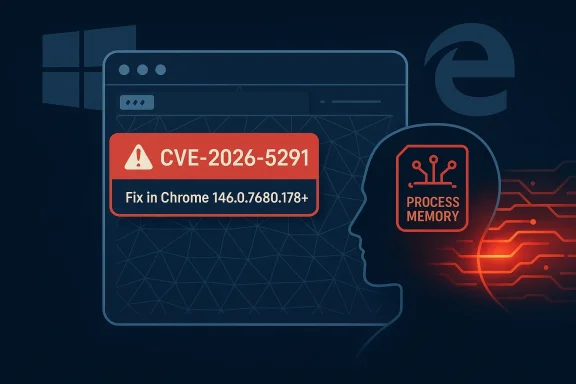
Google’s CVE-2026-5291 is another reminder that browser graphics code remains a high-value target, even when the issue is “only” classified as medium severity. Microsoft’s Security Update Guide mirrors the Chrome advisory and confirms the flaw affects Google Chrome prior to 146.0.7680.178, with the underlying problem described as an inappropriate implementation in WebGL that could let a remote attacker extract potentially sensitive data from process memory through a crafted HTML page. That combination — remote delivery, user interaction, and memory disclosure — is exactly the sort of issue enterprises need to treat as urgent rather than routine.
Chromium-based browsers have spent years moving from simple rendering engines to sprawling application platforms, and that evolution has made their attack surface much larger. WebGL, in particular, sits at the crossroads of graphics acceleration, GPU driver interaction, and browser sandboxing, which makes it attractive to attackers looking for ways to leak memory or weaken browser isolation. CVE-2026-5291 fits that pattern neatly: it is not framed as a full remote code execution issue, but as a sensitive information disclosure flaw that could help attackers gather process-memory data from the browser context.
The practical significance of this kind of bug is easy to underestimate. A browser memory leak may not sound as dramatic as code execution, but in modern exploitation chains, information disclosure is often the stepping stone that makes a second vulnerability far more reliable. That is especially true in a browser environment where address-space layout, allocator state, and object metadata can matter as much as the primary bug itself. The result is a vulnerability that may be assigned a “medium” label while still carrying real-world operational risk.
Google’s patch threshold for this issue, 146.0.7680.178, is also a reminder that Chromium’s stable channel moves quickly during a security cycle. Microsoft’s downstream guidance exists because Edge inherits Chromium fixes through the same upstream codebase, and administrators tracking only vendor-specific messaging can miss the point that the browser they deploy is still effectively riding the Chromium release train. The update-guide entry is therefore less about Microsoft inventing a new finding and more about helping Windows customers understand when the upstream correction is available in their channel.
From a broader security perspective, CVE-2026-5291 belongs to the same family of browser flaws that keep recurring in graphics, audio, media, and rendering subsystems. These components are complex, performance-sensitive, and exposed to untrusted content by design, which makes them persistent sources of risk. In that sense, the vulnerability is not an anomaly; it is a predictable consequence of the browser’s role as the universal application runtime.
The entry also shows how Microsoft uses its vulnerability catalog to track Chromium issues affecting Edge. That does not mean Microsoft authored the bug, and it does not imply a separate Edge-specific exploit path. Instead, it signals that the browser channel is downstream of Chromium and must be evaluated with the upstream patch status in mind.
In practice, the version marker also matters because browser updates do not always land evenly across channels. Stable, Extended Stable, and managed enterprise deployment rings can diverge for days or weeks depending on policy. That means one employee on a fully managed laptop can be protected while another user on a slower channel still carries exposure. That split is common, and it is exactly why version-based guidance is so valuable.
CVE-2026-5291 is described as an inappropriate implementation, which usually suggests a logic or validation failure rather than a classic memory corruption primitive. But in graphics subsystems, logic mistakes can still produce memory exposure if the engine reads, forwards, or preserves more data than it should. That makes WebGL flaws particularly slippery: the headline may sound modest while the exploit value is more substantial than it first appears.
That is why security teams should not judge the issue solely by the word “information.” Sensitive data from process memory can include fragments of tokens, session artifacts, or internal browser state, depending on what is present at the time of disclosure. Even when the exact contents are uncertain, the possibility alone justifies prompt remediation.
That low friction is what keeps browser bugs high on security teams’ priority lists even when they are not rated critical. Attackers love delivery mechanisms that work through ordinary browsing habits, phishing links, or embedded web content. If a victim only has to visit a page for the issue to become reachable, defenders lose a major layer of friction.
For enterprises, the main implication is that patch windows should not be driven only by whether a flaw is weaponized. Browser-delivered attacks frequently blend a vulnerable page with credential harvesting, session theft, or lateral movement staging, so even “medium” browser issues can support broader intrusion chains. The fact that the path is web-delivered should make this easier to prioritize, not harder.
The broader lesson is that browser security is now a supply-chain problem as much as a product problem. A single Chromium defect can cascade into Chrome, Edge, and other Chromium-based browsers with little or no variation in underlying exposure. For defenders, that creates a need for version intelligence, not just vendor trust.
That matters even more in environments with extended-stable policies or delayed rollout rings. A browser team may fix the flaw upstream on one date, but an enterprise fleet might not be protected until its own update cadence catches up. In security operations, that lag is not theoretical; it is the entire risk window.
The enterprise angle is more important than the consumer angle because large fleets often have multiple browser management policies. One group may receive rapid updates, another may be held back for compatibility testing, and a third may be running on a different channel entirely. In that world, a single CVE becomes three or four separate deployment questions.
A useful operational approach is to check three things at once: browser version, channel, and fleet coverage. That lets teams identify not only vulnerable endpoints, but also the policy gaps that allow stale builds to linger. A patch is only useful if the endpoint actually receives it.
When a browser leaks memory from its process space, the attacker may gain clues about heap layout, pointer values, or internal object structures. Those clues can make exploitation of another bug more stable, reduce crash rates, or help bypass some mitigations. In short, the leak may be the enabler that turns a difficult exploit into a repeatable one.
The other issue is that browser memory tends to be richly populated. Tabs, render state, graphics buffers, session state, and transient data all coexist in a live process, and attackers often need only one useful fragment to improve their odds. A disclosure bug does not need to reveal everything to be dangerous.
A browser flaw like CVE-2026-5291 also illustrates why asset visibility matters. If you cannot quickly tell which endpoints are on Chrome, which are on Edge, and which are on outdated branches, you cannot estimate exposure accurately. That is especially problematic in hybrid workplaces where user choice, MDM policy, and unmanaged devices overlap.
The next few weeks will likely show whether defenders can collapse the normal lag between upstream disclosure and fleet-wide protection. If they can, this will be remembered as a routine memory-leak advisory with a fast fix. If they cannot, the bug will instead become another example of how small browser flaws create large operational windows.
Source: NVD / Chromium Security Update Guide - Microsoft Security Response Center
 Overview
Chromium-based browsers have spent years moving from simple rendering engines to sprawling application platforms, and that evolution has made their attack surface much larger. WebGL, in particular, sits at the crossroads of graphics acceleration, GPU driver interaction, and browser sandboxing, which makes it attractive to attackers looking for ways to leak memory or weaken browser isolation. CVE-2026-5291 fits that pattern neatly: it is not framed as a full remote code execution issue, but as a sensitive information disclosure flaw that could help attackers gather process-memory data from the browser context.The practical significance of this kind of bug is easy to underestimate. A browser memory leak may not sound as dramatic as code execution, but in modern exploitation chains, information disclosure is often the stepping stone that makes a second vulnerability far more reliable. That is especially true in a browser environment where address-space layout, allocator state, and object metadata can matter as much as the primary bug itself. The result is a vulnerability that may be assigned a “medium” label while still carrying real-world operational risk.
Google’s patch threshold for this issue, 146.0.7680.178, is also a reminder that Chromium’s stable channel moves quickly during a security cycle. Microsoft’s downstream guidance exists because Edge inherits Chromium fixes through the same upstream codebase, and administrators tracking only vendor-specific messaging can miss the point that the browser they deploy is still effectively riding the Chromium release train. The update-guide entry is therefore less about Microsoft inventing a new finding and more about helping Windows customers understand when the upstream correction is available in their channel.
From a broader security perspective, CVE-2026-5291 belongs to the same family of browser flaws that keep recurring in graphics, audio, media, and rendering subsystems. These components are complex, performance-sensitive, and exposed to untrusted content by design, which makes them persistent sources of risk. In that sense, the vulnerability is not an anomaly; it is a predictable consequence of the browser’s role as the universal application runtime.
What Microsoft’s listing actually tells administrators
Microsoft’s Security Update Guide entry is useful because it condenses multiple moving parts into a single operational signal. It gives defenders a clear upstream version threshold and frames the issue in terms of what matters most for deployment: whether the browser build in use has already incorporated the fix. In a mixed Windows estate, that matters more than the label attached to the bug.The entry also shows how Microsoft uses its vulnerability catalog to track Chromium issues affecting Edge. That does not mean Microsoft authored the bug, and it does not imply a separate Edge-specific exploit path. Instead, it signals that the browser channel is downstream of Chromium and must be evaluated with the upstream patch status in mind.
Why the version number matters
The fixed build, 146.0.7680.178, is the cleanest operational reference point available in the advisory material. Anything earlier is treated as vulnerable, which gives IT teams a simple compliance test for browser fleet audits. For a patch manager, that kind of cutoff is often the difference between a manageable remediation ticket and a vague “we’ll get to it later” risk.In practice, the version marker also matters because browser updates do not always land evenly across channels. Stable, Extended Stable, and managed enterprise deployment rings can diverge for days or weeks depending on policy. That means one employee on a fully managed laptop can be protected while another user on a slower channel still carries exposure. That split is common, and it is exactly why version-based guidance is so valuable.
- Confirm the installed Chrome or Chromium-based browser build.
- Compare it against 146.0.7680.178 or later.
- Verify whether Edge, if used, has already ingested the same upstream fix.
- Treat delayed channel rollout as residual exposure, not a separate risk class.
Why WebGL bugs keep recurring
WebGL is one of those browser technologies that looks simple to end users and deeply complicated to everyone who has to secure it. It exposes hardware-accelerated graphics to the web while still trying to preserve the browser’s isolation model, which means it has to translate untrusted input into GPU commands without ever letting the page escape its boundaries. That tension is fertile ground for bugs.CVE-2026-5291 is described as an inappropriate implementation, which usually suggests a logic or validation failure rather than a classic memory corruption primitive. But in graphics subsystems, logic mistakes can still produce memory exposure if the engine reads, forwards, or preserves more data than it should. That makes WebGL flaws particularly slippery: the headline may sound modest while the exploit value is more substantial than it first appears.
The attacker’s likely advantage
A process-memory disclosure bug is often valuable because it helps attackers defeat modern defensive hardening. By learning memory layout details, object contents, or allocator state, an attacker can improve the reliability of a follow-on exploit. In browser-land, reliability is king; many exploit chains fail not because the bug is absent, but because the exploit needs more information than the attacker can easily guess.That is why security teams should not judge the issue solely by the word “information.” Sensitive data from process memory can include fragments of tokens, session artifacts, or internal browser state, depending on what is present at the time of disclosure. Even when the exact contents are uncertain, the possibility alone justifies prompt remediation.
- WebGL is high-risk because it bridges web content and GPU-backed rendering.
- Logic defects can become memory disclosure bugs even without overt corruption.
- Information leaks often enable more serious follow-on attacks.
- Crafted HTML remains enough to reach the vulnerable path.
The attack scenario is low-friction
The public description says the issue is reachable via a crafted HTML page, which is the most important phrase in the advisory from a threat perspective. It means an attacker does not need local code execution, a malicious extension, or direct system access to begin the attack. A single booby-trapped web page can be enough to trigger the vulnerable WebGL path.That low friction is what keeps browser bugs high on security teams’ priority lists even when they are not rated critical. Attackers love delivery mechanisms that work through ordinary browsing habits, phishing links, or embedded web content. If a victim only has to visit a page for the issue to become reachable, defenders lose a major layer of friction.
User interaction still matters
The CVSS posture associated with the issue reflects user interaction required, which is a meaningful limitation but not a safety guarantee. In the real world, user interaction often means one click, one page load, or one compromised ad slot. That is a thin barrier, especially in consumer environments where vigilance is uneven and social engineering remains effective.For enterprises, the main implication is that patch windows should not be driven only by whether a flaw is weaponized. Browser-delivered attacks frequently blend a vulnerable page with credential harvesting, session theft, or lateral movement staging, so even “medium” browser issues can support broader intrusion chains. The fact that the path is web-delivered should make this easier to prioritize, not harder.
- Delivery can happen through ordinary browsing behavior.
- Email, chat, or advertising can serve as the first touchpoint.
- The vulnerability does not require installed malware to be reachable.
- User interaction lowers the bar for phishing-based exploitation.
How this fits the broader Chromium security pattern
CVE-2026-5291 is part of a familiar upstream/downstream pattern that has become one of the defining features of Chromium security. Google identifies the issue, patches Chrome, and then downstream vendors such as Microsoft record the same vulnerability so their users can map the fix to the software they actually deploy. That ecosystem is efficient, but it also means that patch hygiene is only as strong as the slowest channel in the chain.The broader lesson is that browser security is now a supply-chain problem as much as a product problem. A single Chromium defect can cascade into Chrome, Edge, and other Chromium-based browsers with little or no variation in underlying exposure. For defenders, that creates a need for version intelligence, not just vendor trust.
Why downstream tracking matters
Microsoft’s entry is valuable because many Windows environments standardize on Edge, not Chrome. Administrators need a way to confirm whether the Chromium fix has arrived in their browser build without reverse-engineering the browser’s release history themselves. Microsoft’s Security Update Guide fills that gap by acting as a cross-reference layer between upstream Chromium and downstream deployment reality.That matters even more in environments with extended-stable policies or delayed rollout rings. A browser team may fix the flaw upstream on one date, but an enterprise fleet might not be protected until its own update cadence catches up. In security operations, that lag is not theoretical; it is the entire risk window.
- Chromium fixes do not automatically equal enterprise protection.
- Deployment cadence can lag behind upstream disclosure.
- Microsoft’s catalog helps map upstream bugs to downstream products.
- Version drift creates hidden exposure across managed fleets.
What this means for Windows and Edge environments
For Windows users, the immediate takeaway is straightforward: if your organization uses Microsoft Edge or any other Chromium-based browser, the security story is tied to the upstream Chromium patch. The Microsoft guide does not suggest a separate Edge-only exploit, but it does give administrators a way to see whether their browser channel has absorbed the fix. That distinction matters in mixed browser environments where Chrome and Edge coexist.The enterprise angle is more important than the consumer angle because large fleets often have multiple browser management policies. One group may receive rapid updates, another may be held back for compatibility testing, and a third may be running on a different channel entirely. In that world, a single CVE becomes three or four separate deployment questions.
Patching priorities in practice
Security operations should treat CVE-2026-5291 as part of the browser’s priority one workload, even if the label says medium. The bug is remote, page-triggered, and memory-related, which is enough to justify prompt action. Waiting for evidence of in-the-wild exploitation before patching is a risky bet when the fix already exists.A useful operational approach is to check three things at once: browser version, channel, and fleet coverage. That lets teams identify not only vulnerable endpoints, but also the policy gaps that allow stale builds to linger. A patch is only useful if the endpoint actually receives it.
- Check Edge and Chrome separately if both are allowed.
- Verify channel placement, not just product name.
- Audit devices that sit on deferred or extended-stable branches.
- Confirm update success after deployment, not merely policy assignment.
Why memory disclosure still matters to attackers
There is a tendency in some security circles to rank bugs by whether they lead directly to code execution. That misses the way modern exploitation chains are assembled. Memory disclosure is often the lubricant that makes a harder, riskier exploit practical, especially in highly defended browser processes.When a browser leaks memory from its process space, the attacker may gain clues about heap layout, pointer values, or internal object structures. Those clues can make exploitation of another bug more stable, reduce crash rates, or help bypass some mitigations. In short, the leak may be the enabler that turns a difficult exploit into a repeatable one.
Why “potentially sensitive” is not reassuring
The advisory’s wording is cautious, but caution does not equal harmlessness. “Potentially sensitive information” in a browser memory context can still include data that should never leave the process boundary, even if the exact payload varies by session and timing. That uncertainty is itself a reason to patch quickly, because defenders rarely know in advance what an attacker will find useful.The other issue is that browser memory tends to be richly populated. Tabs, render state, graphics buffers, session state, and transient data all coexist in a live process, and attackers often need only one useful fragment to improve their odds. A disclosure bug does not need to reveal everything to be dangerous.
- Memory leaks can support larger exploit chains.
- Browser processes contain a lot of high-value transient data.
- Small disclosures can still defeat hardening.
- “Potentially sensitive” often means “operationally useful.”
Patch management lessons for admins
This CVE is a useful case study in why browser patch management should be treated as a first-class security discipline. Many organizations still think of browsers as commodity software with low configuration risk, but the reality is that browsers are now among the most exposed codebases on the endpoint. They deserve the same urgency as email security and OS patching.A browser flaw like CVE-2026-5291 also illustrates why asset visibility matters. If you cannot quickly tell which endpoints are on Chrome, which are on Edge, and which are on outdated branches, you cannot estimate exposure accurately. That is especially problematic in hybrid workplaces where user choice, MDM policy, and unmanaged devices overlap.
A practical triage sequence
- Identify browser versions across managed endpoints.
- Map those versions to the fixed build, 146.0.7680.178.
- Confirm whether alternative Chromium-based browsers are in use.
- Force or accelerate updates on any out-of-date channel.
- Re-verify post-update state after the rollout completes.
- Asset discovery should include browser channel information.
- Patch verification should be automatic where possible.
- Exception lists should be time-bound and reviewed.
- Shared workstations and kiosk systems should be checked separately.
Strengths and Opportunities
The encouraging part of CVE-2026-5291 is that the ecosystem worked in the way it is supposed to work: Google identified and fixed the issue, and Microsoft mirrored the upstream signal for downstream customers. That is not a guarantee of safety, but it is a sign that disclosure and remediation are flowing through the Chromium supply chain in a recognizable way. The challenge for defenders is to convert that visibility into faster action.- The flaw is clearly version-bounded, which simplifies remediation.
- Microsoft’s advisory makes downstream tracking easier.
- The issue is disclosed early enough for preventive patching.
- Browser-update automation can eliminate much of the manual burden.
- Security teams can use the event to tighten version inventory.
- The bug reinforces the case for browser channel governance.
- The upstream/downstream model offers a repeatable response pattern.
Risks and Concerns
The main concern is that a memory disclosure bug in WebGL could be treated as lower priority than it deserves, especially because the label is medium rather than high. That would be a mistake. Browser information leaks are often the quiet enablers behind later exploitation, and the fact that the attack can start from a crafted HTML page makes it too easy to ignore.- Users may underestimate a “medium” browser vulnerability.
- Delayed channels can leave long-tail exposure in the enterprise.
- Mixed browser environments complicate remediation.
- Memory disclosure can support follow-on exploitation.
- User interaction requirements still allow phishing delivery.
- Outdated endpoints may persist in unmanaged or contractor fleets.
- Version drift can outpace manual audit processes.
Looking Ahead
The key question now is not whether Chromium will continue to surface WebGL and graphics-related flaws; it almost certainly will. The real question is whether organizations will keep treating browser patching as a fast-moving operational task or as a background maintenance issue. CVE-2026-5291 argues strongly for the former.The next few weeks will likely show whether defenders can collapse the normal lag between upstream disclosure and fleet-wide protection. If they can, this will be remembered as a routine memory-leak advisory with a fast fix. If they cannot, the bug will instead become another example of how small browser flaws create large operational windows.
- Watch for deployment of 146.0.7680.178 or later.
- Check whether Edge Stable and Extended Stable receive the fix on schedule.
- Monitor for exploit-chain behavior combining disclosure with other browser bugs.
- Review managed-browser policies for update lag and exception drift.
- Reassess browser hardening controls, especially on high-risk user groups.
Source: NVD / Chromium Security Update Guide - Microsoft Security Response Center
