

CVE-2026-53195 is a newly published Linux kernel vulnerability, disclosed by kernel.org and added to NVD on June 25, 2026, in the USB serial
The vulnerability lives in
That is the whole bug in one sentence, and it is also the reason it is worth writing about. The kernel is not merely accepting input from a network socket or a userland API; it is handling device firmware metadata in a privileged context. If the firmware image says its payload length is larger than the buffer can safely hold, the old code trusted the wrong number.
According to the CVE description,
The fix is refreshingly direct: reject firmware images whose declared length exceeds the destination capacity. That is not a glamorous mitigation, but it is the kind of boundary check that separates a malformed file from a corrupted kernel heap.
That pattern has been the skeleton key of systems exploitation for decades. The only reason it keeps returning is that software rarely has one “length.” It has the length of the file, the length of a record, the length of a field, the length of a destination allocation, the length remaining after a header, and the length a developer assumed was already checked somewhere else.
Here, the CVE text makes the distinction unusually clear.
That is the deeper lesson. Security checks do not commute. A check performed at one layer may prove that the input is not absurd as a whole, while still failing to prove that a particular subfield is safe for a particular memory operation. The vulnerable code appears to have had a general guardrail, but the overflow happened because the critical edge condition sat one abstraction level lower.
That narrowing matters. Administrators should not treat every kernel CVE as if it were an emergency remote code execution event. The likely exploitation story here involves local interaction, device handling, crafted firmware, or a system configuration where the affected driver path can be reached. For many ordinary desktop users, the practical risk may be low.
But low exposure is not the same as no exposure. USB and serial hardware occupy exactly the sort of messy operational territory where old assumptions go to die. Industrial control environments, lab benches, point-of-sale systems, networking closets, manufacturing stations, and field-service laptops all still use USB-to-serial adapters because the physical world has not finished migrating to clean cloud APIs.
That is why this bug belongs in the enterprise patch conversation. The systems most likely to care about an obscure USB serial driver are often the systems least likely to be updated casually. They may be embedded, vendor-managed, physically exposed, or pinned to a conservative kernel branch because “it works” is doing a lot of unpaid labor.
This is not a bureaucratic footnote. Modern vulnerability management systems are built around scoring, prioritization, and exception handling. A CVE without a finalized CVSS vector can be awkward in risk meetings because the tooling wants a number before the engineering team has enough context to care.
Some third-party vulnerability databases have already attached their own severity interpretations, including “high” classifications and local-attack vectors. Those may be useful hints, but they are not a substitute for understanding the code path. A heap overflow in the kernel is inherently serious as a bug class; its operational urgency depends on reachability, driver presence, device workflow, distro packaging, and whether an attacker can influence the firmware image being parsed.
This is where security teams get into trouble when they outsource judgment to a single score. A Windows-heavy shop with a few Linux build servers may rank this differently from a factory running Linux gateways attached to USB serial devices. The CVE identifier is global; the risk is local.
That is good for precision but challenging for consumers. A sentence like “fix heap overflow in
The answer is almost certainly not “panic,” but it is also not “ignore.” The kernel’s CVE pipeline increasingly exposes bugs that are real but highly contextual. That forces IT teams to become better at asset-aware triage instead of relying on generic severity feeds.
In this case, the affected component is specific enough to make triage practical. If the
That matters because most administrators do not run “Linux” in the abstract. They run Ubuntu kernels, Debian kernels, Red Hat-compatible kernels, SUSE kernels, Android-derived kernels, appliance vendor kernels, or long-term support kernels with backports. A commit hash in the upstream stable tree is a map coordinate, not necessarily the package version sitting on your fleet.
The practical question is whether your distribution has shipped the fix for your branch. For the branches visible in the CVE data, fixed stable releases include versions such as 5.10.259, 5.15.210, 6.1.176, and 6.6.143, with additional affected ranges tied to upstream stable commits. That does not mean every downstream vendor has packaged the fix under those exact numbers.
Enterprise Linux vendors often backport security patches while keeping an older-looking kernel version string. That is why version comparison alone can mislead. A system reporting an older major kernel may still be fixed if the vendor has applied the relevant patch; a custom or vendor-frozen kernel may remain vulnerable even if its version appears close to a safe upstream line.
Developers run Linux containers on Windows workstations. Security teams run Linux appliances. Network teams deploy Linux-based monitoring boxes. Backup products, storage appliances, hypervisors, CI runners, and edge gateways may all include Linux kernels that the Windows team never patches directly but still depends on operationally.
WSL itself is a special case and should not be casually lumped together with every Linux kernel deployment. Microsoft ships and services the WSL kernel through its own channels, and the exposure depends on whether the affected driver is present and reachable in that environment. For most users, USB serial firmware handling inside WSL is unlikely to be the first place this CVE matters.
The bigger WindowsForum angle is inventory discipline. If your organization treats Windows as the managed estate and Linux as the shadow estate, CVEs like this become discovery events. The vulnerability may not be catastrophic, but it asks a very pointed question: do you know where kernel drivers exist in your environment, who updates them, and how quickly obscure hardware paths get patched?
From a security perspective, firmware metadata is input. It may be malformed by accident, modified by an attacker, supplied through a compromised update chain, or exposed through a local workflow that nobody modeled as hostile. The kernel does not get to be less careful because the bytes are destined for hardware.
USB makes that more uncomfortable. USB has always blurred the boundary between peripheral and computer. Devices identify themselves, negotiate capabilities, expose interfaces, and trigger driver behavior. A driver that handles firmware images is part of that trust dance, and any parser in that path deserves the same suspicion as a network protocol parser.
This does not mean every USB serial adapter is now suspect. It means the driver’s mistake belongs to a broader class of bugs where low-level code assumes structured input is more trustworthy than it is. The correct fix is not only “patch this function,” but “stop treating device-adjacent data as benign.”
The available public description does not establish a working exploit, a remote attack path, or confirmed privilege escalation. It establishes an out-of-bounds write condition in kernel memory caused by insufficient validation of a firmware length field. That is enough to justify a fix and enough to merit administrator attention, but not enough to invent drama.
Modern kernels also include mitigations that can make exploitation harder, noisier, or less reliable. Heap hardening, slab allocator behavior, module loading policies, firmware loading controls, lockdown modes, and distribution-specific configurations all affect the real-world story. A bug can be valid and still not be practically exploitable in many environments.
Still, defenders should resist the opposite error. Kernel heap bugs often age badly. What looks like a crash today can become a privilege-escalation primitive tomorrow when researchers understand the allocation pattern, target the right branch, or chain it with another weakness. The safest assumption is not that exploitation is guaranteed, but that memory corruption in kernel space deserves timely patching.
But trivial patches often close nontrivial bugs. The mistake was conceptual: the code validated one property of the input and then behaved as if it had validated a different property. Once maintainers identified the exact invariant that mattered — “this length must fit after the firmware record header” — the fix became obvious.
This is also why static analysis and fuzzing keep finding old bugs in mature code. Drivers accumulate assumptions. A function written years ago may have been safe under one firmware format, one device family, one caller, or one mental model. Later, the surrounding ecosystem changes, and the assumption becomes a vulnerability.
The Linux kernel’s size and longevity make this inevitable. The right measure of project health is not whether such bugs appear, but how quickly they are fixed, how widely the patches propagate, and whether downstream users can understand their exposure.
A rolling distribution may pick up the fix quickly. A conservative enterprise distro may backport it into a kernel package whose version number barely changes. An appliance vendor may need weeks to test and ship an image. A custom kernel maintained by an internal platform team may sit untouched until someone files a ticket with enough detail to survive prioritization.
This lag is especially relevant for hardware-related drivers. Systems using USB serial adapters are often attached to real-world processes where downtime is expensive or inconvenient. Updating the kernel may require maintenance windows, physical access, regression testing, or vendor sign-off. The patch may be small, but the change process may not be.
That is why the best response is targeted rather than theatrical. Find the systems with the affected driver. Determine whether the fixed kernel package is available. Prioritize machines with local user access, USB exposure, lab or industrial roles, and custom firmware workflows. Then patch in the order that matches actual exposure.
This is already a common pain point with Linux kernel CVEs. A scanner sees an upstream version range and marks a host vulnerable, while the distribution has backported the patch. Or the scanner misses a custom kernel because the package metadata does not match a known advisory. Either way, the result is the same: humans must reconcile machine-readable vulnerability data with how Linux is actually shipped.
CVE-2026-53195 is likely to be a classic example because it affects a specific driver file and a specific function. A system can be theoretically within an affected kernel range but practically safe if the driver is absent. Conversely, a system can look managed while carrying a vendor-modified kernel that has not received the upstream fix.
The useful scanner output is not merely “vulnerable” or “not vulnerable.” It is the evidence chain: kernel package, vendor advisory status, loaded modules, available driver configuration, and patch provenance. Without that, the finding is a prompt for investigation, not a conclusion.
It connects badge printers, lab instruments, console cables, industrial controllers, legacy point-of-sale devices, medical equipment, and network gear. It shows up when newer computers need to speak to older machines. It is exactly the kind of technology that survives because replacing the surrounding workflow would cost more than keeping the adapter.
That makes driver-level CVEs uncomfortable. The machines using these devices may not be in the cleanest patch lane. They may sit under desks, inside cabinets, or on segregated networks where inventory agents are unreliable. They may be administered by operations teams rather than central IT.
A vulnerability like this therefore rewards boring discipline. Hardware inventory, module inventory, kernel package tracking, and change ownership are not glamorous controls. They are the difference between “we patched Linux” and “we patched the Linux systems that actually load the vulnerable code.”
Start with whether the affected driver is present or loadable. Then ask whether systems accept USB devices, use TI-based USB serial adapters, process relevant firmware files, or operate in contexts where local attackers, untrusted technicians, or supply-chain tampering are credible. That is the path from CVE trivia to risk management.
For Windows-centric teams, this is also a chance to close the gap between “supported platforms” and “actual dependencies.” If Linux systems are part of your Windows administration workflow, they need the same patch ownership and exception discipline. If Linux appliances are vendor-managed, you need vendor answers, not assumptions.
The absence of an NVD score at publication should not freeze action. It should push teams toward evidence. Where exposure is plausible, patch when your vendor provides an update. Where exposure is implausible, document why. Where the driver is unused, consider disabling or excluding it as part of a broader kernel hardening posture.
io_ti driver, where malformed firmware data can overflow a heap buffer during I2C firmware header construction. The bug is not a Windows flaw, but it matters to WindowsForum readers because Linux now sits everywhere Windows administrators increasingly have to care about: WSL-adjacent workflows, Hyper-V guests, edge boxes, developer laptops, embedded appliances, and mixed-fleet infrastructure. The interesting part is not that another kernel memory bug exists; it is that a tiny USB driver path exposes the continuing fragility of trusted firmware parsing inside privileged code. This is the sort of vulnerability that looks obscure until it is sitting in an inventory report, a scanner dashboard, or a compliance exception queue with no CVSS score attached.
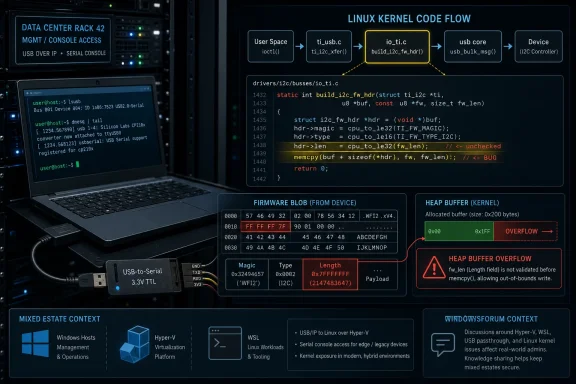 A Small USB Driver Bug Lands in a Much Bigger Security Argument
The vulnerability lives in drivers/usb/serial/io_ti.c, a Linux kernel driver for USB-to-serial hardware associated with TI-based Edgeport-style devices. The failing function, build_i2c_fw_hdr(), allocates a fixed-size heap buffer intended to hold firmware-related data, then copies a length taken from the firmware image without checking that the claimed length fits in the destination space.That is the whole bug in one sentence, and it is also the reason it is worth writing about. The kernel is not merely accepting input from a network socket or a userland API; it is handling device firmware metadata in a privileged context. If the firmware image says its payload length is larger than the buffer can safely hold, the old code trusted the wrong number.
According to the CVE description,
img_header->Length is a little-endian 16-bit field and can reach 65,535. The destination buffer, however, is built around a much smaller available region: (16*1024 - 512) plus the firmware record header. The prior sanity check validated the overall firmware size, but not this specific length field against the space available after the header.The fix is refreshingly direct: reject firmware images whose declared length exceeds the destination capacity. That is not a glamorous mitigation, but it is the kind of boundary check that separates a malformed file from a corrupted kernel heap.
The Dangerous Number Was Hiding in Plain Sight
Many memory-corruption bugs are complicated because the exploit path is complicated. CVE-2026-53195 is conceptually simpler, which makes it more embarrassing and more instructive. A parser accepts a length from a file, allocates a buffer of one size, and copies using a value that can be much larger than the intended destination.That pattern has been the skeleton key of systems exploitation for decades. The only reason it keeps returning is that software rarely has one “length.” It has the length of the file, the length of a record, the length of a field, the length of a destination allocation, the length remaining after a header, and the length a developer assumed was already checked somewhere else.
Here, the CVE text makes the distinction unusually clear.
check_fw_sanity() validated the total firmware size, but it did not validate img_header->Length in the exact context where that value controlled the copy. In kernel code, close enough validation is not validation.That is the deeper lesson. Security checks do not commute. A check performed at one layer may prove that the input is not absurd as a whole, while still failing to prove that a particular subfield is safe for a particular memory operation. The vulnerable code appears to have had a general guardrail, but the overflow happened because the critical edge condition sat one abstraction level lower.
Local, Physical, and Still Worth Taking Seriously
The risk profile is not the same as a remotely reachable server bug. Nothing in the available description suggests a wormable network vulnerability or an internet-facing attack path. This is a flaw in a USB serial driver’s firmware handling path, which narrows the practical exposure.That narrowing matters. Administrators should not treat every kernel CVE as if it were an emergency remote code execution event. The likely exploitation story here involves local interaction, device handling, crafted firmware, or a system configuration where the affected driver path can be reached. For many ordinary desktop users, the practical risk may be low.
But low exposure is not the same as no exposure. USB and serial hardware occupy exactly the sort of messy operational territory where old assumptions go to die. Industrial control environments, lab benches, point-of-sale systems, networking closets, manufacturing stations, and field-service laptops all still use USB-to-serial adapters because the physical world has not finished migrating to clean cloud APIs.
That is why this bug belongs in the enterprise patch conversation. The systems most likely to care about an obscure USB serial driver are often the systems least likely to be updated casually. They may be embedded, vendor-managed, physically exposed, or pinned to a conservative kernel branch because “it works” is doing a lot of unpaid labor.
The CVSS Gap Is Part of the Story
At the time described in the NVD entry, NVD enrichment was still underway and no NIST CVSS score had been assigned. That leaves defenders in a familiar limbo: the vulnerability exists, upstream patches exist, scanners begin to notice it, but the authoritative severity metadata has not yet caught up.This is not a bureaucratic footnote. Modern vulnerability management systems are built around scoring, prioritization, and exception handling. A CVE without a finalized CVSS vector can be awkward in risk meetings because the tooling wants a number before the engineering team has enough context to care.
Some third-party vulnerability databases have already attached their own severity interpretations, including “high” classifications and local-attack vectors. Those may be useful hints, but they are not a substitute for understanding the code path. A heap overflow in the kernel is inherently serious as a bug class; its operational urgency depends on reachability, driver presence, device workflow, distro packaging, and whether an attacker can influence the firmware image being parsed.
This is where security teams get into trouble when they outsource judgment to a single score. A Windows-heavy shop with a few Linux build servers may rank this differently from a factory running Linux gateways attached to USB serial devices. The CVE identifier is global; the risk is local.
Kernel.org’s CVE Pipeline Has Changed the Tempo
The Linux kernel project becoming a more direct source of CVE records has changed the rhythm of Linux vulnerability disclosure. More fixes now arrive with CVE identifiers tied closely to upstream commits, and the descriptions often read like kernel commit summaries because that is effectively what they are. CVE-2026-53195 follows that pattern: terse, technical, and anchored in the specific function that changed.That is good for precision but challenging for consumers. A sentence like “fix heap overflow in
build_i2c_fw_hdr()” is useful to kernel maintainers and distribution security teams. It is less immediately useful to the Windows admin who only wants to know whether a Hyper-V Linux guest, a WSL environment, or an appliance image is in scope.The answer is almost certainly not “panic,” but it is also not “ignore.” The kernel’s CVE pipeline increasingly exposes bugs that are real but highly contextual. That forces IT teams to become better at asset-aware triage instead of relying on generic severity feeds.
In this case, the affected component is specific enough to make triage practical. If the
io_ti driver is not built, not loaded, not available as a module, and not used by any relevant hardware, the operational concern drops sharply. If it is present on systems that accept USB devices or handle serial adapters, the patch deserves attention.Stable Branches Tell Administrators Where to Look
The CVE record lists multiple stable kernel commit references, indicating that fixes were applied across several maintained branches. The affected-version data also shows the familiar pattern of a long-lived kernel issue being corrected in branch-specific stable releases rather than by one universal version number.That matters because most administrators do not run “Linux” in the abstract. They run Ubuntu kernels, Debian kernels, Red Hat-compatible kernels, SUSE kernels, Android-derived kernels, appliance vendor kernels, or long-term support kernels with backports. A commit hash in the upstream stable tree is a map coordinate, not necessarily the package version sitting on your fleet.
The practical question is whether your distribution has shipped the fix for your branch. For the branches visible in the CVE data, fixed stable releases include versions such as 5.10.259, 5.15.210, 6.1.176, and 6.6.143, with additional affected ranges tied to upstream stable commits. That does not mean every downstream vendor has packaged the fix under those exact numbers.
Enterprise Linux vendors often backport security patches while keeping an older-looking kernel version string. That is why version comparison alone can mislead. A system reporting an older major kernel may still be fixed if the vendor has applied the relevant patch; a custom or vendor-frozen kernel may remain vulnerable even if its version appears close to a safe upstream line.
Windows Shops Are Not Outside the Blast Radius
It is tempting for Windows administrators to file this under “Linux problem” and move on. That would be too neat. The modern Windows environment is full of Linux, even when nobody has written “Linux server” on the asset register.Developers run Linux containers on Windows workstations. Security teams run Linux appliances. Network teams deploy Linux-based monitoring boxes. Backup products, storage appliances, hypervisors, CI runners, and edge gateways may all include Linux kernels that the Windows team never patches directly but still depends on operationally.
WSL itself is a special case and should not be casually lumped together with every Linux kernel deployment. Microsoft ships and services the WSL kernel through its own channels, and the exposure depends on whether the affected driver is present and reachable in that environment. For most users, USB serial firmware handling inside WSL is unlikely to be the first place this CVE matters.
The bigger WindowsForum angle is inventory discipline. If your organization treats Windows as the managed estate and Linux as the shadow estate, CVEs like this become discovery events. The vulnerability may not be catastrophic, but it asks a very pointed question: do you know where kernel drivers exist in your environment, who updates them, and how quickly obscure hardware paths get patched?
Firmware Parsing Remains a Privileged Weak Spot
The most interesting technical fact in CVE-2026-53195 is that the input is firmware-shaped. Firmware is often treated as a trusted blob because it comes from a vendor, lives near hardware, and feels less like hostile input than a file downloaded from the internet. That instinct is exactly backwards for kernel parsing.From a security perspective, firmware metadata is input. It may be malformed by accident, modified by an attacker, supplied through a compromised update chain, or exposed through a local workflow that nobody modeled as hostile. The kernel does not get to be less careful because the bytes are destined for hardware.
USB makes that more uncomfortable. USB has always blurred the boundary between peripheral and computer. Devices identify themselves, negotiate capabilities, expose interfaces, and trigger driver behavior. A driver that handles firmware images is part of that trust dance, and any parser in that path deserves the same suspicion as a network protocol parser.
This does not mean every USB serial adapter is now suspect. It means the driver’s mistake belongs to a broader class of bugs where low-level code assumes structured input is more trustworthy than it is. The correct fix is not only “patch this function,” but “stop treating device-adjacent data as benign.”
Heap Overflow Is a Bug Class, Not a Verdict
The phrase heap overflow tends to raise eyebrows because kernel heap corruption can lead to denial of service, information disclosure, or privilege escalation depending on layout, mitigations, and exploitability. But the phrase alone does not tell us which outcome is realistic here.The available public description does not establish a working exploit, a remote attack path, or confirmed privilege escalation. It establishes an out-of-bounds write condition in kernel memory caused by insufficient validation of a firmware length field. That is enough to justify a fix and enough to merit administrator attention, but not enough to invent drama.
Modern kernels also include mitigations that can make exploitation harder, noisier, or less reliable. Heap hardening, slab allocator behavior, module loading policies, firmware loading controls, lockdown modes, and distribution-specific configurations all affect the real-world story. A bug can be valid and still not be practically exploitable in many environments.
Still, defenders should resist the opposite error. Kernel heap bugs often age badly. What looks like a crash today can become a privilege-escalation primitive tomorrow when researchers understand the allocation pattern, target the right branch, or chain it with another weakness. The safest assumption is not that exploitation is guaranteed, but that memory corruption in kernel space deserves timely patching.
The Patch Is Simple Because the Failure Was Conceptual
The fix described in the CVE is not an architectural rewrite. It rejects images where the declared firmware length exceeds the available destination space. That is the kind of patch that can look almost trivial in review.But trivial patches often close nontrivial bugs. The mistake was conceptual: the code validated one property of the input and then behaved as if it had validated a different property. Once maintainers identified the exact invariant that mattered — “this length must fit after the firmware record header” — the fix became obvious.
This is also why static analysis and fuzzing keep finding old bugs in mature code. Drivers accumulate assumptions. A function written years ago may have been safe under one firmware format, one device family, one caller, or one mental model. Later, the surrounding ecosystem changes, and the assumption becomes a vulnerability.
The Linux kernel’s size and longevity make this inevitable. The right measure of project health is not whether such bugs appear, but how quickly they are fixed, how widely the patches propagate, and whether downstream users can understand their exposure.
Distribution Lag Is Where Risk Becomes Operational
Upstream stable commits are only the first act. The second act is distribution packaging, appliance vendor adoption, scanner detection, and local deployment. That is where security risk becomes administrative friction.A rolling distribution may pick up the fix quickly. A conservative enterprise distro may backport it into a kernel package whose version number barely changes. An appliance vendor may need weeks to test and ship an image. A custom kernel maintained by an internal platform team may sit untouched until someone files a ticket with enough detail to survive prioritization.
This lag is especially relevant for hardware-related drivers. Systems using USB serial adapters are often attached to real-world processes where downtime is expensive or inconvenient. Updating the kernel may require maintenance windows, physical access, regression testing, or vendor sign-off. The patch may be small, but the change process may not be.
That is why the best response is targeted rather than theatrical. Find the systems with the affected driver. Determine whether the fixed kernel package is available. Prioritize machines with local user access, USB exposure, lab or industrial roles, and custom firmware workflows. Then patch in the order that matches actual exposure.
Scanner Noise Will Outrun Human Context
Because this CVE now exists in public vulnerability feeds, scanners will flag it. Some will do so accurately, using distro advisories and package metadata. Others will rely on broad kernel version heuristics that generate false positives or ambiguous findings.This is already a common pain point with Linux kernel CVEs. A scanner sees an upstream version range and marks a host vulnerable, while the distribution has backported the patch. Or the scanner misses a custom kernel because the package metadata does not match a known advisory. Either way, the result is the same: humans must reconcile machine-readable vulnerability data with how Linux is actually shipped.
CVE-2026-53195 is likely to be a classic example because it affects a specific driver file and a specific function. A system can be theoretically within an affected kernel range but practically safe if the driver is absent. Conversely, a system can look managed while carrying a vendor-modified kernel that has not received the upstream fix.
The useful scanner output is not merely “vulnerable” or “not vulnerable.” It is the evidence chain: kernel package, vendor advisory status, loaded modules, available driver configuration, and patch provenance. Without that, the finding is a prompt for investigation, not a conclusion.
The Real Work Is Finding the Forgotten Serial Port
For many organizations, the hardest part will not be understanding the CVE. It will be finding the systems where it matters. USB serial hardware tends to hide in plain sight because it is operational plumbing, not strategic infrastructure.It connects badge printers, lab instruments, console cables, industrial controllers, legacy point-of-sale devices, medical equipment, and network gear. It shows up when newer computers need to speak to older machines. It is exactly the kind of technology that survives because replacing the surrounding workflow would cost more than keeping the adapter.
That makes driver-level CVEs uncomfortable. The machines using these devices may not be in the cleanest patch lane. They may sit under desks, inside cabinets, or on segregated networks where inventory agents are unreliable. They may be administered by operations teams rather than central IT.
A vulnerability like this therefore rewards boring discipline. Hardware inventory, module inventory, kernel package tracking, and change ownership are not glamorous controls. They are the difference between “we patched Linux” and “we patched the Linux systems that actually load the vulnerable code.”
The Useful Answer Is Not Panic, It Is Scope
The sane administrator response to CVE-2026-53195 is scoped urgency. Treat it as a real kernel memory-safety bug. Do not treat it as evidence that every Linux system in the building is on fire.Start with whether the affected driver is present or loadable. Then ask whether systems accept USB devices, use TI-based USB serial adapters, process relevant firmware files, or operate in contexts where local attackers, untrusted technicians, or supply-chain tampering are credible. That is the path from CVE trivia to risk management.
For Windows-centric teams, this is also a chance to close the gap between “supported platforms” and “actual dependencies.” If Linux systems are part of your Windows administration workflow, they need the same patch ownership and exception discipline. If Linux appliances are vendor-managed, you need vendor answers, not assumptions.
The absence of an NVD score at publication should not freeze action. It should push teams toward evidence. Where exposure is plausible, patch when your vendor provides an update. Where exposure is implausible, document why. Where the driver is unused, consider disabling or excluding it as part of a broader kernel hardening posture.
The Tiny Bounds Check That Should Drive This Week’s Triage
CVE-2026-53195 is not a reason to rewrite the security calendar, but it is a good test of whether that calendar can handle low-glamour kernel risk. The concrete lessons are narrow enough to act on and broad enough to matter beyond this one driver.- CVE-2026-53195 affects the Linux kernel’s USB serial
io_tidriver, specifically firmware header construction inbuild_i2c_fw_hdr(). - The bug comes from trusting a firmware-provided 16-bit length field without confirming it fits in the allocated destination buffer.
- The upstream fix rejects firmware images whose declared length exceeds the available space after the firmware record header.
- Systems most likely to deserve attention are those using USB-to-serial hardware, accepting local USB interaction, or running Linux in embedded, lab, industrial, or appliance roles.
- Administrators should verify distro or vendor kernel updates rather than relying only on upstream version numbers, because backports can make version strings misleading.
- Windows-focused teams should include Linux guests, appliances, developer systems, and edge devices in the triage if those systems are part of the operational estate.
References
- Primary source: NVD / Linux Kernel
Published: 2026-07-03T01:03:06-07:00
Loading…
nvd.nist.gov - Security advisory: MSRC
Published: 2026-07-03T01:03:06-07:00
Original feed URL
Loading…
msrc.microsoft.com - Related coverage: cvefeed.io
Loading…
cvefeed.io - Related coverage: vuldb.com
Loading…
vuldb.com - Related coverage: security.snyk.io
Loading…
security.snyk.io