

CVE-2026-53223 is a local Linux kernel networking vulnerability disclosed by kernel.org on June 25, 2026, affecting timestamp control-message handling for AF_PACKET sockets across multiple stable kernel ranges and fixed through backported patches in the upstream stable tree. The bug is not a remote wormhole, and it does not hand an attacker root on its own. But it is exactly the kind of low-level kernel flaw that matters in 2026 infrastructure: a narrow confusion between packet metadata paths that can become a high-value information leak or reliability problem on systems that expose packet sockets to untrusted local users. For WindowsForum readers running WSL-heavy developer fleets, Linux appliances, containers, hypervisors, or mixed Windows/Linux estates, the lesson is familiar: the dangerous part of a kernel CVE is often not the drama of the description, but the quiet mismatch between what your scanner thinks is vulnerable and what your distribution has actually patched.
The core of CVE-2026-53223 is a mistaken shortcut in the Linux networking stack. The helper involved,
That sounds obscure because it is. But obscure is not the same as harmless. Linux’s socket buffer, or
The vulnerability appears when timestamping is enabled and the generic timestamp control-message path interprets AF_PACKET control-buffer data as if it were
That final step is where a type-confusion-like logic bug becomes a security issue. For non-linear socket buffers, copying based on the wrong assumption can go beyond the linear head of the packet. Kernel.org’s CVE text says the result can be a hardened usercopy failure or disclosure of adjacent heap contents.
That score is a useful first approximation. This is not an unauthenticated network exploit against every Linux server with an open port. It requires local privileges and a particular interaction with packet sockets, timestamping, and overflow accounting.
But the local-only label can lull defenders into underreacting. Modern “local” attack surfaces are crowded places: containers, CI runners, shared developer workstations, multi-tenant research boxes, packet-capture tooling, service meshes, eBPF-adjacent observability stacks, and WSL environments where Linux user space sits one abstraction layer away from Windows operations. A local kernel information disclosure is not the same as a remote code execution bug, but it can be a stepping stone in exploit chains where defeating address-space layout randomization or learning heap layout matters.
The availability angle also deserves attention. Kernel hardening features are designed to stop unsafe copies, and in this case hardened usercopy may turn a potential leak into a crash or process failure. That is the right security tradeoff, but it still means production systems doing packet capture or timestamp-heavy network diagnostics can experience disruption under the wrong conditions.
That matters because the vulnerability sits at the intersection of legitimate observability and kernel trust boundaries. Timestamping is also a serious feature, not a novelty. High-resolution packet timestamps are important in latency analysis, finance, telecom, industrial networking, and distributed systems debugging.
The bug therefore lives in a place administrators are likely to enable precisely on systems where network data is sensitive. A development laptop with casual packet capture is one scenario. A production host collecting traffic metadata for incident response is another. The latter is where an information disclosure from kernel heap memory becomes more than a theoretical concern.
The fix is not to panic about AF_PACKET or timestamping. The fix is to remember that Linux’s networking stack is a dense layering of historical interfaces, performance shortcuts, and feature accretion. When one path assumes a marker means “this came from the error queue,” and another legitimate path uses the same marker for a different reason, the kernel has to verify ownership, not merely intent.
That pairing is the important idea. A real socket error-queue buffer should not only look like it came from the error queue; it should also have the ownership characteristics of something placed there by the correct kernel path. AF_PACKET receive buffers use normal receive ownership, so they no longer pass as error-queue buffers merely because they carry
In plain English, the kernel stopped trusting a nametag and started checking the badge issuer. That is a small change, but it closes the specific confusion that allowed timestamp code to read one subsystem’s metadata as another subsystem’s structure.
The affected source areas listed in the CVE record —
NVD’s July 2 initial analysis added a broad set of Linux kernel CPE configurations, including release candidates around 4.11 and 7.1, plus stable version ranges such as 4.10.14 up to before 4.11, 4.11.1 up to before 5.10.259, 5.11 up to before 5.15.210, 5.16 up to before 6.1.176, 6.2 up to before 6.6.143, 6.7 up to before 6.12.94, 6.13 up to before 6.18.36, and 6.19 up to before 7.0.13. Kernel.org also listed git commit ranges and multiple stable patch references.
That kind of CPE spread can look bizarre if you expect one vulnerability to map cleanly to one product version. Linux does not work that way. Enterprise distributions often carry older base version numbers with hundreds or thousands of backported fixes. A server reporting a 5.14-derived enterprise kernel, for example, may be patched against a vulnerability that naïve upstream version comparison would mark as affected.
This is why scanners that rely only on upstream kernel version strings create false positives in Linux estates. The real question is not merely “Is this kernel version lower than the fixed upstream version?” It is “Has the vendor kernel package incorporated the relevant patch or an equivalent backport?”
For Windows administrators who are used to KB-driven servicing, Linux kernel CPEs can feel like a regression. Microsoft’s update model usually gives you a product build and cumulative update lineage. Linux gives you upstream semver-like releases, distribution kernel ABIs, vendor patches, livepatch streams, and sometimes appliance-specific kernels. CPEs are useful for discovery, but they are not a substitute for vendor advisory status.
This distinction matters because vulnerability management dashboards often flatten nuance into red, yellow, and green cells. A missing NVD CVSS score, a generic CWE, or a pending enrichment field can make a CVE appear less mature or less actionable than it really is. In this case, kernel.org’s CNA record provides a concrete technical description, affected program files, CVSS vector, and patch references.
The better operational posture is to treat kernel.org as the authoritative origin for the Linux kernel issue and NVD as an aggregator whose enrichment may lag, evolve, or introduce broad CPE mappings that require local interpretation. That is not a criticism of NVD so much as a recognition of scale. The kernel’s CVE process now emits a steady stream of granular fixes, and national databases struggle to translate that into asset-management truth.
If your scanner says CVE-2026-53223 affects a host, do not stop at the CPE. Check the distribution’s security tracker, package changelog, kernel build metadata, or vendor advisory. If your scanner says it does not affect a host, but you run custom kernels in the listed upstream ranges, do not assume you are safe either.
AF_PACKET access is not universally available inside containers, and many hardened container profiles restrict raw socket behavior. But the practical estate is uneven. CI jobs, privileged containers, network troubleshooting pods, monitoring agents, and appliance-like deployments frequently get expanded network capabilities because someone needed visibility more than they needed isolation.
The most obvious risk group is not every Kubernetes workload. It is the smaller set of containers and local users granted network inspection privileges, raw packet access, or elevated capabilities for operational convenience. That is exactly the population defenders should review when a vulnerability touches AF_PACKET and timestamping paths.
WSL deserves a separate mention for this audience. WSL 2 runs a real Linux kernel inside a lightweight VM, so the host Windows kernel is not the same attack surface as a bare-metal Linux box. Still, organizations using WSL for development should track Microsoft’s WSL kernel updates and avoid assuming Linux CVEs are irrelevant simply because the laptop is “a Windows machine.” The boundary is different; the need to patch the Linux kernel component remains.
That does not make the bug unimportant. Kernel information disclosures have a long history of becoming exploit-chain helpers. They can reveal heap contents, pointer-like values, object adjacency, or data that makes another memory corruption bug more reliable.
The availability component is also less glamorous than code execution, but it matters for systems doing network monitoring. If a local user can trigger a hardened usercopy failure under specific socket conditions, the resulting crash or disruption can affect debugging tools, monitoring agents, or workloads that depend on stable capture paths.
The right journalistic posture here is restraint. This is not “all Linux systems remotely hackable.” It is also not “just a local bug.” It is a kernel data handling flaw in a privileged subsystem, scored High by the kernel CNA, with credible confidentiality and availability impact under local attack conditions.
For mainstream distributions, wait for or verify the vendor’s patched package status. Ubuntu, Debian, Red Hat, SUSE, Oracle, Amazon Linux, Rocky, AlmaLinux, and appliance vendors will map upstream commits into their own kernel lines. Some will mark a CVE “not affected” because a feature path differs, some will backport the fix without changing the apparent upstream kernel version, and some will ship it as part of a broader kernel update.
For custom kernels, the upstream stable commit references matter directly. Kernel.org’s CVE record lists multiple stable patch commits because the fix had to land across maintained branches. If you build kernels internally, the task is to identify the branch you track and verify that the relevant backport is present.
For embedded and appliance environments, this CVE is another reminder that Linux kernel patching is often hidden behind vendor firmware. A storage box, firewall, hypervisor appliance, or monitoring probe may contain an affected Linux kernel while exposing no ordinary package manager. In those cases, the CPE question becomes especially fraught because the product’s public version may not map cleanly to the kernel inside.
The operational trap is that these Linux kernels often fall between teams. Endpoint teams patch Windows. Cloud teams patch images. Developers update WSL when something breaks. Security teams ingest CVEs but may not know which kernel belongs to which layer. Infrastructure teams assume the appliance vendor has it covered.
CVE-2026-53223 is not the most catastrophic vulnerability those teams will face this year, but it is a useful test of ownership. Can you identify which systems expose AF_PACKET to untrusted local users or privileged containers? Can you tell whether your WSL kernels, container hosts, and monitoring appliances have picked up the stable fix? Can your vulnerability scanner distinguish a vulnerable upstream version from a distribution kernel with the backport?
If the answer is no, this CVE is doing you a favor. It is showing you where your Linux kernel inventory is soft before a more obviously exploitable bug arrives.
A false positive is not harmless. If administrators learn that Linux kernel CVEs routinely produce noisy tickets, they start bulk-closing them. That habit is dangerous when a future kernel CVE is remotely reachable, actively exploited, or tied to container escape primitives.
A false negative is worse. Custom kernels, pinned cloud images, neglected appliances, and offline build environments can sit outside the clean vendor-advisory loop. They may not light up in a scanner if the product metadata is incomplete, even while they contain the vulnerable code path.
The remedy is boring but effective: maintain kernel provenance. Know whether a system runs a vendor-supported kernel, a cloud-provider kernel, a WSL kernel, a container-host kernel, an appliance firmware kernel, or an internally built kernel. For each category, know where security fixes are announced and how quickly they are deployed.
Linux patch deployment is constrained by reboot windows, livepatch availability, kernel module compatibility, appliance firmware schedules, and the eternal fear that a network-sensitive host will behave differently after an update. Those constraints are real. But they should be weighed against the risk profile of systems where local users or privileged containers can exercise packet socket behavior.
The highest-priority targets are shared systems and hosts with untrusted local execution. Developer build machines, jump boxes, research servers, CI runners, container hosts, and packet-capture nodes deserve attention before single-purpose appliances with no user shell and limited local attack paths.
Administrators should also review capability grants. If containers or service accounts have raw packet access solely because of historical convenience, this is a good moment to remove it. Reducing exposure to AF_PACKET does not replace patching, but it can shrink the set of users and workloads able to reach the vulnerable path.
The concrete takeaways are less about panic and more about disciplined kernel hygiene:
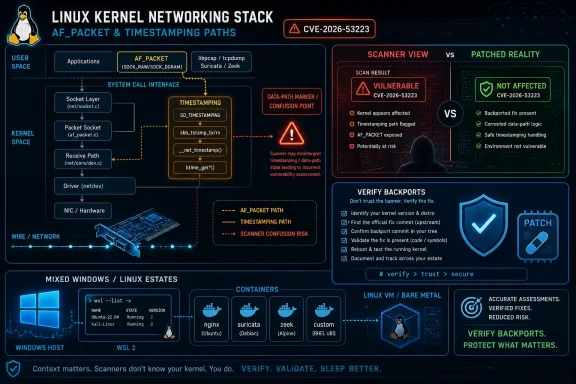 A Small Networking Assumption Became a Kernel Boundary Problem
The core of CVE-2026-53223 is a mistaken shortcut in the Linux networking stack. The helper involved, skb_is_err_queue(), treated PACKET_OUTGOING as enough evidence that a socket buffer came from the socket error queue. That assumption breaks for AF_PACKET sockets, where outgoing packet taps can also arrive with the same marker even though their control buffer belongs to a different subsystem.That sounds obscure because it is. But obscure is not the same as harmless. Linux’s socket buffer, or
skb, is one of the kernel’s most heavily trafficked internal objects, and its control buffer is reused by different networking layers that expect to know who owns the metadata at any moment.The vulnerability appears when timestamping is enabled and the generic timestamp control-message path interprets AF_PACKET control-buffer data as if it were
struct sock_exterr_skb data from a genuine error-queue packet. With SO_RXQ_OVFL enabled, the packet drop counter can overlap the field the timestamping code reads as optional statistics. An odd drop count can push the path into emitting SCM_TIMESTAMPING_OPT_STATS using skb->len and skb->data.That final step is where a type-confusion-like logic bug becomes a security issue. For non-linear socket buffers, copying based on the wrong assumption can go beyond the linear head of the packet. Kernel.org’s CVE text says the result can be a hardened usercopy failure or disclosure of adjacent heap contents.
The Severity Score Gets the Shape Right, but Not the Whole Risk
Kernel.org assigned CVE-2026-53223 a CVSS 3.1 score of 7.1, rated High, with a vector of local attack, low complexity, low privileges, no user interaction, unchanged scope, high confidentiality impact, no integrity impact, and high availability impact. NVD had not provided its own independent CVSS assessment in the material available from its July 2 initial analysis, but it did carry the kernel.org score and added affected CPE ranges.That score is a useful first approximation. This is not an unauthenticated network exploit against every Linux server with an open port. It requires local privileges and a particular interaction with packet sockets, timestamping, and overflow accounting.
But the local-only label can lull defenders into underreacting. Modern “local” attack surfaces are crowded places: containers, CI runners, shared developer workstations, multi-tenant research boxes, packet-capture tooling, service meshes, eBPF-adjacent observability stacks, and WSL environments where Linux user space sits one abstraction layer away from Windows operations. A local kernel information disclosure is not the same as a remote code execution bug, but it can be a stepping stone in exploit chains where defeating address-space layout randomization or learning heap layout matters.
The availability angle also deserves attention. Kernel hardening features are designed to stop unsafe copies, and in this case hardened usercopy may turn a potential leak into a crash or process failure. That is the right security tradeoff, but it still means production systems doing packet capture or timestamp-heavy network diagnostics can experience disruption under the wrong conditions.
AF_PACKET Is the Old Plumbing Nobody Gets to Ignore
AF_PACKET is one of those Linux features that most users never think about and many tools quietly depend on. It is the raw packet interface used by packet capture, traffic inspection, network diagnostics, and assorted monitoring agents. If you have ever used tcpdump, Wireshark capture components, IDS tooling, or low-level traffic collectors on Linux, you have brushed up against this family of interfaces.That matters because the vulnerability sits at the intersection of legitimate observability and kernel trust boundaries. Timestamping is also a serious feature, not a novelty. High-resolution packet timestamps are important in latency analysis, finance, telecom, industrial networking, and distributed systems debugging.
The bug therefore lives in a place administrators are likely to enable precisely on systems where network data is sensitive. A development laptop with casual packet capture is one scenario. A production host collecting traffic metadata for incident response is another. The latter is where an information disclosure from kernel heap memory becomes more than a theoretical concern.
The fix is not to panic about AF_PACKET or timestamping. The fix is to remember that Linux’s networking stack is a dense layering of historical interfaces, performance shortcuts, and feature accretion. When one path assumes a marker means “this came from the error queue,” and another legitimate path uses the same marker for a different reason, the kernel has to verify ownership, not merely intent.
The Patch Is a Lesson in Defensive Identification
The upstream fix is elegant in the way good kernel patches often are: it narrows the meaning of a marker rather than trying to paper over every downstream symptom. Kernel.org’s description saysskb_is_err_queue() remains local to net/socket.c, but now verifies that the PACKET_OUTGOING marker is paired with the sock_rmem_free destructor installed by sock_queue_err_skb().That pairing is the important idea. A real socket error-queue buffer should not only look like it came from the error queue; it should also have the ownership characteristics of something placed there by the correct kernel path. AF_PACKET receive buffers use normal receive ownership, so they no longer pass as error-queue buffers merely because they carry
PACKET_OUTGOING.In plain English, the kernel stopped trusting a nametag and started checking the badge issuer. That is a small change, but it closes the specific confusion that allowed timestamp code to read one subsystem’s metadata as another subsystem’s structure.
The affected source areas listed in the CVE record —
include/net/sock.h, net/core/skbuff.c, and net/socket.c — also tell the story. This is not a user-space bug in tcpdump or a configuration mistake in a distribution package. It is a kernel data-path correctness issue, which means remediation comes through kernel updates or distribution backports, not application-level workarounds.The CPE List Is Noisy Because Kernel Versioning Is Noisy
The user-facing question attached to CVE-2026-53223 is whether a CPE is missing. The short answer is: maybe in a narrow inventory sense, but the larger problem is that CPEs are a blunt instrument for Linux kernel vulnerability tracking.NVD’s July 2 initial analysis added a broad set of Linux kernel CPE configurations, including release candidates around 4.11 and 7.1, plus stable version ranges such as 4.10.14 up to before 4.11, 4.11.1 up to before 5.10.259, 5.11 up to before 5.15.210, 5.16 up to before 6.1.176, 6.2 up to before 6.6.143, 6.7 up to before 6.12.94, 6.13 up to before 6.18.36, and 6.19 up to before 7.0.13. Kernel.org also listed git commit ranges and multiple stable patch references.
That kind of CPE spread can look bizarre if you expect one vulnerability to map cleanly to one product version. Linux does not work that way. Enterprise distributions often carry older base version numbers with hundreds or thousands of backported fixes. A server reporting a 5.14-derived enterprise kernel, for example, may be patched against a vulnerability that naïve upstream version comparison would mark as affected.
This is why scanners that rely only on upstream kernel version strings create false positives in Linux estates. The real question is not merely “Is this kernel version lower than the fixed upstream version?” It is “Has the vendor kernel package incorporated the relevant patch or an equivalent backport?”
For Windows administrators who are used to KB-driven servicing, Linux kernel CPEs can feel like a regression. Microsoft’s update model usually gives you a product build and cumulative update lineage. Linux gives you upstream semver-like releases, distribution kernel ABIs, vendor patches, livepatch streams, and sometimes appliance-specific kernels. CPEs are useful for discovery, but they are not a substitute for vendor advisory status.
NVD’s “Insufficient Information” Is Not a Clean Bill of Health
NVD’s weakness entry for CVE-2026-53223 showedNVD-CWE-noinfo, meaning NIST had insufficient information to assign a specific CWE at that stage. That should not be read as uncertainty that the vulnerability exists. It means the taxonomy mapping had not been resolved.This distinction matters because vulnerability management dashboards often flatten nuance into red, yellow, and green cells. A missing NVD CVSS score, a generic CWE, or a pending enrichment field can make a CVE appear less mature or less actionable than it really is. In this case, kernel.org’s CNA record provides a concrete technical description, affected program files, CVSS vector, and patch references.
The better operational posture is to treat kernel.org as the authoritative origin for the Linux kernel issue and NVD as an aggregator whose enrichment may lag, evolve, or introduce broad CPE mappings that require local interpretation. That is not a criticism of NVD so much as a recognition of scale. The kernel’s CVE process now emits a steady stream of granular fixes, and national databases struggle to translate that into asset-management truth.
If your scanner says CVE-2026-53223 affects a host, do not stop at the CPE. Check the distribution’s security tracker, package changelog, kernel build metadata, or vendor advisory. If your scanner says it does not affect a host, but you run custom kernels in the listed upstream ranges, do not assume you are safe either.
Containers Change the Blast Radius Math
The local-privilege requirement is comforting only if local users are trusted and constrained. Containerized environments complicate that comfort. Containers share the host kernel, and kernel vulnerabilities often turn a container escape discussion from theoretical to urgent depending on namespace exposure, capabilities, seccomp profiles, and device access.AF_PACKET access is not universally available inside containers, and many hardened container profiles restrict raw socket behavior. But the practical estate is uneven. CI jobs, privileged containers, network troubleshooting pods, monitoring agents, and appliance-like deployments frequently get expanded network capabilities because someone needed visibility more than they needed isolation.
The most obvious risk group is not every Kubernetes workload. It is the smaller set of containers and local users granted network inspection privileges, raw packet access, or elevated capabilities for operational convenience. That is exactly the population defenders should review when a vulnerability touches AF_PACKET and timestamping paths.
WSL deserves a separate mention for this audience. WSL 2 runs a real Linux kernel inside a lightweight VM, so the host Windows kernel is not the same attack surface as a bare-metal Linux box. Still, organizations using WSL for development should track Microsoft’s WSL kernel updates and avoid assuming Linux CVEs are irrelevant simply because the laptop is “a Windows machine.” The boundary is different; the need to patch the Linux kernel component remains.
The Exploit Story Is Plausible but Not Yet Publicly Dramatic
Nothing in the available reporting indicates a widely circulating public exploit for CVE-2026-53223 as of July 4, 2026. The CVE description is technical and specific, and the known impact is framed around information disclosure and hardened usercopy-triggered failure rather than arbitrary kernel code execution.That does not make the bug unimportant. Kernel information disclosures have a long history of becoming exploit-chain helpers. They can reveal heap contents, pointer-like values, object adjacency, or data that makes another memory corruption bug more reliable.
The availability component is also less glamorous than code execution, but it matters for systems doing network monitoring. If a local user can trigger a hardened usercopy failure under specific socket conditions, the resulting crash or disruption can affect debugging tools, monitoring agents, or workloads that depend on stable capture paths.
The right journalistic posture here is restraint. This is not “all Linux systems remotely hackable.” It is also not “just a local bug.” It is a kernel data handling flaw in a privileged subsystem, scored High by the kernel CNA, with credible confidentiality and availability impact under local attack conditions.
The Versions Tell Administrators Where to Look First
NVD’s affected configurations span a long history of kernel releases, but most administrators should not manually compare every upstream range. The better workflow is to start with your kernel supplier.For mainstream distributions, wait for or verify the vendor’s patched package status. Ubuntu, Debian, Red Hat, SUSE, Oracle, Amazon Linux, Rocky, AlmaLinux, and appliance vendors will map upstream commits into their own kernel lines. Some will mark a CVE “not affected” because a feature path differs, some will backport the fix without changing the apparent upstream kernel version, and some will ship it as part of a broader kernel update.
For custom kernels, the upstream stable commit references matter directly. Kernel.org’s CVE record lists multiple stable patch commits because the fix had to land across maintained branches. If you build kernels internally, the task is to identify the branch you track and verify that the relevant backport is present.
For embedded and appliance environments, this CVE is another reminder that Linux kernel patching is often hidden behind vendor firmware. A storage box, firewall, hypervisor appliance, or monitoring probe may contain an affected Linux kernel while exposing no ordinary package manager. In those cases, the CPE question becomes especially fraught because the product’s public version may not map cleanly to the kernel inside.
Windows Shops Still Own This Linux Risk
A WindowsForum article about a Linux kernel CVE may seem off-brand until you look at modern Windows estates. Windows admins now routinely own Linux risk through WSL, Hyper-V guests, Azure Linux workloads, container hosts, network appliances, developer workstations, and security tooling. The perimeter between “Windows environment” and “Linux environment” dissolved years ago.The operational trap is that these Linux kernels often fall between teams. Endpoint teams patch Windows. Cloud teams patch images. Developers update WSL when something breaks. Security teams ingest CVEs but may not know which kernel belongs to which layer. Infrastructure teams assume the appliance vendor has it covered.
CVE-2026-53223 is not the most catastrophic vulnerability those teams will face this year, but it is a useful test of ownership. Can you identify which systems expose AF_PACKET to untrusted local users or privileged containers? Can you tell whether your WSL kernels, container hosts, and monitoring appliances have picked up the stable fix? Can your vulnerability scanner distinguish a vulnerable upstream version from a distribution kernel with the backport?
If the answer is no, this CVE is doing you a favor. It is showing you where your Linux kernel inventory is soft before a more obviously exploitable bug arrives.
The Scanner Will Not Save You from Kernel Backports
The CPE mapping in NVD is useful, but it is not definitive for every environment. That point is worth emphasizing because vulnerability management tools often turn NVD CPEs into tickets automatically. Those tickets then bounce between teams because the reported version does not match the vendor’s advisory language.A false positive is not harmless. If administrators learn that Linux kernel CVEs routinely produce noisy tickets, they start bulk-closing them. That habit is dangerous when a future kernel CVE is remotely reachable, actively exploited, or tied to container escape primitives.
A false negative is worse. Custom kernels, pinned cloud images, neglected appliances, and offline build environments can sit outside the clean vendor-advisory loop. They may not light up in a scanner if the product metadata is incomplete, even while they contain the vulnerable code path.
The remedy is boring but effective: maintain kernel provenance. Know whether a system runs a vendor-supported kernel, a cloud-provider kernel, a WSL kernel, a container-host kernel, an appliance firmware kernel, or an internally built kernel. For each category, know where security fixes are announced and how quickly they are deployed.
The Real Patch Window Is Measured in Estates, Not Commits
Kernel.org had patches in the stable tree, and NVD had begun enrichment by July 2. That does not mean the practical remediation window closed. In enterprise reality, the clock runs until the last exposed kernel receives the fix or is otherwise mitigated.Linux patch deployment is constrained by reboot windows, livepatch availability, kernel module compatibility, appliance firmware schedules, and the eternal fear that a network-sensitive host will behave differently after an update. Those constraints are real. But they should be weighed against the risk profile of systems where local users or privileged containers can exercise packet socket behavior.
The highest-priority targets are shared systems and hosts with untrusted local execution. Developer build machines, jump boxes, research servers, CI runners, container hosts, and packet-capture nodes deserve attention before single-purpose appliances with no user shell and limited local attack paths.
Administrators should also review capability grants. If containers or service accounts have raw packet access solely because of historical convenience, this is a good moment to remove it. Reducing exposure to AF_PACKET does not replace patching, but it can shrink the set of users and workloads able to reach the vulnerable path.
A Narrow CVE With a Wide Operational Message
CVE-2026-53223 is a good example of the kind of Linux kernel vulnerability that looks microscopic in code and broad in operations. The fix is a tighter ownership check. The affected surface is a specialized network path. The estate impact depends on distribution backports, custom kernels, scanner interpretation, container capability policy, and whether anyone knows where packet sockets are exposed.The concrete takeaways are less about panic and more about disciplined kernel hygiene:
- Systems running vendor-supported Linux kernels should be checked against the vendor’s security advisory or kernel package changelog, not judged solely by the upstream version string.
- Custom kernel builders should verify that the stable-tree fix for the timestamp error-queue socket-buffer check has been merged into their maintained branch.
- Container hosts should be reviewed for privileged workloads, raw packet access, and network troubleshooting containers that may expose AF_PACKET paths to less-trusted code.
- WSL users in managed Windows fleets should confirm that the WSL Linux kernel update channel is part of normal endpoint maintenance.
- Vulnerability-management teams should treat NVD CPE data as a starting point and reconcile it with distribution backports before closing or escalating tickets.
References
- Primary source: NVD / Linux Kernel
Published: 2026-07-04T01:03:27-07:00
NVD - CVE-2026-53223
 nvd.nist.gov
- Security advisory: MSRC
Published: 2026-07-04T01:03:27-07:00
Original feed URL
Security Update Guide - Microsoft Security Response Center
 msrc.microsoft.com
- Official source: nist.gov
National Vulnerability Database
NIST maintains the National Vulnerability Database (NVD), a repository of information on software and hardware flaws that can compromise computer security. This is a key piece of the nation’s cybersecurity infrastructure.www.nist.gov - Related coverage: ubuntu.com
- Related coverage: labs.cloudsecurityalliance.org
CSA research note nist nvd riskbased enrichment governance 20260426 csa styled
PDF documentlabs.cloudsecurityalliance.org