

CVE-2026-53339 affects you only if your Linux kernel contains the vulnerable Qualcomm CCI I2C driver path and your board can hit the case where the controller exposes two I2C masters but only one master is initialized. The practical remediation is not a workaround hunt: update to a fixed stable kernel, or obtain a vendor kernel that backports the same fix for your branch and board support package. For most ordinary desktops, generic x86 servers, and containers that do not run their own kernel, this is not a broad emergency. For Qualcomm-based Linux devices, embedded products, board-support teams, and anyone testing driver unload or device unbind paths, it is a concrete kernel panic risk that needs verification.
The Linux kernel CVE description identifies CVE-2026-53339 as a NULL pointer dereference in
That is the whole story in operational terms: a board-specific driver teardown bug, not a remotely reachable network service, not a browser exploit, and not evidence that all Linux systems or all Qualcomm devices are exposed. The relevant exposure question is much more precise: does the running kernel include the affected
This distinction matters because vulnerability feeds often flatten Linux kernel issues into a generic “Linux affected” headline. That is not good enough here. A generic x86 Windows desktop, a typical Linux server without Qualcomm CCI hardware, or a cloud VM with no access to that driver path is not the natural target population. The systems worth prioritizing are Qualcomm-based Linux devices, embedded platforms, camera-adjacent designs, Android-adjacent board support packages, and lab devices where the CCI driver may be loaded, unloaded, rebound, or exercised during maintenance and testing.
The source material does not support claims of remote exploitation, privilege escalation, data disclosure, or arbitrary code execution. The supported failure mode is a kernel crash during driver removal or detach. That can still matter. Availability bugs in kernel space are operationally serious when they affect field devices, managed appliances, safety-sensitive maintenance workflows, or development boards used to validate a product line. But the right response is targeted remediation, not broad panic.
That tells admins and developers something important: a device can boot successfully, the enabled I2C master can function normally, and the bug may still remain dormant until the module is unloaded or the platform device is removed. In other words, normal boot testing alone may not expose the issue. Driver lifecycle testing is the critical path.
The mechanism is concise. Initialization is conditional: only the enabled I2C master has its completion initialized. Teardown is too broad: it calls halt logic for both masters. Removal code then waits on a completion associated with a master that was never initialized. In kernel driver terms, cleanup failed to mirror setup. The fix path is therefore about making removal respect initialization state, so teardown only touches objects that were actually prepared or is otherwise safe for partially initialized hardware.
That is why embedded and device teams should take this more seriously than the small code area might suggest. Driver remove paths are often under-tested because boot, probe, and normal device use get most of the attention. Yet remove paths are where lifetime assumptions become unforgiving. If setup skips a resource, cleanup must know that. If hardware exposes more capability than a board enables, the driver must follow the board state, not the maximum theoretical controller layout.
The bug’s practical risk also depends on who can trigger removal. If unloading the module or unbinding the device requires privileged access, then the issue looks primarily like a local availability problem on affected systems. If a management service, test harness, field diagnostic tool, or maintenance workflow can indirectly trigger driver detach, the operational risk rises. Either way, the supported remediation remains the same: move to a fixed stable kernel or a vendor backport that carries the fix.
This table should be read as branch guidance, not as a substitute for source verification. Linux kernels do not move through one universal patch train. A distribution or device vendor may backport a fix into a kernel whose public version string appears older than the upstream fixed release. Conversely, a heavily modified vendor tree may carry vulnerable code even when its marketing or build label looks newer than expected.
That is why the right question is not simply “Is the kernel newer than 5.8?” The better question is: does the branch actually contain the
The kernel team’s general mitigation guidance for this class of issue is to update to the latest stable kernel available for the branch or product rather than treating one isolated commit as a universal cure. That advice is especially important for embedded vendors. A local cherry-pick can appear simple, but old board-support trees often differ from upstream in subtle ways. If a vendor cannot move wholesale to a fixed stable level, the backport should be reviewed in the context of the local tree and tested on the affected board variant.
The same caution applies to severity fields. If a scanner shows no score, a placeholder score, or inconsistent severity from different feeds, do not treat that as proof of either safety or emergency. The source facts support a narrower contextual assessment: on systems without the Qualcomm CCI driver path and matching hardware condition, exposure is unlikely; on Qualcomm-based Linux devices where the vulnerable driver can be unloaded or unbound, the bug can produce a kernel crash.
Mirrored vulnerability databases may repeat the same short description without adding much technical detail. That is normal. They help vulnerability data propagate, but they do not replace branch-aware remediation work. For CVE-2026-53339, a useful investigation needs to answer four concrete questions:
This is also where container and VM findings need careful interpretation. Ordinary Linux containers share the host kernel; they do not bring an independently running kernel driver just because a package or SBOM entry mentions Linux. A container image finding therefore has to be mapped back to the host kernel and hardware. A Linux VM likewise needs hardware and driver context. A VM with no Qualcomm CCI device exposure is not the same as an ARM development board running the affected driver directly.
Embedded appliances are different. If a scanner flags a firmware image, appliance kernel, Android-adjacent board-support package, or edge device, the finding deserves closer review. Those environments are exactly where board-specific kernel drivers live, where version strings may not match upstream cleanly, and where vendor backports determine practical safety.
Hardware support code lives in a world of partial enablement. One board may wire and declare both controllers. Another may expose only one. A development board may differ from the shipping product. A vendor kernel may carry device-tree changes or board-specific patches that change what probes, what initializes, and what stays dormant. Cleanup code that assumes the maximum hardware layout rather than the initialized board state is fragile.
The call trace points to a wait on a completion. In kernel terms, a completion is a synchronization primitive used when one path waits for another event to finish. If the completion object was never initialized for a disabled master, waiting on it is not a harmless no-op. In the reported failure, the result is a NULL pointer dereference.
The fix is conceptually straightforward even if backporting it is not: removal must be conditional in the same way initialization is conditional, or the driver must ensure that any object removal can touch is safely initialized. For maintainers, the lesson is familiar but important. Probe success does not prove remove correctness. A driver can appear stable until the exact lifecycle transition that exposes an initialization mismatch.
For product owners, the Qualcomm detail should drive inventory. Look first at devices with camera, sensor, or imaging-adjacent hardware stacks where CCI may be used. Look at development kits and ARM boards. Look at vendor BSPs that carry Qualcomm support code. Do not waste equal effort on unrelated x86 servers simply because the word “Linux” appears in the CVE title.
A kernel panic during driver removal can interrupt maintenance, testing, recovery, or field diagnostics. In a lab, it can waste engineering time and hide in flaky test results. In an appliance, it can turn a routine management action into an outage. In a product lifecycle, it can become one more reason a vendor kernel must be audited against upstream stable fixes instead of judged by a marketing version string.
The risk is also easy to miss because it lives in teardown. Many validation plans emphasize boot success, feature functionality, and normal runtime behavior. Those tests may pass. The defect appears when the driver is detached or removed, which is exactly the path some production systems rarely exercise and some development systems exercise constantly. That split is why asset context matters more than a generic severity label.
For security teams, the most productive triage posture is contextual severity. If the asset is a generic Linux host with no Qualcomm CCI hardware and no relevant driver path, deprioritize after documenting why. If the asset is a Qualcomm-based embedded device with the vulnerable driver and a board layout matching the one-master case, remediate promptly. If the asset is a vendor appliance and the kernel details are opaque, push the vendor for a specific answer.
For engineering teams, the fix should be validated in code and on hardware. Confirm that
That does not mean CVE-2026-53339 is likely to affect WSL in the direct hardware-driver sense. A Windows laptop running WSL should not be assumed exposed merely because a Linux kernel CVE exists. The relevant question is whether the running kernel contains the vulnerable Qualcomm CCI driver path and whether matching hardware can reach it. For most WSL and generic VM scenarios, that hardware condition will not be present.
Still, Windows admins may own the vulnerability reports that mention Linux kernels. They need enough Linux literacy to avoid both panic and dismissal. If a scanner flags this against a Linux VM, ask whether the VM has the relevant driver and hardware exposure. If it flags a container image, remember that the host kernel is what matters in the ordinary container model. If it flags an embedded appliance, firmware image, or ARM board, ask much more detailed questions.
The most likely affected organizations are not Windows desktop fleets. They are device makers, labs, integrators, mobile and edge teams, and enterprises with Qualcomm-based Linux hardware. That includes development boards, camera-enabled embedded systems, and hardware platforms where Qualcomm support code is part of the kernel. The advisory does not say every such device is vulnerable; it identifies a vulnerable driver behavior under a specific one-master initialization condition.
This distinction is the difference between useful security coverage and fearmongering. The crash is real. The affected code path is specific. The fix exists. The remediation is to update to a fixed stable kernel or obtain a vendor backport. The work is proving whether your asset is in the path and whether your kernel actually contains the fix.
For source-based teams, start with the file path. Search the kernel tree for
For operations teams, logs are useful but not definitive. The crash signature described in the advisory includes a NULL pointer dereference at address zero and a trace involving
For vendor-management teams, ask precise questions. Do not ask only, “Are you affected by CVE-2026-53339?” Ask which kernel branch the product uses, whether
For custom kernel maintainers, resist the urge to close the ticket with a patch reference alone. Backporting a kernel fix is not complete until it is compiled, booted, and exercised against the lifecycle that triggered the bug. In this case, that means removal testing. If the driver is modular, test module unload. If the platform uses device unbind paths, test those. If suspend, resume, diagnostics, or camera-stack reset workflows can touch the same lifecycle, include them in validation.
The forward-looking lesson is simple: Linux kernel CVEs increasingly demand asset-specific reasoning. The headline says “Linux kernel.” The exposure says “Qualcomm CCI I2C driver, vulnerable removal path, one-master-initialized board state.” The fix says “stable update or vendor backport.” The right response is to inventory precisely, patch on the correct branch, and prove the crash path is gone.
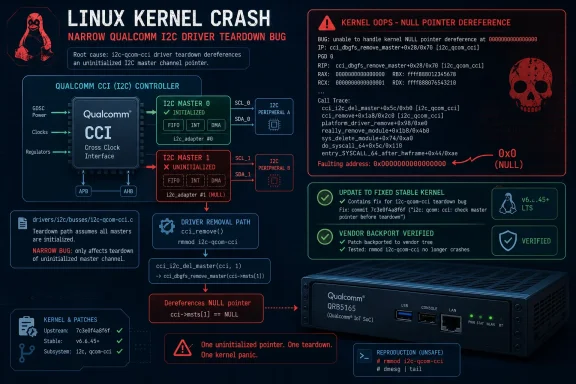 A Small Driver Bug With a Very Specific Blast Radius
The Linux kernel CVE description identifies CVE-2026-53339 as a NULL pointer dereference in cci_remove() in the Qualcomm CCI I2C driver, specifically in drivers/i2c/busses/i2c-qcom-cci.c. The vulnerable behavior is narrow: on modern Qualcomm CCI platforms, the controller may provide two I2C masters, but some boards initialize only one. The faulty removal path attempts to halt both masters even though completion state exists only for the initialized master. When removal waits on the uninitialized path, the kernel can dereference address zero and crash.That is the whole story in operational terms: a board-specific driver teardown bug, not a remotely reachable network service, not a browser exploit, and not evidence that all Linux systems or all Qualcomm devices are exposed. The relevant exposure question is much more precise: does the running kernel include the affected
i2c-qcom-cci driver code, does the system actually use Qualcomm CCI hardware, and can the board configuration create the one-master-initialized condition described by the CVE?This distinction matters because vulnerability feeds often flatten Linux kernel issues into a generic “Linux affected” headline. That is not good enough here. A generic x86 Windows desktop, a typical Linux server without Qualcomm CCI hardware, or a cloud VM with no access to that driver path is not the natural target population. The systems worth prioritizing are Qualcomm-based Linux devices, embedded platforms, camera-adjacent designs, Android-adjacent board support packages, and lab devices where the CCI driver may be loaded, unloaded, rebound, or exercised during maintenance and testing.
The source material does not support claims of remote exploitation, privilege escalation, data disclosure, or arbitrary code execution. The supported failure mode is a kernel crash during driver removal or detach. That can still matter. Availability bugs in kernel space are operationally serious when they affect field devices, managed appliances, safety-sensitive maintenance workflows, or development boards used to validate a product line. But the right response is targeted remediation, not broad panic.
The Crash Happens on the Way Out, Not the Way In
The most useful technical clue is that the failure occurs on the removal path. The advisory’s sample trigger isrmmod i2c-qcom-cci, followed by a kernel NULL pointer dereference at virtual address 0000000000000000. The trace includes wait_for_completion_timeout and cci_remove, then unwinds through the platform-driver removal path and the driver exit routine.That tells admins and developers something important: a device can boot successfully, the enabled I2C master can function normally, and the bug may still remain dormant until the module is unloaded or the platform device is removed. In other words, normal boot testing alone may not expose the issue. Driver lifecycle testing is the critical path.
The mechanism is concise. Initialization is conditional: only the enabled I2C master has its completion initialized. Teardown is too broad: it calls halt logic for both masters. Removal code then waits on a completion associated with a master that was never initialized. In kernel driver terms, cleanup failed to mirror setup. The fix path is therefore about making removal respect initialization state, so teardown only touches objects that were actually prepared or is otherwise safe for partially initialized hardware.
That is why embedded and device teams should take this more seriously than the small code area might suggest. Driver remove paths are often under-tested because boot, probe, and normal device use get most of the attention. Yet remove paths are where lifetime assumptions become unforgiving. If setup skips a resource, cleanup must know that. If hardware exposes more capability than a board enables, the driver must follow the board state, not the maximum theoretical controller layout.
The bug’s practical risk also depends on who can trigger removal. If unloading the module or unbinding the device requires privileged access, then the issue looks primarily like a local availability problem on affected systems. If a management service, test harness, field diagnostic tool, or maintenance workflow can indirectly trigger driver detach, the operational risk rises. Either way, the supported remediation remains the same: move to a fixed stable kernel or a vendor backport that carries the fix.
The Version Map Is the Story
The verified version data is limited but still useful. The issue is identified as affected from Linux 5.8. The fixed stable levels explicitly present in the verified facts are5.10.259, 5.15.210, 6.1.176, and 6.6.143. Those are the only stable release numbers that should drive a version table here. Other specific stable versions must not be treated as verified for this article.| Kernel line or version state | Status for CVE-2026-53339 | Practical interpretation |
|---|---|---|
| Below 5.8 | Not affected by the introduced vulnerable lineage | The CVE’s introducing version data does not place these kernels in scope |
| 5.8 and later affected lineage | Affected unless the relevant fix is present | Version number alone is not enough if a vendor kernel carries backports |
| 5.10.y | Fixed at 5.10.259 | Update to this level or confirm an equivalent vendor backport |
| 5.15.y | Fixed at 5.15.210 | Update to this level or confirm an equivalent vendor backport |
| 6.1.y | Fixed at 6.1.176 | Update to this level or confirm an equivalent vendor backport |
| 6.6.y | Fixed at 6.6.143 | Update to this level or confirm an equivalent vendor backport |
That is why the right question is not simply “Is the kernel newer than 5.8?” The better question is: does the branch actually contain the
i2c-qcom-cci removal fix for this bug? For upstream stable users, the fixed levels above are the clean landing zones. For distro and vendor kernels, the safest answer comes from the source package, changelog, vendor security advisory, or direct vendor confirmation that the relevant patch was backported.The kernel team’s general mitigation guidance for this class of issue is to update to the latest stable kernel available for the branch or product rather than treating one isolated commit as a universal cure. That advice is especially important for embedded vendors. A local cherry-pick can appear simple, but old board-support trees often differ from upstream in subtle ways. If a vendor cannot move wholesale to a fixed stable level, the backport should be reviewed in the context of the local tree and tested on the affected board variant.
Vulnerability Databases Are the Starting Point, Not the Remediation Plan
CVE records and vulnerability databases are useful because they give scanners, SBOM platforms, and compliance programs a common identifier. But for this issue, the operationally useful information is the driver path, the affected hardware condition, and the fixed branch levels. A dashboard that says “Linux kernel NULL pointer dereference” without hardware context is not enough to decide risk.The same caution applies to severity fields. If a scanner shows no score, a placeholder score, or inconsistent severity from different feeds, do not treat that as proof of either safety or emergency. The source facts support a narrower contextual assessment: on systems without the Qualcomm CCI driver path and matching hardware condition, exposure is unlikely; on Qualcomm-based Linux devices where the vulnerable driver can be unloaded or unbound, the bug can produce a kernel crash.
Mirrored vulnerability databases may repeat the same short description without adding much technical detail. That is normal. They help vulnerability data propagate, but they do not replace branch-aware remediation work. For CVE-2026-53339, a useful investigation needs to answer four concrete questions:
- Does the kernel tree include
drivers/i2c/busses/i2c-qcom-cci.c? - Is the driver built into the kernel or available as the
i2c-qcom-ccimodule? - Is the device based on Qualcomm CCI hardware where only one of two I2C masters may be initialized?
- Is the kernel at a fixed stable level or carrying an equivalent vendor backport?
This is also where container and VM findings need careful interpretation. Ordinary Linux containers share the host kernel; they do not bring an independently running kernel driver just because a package or SBOM entry mentions Linux. A container image finding therefore has to be mapped back to the host kernel and hardware. A Linux VM likewise needs hardware and driver context. A VM with no Qualcomm CCI device exposure is not the same as an ARM development board running the affected driver directly.
Embedded appliances are different. If a scanner flags a firmware image, appliance kernel, Android-adjacent board-support package, or edge device, the finding deserves closer review. Those environments are exactly where board-specific kernel drivers live, where version strings may not match upstream cleanly, and where vendor backports determine practical safety.
The Qualcomm Angle Is About Board Reality, Not Brand Panic
The vulnerability description names the Qualcomm CCI controller, but the correct reading is not “all Qualcomm systems are vulnerable.” The failure depends on Linux driver cleanup behavior on boards where the controller exposes two I2C masters while only one is initialized. That is a board and driver-state issue, not a broad brand indictment.Hardware support code lives in a world of partial enablement. One board may wire and declare both controllers. Another may expose only one. A development board may differ from the shipping product. A vendor kernel may carry device-tree changes or board-specific patches that change what probes, what initializes, and what stays dormant. Cleanup code that assumes the maximum hardware layout rather than the initialized board state is fragile.
The call trace points to a wait on a completion. In kernel terms, a completion is a synchronization primitive used when one path waits for another event to finish. If the completion object was never initialized for a disabled master, waiting on it is not a harmless no-op. In the reported failure, the result is a NULL pointer dereference.
The fix is conceptually straightforward even if backporting it is not: removal must be conditional in the same way initialization is conditional, or the driver must ensure that any object removal can touch is safely initialized. For maintainers, the lesson is familiar but important. Probe success does not prove remove correctness. A driver can appear stable until the exact lifecycle transition that exposes an initialization mismatch.
For product owners, the Qualcomm detail should drive inventory. Look first at devices with camera, sensor, or imaging-adjacent hardware stacks where CCI may be used. Look at development kits and ARM boards. Look at vendor BSPs that carry Qualcomm support code. Do not waste equal effort on unrelated x86 servers simply because the word “Linux” appears in the CVE title.
Action Checklist for Admins, Vendors, and Kernel Teams
Use one focused checklist rather than duplicating the same explanation across triage, remediation, and validation. The goal is to prove whether the vulnerable path is reachable and whether the fix is present.- Inventory Linux kernels and device images that include
drivers/i2c/busses/i2c-qcom-cci.cor expose thei2c-qcom-ccimodule. - Prioritize Qualcomm-based boards and products where only one CCI I2C master may be initialized.
- Check the actual running kernel branch, source package, vendor BSP, or firmware tree rather than relying only on a scanner’s package match.
- For upstream stable branches, treat
5.10.259,5.15.210,6.1.176, and6.6.143as the verified fixed levels currently available in the provided facts. - For distro or vendor kernels, confirm whether the equivalent fix was backported even if the visible kernel version is older than an upstream fixed level.
- Prefer a maintained stable update or vendor update over an isolated local cherry-pick.
- If a backport is unavoidable, test the affected board condition directly: two-master-capable CCI hardware with only one master initialized.
- Exercise driver removal and device unbind paths, including
rmmod i2c-qcom-cciwhere the driver is modular and safe to test. - Review crash logs for NULL pointer dereferences involving
wait_for_completion_timeoutandcci_remove. - Treat container-only findings as context-dependent because ordinary containers share the host kernel.
- Ask appliance and hardware vendors for the kernel branch, driver presence, board configuration, and backport status.
Why This Still Matters Without a Dramatic Exploit Story
Some vulnerability writeups become inflated because they try to turn every kernel bug into a universal crisis. This one should not be inflated. The source facts do not support a remote attack story, a broad desktop threat, or a claim that all Qualcomm Linux devices are automatically vulnerable. But underplaying it would also be a mistake for the teams that actually ship or manage affected boards.A kernel panic during driver removal can interrupt maintenance, testing, recovery, or field diagnostics. In a lab, it can waste engineering time and hide in flaky test results. In an appliance, it can turn a routine management action into an outage. In a product lifecycle, it can become one more reason a vendor kernel must be audited against upstream stable fixes instead of judged by a marketing version string.
The risk is also easy to miss because it lives in teardown. Many validation plans emphasize boot success, feature functionality, and normal runtime behavior. Those tests may pass. The defect appears when the driver is detached or removed, which is exactly the path some production systems rarely exercise and some development systems exercise constantly. That split is why asset context matters more than a generic severity label.
For security teams, the most productive triage posture is contextual severity. If the asset is a generic Linux host with no Qualcomm CCI hardware and no relevant driver path, deprioritize after documenting why. If the asset is a Qualcomm-based embedded device with the vulnerable driver and a board layout matching the one-master case, remediate promptly. If the asset is a vendor appliance and the kernel details are opaque, push the vendor for a specific answer.
For engineering teams, the fix should be validated in code and on hardware. Confirm that
cci_remove() no longer waits on state that was never initialized. Confirm that module unload or device unbind no longer triggers the crash on the affected board variant. Confirm that the fix is carried in every product branch that inherited the vulnerable code. A clean compile is not enough.The Windows Admin’s Linux Problem Keeps Getting Less Optional
At first glance, a Qualcomm I2C driver CVE may seem outside the WindowsForum universe. But modern Windows administration increasingly includes Linux systems at the edge of the estate: WSL developer machines, Linux containers on Windows hosts, Hyper-V Linux guests, Azure and on-prem Linux appliances, Android-adjacent devices, ARM development boards, and vendor hardware whose management plane quietly runs Linux.That does not mean CVE-2026-53339 is likely to affect WSL in the direct hardware-driver sense. A Windows laptop running WSL should not be assumed exposed merely because a Linux kernel CVE exists. The relevant question is whether the running kernel contains the vulnerable Qualcomm CCI driver path and whether matching hardware can reach it. For most WSL and generic VM scenarios, that hardware condition will not be present.
Still, Windows admins may own the vulnerability reports that mention Linux kernels. They need enough Linux literacy to avoid both panic and dismissal. If a scanner flags this against a Linux VM, ask whether the VM has the relevant driver and hardware exposure. If it flags a container image, remember that the host kernel is what matters in the ordinary container model. If it flags an embedded appliance, firmware image, or ARM board, ask much more detailed questions.
The most likely affected organizations are not Windows desktop fleets. They are device makers, labs, integrators, mobile and edge teams, and enterprises with Qualcomm-based Linux hardware. That includes development boards, camera-enabled embedded systems, and hardware platforms where Qualcomm support code is part of the kernel. The advisory does not say every such device is vulnerable; it identifies a vulnerable driver behavior under a specific one-master initialization condition.
This distinction is the difference between useful security coverage and fearmongering. The crash is real. The affected code path is specific. The fix exists. The remediation is to update to a fixed stable kernel or obtain a vendor backport. The work is proving whether your asset is in the path and whether your kernel actually contains the fix.
The Fix Exists, but the Real Work Is Proving You Have It
CVE-2026-53339 is a good example of why Linux kernel remediation cannot stop at a CVE ID. The same logical bug may be fixed across multiple stable branches, distributions, and vendor trees. The visible version string may not tell the whole story. A vendor can backport the fix into an older-looking kernel, while a custom BSP can remain vulnerable despite appearing modern.For source-based teams, start with the file path. Search the kernel tree for
drivers/i2c/busses/i2c-qcom-cci.c, inspect whether the driver is enabled, and review the removal logic around cci_remove(). Determine whether teardown now respects which masters were initialized. Then build and test on the relevant board variant.For operations teams, logs are useful but not definitive. The crash signature described in the advisory includes a NULL pointer dereference at address zero and a trace involving
wait_for_completion_timeout and cci_remove. If you have seen unexplained panics during module unload or device unbind on Qualcomm boards, this CVE gives you a concrete suspect. If you have not seen the crash, that does not prove immunity; it may only mean the failing path has not been exercised.For vendor-management teams, ask precise questions. Do not ask only, “Are you affected by CVE-2026-53339?” Ask which kernel branch the product uses, whether
i2c-qcom-cci is present, whether the board can initialize only one of two CCI I2C masters, and whether the fix corresponding to the relevant upstream stable branch has been applied and tested. A precise bug deserves a precise vendor answer.For custom kernel maintainers, resist the urge to close the ticket with a patch reference alone. Backporting a kernel fix is not complete until it is compiled, booted, and exercised against the lifecycle that triggered the bug. In this case, that means removal testing. If the driver is modular, test module unload. If the platform uses device unbind paths, test those. If suspend, resume, diagnostics, or camera-stack reset workflows can touch the same lifecycle, include them in validation.
The forward-looking lesson is simple: Linux kernel CVEs increasingly demand asset-specific reasoning. The headline says “Linux kernel.” The exposure says “Qualcomm CCI I2C driver, vulnerable removal path, one-master-initialized board state.” The fix says “stable update or vendor backport.” The right response is to inventory precisely, patch on the correct branch, and prove the crash path is gone.
References
- Primary source: NVD / Linux Kernel
Published: 2026-07-09T01:45:03-07:00
NVD - CVE-2026-53339
 nvd.nist.gov
- Security advisory: MSRC
Published: 2026-07-09T01:45:03-07:00
Original feed URL
Security Update Guide - Microsoft Security Response Center
 msrc.microsoft.com
- Related coverage: lists.openwall.net
- Related coverage: vulnerability.circl.lu
Vulnerability-Lookup
Vulnerability-Lookup - Fast vulnerability lookup correlation from different sources.vulnerability.circl.lu - Related coverage: stack.watch
Linux Kernel Security Vulnerabilities in 2026
 stack.watch