

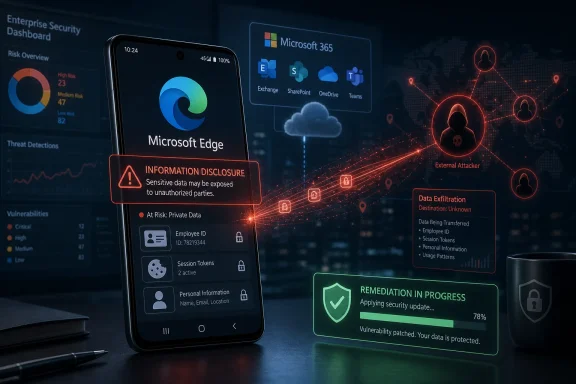
Microsoft disclosed CVE-2026-58296 on July 3, 2026, as a high-severity information disclosure vulnerability in Microsoft Edge for Android that can expose private personal information to an unauthorized attacker over a network. The sparse advisory, published through Microsoft’s Security Response Center and mirrored by vulnerability trackers including CVEFeed and SecurityVulnerability.io, says less than administrators would like and enough that they should act. This is not a Windows kernel panic or an Exchange-style emergency, but it is a reminder that the browser on a phone is now part of the enterprise perimeter. The uncomfortable part is not just the bug; it is how little public detail defenders get while attackers can often learn by diffing the patch.
CVE-2026-58296 lands in the category of vulnerabilities that look modest until you remember where they live. Microsoft Edge for Android is not merely a mobile convenience for people who prefer Microsoft accounts and synced tabs. In many organizations, it is a managed access point for Microsoft 365, conditional access policies, corporate intranets, password managers, identity flows, and web apps that were never designed with a hostile mobile environment in mind.
Microsoft’s public description is blunt but narrow: exposure of private personal information to an unauthorized actor in Microsoft Edge for Android may allow information disclosure over a network. CVEFeed lists the vulnerability as published on July 3, 2026, with a CVSS 3.1 score of 7.1, which places it in the high-severity band. SecurityVulnerability.io reports affected versions as Microsoft Edge Chromium-based builds earlier than 150.0.4078.48.
That combination tells us several things. The flaw is not being positioned as remote code execution, not as privilege escalation, and not as a browser sandbox escape. But it is being treated as serious because the confidentiality impact is material, the attack vector is network-facing, and the flaw apparently does not require prior privileges.
The advisory’s restraint is itself part of the story. Microsoft has not, at least in the public material available now, laid out the exact data exposed, the vulnerable component, or a step-by-step exploitation path. That is normal for a newly published browser vulnerability, but normal does not mean satisfying. For defenders, “information disclosure” is a broad label that can span anything from low-value diagnostic leakage to tokens, identifiers, browsing context, form data, or other privacy-sensitive material.
The mobile browser is especially sensitive because it blends personal and work context. A user may authenticate to Outlook, Teams, SharePoint, a banking site, a healthcare portal, and a consumer identity provider in the same browser profile, sometimes within minutes. Even when the browser is managed, the phone often straddles a messy boundary between enterprise policy and personal behavior.
Microsoft’s description does not say which class of private information is at risk. That absence should prevent alarmist speculation, but it should not invite complacency. The security impact of a disclosure bug is determined less by the label and more by what crosses the boundary: credentials, session state, personally identifiable information, browsing metadata, or data belonging to another origin or profile.
In browsers, information disclosure can also be a stepping stone. Attackers do not always need code execution if they can extract enough context to impersonate, correlate, track, or phish with precision. A browser that leaks private state can become a reconnaissance tool, and reconnaissance is often the phase defenders underestimate because it does not look like a breach until later.
SecurityVulnerability.io lists the attack vector as network, attack complexity as low, privileges required as none, and user interaction as required. If accurate, that shape matters. It suggests a scenario where an attacker may not need an account on the victim’s device or service, but the user likely has to do something — visit a page, interact with content, follow a link, open a crafted resource, or otherwise put the browser in the vulnerable path.
That “user interaction required” phrase can be misleading. In corporate reality, getting users to tap links is not a high barrier; it is the foundation of phishing. Mobile screens make URL inspection harder, notification-driven workflows reward speed, and users often trust links delivered through collaboration tools they already use for work.
The public record does not show confirmed exploitation in the wild from Microsoft’s advisory text as currently surfaced by public trackers. That is reassuring, but not exculpatory. The window between advisory publication and broad mobile update adoption is where opportunistic actors often test whether a bug can be reproduced from patch differences, crash behavior, or vague public metadata.
That means the existence of the vulnerability is high-confidence. The technical details, however, remain low-resolution for defenders outside Microsoft and any coordinated disclosure circle. We know the class, the affected product, the broad impact, and the remediation direction. We do not know the root cause, the exposed data category, whether the issue sits in Microsoft’s Android-specific code, Chromium integration, sync behavior, WebView-adjacent handling, permissions, account plumbing, or another browser subsystem.
This asymmetry is common in vulnerability response. Vendors publish enough to trigger patching while withholding enough to avoid gifting exploit recipes. But attackers can work backward from updates, especially in browser ecosystems where code changes, binary diffs, and behavioral tests can narrow the search.
The practical result is a weird inversion. The people responsible for patching must make decisions with less technical detail than the people most motivated to reverse-engineer the flaw. That is why a high confidence in the bug’s existence, combined with limited public mechanics, should push organizations toward fast remediation rather than debate over exploit elegance.
For unmanaged users, the fix is simple in theory: update Microsoft Edge for Android through the app store and verify the installed version. For administrators, the problem is proof. It is one thing to tell users to update; it is another to know which devices actually moved beyond the affected range.
Organizations using Microsoft Intune or another mobile device management platform should treat the fixed Edge version as a compliance checkpoint. If SecurityVulnerability.io’s affected-version data is accurate, builds earlier than 150.0.4078.48 should be considered exposed until patched. That does not mean every device is equally at risk, but it gives administrators a concrete line to enforce.
The BYOD edge case is harder. A user may access corporate resources from a personal Android phone with Edge installed but not tightly managed. Conditional access can require approved apps, device compliance, or app protection policies, but those policies are only as good as their configuration and enforcement. CVE-2026-58296 is a reminder that browser choice on mobile is not a lifestyle preference when the browser is used to reach work data.
This is one of the less glamorous consequences of Chromium consolidation. The industry benefits from shared engine investment, rapid patch flow, and a large security research community. But every browser vendor also adds differentiating features: account sync, enterprise policy, password storage, shopping tools, PDF handling, feed surfaces, AI integrations, and mobile UX layers. Those features are precisely where privacy boundaries can become complicated.
For Microsoft, Edge is no longer just a browser. It is a distribution channel for search, Copilot experiences, Microsoft account services, enterprise controls, and cross-device continuity. On Android, that means Microsoft’s security posture depends partly on Google’s platform and partly on Microsoft’s own app architecture. The product boundary is clear to users; the engineering boundary may not be.
That is why the advisory’s lack of detail is notable. If the flaw is in an Edge-specific layer, Microsoft’s mobile browser hardening becomes the focus. If it is inherited from Chromium, then the question becomes whether other Chromium-based Android browsers are affected or whether Microsoft’s configuration made this instance unique. Public advisories often avoid that level of explanation early on, but enterprise defenders benefit when vendors eventually clarify the lineage.
That is exactly the terrain where mobile users are weakest. Android users are trained to move quickly between notifications, chats, mail, QR codes, calendar invites, and authentication prompts. The same device that receives the lure often holds the authenticator, the browser session, and the personal context that makes the lure persuasive.
If the disclosed information is merely personal metadata, the risk may be privacy and tracking. If it includes account or session material, the risk moves toward compromise. If it exposes cross-origin browser state, the implications become more serious still. We do not have enough public evidence to pick one, and responsible analysis should say so.
What we can say is that user interaction requirements should not reduce urgency by much. In 2026, “requires the user to click” is not the comforting phrase it once was. It describes most successful intrusion starts.
The first task is inventory. Find Android devices with Edge installed, determine the installed version, and compare it to the fixed version reported by public trackers. Where management tooling cannot see app versions, that visibility gap should be treated as a finding in itself.
The second task is enforcement. Managed devices should receive the updated Edge build through the organization’s chosen app deployment channel. If policies allow corporate access only through approved browsers, those policies should be checked to ensure stale versions do not remain approved indefinitely.
The third task is user communication. This is not a case for panic messaging, but it is a good moment to remind users that browser updates on mobile matter as much as operating system updates. A short instruction to update Edge from the app store and restart the browser may do more good than a dense CVE bulletin forwarded to everyone.
The pressure is made worse by passwordless and multifactor workflows. Mobile devices are not only consuming enterprise sessions; they often help approve them. That increases the cost of any bug that leaks browser state or personal context, because attackers can use that information to shape more credible prompts, target specific services, or understand user habits.
The proper response is not to ban mobile browsing or declare Edge uniquely unsafe. Every major browser ships security fixes, and the presence of a CVE is usually evidence of a functioning disclosure process rather than exceptional negligence. The better response is to make mobile browser versioning visible, enforceable, and boring.
For WindowsForum readers, the Windows angle is also straightforward. Microsoft’s ecosystem now crosses Windows, Android, iOS, macOS, and the web. A vulnerability in Edge for Android may not touch the Windows build at all, but it can still affect a Windows-centric organization if the same identity, sync, and cloud services are in play. Platform boundaries do not map cleanly to risk boundaries anymore.
That is why waiting for the next routine review is a poor fit. CVE-2026-58296 was published on Friday, July 3, 2026, just before a U.S. holiday weekend. That timing is inconvenient, but attackers do not respect maintenance calendars. Holiday publication also increases the chance that consumer users and thinly staffed IT teams will not notice until the following week.
The good news is that mobile app updates are usually less disruptive than desktop OS updates. Updating Edge for Android should not require the kind of regression testing that accompanies a Windows cumulative update or a server patch. The bad news is that because the action is easy, organizations often assume it happened without verifying.
This is where security operations maturity shows. Mature teams do not merely announce a patch; they measure uptake. They know which devices are stuck, which users have disabled auto-updates, and which access paths still tolerate vulnerable clients.
 Microsoft Ships a Small Advisory for a Big Privacy Surface
CVE-2026-58296 lands in the category of vulnerabilities that look modest until you remember where they live. Microsoft Edge for Android is not merely a mobile convenience for people who prefer Microsoft accounts and synced tabs. In many organizations, it is a managed access point for Microsoft 365, conditional access policies, corporate intranets, password managers, identity flows, and web apps that were never designed with a hostile mobile environment in mind.Microsoft’s public description is blunt but narrow: exposure of private personal information to an unauthorized actor in Microsoft Edge for Android may allow information disclosure over a network. CVEFeed lists the vulnerability as published on July 3, 2026, with a CVSS 3.1 score of 7.1, which places it in the high-severity band. SecurityVulnerability.io reports affected versions as Microsoft Edge Chromium-based builds earlier than 150.0.4078.48.
That combination tells us several things. The flaw is not being positioned as remote code execution, not as privilege escalation, and not as a browser sandbox escape. But it is being treated as serious because the confidentiality impact is material, the attack vector is network-facing, and the flaw apparently does not require prior privileges.
The advisory’s restraint is itself part of the story. Microsoft has not, at least in the public material available now, laid out the exact data exposed, the vulnerable component, or a step-by-step exploitation path. That is normal for a newly published browser vulnerability, but normal does not mean satisfying. For defenders, “information disclosure” is a broad label that can span anything from low-value diagnostic leakage to tokens, identifiers, browsing context, form data, or other privacy-sensitive material.
The Phrase “Information Disclosure” Does Too Much Work
Security teams have learned to fear tidy labels. “Information disclosure” sounds less dramatic than “remote code execution,” but modern identity systems have made secrets smaller, more portable, and more valuable. A leaked cookie, token, URL parameter, autofill value, device identifier, or account-linked browsing artifact can matter more than an old-fashioned crash.The mobile browser is especially sensitive because it blends personal and work context. A user may authenticate to Outlook, Teams, SharePoint, a banking site, a healthcare portal, and a consumer identity provider in the same browser profile, sometimes within minutes. Even when the browser is managed, the phone often straddles a messy boundary between enterprise policy and personal behavior.
Microsoft’s description does not say which class of private information is at risk. That absence should prevent alarmist speculation, but it should not invite complacency. The security impact of a disclosure bug is determined less by the label and more by what crosses the boundary: credentials, session state, personally identifiable information, browsing metadata, or data belonging to another origin or profile.
In browsers, information disclosure can also be a stepping stone. Attackers do not always need code execution if they can extract enough context to impersonate, correlate, track, or phish with precision. A browser that leaks private state can become a reconnaissance tool, and reconnaissance is often the phase defenders underestimate because it does not look like a breach until later.
CVSS Says “High,” but the Missing Details Set the Real Risk
The reported CVSS 3.1 score of 7.1 is useful but incomplete. It tells patching teams that Microsoft and the vulnerability ecosystem consider the issue more than theoretical housekeeping. It does not tell an enterprise whether its specific exposure is concentrated among executives, frontline Android fleets, unmanaged BYOD users, or anyone who has Edge installed and signed in.SecurityVulnerability.io lists the attack vector as network, attack complexity as low, privileges required as none, and user interaction as required. If accurate, that shape matters. It suggests a scenario where an attacker may not need an account on the victim’s device or service, but the user likely has to do something — visit a page, interact with content, follow a link, open a crafted resource, or otherwise put the browser in the vulnerable path.
That “user interaction required” phrase can be misleading. In corporate reality, getting users to tap links is not a high barrier; it is the foundation of phishing. Mobile screens make URL inspection harder, notification-driven workflows reward speed, and users often trust links delivered through collaboration tools they already use for work.
The public record does not show confirmed exploitation in the wild from Microsoft’s advisory text as currently surfaced by public trackers. That is reassuring, but not exculpatory. The window between advisory publication and broad mobile update adoption is where opportunistic actors often test whether a bug can be reproduced from patch differences, crash behavior, or vague public metadata.
The Confidence Metric Is Really a Warning About Asymmetry
The user-supplied metric text — describing confidence in the existence of the vulnerability and the credibility of known technical details — is a useful lens for this case. CVE-2026-58296 is not a rumor floating around a paste site. It has been acknowledged through Microsoft’s vulnerability update process, assigned a CVE, scored, and associated with a specific product and fixed build range by public vulnerability trackers.That means the existence of the vulnerability is high-confidence. The technical details, however, remain low-resolution for defenders outside Microsoft and any coordinated disclosure circle. We know the class, the affected product, the broad impact, and the remediation direction. We do not know the root cause, the exposed data category, whether the issue sits in Microsoft’s Android-specific code, Chromium integration, sync behavior, WebView-adjacent handling, permissions, account plumbing, or another browser subsystem.
This asymmetry is common in vulnerability response. Vendors publish enough to trigger patching while withholding enough to avoid gifting exploit recipes. But attackers can work backward from updates, especially in browser ecosystems where code changes, binary diffs, and behavioral tests can narrow the search.
The practical result is a weird inversion. The people responsible for patching must make decisions with less technical detail than the people most motivated to reverse-engineer the flaw. That is why a high confidence in the bug’s existence, combined with limited public mechanics, should push organizations toward fast remediation rather than debate over exploit elegance.
Android Makes Browser Patching a Policy Problem
On desktop Windows, Edge updates are familiar territory. Enterprises may use rings, policies, update baselines, and inventory tools to track browser versions. On Android, the picture is more fragmented, because update delivery depends on app stores, device management, user behavior, OEM constraints, and whether the device is corporate-owned or BYOD.For unmanaged users, the fix is simple in theory: update Microsoft Edge for Android through the app store and verify the installed version. For administrators, the problem is proof. It is one thing to tell users to update; it is another to know which devices actually moved beyond the affected range.
Organizations using Microsoft Intune or another mobile device management platform should treat the fixed Edge version as a compliance checkpoint. If SecurityVulnerability.io’s affected-version data is accurate, builds earlier than 150.0.4078.48 should be considered exposed until patched. That does not mean every device is equally at risk, but it gives administrators a concrete line to enforce.
The BYOD edge case is harder. A user may access corporate resources from a personal Android phone with Edge installed but not tightly managed. Conditional access can require approved apps, device compliance, or app protection policies, but those policies are only as good as their configuration and enforcement. CVE-2026-58296 is a reminder that browser choice on mobile is not a lifestyle preference when the browser is used to reach work data.
Microsoft’s Chromium Bet Does Not Remove Microsoft’s Responsibility
Edge for Android is Chromium-based, but this advisory is branded as Microsoft Edge for Android. That distinction matters because users and administrators do not patch “Chromium” in the abstract; they patch the app distributed by Microsoft. Whether the vulnerable code originates in upstream Chromium, Microsoft’s mobile layer, sync features, identity integration, or Android-specific glue, the operational responsibility lands with the vendor shipping the browser.This is one of the less glamorous consequences of Chromium consolidation. The industry benefits from shared engine investment, rapid patch flow, and a large security research community. But every browser vendor also adds differentiating features: account sync, enterprise policy, password storage, shopping tools, PDF handling, feed surfaces, AI integrations, and mobile UX layers. Those features are precisely where privacy boundaries can become complicated.
For Microsoft, Edge is no longer just a browser. It is a distribution channel for search, Copilot experiences, Microsoft account services, enterprise controls, and cross-device continuity. On Android, that means Microsoft’s security posture depends partly on Google’s platform and partly on Microsoft’s own app architecture. The product boundary is clear to users; the engineering boundary may not be.
That is why the advisory’s lack of detail is notable. If the flaw is in an Edge-specific layer, Microsoft’s mobile browser hardening becomes the focus. If it is inherited from Chromium, then the question becomes whether other Chromium-based Android browsers are affected or whether Microsoft’s configuration made this instance unique. Public advisories often avoid that level of explanation early on, but enterprise defenders benefit when vendors eventually clarify the lineage.
The Real-World Attack Path Probably Starts With Trust
Because the public scoring indicates user interaction is required, the likely risk model is not a worm sprinting across Android phones. It is a crafted interaction. That could mean a link, a page, a redirect chain, embedded content, a malicious site, or another network-delivered prompt that coaxes the browser into exposing data it should not.That is exactly the terrain where mobile users are weakest. Android users are trained to move quickly between notifications, chats, mail, QR codes, calendar invites, and authentication prompts. The same device that receives the lure often holds the authenticator, the browser session, and the personal context that makes the lure persuasive.
If the disclosed information is merely personal metadata, the risk may be privacy and tracking. If it includes account or session material, the risk moves toward compromise. If it exposes cross-origin browser state, the implications become more serious still. We do not have enough public evidence to pick one, and responsible analysis should say so.
What we can say is that user interaction requirements should not reduce urgency by much. In 2026, “requires the user to click” is not the comforting phrase it once was. It describes most successful intrusion starts.
Security Teams Should Patch First and Investigate Second
There is a recurring temptation in vulnerability management to wait for full technical details before prioritizing. That instinct is understandable; teams are drowning in CVEs, and not every high score deserves a weekend change window. But mobile browser vulnerabilities touching private information deserve faster handling because the remediation path is usually low-friction and the exposure is often broad.The first task is inventory. Find Android devices with Edge installed, determine the installed version, and compare it to the fixed version reported by public trackers. Where management tooling cannot see app versions, that visibility gap should be treated as a finding in itself.
The second task is enforcement. Managed devices should receive the updated Edge build through the organization’s chosen app deployment channel. If policies allow corporate access only through approved browsers, those policies should be checked to ensure stale versions do not remain approved indefinitely.
The third task is user communication. This is not a case for panic messaging, but it is a good moment to remind users that browser updates on mobile matter as much as operating system updates. A short instruction to update Edge from the app store and restart the browser may do more good than a dense CVE bulletin forwarded to everyone.
The Enterprise Lesson Is Bigger Than One Android Bug
CVE-2026-58296 is a small window into a larger management problem. Enterprises have spent years tightening desktop browser governance while mobile browsers quietly became identity terminals. The same users who would never be allowed to run an outdated desktop browser may be reaching sensitive SaaS apps through personal phones with uneven app hygiene.The pressure is made worse by passwordless and multifactor workflows. Mobile devices are not only consuming enterprise sessions; they often help approve them. That increases the cost of any bug that leaks browser state or personal context, because attackers can use that information to shape more credible prompts, target specific services, or understand user habits.
The proper response is not to ban mobile browsing or declare Edge uniquely unsafe. Every major browser ships security fixes, and the presence of a CVE is usually evidence of a functioning disclosure process rather than exceptional negligence. The better response is to make mobile browser versioning visible, enforceable, and boring.
For WindowsForum readers, the Windows angle is also straightforward. Microsoft’s ecosystem now crosses Windows, Android, iOS, macOS, and the web. A vulnerability in Edge for Android may not touch the Windows build at all, but it can still affect a Windows-centric organization if the same identity, sync, and cloud services are in play. Platform boundaries do not map cleanly to risk boundaries anymore.
Patch Tuesday Thinking Fails on Mobile
Traditional Microsoft shops are conditioned around Patch Tuesday, emergency out-of-band updates, and Windows Update rings. Mobile app security moves differently. Browser updates can appear outside monthly operating system cycles, and users may receive them silently, manually, late, or not at all depending on device settings and management posture.That is why waiting for the next routine review is a poor fit. CVE-2026-58296 was published on Friday, July 3, 2026, just before a U.S. holiday weekend. That timing is inconvenient, but attackers do not respect maintenance calendars. Holiday publication also increases the chance that consumer users and thinly staffed IT teams will not notice until the following week.
The good news is that mobile app updates are usually less disruptive than desktop OS updates. Updating Edge for Android should not require the kind of regression testing that accompanies a Windows cumulative update or a server patch. The bad news is that because the action is easy, organizations often assume it happened without verifying.
This is where security operations maturity shows. Mature teams do not merely announce a patch; they measure uptake. They know which devices are stuck, which users have disabled auto-updates, and which access paths still tolerate vulnerable clients.
The Evidence Points to Action, Not Panic
CVE-2026-58296 is a confirmed Microsoft Edge for Android vulnerability with a high CVSS score, a public disclosure date of July 3, 2026, and an information disclosure impact involving private personal information.- Organizations should update Microsoft Edge for Android to the fixed build as soon as it is available through their app distribution channel.
- Administrators should treat Edge for Android versions earlier than 150.0.4078.48 as potentially affected if relying on the version range reported by SecurityVulnerability.io.
- Security teams should prioritize managed Android devices that access Microsoft 365, internal web apps, privileged admin portals, or identity workflows.
- BYOD policies should be reviewed to ensure that outdated mobile browsers are not silently permitted to reach corporate resources.
- The lack of public exploit details should not be mistaken for low risk, because vendor-confirmed browser bugs can often be studied after patches ship.
References
- Primary source: MSRC
Published: 2026-07-03T07:00:00-07:00
Security Update Guide - Microsoft Security Response Center
 msrc.microsoft.com
- Related coverage: securityvulnerability.io
CVE-2026-58296 : Information Disclosure Vulnerability in Microsoft Edge for Android
Discover the information disclosure vulnerability affecting Microsoft Edge for Android and how it impacts user privacy. Learn more about CVE-2026-58296.securityvulnerability.io - Related coverage: sentinelone.com
CVE-2026-42891: Microsoft Edge Chromium Auth Bypass Flaw
CVE-2026-42891 is an authentication bypass vulnerability in Microsoft Edge Chromium. Learn about its impact, affected versions, and mitigation methods.www.sentinelone.com
- Related coverage: aha.org
h isac tlp white microsoft edge addresses exploited zero day vulnerability cve 2024 7971 8 23 2024
PDF documentwww.aha.org
