

CVE-2026-58630 puts Azure App Service on Azure Stack Hub operators on notice for a newly published elevation of privilege vulnerability that demands careful verification, disciplined patch management, and a sharper review of administrative boundaries across hybrid cloud deployments. The advisory was published on July 23, 2026, and its narrow product scope matters: this is not a general Azure App Service issue affecting every web app hosted in Microsoft’s public cloud, but a security concern for the App Service resource provider deployed within Azure Stack Hub environments.
For enterprises operating Azure services in their own datacenters, disconnected environments, sovereign clouds, or regulated hybrid infrastructure, that distinction does not reduce the importance of the vulnerability. It increases it. Azure Stack Hub combines cloud-style control planes and platform services with operator-managed infrastructure, meaning a weakness that enables unauthorized privilege gain can have consequences well beyond one tenant application.
The immediate challenge is that the public advisory identifies the vulnerability class but does not, by itself, provide enough safely verifiable technical detail to reconstruct the attack path. That restraint is normal for a newly disclosed cloud-platform security issue. It also means operators should avoid both extremes: neither dismissing the CVE because exploit details are sparse nor making unsupported assumptions about the affected component, required attacker access, or available workaround.
CVE-2026-58630 is classified as an elevation of privilege vulnerability in Azure App Service on Azure Stack Hub. In practical terms, elevation of privilege describes a flaw that could allow an attacker to gain permissions beyond those they were originally authorized to hold.
That outcome can take several forms depending on the affected implementation:
That may sound cautious, but it is the correct security posture. In hybrid cloud operations, inaccurate assumptions can cause two separate failures: a team may overlook an exposed system, or it may disrupt business-critical applications by applying an unsuitable platform update without a controlled maintenance plan.
Azure App Service on Azure Stack Hub gives operators the ability to offer platform services for web applications, APIs, background workloads, and selected Azure Functions capabilities close to on-premises systems and data. That makes it attractive for organizations with latency, compliance, data-residency, connectivity, or sovereignty requirements.
It also produces a layered security model.
The risk is therefore best understood as a question of blast radius. The more broadly privileged the affected identity or component becomes, the more important it is to determine whether an attacker could move from a tenant-facing surface toward operator-level functions, deployment secrets, service configuration, or adjacent workloads.
A threat actor does not always need an unauthenticated path from the internet to cause material harm. Real-world compromises frequently begin with limited access obtained through a stolen credential, a malicious insider, an exposed deployment token, a vulnerable application, or a compromised developer workstation. Privilege escalation can turn that limited access into a more dangerous position.
That is why the vulnerability deserves priority even if public exploit code is not available. The absence of a known proof of concept is not the same as the absence of risk. Security researchers, attackers, and automated analysis tools often examine vendor fixes, version differences, and advisory metadata after publication.
For CVE-2026-58630, the existence of a Microsoft-published advisory provides a strong reason to treat the issue as real and actionable. At the same time, the scarcity of public technical detail means defenders should remain careful in interpreting what the CVE does not say. A public label of “elevation of privilege” should not be expanded into claims of tenant escape, host compromise, or full infrastructure control unless the vendor provides evidence for those outcomes.
Organizations sometimes confuse Azure App Service in public Azure with the independently deployed App Service resource provider on Azure Stack Hub. A public Azure subscription using Web Apps does not automatically mean the organization is affected by this specific CVE. Conversely, a business unit may operate Azure Stack Hub services that central IT has not fully captured in an enterprise asset inventory.
A system outside that supported lifecycle is harder to secure for several reasons:
Do not rely on an old screenshot, copied CVE summary, or generic Patch Tuesday checklist. The remediation route for a resource provider may differ from a Windows Server cumulative update or an Azure Stack Hub infrastructure hotfix.
Security updates must be balanced with availability requirements, but “waiting for the next routine maintenance cycle” is usually a poor default for a confirmed elevation-of-privilege issue in a hybrid platform. The right target is a prioritized, tested, and accelerated change window that reflects the environment’s exposure and business criticality.
Particular attention should go to:
For tenant applications that must remain publicly accessible, focus on reducing access to their management paths rather than trying to remove all internet exposure. The relevant question is not only “Can users reach the website?” but also “Who can reach the systems that manage, deploy, configure, and administer it?”
The most resilient environments tend to share several traits:
The key is disciplined action rather than speculation. Confirm whether App Service on Azure Stack Hub is deployed, identify the precise platform and resource-provider versions, validate the vendor’s current remediation guidance, prioritize exposed and high-value environments, apply the supported fix through a controlled update process, and verify both security controls and hosted application functionality afterward.
The vulnerability also reinforces a broader reality of Azure Stack Hub operations: platform services running close to sensitive data and internal systems require the same rigor as any other critical infrastructure. Strong identity governance, current servicing, restricted management exposure, tested backups, and meaningful telemetry remain the most effective ways to limit the impact of privilege-escalation flaws—both this one and the next one.
For enterprises operating Azure services in their own datacenters, disconnected environments, sovereign clouds, or regulated hybrid infrastructure, that distinction does not reduce the importance of the vulnerability. It increases it. Azure Stack Hub combines cloud-style control planes and platform services with operator-managed infrastructure, meaning a weakness that enables unauthorized privilege gain can have consequences well beyond one tenant application.
The immediate challenge is that the public advisory identifies the vulnerability class but does not, by itself, provide enough safely verifiable technical detail to reconstruct the attack path. That restraint is normal for a newly disclosed cloud-platform security issue. It also means operators should avoid both extremes: neither dismissing the CVE because exploit details are sparse nor making unsupported assumptions about the affected component, required attacker access, or available workaround.
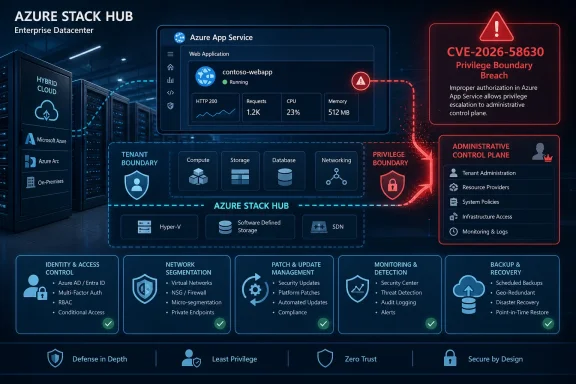 Overview: What CVE-2026-58630 Means
CVE-2026-58630 is classified as an elevation of privilege vulnerability in Azure App Service on Azure Stack Hub. In practical terms, elevation of privilege describes a flaw that could allow an attacker to gain permissions beyond those they were originally authorized to hold.That outcome can take several forms depending on the affected implementation:
- A low-privileged tenant identity gaining access to higher-value App Service functions.
- An authenticated user escaping a restricted administrative boundary.
- A compromised workload or deployment credential reaching resources outside its intended scope.
- A service-to-service authorization weakness permitting actions that should require stronger privileges.
- An attacker leveraging an existing foothold to obtain more powerful control-plane, data-plane, or management capabilities.
That may sound cautious, but it is the correct security posture. In hybrid cloud operations, inaccurate assumptions can cause two separate failures: a team may overlook an exposed system, or it may disrupt business-critical applications by applying an unsuitable platform update without a controlled maintenance plan.
Why Azure Stack Hub Deserves Separate Attention
Azure Stack Hub is often mistakenly treated as a local extension of public Azure. It shares Azure concepts, management patterns, APIs, and resource providers, but it is an integrated system operated in the customer’s or service provider’s environment. The organization running it is responsible for its maintenance, operational readiness, identity configuration, network design, resource-provider lifecycle, and supporting infrastructure.Azure App Service on Azure Stack Hub gives operators the ability to offer platform services for web applications, APIs, background workloads, and selected Azure Functions capabilities close to on-premises systems and data. That makes it attractive for organizations with latency, compliance, data-residency, connectivity, or sovereignty requirements.
It also produces a layered security model.
The layers involved in App Service on Azure Stack Hub
A typical deployment can involve several security-relevant planes:- Azure Stack Hub infrastructure, including the integrated system and platform update state.
- The App Service resource provider, which delivers the service management and application-hosting capabilities.
- App Service roles and worker infrastructure, which process and host tenant workloads.
- Tenant applications, deployment endpoints, application identities, and associated secrets.
- Administrative portals and APIs, used by cloud operators and tenant administrators.
- Supporting SQL Server and file-share components, which can hold service configuration, metering data, application content, and operational state.
- Identity services, including Microsoft Entra ID or Active Directory Federation Services, depending on the deployment model.
The risk is therefore best understood as a question of blast radius. The more broadly privileged the affected identity or component becomes, the more important it is to determine whether an attacker could move from a tenant-facing surface toward operator-level functions, deployment secrets, service configuration, or adjacent workloads.
The Significance of Elevation of Privilege in a PaaS Environment
Many organizations instinctively prioritize remote code execution above other vulnerability categories. Remote code execution is unquestionably serious, but elevation of privilege vulnerabilities can be equally consequential in a platform-as-a-service environment.A threat actor does not always need an unauthenticated path from the internet to cause material harm. Real-world compromises frequently begin with limited access obtained through a stolen credential, a malicious insider, an exposed deployment token, a vulnerable application, or a compromised developer workstation. Privilege escalation can turn that limited access into a more dangerous position.
From initial access to higher-value control
Consider several broad risk scenarios, without assuming that any describes CVE-2026-58630 specifically:- An attacker gains access to a tenant account with basic App Service permissions.
- A deployment credential, publishing profile, automation identity, or API token is exposed.
- A web application is compromised through an unrelated application-level flaw.
- A user with access to a limited management function abuses an authorization gap.
- A service component processes a request under a more privileged context than intended.
That is why the vulnerability deserves priority even if public exploit code is not available. The absence of a known proof of concept is not the same as the absence of risk. Security researchers, attackers, and automated analysis tools often examine vendor fixes, version differences, and advisory metadata after publication.
Confidentiality, integrity, and availability risks
An elevated identity can create risks across the classic security triad:- Confidentiality: Exposure of application configuration, stored secrets, connection strings, certificates, tenant content, or operational metadata.
- Integrity: Unauthorized changes to app settings, deployment artifacts, access controls, routing configuration, resource settings, or service records.
- Availability: Deletion, disabling, misconfiguration, scaling abuse, application downtime, or disruption of critical internal services.
What Is Confirmed and What Requires Validation
The most responsible response to CVE-2026-58630 begins by separating verified advisory facts from operational assumptions.Confirmed at a high level
The published information establishes the following:- The issue is tracked as CVE-2026-58630.
- It concerns Azure App Service on Azure Stack Hub.
- The identified security impact is elevation of privilege.
- The CVE was published on July 23, 2026.
Details that should not be invented
Teams should avoid assuming any of the following until they verify the current security advisory and associated release guidance:- The exact vulnerable App Service resource-provider versions.
- Whether a platform-level Azure Stack Hub update is required in addition to an App Service update.
- Whether the flaw requires local, network, authenticated, tenant, or administrative access.
- Whether exploitation is known to be occurring in the wild.
- Whether the issue has public exploit code.
- Whether a mitigation is available before a full update can be deployed.
- Whether the fix is delivered through a hotfix, an updated installer, a resource-provider release, or another servicing mechanism.
- Whether an affected deployment has observable indicators unique to this CVE.
A note on confidence and disclosure maturity
Vulnerability records may include information related to confidence in the existence of the flaw and the credibility of its known technical details. Such information helps security teams understand whether a vulnerability is vendor-confirmed, independently corroborated, or still based on limited disclosure.For CVE-2026-58630, the existence of a Microsoft-published advisory provides a strong reason to treat the issue as real and actionable. At the same time, the scarcity of public technical detail means defenders should remain careful in interpreting what the CVE does not say. A public label of “elevation of privilege” should not be expanded into claims of tenant escape, host compromise, or full infrastructure control unless the vendor provides evidence for those outcomes.
Determining Whether Your Environment Is in Scope
The first operational task is straightforward: identify whether Azure App Service on Azure Stack Hub is deployed at all.Organizations sometimes confuse Azure App Service in public Azure with the independently deployed App Service resource provider on Azure Stack Hub. A public Azure subscription using Web Apps does not automatically mean the organization is affected by this specific CVE. Conversely, a business unit may operate Azure Stack Hub services that central IT has not fully captured in an enterprise asset inventory.
Build a precise inventory
Create a record of each Azure Stack Hub instance that includes:- Azure Stack Hub version and build.
- Current hotfix level.
- Connectivity model: connected, partially disconnected, or disconnected.
- Identity provider and authentication configuration.
- App Service resource-provider version and build.
- App Service role health and role-instance inventory.
- Tenant subscriptions and critical hosted applications.
- Worker tiers, App Service plans, and Functions usage.
- Supporting SQL Server topology and high-availability configuration.
- App content file-share location and backup status.
- Kudu, SCM, deployment, and administrative endpoint exposure.
- Privileged roles, break-glass accounts, and automation identities.
Treat unsupported configurations as a risk multiplier
Azure Stack Hub servicing follows a limited support window. Operators are expected to run the current release or one of the two immediately preceding platform versions. Resource providers have their own compatibility and support expectations, with the most recent compatible resource-provider version generally being the supported target.A system outside that supported lifecycle is harder to secure for several reasons:
- It may not receive an applicable hotfix.
- Upgrade paths may require multiple staged updates.
- Existing configuration drift can complicate remediation.
- Vendor support may be constrained until the environment is brought forward.
- Older operating-system and framework components can increase the number of parallel security issues.
A Practical Response Plan for Cloud Operators
A measured response can begin immediately, even before a maintenance window is approved.1. Verify the advisory and remediation path
Use the current vendor security guidance to confirm the affected products, affected versions, required updates, mitigations, and any prerequisites. Security teams should document the advisory state at the time of review because cloud security guidance can be clarified or revised after first publication.Do not rely on an old screenshot, copied CVE summary, or generic Patch Tuesday checklist. The remediation route for a resource provider may differ from a Windows Server cumulative update or an Azure Stack Hub infrastructure hotfix.
2. Identify exposed and high-value deployments
Prioritize environments that have one or more of the following characteristics:- Multi-tenant usage.
- Internet-accessible tenant applications.
- Direct connectivity to internal systems.
- Hosting for identity, finance, healthcare, manufacturing, or regulated workloads.
- High concentrations of tenant applications on shared worker infrastructure.
- Broadly privileged operators or service accounts.
- Legacy deployment credentials or weak secret-management practices.
- Delayed update history.
- Disconnected operation with manually managed packages.
3. Protect the update process itself
Azure Stack Hub and App Service updates are not simple endpoint patches. They can affect service roles, portals, workload hosting, framework availability, and operational dependencies. Before applying remediation:- Confirm that all App Service roles report a healthy and ready state.
- Review applicable release notes and known issues.
- Back up App Service secrets.
- Back up relevant App Service and SQL Server databases.
- Validate backups of tenant application content file shares.
- Confirm free capacity, maintenance windows, and rollback procedures.
- Verify required update packages, dependencies, and signatures.
- Notify application owners about any expected service impact.
- Test the sequence in a representative non-production environment where feasible.
- Establish technical ownership for platform, App Service, identity, network, database, and application validation.
4. Apply the vendor-provided fix promptly
Once the correct remediation is confirmed, deploy it using the documented update route rather than attempting unsupported file replacement, manual binary changes, or improvised configuration edits.Security updates must be balanced with availability requirements, but “waiting for the next routine maintenance cycle” is usually a poor default for a confirmed elevation-of-privilege issue in a hybrid platform. The right target is a prioritized, tested, and accelerated change window that reflects the environment’s exposure and business criticality.
5. Validate security and functionality after the change
A successful installer completion message is not enough. Post-update validation should include:- Confirmation of the expected Azure Stack Hub and App Service resource-provider versions.
- Review of role health in the administration portal.
- Authentication testing for tenant and operator portals.
- Verification of deployment and SCM/Kudu access controls.
- Application availability testing across representative plans and worker tiers.
- Validation of deployment pipelines and automation identities.
- Confirmation that custom certificates, TLS settings, and secret references remain intact.
- Review of audit logs for unexpected role or permission changes.
- Validation of database connectivity, application content access, and scale operations.
Compensating Controls While Remediation Is Pending
A compensating control is not a replacement for a security fix. It can, however, reduce opportunity while the team prepares and validates an update.Reduce privilege concentration
Review Azure Stack Hub and App Service administrative roles immediately. Remove inactive assignments, avoid standing high-privilege access where possible, and require time-bound elevation for administrative work.Particular attention should go to:
- Cloud operator accounts.
- App Service administrators.
- SQL Server administrative identities.
- Deployment automation service principals.
- Break-glass accounts.
- Accounts with access to shared secrets or infrastructure configuration.
- Legacy accounts created for one-time migrations or support engagements.
Tighten access to management and deployment surfaces
Administrative portals, management APIs, deployment endpoints, and SCM/Kudu interfaces should not be more broadly exposed than necessary. Restrict access by network location where architecture permits, require strong authentication, and monitor unusual sign-in or deployment behavior.For tenant applications that must remain publicly accessible, focus on reducing access to their management paths rather than trying to remove all internet exposure. The relevant question is not only “Can users reach the website?” but also “Who can reach the systems that manage, deploy, configure, and administer it?”
Rotate sensitive credentials where risk justifies it
Credential rotation should be targeted and operationally planned. Priority candidates include:- App publishing credentials.
- Deployment tokens.
- Automation secrets.
- Database connection strings.
- Storage access keys.
- Service-account passwords.
- Certificates used for service authentication.
- Accounts with historic broad permissions.
Improve monitoring before and after patching
Security teams should establish a baseline for behavior across the App Service and Azure Stack Hub management planes. Look for:- Unexpected elevation or role-assignment changes.
- New privileged identities or service principals.
- Unusual deployment activity.
- Changes to application settings, connection strings, or managed identities.
- Access to administrative endpoints from unfamiliar networks.
- Suspicious SQL activity involving App Service-related databases.
- Sudden changes in worker allocation, scaling, or plan configuration.
- Repeated authentication failures followed by successful administrative sign-ins.
- Unplanned changes to certificates, secrets, or storage locations.
Common Mistakes to Avoid
The response to an Azure Stack Hub vulnerability can go wrong in predictable ways.Assuming public Azure remediation covers Azure Stack Hub
Azure Stack Hub has its own servicing model, infrastructure dependencies, and resource-provider lifecycle. A patch applied to a public Azure workload, Windows Server host, developer workstation, or cloud-only App Service subscription does not necessarily remediate the local Azure Stack Hub service.Updating only the platform or only the resource provider
The correct remedy may involve a specific App Service release, an Azure Stack Hub update, a hotfix, or a combination of these. Operators should not presume that an up-to-date host platform automatically means the App Service resource provider is current.Treating “no public exploit” as “no urgency”
Public exploit availability is just one risk signal. A confirmed privilege-escalation vulnerability affecting a shared application platform still warrants urgent verification and a defined remediation deadline.Conducting a patch without application-owner validation
The App Service platform supports applications with varied runtimes, deployment methods, certificates, dependencies, and availability expectations. Updating without a validation plan can convert a security response into an avoidable outage.Using unsupported manual mitigations
Unauthorized changes to resource-provider internals, service databases, role configuration, or system components can cause drift, break future upgrades, and complicate support. Follow the supported remediation guidance and document every emergency configuration adjustment.The Broader Security Lesson for Hybrid Cloud
CVE-2026-58630 is a reminder that hybrid cloud security is an operational discipline, not a product setting. Azure Stack Hub gives organizations control over where cloud services run, but it also requires them to operate a regular servicing, backup, monitoring, identity-governance, and incident-response program.The most resilient environments tend to share several traits:
- They maintain current inventories of platform and resource-provider builds.
- They distinguish public Azure services from Azure Stack Hub equivalents.
- They patch through tested, repeatable change processes.
- They treat privileged access as temporary and auditable.
- They maintain reliable backups of service databases, secrets, and tenant content.
- They segment administrative, tenant, deployment, and workload access.
- They rehearse recovery procedures rather than merely documenting them.
- They validate both security posture and business functionality after every major update.
Conclusion
CVE-2026-58630 should be treated as a meaningful security event for organizations running Azure App Service on Azure Stack Hub. Its elevation-of-privilege classification raises the possibility that an attacker with some level of access could obtain permissions beyond their intended boundary, making rapid scoping and supported remediation essential.The key is disciplined action rather than speculation. Confirm whether App Service on Azure Stack Hub is deployed, identify the precise platform and resource-provider versions, validate the vendor’s current remediation guidance, prioritize exposed and high-value environments, apply the supported fix through a controlled update process, and verify both security controls and hosted application functionality afterward.
The vulnerability also reinforces a broader reality of Azure Stack Hub operations: platform services running close to sensitive data and internal systems require the same rigor as any other critical infrastructure. Strong identity governance, current servicing, restricted management exposure, tested backups, and meaningful telemetry remain the most effective ways to limit the impact of privilege-escalation flaws—both this one and the next one.
References
- Primary source: MSRC
Published: 2026-07-23T07:00:00-07:00
Loading…
msrc.microsoft.com - Official source: learn.microsoft.com
Loading…
learn.microsoft.com - Official source: azure.microsoft.com
Loading…
azure.microsoft.com - Related coverage: zeropath.com
Brief Summary: CVE-2026-35435 — Azure AI Foundry M365 Agents Elevation of Privilege via Improper Access Control - ZeroPath Blog | ZeroPath
A short review of CVE-2026-35435, a critical improper access control vulnerability in Azure AI Foundry M365 published agents that allowed unauthenticated privilege escalation over the network. Microsoft has already mitigated this server-side, and no customer action is required. Includes patch...zeropath.com