

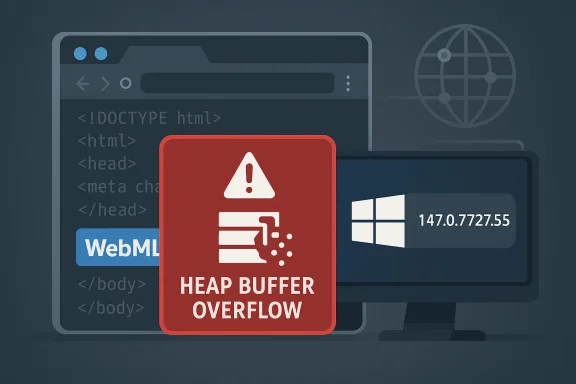
Chromium has landed another high-severity memory-safety bug in its WebML stack, and this one deserves attention because it sits in the browser’s highly exposed attack surface. According to the CVE record, CVE-2026-5867 is a heap buffer overflow in Google Chrome prior to 147.0.7727.55, and a crafted HTML page could let a remote attacker obtain potentially sensitive information from process memory. Google’s own Chrome release notes list the issue as High severity and place it among a cluster of WebML-related fixes in the April 7, 2026 stable desktop update. (chromereleases.googleblog.com)
Browser security stories often blur together until one detail makes the pattern obvious: the modern web engine is a giant, permanent parser for hostile input. That is exactly why memory corruption in browser components remains so important, even when the headline does not say “remote code execution.” In this case, the flaw lives in WebML, Chromium’s web machine learning layer, which is part of the broader browser platform and therefore reachable through normal page rendering and script-driven workloads. (chromium.googlesource.com)
The important context here is that Chromium has spent years hardening itself against the same class of bugs: heap buffer overflows, use-after-free conditions, integer overflows, and type confusions. Google’s April 7 stable update for Chrome 147 lists a long string of security fixes, including multiple WebML entries, which suggests that the component is under active security pressure rather than being a one-off target. CVE-2026-5867 sits alongside other nearby WebML issues such as CVE-2026-5858, CVE-2026-5859, and CVE-2026-5869, reinforcing that this is not an isolated defect but part of a broader security cleanup cycle. (chromereleases.googleblog.com)
From an architectural standpoint, WebML matters because browser vendors are trying to make machine learning available directly inside web pages without forcing users into separate native apps or plugins. That’s a powerful feature, but it also widens the browser’s trusted compute surface. The more complex the browser becomes, the more opportunities attackers have to turn malformed input into memory disclosure, instability, or sandbox escape chaining opportunities. (chromium.googlesource.com)
The downstream impact is equally important for Windows users and enterprise fleets. Microsoft’s Security Update Guide tracks Chromium-origin vulnerabilities because Microsoft Edge is Chromium-based, so a Chrome fix is not merely a Google problem. In practical terms, this means defenders watching Edge security should treat the Chrome release as an upstream signal and verify whether their own browser channels have ingested the patch.
One more piece of context stands out: this particular issue was reported by Syn4pse on 2026-03-14, and Google had already moved the fix into Chrome 147 by the time the stable desktop release hit on 2026-04-07. That cadence matters because it shows the vulnerability was identified and addressed before the widest stable rollout, but after enough time had elapsed for a public security record to appear. In other words, this is a textbook upstream patch-and-propagate event, not a theoretical bug sitting dormant in a lab. (chromereleases.googleblog.com)
The NVD/CVE summary says the attack could be triggered via a crafted HTML page. That means the attacker does not need local access, a malicious extension, or a preexisting foothold on the target system; they need only to persuade the victim to visit or render the page. The browser’s own parsing and execution machinery then becomes the delivery mechanism. That’s exactly why browser bugs often receive outsize attention compared with similarly worded flaws in less exposed software. (chromereleases.googleblog.com)
Another reason WebML bugs matter is that they often sit adjacent to other subsystems that are already highly targeted. Browser exploitation chains commonly combine a memory disclosure bug with a sandbox escape or logic flaw elsewhere. So even though CVE-2026-5867 is described as an information leak, defenders should think about it as part of the broader Chromium attack ecosystem rather than as a standalone nuisance. (chromereleases.googleblog.com)
Google’s release notes also caution that some bug details may stay restricted until the majority of users are updated. That policy is standard for browser security and exists to reduce the chance that exploit development races ahead of patch adoption. It is a good example of security through coordinated disclosure, not secrecy for its own sake. (chromereleases.googleblog.com)
This is especially important in organizations that rely on browser-based line-of-business apps, remote management portals, or internal dashboards that are routinely opened in Edge. If the page render path can be reached through normal browsing and the engine is vulnerable to memory disclosure, then an attacker who can lure a user to malicious content may gain a foothold for reconnaissance or for later exploitation. That is why upstream-vs-downstream patch lag is not an academic issue. (chromereleases.googleblog.com)
The broader Chrome 147 release also underscores how browsers are becoming more like operating systems in miniature. They ship on tight cadences, maintain multiple channels, and absorb vulnerabilities from a sprawling set of features that are all reachable through untrusted content. That means security updates are no longer just “browser updates”; they are platform maintenance events. (chromereleases.googleblog.com)
The enterprise story is even more complicated if Chromium is embedded in a product other than Chrome or Edge. WebView-based applications, kiosk software, automation platforms, and specialized line-of-business tools can all inherit the same browser engine vulnerabilities without advertising themselves as browsers at all. That makes the security blast radius broader than the Chrome branding suggests. (chromium.googlesource.com)
The third risk is ecosystem fragmentation. Chrome, Edge, WebView consumers, and other Chromium-based surfaces do not always move in lockstep. The more variants a company deploys, the more likely it is that one old build survives somewhere behind the scenes. That makes this advisory a reminder that browser patching is a governance problem as much as a technical one.
For WindowsForum readers, the bottom line is simple: patching matters immediately, but understanding where Chromium lives in your environment matters just as much. The browser update is only part of the story; the real task is confirming that every product consuming Chromium has actually inherited the fix. That distinction is what separates a clean security posture from one that only looks clean on paper. (chromereleases.googleblog.com)
CVE-2026-5867 is not the loudest kind of browser vulnerability, but it is exactly the kind security teams should take seriously: remotely reachable, memory-corrupting, and tied to a modern feature set that expands the browser’s attack surface. The fix is already in Chrome 147.0.7727.55, and the broader challenge now is making sure the rest of the Chromium ecosystem catches up before attackers decide to take advantage of the gap.
Source: NVD / Chromium Security Update Guide - Microsoft Security Response Center
 Background
Browser security stories often blur together until one detail makes the pattern obvious: the modern web engine is a giant, permanent parser for hostile input. That is exactly why memory corruption in browser components remains so important, even when the headline does not say “remote code execution.” In this case, the flaw lives in WebML, Chromium’s web machine learning layer, which is part of the broader browser platform and therefore reachable through normal page rendering and script-driven workloads. (chromium.googlesource.com)The important context here is that Chromium has spent years hardening itself against the same class of bugs: heap buffer overflows, use-after-free conditions, integer overflows, and type confusions. Google’s April 7 stable update for Chrome 147 lists a long string of security fixes, including multiple WebML entries, which suggests that the component is under active security pressure rather than being a one-off target. CVE-2026-5867 sits alongside other nearby WebML issues such as CVE-2026-5858, CVE-2026-5859, and CVE-2026-5869, reinforcing that this is not an isolated defect but part of a broader security cleanup cycle. (chromereleases.googleblog.com)
From an architectural standpoint, WebML matters because browser vendors are trying to make machine learning available directly inside web pages without forcing users into separate native apps or plugins. That’s a powerful feature, but it also widens the browser’s trusted compute surface. The more complex the browser becomes, the more opportunities attackers have to turn malformed input into memory disclosure, instability, or sandbox escape chaining opportunities. (chromium.googlesource.com)
The downstream impact is equally important for Windows users and enterprise fleets. Microsoft’s Security Update Guide tracks Chromium-origin vulnerabilities because Microsoft Edge is Chromium-based, so a Chrome fix is not merely a Google problem. In practical terms, this means defenders watching Edge security should treat the Chrome release as an upstream signal and verify whether their own browser channels have ingested the patch.
One more piece of context stands out: this particular issue was reported by Syn4pse on 2026-03-14, and Google had already moved the fix into Chrome 147 by the time the stable desktop release hit on 2026-04-07. That cadence matters because it shows the vulnerability was identified and addressed before the widest stable rollout, but after enough time had elapsed for a public security record to appear. In other words, this is a textbook upstream patch-and-propagate event, not a theoretical bug sitting dormant in a lab. (chromereleases.googleblog.com)
What CVE-2026-5867 Actually Is
At the center of the advisory is a straightforward but dangerous memory bug: a heap buffer overflow. In browser terms, that usually means some internal component writes past the end of an allocated buffer, corrupting adjacent memory or, in this case, potentially exposing sensitive process data to an attacker-controlled page. The wording in the CVE description is notable because it emphasizes information disclosure rather than direct code execution, which makes the flaw look less dramatic on paper while still being very meaningful in real-world exploitation scenarios. (chromereleases.googleblog.com)Why a disclosure bug still matters
A heap overflow does not have to produce an instant crash or an obvious exploit chain to be serious. In a browser, even a partial read of process memory can reveal pointers, object layouts, heap state, and other details that make subsequent exploitation easier. That is why leaks are often treated as enablers: they can help attackers bypass mitigations such as ASLR, tighten precision for follow-on exploitation, or simply expose secrets that should never have been reachable from a web page. (chromereleases.googleblog.com)The NVD/CVE summary says the attack could be triggered via a crafted HTML page. That means the attacker does not need local access, a malicious extension, or a preexisting foothold on the target system; they need only to persuade the victim to visit or render the page. The browser’s own parsing and execution machinery then becomes the delivery mechanism. That’s exactly why browser bugs often receive outsize attention compared with similarly worded flaws in less exposed software. (chromereleases.googleblog.com)
- The flaw affects Google Chrome prior to 147.0.7727.55.
- The vulnerable area is WebML, part of Chromium’s browser platform.
- The described impact is potential sensitive information disclosure from process memory.
- The trigger is a crafted HTML page, so remote delivery is feasible.
- Google categorized the issue as High severity. (chromereleases.googleblog.com)
Why WebML Is a Particularly Sensitive Attack Surface
WebML is attractive to browser makers because it brings machine learning closer to the web platform, but that convenience comes with engineering tradeoffs. It must coordinate with graphics, compute, and data-handling layers that were not designed for small, simple input paths. Those are exactly the kinds of environments where an off-by-one, size confusion, or incorrect bounds check can become a heap overflow. (chromium.googlesource.com)WebML and browser complexity
The more native-like the browser gets, the more it resembles a full operating environment. That is a strength for developers and users, but from a security perspective it increases the number of places where user-controlled content can influence low-level memory operations. WebML also lives in a world of optimized code paths, and optimized code is often where subtle safety mistakes survive longer than they should. (chromium.googlesource.com)Another reason WebML bugs matter is that they often sit adjacent to other subsystems that are already highly targeted. Browser exploitation chains commonly combine a memory disclosure bug with a sandbox escape or logic flaw elsewhere. So even though CVE-2026-5867 is described as an information leak, defenders should think about it as part of the broader Chromium attack ecosystem rather than as a standalone nuisance. (chromereleases.googleblog.com)
- WebML expands the browser’s native code exposure.
- Complex media and compute paths are historically bug-prone.
- A memory disclosure can serve as a stepping stone in a larger exploit chain.
- Browser attackers favor features that can be reached through ordinary page content.
- Security fixes in one engine component often reduce risk across multiple downstream products. (chromereleases.googleblog.com)
The Chrome 147 Patch Cycle
The critical remediation point is Chrome 147.0.7727.55. Google’s April 7, 2026 stable desktop release moved Chrome 147 to the stable channel and explicitly listed CVE-2026-5867 among the security fixes. The same release notes also show several other high-severity WebML entries, underscoring that this was a significant security maintenance milestone rather than a single-feature hotfix. (chromereleases.googleblog.com)What changed in the stable channel
The stable desktop update is the moment when upstream work becomes broadly relevant for end users and enterprise administrators. Google’s notes say the release would roll out over the coming days and weeks, which is typical for Chrome’s staged distribution model. That staggered rollout is helpful for crash containment, but it also means defenders should not assume every endpoint is protected the instant a release is announced. (chromereleases.googleblog.com)Google’s release notes also caution that some bug details may stay restricted until the majority of users are updated. That policy is standard for browser security and exists to reduce the chance that exploit development races ahead of patch adoption. It is a good example of security through coordinated disclosure, not secrecy for its own sake. (chromereleases.googleblog.com)
- Verify whether managed Chrome channels are already on 147.0.7727.55 or later.
- Confirm whether Linux and Windows/Mac channels are aligned in your fleet.
- Check whether any embedded browser surfaces still bundle an older Chromium build.
- Treat mobile and desktop release timelines separately.
- Reassess exposure in any product that reuses Chromium WebML code. (chromereleases.googleblog.com)
Microsoft Edge and the Downstream Effect
Because Microsoft Edge is built on Chromium, Chrome’s security work often arrives in Microsoft’s ecosystem as a downstream update-tracking issue. Microsoft’s vulnerability guidance infrastructure exists in part to tell customers when an upstream Chromium fix has been ingested and whether their own channel remains exposed. That makes CVE-2026-5867 relevant beyond Chrome itself, even if the initial writeup comes from Google.Why Windows admins should care
For enterprise Windows administrators, the practical risk is not whether the advisory mentions Edge in the first paragraph. The real question is whether their managed browser builds are still sitting on a pre-patch Chromium base. Since Edge often trails Chromium by some margin, security teams need to validate version parity rather than assuming that a Chrome fix has automatically reached every endpoint.This is especially important in organizations that rely on browser-based line-of-business apps, remote management portals, or internal dashboards that are routinely opened in Edge. If the page render path can be reached through normal browsing and the engine is vulnerable to memory disclosure, then an attacker who can lure a user to malicious content may gain a foothold for reconnaissance or for later exploitation. That is why upstream-vs-downstream patch lag is not an academic issue. (chromereleases.googleblog.com)
- Chrome users should move to 147.0.7727.55 or later.
- Edge users should confirm the corresponding Chromium ingestion point.
- Enterprise fleets need version inventory, not just CVE awareness.
- Managed update rings can delay patch availability even after release.
- Embedded Chromium consumers may inherit the issue indirectly. (chromereleases.googleblog.com)
How This Fits the April 2026 Chrome Security Wave
CVE-2026-5867 is part of a much larger April 2026 Chrome security wave that includes many memory-safety issues across multiple components. In the same stable release, Google listed critical and high-severity items in V8, WebRTC, Media, ANGLE, Skia, and other subsystems. That breadth tells us the browser’s security posture is being shaped by a continuous stream of defect discovery rather than a single hardening breakthrough. (chromereleases.googleblog.com)The clustering effect
Security teams should notice the clustering around WebML because it suggests either shared complexity or a shared review focus. When one subsystem produces several related findings, it often means the code path is dense, performance-sensitive, and hard to reason about under adversarial input. That is not unusual for modern browser platforms, but it is a reminder that one fix rarely eliminates the underlying engineering tension. (chromereleases.googleblog.com)The broader Chrome 147 release also underscores how browsers are becoming more like operating systems in miniature. They ship on tight cadences, maintain multiple channels, and absorb vulnerabilities from a sprawling set of features that are all reachable through untrusted content. That means security updates are no longer just “browser updates”; they are platform maintenance events. (chromereleases.googleblog.com)
- WebML is not the only component under pressure.
- Chrome 147 contains a dense set of memory-safety fixes.
- The security cycle reflects both attacker interest and internal bug discovery.
- The release model emphasizes staged deployment across channels.
- Administrators should treat browser patching as a recurring operational process. (chromereleases.googleblog.com)
Enterprise Risk Versus Consumer Risk
For consumers, the action item is fairly simple: update Chrome and make sure automatic updates are not blocked. Most home users do not need to parse the security taxonomy in detail; they need to ensure they are on a build at or beyond the fixed version. In a typical consumer workflow, that is enough to eliminate the direct exposure described in the CVE. (chromereleases.googleblog.com)Enterprise concerns are broader
Enterprises, by contrast, need to think in terms of inventory, policy, and drift. A browser may be nominally updated on some endpoints but remain behind on others because of deferred reboot cycles, ring-based deployment, offline devices, or software packaging constraints. That is why a single browser CVE can become a fleet management problem in a way that is invisible to end users. (chromereleases.googleblog.com)The enterprise story is even more complicated if Chromium is embedded in a product other than Chrome or Edge. WebView-based applications, kiosk software, automation platforms, and specialized line-of-business tools can all inherit the same browser engine vulnerabilities without advertising themselves as browsers at all. That makes the security blast radius broader than the Chrome branding suggests. (chromium.googlesource.com)
- Consumer response is mostly about automatic updates.
- Enterprise response requires asset discovery and version compliance.
- Embedded or wrapped Chromium products may lag behind browsers.
- Managed endpoints can remain exposed longer than expected.
- Security teams should map browser builds to business-critical workflows. (chromereleases.googleblog.com)
Strengths and Opportunities
The encouraging part of this advisory is that it shows a mature disclosure-and-fix process at work. Google identified, patched, and shipped the fix before the stable desktop rollout was complete, while Microsoft’s guidance machinery gives downstream users a way to track inherited exposure. That combination makes the ecosystem more defensible, even if it also makes the maintenance burden heavier. (chromereleases.googleblog.com)- Rapid upstream patching reduces the window of exposure.
- Stable-channel release notes give defenders a concrete version target.
- Security severity labeling helps organizations prioritize response.
- Downstream visibility in Microsoft guidance improves enterprise awareness.
- Multiple related fixes suggest active scrutiny of risky code paths.
- Automatic updates can neutralize many consumer risks quickly.
- Public CVE records improve threat tracking and cross-vendor coordination. (chromereleases.googleblog.com)
Risks and Concerns
The immediate concern is that a heap buffer overflow in a browser engine can be more than a leak. Even when the public writeup focuses on information disclosure, these bugs often serve as preconditions for more ambitious exploitation chains, especially if a victim visits attacker-controlled content in a highly targeted campaign. That possibility is why memory disclosure bugs still trigger urgent patch guidance. (chromereleases.googleblog.com)- A leak can expose heap structure and pointer data.
- Malicious pages can be delivered at scale through normal browsing channels.
- Patch lag creates a window for targeted exploitation.
- Downstream products may not update as quickly as Chrome itself.
- Embedded Chromium deployments can be overlooked in asset inventories.
- Enterprises may falsely assume that “browser updated” means all Chromium-based apps updated.
- Security teams may underestimate a disclosure bug because it does not promise immediate RCE. (chromereleases.googleblog.com)
The third risk is ecosystem fragmentation. Chrome, Edge, WebView consumers, and other Chromium-based surfaces do not always move in lockstep. The more variants a company deploys, the more likely it is that one old build survives somewhere behind the scenes. That makes this advisory a reminder that browser patching is a governance problem as much as a technical one.
What to Watch Next
The next few days and weeks will tell us how quickly downstream ecosystems absorb the Chrome 147 fix and whether Microsoft’s guidance updates reflect the same patch lineage for Edge. The most important practical metric is not the CVE record itself but the point at which managed fleets can prove they are no longer running pre-147 Chromium builds. That is where theory becomes exposure management. (chromereleases.googleblog.com)Key indicators
- Confirm whether Chrome channels are fully at 147.0.7727.55 or later.
- Watch Microsoft Edge guidance for corresponding downstream version coverage.
- Review whether any WebView-based applications embed older Chromium bits.
- Monitor whether additional WebML issues appear in subsequent security bulletins.
- Check whether vendors backport the fix into long-term or extended-stable branches. (chromereleases.googleblog.com)
For WindowsForum readers, the bottom line is simple: patching matters immediately, but understanding where Chromium lives in your environment matters just as much. The browser update is only part of the story; the real task is confirming that every product consuming Chromium has actually inherited the fix. That distinction is what separates a clean security posture from one that only looks clean on paper. (chromereleases.googleblog.com)
CVE-2026-5867 is not the loudest kind of browser vulnerability, but it is exactly the kind security teams should take seriously: remotely reachable, memory-corrupting, and tied to a modern feature set that expands the browser’s attack surface. The fix is already in Chrome 147.0.7727.55, and the broader challenge now is making sure the rest of the Chromium ecosystem catches up before attackers decide to take advantage of the gap.
Source: NVD / Chromium Security Update Guide - Microsoft Security Response Center
