

Chromium’s latest security cycle has surfaced a memory-disclosure flaw in WebCodecs, tracked as CVE-2026-5888, and the practical story is less about dramatic remote takeover than about quietly leaking data from browser process memory. Google says the issue affects Chrome prior to 147.0.7727.55, while Microsoft’s security guidance is already surfacing the same CVE for Edge customers who need to know when the upstream Chromium fix has been absorbed. In other words, this is another reminder that browser security is now a race between disclosure, patch rollout, and the long tail of downstream builds. mium’s security model is built on a simple but unforgiving reality: every high-value browser feature expands the attack surface. WebCodecs is a particularly important example because it exists at the intersection of media performance and complex parsing logic, the kind of code that routinely handles large buffers, state transitions, and platform-specific acceleration paths. When a flaw appears there, it often reflects the tension between speed and memory safety rather than a single obvious coding mistake.
The CVE record for cribes an uninitialized use in WebCodecs that could allow a remote attacker to obtain potentially sensitive information from process memory through a crafted HTML page. That matters because information disclosure bugs are not just “less bad” versions of code execution bugs; they can be a stepping stone toward sandbox escape chains, renderer compromise, or simply the theft of tokens, fragments of page data, or other sensitive memory residues. The weakness is mapped to CWE-457, which is the classic use of an uninitialized variable pattern.
Google’s public Chrome release notes givte stopping point: Chrome 147.0.7727.55 is the first version that fixes the issue. The Chromium project has also published a related issue entry, which is standard practice when the browser team wants downstream vendors and security teams to anchor their remediation to a specific code change rather than a vague “patched sometime this month” note. The key operational takeaway is that versioning, not just CVE naming, is what tells defenders when the exposure window closes.
The appearance of the same CVE in Microsoft’s Security Updatee way Chromium vulnerabilities propagate through the browser ecosystem. Microsoft Edge inherits Chromium engine fixes downstream, so a Chrome-origin CVE often appears in Microsoft’s tracker to help administrators determine whether Edge has already absorbed the fix. That documentation pattern is now familiar enough to be part of the patch-management rhythm for enterprise Windows shops.
This also fits a broader trend in 2026 Chromium security reporting: browser updateminated by memory-safety bugs in feature-rich subsystems rather than headline-grabbing, single-click remote code execution flaws. In the March 2026 stable cycle alone, Google publicly listed multiple security issues across the browser stack, including a heap buffer overflow in WebCodecs and several other component bugs, showing that media and graphics features remain especially dense attack surfaces. (chromereleases.googleblog.com)
At a technical level, an uninitialized use means code reads a value before it has been assigned a safe, deterministic state. In C and C++ codebases like Chromium, that can produce unpredictable output, information leakage, or downstream memory confusion depending on what stale bytes happen to occupy the slot. In browser code, even “just” reading garbage can become security-relevant if that garbage originated from prior sensitive activity in the same process.
The potential impact irase “sensitive information” might suggest. Depending on process layout and allocator behavior, the leak could expose:
The Chrome releases archive shows that WebCodecs has already beey hotspot in 2026. In the March stable update, Google recorded a heap buffer overflow in WebCodecs as CVE-2026-3544, reinforcing the pattern that this subsystem sits in a difficult part of the browser stack where correctness, speed, and security all compete for the same lines of code. The new disclosure bug is different in mechanics, but it lands in the same general neighborhood of concern. (chromereleases.googleblog.com)
That progression is typical of modern Chrome release engineering. Google stages features and security fixes through beta and early-stable rings, then announces the final stable build once the patch is ready for bdefenders, the lesson is not to treat “we’re on Chrome 147” as good enough. The meaningful threshold here is the precise subversion number, 147.0.7727.55.
The release cadence also reveals something about Chromium’s security posture: browser vulnerabilities are often fixed in batches, but public release notes still expose enough detail for defenders to act quickly. The tension is obvious. Google wants to inform users, researchers, and downstream vendors without handing exploit writers too much time before the fix is widely deployed. That balance is delicate, and Chromium’s release notes are one of the mechanisms used to strike it. (chromereleases.googleblog.com)
For enterprise defenders, that is crucial. Many organizations manage Chrome and Edge side by side, and both browsers may be allowed or even required depending on line-of-business applications, legacy web appsA Chromium bug like this therefore becomes a cross-browser patch-management event, not a single-vendor cleanup job. That is why these advisories matter.
In practice, that also means Microsoft’s entrthe worst gaps in browser security operations: ambiguity. If Google has fixed the bug, but your Edge deployment has not yet ingested the fix, your exposure persists. The guide turns that upstream/downstream relationship into something measurable rather than assumed.
The risk is higher when:
A practical enterprise response usually looks like this:
The risk is amplified by the way modern browsing works. Users rarely think about browser subcomponents like WebCodecs, but those features are increasingly used by everyday services without any visible sign to the user. A page can invoke rich med hood, and that is exactly the kind of place where memory-handling bugs hide.
It is also worth remembering that browsers often update quietly in the background but defer full protection until the application restarts. Users who leave browsers open for days can think they are protected when they are still running an older binary in memory. That operational detail math patch-bound issues like this one.
The March 2026 Chrome stable notes already showed a separate heap buffer overflow in WebCodecs, which is a strong signal that this subsystem has become an active security frontier. When one API produces both overflow and uninitialized-use bugs in the same release window, defenders should assume the area is under intense scrutiny from both researchers and attackers. (chromereleases.googleblog.com)
The fact that the trigger is described as a crafted HTML page also suggests the attack can ride on ordinary browser behavior rather than requiring privileged access. That is why browser APIs are such rich targets: they combine complex implementation details with a fully hostile input source. erimeter when the input is the web itself.
That policy is visible in Chrome’s release notes, which note that some bug details may be restricted until a majority of users are updated. This is not secrecy for its own sake; it is an attempt to reduce the advantage that exploit developers gain from immediate disclosure. In browser security, timing is part of the defense. (chromereleases.googleblog.com)
The broader implication is that brocollaborative in a very literal sense. Google may discover and fix the flaw, Microsoft may document the downstream impact, and administrators may still need to intervene locally to ensure the patched build is actually deployed. The chain is only as strong as its slowest update ring.
There is also a larger lesson here for browser vendors and enterprise security teams alike. As rich media APIs continue to expand, the browser security conversation will keep shifting toward subtle memory-safety errors rather than dramatic full-control bugs. That means continuous patch discipline is no longer a best practice; it is the baseline requirement for staying safe on the modern web. (chromereleases.googleblog.com)
What to watch next:
Source: NVD / Chromium Security Update Guide - Microsoft Security Response Center
The CVE record for cribes an uninitialized use in WebCodecs that could allow a remote attacker to obtain potentially sensitive information from process memory through a crafted HTML page. That matters because information disclosure bugs are not just “less bad” versions of code execution bugs; they can be a stepping stone toward sandbox escape chains, renderer compromise, or simply the theft of tokens, fragments of page data, or other sensitive memory residues. The weakness is mapped to CWE-457, which is the classic use of an uninitialized variable pattern.
Google’s public Chrome release notes givte stopping point: Chrome 147.0.7727.55 is the first version that fixes the issue. The Chromium project has also published a related issue entry, which is standard practice when the browser team wants downstream vendors and security teams to anchor their remediation to a specific code change rather than a vague “patched sometime this month” note. The key operational takeaway is that versioning, not just CVE naming, is what tells defenders when the exposure window closes.
The appearance of the same CVE in Microsoft’s Security Updatee way Chromium vulnerabilities propagate through the browser ecosystem. Microsoft Edge inherits Chromium engine fixes downstream, so a Chrome-origin CVE often appears in Microsoft’s tracker to help administrators determine whether Edge has already absorbed the fix. That documentation pattern is now familiar enough to be part of the patch-management rhythm for enterprise Windows shops.
This also fits a broader trend in 2026 Chromium security reporting: browser updateminated by memory-safety bugs in feature-rich subsystems rather than headline-grabbing, single-click remote code execution flaws. In the March 2026 stable cycle alone, Google publicly listed multiple security issues across the browser stack, including a heap buffer overflow in WebCodecs and several other component bugs, showing that media and graphics features remain especially dense attack surfaces. (chromereleases.googleblog.com)
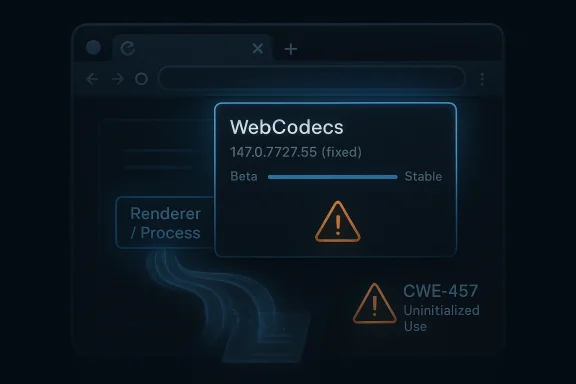 What CVE-2026-5888 Actually Is
At a technical level, an uninitialized use means code reads a value before it has been assigned a safe, deterministic state. In C and C++ codebases like Chromium, that can produce unpredictable output, information leakage, or downstream memory confusion depending on what stale bytes happen to occupy the slot. In browser code, even “just” reading garbage can become security-relevant if that garbage originated from prior sensitive activity in the same process.disclosure matters
The disclosure path in this case is particularly important because the attacker allegedly triggers it with a crafted HTML page. That means the attack surface is not an obscure administrative interface or local-only feature; it is web content, the browser’s most exposed trust boundary. If a webpage can provoke the browser into revealing process memory, the attacker gains an opening into data that should have remained isolated by the browser sandbox.The potential impact irase “sensitive information” might suggest. Depending on process layout and allocator behavior, the leak could expose:
- fragments of recently handled media data,
- pointers or address-like values useful for exploitation,
- page content that should have been cleared,
- internal browser state that helps an attacker refine follow-on attacks,
- remnants of authentication or session-related material in memory.
Why WebCodecs is a plausible target
Weo let web apps work directly with encoded audio and video data, which makes it valuable for conferencing, streaming, editing, and real-time playback workflows. Features like this tend to be performance-sensitive and lower-level than ordinary HTML rendering, which means they often demand more careful state management. That makes them attractive to attackers looking for edge-case parsing behavior or memory handling mistakes.The Chrome releases archive shows that WebCodecs has already beey hotspot in 2026. In the March stable update, Google recorded a heap buffer overflow in WebCodecs as CVE-2026-3544, reinforcing the pattern that this subsystem sits in a difficult part of the browser stack where correctness, speed, and security all compete for the same lines of code. The new disclosure bug is different in mechanics, but it lands in the same general neighborhood of concern. (chromereleases.googleblog.com)
The Release Timeline and Why It Matters
Google’s public fix timeline is clear enough to guide patching. The issue is fixed in Chrome 147.0.7727.55, and the Chrome release channel had already moved through early stable and beta builds on April 1, 2026 before that stabilized patch point was documented. That staging matters because Chrome users often see fixes roll through channels before enterprises fully normalize on the new build number. (chromereleases.googleblog.com)Stable, beta, and early-stable signals
The Chrome Beta channel on April 1, 2026 was updated to 147.0.7727.49, and the early stable channel for desktop was updated the same day to 147.0.7727.49/.50 for a small percentage of users. Those releases are not themselves the final security answer for CVE-2026-5888, but they show the build train moving toward the stable point where the patched code landed. (chromereleases.googleblog.com)That progression is typical of modern Chrome release engineering. Google stages features and security fixes through beta and early-stable rings, then announces the final stable build once the patch is ready for bdefenders, the lesson is not to treat “we’re on Chrome 147” as good enough. The meaningful threshold here is the precise subversion number, 147.0.7727.55.
What the numbers tell administrators
Version pinning can feel fussy, but it is the only reliable way to distinguish vulnerable and non-vulnerable fleets. A machine on 147.0.7727.49 is still in the affected range if the security note says the fix begins at 147.0.7727.55. That matterprises where update channels, deferred rings, or managed policies can leave browsers several increments behind the public stable release.The release cadence also reveals something about Chromium’s security posture: browser vulnerabilities are often fixed in batches, but public release notes still expose enough detail for defenders to act quickly. The tension is obvious. Google wants to inform users, researchers, and downstream vendors without handing exploit writers too much time before the fix is widely deployed. That balance is delicate, and Chromium’s release notes are one of the mechanisms used to strike it. (chromereleases.googleblog.com)
Why Microsoft Is Listing It in the Security Update Guide
Microsoft’s decision to include the Chromium CVE in its own security guidance is not a second independent disclosure of the same bug; it is a downstream tracking signal. Edge is Chromium-based, so Microsoft’s Security Update Guide helps administrators understand whether their Edge builds have incorporated the upstream Chromium fix and are therefore no longer vulnerable. That is a practical service, not a duplicate vulnerability program.The Edge dependency chain
This pattern has become routine for Chromium-origin CVEs. The browser engine is shared, the codebase is upstreamed by Google, and Microsoft tracks affected CVEs to help Edge customers map a Chrome fix to an Edge version. The result is that security teams do not need to reverse-engineer whether a particular Edge build pulled in the relevant commit; they can use the Microsoft guidance as a validation layer.For enterprise defenders, that is crucial. Many organizations manage Chrome and Edge side by side, and both browsers may be allowed or even required depending on line-of-business applications, legacy web appsA Chromium bug like this therefore becomes a cross-browser patch-management event, not a single-vendor cleanup job. That is why these advisories matter.
Why the guide is operationally useful
Microsoft’s Security Update Guide is designed to help customers subscribe to and track public vulnerability information across supported products and dependencies. The company explicitly positions the guide as a centralized source of truth for security-update status, which makes it the obvious place to surface Chromium fixes that affect Edge. For admins, the benefit is simple: one place to check whether the browser engine in their fleet has crossed the safe version boundary.In practice, that also means Microsoft’s entrthe worst gaps in browser security operations: ambiguity. If Google has fixed the bug, but your Edge deployment has not yet ingested the fix, your exposure persists. The guide turns that upstream/downstream relationship into something measurable rather than assumed.
Enterprise Impact: Patching, Exposure, and Fleet Reality
In enterprise environments, the danger is not usually one perfectly targeted exploit chain. It is the possibility that a small but meaningful s in circulation across hundreds or thousands of endpoints long after a fix exists. CVE-2026-5888 belongs to exactly that class of problem, because it can be triggered by web content and because browser patch lag is common in managed fleets.What administrators should worry about
A browser information leak is dangerous when it lands on endpoints that process sensitive internal content, authenticated web apps, or remote work sessions. not directly execute code, the leak can still expose memory that helps attackers plan a second-stage attack or steal operationally useful data. In a corporate environment, that may be enough to justify accelerated patching.The risk is higher when:
- browsers are pinned to older channels,
- update deferrals are in place,
- user devices are allowed to sit offline for long periods,
- Edge and Chrome versions drift apart,
- managed woh-value internal portals,
- shared devices handle multiple sessions during a workday.
How this affects patch strategy
Security teams should treat this as a browser-engine remediation rather than a narrow application patch. That means validating the exact Chrome and Edge build numbers across the fleet, checking update ring beg that devices on extended or deferred channels are not stranded on pre-fix builds. The patch window is only closed once both the vendor update and the endpoint rollout are complete.A practical enterprise response usually looks like this:
- Identify all Chrome and Edge versions in production.
- Compare them with the fixed version baseline.
- Prioritize externally exposed and high-value user groups.
- Force update checks on managed endpoints where policy permits.
- Verify the patched version after rollout, not ju.
- Watch for devices that fail to restart or delay relaunching the browser.
Why browser leaks can still be high priority
It is tempting to down-rank an information disclosure issue below “true” exploitation bugs, but defenders should resist that habit. Modern browser exploitation often begins with a leak because leaks reduce randomness, reveal memory layout, or hat makes the next exploit more reliable. Even when the official severity is Medium, the strategic value of a disclosure can be substantial.Consumer Impact: What It Means for Everyday Users
For ordinary users, the direct takeaway is straightforward: update Chrome or Edge immediately if you are below the fixed build. The issue is reachable through a crafted webpar does not need to download a traditional malware file to be exposed. The attack surface is the normal act of browsing.Why the average user should care
Even if attackers cannot instantly turn the bug into full control of a machine, leaking process memory can still matter. It can expose private page data, session information, or internal browser state that a user reasonably expected to remain hidden. In a world ofrise portals, and browser-based productivity tools, that is not a trivial loss of confidentiality.The risk is amplified by the way modern browsing works. Users rarely think about browser subcomponents like WebCodecs, but those features are increasingly used by everyday services without any visible sign to the user. A page can invoke rich med hood, and that is exactly the kind of place where memory-handling bugs hide.
What users should do
Most users do not need deep technical triage; they need hygiene. If Chrome or Edge has not updated recently, open the browser’s version page, check whether it is at or above the fixed release, and restart if prompted. If automatic updating is disabled, re-enable it or replace the software management habit thate first place. Waiting for “later” is not a plan here.It is also worth remembering that browsers often update quietly in the background but defer full protection until the application restarts. Users who leave browsers open for days can think they are protected when they are still running an older binary in memory. That operational detail math patch-bound issues like this one.
WebCodecs as an Attack Surface
WebCodecs sits in a category that security teams increasingly watch with special care: APIs that bridge web content and low-level media processing. That bridge is useful, but it also means the code has to translate between untrusted page input and highly optimized internal buffers. Those are exactly the conditions where uninitialized surity problem.Performance features often carry security debt
Modern browsers have spent years adding APIs to keep rich applications fast enough for real-time communication, streaming, editing, and AI-assisted media workflows. But every new fast path can weaken the simplicity that made the browser easier to secure in the first place. WebCodecs is a good example: it unlocks developer capability, but it also increases the number of places where data handling must be exact.The March 2026 Chrome stable notes already showed a separate heap buffer overflow in WebCodecs, which is a strong signal that this subsystem has become an active security frontier. When one API produces both overflow and uninitialized-use bugs in the same release window, defenders should assume the area is under intense scrutiny from both researchers and attackers. (chromereleases.googleblog.com)
Why uninitialized state is so dangerous here
Media pipelines often reuse structures, buffers, and metadata across frames or packets. If a code path assumes something has been initialized but it has not, the result can be stale memory being read as valid state. In some cases that means corrupt behavior; in others it means data from one context is accidentally exposed to anoth the sort of bug browsers have spent years trying to eliminate.The fact that the trigger is described as a crafted HTML page also suggests the attack can ride on ordinary browser behavior rather than requiring privileged access. That is why browser APIs are such rich targets: they combine complex implementation details with a fully hostile input source. erimeter when the input is the web itself.
How This Fits the 2026 Chromium Security Pattern
The 2026 Chrome release notes show a familiar rhythm: a series of memory-safety and policy-enforcement fixes, many of them in high-value subsystems like WebCodecs, V8, DevTools, WebAudio, and navigation-related components. CVE-2026-5888 does not stand alone; it belongs to that wider pattern of browser-engine hardening through repeated patch cycles. (chromereleases.googleblog.com)A browser ecosystem under constant repair
Chromium’s open-source release model means security issues appear in public almost as soon as they are ready to be remediated. That creates a strange dynamic: defenders gain fast visibility, but so do attackers. Google’s strategy is to close the exploit window quickly by releasing fixes in stable updates while limiting detailed bug information until most users are protected. (chromereleases.googleblog.com)That policy is visible in Chrome’s release notes, which note that some bug details may be restricted until a majority of users are updated. This is not secrecy for its own sake; it is an attempt to reduce the advantage that exploit developers gain from immediate disclosure. In browser security, timing is part of the defense. (chromereleases.googleblog.com)
Why downstream vendors care so much
For Microsoft, the Chrome release cycle is effectively an upstream dependency feed. The company’s Edge guidance translates Google’s fix into actionable status for Windows environments, which is especially useful because enterprise customers often standardize on Edge policies and update rings. A CVE like this therefore becomes a coordination problem across vendors, not a single patch event.The broader implication is that brocollaborative in a very literal sense. Google may discover and fix the flaw, Microsoft may document the downstream impact, and administrators may still need to intervene locally to ensure the patched build is actually deployed. The chain is only as strong as its slowest update ring.
Strengths and Opportunities
The good news is that this vulnerability appears to have a clear fixed version, a straightforward upstream description, and a downstream tracking path that helps administrators verify remediation. Thater to operationalize than more ambiguous browser bugs. It also reinforces the value of vendor-maintained security guides, which reduce confusion for mixed-browser environments.- Clear fixed build: Chrome 147.0.7727.55 gives defenders a concrete cutoff.
- Downstream visibility: Microsoft’s Security Update Guideack exposure.
- Fast remediation path: Browser updates can be deployed quickly compaches. (chromereleases.googleblog.com)
- Low-friction mitigation: Most users only need to update and restart.
- Better version auditing: lidate exact browser build numbers.
- Useful intelligence signal: The bug highlights WebCodecs as an area worth closer review. (chromereleases.googleblog.com)
- Enterprise policy leverage: Managed fleets can force faster browser compliance than many other software classes.
Risks and Concerns
The concern is not that CVE-2026-5888 is ter bug of the year. The concern is that it sits in a high-exposure feature area and cou a broader exploit strategy. Browser disclosure bugs often look modest in isolation but bnce combined with other primitives.- Information leakage can enable chaining: a memory leak mploit step.
- Web-facing trigger surface: a crafted HTML page is easy to distribute at scale.
- Patch lag risk: deferred update rings can leave fleets exposed for days or weeks.
- Browser restart dependence: updates do not fully protect users until the app is relaunched.
- **Mixed browser environmentmay not move in lockstep.
- Feature complexity: WebCodecs remains a difficult area to implement safely. (chromereleases.googleblog.com)
- Underestimation risk: Medium-rated bugs are sometimes treated too casually by users and help desks.
Looking Ahead
The most important next step is simple: watch how quickly organizations align their browser inventories with the fixed build. The technical issue is already described, the upstream fix is already public, and the downstream tracking path is in place. What remains is the messy real-world question of rollout speed, device uptime, and whether users actually restart their browsers after updates are delivered.There is also a larger lesson here for browser vendors and enterprise security teams alike. As rich media APIs continue to expand, the browser security conversation will keep shifting toward subtle memory-safety errors rather than dramatic full-control bugs. That means continuous patch discipline is no longer a best practice; it is the baseline requirement for staying safe on the modern web. (chromereleases.googleblog.com)
What to watch next:
- confirmas fully absorbed the Chromium fix in managed channels,
- whether additional WebCodecs issues appear in subsequent Chrome release notes, (chromereleases.googleblog.com)
- enterprise guidance on forcing browser restarts after update deployment,
- any follow-on research that shows exploitation chaining from the memory disclosure,
- whether other Chromium-based browsers independently publish matching remediation notices.
Source: NVD / Chromium Security Update Guide - Microsoft Security Response Center
