

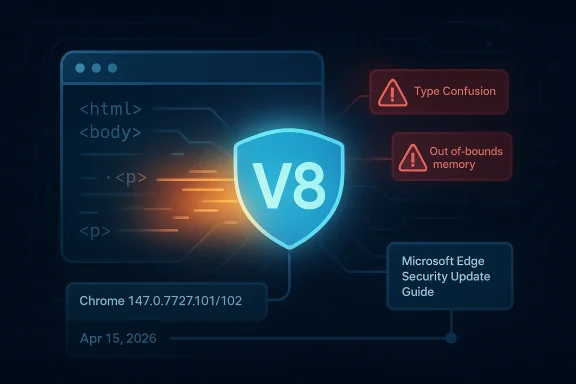
Chromium’s newly disclosed CVE-2026-6363 is a reminder that the browser’s most sensitive attack surface still lives in V8, the JavaScript engine that powers Chrome’s page execution model. Google says the bug is a type confusion issue that could let a remote attacker trigger out-of-bounds memory access through a crafted HTML page, and the stable fix landed in Chrome 147.0.7727.101/102 on April 15, 2026. Microsoft has already mirrored the issue in its Security Update Guide for Microsoft Edge (Chromium-based), underscoring how quickly a Chrome patch becomes an enterprise patching event across the wider Chromium ecosystem. at the center of modern Chromium browser security because it converts untrusted JavaScript into something the machine can execute quickly. That performance advantage is also why the engine is so frequently targeted: a small type-system mistake can have large memory-safety consequences, especially when the bug can be reached from a page that a user merely visits. Google’s own release notes classify CVE-2026-6363 as Medium severity, but the practical risk looks more serious than that label suggests because the exploit path is remote and browser-delivered.
The pattern is familks browser security closely. Google publishes the upstream fix, then Microsoft records the same Chromium-origin flaw in the Edge Security Update Guide so organizations can verify whether the downstream Edge build has absorbed the patch. That workflow is part of the Chromium supply chain now, and it means defenders must watch not only Chrome releases but also the cadence at which Edge, WebView, and other Chromium consumers ingest those changes.
The timing also matters. Chrome 147 became April 7, 2026, and within days Google pushed a follow-up stable update to 147.0.7727.101/102 that added the CVE-2026-6363 fix among 31 security fixes. That sequence suggests the bug was found and patched after the broader 147 line was already rolling out, which is exactly the kind of mid-cycle correction that enterprises dislike because it creates a second validation and deployment wave.
Just as importantly, the issue is not isolated. Chrome’s April 2026 release train also included multiple high-impact V8 problems and other memory-safety issues, reinforcing a broader reality: the browser engine remains a dense, high-value target, and even one fixed bug does not alter the structural pressure on the entire codebase. CVE-2026-6363 should therefore be read less as a one-off defect and more as another data point in the continuing hardening effort around JavaScript execution.
Chromium’s architecture splits responsibilities between the browser process, renderer processes, and specialized subsystems such as V8. That design is supposed to reduce the blast radius of any one defect, but V8 bugs are especially dangerous because they sit near the trust boundary where attacker-controlled code and executed. A type confusion in that layer can collapse the assumptions that keep object layouts and memory accesses safe.
Historically, browser vendors have treated V8 issues as among the highest-priority classes of bug because they are often reachable with little more than a malicious page and a willing click. The most worrying part of that model is not just exploitation, but reliability: a sufficiently advanced attacker can sometimes move from a memory corruption primitive to sandbox escape chaining, or at minimum to stable information leaks and code execution within the renderer context. That is why seemingly abstract engine defects often become urgent patch items for both consumer and enterprise fleets. Even a “medium” browser CVE can have high operational weight.
CVE-2026-6363 fits into a long arc of JavaScript engine hardening. Modern browser teams invest heavily in mitigation layers such as exploit protections, compiler hardening, and process isolation, yet type confusion remains a recurring class because dynamic languages and aggressive optimization are hard to reconcile. The engine must constantly infer types, deoptimize code, and phich means the implementation is always balancing on a narrow edge between speed and safety. That tradeoff is what makes V8 simultaneously one of Chrome’s greatest strengths and one of its greatest liabilities.
Microsoft’s Security Update Guide is part of the downstream answer to that risk. When Microsoft lists a Chromium CVE for Edge, it is not claiming ownership of the flaw; it is telling defenders where the upstream fix stands in the Edge build lineage. That matters because many enterprises standardize on Edge even when they test Chrome, and many internal apps depend on WebView or WebView2, which inherit Chromium engine behavior in a different wrapper.
The practical significance is that type confusion rarely stays theoretical. Attackers tend to use it as a bridge: first they gain a controd or write, then they groom memory, then they look for a follow-on bug or bypass. That makes the fix urgent even when the initial advisory sounds narrower than the threat model suggests. Memory corruption in V8 is never just a logic bug.
The update sequence is notable because the same stable train had already matured to 147.0.7727.55/56 a week earlier. That means organizations that validated early stable 147 still had to re-open the workstream for a later patch, which is a common but frustrating reality for defenders. Security teams often want a single clean maintenance window; browser vendors, by contrast, ship when the bug is fixed, not when the enterprise calendar is convenient.
That density also tells defenders something else: Chrome and Chromium continue to attract a high volume of bug reports from both internal and external researchers. The presence of multiple fixes in one release does not necessarily imply a systemic regression, but it does show the codebase is under constant adversarial scrutiny. For enterprises, the lesson is blunt: browser update latency is a security decision, not a convenience choice. Delay compounds risk.
That is exactly why browser CVEs are so operationally noisy. The exploit path is not exotic: users browse, tabs load, script executes, and a vulnerable engi Because the entry vector is web content, security gateways and URL filtering can reduce exposure but cannot eliminate it. Browsers are exposed by design.
This distinction is easy to miss but important. Many enterprise administrators treat Edge as a Microsoft product and Chrome as a Google product, yet the browser engine underneath both is shared. When Google patches V8, Microsoft still has to ingest the change, test it, and release it on its own schedule. That staggered model is efficient for code reuse, but it creates a period in which Chrome may be fixed while some Edge channels are still catching up.
For companies using managed browsers, this also ties into policy enforcement. Patch rings, update deferrals, and application compatibility work all become relevant when the browser is the front door to internal applications. A fix like CVE-2026-6363 can be “just a browser bug” on paper, but in an enterprise it often touches identity flows, web apps, and line-of-business tools. The blast radius is larger than the browser window.
Enteavier burden. They must verify that managed endpoints have picked up the fixed channel, assess whether holdbacks are in place, and ensure any embedded Chromium surfaces are updated too. Because browser updates are often tightly coupled with identity providers, SaaS portals, and internal workflows, patch timing can influence productivity as well as exposure. Enterprise risk is less about one devet consistency.
That mismatch is not unusual. Severity labels are editorial shorthand; exploitation reality is adversarial and contextual. A flaw that requires only a crafted page can become serious very quickly if the exploit chaitarget population is broad, or if attackers can combine it with a second bug to bypass a mitigation. Do not let the word “Medium” lull you into complacency.
This is especially important because browsers are rich, complex targets. Attackers do not need every exploit to be perfect if they can pivot from one partial primitive to another. That is why a type confusion issue in V8 deserves immediate attention even when the public write-up does not describe full remote code execution. The first primitive is often the hardest part.
Still, the absence of a public exploit report should not delay remediation. Browser bugs often move from disclosure to exploitation faster than organizations can complete change management. The best defense is to compress that window aggressively, especially for user-facing browsers that are opened dozens of times a day across thousands of endpoints. Patch velocity is part of browser security now.
For Chrome, the upside is obvious: the team continues to demonstrate responsive security operations and rapid stable-channel remediation. For Edge, the challenge is less about originality and more about trust—trust that Microsoft will surface upstream CVEs quickly, test them carefully, and communicate status clearly enough for enterprise admins to act. That is why downstream vulnerability entries matter so much.
The broader market implication is that browser security has become a platform governance story. If your line-of-business stack assumes Chromium compatibility, then Chromium’s vulnerability cadence becomes your vulnerability cadence. That affects procurement, endpoint management, and even application design decisions. Browser engine risk is now ecosystem risk.
This is especially true in regulated environments. If a browser CVE touches identity portals, fnternal dashboards, delayed patching can become a compliance issue, not just a technical one. In that sense, every Chromium CVE is also a test of operational maturity across the enterprise software stack. Security is judged by deployment speed.
Another concern is version fragmentation. Enterprises do not all update at the same pace, and some will have a mix of Chrome, Edge, beta branches, and embedded Chromium surfaces. If any of those channels lag behind the fixed version, the organization still has exposure even if the headline CVE looks addressed elsewhere.
For users, the prescription remains simple: update promptly and keep browser channels current. For enterprises, the challenge is richer and harder: build a patch process that treats browser engines like critical infrastructure rather than commodity software. That means inventorying all Chromium-derived surfaces, checking the downstream status in Microsoft’s guidance, and making sure update deferrals do not quietly become exposure windows.
Source: NVD / Chromium Security Update Guide - Microsoft Security Response Center
The pattern is familks browser security closely. Google publishes the upstream fix, then Microsoft records the same Chromium-origin flaw in the Edge Security Update Guide so organizations can verify whether the downstream Edge build has absorbed the patch. That workflow is part of the Chromium supply chain now, and it means defenders must watch not only Chrome releases but also the cadence at which Edge, WebView, and other Chromium consumers ingest those changes.
The timing also matters. Chrome 147 became April 7, 2026, and within days Google pushed a follow-up stable update to 147.0.7727.101/102 that added the CVE-2026-6363 fix among 31 security fixes. That sequence suggests the bug was found and patched after the broader 147 line was already rolling out, which is exactly the kind of mid-cycle correction that enterprises dislike because it creates a second validation and deployment wave.
Just as importantly, the issue is not isolated. Chrome’s April 2026 release train also included multiple high-impact V8 problems and other memory-safety issues, reinforcing a broader reality: the browser engine remains a dense, high-value target, and even one fixed bug does not alter the structural pressure on the entire codebase. CVE-2026-6363 should therefore be read less as a one-off defect and more as another data point in the continuing hardening effort around JavaScript execution.
 Background
Chromium’s architecture splits responsibilities between the browser process, renderer processes, and specialized subsystems such as V8. That design is supposed to reduce the blast radius of any one defect, but V8 bugs are especially dangerous because they sit near the trust boundary where attacker-controlled code and executed. A type confusion in that layer can collapse the assumptions that keep object layouts and memory accesses safe.Historically, browser vendors have treated V8 issues as among the highest-priority classes of bug because they are often reachable with little more than a malicious page and a willing click. The most worrying part of that model is not just exploitation, but reliability: a sufficiently advanced attacker can sometimes move from a memory corruption primitive to sandbox escape chaining, or at minimum to stable information leaks and code execution within the renderer context. That is why seemingly abstract engine defects often become urgent patch items for both consumer and enterprise fleets. Even a “medium” browser CVE can have high operational weight.
CVE-2026-6363 fits into a long arc of JavaScript engine hardening. Modern browser teams invest heavily in mitigation layers such as exploit protections, compiler hardening, and process isolation, yet type confusion remains a recurring class because dynamic languages and aggressive optimization are hard to reconcile. The engine must constantly infer types, deoptimize code, and phich means the implementation is always balancing on a narrow edge between speed and safety. That tradeoff is what makes V8 simultaneously one of Chrome’s greatest strengths and one of its greatest liabilities.
Microsoft’s Security Update Guide is part of the downstream answer to that risk. When Microsoft lists a Chromium CVE for Edge, it is not claiming ownership of the flaw; it is telling defenders where the upstream fix stands in the Edge build lineage. That matters because many enterprises standardize on Edge even when they test Chrome, and many internal apps depend on WebView or WebView2, which inherit Chromium engine behavior in a different wrapper.
Why type confusion still matters
Type confusion bugs are attractive to attackers because they often produmitives. If the program believes one object is another, operations intended for a safe layout can end up reading or writing the wrong memory region. In a browser engine, that can expose secrets, corrupt nearby structures, or set up later stages of exploitation.The practical significance is that type confusion rarely stays theoretical. Attackers tend to use it as a bridge: first they gain a controd or write, then they groom memory, then they look for a follow-on bug or bypass. That makes the fix urgent even when the initial advisory sounds narrower than the threat model suggests. Memory corruption in V8 is never just a logic bug.
- Type confusion can create read and write primitives.
- Those primitives can lead to sandboxed code execution.
- Browser exploits often chain multiple bugs rather than relying on one flaw.
- The real-world danger is usually greater than the short advisory text implies.
What Google Fixed
Google’s April 15 stable update for Chrome 147 is the key upstream event for CVE-2026-6363. The release notes explicitly identify the bug as “Type Confusion in V8” and place it among the security fixes in the 147.0.7727.101/102 branch. In other words, this is not a speculative issue or a future-risk advisory; it is a live patch shipped to the stable channel.The update sequence is notable because the same stable train had already matured to 147.0.7727.55/56 a week earlier. That means organizations that validated early stable 147 still had to re-open the workstream for a later patch, which is a common but frustrating reality for defenders. Security teams often want a single clean maintenance window; browser vendors, by contrast, ship when the bug is fixed, not when the enterprise calendar is convenient.
Security fix density in 147
Chrome’s April 15 desktop update bundled 31 security fixes, which is a reminder that browser hardening is cumulative. Even if CVE-2026-6363 is the headline, it exists inside a larger batch of memory-safety and policy issues, and that context matters when evaluating urgency. A browser release with this many fixes tends to indicate a mature vulnerability discovery pipeline rather than one isolated defect.That density also tells defenders something else: Chrome and Chromium continue to attract a high volume of bug reports from both internal and external researchers. The presence of multiple fixes in one release does not necessarily imply a systemic regression, but it does show the codebase is under constant adversarial scrutiny. For enterprises, the lesson is blunt: browser update latency is a security decision, not a convenience choice. Delay compounds risk.
- The patch is already in the stable channel.
- The release branch is 147.0.7727.101/102.
- The vulnerability is reachable through a crafted HTML page.
- The fix arrived as part of a larger multi-bug security wave.
Why “crafted HTML page” is important
The attack surface description is means the attacker does not need a local foothold or a plugin. A malicious web page is enough to begin the exploitation chain, which places the issue squarely in the category of drive-by browser risk. Even if exploitability is not trivial, the delivery mechanism is extremely common and hard to filter perfectly.That is exactly why browser CVEs are so operationally noisy. The exploit path is not exotic: users browse, tabs load, script executes, and a vulnerable engi Because the entry vector is web content, security gateways and URL filtering can reduce exposure but cannot eliminate it. Browsers are exposed by design.
Microsoft Edge and the Downstream Patch Chain
Microsoft’s role here is to translate Chromium’s upstream security work into downstream guidance for Edge customers. The Security Update Guide entry for CVE-2026-6363 exists because Edge rides on Chromium and inherits its engine vulnerabilities until Microsoft packages the relevant upstream fixes into its own builds. That makes Microsoft a distribution point for patch status, not the original source of the bug.This distinction is easy to miss but important. Many enterprise administrators treat Edge as a Microsoft product and Chrome as a Google product, yet the browser engine underneath both is shared. When Google patches V8, Microsoft still has to ingest the change, test it, and release it on its own schedule. That staggered model is efficient for code reuse, but it creates a period in which Chrome may be fixed while some Edge channels are still catching up.
What the Security Update Guide tells admins
Microsoft’s guidance is useful because it gives IT teams one more place to track status across their fleet. In practice, admins want to know whether their Edge channel already contains the fix, whether any embedded browser components are impacted, and whether they need to accelerate testing. The SUG entry helps convert an upstream Chromium bulletin into a downstream operational action item.For companies using managed browsers, this also ties into policy enforcement. Patch rings, update deferrals, and application compatibility work all become relevant when the browser is the front door to internal applications. A fix like CVE-2026-6363 can be “just a browser bug” on paper, but in an enterprise it often touches identity flows, web apps, and line-of-business tools. The blast radius is larger than the browser window.
- Edge will need the upstream Chromium fix before Microsoft can mark it clean.
- WebView-based applications may inherit the same engine risk profile.
- Enterprises should validate the channel/version they actually deploy.
- The SUG is the right place to confirm downstream status.
Consumer versus enterprise exposure
Consumers primarily face this as a simple update prompt. The advice is straightforward: update Chrome or Edge promptly and avoid delay. Consumers do not usually need to map browser channels to internal application compatibility, so the issue is operationally simple even if the underlying exploit class is not.Enteavier burden. They must verify that managed endpoints have picked up the fixed channel, assess whether holdbacks are in place, and ensure any embedded Chromium surfaces are updated too. Because browser updates are often tightly coupled with identity providers, SaaS portals, and internal workflows, patch timing can influence productivity as well as exposure. Enterprise risk is less about one devet consistency.
How Serious Is the Risk?
Google tagged the Chromium severity as Medium, but defenders should be cautious about reading that label literally. Browser vendors sometimes use “Medium” for issues that are exploitable but partially constrained by exploitability hurdles, sanser interaction. The CVSS data associated with the Microsoft-facing record points to a high-risk profile, including network attackability and user interaction.That mismatch is not unusual. Severity labels are editorial shorthand; exploitation reality is adversarial and contextual. A flaw that requires only a crafted page can become serious very quickly if the exploit chaitarget population is broad, or if attackers can combine it with a second bug to bypass a mitigation. Do not let the word “Medium” lull you into complacency.
Why memory access matters
The advisory says the bug could potentially permit out-of-bounds memory access, which is the kind of primitive security engineers take very seriously. OOB access may reveal memory contents, corrupt state, or set up code execution depending on the surrounding conditions. In a browser engine, even a read primitive can be enough to erode exploit mitigations over time.This is especially important because browsers are rich, complex targets. Attackers do not need every exploit to be perfect if they can pivot from one partial primitive to another. That is why a type confusion issue in V8 deserves immediate attention even when the public write-up does not describe full remote code execution. The first primitive is often the hardest part.
- Out-of-bounds access can expose secrets or corrupt memory.
- User interaction does not always reduce risk enough to matter.
- An exploit chain may start with a type confusion bug and end elsewhere.
- Browser memory safety bugs are especially valuable to attackers.
The role of exploit maturity
Not every browser CVE is equally likely to be weaponized, and that matters when prioritizing patches. Some bugs are found and patched before reliable exploitation appears; others become public quickly and are folded into exploit kits or targeted campaigns. Without public exploitation reporting, CVE-2026-6363 sits in the “fix fast, monitor closely” category rather than the “known active exploitation” bucket.Still, the absence of a public exploit report should not delay remediation. Browser bugs often move from disclosure to exploitation faster than organizations can complete change management. The best defense is to compress that window aggressively, especially for user-facing browsers that are opened dozens of times a day across thousands of endpoints. Patch velocity is part of browser security now.
Competitive Implications for Chrome, Edge, and the Browser Market
CVE-2026-6363 does not change the browser market share story on its own, but it does reinforce how tightly coupled Chrome and Edge have become. Google still leads the upstream engineering effort, while Microsoft’s value proposition increasingly depends on fast, reliable downstream ingestion and enterprise manageability. That dependency is not a weakness for Edge so much as a structural reality of the Chromium era.For Chrome, the upside is obvious: the team continues to demonstrate responsive security operations and rapid stable-channel remediation. For Edge, the challenge is less about originality and more about trust—trust that Microsoft will surface upstream CVEs quickly, test them carefully, and communicate status clearly enough for enterprise admins to act. That is why downstream vulnerability entries matter so much.
What this means for rivals
Safari and Firefox are not directly implicated by this Chromium bug, but they benefit indirectly from every high-profile Chromium advisory because browser security comparisons often become part of product perception. When Chrome has a steady stream of memory-safety fixes, rival vendors can emphasize architectural differences, sandbox design, or update cadence. At the same time, Chromium’s market dominance means its bugs set the agenda for a huge share of the web.The broader market implication is that browser security has become a platform governance story. If your line-of-business stack assumes Chromium compatibility, then Chromium’s vulnerability cadence becomes your vulnerability cadence. That affects procurement, endpoint management, and even application design decisions. Browser engine risk is now ecosystem risk.
- Chrome sets the upstream pace.
- Edge depends on downstream ingestion.
- Enterprises need a browser strategy, not just a patch strategy.
- Chromium bugs influence the entire web software supply chain.
Why this favors disciplined patching vendors
Vendors that can communicate clearly and ship quickly gain credibility. Google has that role on the upstream side, while Microsoft must show the same discipline in downstream packaging and disclosure. For customers, the winner is the vendor that reduces ambiguity, not the one that simply promises eventual remediation.This is especially true in regulated environments. If a browser CVE touches identity portals, fnternal dashboards, delayed patching can become a compliance issue, not just a technical one. In that sense, every Chromium CVE is also a test of operational maturity across the enterprise software stack. Security is judged by deployment speed.
Strengths and Opportunities
The positive side of this event is that the ecosystem is working as designed: the bug was identified, patched upstream, and surfaced downstream for customers who need to know whether Edge remains exposed. Just as importantly, the public record is already rich enough for defenders to act without waiting for rumor or reverse-engineering. That makes the response more practical than chaotic.- Rapid upstream fix in Chrome stable.
- Clear downstream tracking in Microsoft’s Security Update Guide.
- Improved visibility for admins managing mixed browser fleets.
- Opportunity to tighten browser patch governance.
- A useful reminder to audit WebView-dependent applications.
- Better alignment between browser security and endpoint compliance.
- Reinforces the value of channel discipline across fleets.
Risks and Concerns
The biggest concern is that the vulnerability is reachable from a crafted HTML page, which means ordinary browsing behavior can be enough to trigger a dangerous code path. Even if exploitation is nontrivial, the delivery mechanism is easy to scale. That combination keeps the issue high on the operational priority list.Another concern is version fragmentation. Enterprises do not all update at the same pace, and some will have a mix of Chrome, Edge, beta branches, and embedded Chromium surfaces. If any of those channels lag behind the fixed version, the organization still has exposure even if the headline CVE looks addressed elsewhere.
- Patch lag across managed and unmanaged endpoints.
- Misread severity labels that understate real risk.
- Hidden exposure in embedded Chromium apps.
- Delayed validation because browser updates can affect workflows.
- Greater risk where users browse with elevated trust or weak segmentation.
- The possibility that exploit research continues after disclosure.
- Dependency on downstream vendors to ship quickly.
Looking Ahead
CVE-2026-6363 is unlikely to be the last V8 security issue we see in 2026. The combination of large-scale JavaScript execution, just-in-time optimization, and aggressive performance engineering makes engine bugs a recurring feature of the browser landscape. The important question is not whether more bugs will arrive, but whether browser vendors and administrators can continue to shorten the time between disclosure and full fleet remediation.For users, the prescription remains simple: update promptly and keep browser channels current. For enterprises, the challenge is richer and harder: build a patch process that treats browser engines like critical infrastructure rather than commodity software. That means inventorying all Chromium-derived surfaces, checking the downstream status in Microsoft’s guidance, and making sure update deferrals do not quietly become exposure windows.
What to watch next
- Whether Microsoft updates the Edge Security Update Guide with concrete downstream version parity.
- Whether researchers publish additional technical analysis of the V8 type confusion.
- Whether exploit telemetry shows any signs of real-world abuse.
- Whether other Chromium consumers, including embedded runtimes, disclose matching patch status.
- Whether Chrome’s next stable branch bundles more V8 hardening changes.
Source: NVD / Chromium Security Update Guide - Microsoft Security Response Center
Last edited:
