

CVE-2026-63958 is a newly cataloged Linux kernel vulnerability in the USB Type-C Connector System Software Interface, or UCSI, code that deserves attention well beyond the usual Linux security mailing lists: a malformed connector-change notification from firmware or a USB-C controller can cause the kernel to schedule work through memory outside its allocated connector array. The upstream fix is small—a strict bounds check before the array is dereferenced—but the affected trust boundary is important. USB-C ports increasingly depend on embedded controllers, ACPI firmware, and external I2C-attached management silicon, meaning that this is not simply a case of an application mishandling untrusted network input. It is a reminder that hardware-management notifications must be treated as untrusted data, even when they arrive from components inside the device.
UCSI is the software interface designed to let an operating system manage USB Type-C connectors without requiring each OS vendor to implement a separate, deeply hardware-specific driver stack for every controller. It establishes a division of labor between the operating system policy manager and the platform policy manager, commonly abbreviated as OPM and PPM.
That component monitors the physical Type-C port. It detects cable insertion, removal, USB Power Delivery negotiation, orientation, power role, data role, partner capabilities, alternate-mode events, and other state changes. It then reports relevant events upward to the operating system through the UCSI protocol.
Without a standardized interface, operating systems would require many vendor- and board-specific drivers. UCSI instead gives them a common command and notification model. Windows includes a UCSI driver for compliant ACPI-based implementations, while Linux has maintained a UCSI subsystem since the Linux 4.13 era.
The kernel allocates an internal array to represent the connectors the PPM says exist during initialization. Later, when the PPM sends a Connector Change Indication through the Command Completion and Connector Change Indication register, the Linux UCSI driver extracts the connector number and uses it to locate that connector’s work item.
The problem was that the driver trusted the reported number before verifying that it was valid for the initialized connector array.
Linux uses the number of connectors reported during UCSI capability discovery to size and populate its internal
Before the fix,
That distinction matters because code often converts a one-based protocol value into a zero-based C array index. If the input is zero, subtracting one can itself produce an invalid result. If the value is excessively large, it can point past the array’s final element.
A malformed number could therefore steer the kernel toward memory beyond the intended array and pass that location to
The upstream correction rejects invalid connector values before the array is dereferenced. It is a narrow patch, but it closes the hazardous path at exactly the point where untrusted protocol data becomes a pointer-based memory access.
Real systems are more complicated. Firmware can contain bugs, configuration mistakes, state-machine faults, memory corruption vulnerabilities of its own, or unexpected behavior caused by marginal hardware conditions. A controller may also be replaced or influenced by an external device in designs that attach UCSI hardware over buses such as I2C.
The lesson is not that every USB-C controller is hostile. The lesson is that the kernel must remain robust when a component below it returns data that violates the protocol contract.
The malicious scenario requires more careful threat modeling. An attacker would generally need a path to influence the UCSI PPM, its firmware, its bus communications, or an attached controller. That does not make the issue irrelevant; it means exploitability depends heavily on the specific system architecture and the attacker’s preexisting access.
A kiosk, laboratory workstation, shared office laptop, industrial terminal, or device that accepts uncontrolled USB-C accessories may face different risks from a sealed server in a data center. Organizations should avoid treating all kernel CVEs as identical, but they should also avoid assuming a hardware-triggered defect is automatically harmless.
Conversely, a custom-built kernel based on an affected branch remains vulnerable until the relevant upstream commit or equivalent validation logic is incorporated. Organizations that maintain their own kernels should not assume that a later unrelated driver update happened to include the correction.
Still, the long lifespan of the code illustrates how easily protocol-boundary checks can be omitted when an implementation originally assumes the device below it will always obey the specification.
Because the invalid object is involved in workqueue scheduling, the outcome may vary depending on allocator state, compiler options, kernel configuration, and the layout of neighboring memory. That variability is one reason security teams should avoid asserting either that the flaw is “only a denial of service” or that it is definitely code execution.
Whether an attacker can turn that condition into controlled memory corruption or privilege escalation is not established by the CVE description. It would require a credible ability to influence the PPM notification and shape nearby kernel memory in a useful way. Those prerequisites may be difficult in many real-world machines, but the privileged context raises the stakes if a practical exploit path is discovered.
That makes prompt routine patching the sensible response. It does not justify emergency statements that every USB-C cable, dock, or charger can compromise every Linux device.
A desktop motherboard may expose Type-C through a controller stack that does not use the affected UCSI implementation. Another laptop may expose only one USB-C port yet rely on UCSI extensively through ACPI and embedded-controller firmware.
This distinction matters for troubleshooting. Replacing a dock might avoid a sequence that triggers a firmware bug, but the underlying defect is in the host Linux kernel’s acceptance of an invalid PPM notification.
The Linux flaw should therefore not be converted into an unsupported claim that Windows machines are vulnerable. No such conclusion follows from the Linux CVE alone.
A Windows system with faulty embedded-controller or USB-C controller firmware may exhibit docking failures, charging oddities, display-output problems, unexpected disconnects, or other Type-C instability even if its operating system safely rejects the bad input. Defensive OS drivers can contain damage, but they cannot always turn broken firmware behavior into a reliable user experience.
IT teams managing mixed Windows and Linux fleets should keep the remediation tracks separate:
Systems without UCSI support are not affected by this particular code path. Systems with UCSI support but no untrusted physical-access exposure may receive a different priority than public-facing or field-deployed devices, but both should be included in normal patch cycles.
A rational interim classification is “patch in the next scheduled kernel update, accelerate where USB-C physical access, embedded deployments, or controller-firmware uncertainty make the exposure more meaningful.” That is more useful than inventing a score before the available evidence supports one.
For laptop fleets, the technical update is often easier but deployment telemetry becomes important. Verify not only package installation but also that endpoints have rebooted into the updated kernel. A patched package on disk does not protect a machine still running the old kernel image.
Users of rolling-release distributions should install the current supported kernel and watch for distribution advisories. Users of long-term-support distributions should look for a security update or a distribution backport rather than assuming their older base kernel is permanently exposed.
The relevant source-level change is conceptually straightforward: reject a connector number of zero or one greater than the UCSI capability-reported connector count before using it to reference the connector array. For most users, however, applying the maintained kernel update is preferable to manually patching a single driver file.
If a device is known to exhibit USB-C crashes or erratic connector behavior before an update can be applied, minimizing use of suspect accessories is a reasonable temporary operational precaution. But it should be framed as a stability measure, not as proof that every accessory is malicious.
Users should favor vendor documentation over raw upstream version comparison when running a distribution kernel. The vendor’s package revision is the authoritative indicator for that build.
Until that work produces reproducible evidence, it is appropriate to describe the issue as a potentially dangerous kernel memory-safety flaw with architecture-dependent exploitability rather than to overstate its practical reach.
That audit could produce additional defensive patches even if no closely related CVEs emerge. In mature kernel subsystems, security often advances through this kind of careful boundary review.
CVE-2026-63958 ultimately reinforces a principle that applies to every modern PC operating system: the USB-C stack spans silicon, firmware, buses, drivers, and user-facing devices, so security cannot rest on a single layer behaving perfectly. Linux now rejects malformed UCSI connector identifiers before they can escape the connector array’s boundaries, and administrators should ensure that protection reaches their running kernels. The longer-term value of this fix lies not only in preventing one out-of-bounds workqueue operation, but in strengthening the expectation that firmware-originated events are validated rigorously wherever they meet privileged operating-system code.
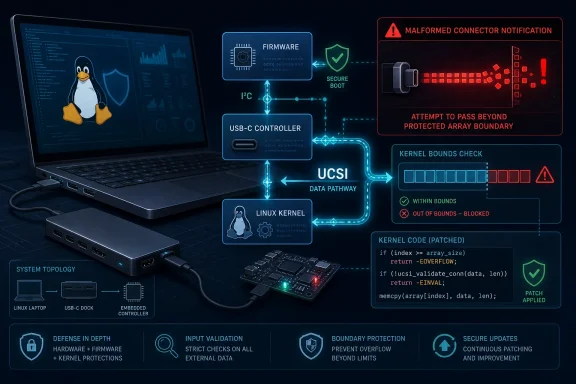 Background
UCSI is the software interface designed to let an operating system manage USB Type-C connectors without requiring each OS vendor to implement a separate, deeply hardware-specific driver stack for every controller. It establishes a division of labor between the operating system policy manager and the platform policy manager, commonly abbreviated as OPM and PPM.The role of the PPM
The PPM normally lives in platform firmware or controller firmware. Depending on the device design, it may be implemented by an embedded controller, a dedicated USB-C controller, or another management component connected through transports such as ACPI, I2C, Qualcomm GLINK, Cypress CCG, or STM32G0-based hardware.That component monitors the physical Type-C port. It detects cable insertion, removal, USB Power Delivery negotiation, orientation, power role, data role, partner capabilities, alternate-mode events, and other state changes. It then reports relevant events upward to the operating system through the UCSI protocol.
Why UCSI matters on modern PCs
The approach is attractive because USB-C has become a convergence point for charging, peripherals, display output, docks, external storage, Ethernet adapters, and increasingly sophisticated power negotiation. A typical laptop’s USB-C port may be responsible for deciding whether a connected device supplies power, receives power, exposes DisplayPort output, supports Thunderbolt or USB4 functionality, and works safely with a dock.Without a standardized interface, operating systems would require many vendor- and board-specific drivers. UCSI instead gives them a common command and notification model. Windows includes a UCSI driver for compliant ACPI-based implementations, while Linux has maintained a UCSI subsystem since the Linux 4.13 era.
A vulnerability in the translation layer
CVE-2026-63958 is not a flaw in USB-C electrical signaling or the USB Power Delivery protocol itself. It is a software memory-safety defect in the Linux kernel’s handling of an event received from the UCSI PPM.The kernel allocates an internal array to represent the connectors the PPM says exist during initialization. Later, when the PPM sends a Connector Change Indication through the Command Completion and Connector Change Indication register, the Linux UCSI driver extracts the connector number and uses it to locate that connector’s work item.
The problem was that the driver trusted the reported number before verifying that it was valid for the initialized connector array.
The Technical Fault
The core issue is a classic out-of-bounds array access, but its details show why defensive checks at hardware and firmware boundaries matter.A seven-bit value meets a smaller array
The UCSI Connector Change Indication contains a connector number represented as a seven-bit field. In principle, that permits values from 0 through 127. Yet most actual computers expose only one, two, or perhaps four physical USB-C connectors.Linux uses the number of connectors reported during UCSI capability discovery to size and populate its internal
ucsi->connector[] array. A subsequent event should refer only to a connector in that reported range. In practical terms, a machine with two Type-C ports should only produce valid connector identifiers corresponding to those ports.Before the fix,
ucsi_connector_change() could receive the connector number, convert it into an array index, and access the associated connector structure without first establishing that the number was nonzero and no greater than cap.num_connectors.The off-by-one convention is meaningful
UCSI connector numbering is conventionally one-based. Connector number zero is not a usable physical connector identifier, even though zero is representable by a seven-bit field. The validity rule is therefore not merely “less than the number of connectors”; it must reject zero and reject any value greater than the capability-reported connector count.That distinction matters because code often converts a one-based protocol value into a zero-based C array index. If the input is zero, subtracting one can itself produce an invalid result. If the value is excessively large, it can point past the array’s final element.
What the vulnerable path does
The affected routine handles notification processing after the PPM announces that a connector’s state changed. Its job is to identify the relevant connector object and queue work that will obtain and process the updated state.A malformed number could therefore steer the kernel toward memory beyond the intended array and pass that location to
schedule_work(). This is more serious than simply reading an incorrect port state. Workqueue scheduling relies on a valid work structure, and interpreting unrelated memory as such a structure can create instability, corruption, or a crash.The upstream correction rejects invalid connector values before the array is dereferenced. It is a narrow patch, but it closes the hazardous path at exactly the point where untrusted protocol data becomes a pointer-based memory access.
Why the Trust Boundary Is Important
Kernel vulnerabilities are often described in terms of whether an attacker is local, remote, privileged, or adjacent. Those labels are useful, but CVE-2026-63958 demonstrates an additional category that is increasingly relevant: firmware-mediated input to a privileged kernel driver.Firmware is not automatically trustworthy
Embedded controllers and peripheral-management controllers are often treated as part of a trusted computing base. In a perfect world, that assumption is reasonable: these are vendor-controlled components built into the device and expected to follow protocol specifications.Real systems are more complicated. Firmware can contain bugs, configuration mistakes, state-machine faults, memory corruption vulnerabilities of its own, or unexpected behavior caused by marginal hardware conditions. A controller may also be replaced or influenced by an external device in designs that attach UCSI hardware over buses such as I2C.
The lesson is not that every USB-C controller is hostile. The lesson is that the kernel must remain robust when a component below it returns data that violates the protocol contract.
Malicious versus buggy behavior
The vulnerability description explicitly recognizes both buggy and malicious PPM behavior. The buggy scenario is the easier one to understand: an embedded-controller firmware fault emits a nonsensical connector identifier following a docking event, a reset, or an unusual power-state transition.The malicious scenario requires more careful threat modeling. An attacker would generally need a path to influence the UCSI PPM, its firmware, its bus communications, or an attached controller. That does not make the issue irrelevant; it means exploitability depends heavily on the specific system architecture and the attacker’s preexisting access.
Physical complexity changes the equation
USB-C ecosystems contain docks, cables, chargers, displays, adapters, hubs, retimers, controllers, and sometimes proprietary management logic. Each layer creates potential interoperability failures, and in some environments physical access is a realistic part of the threat model.A kiosk, laboratory workstation, shared office laptop, industrial terminal, or device that accepts uncontrolled USB-C accessories may face different risks from a sealed server in a data center. Organizations should avoid treating all kernel CVEs as identical, but they should also avoid assuming a hardware-triggered defect is automatically harmless.
Affected Linux Kernel Releases
The vulnerability record identifies the Linux UCSI implementation as affected from Linux 4.13 until fixed releases were incorporated into supported stable branches. The published fixed points are Linux 6.1.176, 6.6.143, 6.12.93, 6.18.35, and 7.0.12, with the fix present in the subsequent 7.1 development line.The important version thresholds
Administrators should treat the following releases as the relevant baseline for the patched stable series:- Linux 6.1 series: Update to 6.1.176 or later.
- Linux 6.6 series: Update to 6.6.143 or later.
- Linux 6.12 series: Update to 6.12.93 or later.
- Linux 6.18 series: Update to 6.18.35 or later.
- Linux 7.0 series: Update to 7.0.12 or later.
- Linux 7.1 and newer: The correction is included from the original upstream fix onward.
Distribution packaging can obscure status
A security team should therefore verify the vendor advisory, package changelog, source package revision, or kernel build information rather than rely solely onuname -r. Red Hat Enterprise Linux, SUSE Linux Enterprise, Ubuntu LTS, Debian stable, Android-derived kernels, appliance distributions, and embedded Linux vendors may all package backports differently.Conversely, a custom-built kernel based on an affected branch remains vulnerable until the relevant upstream commit or equivalent validation logic is incorporated. Organizations that maintain their own kernels should not assume that a later unrelated driver update happened to include the correction.
The age of the affected code
The UCSI support path dates to Linux 4.13, which means the vulnerable assumption persisted for years. That history does not mean every system running an older kernel is equally exposed. UCSI must be enabled, a relevant UCSI transport and controller must be active, and a malformed notification must occur.Still, the long lifespan of the code illustrates how easily protocol-boundary checks can be omitted when an implementation originally assumes the device below it will always obey the specification.
Exploitability and Likely Impact
As of July 21, 2026, the CVE entry does not include a completed NVD CVSS assessment. That absence should not be mistaken for an all-clear or a declaration that the issue is low severity. It means organizations must make a reasoned, environment-specific prioritization decision while public scoring and downstream analysis mature.The most immediate consequence is likely stability
The most straightforward result of scheduling work on an invalid memory location is a kernel crash, a hang, or other unpredictable behavior. On a laptop, that can mean a sudden reboot or loss of unsaved work after a USB-C connection event. On an embedded system, it can become a service interruption requiring physical intervention.Because the invalid object is involved in workqueue scheduling, the outcome may vary depending on allocator state, compiler options, kernel configuration, and the layout of neighboring memory. That variability is one reason security teams should avoid asserting either that the flaw is “only a denial of service” or that it is definitely code execution.
Memory corruption deserves caution
Out-of-bounds kernel accesses are inherently concerning. The reported condition goes beyond an ordinary rejected event: it can cause the kernel to interpret memory past the connector array as a structure containing workqueue state.Whether an attacker can turn that condition into controlled memory corruption or privilege escalation is not established by the CVE description. It would require a credible ability to influence the PPM notification and shape nearby kernel memory in a useful way. Those prerequisites may be difficult in many real-world machines, but the privileged context raises the stakes if a practical exploit path is discovered.
No public exploitation should be presumed
There is no basis in the published record to claim known exploitation in the wild, a public proof of concept, or a confirmed remote attack vector. Security reporting should be disciplined here: the vulnerability is real and patched, but public exploitability details remain limited.That makes prompt routine patching the sensible response. It does not justify emergency statements that every USB-C cable, dock, or charger can compromise every Linux device.
The USB-C and UCSI Architecture Behind the Bug
Understanding the moving parts helps explain which systems are relevant and why certain apparently similar systems may not be affected.UCSI is not the same as USB-C support
A Linux system can have USB-C ports without using the UCSI driver. Some platforms use Type-C Port Controller Interface drivers, vendor-specific controller drivers, or other Type-C framework integrations. CVE-2026-63958 specifically concerns the UCSI code path in the Linux kernel, particularly the connector-change processing logic.A desktop motherboard may expose Type-C through a controller stack that does not use the affected UCSI implementation. Another laptop may expose only one USB-C port yet rely on UCSI extensively through ACPI and embedded-controller firmware.
The affected transport landscape
The vulnerability description identifies several relevant sources of PPM-originated data:- Embedded-controller firmware can act as the UCSI platform policy manager on many notebooks.
- Cypress CCG-based controllers may present UCSI-related events through their Linux transport implementation.
- STM32G0-based UCSI controllers are used in some USB-C management designs.
- Qualcomm GLINK transports can carry UCSI communications on supported ARM-based platforms.
- I2C-attached controllers create a pathway in which the kernel receives controller-originated state over a shared hardware bus.
Why docks are not automatically the culprit
A dock may trigger a connector-change event by changing the Type-C topology or power-delivery state, but that does not mean the dock itself supplies the malformed UCSI message. In many designs, the host’s embedded controller or dedicated Type-C controller remains the PPM and generates the notification after observing the dock.This distinction matters for troubleshooting. Replacing a dock might avoid a sequence that triggers a firmware bug, but the underlying defect is in the host Linux kernel’s acceptance of an invalid PPM notification.
Implications for Windows Users
WindowsForum readers should note a crucial point: CVE-2026-63958 is a Linux kernel vulnerability, not a confirmed vulnerability in Windows, Windows 11, Windows Server, or Microsoft’s UCSI driver. The affected file is part of the Linux kernel’s UCSI implementation.Shared standards do not imply shared flaws
Windows also supports UCSI on compatible hardware, especially through ACPI-based designs, because UCSI is an industry interface rather than a Linux-specific invention. However, two operating systems can implement the same specification with very different internal data structures, validation logic, and error handling.The Linux flaw should therefore not be converted into an unsupported claim that Windows machines are vulnerable. No such conclusion follows from the Linux CVE alone.
The relevant Windows lesson
The event nevertheless has practical relevance for Windows users and OEMs. It highlights the importance of firmware quality in the USB-C stack. A PPM that emits an invalid connector number is violating the protocol independently of which operating system is listening.A Windows system with faulty embedded-controller or USB-C controller firmware may exhibit docking failures, charging oddities, display-output problems, unexpected disconnects, or other Type-C instability even if its operating system safely rejects the bad input. Defensive OS drivers can contain damage, but they cannot always turn broken firmware behavior into a reliable user experience.
Dual-boot and fleet-management considerations
Dual-boot users are a particularly clear example. A single laptop can be fully updated on Windows yet boot an outdated Linux distribution that remains exposed to the Linux kernel defect. Windows Update does not update a user-installed Linux kernel, and Linux distribution updates do not alter Windows’ UCSI driver.IT teams managing mixed Windows and Linux fleets should keep the remediation tracks separate:
- Windows endpoints should continue to receive OEM firmware, dock firmware, and Microsoft updates according to normal policy.
- Linux endpoints need a kernel update that includes the UCSI bounds-check fix.
- Shared USB-C accessories should be assessed as compatibility and firmware-management assets, not assumed to be either the direct vulnerability source or a complete mitigation.
Enterprise Impact and Patch Management
For enterprises, CVE-2026-63958 is best handled as a kernel-maintenance and asset-classification exercise rather than a panic-driven incident.Prioritize systems with active UCSI hardware
The first question is whether the Linux endpoint actually loads and uses the UCSI stack. Relevant systems will often show UCSI-related modules, device entries, kernel log messages, or Type-C subsystem activity. Administrators can inspect their platform documentation, kernel configuration, loaded modules, and distribution hardware inventory tools to determine relevance.Systems without UCSI support are not affected by this particular code path. Systems with UCSI support but no untrusted physical-access exposure may receive a different priority than public-facing or field-deployed devices, but both should be included in normal patch cycles.
Do not wait for a severity score
A missing CVSS score can disrupt vulnerability-management workflows that depend on numeric prioritization. This is a weakness in process, not a reason to defer evaluation. The defect is a kernel out-of-bounds access reachable from a device-management notification, and a fix exists in maintained Linux stable branches.A rational interim classification is “patch in the next scheduled kernel update, accelerate where USB-C physical access, embedded deployments, or controller-firmware uncertainty make the exposure more meaningful.” That is more useful than inventing a score before the available evidence supports one.
Kernel updates require operational planning
Production Linux kernel updates may require a reboot, which is often the real scheduling challenge. Organizations should coordinate maintenance around redundancy, high-availability failover, workload draining, and hardware-validation procedures.For laptop fleets, the technical update is often easier but deployment telemetry becomes important. Verify not only package installation but also that endpoints have rebooted into the updated kernel. A patched package on disk does not protect a machine still running the old kernel image.
Recommended enterprise workflow
A practical response can follow this sequence:- Identify Linux assets using UCSI-capable USB-C hardware and the affected kernel path.
- Map installed and running kernel builds to the vendor’s fixed package advisory.
- Deploy the vendor-supported kernel update through established rings or pilot groups.
- Reboot systems and verify that the fixed kernel is the active kernel.
- Test high-value USB-C workflows, including docks, displays, charging, storage, and power-state transitions.
- Track OEM firmware updates separately, especially where recurring Type-C instability suggests a PPM defect.
- Document compensating controls for systems that cannot yet be restarted or updated.
Consumer and Enthusiast Guidance
For home users, developers, and Linux enthusiasts, the message is simpler: update the kernel through your distribution’s supported update channel, then reboot.Check the running kernel, not just the package manager
After applying updates, verify the kernel currently in use. A machine may download a new kernel package while continuing to run the vulnerable one until the next restart. This is especially common on desktops and laptops that are frequently suspended rather than rebooted.Users of rolling-release distributions should install the current supported kernel and watch for distribution advisories. Users of long-term-support distributions should look for a security update or a distribution backport rather than assuming their older base kernel is permanently exposed.
Custom kernels need deliberate maintenance
People building their own kernels, using mainline kernels on older distributions, or deploying third-party performance kernels should verify the source revision or patch set. A vendor package update cannot protect a manually compiled kernel that remains in the bootloader configuration.The relevant source-level change is conceptually straightforward: reject a connector number of zero or one greater than the UCSI capability-reported connector count before using it to reference the connector array. For most users, however, applying the maintained kernel update is preferable to manually patching a single driver file.
Avoid counterproductive workarounds
Disabling USB-C ports, avoiding all docks, or refusing to use chargers is usually not a proportionate response. Those measures may create substantial usability costs and do not replace patching.If a device is known to exhibit USB-C crashes or erratic connector behavior before an update can be applied, minimizing use of suspect accessories is a reasonable temporary operational precaution. But it should be framed as a stability measure, not as proof that every accessory is malicious.
Strengths and Opportunities
The response to CVE-2026-63958 contains several encouraging signs for Linux platform security.A narrow, auditable correction
The patch is easy to understand and review: validate the incoming protocol identifier before dereferencing an array. Small fixes reduce regression risk and make distribution backports more practical.Stable-branch coverage is broad
The correction was backported to several maintained kernel lines rather than being left only in a future mainline release. That gives distributions and device vendors a clear path to ship a targeted repair without forcing an unnecessary major kernel transition.The bug improves future review practices
This vulnerability should encourage maintainers to review other UCSI notification fields and similar hardware-management interfaces for assumptions about firmware correctness. Input validation at the point of use is a reusable pattern, particularly where a bounded kernel object is selected by a protocol-provided identifier.Firmware and OS teams have a shared diagnostic signal
An invalid connector number should be considered useful telemetry. Once kernels reject it safely, platform vendors can investigate why their controller firmware emitted it, improving reliability for Linux and Windows users alike.Risks and Concerns
The small size of the code fix should not obscure the operational and security questions that remain.Firmware defects may persist after the kernel update
The patch prevents the Linux kernel from performing the unsafe array access. It does not repair a PPM, embedded controller, or Type-C controller that produces malformed notifications. Users may still experience USB-C feature failures that require an OEM firmware update.Public severity data remains incomplete
No completed NVD CVSS assessment was available when the vulnerability record was published and updated on July 19 and July 20, 2026, respectively. Organizations that rely heavily on automated severity thresholds may under-prioritize the issue until their processes incorporate technical context.Exploitability will vary across hardware designs
A laptop with an integrated embedded controller, an ARM platform with a distinct controller transport, and an embedded appliance with externally reachable I2C-connected Type-C management hardware do not share the same attack surface. Blanket claims of either criticality or irrelevance would be misleading.Regression testing is still warranted
USB-C is sensitive to timing and state transitions. Although the change is logically simple, enterprises and hardware enthusiasts should test charging, docking, display output, sleep and resume, cable reattachment, and alternate-mode operation after kernel deployment.What to Watch Next
The next developments around CVE-2026-63958 will likely determine whether it remains a routine kernel hardening fix or attracts more urgent attention.Distribution advisories and backports
The most practical near-term signal will be distribution-specific security advisories. These will identify the package versions that include the fix for supported product lines and clarify whether particular enterprise kernels received a direct backport.Users should favor vendor documentation over raw upstream version comparison when running a distribution kernel. The vendor’s package revision is the authoritative indicator for that build.
Further analysis of attack prerequisites
Researchers may investigate whether a malformed UCSI notification can be induced by a normal external accessory, requires compromised controller firmware, depends on physical bus access, or needs another local privilege escalation first. Those distinctions will shape realistic risk assessments.Until that work produces reproducible evidence, it is appropriate to describe the issue as a potentially dangerous kernel memory-safety flaw with architecture-dependent exploitability rather than to overstate its practical reach.
Related UCSI hardening work
The defect may prompt broader auditing of UCSI command responses and asynchronous notifications. The same general question applies throughout hardware-management code: does the driver validate every device-supplied index, length, count, state value, and capability field before it controls memory access or work scheduling?That audit could produce additional defensive patches even if no closely related CVEs emerge. In mature kernel subsystems, security often advances through this kind of careful boundary review.
OEM firmware releases
Platform vendors may also issue embedded-controller, BIOS, dock, or USB-C controller firmware updates where they identify a device-specific source of invalid notifications. Such updates should be evaluated on their own merits; they can improve reliability, but they do not eliminate the need for the operating system’s kernel-side validation.CVE-2026-63958 ultimately reinforces a principle that applies to every modern PC operating system: the USB-C stack spans silicon, firmware, buses, drivers, and user-facing devices, so security cannot rest on a single layer behaving perfectly. Linux now rejects malformed UCSI connector identifiers before they can escape the connector array’s boundaries, and administrators should ensure that protection reaches their running kernels. The longer-term value of this fix lies not only in preventing one out-of-bounds workqueue operation, but in strengthening the expectation that firmware-originated events are validated rigorously wherever they meet privileged operating-system code.
References
- Primary source: NVD / Linux Kernel
Published: 2026-07-21T01:02:31-07:00
NVD - CVE-2026-63958
 nvd.nist.gov
- Security advisory: MSRC
Published: 2026-07-21T01:02:31-07:00
Original feed URL
Security Update Guide - Microsoft Security Response Center
 msrc.microsoft.com
- Related coverage: code.googlesource.com