

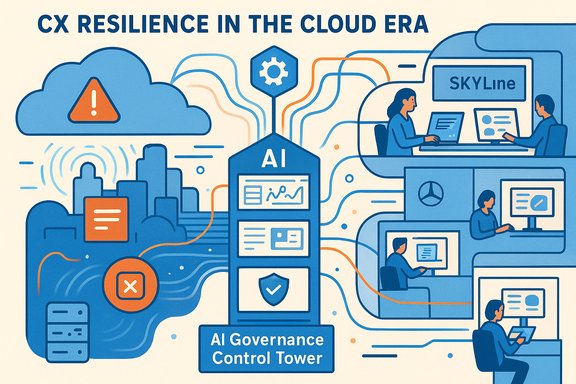
The latest week in enterprise customer experience (CX) has been defined by a brutal reminder of cloud fragility, a major vendor doubling down on AI-first workflows in a strong quarter, a sober set of Forrester predictions that warn CX teams to choose relevance over vanity metrics, and a pragmatic, India‑focused CRM rebuild that shows how vendors are turning AI and workflow tooling into dealer‑level operational wins.
Modern CX rests on three pillars: cloud infrastructure, workflow automation, and data‑driven decisioning. When any pillar wobbles, the customer journey is the first thing customers notice and the last thing companies can afford to leave broken. Over the past two weeks we saw an Azure Front Door configuration error that caused global routing and authentication failures; ServiceNow report a robust quarter and push an enterprise AI governance story; Forrester warn that CX teams risk an era of “metric obsession”; and Zoho roll out a bespoke Dealer Management System (DMS) called SKYLine for Mercedes‑Benz India that swaps centralized legacy systems for a decentralized CRM model. Each of these developments has practical implications for contact centers, CX leaders, and tech procurement teams.
Conclusion
The combined narrative of the Azure outage, ServiceNow’s AI governance push, Forrester’s sober predictions and Zoho’s SKYLine rollout should reframe CX planning for the coming 12–18 months. CX leaders who treat resilience, meaningful measurement, and responsible AI governance as strategic priorities will not only survive the next outage; they will turn these challenges into differentiators that customers remember for the right reasons.
Source: CX Today Big CX News from AWS, ServiceNow, Forrester & Zoho
 Background / Overview
Modern CX rests on three pillars: cloud infrastructure, workflow automation, and data‑driven decisioning. When any pillar wobbles, the customer journey is the first thing customers notice and the last thing companies can afford to leave broken. Over the past two weeks we saw an Azure Front Door configuration error that caused global routing and authentication failures; ServiceNow report a robust quarter and push an enterprise AI governance story; Forrester warn that CX teams risk an era of “metric obsession”; and Zoho roll out a bespoke Dealer Management System (DMS) called SKYLine for Mercedes‑Benz India that swaps centralized legacy systems for a decentralized CRM model. Each of these developments has practical implications for contact centers, CX leaders, and tech procurement teams. What happened with Azure — a technical and CX fallout
The incident, in plain terms
On October 29, 2025, Microsoft’s Azure experienced a high‑impact outage caused by an inadvertent configuration change in Azure Front Door (AFD), the global edge and application delivery network that handles content delivery, TLS termination and routing for many Microsoft and customer endpoints. The misconfiguration left numerous AFD nodes in an invalid state, preventing them from serving traffic correctly and producing widespread timeouts, TLS errors, and authentication failures across Microsoft services and customer applications. Public reporting and Microsoft’s status updates show the incident began in the middle of the UTC day and recovery completed in incremental rings as AFD was rolled back and traffic rerouted.Real CX impacts — voice, SMS and contact centers
The outage wasn’t a simple webpage blip. It affected systems that underpin customer journeys across airlines, retail, gaming, and public services. Notably, Azure Communication Services (ACS) — the Microsoft platform for provisioning phone numbers, voice calls and SMS messaging — experienced errors and latencies during the incident. Dynamics 365 Contact Center (Microsoft’s CCaaS/CC solution) relies on ACS for its voice and SMS channels, which meant many customer‑facing telephony and messaging flows degraded or failed during the outage. That translated into disrupted airline check‑ins, mobile app failures, checkout interruptions and unprocessed portal sign‑ins for customers mid‑journey.Why this matters for CX teams
- Customer trust is fragile: Outages hit the moments that matter — check‑in, payment, order confirmation — and erode trust faster than any marketing campaign can recover it.
- Edge/control planes are failure surfaces: Small configuration errors on global control planes (AFD, DNS, load balancers) can cascade quickly and broadly.
- Operational readiness matters more than ever: Rapid rollbacks, pre‑written runbooks, and an out‑of‑band admin path are no longer nice‑to‑have. They are survival tools.
How to harden CX systems against cloud control‑plane failures
Short checklist (practical, immediate)
- Pre‑provision alternate telephony paths: Maintain a secondary SIP trunk or PSTN gateway that can be activated if ACS or the primary cloud telephony provider is unavailable.
- Cache critical customer data: Keep a local fallback for phone numbers, last‑mile OTP delivery fallbacks (alternate SMS providers), and offline check‑in instructions.
- Test DNS and routing failovers quarterly: Exercise TTL changes, cache flushes, and client retry behavior in scheduled chaos drills.
- Embed SLOs and resilience KPIs in CX metrics: Move availability and degradability from IT dashboards into CX scorecards and SLA contracts.
Longer term architectural moves
- Classify journeys by impact: Reserve active multi‑region or multi‑cloud failover for high‑criticality paths (payments, check‑ins), apply graceful degradation elsewhere.
- Insist on vendor transparency: Contractually require post‑incident root cause analyses and remediation plans as part of SLA negotiation.
- Invest in cross‑functional war rooms: During incidents, empower CX, engineering, comms, legal and operations to make decisions without approval bottlenecks.
ServiceNow: earnings, AI agents and the AI Control Tower
The facts — numbers and product signals
ServiceNow reported third‑quarter 2025 total revenues of $3.407 billion, a 22% year‑over‑year increase. Subscription revenue for the quarter was $3.299 billion. The quarter also featured an emphasis on AI product uptake: the company said AI agent consumption and Now Assist deals accelerated, and management highlighted an AI Control Tower concept to monitor, govern and operationalize agentic AI across enterprises. These figures and product claims are taken from ServiceNow’s official financial release and the earnings call transcript.What the AI Control Tower is trying to solve
ServiceNow’s pitch is that enterprises need a central governance and observability plane for AI agents — a place to register agents, track their actions, define policies, and ensure compliance across a sprawling tech estate. For large firms attempting agentic automation across CRM, ITSM, finance and operations, the Control Tower promises:- Visibility across agent deployments and connectors
- Policy enforcement (who can act on behalf of customers, what approvals are required)
- Auditable traces of agent decisions and tool calls
Strengths and pragmatic value
- Platform fit: ServiceNow already runs cross‑enterprise workflows; adding agent governance to that workflow fabric is a sensible, enterprise‑native move.
- Demand signal: The company reported rapid uptake of AI products and growing ACV for Now Assist — real commercial traction that validates demand for managed, auditable agent tooling.
- Operational ROI: By standardizing agent deployment and tracing, the Control Tower can reduce rollback time, improve audit readiness and lower risk for regulated customers.
Risks and caveats
- Vendor consolidation risk: Centralizing agent governance inside a single vendor increases lock‑in risk; procurement teams should demand portability and API access for audit data.
- Overpromising on governance: Governance tooling is helpful, but governance also requires culture, training, and change management. The Control Tower is tooling, not a substitute for internal processes.
- Capacity and cost: Agentic AI is compute‑intensive. Buyers must model long‑term costs and confirm capacity commitments in procurement terms.
Forrester’s CX predictions: metric obsession, AI pitfalls and a 2026 inflection
The headline thesis
Forrester — via Maxie Schmidt, VP and Principal Analyst — frames 2025 as a tough year for CX teams and describes a looming hazard: “metric obsession” and “measurement without meaning.” The firm warns that organizations that double‑down on dashboards and vanity metrics risk becoming irrelevant, while those that modernize, upskill and embed CX into business outcomes will break free and make CX a growth catalyst in 2026. Forrester’s predictions include concrete risks such as AI‑led research scandals and self‑service initiatives that harm the total experience if deployed prematurely.What CX leaders should take from Forrester
- Measurement must tie to action: Dashboards are useless unless they pinpoint decisions and drive investments that improve business outcomes.
- AI requires human oversight: Forrester predicts real scandals where organizations rely solely on autonomous AI research or synthetic audiences — human researchers remain essential for validity and ethics.
- Strategic design investment pays off: Design systems, strong governance, and cross‑functional ownership will differentiate the winners.
Practical response checklist
- Replace “vanity dashboards” with a prioritized list of moments that matter and the specific interventions that will move those metrics.
- Implement human‑in‑the‑loop checks for any AI that influences customer outcomes.
- Treat design systems as products: allocate budget, owners, and KPIs tied to accessibility, conversion uplift and operational cost reduction.
Zoho’s SKYLine for Mercedes‑Benz India — local innovation at scale
What SKYLine is and who it affects
Zoho and Mercedes‑Benz India have launched SKYLine, a decentralized Dealer Management System (DMS) built on Zoho CRM and orchestration via Zoho’s Qntrl workflow engine. SKYLine is live across Mercedes‑Benz dealerships in India and was co‑developed to provide dealer autonomy while preserving OEM-level control through a middleware layer that integrates with legacy HQ systems. The rollout reportedly involved large volumes of UAT and training (over 5,000 man‑days for UAT and 3,000 man‑days of training). Multiple Indian and industry outlets confirmed the announcement.Why this matters to CX and contact center teams
- Decentralized CRM instances: Each dealership runs its own CRM instance, enabling tailored workflows without sacrificing central governance — a pragmatic approach to balancing autonomy and compliance.
- Real‑time customer portals: Vehicle owners can track service updates, invoices and service history via a unified portal, reducing friction and call volume for dealer contact centers.
- Middleware integration: The co‑developed transformation layer lets dealers exchange data with global HQ systems without forcing a rip‑and‑replace of legacy platforms — a real win for complex enterprise migrations.
Strengths and potential risks
- Strengths:
- Reduced time to value by embedding CRM logic at the dealer level.
- Better customer visibility and personalized service journeys.
- Localized training and rollout reduces change friction.
- Risks:
- Operational variance across dealer instances could complicate central reporting unless governance is strict.
- The middleware becomes a critical dependency; its resilience and observability must be validated.
- Data residency and synchronization lags could produce mismatches in inventory or campaign targeting if not closely monitored.
Cross‑cutting analysis: what ties these stories together
- Concentration vs. autonomy: The Azure outage and the AWS disruption earlier in October show the systemic risk of concentrated control planes. Zoho’s SKYLine, by contrast, demonstrates the practical benefits of decentralized architecture where appropriate. The lesson: centralization buys scale; decentralization buys resilience and autonomy.
- AI is now an operational problem, not an R&D project: ServiceNow’s Control Tower and Forrester’s warnings both make the same point—AI requires governance, observability and careful human oversight if it’s to improve customer outcomes rather than damage them.
- CX is a board‑level risk: Outages and failed AI initiatives carry reputational and financial costs. CX continuity, SLOs for customer journeys, and contractual incident remediation need board attention and funded programs.
Tactical playbook: 10 concrete actions CX leaders should prioritize now
- Map your moments that matter and classify each by customer impact.
- For high‑impact journeys, design multi‑region/multi‑path failover (active‑passive or active‑active).
- Pre‑provision alternate telephony and SMS providers; script vendor‑switch playbooks.
- Bake AI observability into procurement: require auditable logs, model lineage and data processing contracts.
- Treat design systems as measurable products with owners and budgets.
- Run quarterly outage tabletop exercises with comms scripting and external messaging templates.
- Negotiate vendor SLAs that include post‑incident root cause analysis and remediation timelines.
- Pilot AI agents in low‑risk channels with human‑in‑the‑loop gating and A/B testing.
- Implement a Control Tower or equivalent governance layer if you run at scale — but insist on exportable logs and vendor‑neutral APIs.
- Train CX staff on AI literacy and resilience protocols; governance is people + process + tech.
What to watch next (risk indicators and bullish signs)
- Risk indicators:
- Increase in control‑plane changes or short‑notice global configuration pushes at hyperscalers.
- Overreliance on a single telephony/SMS provider for critical journeys.
- CX dashboards that lack clear linkage to business outcomes.
- Bullish signs:
- Vendors publishing mature governance tooling and audit trails for agent activity.
- Adoption of decentralized models for retail or dealer networks that preserve central oversight without forcing single‑pane dependence.
- Vendors committing contractual capacity or pricing protections for heavy agent compute workloads.
Final verdict — an urgency to act, not panic
This week’s headlines form a coherent brief: enterprises must design customer experiences that expect failure and govern AI with the same rigor applied to financial controls. Hyperscalers remain essential — they offer scale, security and innovation that are impossible for most companies to replicate. But scale concentrates risk; the countermeasure is disciplined architecture, governance, and cross‑functional operational readiness.- For CX teams: shrink the distance between metrics and decisions. Replace vanity KPIs with mission‑critical metrics tied to business outcomes.
- For platform and SRE teams: treat control planes and edge fabrics as first‑class disaster surfaces. Test and contract accordingly.
- For procurement and legal: require transparency, post‑incident RCA, and explicit remediation commitments for services that affect customer journeys.
- For product and design teams: invest in reusable design systems and test AI features with human oversight before scaling.
Conclusion
The combined narrative of the Azure outage, ServiceNow’s AI governance push, Forrester’s sober predictions and Zoho’s SKYLine rollout should reframe CX planning for the coming 12–18 months. CX leaders who treat resilience, meaningful measurement, and responsible AI governance as strategic priorities will not only survive the next outage; they will turn these challenges into differentiators that customers remember for the right reasons.
Source: CX Today Big CX News from AWS, ServiceNow, Forrester & Zoho
