
Rising power prices, tougher carbon reporting rules and the sheer growth of digital infrastructure have turned data center sustainability from a facilities issue into an executive strategy question. What used to be framed as an energy-efficiency project is now tied directly to operating expense, compliance risk and long-term resilience. For IT leaders, the core message is simple: decarbonization is no longer separate from performance; it is part of performance.
The shift is being driven by a collision of forces. In the United States, the Department of Energy says data centers consumed about 4.4% of total U.S. electricity in 2023 and could rise to roughly 6.7% to 12% by 2028, underscoring how quickly the sector is becoming a power-market issue as well as an IT one. In Europe, regulators have already moved beyond broad sustainability rhetoric and into structured reporting, with the European Commission adopting an EU-wide scheme for data center sustainability rating and reporting. That combination of cost, regulation and scrutiny means infrastructure decisions are now strategic decisions.
Forward-looking organizations are responding by rethinking how they site capacity, source power, cool dense workloads and evaluate vendors. The most mature enterprises are also treating sustainability metrics as part of architecture planning rather than after-the-fact reporting. That is where the strategic opportunity lies: turning carbon pressure into better engineering, better procurement and better operational discipline.
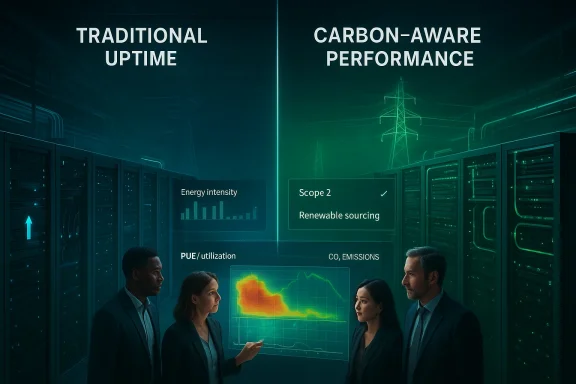
The modern data center is no longer judged only on uptime, latency and cost per virtual machine. It is increasingly assessed on energy intensity, emissions transparency and the ability to support business growth without producing outsized environmental risk. That marks a fundamental change in how infrastructure leaders define success.
A few years ago, sustainability language often lived in annual ESG reports or corporate communications. Today, it is entering request-for-proposal language, board discussions and contract negotiations with cloud, colocation and hardware providers. As reporting standards tighten, the data center becomes both a source of emissions and a source of evidence.
This shift is especially visible in the rise of Scope 2 emissions awareness. Because purchased electricity is a major input to data center operations, power sourcing decisions now affect the carbon profile that enterprises report to regulators, investors and customers. In practical terms, electricity is no longer just a utility line item; it is also a disclosure variable.
The change also reflects a broader change in enterprise IT economics. AI, storage growth and 24/7 digital operations are raising power density at the same time that grids in some regions are becoming tighter and more expensive. The result is a strategic squeeze: more compute demand, more carbon scrutiny and less room for inefficient design.
Organizations that delay modernization may find themselves paying in three ways at once: higher utility costs, higher compliance costs and higher reputational costs. That makes decarbonization less about virtue signaling and more about operational hedging. In other words, sustainability is becoming a resilience tool.
The second pressure is compliance. Sustainability reporting is becoming more standardized, more auditable and less forgiving of vague claims. That means infrastructure teams need better data, better measurement and better defensibility around energy sourcing and emissions calculations.
The third pressure is corporate commitment. Net-zero goals, ESG targets and supplier sustainability programs are moving accountability deeper into the IT organization. That does not mean IT owns the entire sustainability agenda, but it does mean IT is accountable for a large share of the operational evidence.
The same is true for workload placement. A workload that can run in a region with a lower-carbon, more stable power mix may deliver lower long-term total cost of ownership even if the immediate colocation rate is slightly higher. That tradeoff is increasingly rational for enterprise buyers.
For global organizations, the implication is straightforward: local shortcuts can become global liabilities. If one region’s reporting practices are looser than another’s, the stricter regime tends to become the enterprise standard. That is why sustainability and governance now need to be designed into architecture, not appended later.
In Europe, the Energy Efficiency Directive framework already ties data center reporting to transparent performance indicators, including energy and water considerations and the use of renewable energy. That matters because once a metric becomes standardized, it can shape procurement, finance and public perception all at once.
In the United States, the regulatory picture is less centralized but still moving. Federal energy and sustainability programs are pushing buildings and operations toward lower emissions, while the DOE’s data center electricity findings underscore why policymakers are paying attention. Even without a single nationwide data center carbon rule, pressure is building through multiple channels.
This also raises the quality bar for claims. Organizations can no longer rely on broad statements about being “green” or “efficient.” They need metered, documented and often externally defensible information. The era of soft claims is ending.
Site selection is the clearest example. Traditional criteria such as connectivity, real estate, disaster recovery and labor pool still matter, but they now sit alongside grid carbon density, renewable availability and the stability of power supply. In many cases, the least expensive site on paper may be the most expensive over time once carbon reporting and energy risk are included.
Capacity planning is changing too. High-density workloads, especially AI training and inference, require more power and more sophisticated cooling. That means architects must think about where workloads run, when they run and how much heat they generate. Performance planning and energy planning are merging.
This is one reason global enterprises are reassessing whether every workload needs to stay in a single market. Geographic distribution models can balance regulatory exposure, user latency and energy performance. When designed well, they can also improve resilience by reducing dependence on one power regime.
The DOE’s estimate that data centers could consume as much as 6.7% to 12% of U.S. electricity by 2028 shows why this is not a theoretical concern. It suggests that infrastructure planners will increasingly have to coordinate with energy availability, not just IT demand forecasts.
Cooling optimization is particularly important because high-density workloads generate concentrated heat. Techniques such as hot- and cold-aisle containment, airflow management and liquid cooling can reduce waste and support denser deployments. Outside-air cooling and waste-heat recovery can also be powerful when climate and facility design allow them.
Power optimization matters for the same reason. High-efficiency UPS systems, smarter distribution and dynamic load balancing can cut waste while improving resilience. On-site storage can smooth peaks, support peak-shaving and help data centers behave more like grid assets than pure consumers. That is an important strategic distinction.
A modern sustainability strategy should also consider storage and distributed generation. On-site batteries or hybrid energy systems can improve resilience and reduce dependence on stressed grids. That becomes more attractive as AI and digital services increase the cost of downtime. Reliability and decarbonization are converging priorities.
This affects colocation decisions, cloud procurement and hardware purchasing. A supplier with strong efficiency metrics and transparent reporting may help an enterprise lower risk even if it is not the cheapest option. In tightly regulated industries, that difference may be decisive. It is not just about who can host the workload, but who can prove how they host it.
The ripple effect reaches contract language. More organizations are asking for sustainability reporting, emissions data and energy commitments as part of commercial terms. That changes the bargaining dynamic and pushes sustainability down into operational SLAs rather than leaving it at the executive summary level.
The competitive implication is clear: sustainability is becoming part of product differentiation. Providers that can show measurable performance, not just marketing language, will have an easier time winning enterprise trust. In this market, transparency is a feature.
Virtualization can improve utilization and reduce the number of physical systems needed for a given workload. More efficient CPU architectures can lower power draw at the same performance level. Software optimization matters too, because inefficient code can waste energy at massive scale when multiplied across thousands of nodes.
Lifecycle management is another underappreciated lever. Legacy hardware often consumes more energy per unit of work than modern systems. Retiring that equipment on a disciplined schedule can cut both operational cost and emissions. Sometimes the greenest server is the one you no longer keep running.
This is where IT operations and sustainability begin to overlap most clearly. Monitoring, orchestration and capacity planning tools can all support lower-energy operations if they are configured with efficiency goals in mind. The same AI tools that increase demand can also be used to reduce waste.
Boards and executive committees increasingly want a clear explanation of how growth plans affect energy use, reporting exposure and resilience. That means infrastructure leaders need to speak the language of risk and return, not just the language of engineering. A strong sustainability program is therefore as much about decision-making discipline as it is about technology choice.
This also changes internal accountability. Metrics need owners, reporting needs review cycles and improvement targets need milestones. Without governance, even good sustainability ideas tend to become pilot projects that never scale. Execution is the real differentiator.
Leadership teams should treat sustainability as a design constraint and a business enabler at the same time. Done well, it can improve cost predictability, reduce reputational risk and create operational flexibility. Done poorly, it becomes a spreadsheet exercise with no strategic value.
A second trend is the growing convergence between digital infrastructure and energy infrastructure. Data centers are becoming major grid participants, not passive loads, and that will reshape how utilities, regulators and enterprises interact. In that environment, strategy will increasingly mean designing for carbon, power and resilience at the same time. That is the real shift underway.
Source: TechTarget Decarbonizing data centers: Turning sustainability into strategy | TechTarget
The shift is being driven by a collision of forces. In the United States, the Department of Energy says data centers consumed about 4.4% of total U.S. electricity in 2023 and could rise to roughly 6.7% to 12% by 2028, underscoring how quickly the sector is becoming a power-market issue as well as an IT one. In Europe, regulators have already moved beyond broad sustainability rhetoric and into structured reporting, with the European Commission adopting an EU-wide scheme for data center sustainability rating and reporting. That combination of cost, regulation and scrutiny means infrastructure decisions are now strategic decisions.
Forward-looking organizations are responding by rethinking how they site capacity, source power, cool dense workloads and evaluate vendors. The most mature enterprises are also treating sustainability metrics as part of architecture planning rather than after-the-fact reporting. That is where the strategic opportunity lies: turning carbon pressure into better engineering, better procurement and better operational discipline.
 Overview
The modern data center is no longer judged only on uptime, latency and cost per virtual machine. It is increasingly assessed on energy intensity, emissions transparency and the ability to support business growth without producing outsized environmental risk. That marks a fundamental change in how infrastructure leaders define success.A few years ago, sustainability language often lived in annual ESG reports or corporate communications. Today, it is entering request-for-proposal language, board discussions and contract negotiations with cloud, colocation and hardware providers. As reporting standards tighten, the data center becomes both a source of emissions and a source of evidence.
This shift is especially visible in the rise of Scope 2 emissions awareness. Because purchased electricity is a major input to data center operations, power sourcing decisions now affect the carbon profile that enterprises report to regulators, investors and customers. In practical terms, electricity is no longer just a utility line item; it is also a disclosure variable.
The change also reflects a broader change in enterprise IT economics. AI, storage growth and 24/7 digital operations are raising power density at the same time that grids in some regions are becoming tighter and more expensive. The result is a strategic squeeze: more compute demand, more carbon scrutiny and less room for inefficient design.
Why this topic matters now
The timing matters because the sector is being asked to do more with less margin for error. The European Commission’s data center sustainability framework and the DOE’s electricity demand estimates show that this is not a niche issue, but a systemic one affecting public policy, capital planning and industrial strategy. Those forces are converging just as enterprises are trying to support AI, automation and distributed digital services.Organizations that delay modernization may find themselves paying in three ways at once: higher utility costs, higher compliance costs and higher reputational costs. That makes decarbonization less about virtue signaling and more about operational hedging. In other words, sustainability is becoming a resilience tool.
- Higher energy prices turn inefficiency into recurring financial drag.
- Reporting mandates turn energy data into auditable corporate evidence.
- Customer expectations turn emissions performance into a competitive differentiator.
- AI growth increases both density and power urgency.
- Grid constraints make location strategy more important than before.
The Three Pressures Reshaping IT Strategy
The first pressure is economics. Power is no longer a stable background cost that can be absorbed into overhead. It is a volatile operating expense influenced by demand spikes, grid congestion and the power profile of high-density systems.The second pressure is compliance. Sustainability reporting is becoming more standardized, more auditable and less forgiving of vague claims. That means infrastructure teams need better data, better measurement and better defensibility around energy sourcing and emissions calculations.
The third pressure is corporate commitment. Net-zero goals, ESG targets and supplier sustainability programs are moving accountability deeper into the IT organization. That does not mean IT owns the entire sustainability agenda, but it does mean IT is accountable for a large share of the operational evidence.
Energy economics as a strategic lever
Power costs can now change the business case for a data center expansion as much as construction cost or bandwidth availability. If electricity prices are volatile, then efficiency is not just a green measure; it is a financial hedge. That makes PUE and utilization more than metrics for a slide deck.The same is true for workload placement. A workload that can run in a region with a lower-carbon, more stable power mix may deliver lower long-term total cost of ownership even if the immediate colocation rate is slightly higher. That tradeoff is increasingly rational for enterprise buyers.
Compliance as an operational discipline
Compliance is no longer just about saying the right things in a sustainability report. It is about proving energy use, carbon intensity and the effectiveness of mitigation steps through traceable records. The European Union’s reporting scheme is a clear sign of that direction, requiring data center operators to report key performance indicators into a European database on a scheduled basis.For global organizations, the implication is straightforward: local shortcuts can become global liabilities. If one region’s reporting practices are looser than another’s, the stricter regime tends to become the enterprise standard. That is why sustainability and governance now need to be designed into architecture, not appended later.
- Energy volatility can move sustainability from a cost-center topic to a CFO topic.
- Auditable data is becoming essential, not optional.
- Grid access can determine whether growth is feasible.
- Corporate claims increasingly require supporting evidence.
- Regional rules can spill over into global policies.
Regulatory Expectations Are Becoming Design Inputs
The regulatory landscape is changing from broad aspiration to measurable obligation. The European Commission’s sustainability rating scheme is especially important because it turns data center performance into something that can be compared and tracked rather than merely discussed. That is a major cultural shift for infrastructure leaders.In Europe, the Energy Efficiency Directive framework already ties data center reporting to transparent performance indicators, including energy and water considerations and the use of renewable energy. That matters because once a metric becomes standardized, it can shape procurement, finance and public perception all at once.
In the United States, the regulatory picture is less centralized but still moving. Federal energy and sustainability programs are pushing buildings and operations toward lower emissions, while the DOE’s data center electricity findings underscore why policymakers are paying attention. Even without a single nationwide data center carbon rule, pressure is building through multiple channels.
Scope 2 and the rise of traceable energy sourcing
The practical effect of Scope 2 accounting is that power procurement decisions become carbon decisions. A data center buying electricity from a high-carbon grid will look very different on a sustainability report than one backed by renewable contracts or cleaner regional generation. That is why energy sourcing is increasingly part of the IT architecture conversation.This also raises the quality bar for claims. Organizations can no longer rely on broad statements about being “green” or “efficient.” They need metered, documented and often externally defensible information. The era of soft claims is ending.
Accountability replaces aspiration
A second major change is that regulators and stakeholders want proof of progress, not just future commitments. That means organizations need data retention, auditing processes and supplier documentation as part of the operating model. In practice, this elevates sustainability governance from communications to controls.- Auditable metrics are becoming the norm.
- Renewable procurement must be documented clearly.
- Supplier transparency now matters in compliance assessments.
- Regional regulations increasingly influence global standards.
- Internal controls are now part of sustainability execution.
Architecture Is Becoming Carbon-Aware
Data center architecture is no longer just about latency and throughput. It is also about carbon intensity, energy resilience and the ability to place workloads intelligently across regions and platforms. This is creating a new class of design decision: carbon-aware architecture.Site selection is the clearest example. Traditional criteria such as connectivity, real estate, disaster recovery and labor pool still matter, but they now sit alongside grid carbon density, renewable availability and the stability of power supply. In many cases, the least expensive site on paper may be the most expensive over time once carbon reporting and energy risk are included.
Capacity planning is changing too. High-density workloads, especially AI training and inference, require more power and more sophisticated cooling. That means architects must think about where workloads run, when they run and how much heat they generate. Performance planning and energy planning are merging.
Location strategy and energy mix
Geography now shapes sustainability outcomes. Some regions offer cleaner grids, stronger renewable access or better long-term grid reliability, while others expose organizations to more carbon intensity and power volatility. Choosing between them is no longer only a logistics question; it is a strategic climate and financial question.This is one reason global enterprises are reassessing whether every workload needs to stay in a single market. Geographic distribution models can balance regulatory exposure, user latency and energy performance. When designed well, they can also improve resilience by reducing dependence on one power regime.
Capacity under constraint
Growth used to mean buying more compute and expanding later. Today, capacity planning must factor in power ceilings, cooling limits and the possibility that the grid itself may become the bottleneck. That is especially true in markets where data center demand is rising faster than utility infrastructure can adapt.The DOE’s estimate that data centers could consume as much as 6.7% to 12% of U.S. electricity by 2028 shows why this is not a theoretical concern. It suggests that infrastructure planners will increasingly have to coordinate with energy availability, not just IT demand forecasts.
- Regional power mix can alter total carbon impact.
- Cooling limits can constrain expansion before floor space does.
- Power availability is becoming a gating factor.
- AI density amplifies design pressure.
- Workload placement can lower both risk and emissions.
Cooling and Power Are the Biggest Efficiency Levers
If sustainability strategy has a physical core, it is cooling and power distribution. Those two systems determine how much energy is wasted before a server even starts doing useful work. In many facilities, the fastest gains come not from replacing the entire stack but from tightening the infrastructure around it.Cooling optimization is particularly important because high-density workloads generate concentrated heat. Techniques such as hot- and cold-aisle containment, airflow management and liquid cooling can reduce waste and support denser deployments. Outside-air cooling and waste-heat recovery can also be powerful when climate and facility design allow them.
Power optimization matters for the same reason. High-efficiency UPS systems, smarter distribution and dynamic load balancing can cut waste while improving resilience. On-site storage can smooth peaks, support peak-shaving and help data centers behave more like grid assets than pure consumers. That is an important strategic distinction.
Cooling technologies that matter most
The best cooling strategy depends on workload type, facility age and local climate. There is no universal answer, which is why incremental modernization often beats all-or-nothing rebuilds. Still, some approaches consistently offer strong returns.- Hot/cold aisle containment reduces recirculation.
- Liquid cooling supports dense AI and HPC loads.
- Airflow optimization improves efficiency without massive capex.
- Free-air cooling can work in favorable climates.
- Waste-heat reuse adds value where district heating exists.
Power distribution and resilience
Power-side improvements are just as important as cooling-side improvements. Better monitoring can reveal invisible inefficiencies, while modular design can let operators scale capacity more precisely. This matters because overprovisioning is expensive not only in capital terms but also in operational carbon terms.A modern sustainability strategy should also consider storage and distributed generation. On-site batteries or hybrid energy systems can improve resilience and reduce dependence on stressed grids. That becomes more attractive as AI and digital services increase the cost of downtime. Reliability and decarbonization are converging priorities.
- UPS efficiency can affect losses across the whole site.
- Modular capacity can reduce overbuild.
- Monitoring systems expose hidden waste.
- Energy storage can improve both resilience and flexibility.
- Load balancing can defer unnecessary expansion.
Procurement Is Now a Carbon Decision
Vendor management used to focus on price, service levels and technical fit. Those still matter, but sustainability is now part of due diligence. Enterprises are asking harder questions about how providers source power, measure emissions and disclose performance.This affects colocation decisions, cloud procurement and hardware purchasing. A supplier with strong efficiency metrics and transparent reporting may help an enterprise lower risk even if it is not the cheapest option. In tightly regulated industries, that difference may be decisive. It is not just about who can host the workload, but who can prove how they host it.
The ripple effect reaches contract language. More organizations are asking for sustainability reporting, emissions data and energy commitments as part of commercial terms. That changes the bargaining dynamic and pushes sustainability down into operational SLAs rather than leaving it at the executive summary level.
What enterprises should demand from vendors
Procurement teams need a more disciplined framework for evaluating sustainability claims. The goal is not to reject every provider that lacks perfect metrics, but to avoid being trapped by unverifiable promises.- Energy sourcing disclosure
- Emissions reporting methodology
- Power and cooling efficiency metrics
- Evidence of continuous improvement
- Audit readiness and data retention
- Transparency on renewable claims
Cloud, colocation and OEM implications
Cloud providers and hyperscalers are already under intense scrutiny because their scale magnifies both the opportunity and the risk. Colocation providers are facing similar pressure as customers ask how facilities are powered and cooled. Hardware OEMs, meanwhile, are being pushed to improve processor efficiency, server power profiles and lifecycle sustainability.The competitive implication is clear: sustainability is becoming part of product differentiation. Providers that can show measurable performance, not just marketing language, will have an easier time winning enterprise trust. In this market, transparency is a feature.
- Contract terms may need sustainability clauses.
- Audit rights are increasingly valuable.
- Hardware efficiency influences platform choice.
- Supplier transparency reduces reporting risk.
- Renewable claims require evidence, not slogans.
The Stack Itself Must Become More Efficient
Not every decarbonization gain requires a new building or a new power contract. A large share of progress comes from making the compute stack itself less wasteful. That means virtualization, workload consolidation, efficient processors and better software design.Virtualization can improve utilization and reduce the number of physical systems needed for a given workload. More efficient CPU architectures can lower power draw at the same performance level. Software optimization matters too, because inefficient code can waste energy at massive scale when multiplied across thousands of nodes.
Lifecycle management is another underappreciated lever. Legacy hardware often consumes more energy per unit of work than modern systems. Retiring that equipment on a disciplined schedule can cut both operational cost and emissions. Sometimes the greenest server is the one you no longer keep running.
Software, utilization and automation
Software decisions are often hidden sustainability decisions. A poorly tuned application or underutilized cluster can burn energy without adding business value. Automation can help by moving workloads, scaling resources and reducing the human error that leads to inefficiency.This is where IT operations and sustainability begin to overlap most clearly. Monitoring, orchestration and capacity planning tools can all support lower-energy operations if they are configured with efficiency goals in mind. The same AI tools that increase demand can also be used to reduce waste.
Hardware refresh and retirement
Refreshing infrastructure is expensive, but so is carrying old inefficiency forward. The challenge is to quantify that tradeoff in both carbon and cash terms. Organizations that can model total cost accurately are better positioned to justify replacements that pay back over time.- Virtualization can improve server utilization.
- Efficient chips can lower watt-per-workload.
- Code optimization reduces avoidable energy demand.
- Retirement planning removes energy-hungry legacy systems.
- Automation can reduce waste at scale.
Enterprise Leadership Must Treat Sustainability as Governance
The biggest mistake organizations make is assuming sustainability belongs entirely to facilities teams or corporate social responsibility teams. The reality is that data center sustainability is a governance issue that touches procurement, finance, security, architecture and operations. That is why it belongs in IT leadership discussions.Boards and executive committees increasingly want a clear explanation of how growth plans affect energy use, reporting exposure and resilience. That means infrastructure leaders need to speak the language of risk and return, not just the language of engineering. A strong sustainability program is therefore as much about decision-making discipline as it is about technology choice.
This also changes internal accountability. Metrics need owners, reporting needs review cycles and improvement targets need milestones. Without governance, even good sustainability ideas tend to become pilot projects that never scale. Execution is the real differentiator.
How leadership should frame the issue
The right framing is not “Should we care about sustainability?” The real question is whether the organization can afford infrastructure strategies that ignore power risk, compliance burden and customer expectations. That is a materially different discussion.Leadership teams should treat sustainability as a design constraint and a business enabler at the same time. Done well, it can improve cost predictability, reduce reputational risk and create operational flexibility. Done poorly, it becomes a spreadsheet exercise with no strategic value.
- Governance keeps sustainability from becoming theater.
- Ownership ensures reporting is not abandoned.
- Cross-functional alignment prevents siloed decisions.
- Metrics make improvement measurable.
- Executive framing turns sustainability into business language.
Strengths and Opportunities
The strongest part of the decarbonization agenda is that it aligns environmental goals with operational goals. That gives IT leaders a way to justify investment in terms that resonate with finance, risk and operations. It also creates room for innovation in how infrastructure is designed, sourced and managed.- Lower operating cost through better efficiency.
- Improved resilience via smarter power and storage choices.
- Better compliance readiness with auditable reporting.
- Stronger vendor leverage through sustainability-aware procurement.
- Competitive differentiation in markets where customers care about ESG.
- More efficient AI growth through power-aware architecture.
- Long-term flexibility by reducing dependence on any single energy profile.
Risks and Concerns
The biggest risk is that organizations will treat sustainability as a branding exercise rather than an engineering discipline. If the data is weak, the claims are weak; if the governance is weak, the improvements do not last. There is also a danger of overpromising on renewable sourcing or underestimating the operational complexity of high-density workloads.- Greenwashing risk if claims outpace evidence.
- Capex strain from rushed infrastructure changes.
- Regulatory mismatch across regions and business units.
- Grid limitations that constrain expansion plans.
- Cooling complexity as workloads become denser.
- Vendor opacity that weakens reporting confidence.
- Implementation fatigue if initiatives are too fragmented.
Looking Ahead
The next phase of data center decarbonization will be defined by measurement quality, workload intelligence and power-system integration. As reporting becomes more standardized and more visible, the organizations that win will be the ones that can connect engineering decisions to business outcomes with confidence. The winners will not necessarily be the loudest sustainability advocates; they will be the most disciplined operators.A second trend is the growing convergence between digital infrastructure and energy infrastructure. Data centers are becoming major grid participants, not passive loads, and that will reshape how utilities, regulators and enterprises interact. In that environment, strategy will increasingly mean designing for carbon, power and resilience at the same time. That is the real shift underway.
- Better reporting will separate serious programs from symbolic ones.
- AI workloads will accelerate demand for efficient cooling and power.
- Renewable sourcing will become more sophisticated and more scrutinized.
- On-site storage will grow in value as a resilience tool.
- Carbon-aware scheduling may become a mainstream operational practice.
Source: TechTarget Decarbonizing data centers: Turning sustainability into strategy | TechTarget
